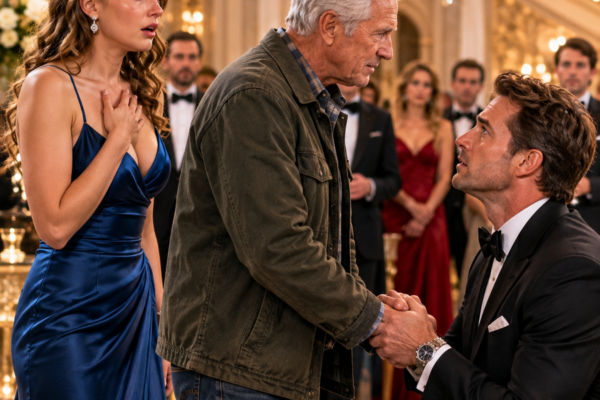
Part 2: “I’d rather burn the whole thing down myself than let her touch you.”
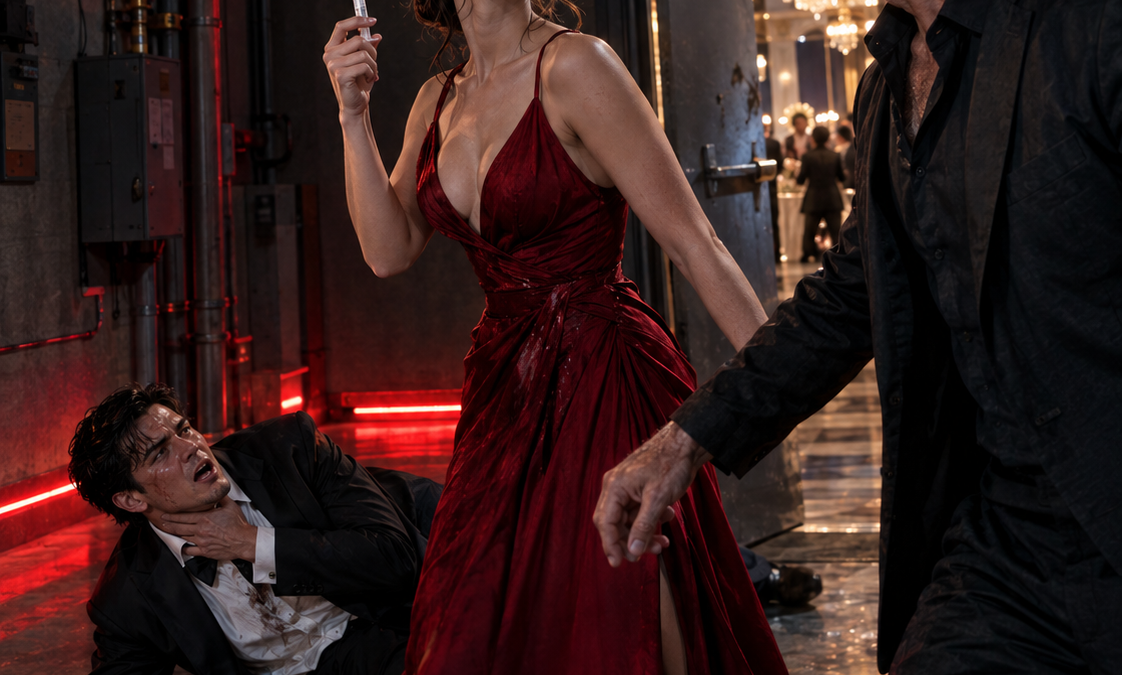
Chapter 5: The Only Way Out Is Through
“I’d rather walk.”
“It’s twenty degrees and you’re three miles from the nearest hotel.” Gerald’s breath fogged in the cold. “I’m not going to hurt you, Elena. I’ve known you for nine years. I was at your wedding.”
“You were in the records room five minutes ago telling Priya Nair to have me handled.”
Something flickered across his face — surprise, then resignation. “You heard that.”
“I heard enough.”
Gerald looked at her for a long moment. Then he set the briefcase down on the hood of his car and raised both hands, palms out.
“I’m not Meridian,” he said. “I work for the family. I’ve worked for the family for thirty years. I knew your husband’s father when he was a decent man, and I’ve watched his mother turn this company into something I don’t recognize. I’ve been trying to protect the Kestrel name because that’s my job. But there’s a difference between protecting a name and protecting a criminal enterprise.”
“You just told them to accelerate the timeline.”
“To buy us time.” He lowered his hands. “If Meridian executes the Cypress transfers on the thirty-first, the money leaves the country and there’s no trail. If I tell them to accelerate it, they rush. They make mistakes. They leave something we can use.”
“We?”
“Your husband has been investigating Meridian for six months. I’ve been feeding him documents. Quietly. Because if I go public, your mother-in-law doesn’t just fire me — she ends me. You know she has the resources.”
Elena crossed her arms against the cold. “Then why are you standing in a parking lot talking to me?”
“Because you’re the only person in this family she can’t control. You’re not on the payroll. You’re not afraid of her. And you’ve already gone to the attorney general, which means the clock is running.” He reached into his coat and pulled out a folded piece of paper. “This is the password to Meridian’s client portal. It won’t get you everything — Marisol is paranoid and keeps the operational records offline — but it will get you the list of contracts. The names of the people she’s been hiring.”
He held it out.
Elena didn’t take it.
“Why should I trust you?”
“Because I’m about to lose my license and probably my freedom for giving you this. That’s not something you do for someone you’re trying to bury.”
She took the paper.
“One more thing,” Gerald said. “The Cypress transfers are being routed through a holding company called Oakhurst. Oakhurst has a subsidiary in Baton Rouge that operates a security firm. And that security firm has a standing contract with a man named Cyrus Bell.”
“Who’s Cyrus Bell?”
“The man your mother-in-law hires when she wants something to look like an accident.”
Elena’s mouth went dry.
“Get out of here,” Gerald said. “Go somewhere she can’t find you. And don’t use your phone.”
She walked. Two blocks. Three. Her legs were shaking and her hands were shaking and she could feel the cold seeping through her coat, and she didn’t stop until she found a diner that was open twenty-four hours — a real one, linoleum and chrome and a counter full of night-shift workers.
She ordered coffee. She unfolded the paper. She opened her borrowed laptop, because she was past caring about being logged, and she typed in the Meridian portal credentials.
It took four tries. The interface was old, clunky, designed to look like a legacy system but protected like a bank vault. But she was in.
Contracts. Dozens of them. Redacted names, coded projects, dates and amounts. And there, halfway down the list, a contract labeled PROJECT CARDINAL — ACTIVE.
She clicked it.
The file that opened was thin — a single page. A photograph of a man in his fifties, weathered face, grey stubble. A name: Cyrus Bell, Principal Operator, Meridian Domestic. And beneath that, in the Target field, a name that made her stomach drop through the floor:
VASQUEZ-KESTREL, ELENA M.
Status: PENDING AUTHORIZATION.
The coffee cup slipped from her hand. It hit the counter and shattered, and the night-shift waitress came running with a rag, and Elena sat there with ceramic shards on the linoleum and coffee soaking into her jeans, staring at a screen that said her mother-in-law had put a contract out on her life.
She picked up her phone — breaking every rule — and called the only number she could think of.
Adrian answered on the first ring.
“Elena.”
“There’s a man named Cyrus Bell.”
Silence.
“You knew.”
“I didn’t know his name.” His voice was tight, controlled. “I knew the contract existed. I’ve been trying to get it canceled for three weeks.”
“Canceled. You can’t cancel a murder contract, Adrian. You can stop it. Or you can let it happen. There’s no third option.”
“There is if you’re the one paying for it.”
The diner hummed around her. The waitress was wiping up the coffee. A man at the end of the counter was eating pie and reading a newspaper like the world wasn’t ending.
“What did you do?” Elena asked.
“I took out a second contract. Larger. With the same firm. On the same target. And I structured it so that the only way the second contract executes is if the first one fails.” He paused. “It’s an insurance policy. As long as I’m alive and paying, Cyrus Bell can’t touch you. The firm won’t risk the bigger payout.”
“That’s insane.”
“It’s the family business.”
Elena closed her eyes. Behind her eyelids she saw the photograph from the envelope — Adrian and Katherine in the lobby. The note in Marisol’s handwriting. For the divorce file. Release only if she fights.
“Your mother put a hit on me,” she said. “She’s been planning this for months. Maybe years. She knew I’d fight the divorce, and she knew I’d find the transfers, and she set all of it up so that by the time I figured it out, it would be too late.”
“Yes.”
“And you’ve been trying to get me to sign the papers so I’d be safe, and I wouldn’t, and now I’m on a kill list, and the only thing standing between me and a man named Cyrus Bell is a counter-contract that you’re paying for with money I can’t trace.”
“Yes.”
“Adrian.” Her voice broke. “Why didn’t you just tell me?”
“Because you wouldn’t have believed me.” He said it simply. “You would have thought I was manipulating you. And you would have been right to think so, because I was manipulating you — I just happened to be manipulating you toward the only exit I could find.”
“That’s not an answer.”
“It’s the only one I have.”
The waitress set a fresh cup of coffee in front of her. Elena wrapped her hands around it and watched the steam rise and thought about nine years of marriage, about all the locked doors and the silences and the nights she’d lain awake next to a man who was already awake, already planning, already trying to save her from something she couldn’t see.
“You should have trusted me,” she said.
“I know.”
“You should have told me the truth and let me make my own decisions.”
“I know.”
“I could have helped you. I was helping you — I found the transfers on my own. I found Hale. I found the envelope.”
“I know.”
She was crying now. Quietly. The kind of crying you do in public when you refuse to let it be a spectacle.
“What do I do?” she asked.
“Meet me. Tonight. There’s a place—”
“No.”
“Elena—”
“No, Adrian. No more meetings. No more secrets. No more doing things for me without letting me choose.” She wiped her face with the back of her hand. “You want me to trust you? Then trust me. Give me everything you have. Every document, every name, every account. And then let me decide what to do with it.”
He was quiet for a long time. Then: “If you go public with this, you don’t just take down my mother. You take down the whole family. Grant. The board. The company. Thousands of employees. And me.”
“I know.”
“You’d be destroying the thing I’ve spent my whole life protecting.”
“I know.”
Another silence. She could hear him breathing. She could hear the Gulf in the background, the same Gulf that was outside her window, the same water that had been there on their wedding day and on every day since.
“Okay,” he said. “But not over the phone. And not tonight. There’s a place my father kept — a cabin on the bay, off the records. Nobody knows about it. Not Meridian. Not my mother. I’ll send you the coordinates.”
“Adrian.”
“What.”
“If this is a trap—”
“It’s not.”
“If it is—”
“It’s not.” He paused. “Elena. I’d rather burn the whole thing down myself than let her touch you. You have to know that by now.”
She closed her eyes.
“I don’t know anything by now,” she said. “That’s the problem.”
Chapter 6: The Cabin on the Bay
The coordinates led to a dirt road off a two-lane highway, forty minutes south of the city, in a part of the coastline that hadn’t been developed yet — salt marsh and live oak, a single-lane bridge over a tidal creek, a gate that opened with a code Adrian texted her at the last minute. The cabin was small and old, wood siding gone silver with weather, a screened porch facing the bay.
Adrian was already there when she arrived. He’d lit a fire. He’d brought food — bread, cheese, a bottle of wine, a thermos of coffee. He’d made the bed in the loft with clean sheets. He’d done all the small domestic things she’d spent nine years wishing he’d do more of, and he’d done them in a house she’d never known existed.
“How long have you had this place?” she asked.
“Since my father died. He left it to me in a trust. Off the books.”
“Your mother doesn’t know?”
“My mother knows everything. But she’s never been able to find this one.” He handed her a mug of coffee. “It’s the only thing I own that she can’t take.”
They sat on the porch with the fire behind them and the bay in front of them, and for a while neither of them said anything. The sun was going down — the sky gone pink and gold over the water, the marsh grass turning silver in the wind. It was beautiful. It was the kind of beauty that made you want to believe in something.
“I brought everything,” Adrian said finally. He nodded toward a duffel bag by the door. “Documents. Hard drives. The Meridian contracts. A recording of a phone call between my mother and a man I believe is Cyrus Bell.”
“You recorded your mother?”
“I’ve been recording her for two years. I just never had enough to use it.”
Elena set down her mug. “What changed?”
“You.” He looked at her — really looked at her, the way he had in the boardroom, but without the mask this time. “I spent nine years trying to keep you safe by keeping you out. And all it did was make you a target. So I’m done. No more secrets. No more protecting you from things you have a right to know. You want everything? It’s in the bag. You want to go to the press? I’ll drive you to the newsroom myself.”
“And if I do — what happens to you?”
“I lose the company. I probably go to prison. My mother goes to prison, which is the only part of this I’ll actually enjoy.” He shrugged. “And you’re free.”
“Free to do what?”
“Whatever you want.” He said it like it was simple. Like he’d already accepted it. “You’re thirty-five years old, Elena. You’ve spent nine of those years in a family that treated you like a problem to be managed. You don’t owe us anything. Not me. Not the foundation. Not the name.”
She looked out at the bay. A heron stood in the shallows, motionless, waiting for something to swim too close.
“You said you married me as containment.”
“I said a lot of things.”
“You said you wanted me close enough to see the machinery so I’d leave before it crushed me.” She turned to face him. “That’s not love, Adrian. That’s management.”
He flinched. It was a small thing — a tightening around the eyes, a breath held a beat too long — but she saw it.
“You’re right,” he said. “It was.”
“So what is it now?”
He didn’t answer immediately. He looked at her for a long moment, the firelight moving on his face, and then he said, “When I was twenty-nine, my father took me out on his boat and told me that the family had a choice to make. We could keep doing what we’d always done — the shell companies, the off-books security, the money moving through the foundation like water through a cracked pipe — or we could stop. He told me he’d spent his whole life trying to stop. And that he’d failed. And that if I ever wanted to be different, I had to be willing to lose everything.”
“Did you believe him?”
“No. I thought he was weak.” Adrian picked up his mug, then set it down without drinking. “Then I met you. And for the first time in my life I wanted something that wasn’t part of the machine. And I realized he wasn’t weak. He was just early.”
“Early for what?”
“For this.” He gestured at the cabin, the fire, the two of them sitting on a porch in the dark. “For the version of my life where I don’t have to choose between the family and my conscience. For the version where I get to keep you.”
Elena was quiet.
“You don’t have to decide anything tonight,” he said. “You don’t have to decide anything at all. I just — I wanted you to know. Whatever happens next, I wanted you to know that the last nine years weren’t a lie. They were just the wrong shape.”
She stood up. Walked to the edge of the porch. The heron took off, wings wide, disappearing into the dark.
“I’m not signing the divorce papers,” she said.
Adrian didn’t move. “Elena—”
“I’m not signing them, and I’m not walking away, and I’m not letting your mother win.” She turned to face him. “But I’m not your wife right now, either. I’m not the foundation chair. I’m not the woman you married as containment. I’m just — me. And I need you to meet me for the first time.”
He stood up slowly. Crossed the porch. Stopped an arm’s length away.
“Hi,” he said.
She laughed — a real laugh, startled out of her, the first honest sound she’d made in weeks.
“Hi,” she said.
And for a moment they just stood there, two people in the dark on a porch by the bay, with everything between them and nothing between them, and Elena felt something shift. Not forgiveness. Not trust. Something smaller and stranger: the possibility of both, sitting on the far side of a long road.
“I need to tell you something,” she said. “About the fertility treatments.”
Adrian went very still.
“I stopped them six months ago. Without telling you.”
“Why?”
“Because I found the transfers. And I knew that if your mother was willing to frame me for fraud, she’d be willing to hurt a child. Mine. Yours. Any child I brought into that family.” She crossed her arms. “I didn’t tell you because I didn’t trust you. And I didn’t trust you because you’d given me a thousand reasons not to.”
“I know.”
“So here’s my condition. If we do this — whatever this is — we do it my way. No more secrets. No more protecting me without asking. You tell me everything, all the time, even when it’s ugly. And in exchange—” She took a breath. “In exchange I’ll try to believe you.”
Adrian looked at her. The firelight caught his face and made it younger than it was, or older, she couldn’t tell.
“That’s a hell of a deal,” he said.
“Take it or leave it.”
He held out his hand.
She looked at it for a long moment. Then she took it.
“I’m not saying I forgive you,” she said.
“I know.”
“I’m not saying I love you.”
“I know.”
“I’m saying I’m willing to find out.”
He nodded. His grip was warm and steady and she didn’t let go.
“That’s enough,” he said. “That’s more than enough.”
Behind them, the fire burned down. In front of them, the bay moved in the dark, patient, indifferent, eternal.
And somewhere out in the marsh, a phone buzzed with a text from an unknown number:
She knows. Run.
Chapter 7: The Sister in the Safe House
They left the cabin at midnight.
Adrian drove. Elena sat in the passenger seat with the duffel bag at her feet and her phone powered off in the glove compartment, watching the marshland slide past in the dark. Neither of them spoke for the first twenty minutes. The text — She knows. Run. — sat between them like a third passenger.
“Katherine?” Elena asked finally.
“Probably.” Adrian’s hands were tight on the wheel. “She’s the only one who knew where we were. She’s been tracking my mother’s movements through the Meridian portal.”
“And she sent that text because—”
“Because my mother found out about the cabin. Or found out that Katherine found out. Either way, we’re blown.”
They drove north, away from the city, through small towns with shuttered gas stations and Baptist churches and dollar stores. Just before the state line, Adrian turned onto a private road that wound through pine woods for a mile before ending at a low, modern house built into a hillside — glass and stone and a garage full of vehicles Elena had never seen.
“Whose is this?”
“Mine. Or it was, before I put it in a trust my mother can’t access.” He killed the engine. “Welcome to the only place in the world where I’m not Adrian Kestrel.”
Inside, the house was warm and spare — concrete floors, a wall of windows facing the woods, a kitchen with nothing on the counters. No photographs. No personal effects. A safe house in the truest sense.
A woman was waiting in the living room.
She was smaller than Elena expected. Blonde, yes, but the kind of blonde that came from a bottle, roots showing dark at the temples. She had Adrian’s eyes — that same flat grey — but set in a face that was all sharp angles and exhaustion. She was holding a baby.
“Elena,” Katherine Hale said. “I’ve heard a lot about you.”
“None of it good, I assume.”
“Actually, all of it good.” Katherine shifted the baby to her other hip. He was asleep, dark lashes fanned against brown skin, a fist curled against his mother’s collarbone. “Adrian talks about you like you’re a religion.”
Adrian made a sound — something between a cough and a laugh. “I do not.”
“You absolutely do.” Katherine looked at Elena. “He’s been trying to get you out of that family for six years. Did he tell you that?”
“No.”
“Of course he didn’t.” She turned and walked toward the kitchen. “There’s coffee. There’s also a bed upstairs with clean sheets and a door that locks. I figured you’d want the lock more than the sheets.”
Elena followed her. Behind her, she heard Adrian lock the front door and check the windows — a routine, she realized. A man who’d been living like this for a long time.
In the kitchen, Katherine set the baby in a bassinet by the window and poured two cups of coffee. She didn’t offer Adrian one. He didn’t ask.
“Tell me about Meridian,” Elena said.
“Straight to it. I like you.” Katherine leaned against the counter. “Meridian Holdings is a private security firm incorporated in the Caymans. It has a domestic operations division that does everything from corporate counter-surveillance to — well. You saw the contract.”
“Project Cardinal. On me.”
“On you.” Katherine’s mouth tightened. “It was authorized three weeks ago. The same week the board voted to remove you from the foundation. The same week Adrian filed for divorce. That’s not a coincidence.”
“Your mother knew I’d fight.”
“She knew you’d find the transfers. She wanted you to find them. The whole thing — the Alder Lane shell, the forged signatures, the Crescent Care invoices — it was bait. You were supposed to find it, and then you were supposed to be discredited, and then you were supposed to be—” She glanced at the bassinet. “Well.”
“Handled.”
“Yes.”
Elena wrapped her hands around the coffee mug. It was hot enough to hurt, and she let it.
“Where does Cyrus Bell come in?”
“He’s the operator. Meridian’s domestic director. He’s ex-military, ex-private contractor, ex-everything. He’s the one who arranges the accidents. Car crashes. Gas leaks. Home invasions that look like burglaries.” Katherine’s voice was flat, clinical, the voice of someone who’d spent years studying a machine. “He’s killed at least nine people that I can prove. Maybe more.”
“And Adrian put a counter-contract on me.”
“I know.” Katherine looked at her brother, who was standing in the kitchen doorway, silent. “It was stupid and reckless and the only thing he could think of. The firm won’t execute a contract if there’s a bigger payout on the same target. It’s a loophole. It’ll hold until someone in Meridian decides the loophole isn’t worth the trouble.”
“How long do we have?”
“Three weeks. Maybe less.” Katherine picked up her own coffee. “The Cypress transfers execute on the thirty-first. If that money leaves the country, everything we have becomes circumstantial. We need to move before then.”
“Move how?”
Katherine looked at Adrian. Adrian looked at Elena.
“There’s a gala,” he said. “New Year’s Eve. The family’s annual foundation benefit. Five hundred people. Press. Board members. Every major donor in the state.”
“You want to expose your mother in front of five hundred people.”
“I want to expose the evidence in front of five hundred people. The forged invoices. The shell companies. The Meridian contracts. The recording of her authorizing Project Cardinal.” He crossed his arms. “If we do it there, she can’t bury it. She can’t pay off the police. She can’t make it disappear. It’ll be public before she can move.”
“And what happens to you?”
“I get arrested, probably. Conspiracy. Accessory to money laundering. I don’t know.” He said it without drama. “I’ve made peace with it.”
Elena set down her mug.
“No,” she said.
Adrian blinked. “No?”
“No, you don’t get to make peace with it. Not without me.” She stood up. “You’ve spent nine years making decisions for both of us. This one, we make together. And if we’re going to bring down your mother, we’re going to do it in a way that doesn’t put you in a cell.”
“Elena—”
“I’m not finished.” She turned to Katherine. “You said you can prove Cyrus Bell has killed nine people. Can you prove your mother paid him?”
“I can prove Meridian paid him. The contracts are signed by a corporate officer. The corporate officer is a shell. The shell is owned by another shell. But there’s a phone call — Adrian recorded it — where Marisol authorizes the Cardinal contract by name. She says, ‘The wife is a problem. Handle it.'”
“She says the wife.”
“She says the wife.”
Elena closed her eyes. Nine years. Nine years of Easter lunches and garden parties and the woman’s hand hovering near her shoulder like it might touch her, might not. Nine years of being the wife — the outsider, the hunger, the maid.
“Do you have the recording?” she asked.
“On three separate hard drives. Two in a safe deposit box. One buried in a digital archive that Marisol doesn’t know exists.”
“Then here’s what we do.” Elena opened her eyes. “We don’t go to the gala to expose her. We go to the gala to bait her. We let her think we’re going to expose her. We let her panic. And then we catch her in the act of trying to stop us — and we catch Cyrus Bell doing it.”
Adrian stared at her.
“That’s insane,” he said.
“That’s strategy.” She turned to him. “You want to protect me? Protect me by letting me choose the battlefield. I’m done being the damsel. I’m done being the target. I’m going to be the one holding the gun.”
Katherine laughed — a sharp, surprised sound. “I like her,” she said to Adrian. “I really do.”
Adrian didn’t laugh. He was looking at Elena like he’d never seen her before.
“You could get killed,” he said.
“Then I’ll get killed on my own terms. Not your mother’s.”
Silence.
Then Adrian nodded, slowly.
“Okay,” he said. “We do it your way.”
Chapter 8: The Quiet Before
The next two weeks were the strangest of Elena’s life.
They stayed in the house in the pines. Katherine came and went — she had a job to keep up appearances at, a nanny she trusted, a circuit of safe houses of her own. Adrian spent most of his time on the phone, working angles, calling in favors with people who owed him things. Elena spent most of her time in the kitchen, because the kitchen was the only room in the house that didn’t feel like a trap.
She learned things about him in those weeks.
She learned that he couldn’t sleep past five a.m. She learned that he made coffee by measuring it with his hand, never a spoon. She learned that when he was thinking hard, he flipped a pen between his fingers — a fountain pen, black lacquer, given to him by his father — and that he’d had it for twenty years and never let anyone else touch it.
She learned that he’d kept every birthday card she’d ever given him. All nine. In a drawer in the office of the house in the pines, where he thought she wouldn’t look.
She found them on the fourth day. She’d been looking for a phone charger and opened the wrong drawer, and there they were: nine cards, nine years, arranged chronologically, the earliest one already faded at the edges. She’d written Happy birthday, old man on the first one. He was thirty-three. He’d laughed when he read it.
She closed the drawer and didn’t mention it.
On the fifth night, she woke at 2 a.m. and found him on the back porch, in the cold, looking at the stars.
“Couldn’t sleep?” she asked.
“Never can.” He didn’t turn around. “You should go back inside. It’s freezing.”
She sat down next to him anyway. He was in a t-shirt and jeans, no coat, arms bare in the December cold. She could see the scar on his left forearm — the one he’d told her came from a boating accident, the one she’d always known was a lie.
“The scar,” she said. “What is it really?”
He was quiet for a long moment.
“My father,” he said.
She didn’t flinch. She’d suspected, for years, something like that.
“Tell me.”
“He caught me skimming.” Adrian’s voice was flat. “I was nineteen. I’d figured out that the shipping contracts were being used to move money, and I thought — stupidly — that I could take a little for myself. Pay for college without the family’s money. He found out. He didn’t hit me. He just took a letter opener and cut me, and then he made me watch while he sewed it up. He said, ‘This is what happens when you steal from the family. It leaves a mark.'”
Elena was silent.
“I’ve been trying to leave that family since I was nineteen years old,” he said. “Every year, I told myself it was the last. Every year, something pulled me back. My father’s death. The foundation. You.”
“Me?”
“I couldn’t leave while you were in it. I couldn’t leave you in it.” He looked at her finally. “That’s the truth. That’s the real reason I married you. Not containment. Not management. I looked at you at that gala and I thought, She’s the only clean thing in this room. And I wanted to be near it.”
She didn’t know what to say. So she didn’t say anything. She just sat next to him in the cold, shoulder to shoulder, not touching, and let the silence do its work.
“We could leave,” she said finally. “After the gala. After all of it. Go somewhere else. Start over.”
“You’d do that?”
“I don’t know.” She looked at him. “But I’m willing to consider it.”
He smiled — a real smile, small and crooked and tired. “That’s more than I deserve.”
“Probably.” She stood up. “Come inside. You’re going to get sick.”
He followed her in. And that night, for the first time in nine years, they slept in the same bed without touching — just the warmth of two bodies in the dark, the sound of the pine trees outside, and the strange, fragile peace of two people who had finally stopped lying to each other.
 [Tap here for the Next Part ]