Daughter Kept Her Blue-Collar Dad A Secret—Until Her Billionaire Date Knelt Before Him
Daughter Kept Her Blue-Collar Dad A Secret—Until Her Billionaire Date Knelt Before Him
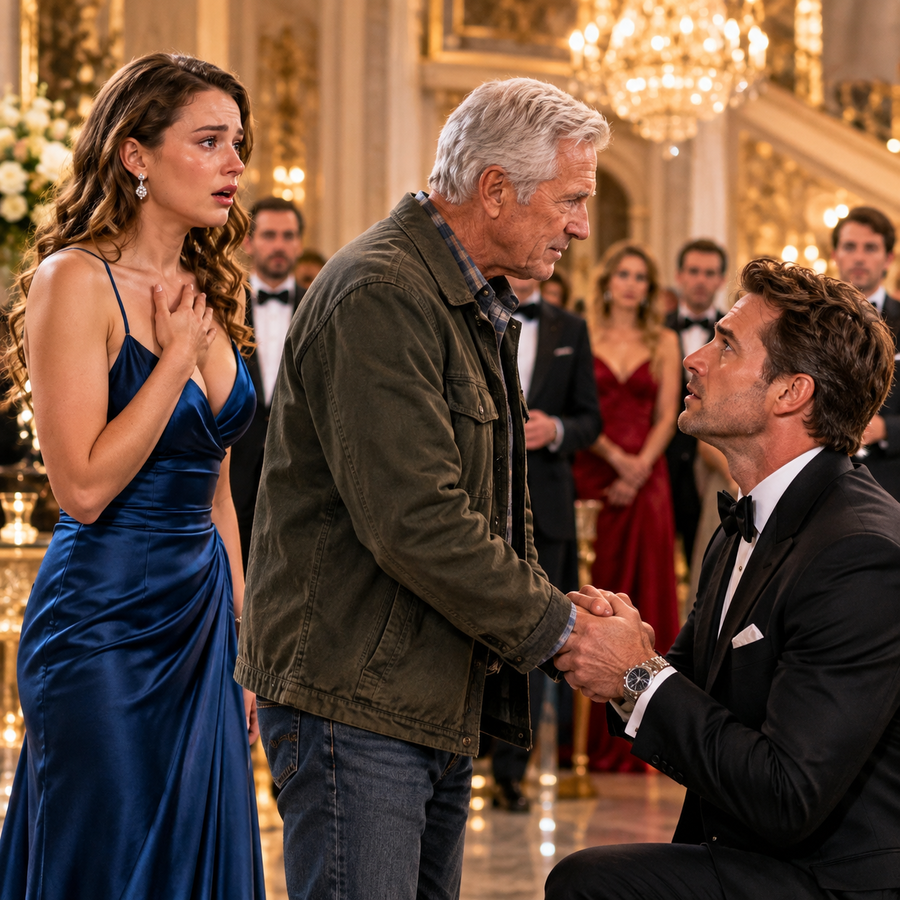
The birthday cake had 47 candles on it, one for each floor of the Ashford Grand’s rooftop terrace, or so the hotel’s event coordinator had joked when she said it down.
Emily Callahan had not laughed. She had been too busy checking the elevator bank, too busy watching the gold-paneled doors for anyone who might ruin the careful architecture of the evening she had spent six weeks building.
She had not expected her father to ruin it.
She had not even invited him.
Emily Callahan was 24 years old, and she had learned in the three years since she’d left Denton Falls for the city that the world rewarded people who looked like they had always belonged.
She was good at looking like she had always belonged. Her apartment was in Midtown, a studio she could barely afford on her analyst salary at Hargrave Capital, but she had furnished it with the careful precision of someone building a stage set, a single oversized art print from a gallery opening, a brass floor
lamp that caught the light just right.
Books arranged not by genre, but by spine color. Everything in her life, she had learned, was a form of communication, and what Emily communicated deliberately and exhaustingly was that she had not grown up in a two-bedroom rental in Denton Falls with a garage that smelled of machine oil and a father who came home every evening with grease under his fingernails that he could never fully scrub away.
Her father’s name was Jack Callahan.
He was 53 years old, 6 ft of quiet and callous impatience. He had been a machinist for 30 years, the kind of man who could hear a mechanical problem before he could see it, a faint vibration in a gear assembly, a half-second delay in a hydraulic press, a sound so subtle most people would have called it silence.
He worked at Meridian Industrial Services, a mid-sized shop on the east side of Denton Falls, and he had worked there since Emily was two years old, since the year after her mother, Carol, had been diagnosed with the illness that would take her slowly over the following decade.
Emily did talk about her mother either.
The grief was too old and too private to share with people who would have nodded sympathetically while already thinking about something else.
What she did, instead, was invent a version of her father that fit the world she was trying to occupy.
She told people he was in engineering. She told people he was semi-retired.
When pressed, she said he consulted for industrial firms, which was technically not a lie.
Jack had on several occasions over the years and been called in by other shops to diagnose problems their own mechanics couldn’t solve.
Emily took this fact and built a palace on top of it, and she told herself in the moments when the dishonesty sat heavy in her chest that she was simply translating.
Her friends at Hargrave Capital were not terrible people, not individually. There was Vivienne Marsh, who had gone to Dartmouth and wore the same $3,000 blazer in rotation as if daring anyone to notice.
There was Connor Ashby, who drove a car that cost more than Emily’s annual salary and spoke about it with the studied casualness of someone who had been told his whole life that having money was only gauche if you tried.
There was Sloane Whitfield, who had a gift for making people feel that the room had gotten smaller when she walked in.
And who once, at a dinner Emily had organized, had looked at a waiter’s shoes and said nothing, just looked, then looked away, and somehow that had been enough.
These were the people Emily had arranged her life around.
She had done it carefully, the way you arrange stones crossing a river, testing each one before you put your weight on it. She had also done it at a cost she was only beginning to understand.
Her birthday was June 14th.
She had booked the rooftop terrace at the Ashford Grand six weeks out, had sent digital invitations with an aesthetic she had spent an embarrassing amount of time selecting, had coordinated a dress code, cocktail, understated luxury, and had confirmed the guest list three times. 31 people.
Not one of them from Denton Falls.
Not her father. She had called Jack the week before and told him she was doing something small with colleagues.
She had used that word deliberately. Colleagues, not friends.
Colleagues implied professional distance, implied that the event was work adjacent, implied that his absence was not a rejection but simply a matter of category.
Jack had said that sounded nice.
He had asked if she wanted him to drive up that weekend instead. Maybe Sunday they could get breakfast.
Emily had said she’d check her schedule.
She hadn’t checked her schedule.
She had not thought, not seriously, that he would come.
Jack Callahan left Denton Falls at 4:00 in the afternoon on June 14th with a wrapped box on the passenger seat of his truck, a 2009 Ford F-150 with a replaced transmission and a crack in the dashboard that he had never gotten around to fixing because it
didn’t affect the drive.
The box contained a first edition copy of The Hitchhiker’s Guide to the Galaxy, Emily’s favorite books since she was 12, which he had found at an estate sale three months ago and had been holding since then, waiting.
He wore the cleanest thing he owned that wasn’t a work shirt, a collared button down in dark blue tucked into his good jeans.
His boots were the dress boots, not the steel-toed ones.
He had combed his hair.
He did not own a blazer. He found the Ashford Grand without trouble and stood for a moment on the sidewalk outside it, looking up at the glass facade, the uniform doorman, the kind of building that made Denton Falls feel like it existed in a different universe.
He thought briefly about calling Emily to say he was there. He decided against it.
He did not want to give her the opportunity to say no. The elevator to the rooftop had mirrored walls.
Jack looked at himself in them, at the working man’s face, the weathered hands, the shirt that was clean but not expensive, and he felt the particular loneliness of a person who knows they are about to be out of place, but is going anyway because the alternative is not going, and not going means something he refuses to let it mean.
The terrace
was everything Emily had arranged it to be.
The city spread out below in the last of the June light, all gold and glass.
Strings of warm bulbs traced the perimeter. A bartender in a white jacket stood behind a table dressed like an altar.
Thirty-odd people in cocktail attire talked in clusters, their laughter light and calibrated, the kind of laughter that has been practiced until it doesn’t sound practiced anymore.
Jack saw Emily immediately.
She was in the center of the room in a black dress, holding a glass of champagne, laughing at something Connor Ashby was saying. She looked, Jack thought, genuinely happy.
The observation produced in him a complicated feeling, pride and something else, something thinner that he did not name.
She saw him at almost the same moment.
He watched her face travel through several expressions in rapid succession, like channels being changed.
Recognition, surprise, and then something that compressed itself quickly into a flat, controlled calm that was worse than either of the others. She came to him.
Dad. Her voice was low and even.
What are you doing here?
Brought your birthday present.
He held up the box.
I know you said you had work people coming, but I thought maybe for a few minutes now isn’t a good time.
She was already moving, angling him toward the edge of the terrace, away from the central cluster of guests.
I’m in the middle of things.
This is this is complicated.
Jack looked at the room. He looked at the people.
He looked at the way nobody was looking at them yet, but the way a few people were beginning I can just give you the gift and head out, he said.
People are watching.
Emily, you can’t be here like this.
She said it quietly, not cruelly, but with the particular firmness of someone who has made a decision and is pushing through the discomfort of it.
I’m sorry.
You just you can’t.
Jack held the box. The paper was blue with small gold stars on it.
Emily had always liked stars.
He had wrapped it himself three times because the first two attempts had looked wrong. Okay, he said.
He did not raise his voice. He did not say the things a person might have been forgiven for saying.
He stood there with his daughter’s birthday present in his hands and said okay, and that single word contained everything the 4-hour round trip, the first edition book, the dress boots, the combed hair, the hope he had not quite let himself articulate even to himself, and he absorbed it quietly, the way a structure absorbs load, spreading the weight so it doesn’t show.
He turned toward the elevator.
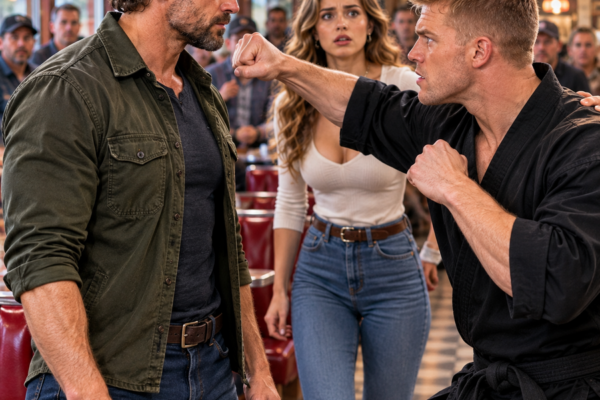
He had almost reached it when Connor Ashby’s voice carried across the terrace, curious and carrying the easy confidence of a man who has never had to worry about being overheard.
Hey, Emily, is that the maintenance guy?
Did you order something fixed up here?
Laughter, light and reflexive from two or three people nearby.
Jack stopped.
Not because he was angry, anger was not the feeling, or not exactly, but because he had not quite finished calculating whether to simply keep walking or to pause and let the moment be what it was.
He paused. No, seriously, Connor continued, now with the performing quality of a person who has noticed he has an audience and is leaning into it.
Sir, are you here about the HVAC?
Because there was a weird rattling earlier. More laughter.
Sloan Whitfield said, almost to herself but not quite, bold of him to show up in those shoes.
Emily said nothing. She stood at the center of the room and she said nothing.
And Jack heard the silence she made, and it was the loudest thing on the terrace.
There was a night when Emily was nine years old, when the heat went out in February. The rental house had an ancient furnace, and the ancient furnace had finally decided it was finished.
The temperature in the house dropped to 52 degrees overnight.
Jack fixed it himself.
He was up from midnight until 4 in the morning in the basement, working by flashlight, because the repairman they called couldn’t come until Tuesday, and Tuesday was three days away.
Emily had woken up at two and come down the stairs to find her father lying on the concrete floor in his undershirt and work pants, arm buried in the machinery up to the elbow, breath fogging in the cold.
He had looked up at her and said, without breaking his focus, go back to bed.
I’m I’ve almost got it.
By 4:30, the heat was on.
She had stood at the top of the stairs and listened to the furnace kick to life and felt, at nine years old, a love so physical it was almost frightening, the certainty that her father could fix anything, that nothing was permanently broken while he was there. She had stopped feeling that way somewhere around 16, not because Jack changed, but because she changed, because she began to understand, with the dawning and merciless clarity of adolescence, that the world outside Denton Falls ran on a different currency than the one her father dealt in.
That
capability and worth, in the language of the world she was being invited into via standardized tests and scholarship applications and college visits, were not the same thing. That the skills her father had real, irreplaceable, the kind you developed over decades of patient attention, did not translate into the social grammar she was learning to read.
She had not fallen out of love with him.
She had begun, instead, to love him secretly. The way you love something you are ashamed to claim.
Carol Callahan had died when Emily was 14, breast cancer, diagnosed late because she had put off the appointment twice and then a third time, each delay its own complicated story of cost and inconvenience and the particular way people who are used to managing put off the things that require someone to manage them.
Jack had sold his stake in a small parts manufacturing partnership he’d helped build over seven years, sold it fast below value to cover the treatment costs that insurance wouldn’t reach.
Emily hadn’t known about the partnership until years later.
She hadn’t known about the sale until later still.
What she knew at 14 and 15 and 16 was that her father worked more, that he was quieter after Carol died, not in a broken way, but in a settled way, like a man who has located the bottom of something and made his peace with the depth, that he was always there at her school performances, at her graduation, at the day she left for college, standing beside the truck with his hands in his pockets and his eyes bright, telling her she was going to do great. She had called him every Sunday for the first two years of college, then every other Sunday, then once a month.
The calls got shorter as her life in the city got bigger, as the distance between Denton Falls and where she was trying to go felt less like geography and more like a gap she was constantly, consciously widening. She had told herself this was growth.
She had told herself it was necessary. She had not told herself what it cost him.
She had not thought very carefully about that.
Connor Ashby was 27 and had never, in his life, been made to feel small by anyone he didn’t respect, which meant he had never been made to feel small at all.
He had the specific confidence of someone who has been told his whole life that his instincts are good and his judgment sound, and so he moved through rooms with the unhurried ease of a man who has never once considered that he might be wrong about what something means.
He looked at Jack Callahan and saw old jeans, a department store shirt, boots that had not cost enough, hands that were too large and too marked to belong here. He assembled these details into a conclusion that required no effort and no revision because the conclusion was the same conclusion he always reached, and it had always, in his experience, been correct.
So really, he said. Setting his glass on the railing and turning fully to face Jack with the performative generosity of someone who has decided to be gracious toward a person beneath them.
What is it you do?
I’m curious.
Machinist, Jack said. His voice was even.
Right, right.
Connor nodded slowly as if absorbing news.
So that’s that’s skilled work, yeah?
Like you must make decent money.
I’ve heard the trades pay well these days with the shortage and everything.
The tone was the thing, not the words, which were technically neutral, but the tone, which contained the word these days like a small knife. The implication that this was a recent surprise, that skilled work paying well was a novelty requiring acknowledgment.
Vivian Marsh had drifted over.
She looked at Jack’s hands, which were resting at his sides, and her expression was the one Sloane had worn not discussed exactly, but the particular withdrawal of a person who has decided something is not relevant to her.
You must be Emily’s.
Vivian trailed off, leaving the sentence open in a way that was somehow worse than finishing it. Her father, Jack said.
A brief recalibration moved through the small cluster of people nearest them.
Emily was 15 ft away. She had not moved toward him.
Emily’s dad, Connor said.
And now his tone shifted into something even more aggressively friendly, the kind of friendly that is a way of controlling a situation.
That’s great.
She’s never mentioned well.
She’s always so private.
Emily, you know how she is.
He paused. She said you were an engineering.
Jack looked at him for a moment. He said, I work on machines.
Sure, sure.
Connor picked up his glass again. So you drove up for her birthday?
That’s a hike.
From where is it? Denton something?
Denton Falls.
Right. Connor smiled.
Must have been a long drive in the truck.
He had seen the truck from the terrace when Jack arrived. He said this to remind Jack that he had seen the truck from the terrace.
The truck in Connor’s calculus was a closing argument.
Across the room, Emily heard Denton Falls and felt something cold move through her.
She put her glass down on the nearest surface.
She should have crossed the room. She should have moved the 3 seconds it would have taken to stand beside her father, to introduce him properly, to place herself between him and what was happening.
She knew this clearly and completely in the part of her that was still the girl who had stood at the top of the basement stairs listening to her father breathe cold air in the dark and thought, Nothing is broken while he’s here.
She stayed where she was, Connor said.
You know, I’ve always thought there’s something almost romantic about the trades.
Like really tangible work.
Must be satisfying, right?
Getting your hands dirty.
The phrase getting your hands dirty landed where he intended it to.
Jack held his daughter’s birthday present and did not respond.
He looked once toward Emily, a single, quiet look that asked nothing and said everything.
And then he looked back at Connor and said, I’m going to head out.
He turned toward the elevator.
Behind him, Sloane said something that made Vivian laugh.
He did not hear what it was. The convoy arrived at the Ashford Grand at 8:53 in the evening.
Three black SUVs moving with the unhurried certainty of vehicles that were accustomed to being made room for.
The hotel’s valet staff materialized with the coordinated of people who had been briefed.
The doorman straightened. The man who stepped from the second vehicle was 60 years old and dressed with the kind of simplicity that costs a great deal.
A dark suit, no tie, the jacket, the specific weight of something Italian and bespoke. He was not tall.
He was not particularly striking in the way of men whose photographs appear in financial publications.
He had gray at his temples and a face that had spent time outdoors, and he moved through the lobby with the unhurried certainty of someone who has not needed to perform authority for a very long time. His name was Richard Hayes.
He was the chairman and founder of Hayes Industrial Holdings, a conglomerate with manufacturing interests in 11 countries, and he was worth, depending on the quarter and whom you asked, somewhere between $4 and $6 billion.
He was also, technically, not booked for anything at the Ashford Grand that evening.
He was here because his assistant had mentioned, while reviewing the evening’s calendar, that the Ashford Grand was hosting an event on its rooftop, and because Richard had a meeting earlier that day at the firm on the 17th floor of the building next door, and because he sometimes, when he was in the city without a dinner engagement, simply liked to have a drink somewhere high up and look at the lights.
He stepped from the elevator onto the rooftop at 8:56. He saw the party noted it with the incurious half attention of a man who has attended more parties than he can remember and moved toward the bar.
He was halfway across the terrace when he stopped. He stopped because he had seen something he had not expected to see.
A man in dark jeans and a collared shirt standing near the elevator bank with a gift-wrapped box in his hands, in the process of pressing the down button, a man whose back was to him, but whose posture, the particular set of the shoulders, the way the head sat on the neck was immediately and completely recognizable. Richard Hayes crossed the terrace in 12 steps.
He put a hand on the man’s shoulder.
Jack, Jack Callahan turned.
Whatever expression had been on his face when he turned the flattened, controlled expression of a man who has absorbed something and is in the process of walking quietly away from it, changed. It opened slightly, not with surprise exactly, but with something warmer and less guarded than what had been there before.
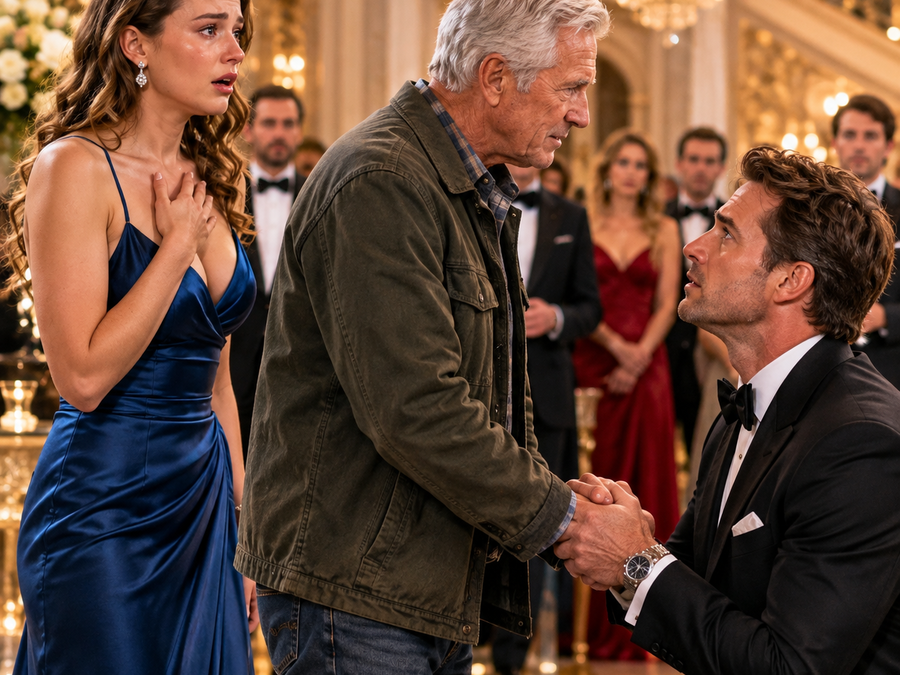
Richard, he said, my god. Richard shook his head, not with disbelief, but with something closer to feeling.
He took Jack’s hand and held it.
I have been trying to find you for two years. The terrace had not gone quiet.
Terraces don’t go quiet.
There are too many conversations, too many separate gravity wells of sound, but something shifted in the room, the way a room shifts when its center of gravity moves. Heads turned.
The shift traveled outward from where Richard Hayes was standing because everyone on that terrace knew who Richard Hayes was, and nobody who knew who Richard Hayes was had ever seen him look at a man in department store clothing the way he was looking at this one.
Connor Ashby turned. His expression was pleasant, waiting for information.
Vivian Marsh turned.
Sloane Whitfield turned.
Emily turned.
Richard Hayes looked at Jack Callahan with the attentiveness of a man who is making up for lost time, and he said, loud enough to carry, it’s good to see you, boss.
The word landed in the room like something thrown. Boss, not as a title, not with irony, with simple and straightforward warmth, the word of a younger man acknowledging an older one, the word of someone who has not forgotten where things started.
Emily stood 15 ft away and felt the floor of her carefully constructed world tilt beneath her.
Richard Hayes took Jack’s arm and steered him gently toward the seating area at the terrace’s edge, the good chairs, the ones with the best view, the ones Emily had reserved for the inner circle of her evening.
He sat down across from Jack with the focused attention of a man who does not multitask emotions.
Around them, the party had not stopped, but had reorganized.
People were listening without quite looking like they were listening.
Connor Ashby had drifted closer.
I heard you were still in Denton Falls, Richard said.
Still in Denton Falls, Jack confirmed. Still at Meridian?
Shop manager now. Have been for eight years.
Richard looked at him for a moment.
Then he laughed a real laugh, short and private and not for anyone else’s benefit.
Of course you are, he said. Of course.
He turned slightly in his chair. He was aware of the room.
He had been aware of rooms his whole adult life. It was one of the things that had made him successful, the calibrated awareness of who was listening and what they were hearing.
And he made a decision, in the way he made decisions quickly and without visible deliberation, to say the next thing loudly enough to be heard.
This man, Richard said, taught me everything I know about how a machine works. Not metaphorically, literally.
I was 22 years old and I was trying to run a two-bay automotive repair shop in Harrisburg that I had borrowed money to buy. And that was, at the time, six weeks from closing.
I couldn’t afford to hire a real mechanic.
I hired Jack Callahan instead.
He was 25.
The party had gone quiet now.
Properly quiet.
He diagnosed four problems in the first week that I had not known existed, Richard continued.
He rebuilt our press from components he sourced himself at cost because I couldn’t afford the full replacement part.
He trained me me personally by hand on weekends because he said I should understand what was happening in my own shop even if I was never going to do it myself.
He looked at Jack.
You remember the Hendricks job, the one everybody said couldn’t be fixed?
I remember, Jack said. That job is what kept the lights on.
Richard was quiet for a moment.
And then there was the partnership.
You know, I’ve told this story for 30 years, and I still don’t have the language for it.
He looked at the room briefly, as if deciding whether to continue. He continued.
In 1998, we started a small parts manufacturing operation together.
Nothing big, a five-machine shop, six employees.
Jack had 20%. It was his idea as much as mine.
He stopped. His wife got sick.
You all know what that costs.
You know what insurance covers and what it doesn’t.
Jack sold his stake back to me in three months at whatever I could afford to give him, which was not what it was worth, and he never once mentioned it afterward, not once, not when the company grew, not when it became something else. Richard shook his head.
I have sent him a check every year since I had the money to send it.
He sends them back.
Jack said nothing. He was looking at his hands.
He sends them back, Richard repeated. For the room, every single one.
The silence that followed was not awkward. It was the silence of people absorbing information and revising the structures they had built around it.
Connor Ashby said nothing.
Vivian Marsh said nothing.
Sloan Whitfield stood with her champagne glass at her side and looked at Jack Callahan with an expression that was not quite anything she had words for.
Emily pressed her back against the terrace railing and felt something break open in her chest, not cleanly, the way glass breaks, but slowly, the way ice does, the fracture spreading in all directions at once from a center point she had not known was under stress. The center point was every Sunday call she had shortened, every colleague she had substituted for father.
Every afternoon, she had spent constructing a version of her life that her father did not appear in.
The center point was 15 minutes ago when she had stood across the room and said nothing, Emily went to the bathroom.
It was the only place on the rooftop with a door that closed, and she needed a door that closed.
She stood at the sink and ran cold water over her wrists and looked at herself in the mirror. She was 24 years old in a good dress at her own birthday party, and she had just watched her father be introduced to 30 people as a legend, as the foundation of a billion dollar fortune, as the man a billionaire called boss, and she had spent the last hour trying to make him invisible.
The memories came in no particular order, with the brutal randomness of things you have been not quite suppressing for a long time. Her father lying on the basement floor at 2:00 in the morning in February, fixing the furnace by flashlight because Tuesday was too far away.
Her father sitting at the kitchen table with her science project at 11:00 at night, not doing it for her, but asking the right questions, patient as a man who has all the time in the world until she found the answer herself. Her father driving 4 hours round trip to bring her spare laptop charger when hers broke the night before a major presentation because she had texted him in a panic, and he had not once said this is inconvenient or can you find another way?
He had just said I’ll leave in 20 minutes.
Her father standing in the driveway on the day she left for college with his hands in his pockets and his eyes bright, saying you’re going to do great, saying it simply and completely the way he said everything without performance, without
reservation, as a statement of fact.
She thought about the stake he had sold.
She thought about the checks that came back unopened. She had built an entire architecture of omission around this man.
She had told people he was in engineering. She had said colleague event to avoid inviting him.
She had stood 15 feet away and watched Connor Ashby speak to him with the casual condescension of someone who has never questioned his own calibrations, and she had not moved, and she had not spoken, and the silence she had made was the specific silence of a person choosing not to claim someone.
The worst part, the part that sat in her chest like a weight that would need to be carried for a long time, was that she knew he had known.
He was not a man who missed things. He had looked at her once across that terrace with a look that asked nothing and said everything.
And then he had turned away.
Not with bitterness, with the particular dignity of a man who has decided to spare the person he loves the discomfort of his own pain.
She put her hands on the sink and breathed.
Then she dried her hands, straightened her dress, and went back out.
By 10:00 the party had shifted.
Not ended.
The champagne was still flowing.
The city still spread out below, but shifted. Changed in some fundamental atmospheric way.
Like a weather system that has moved through.
The people who had laughed at Jack’s boots were now distributed around the terrace in various configurations of recalibration.
Connor Ashby had spent 20 minutes in animated conversation with Richard Hayes and had emerged from it visibly chastened, which was, Emily thought, probably as good as it was going to get. Jack himself had left at 9:15.
He had said goodbye to Richard. The two men had stood together for several minutes by the railing, talking quietly in the particular way of people who have a long history of working alongside each other, talking without needing to perform for anyone.
And then he had picked up his daughter’s birthday present from the chair where he’d set it down.
And he had found Emily in the crowd.
And he had said, I’m going to head out.
Happy birthday, Em. He had handed her the box.
She had said, Dad, and he had shaken his head slightly, kindly, in the way of someone saying not here, not right now.
It’s fine.
And then he had gone. She had stood holding the box until the crowd closed around her again.
She left the party at 10:30. Vivienne and Sloan were still there.
She told them she had an early morning. She took the elevator down, crossed the lobby, and walked outside into the June night.
His truck was still there.
She didn’t know why she thought it would It had been over an hour since he left, but it was.
Parked two blocks down from the hotel at a meter. The familiar dent in the left rear panel.
The crack across the dashboard just visible through the windshield.
He was in it. She could see him through the glass, sitting with the engine off, looking at his phone.
Probably he had been waiting for the traffic to thin.
Probably he had stopped to sit for a minute before the long drive home. She tapped on the passenger window.
He looked up. He unlocked the door.
She climbed in.
The truck smelled the way it always had, like clean metal and the faint cedar of the air freshener he bought in packs of six from the hardware store.
And beneath that, something warmer and more specific, something that was just the smell of her father’s truck.
The smell of a thousand drives home from school and hardware stores.
And the one summer he had taken her to every national park within a day’s drive, just the two of them.
One summer after her mother died, because he had decided she needed to see something large. She held the birthday present in her lap.
She hadn’t opened it yet.
Dad, she said. He waited.
She tried to find the start of what she wanted to say and found instead that she was crying not the prepared, controlled cry of someone who has rehearsed the moment, but the abrupt, helpless crying of someone who has been holding something in for a long time and has run out of capacity to keep holding it.
She pressed the back of her hand to her mouth.
Jack didn’t say anything.
He put one hand on her shoulder, the way he had when she was small and frightened, and he let her cry.
When she could talk, she said, I’m sorry.
I’m so sorry.
I don’t know how to.
She stopped.
I told people you were in engineering.
I didn’t invite you tonight.
I stood there and I didn’t.
Her voice broke on the end of it. I know, Jack said.
He said it simply without emphasis. You should be angry with me.
He was quiet for a moment, in the way that meant he was thinking about what he actually wanted to say rather than what was easy to say.
I understand it, he said finally.
You went somewhere new and you wanted to fit.
That’s not that’s not a bad thing, M, wanting to fit.
I was ashamed of you. The sentence lay between them in the cab of the old truck.
And it was the worst sentence, the truest and most awful sentence.
And she had needed to say it out loud because it was the only way to start to stop saying it to herself. Jack looked through the windshield for a moment.
The street outside was quiet late enough that most of the foot traffic had thinned.
The city settling into its nighttime register. I know, he said again.
And then, that one was hard.
I’m sorry.
I believe you. I need you to know.
She stopped, tried again.
I need you to know that the things I’ve been ashamed of were never actually about you.
They were about me, about what I was scared of, about what I thought it meant about me, about my chances if people knew where I came from. I made you smaller so I could feel bigger, and that is She pressed her hand to her eyes.
That is the worst thing I’ve ever done.
Jack was quiet.
She waited for him to absolve her, which is what she wanted, which is what she had told herself she needed.
He didn’t.
Quite. What he did instead was more complicated and more valuable.
There’s something I want to tell you, he said.
Not about tonight.
Just something I’ve been carrying and maybe should have said sooner.
She turned to look at him.
Your mother and I used to talk about what it would mean for you to have a different life than the one we had. Not better.
We never said better because I don’t think it’s better or worse.
I think it’s different.
But we wanted you to have more options.
That was the word she used.
Options.
He looked at his hands, at the weathered knuckles and the healed cuts and the permanent traces of a working life. When you started pulling away, when you stopped talking about home, stopped calling so much, I told myself that was the trade.
That you needing to build distance from where you came from was part of you building the options we wanted for you.
He paused, but somewhere in the last year or two I started wondering if that was true or if I was just telling myself a story that made it easier. The honesty of this, its clarity and its cost hit Emily somewhere she had not expected.
The hardest thing tonight, Jack said, wasn’t what your friend said about my boots.
People like that, he made a small gesture, I’ve been around enough to know what that is and where it comes from and it doesn’t reach very far inside me.
He looked at her.
The hardest thing was the look on your face when you saw me walk out of that elevator because that look wasn’t a stranger’s look.
That was yours and it told me that somewhere in the last few years you’d started seeing me through their eyes and I think he stopped.
I think that’s what I’d been afraid of, that you’d forget how to see me as myself.
Emily was crying again, quietly now, not the helpless earlier kind.
I haven’t forgotten, she said.
I let myself pretend to forget.
That’s different and I’m not going to do it anymore.
Jack looked at her for a long moment, then he nodded once.
Okay, he said. She opened the birthday present then, right there in the cab of the truck with the city quiet outside and the air smelling of cedar.
When she lifted the lid and saw the book, the old edition, the yellowed pages, her favorite from when she was 12, she started crying again and this time she didn’t try to stop.
I found it at the Henderson’s estate sale in March, Jack said.
Figured you might want it.
I want it, she said. It did not happen overnight.
The things that matter rarely do.
Emily did not wake up the morning after her birthday party transformed, fully formed. Her relationship with her father restored, and her values recalibrated, and her social instincts reprogrammed.
She woke up with a headache and the particular rawness of someone who has cried genuinely for the first time in a while.
And she made coffee and sat on her floor and thought for a long time.
She called Jack that afternoon.
He answered on the second ring, the way he always did, as if he had been expecting it without waiting for it.
Did you get home okay? She asked.
Got in around 1:30. Traffic cleared up past the toll.
Good. She sat with the coffee mug between her hands.
I want to come down this weekend.
If that’s okay.
It’s always okay.
And I want She stopped, then continued. I want to stop doing the thing where I pretend with everyone, not just with you.
I want to stop pretending I came from somewhere I didn’t come from.
There was a brief silence.
That’s going to take some adjusting, Jack said.
Not a warning, just an observation from someone who has done hard things before and knows what they feel like at the start. I know, Emily said.
She drove to Denton Falls that Saturday.
She had not been home in 11 months. The house was the same, the rental with the patched siding and the garage that always smelled faintly of machine oil, regardless of what was in it.
And she stood on the front step for a moment before going in, breathing the familiar specific smell of the neighborhood, the late spring cut grass and the diesel from the road and the machine oil. And she let it be exactly what it was.
Jack made breakfast, eggs and toast, and the bad coffee from the machine on the counter that he had never replaced.
And they sat at the kitchen table and talked for 3 hours about Carol, which they had not done in a long time, both of them having learned over the years to carry the grief separately.
About his job, which he told her about in the specific technical detail he had always offered when she was willing to listen, the recalibration project he’d been leading, the apprentice he’d taken on who was genuinely talented.
The friction with the plant owner over a capital investment that Jack thought was necessary and the owner thought was expensive, about her job, which she told him about honestly, including the parts that were grinding and the parts that she was good at and the parts that she was not sure she wanted to keep doing.
It was a conversation between two adults, not a performance of filial duty. It had been a long time since their conversations had felt like that.
She told Connor Ashby on Monday that she needed to step back from the group. Not dramatically, she did not make a speech.
She did not deliver a verdict. She simply began being elsewhere.
And when he asked directly, she said, I think I’ve been spending time with people who make me worse and I’m trying to stop doing that.
Connor received this information with the puzzled expression of someone who has never considered that he might fall into that category and Emily did not clarify. She called her father on Sundays again.
Not out of obligation, she had called out of obligation before and the calls had been short and thin and conducted with one eye on whatever else she had been doing.
She called because she wanted to, which was different and the calls were longer.
In September, Hargrave Capital held its annual all staff retreat and the name tags asked for a fun fact. Emily wrote, my dad is a machinist and knows how to fix literally anything.
He taught me what actual expertise looks like. It was a small thing.
It cost her nothing and produced in her when she looked at it, something she recognized as pride.
Richard Hayes called Jack in July.
He had been calling periodically for years. Jack knew this, had taken most of the calls, had sent back most of what Richard tried to give him.
This call was different. Richard had a specific offer.
He was building a training and apprenticeship division within Hayes Industrial Holdings, a program designed to develop skilled trades workers from community college partnerships, and he wanted Jack to help design the curriculum, not as an employee, as an architect. He could do it from Denton Falls.
He could do as much or as little as he wanted.
He would be paid for his time at a rate that Richard specified, which was more than Jack had made in five years at Meridian.
Jack said he’d think about it.
He called Emily that evening and told her about the offer.
She listened without interrupting which she had been working on.
What are you thinking?
she asked when he finished.
I’m thinking I like what I do, he said.
I like being in the shop.
I like working with the apprentice I’ve got now, kid named Marcus.
He’s got real instincts.
I’m not sure I want to trade that for an office project, even a good one.
You could probably do both. Maybe.
What would feel right to you?
she asked. Not to Richard, not to anyone else.
To you.
There was a pause.
I’d want to design it properly, he said.
Not a program that looks good in a press release.
One that actually produces people who can do the work.
I’d want approval over the curriculum.
I’d want it to be built around real shop time, not classroom theory.
Tell him that.
He’d probably say yes.
Then tell him that. Jack did, eventually.
He and Richard spent three months on the phone and in occasional meetings working out the parameters, and in November, Jack signed an agreement to serve as curriculum director for the Hayes Trades Initiative on a part-time consulting basis. He kept his job at Meridian.
He kept his shop. He kept the truck.
He did not move to a better house. He did not buy a suit.
He was, as far as anyone who knew him could tell, exactly the same person he had always been, which was Emily had come to understand the whole point.
The following June, Emily organized a birthday dinner, not a party a dinner, at a restaurant in her neighborhood that was good without being the kind of good that requires a dress code.
She invited six people, two colleagues she had grown genuinely close to, a college friend she had stayed in contact with, and her father.
She introduced him at the table.
This is my dad, Jack Callahan, she said.
He’s a machinist and a shop manager, and he’s been doing an apprenticeship program for Hayes Industrial Holdings for about eight months now.
He’s also the reason I can change my own oil, rewire a lamp, and diagnose a rattling sound in a car engine, which are probably more useful skills than anything I learned in the first two years of my finance job.
Jack shook hands around the table. He was wearing the dark blue collared shirt.
He looked, Emily thought, like himself.
Over dinner, Marcus, the apprentice Jack had mentioned, whom he had brought along at Emily’s specific invitation, talked for 20 minutes about a hydraulic press calibration problem that Jack had walked him through, explaining it with the
enthusiasm of someone who has recently discovered that they are genuinely good at something.
The finance colleague, a woman named Petra, who had a background in mechanical engineering before she’d moved into markets, leaned forward and started asking real questions, and the table was soon absorbed in a conversation about load tolerances and pressure variance that Emily could follow only about 60% of and that she found she did not want to end.
Jack answered questions.
He did not perform expertise.
He simply spoke with precision about things he understood completely in the way of a man who has never needed his knowledge to be legible to rooms that didn’t understand it, who has never required an audience to confirm what he already knows.
Emily watched him and thought about the word grounded, thought about what it actually meant below the place where it had become cliché. A person who knows where they stand, who cannot be moved from that knowledge, by rooms that look at them the wrong way, by children who are too young to see clearly, by the long erosion of being unrecognized.
A person who has done the work for so long and so honestly that the work itself has become identity, and identity cannot be revoked by strangers with expensive shoes. She had spent three years trying to build something that her father had built without trying, over 30 years of early mornings in cold basements and machines that needed to be understood from the inside out.
She was, she thought, only beginning to understand what that meant.
The present she had never properly thanked him for was still on her bookshelf.
The Hitchhiker’s Guide to the Galaxy, first edition, 1,979, spine intact, pages yellowed at the edges with a small piece of paper tucked inside the front cover in her father’s handwriting.
It said, Happy Birthday, M.
Don’t forget the answer is 42.
Love, Dad.
She had read it again in March on the train home from Denton Falls, and she had thought about the answer being 42 about the joke, which was that the answer was meaningless without the question, which was the actual point, which was that you had to know what you were asking before the answer could mean anything. She had been asking the wrong question for years.
She had been asking, What does it cost me to be where I came from?
When the question she should have been asking was, What does it cost me not to be?
The answer, it turned out, was everything, or nearly everything. She was getting it back.
Some people don’t need a room to stand up for them.
They’ve been standing on their own for so long that the room doesn’t know it’s been missing the point until the person it underestimated has already turned to leave, and someone who built something real from nothing says, That’s the man who taught me how.
Emily had thought her father was too small for the world she was entering.
What she hadn’t understood yet was that the world she was entering was too small for him, and that he had never needed it to be larger because he had always known exactly where he stood.