She Rejected Every Rich Suitor—Until a Poor Single Dad Risked His Job to Protect Her

She Rejected Every Rich Suitor—Until a Poor Single Dad Risked His Job to Protect Her

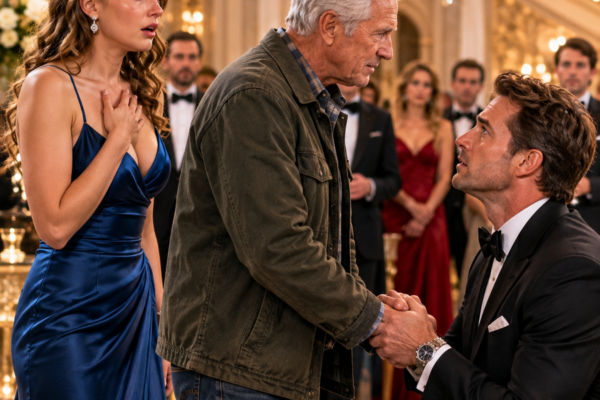
Take your hand off her. The words were not loud, but they cut through the polished hotel corridor so cleanly that even the laughter from the ballroom seemed to fade behind them.
Prescott Vale turned slowly, still holding Cala Whitmore by the wrist as if her refusal had been an inconvenience instead of an answer. Excuse me, he said.
Merrick Hale stood 10 ft away in faded work pants, a navy maintenance shirt, and boots marked with the dust of a 12-hour shift.
A tool bag hung from one hand.
His expression carried no anger, no challenge, only the quiet steadiness of a man who had learned long ago that dignity did not need an audience. She asked you to let go.
Prescott gave a short laugh. This has nothing to do with you.
Maybe not.
Merrick set the tool bag gently against the wall. But I heard her.
Cala said nothing. For most of her adult life, men had rushed toward her for one reason or another.
Some wanted her attention, some wanted her connections, some wanted the name printed on the financial pages beside hers. And Prescott, with his tailored tuxedo and old money confidence, had spent six months behaving as though persistence could eventually turn no into yes.
Tonight, at the Whitmore Foundation Charity Gala in downtown Chicago, he had finally stopped pretending. Cala, Prescott said, lowering his voice, we are not finished.
We are, she replied.
You are making a scene. Then stop making one.
His fingers tightened just enough to keep her from stepping away.
That was when Merrick moved closer.
Not fast, not dramatically, just one measured step. The crystal lights above them reflected across the marble floor, and somewhere inside the ballroom a jazz trio continued playing, unaware that three lives had just reached the edge of something none of them could yet see.
Prescott looked Merrick up and down, the inexpensive shirt, the worn belt, the hotel contractor badge clipped near his pocket. Do you have any idea who you are talking to?
Merrick glanced at the badge on Prescott’s lapel, then back at his face.
No.
Prescott smiled. That is what I thought.
Merrick’s eyes shifted toward Cala.
She was composed, but he noticed the small things powerful people often taught themselves to hide.
The tension in her shoulders, the controlled breath, the way her free hand had curled against the fabric of her dress.
Merrick had a daughter at home, eight years old. Juniper was probably asleep on the couch again with colored pencils scattered across her homework.
He had spent years teaching her that being kind did not mean being weak, and that respect mattered most when nobody important was watching. Standing in that corridor, Merrick realized those lessons would mean nothing if he ignored them when they became inconvenient.
Sir, he said, let her go.
Prescott’s smile disappeared.
You should walk away. No.
I said walk away. Merrick remained still.
And she said let go.
For the first time, Prescott looked around.
Two servers had stopped near the ballroom doors. A security guard was approaching from the far end of the corridor.
Lenore Say, Cala’s chief operating officer, had stepped out of the ballroom and was watching with a face that had gone completely cold.
Prescott released Cala. He adjusted his cuff as though nothing had happened.
You just made a very expensive mistake, he told Merrick. Merrick picked up his tool bag.
Would not be my first.
Then he turned to Cala.
Are you all right, ma’am?
Ma’am, not Cala Whitmore, not chief executive officer Whitmore, not the billionaire whose company occupied 42 floors of glass and steel along the Chicago River.
Just ma’am.
She studied him, almost suspicious of the simplicity of it.
I am now, she said. Merrick nodded once.
Good.
And then he started walking away.
Cala blinked. Wait.
He stopped. You do not know who I am.
Merrick looked back at her.
No, ma’am.
You really do not.
He shook his head. For reasons she could not explain, something inside her loosened.
She had spent years meeting who learned her net worth before learning her favorite coffee.
Men who rehearsed charm, calculated opportunity, and called ambition affection. This stranger had stepped between her and humiliation without knowing her name, and now he appeared perfectly willing to disappear without asking for anything.
Then why did you help me?
She asked.
Merrick looked toward Prescott, then back at her. His answer was so simple that the corridor felt quiet around it.
Because you said no.
Before we continue, where are you watching from? Drop your city or country in the comments below.
And if you believe dignity, respect, and second chances still matter, hit like and subscribe. Stories like this remind us that character is often revealed in the moments when nobody expects a reward.
Now back to Merrick Hale. Cala watched Merrick disappear through the service doors, and for several seconds she remained exactly where he had left her, surrounded by marble, crystal light, and the faint sound of applause from a ballroom full of people who believed they knew her.
Lenora stepped closer.
Are you all right?
Cala looked down at her wrist, then toward the closed doors. Yes.
Do you want me to have security remove Prescott?
Not yet.
Lenora studied her. And the maintenance man?
Cala’s eyes stayed on the doorway.
I do not even know his name.
That should not have mattered.
Cala Whittemore knew thousands of names, investors, mayors, engineers, senators, men who owned buildings, banks, private aircraft, and entire pieces of cities.
Her assistant kept the calendar so full that conversations were measured in 15-minute blocks.
Yet as she returned to the ballroom, smiling when required and shaking hands when expected, one nameless man in worn work boots remained in her thoughts.
It was not because he had defended her.
Plenty of men had offered to protect Cala over the years. Protection, she had learned, often arrived with an invoice hidden behind the gesture.
What unsettled her was that Merrick had walked away. He had not asked for her number.
He had not waited for gratitude.
He had not even stayed long enough to discover that the woman he had defended controlled the company whose foundation had raised nearly $12 million that evening.
Cala had spent most of her adult life being pursued.
At 36, she had become skilled at recognizing the pattern.
First came admiration, then curiosity, then the question hidden beneath the smile.
What can being close to you do for me? 3 months earlier, a venture capitalist named Graham Mercer had invited her to dinner at a quiet restaurant in River North.
For 40 minutes, he asked about her childhood, her favorite books, even the little lake in Connecticut where she had learned to swim.
Cala had almost believed he was interested. Then dessert arrived.
Graham placed a folder beside her coffee.
There is one small opportunity one thought Whitmore might want to consider. Cala never saw him again.
Before that, an heir to a national hotel chain had sent 200 white roses to her office.
The card read, Dinner Friday? She declined.
The next morning, his father called requesting access to a city infrastructure project Cala’s company was bidding on.
Even flowers had started to feel like paperwork.
Prescott Vale had simply been more patient than the others. He came from money old enough to have portraits attached to it.
His family name opened private clubs and closed negotiations. At first, he had been charming.
He remembered birthdays. He donated generously to her foundation.
He listened when she spoke. Then the language changed.
Dinner became expectation. Attention became entitlement.
We make sense together, he had told her once. You run systems.
I run capital.
Imagine what our families could build. Cala had stared at him across the table.
You just described a merger.
Prescott had smiled. Maybe love is just the right merger.
She had laughed then because she thought he was joking. Tonight, she finally understood he was not.
Near midnight, Cala stepped out onto the hotel’s private terrace.
Chicago spread beneath her in white and amber lights, the river cutting between towers of glass like a dark ribbon.
She wrapped her arms loosely around herself.
Behind her, the gala continued without missing a beat.
Money was still being pledged.
Champagne was still being poured.
Men were still waiting for their chance to speak with her. Lenora joined her carrying two cups of coffee.
You disappeared. I am standing 20 ft from the ballroom.
For you, that qualifies. Cala accepted the cup.
Lenora leaned against the railing.
His name is Merrick Hale.
Cala turned. Who?
Lenora gave her a look. The man you have been thinking about for the last hour.
Cala took a slow sip. I was not thinking about him.
Of course not.
What do you know? 39 works for a building systems contractor.
Elevator maintenance, electrical diagnostics, emergency repairs, lives in Berwyn, no disciplinary complaints, no social media worth mentioning.
Cala frowned. You investigated him?
I asked hotel operations who he was. Lenora paused.
You were the one who sounds disappointed that I stopped there. Cala looked back toward the city.
Did he know who I was? According to the hotel manager, no.
Silence settled between them.
Cala thought of Merrick’s face when she had asked why he helped her.
No performance, no polished line. Because you said no.
She had heard declarations worth millions and promises rehearsed by men who owned half the room.
None had stayed with her like those five words.
Lenora smiled faintly. Interesting, is it not?
Cala shook her head. What?
The first man in years who does not chase you. Cala looked through the glass doors toward the ballroom where Prescott was already talking comfortably with investors as if nothing had happened.
Then her eyes returned to the service corridor Merrick had vanished through. For the first time in a very long while, the man she could not stop thinking about was the one who had wanted absolutely nothing from her.
By the time Merrick Hale reached Berwyn, the city had gone quiet in the way working neighborhoods often did after midnight.
Streetlights washed the parked cars in pale amber, and the August air still held the day’s heat against the brick buildings.
He climbed the narrow stairs to his second floor apartment with his tool bag in one hand and a paper sack from a 24-hour diner in the other.
The lock stuck twice before turning.
Inside, the living room lamp was still on. Juniper was asleep sideways across the couch, one sock missing, colored pencils scattered around her like tiny fallen branches.
A drawing rested on her chest. Merrick set the food on the counter and carefully lifted the paper.
It showed three buildings connected by sky bridges, each window painted a different color.
Above them in Juniper’s uneven handwriting were the words, a city where nobody gets left out.
Merrick smiled.
That is ambitious, he whispered. Juniper stirred.
Daddy, go back to sleep, June. She pushed herself up, hair tangled across her face.
You are late.
I know. Did the fancy people break something?
Merrick took off his work boots and lined them neatly by the door.
Fancy people break plenty of things.
Juniper squinted at him.
Did you fix it? He paused.
Not exactly. Did you save anyone?
Merrick looked at her for a moment.
The question was ordinary in their home.
Juniper asked it whenever he came back from emergency calls because in her mind, fixing a trapped elevator and rescuing a person were roughly the same profession.
Just help someone who needed a little room to breathe, he said. So yes.
Merrick gave her a tired smile. Maybe a little.
She nodded as if the matter was settled. Then she spotted the diner bag.
French fries.
You were supposed to be asleep.
That was not my question. He laughed softly and handed her three.
Their apartment was small but carefully kept.
Two bedrooms, one bathroom, a kitchen barely wide enough for two people to pass without turning sideways.
The refrigerator hummed louder than it should. The window above the sink looked toward the elevated tracks.
Every few minutes, a train rolled by with a metallic thunder that rattled the glasses in the cabinet.
Merrick had once promised himself they would move somewhere quieter. Then medical bills came.
Then funeral expenses. Then the company that employed his late wife closed her life insurance claim with more conditions than mercy.
After that, promises became smaller.
Keep the heat on.
Keep Juniper in the same school. Keep breakfast in the cabinet.
Keep moving.
His phone buzzed on the counter.
Payment reminder, rent balance due. Merrick turned the screen face down before Juniper could see it.
She saw anyway.
Children often noticed the things adults worked hardest to hide.
Are we okay?
She asked. We are okay.
You always say that.
Because it keeps being true.
Juniper studied him with the serious gray eyes she had inherited from her mother.
Mom used to say okay and good were different.
Merrick’s hand stopped halfway to the refrigerator.
For a second, the apartment seemed quieter than usual.
Your mom said a lot of smart things.
Was she smarter than you?
By a dangerous amount.
Juniper smiled.
Merrick opened the refrigerator and found exactly what he expected. Half a carton of milk, mustard, four eggs, leftover pasta, and a jar of strawberry jam.
He put the diner sandwich beside the pasta.
Tomorrow’s lunch.
Nothing wasted.
Juniper climbed onto a kitchen chair.
Was the person you helped nice? She was having a bad night.
That does not answer the question. Merrick looked at his daughter.
She seemed nice. Was she rich?
He gave her a puzzled look.
Why would that matter?
Because you said fancy people. I did not say she was fancy.
You implied it.
Merrick shook his head. You are eight years old.
Stop using implied correctly. Juniper grinned.
So was she.
Merrick thought about the woman in the corridor, the calm voice, the controlled fear, the way she had looked almost confused when he walked away without asking her name. I do not know, he said.
That was true.
He knew nothing about Cala Whitmore.
Not yet.
To him, she had simply been a woman whose answer had been ignored.
That had been enough. Later, after Juniper finally went to bed, Merrick sat alone at the kitchen table with a glass of tap water and the rent notice glowing on his phone.
He opened his banking app.
$1,418.
Rent was $1,600.
Juniper’s school field trip payment was due Friday.
His truck needed front brakes before winter.
Merrick rubbed both hands over his face and stared through the window as another train passed.
He could have taken Prescott’s threat seriously.
Maybe he should have.
Men in expensive tuxedos did not usually warn maintenance workers about costly mistakes unless they had the means to make them costly.
But Merrick had learned something during the hardest years of his life.
Fear was expensive, too. It charged interest in silence, compromise, and the kind of regret that followed a man home.
So he closed the banking app, turned off the kitchen light, and walked toward Juniper’s room.
He did not know Cala Whitmore’s name.
He did not know she ran a company worth billions, and he certainly did not know that before the week was over, he would step into her world again.
This time, neither of them would be able to walk away unchanged.
Three mornings later, Merrick was halfway through replacing a worn relay in a freight elevator on the west side when his supervisor called.
“Hale, I need you downtown.”
Merrick balanced the phone between his shoulder and ear.
“I’m already on a job.”
“Not anymore.
Whitmore Urban Systems has three elevators cycling in default mode, and their regular contractor cannot isolate it.”
Merrick tightened the relay screw.
“Send Nolan.”
Nolan already went. They sent him home.
That encouraging, huh? His supervisor sighed.
Just get there.”
Less than an hour later, Merrick stood beneath a 42-story tower of glass along the Chicago River, staring up at a silver sign mounted above the entrance. Whitmore Urban Systems.
The name meant nothing to him at first. Then he stepped through the revolving doors.
The lobby was all stone, sunlight, and quiet money. Employees crossed the floor with tablets tucked under their arms.
A security desk stretched beneath a wall displaying city infrastructure projects from Dallas, Denver, Seattle, and Boston.
Merrick signed the contractor log and clipped a temporary badge to his shirt.
Service elevator bank is through there, the guard said.
Executive lift keeps stalling between floors 38 and 40. Merrick nodded.
Any passengers trapped? Not now.
Good. He had just opened the control cabinet when a familiar voice behind him said, You have got to be kidding me.
Merrick turned. Cala stood 20 ft away in a charcoal business suit, a folder tucked beneath one arm.
Lenora was beside her, trying unsuccessfully not to smile. Merrick looked from Cala to the enormous silver company logo behind her, then back to Cala.
You are the CEO? Cala folded her arms.
That sounds almost accusatory.
More surprised than accusing. You really did not know?
I told you I did not.
Lenora looked at Cala.
I believe this officially settles it. Cala ignored her.
And now?
Merrick glanced at the open elevator panel.
Now I know your elevator is broken. Cala waited for more.
There was no more. That is it?
Would you prefer a speech?
Most people usually react.
Merrick crouched beside the diagnostic panel and connected his meter.
Most people are not trying to find a voltage drop.
Cala stared at him, then laughed before she could stop herself. It was not the polite laugh she used at board dinners or investor lunches.
It came out quick and unguarded.
Merrick looked over his shoulder. Something funny?
Apparently. He returned to the panel.
Give me 20 minutes.
People usually tell me five. Then they want you to like them, and you do not.
Merrick paused. I would rather fix the elevator.
Lenora quietly walked away, leaving Cala standing there with an expression she had not worn in years, curiosity without suspicion. For the next 15 minutes, Merrick worked while Cala pretended to read emails.
He listened to the motor housing, checked the door sensors, then traced the issue to a miscalibrated load monitor. There, he said, your system thinks the car is overweight when it is not.
stepped closer.
Can that happen suddenly?
Usually after a software update or a bad recalibration. We updated last week.
Then somebody probably trusted the computer more than the machine.
You say that like it is a character flaw.
Sometimes it is. She smiled faintly.
You always talk like this. Like what?
As if every sentence is secretly about something else.
Merrick closed the panel.
No, sometimes an elevator is just an elevator. The car chimed.
Doors opened smoothly.
Cala stepped inside, then turned before Merrick could walk away.
Merrick.
He stopped.
She had read his name from the badge. Why did you help me that night?
He met her eyes. We already covered that.
I know what you said. I am asking why you got involved when everyone else stayed out of it.
The lobby seemed to soften around them. Air conditioning hummed overhead.
Somewhere behind the security desk, a phone rang once and stopped. Merrick rested one hand on his tool bag.
Because you said no.
That’s simple.
It should be.
Cala’s expression changed.
Not dramatically, just enough for something guarded to loosen. You did not know who I was.
Would it have mattered?
To most people, yes.
Merrick nodded toward the elevator. Then maybe most people are making it too complicated.
The doors began to close.
Cala held them with one hand.
Can I ask you something else?
You seem determined too. What do you want?
Merrick frowned. From you.
He looked genuinely confused. Nothing.
For Cala, the answer landed harder than any compliment she had heard in years. Men had offered her yachts, penthouses, partnerships, weekends in Aspen, seats at private clubs, and futures designed like business plans.
Every gift had carried an invisible string.
Every promise seemed to have a number attached.
But Merrick Hale stood in front of her with grease on one sleeve, a tool bag at his and no interest in turning kindness into currency. He picked up his equipment.
Your elevator is good.
Cala watched him walk toward the service corridor. Merrick, he looked back again.
She almost asked him to stay, almost asked for coffee, almost asked the question she had not allowed herself to ask in years.
What if someone could see her without calculating her? Instead, she said, Thank you.
Merrick gave a small nod. You are welcome, Ms.Whitmore.
Then he left.
Cala remained inside the elevator as the doors closed. And for the first time in years, being called Ms.Whitmore felt strangely disappointing.
Cala told herself she was only curious. That was the lie she used on Monday morning when she asked Lenora which contractor handled the building systems account.
It was the same lie she used on Tuesday when she noticed Merrick in the lobby and found herself slowing down instead of walking past.
By Wednesday, even Lenora had stopped pretending not to notice.
You know, she said as they crossed the executive floor, normal people just ask someone to coffee.
Cala kept her eyes on the tablet in her hand.
I am not asking anyone to coffee. Of course not.
I am evaluating the reliability of our maintenance vendors.
Lenora smiled with remarkable emotional investment. Cala ignored her, but the truth was harder to ignore.
Merrick kept appearing in small moments, and every one of them seemed to contradict what she had spent years learning about powerful men.
That afternoon, a young analyst named Sophie spilled an entire cup of coffee outside the conference room just as Cala approached with two board members.
Sophie froze. Ms.Whitmore, I am so sorry.
Cala had barely opened her mouth when Merrick stepped out of the service hallway carrying a voltage tester.
He took one look at the floor, then at Sophie’s pale face.
You burned, he asked.
Sophie blinked.
What? Your hand.
Coffee hit you?
No good.
He grabbed a stack of paper towels from a supply cart and crouched.
Sophie looked toward Cala, terrified.
I can clean it. Merrick shook his head.
You have got a meeting.
But this is my fault.
Most messes are somebody’s fault.
He wiped the coffee from the tile. Does not mean they need a public trial.
One of the board members laughed softly.
Merrick did not. Cala noticed that, too.
He was not performing kindness because she was watching. In fact, he seemed almost unaware that she was there.
Later that week, security stopped the delivery driver at the employee entrance because his paperwork listed the wrong suite number.
The driver, a tired man in his sixties, kept explaining that dispatch had changed the route. The guard grew impatient.
Merrick walked over, checked the shipping label, then pointed toward the freight elevators. Suite 1800 moved to 2100 last month.
Building directory never updated.
The guard frowned.
You sure? I changed the panel myself.
Then Merrick helped the driver load two boxes onto a cart. No lecture, no humiliation, just a problem solved without making anyone feel small.
Cala watched from across the lobby. She had spent 20 years around executives who could command a room.
Merrick had a different kind of power. He knew how to lower the temperature of one.
The moment that changed everything came on Friday evening. Cala had stayed late after a city planning meeting, and when she reached the lobby, she saw Merrick sitting near the windows with a little girl beside him.
Juniper, Cala recognized her immediately from the small photograph tucked behind Merrick’s contractor badge.
Juniper had a sketchbook open across her knees and was drawing the skyline.
Merrick was eating french fries from a paper carton.
That building is leaning, he told her. It is artistic perspective.
It is structurally concerning.
You fix elevators. I design cities.
Cala smiled before either of them noticed her.
Juniper looked up first.
Hi.
Hi. Merrick turned, surprised.
Ms.Whitmore.
Juniper’s eyes widened.
You work here? Cala almost laughed.
Something like that.
Merrick gave her a look.
Do Do start.
Juniper held up her drawing. Dad says this building would fall over.
Cala examined it carefully. Your dad lacks imagination.
Thank you. Merrick shook his head.
Great. Now there are two of you.
Juniper moved her backpack from the bench. You can sit.
Cala hesitated.
There were still emails waiting upstairs. A board packet needed approval.
A driver was probably circling the block.
She sat down anyway. Juniper pushed the carton toward her.
Want a fry?
Cala accepted one. Best offer I have had all day.
Really?
By far.
For 20 minutes, Cala Whitmore sat in the lobby of her own billion dollar company eating french fries from a paper carton with a maintenance technician and his eight year old daughter. No one asked about quarterly earnings.
No one mentioned acquisitions.
No one wanted access, influence, or a favor.
Juniper explained her plan for a city where every apartment had a rooftop garden. Merrick argued that somebody still had to maintain the elevators.
Cala laughed until her eyes watered. It was ordinary.
That was what made it extraordinary. When Juniper went to use the restroom, Cala looked at Merrick.
She is wonderful.
His expression softened.
She is the best thing that ever happened to me.
You are a good father.
Merrick looked down at the fries.
I try to be present. Sometimes that is the whole job.
Cala studied him.
You really do not want anything from me, do you? He looked up.
You keep asking that. Because I keep expecting the answer to change.
Why?
She almost told him. About Graham.
About the roses. About Prescott.
About every conversation that eventually revealed a price tag.
Instead she said, experience. Merrick was quiet for a moment.
Then maybe experience taught you the wrong lesson.
Cala’s eyes held his.
Which lesson is that? That kindness always comes with a bill.
Juniper returned before Cala could answer.
But the word stayed.
And across the lobby, unnoticed by all three of them, Prescott Vale had just stepped through the revolving doors and seen exactly where Cala was sitting.
Prescott did not approach them that night.
That would have been too obvious, and Prescott Vale had built his life around making control look like patience.
He simply stood near the revolving doors, watched Cala laugh at something Juniper said, and understood immediately what made Merrick Hale dangerous.
It was not money. Merrick had almost none.
It was not influence.
He had no board seat, no family name, no invitation to the rooms Prescott had spent his entire life entering without knocking. It was peace.
Cala looked peaceful beside him.
Two days later, Merrick received a call asking him to meet a prospective client at a private club near the Gold Coast.
The address surprised him, but contract work had been slow, and slow weeks did not care about pride. He arrived in a clean button-down shirt with his work jacket folded over one arm.
Prescott was waiting alone in a corner booth. Merrick stopped.
You have got to be kidding me.
Prescott gestured to the seat across from him.
Sit.
Merrick remained standing. I do not work for you.
No, but you need work. That landed exactly where Prescott intended.
Merrick’s expression did not change.
What do you want?
Prescott slid a cream-colored envelope across the table.
Efficiency. Merrick opened it.
Inside was a cashier’s check for $50,000.
He looked at the number once, then back at Prescott.
For what? Walk away from Cala.
Merrick gave a tired half laugh. I am not with Cala.
Do not insult me.
I am not. Prescott leaned back.
Men like you always say the same thing. You are different.
You do not care about the money. You only want to help.
He tapped the envelope. Then eventually reality arrives.
Merrick closed it and pushed it back.
Reality was already here before you showed up.
Prescott’s eyes hardened.
You have overdue rent, medical debt, a truck that needs repairs, a daughter in a private after-school science program you can barely afford.
Merrick went still, not frightened. Still.
You looked into my daughter? I looked into you.
Merrick’s voice lowered.
Leave her out of this. Then make this easy.
Prescott pushed the check back again.
Name your price.
Merrick looked at it for a long moment. $50,000 could clear the rent, replace the brakes, pay down debt, buy Juniper a winter coat before the first cold snap.
For one breath, the number became groceries, school supplies, and a little room to breathe.
Then he looked at Prescott.
Is this what you think she costs?
Prescott smiled.
No, he leaned forward. It is what you cost.
The room seemed to narrow. Merrick picked up the check, folded it once, then tore it cleanly down the middle.
He placed both pieces on the table.
You spent all that money finding out I am broke and still learned nothing about me.
Prescott’s smile disappeared.
You are making a mistake.
Probably.
Merrick stood. But at least it is mine.
He walked out without ordering coffee. Three days later, his supervisor called him into the office before sunrise.
The fluorescent light above the desk buzzed faintly.
A termination packet sat between them. What is this?
Merrick asked. His supervisor would not meet his eyes.
Whitmore Property Management is restructuring vendor access.
We lost the downtown contract.
That is half our commercial work.
I know. And I am the one getting cut.
Silence answered first.
Merrick looked at the packet again. Why me?
His supervisor finally looked up. Because someone asked for you by name.
Merrick understood.
Prescott had not bought him, so he had decided to price the consequences instead. That afternoon, Cala texted Merrick for the first time.
Lenora had given her his number under the excuse of building maintenance.
Want to get coffee sometime?
Merrick stared at the message from the driver’s seat of his truck.
On the passenger side sat a cardboard box containing his tools, two spare uniforms, and a framed photograph of Juniper from first grade.
He typed three different replies, deleted all three. Finally, he wrote, busy week.
Maybe another time. Cala answered almost immediately.
Everything okay? Merrick looked at the termination packet beside the steering wheel.
He could tell her, one phone call from Calla Whitmore could probably fix everything.
That was exactly why he did not.
Fine. Just work.
He sent the lie and put the phone face down.
That evening, Juniper found him at the kitchen table adding numbers on the back of an envelope. Are we okay?
she asked.
Merrick looked up.
Same question, same gray eyes.
Harder answer. We will be.
That is different from yes.
Merrick smiled faintly.
You noticed too much. Juniper climbed into the chair beside him.
Mom said noticing people is a kind of kindness. Merrick looked toward the dark window.
Somewhere downtown, Calla was probably finishing another 14 hour day beneath glass and steel. He wanted to tell her what had happened.
He wanted, for once, to let somebody stronger carry part of the weight. But pride and dignity are not always the same thing, even when they were similar faces.
Merrick had not learned the difference yet, so he stayed silent, took a temporary overnight maintenance job across town and disappeared from Calla’s world without knowing that his silence was about to hurt her more than Prescott ever could.
For the first two days, Calla told herself Merrick was busy.
On the third, she stopped believing it. His name disappeared from the contractor schedule.
His temporary badge was gone from the security desk. The service elevator ran perfectly, but every time the doors opened, she caught herself expecting to see worn work boots and a tool bag waiting on the other side.
He never appeared. She sent one more message.
Coffee offer still stands.
No answer. That silence bothered her more than she wanted to admit.
By Friday evening, Calla sat alone at the head of a conference table designed for 20 people, staring at financial projections she had already read twice. Outside the windows, Chicago glowed beneath a hazy summer sunset.
Lenora entered without knocking and placed a folder on the table. You have been on the same page for 12 minutes.
Calla did not look up.
It is a complicated page.
It is a parking revenue forecast. Cala closed the document.
What do you want? Lenora sat across from her.
To ask why you are angry. I am not angry.
Then disappointed. Cala looked toward the windows.
I thought he was different.
Lenora waited.
He defended me. He acted like money did not matter.
Like none of this mattered. Cala gestured toward the glass walls, the skyline, the quiet evidence of everything she had built.
Then the second things became complicated, he disappeared.
Lenora’s expression changed.
Cala, what exactly do you think happened? I do not know.
That is the point.
Did you ask? Twice.
And because a man did not explain his entire life to you on command, you decided he failed some test.
Cala’s eyes sharpened.
That is unfair. Maybe.
Lenora slid the folder across the table.
So is this. Cala opened it.
The first page was a vendor termination notice.
The second showed Merrick’s employment record.
The third contained an internal email forwarded through a property management subcontractor. Her eye stopped on one line.
Remove Hale from Whitmore associated accounts effective immediately. Request origin Vail Capital Relations.
Cala read it again.
Slower.
Prescott. Lenora nodded.
He leaned on one of the investment groups that owns part of Merrick contracting company. The downtown contract disappeared three days after the gala.
Cala went still.
Why did nobody tell me? Because Prescott made sure your name never appeared anywhere.
And Merrick lost his job. The city outside seemed to fall away.
Cala looked at her phone lying beside the folder. Busy week.
Maybe another time.
Fine. Just work.
Suddenly those messages sounded different.
Not distant. Protective.
He knew. She whispered.
Lenora nodded.
I think Prescott approached him directly first.
Cala’s face hardened.
How do you know?
Lenora placed two torn pieces of a photocopied cashier’s check on top of the file.
$50,000.
The The manager remembered the meeting.
Prescott’s assistant arranged the check.
Cala stared at the amount.
Merrick refused it, apparently with emphasis. Cala closed her eyes.
For years, men had spent fortunes trying to impress her.
Merrick Hale had lost nearly everything and never told her.
The realization did not feel romantic, not at first. It felt painful because beneath his dignity, she could finally see something else, fear.
Not fear of Prescott, fear of becoming another man who needed something from her. He thought asking me for help would make him like them, Cala said.
Lenora leaned back.
Maybe.
That is ridiculous.
People carry old wounds into new rooms.
Cala looked down at the check again.
So do I.
The next morning, before Cala could decide what to do, security called from the lobby.
Ms.Whitmore, there is a young visitor asking for you.
Who?
A pause.
Juniper Hale.
Cala was downstairs in less than 3 minutes.
Juniper stood beside the security desk wearing a purple backpack and holding a large sheet of folded drawing paper.
A woman Cala recognized as Juniper’s after school program director waited nearby.
My dad does not know I brought this, Juniper said immediately.
Cala crouched slightly. Then this sounds serious.
Juniper handed her the drawing. It was the same city of connected buildings she had seen before, but now three small figures stood beneath one rooftop garden.
One was Juniper, one was Merrick.
The third had dark business clothes and long brown hair.
Cala’s throat tightened.
At the bottom, Juniper had written, Dad says good people do not make you owe them.
Cala read the sentence twice.
He said that. Juniper nodded.
He says people should help because it is right, not because they get something back. She hesitated.
But he is sad lately.
Cala looked up. Did he say why?
No.
Dad thinks not talking about problems makes them smaller. Juniper frowned.
It does not. Cala almost smiled.
No, it usually does not. Juniper pointed at the third figure in the drawing.
I thought maybe you should have it.
Why? Because he smiles more when you are around.
The lobby filled strangely quiet. Cala looked at the paper, then at the child who had just said in 10 seconds what adults had spent weeks avoiding.
Grace sometimes arrived without strategy. Truth often came without permission, and second chances did not always knock twice.
Cala stood, holding the drawing carefully against her chest. For the first time since Merrick disappeared, she was no longer wondering why he had left.
She knew.
He had not walked away because he wanted something from her. He had walked away because he refused to let her believe she owed him anything.
And that was the moment Cala Whittemore stopped waiting for Merrick Hale to come back.
Cala did not call Merrick that day.
She did something harder.
She waited until she had the truth in her hands.
By Monday morning, Lenora had assembled every email, every vendor note, every transfer request, every quiet pressure point Prescott had used to push Merrick out of the Whittemore account.
By Tuesday, Cala’s legal team had confirmed what Lenora already suspected.
Prescott had used investment leverage to punish a man who had refused to be bought.
On Wednesday, the quarterly board meeting began at 9 o’clock sharp.
22 executives and investors filled the glass conference room on the 41st floor.
Chicago stretched beneath them in silver morning light. Coffee steamed beside leather folders.
Screens glowed with revenue forecasts, expansion maps, and the final terms of a major financing partnership with Vale Capital.
Prescott sat three seats from Cala, calm and polished, wearing the expression of a man who believed the outcome had already been decided.
Before we move to the vote, he said, I would like to clarify one thing.
Cala looked at him. Go ahead.
Prescott stood.
Vale Capital is prepared to increase its commitment by another $75 million, provided the board approves the infrastructure package today.
A few heads turned. Pens moved.
Numbers had a way of making people listen. Prescott smiled.
This partnership is good for Whitmore, good for our investors, good for the city.
Cala folded her hands. Anything else?
Only that distractions should remain outside this room.
His eyes held hers. Personal distractions.
Lenora stopped writing.
One director glanced toward Cala then away.
Cala’s voice remained calm.
Be specific.
Prescott gave a small shrug. The maintenance worker.
Silence shifted through the room.
Merrick Hale, Cala said.
Prescott smiled.
If you insist on using his name. Cala did not move.
I do.
Fine.
Merrick Hale, a contractor with financial problems and no meaningful connection to this company.
I understand you have developed some sympathy for him.
Sympathy, call it whatever you like. Prescott leaned one hand against the table.
But we are discussing hundreds of millions of dollars. He is nobody.
The room became very still.
Cala looked at him for several seconds.
Not angry, not wounded, just certain. Then she reached for the remote beside her folder.
The presentation screen changed.
The first slide showed an internal vendor termination notice. The second showed Vale Capital correspondence.
The third displayed the copied cashier’s check for $50,000.
Prescott’s expression changed.
What is this?
Cala looked around the table. Documentation.
Cala, this is not relevant to the vote. It is now.
Prescott sat straighter.
You are misunderstanding a routine business decision. A routine decision to remove one technician by name.
I do not manage every subcontractor, but your office issued the request. Another slide appeared.
Date, time, authorization. Lenora placed printed copies in front of each board member.
Prescott looked down at the page.
This proves nothing.
Cala ‘s voice stayed quiet.
Then let us discuss the check.
A director at the far end removed his glasses. Prescott exhaled sharply.
You are really doing this? Yes.
For him.
Cala ‘s eyes did not leave his.
No, she paused. For the standard this company claims to have.
Prescott laughed once, but there was no humor in it. You are willing to jeopardize a financing agreement over a maintenance man?
Cala stood. You still do not understand.
The room waited. Sunlight reflected against the river below.
Somewhere beyond the glass walls, an elevator chimed softly.
Merrick Hale did not ask me for money. He did not ask for access.
He did not ask for a job. He did not even tell me when your actions cost him his livelihood.
Prescott shook his head. That does not make him important.
Cala’s expression softened, but only slightly.
It makes him the first man in years who treated me like I was somebody before he knew my name.
No one spoke. Not one chair moved.
Even Prescott seemed to forget what he had planned to say next.
Cala continued.
You saw a poor man and assumed he had a price.
You saw me and assumed persistence would eventually become permission. That is not partnership.
That is entitlement dressed in a suit.
Prescott’s face tightened.
If you cancel this deal, the company loses money.
Probably a great deal of money. Then we will earn it another way.
You cannot be serious.
Cala looked toward the board. Whitmore Urban Systems is withdrawing from the Vale Capital financing agreement effective immediately.
A murmur moved around the table.
Prescott stared at her. You are throwing away hundreds of millions of dollars for him.
Cala shook her head. No.
I am walking away from a man who thinks everyone has a price.
The room fell silent again. This time, the silence did not belong to Prescott.
It belonged to the truth. Cala gathered her folder and turned toward the glass doors.
Then she stopped.
At the far end of the conference room, beside Lenora, stood Merrick Hale. His work jacket was folded over one arm.
His expression was stunned. Lenora had invited him without telling Cala.
For one long moment, Cala and Merrick simply looked at each other. He had one step forward when everyone else stayed quiet.
Now she had done the same for him.
Merrick’s eyes moved to the screen, then to Prescott, then back to Cala.
You did not have to do that, he said softly.
Cala held his gaze. Neither did you.
And for the first time, Merrick had no answer.
For several seconds after the meeting ended, Merrick remained near the glass doors as board members quietly gathered their folders and avoided looking at Prescott. The man who had once spoken as though every room belonged to him now stood alone at the far end of the table, surrounded by numbers that could no longer buy obedience.
Cala did not celebrate. She simply closed the folder in front of her and turned toward Merrick.
You heard all of that? She asked.
Enough.
Lenora invited you.
Apparently, she enjoys surprises.
Lenora passed them with a faint smile. Only useful ones.
Then she left them alone.
Merrick looked out across Chicago, 41 floors below. You really walked away from that deal?
Yes.
Because of what he did to me. Cala shook her head.
Because of what he showed me about himself. Merrick studied her.
There is a difference.
A big one.
He looked down at his folded work jacket. You still did not have to defend me.
Cala stepped closer, not as a chief executive officer, not as the woman whose signature could move millions of dollars, but simply as Cala.
Neither did you.
Merrick gave a small smile. We seem to keep saying that.
Maybe we should stop keeping score.
That was the first thing she said that made him laugh.
Not loudly, just enough to soften the room.
But Merrick still did not ask for his old contract back.
He did not ask for compensation.
Cala did not offer him a check. She had finally understood that kindness could become another kind of pressure if it came wrapped in obligation.
So instead, she asked one question. Are you working tonight?
Merrick nodded.
Temporary maintenance shift in Cicero. Tomorrow?
Probably.
Sunday?
He narrowed his eyes. Why?
Cala smiled. Because I would like to bring dinner.
Merrick looked almost suspicious.
To where? Your place.
That is ambitious.
I run infrastructure systems in 12 states.
My apartment is more complicated than that. I will take my chances.
Sunday evening, just after 6:00, someone knocked on Merrick’s apartment door.
Juniper ran to answer before he could stop her.
Cala stood in the hallway wearing jeans, a simple cream sweater, and no trace of the polished armor she wore downtown. In one hand, she carried a large pizza box.
In the other, a paper bag from a neighborhood bakery. Juniper stared at her.
You brought dessert? I was told this was a serious household.
Juniper stepped aside immediately. You can come in.
Merrick appeared from the kitchen, drying his hands on a towel.
You actually came.
Cala lifted the pizza. I said I would.
Most people say a lot of things. Her expression softened.
I know.
The words carried enough history that neither of them needed to explain them. They ate at the small kitchen table beneath the humming refrigerator light because Merrick had not replaced the burned-out fixture above the stove.
Juniper talked about her rooftop Garden City.
Cala listened as though it were a billion-dollar proposal.
Merrick watched them argue over whether every building needed a library. For the first time in months, the overdue notices on the counter seemed less powerful than the laughter filling the room.
After dinner, Juniper fell asleep on the couch with her sketchbook open beside her.
Cala helped Merrick gather the paper plates. I owe you an apology, she said quietly.
Merrick looked at her. For what?
I thought you disappeared because you were like the others. He placed two cups beside the sink.
I disappeared because I did not want to become like them. I know that now.
I was wrong, too.
Cala waited.
Merrick leaned against the counter. I thought accepting help meant owing someone.
Sometimes it does. And sometimes she looked toward Juniper, then back at him.
Sometimes it means trusting them. The apartment went still except for the passing train outside.
Merrick poured coffee into two mismatched mugs.
Cala accepted hers with both hands.
I spent years wondering what men wanted from me, she said.
You were the first one who never asked. Merrick looked into his cup.
I want something.
Cala raised an eyebrow.
There it is. He smiled.
Another cup of coffee.
That is all. And maybe dinner again next Sunday.
Cala’s smile came slowly, carefully, like a door opening after years of being locked.
Coffee first.
Merrick lifted his mug. Coffee first.
No limousine waited downstairs. No cameras captured the moment.
No one in the city knew that a woman who had spent years being chased had finally found someone willing to simply walk beside her. On the couch, Juniper shifted in her sleep, one hand resting over the drawing of three people beneath a rooftop garden.
Merrick switched off the kitchen light and Cala stayed. Sometimes a second chance does not arrive with applause.
Sometimes it arrives carrying pizza and asks if there is room at the table.