“Who Saved the 87 Wounded Navy SEALs?” Hospital Director Asked — “The Quiet Nurse…” They Answered
“Who Saved the 87 Wounded Navy SEALs?” Hospital Director Asked — “The Quiet Nurse…” They Answered
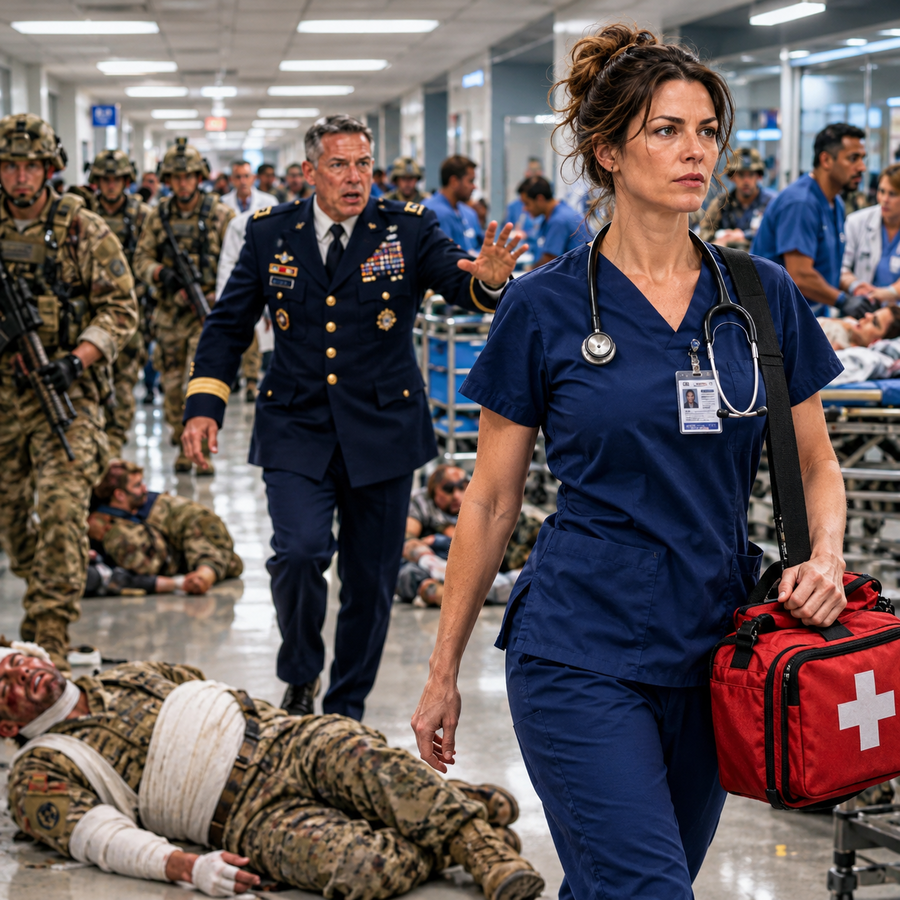
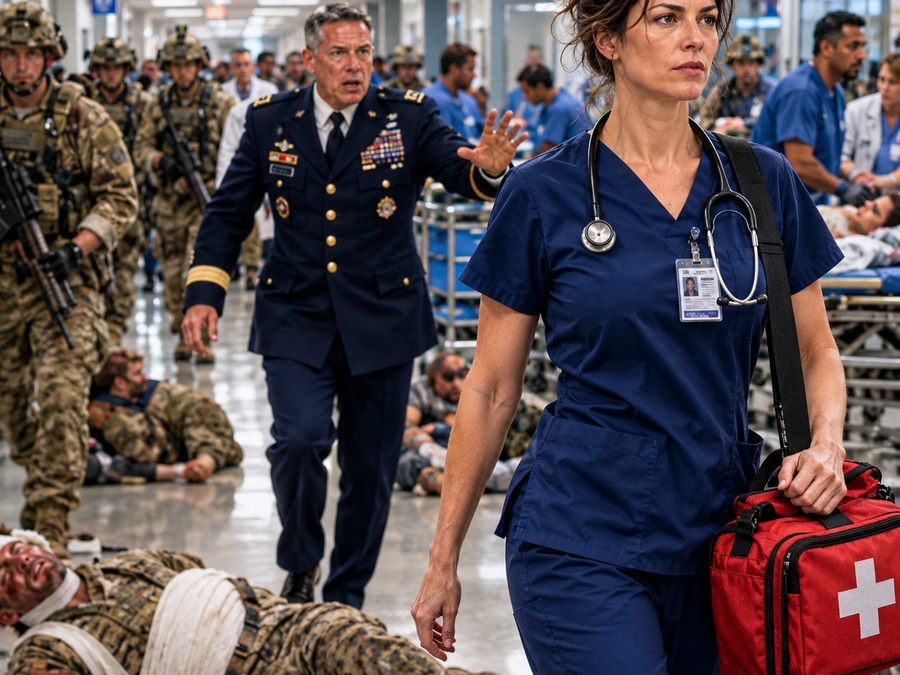
A quiet nurse at a crowded city hospital was mocked, ignored, and treated like she was too ordinary to matter. But when 87 wounded Navy SEALs were rushed through the doors after a classified disaster, every doctor froze under the pressure except her.
The hospital director demanded to know who had kept so many dying men alive before surgery could even begin. The answer silenced the entire ER.
The quiet nurse.
No one knew Hannah Mercer had spent years buried inside America’s most dangerous special operations missions.
And now, the people who humiliated her are about to discover that the woman they dismissed was the only reason 87 heroes were still breathing.
Before we begin, hit the like button, subscribe, and comment where you’re listening from.
Welcome to the channel.
This story is about respect, courage, and the quiet people we should never underestimate.
“Who signed off on putting her in trauma rotation?”
Director Calvin Rusk asked, loud enough for the entire ER to hear. Hannah Mercer stood beside the medication cart with a box of saline flushes in her hands.
Nobody answered him. That made it worse.
Rusk loved silence when he controlled it.
He loved watching people shrink inside it.
He stood in the center of St.Bartholomew Medical Center’s emergency department like he owned every breath in the building.
Expensive charcoal suit, silver tie, perfect hair. A hospital badge clipped to his lapel, even though he had not touched a patient in 20 years.
His eyes moved over Hannah’s bright blue scrubs.
Not navy, not faded. Bright blue, the color the hospital issued to trauma nurses.
On her, somehow, the color looked too clean for the room. She was 36, white American, light brown hair twisted into a loose low bun, green eyes that usually stayed lowered, lean athletic build hidden under oversized scrubs.
A faint scar near her right eyebrow.
A small burn mark on her left forearm that most people assumed came from a kitchen accident.
It had not. You, Rusk said, pointing at her.
Come here.
Hannah set the saline flushes down in careful rows. Then she walked toward him.
Around them, the ER kept moving. Monitors beeped.
A child cried in bay four.
A drunk man argued with a security guard near triage.
Somewhere behind the curtains, an elderly woman coughed with the wet heaviness of pneumonia. But half the staff had stopped pretending not to listen.
Rusk enjoyed that.
Public correction was his favorite kind. Hannah Mercer, he said, reading her badge like he had never seen her before.
Temporary transfer from night observation. Yes, sir.
Her voice was calm.
Too calm.
Dr.Malcolm Ives leaned against the nurses’ station with a tablet in one hand and a smug half smile on his face.
He was the chief of trauma surgery, though he moved through the ER like a visiting emperor forced to inspect a farm.
Beside him stood charge nurse Denise Calloway, arms crossed, mouth tight.
Denise had warned Hannah that morning. Keep your head down.
Do what they say. Do not make Rusk notice you.
Too late. Rusk held up a clipboard.
You marked the thoracotomy tray in bay two as incomplete. It was incomplete.
A few nurses looked away. Ives laughed under his breath.
Rusk’s smile thinned.
It had enough supplies for a standard trauma case.
No, sir.
It was missing two rib spreader blades, sterile suction tubing, and a backup vascular clamp.
And you thought that required an incident note?
Yes. Because you are what, exactly?
Rusk asked. A trauma surgeon now?
No, sir.
An administrator? No, sir.
A military logistics officer? Something inside Hannah went still.
Not tense.
Still.
Like water freezing from the center outward.
No, sir. She said again.
Rusk stepped closer.
Then maybe you should learn the difference between nursing and pretending to understand operations.
The words landed exactly where he wanted them to land. In front of nurses.
In front of residents. In front of patients.
In front of Dr.Ives, who smiled wider. Hannah did not blink.
She had been humiliated in worse rooms by louder men who carried rifles and fear instead of clipboards. This was just another kind of noise.
Rusk tapped the clipboard against his palm.
Your note triggered an automatic compliance alert. That is what the system is for.
No, Ms.Mercer. The system is not for making this hospital look negligent because a quiet little nurse wants attention.
Hannah’s hands remained at her sides.
Steady. Denise shifted her weight.
Hannah? Denise said quietly.
Just say you misunderstood.
Hannah looked at her.
Denise’s eyes begged her to survive the moment.
So Hannah did what she had spent two years at St.Jude’s following me doing.
She swallowed the truth. I may have misunderstood the inventory standard, she said.
Rusk smiled as if he had performed surgery with words.
There. Was that so hard?
Hannah said nothing.
Ives pushed away from the counter.
Put her in low acuity, he said. Sprained ankles and stomach bugs.
She gets nervous around real trauma. A resident snorted.
Hannah heard it. She always heard everything.
The squeak of rubber soles behind her.
The rhythm of Ives tapping his ring against the tablet.
The slight flutter in Denise’s breathing.
The incoming ambulance radio crackling near triage. Small things.
Small things kept people alive.
Rusk leaned closer, lowering his voice just enough to pretend mercy.
You are here because we are short-staffed. Not because you are special.
Remember that. Yes, sir.
Good.
Now, go be quiet somewhere useful.
The ER resumed. People moved again because the show was over.
Hannah turned back toward the medication cart.
Her face stayed blank.
Inside, something old paced behind a locked door. Not anger.
Anger was too hot.
This was colder, controlled, stored. She finished lining up the saline flushes by expiration date.
Jimmy Arlen, the youngest ER tech on shift, rolled a supply cart beside her.
“You okay?”
he asked.
“I’m working.”
“That was not what I asked.”
“It is the answer I have.”
Jimmy was 28, broad-shouldered, kind in a place that punished kindness.
He had a habit of talking too much when nervous and chewing mint gum like it owed him money.
He glanced toward Rusk’s office window.
“Director Sunshine is in rare form today.
” Hannah almost smiled.
Almost.
“Do not call him that where he can hear you.”
“He can hear his own ego from the parking garage.”
This time, one corner of her mouth moved.
Jimmy saw it and looked victorious.
“There she is,” he said.
“Proof of life.”
Hannah picked up a stack of gauze packs.
“Bay 6 needs restock.”
“I’ll do it.”
“I already started.
” “You always already started.
He lowered his voice.
You know you don’t have to take that from them forever.
Hannah paused.
Forever was a dangerous word. It assumed the future had room.
I take it because patients need nurses more than nurses need pride.
Jimmy studied her. That sounds like something carved on a war memorial.
Her fingers tightened around the gauze for half a second, then relaxed. It is just a sentence.
No, Jimmy said. It is a Hannah sentence.
Across the ER, Dr.Ives barked for someone to bring coffee.
No one moved fast enough.
He cursed under his breath, caught himself before saying the rest, then pointed at a resident.
You, move.
Hannah watched without appearing to watch.
Ives was talented.
That made him more dangerous.
Incompetent arrogant men caused obvious damage. Competent arrogant men caused quiet damage because people trusted them too long.
He made fast decisions.
Sometimes they were right.
When they were wrong, he blamed gravity, staff, timing, bad luck, nurses, weather, anything except Malcolm Ives. Rusk loved him because donors loved him.
Rusk measured care in headlines, awards, and surgical wings named after dead millionaires.
Hannah measured care in pulse pressure, airway sounds, skin temperature, and whether a frightened patient stopped clutching the sheet.
Those were not the same religion. At 10:17 a.m., the first strange thing happened.
The ambulance radio went quiet.
Not dead. Quiet.
The dispatcher stopped mid-sentence during a routine transport update. Static hissed for 3 seconds.
Then a different voice came over the channel. St.Bartholomew command, standby for mass casualty notification.
Hannah’s head lifted.
Denise grabbed the radio. Dispatch, repeat.
Static. Then, multiple critical incoming military personnel.
Estimated number unknown. Prepare all trauma bays.
The room changed.
Not panic yet. Pre-panic.
That charged half second before the body understands what the mind has heard. Rusk stepped out of his office.
What is happening?
Denise looked at the radio.
Mass casualty, military. How many?
Unknown. Ives appeared from trauma one, annoyed.
Unknown means four.
Maybe five. They always exaggerate.
The radio crackled again. St.Bartholomew, confirm capacity for 87 casualties.
No one moved. The number hung in the air like a weapon.
87. Jimmy stopped chewing.
Denise whispered, “That cannot be right.
” The dispatcher came back, voice tight.
Repeat.
87 wounded. Multiple blast injuries, penetrating trauma, burns, respiratory distress.
ETA first wave 7 minutes.
Security escort inbound.
Rusk’s face drained.
Ives straightened.
The residents stared at one another.
Hannah set the gauze down. 7 minutes, 87 casualties, blast injuries, military personnel.
The old door inside her chest opened 1 inch. Not fully enough.
Clear ambulatory patients from bays 3 through 10. Hannah said.
Nobody heard her at first. She raised her voice, not shouting.
Command voice did not need volume. It needed shape.
Move low acuity patients to the east waiting area. Convert procedure rooms into treatment zones.
Bring every crash cart to center line.
Open surgical supply overflow now.
Denise turned to her. What?
Hannah was already moving.
Jimmy, get every tourniquet in the building. Not one box, all of them.
Trauma gauze, pressure dressings, pelvic binders, chest seals. If central supply argues, tell them to come argue over bodies.
Jimmy blinked, then ran.
Ives stared at her.
Excuse me? Hannah did not stop.
Call blood bank.
Massive transfusion protocol. Tell them not units, coolers.
O negative first, type specific later. Activate OR, ICU, respiratory therapy, radiology, pharmacy.
Every ventilator, every portable suction, every warming blanket. Rusk found his voice.
Ms.Mercer, you do not give operational orders in my hospital.
Hannah turned. For the first time since he had known her, she looked directly into his eyes.
Green, clear, flat as glass over deep water. Then give them yourself.
Rusk opened his mouth.
Nothing came out.
Outside, sirens began.
Not one, many.
The sound rose from the city like a storm climbing concrete. Hannah looked away from him.
Denise, divide staff into red, yellow, green, black zones. Red gets airway, breathing, circulation.
Yellow gets delayed but stable. Green walks.
Black gets comfort if unsalvageable.
Denise swallowed.
That is military triage. Yes.
How do you know that?
Hannah picked up trauma shears and slid them into her pocket.
Later.
The ambulance bay doors opened. Cold air rushed in.
The first vehicle arrived too fast, tires screaming against wet pavement.
Then the second.
Then two black tactical transport trucks.
Then more ambulances.
Then unmarked federal SUVs.
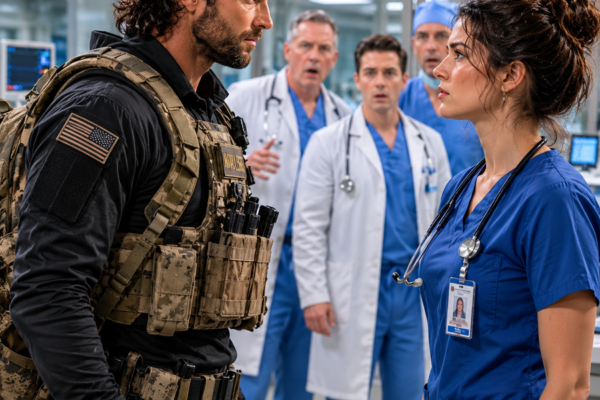
Armed men jumped out before engines stopped. They were not ordinary soldiers.
Even under blood and dust, their movement gave them away. Tight spacing, weapons controlled.
Eyes scanning rooflines, doors, windows. Some carried wounded men.
Some were wounded themselves and refused to sit.
Navy SEALs. Hannah knew before anyone said it.
Her body knew.
The gate.
The silence between commands.
The way pain was filed away until the mission ended. The first stretcher burst through the doors.
Male, early 30s, covered in gray dust and dark blood.
Chest wound. Labored breathing.
Skin mottled. One operator squeezed a bag valve mask while walking.
Blast injury. The medic shouted.
Needle decompression attempted left side.
No improvement.
Pressure falling. Ives stepped forward.
Trauma one.
Hannah caught the patient’s wrist as the stretcher passed.
Weak radial pulse.
Too weak. She looked at the neck veins.
Looked at the trachea. Looked at the chest rise.
Right tension pneumothorax, she said. The medic snapped his eyes to her.
We decompressed left. Wrong side.
Ives glared.
You cannot determine that in 2 seconds.
Hannah was already tearing open a 14-gauge angiocath.
“Watch me.”
She found the second intercostal space, mid-clavicular line, right side.
Clean fast.
Inserted clean.
A sharp hiss of trapped air escaped.
The patient’s chest rose.
The monitor climbed from oxygen saturation 78 to 84, then 89.
The SEAL medic stared.
“I’ve stared harder.”
Hannah looked at him.
“He still needs a chest tube.”
Then she moved to the next stretcher. Second casualty.
Junctional hemorrhage.
Tourniquet useless because the wound was too high in the groin. Third casualty.
Airway burned. Soot around nostrils.
Voice hoarse.
Intubate now, not after swelling closed the throat.
Fourth casualty.
Traumatic amputation. Tourniquet placed too low and loose.
Fix it.
Fifth. Sixth.
Seventh.
The ER dissolved into controlled disaster.
Hannah moved through it like she had been born in that exact kind of chaos.
She did not run unless running saved time. She did not shout unless shouting saved a life.
Her hands never searched. They arrived.
A clamp appeared before anyone asked for it. A chest seal went on before the resident identified the wound.
A pressure dressing was packed into bleeding muscle with brutal precision while the patient groaned through clenched teeth.
“Stay with me.”
Hannah told him. The SEAL gripped her wrist.
“Ma’am.”
He breathed.
“How many?”
“Too many to count right now.”
“Team?”
“Alive until I say otherwise.”
His eyes sharpened. That was not a civilian answer.
Hannah moved on.
Rusk stood near the nurses station with his phone pressed to his ear, trying to sound important.
Yes, we are managing. Yes, the hospital is fully capable.
No, I do not need federal command interfering with civilian medical operations. Behind him, a resident vomited into a trash can.
Denise screamed for more blood. Ives argued with an anesthesiologist about OR priority.
Another SEAL collapsed while trying to carry his teammate.
Hannah caught him before his head hit the floor.
Not your turn to die, she said. His eyes fluttered.
Was not planning on it.
Plans change. She cut open his uniform sleeve.
Shrapnel in the upper arm.
Bleeding controlled, but his breathing was wrong.
She pressed two fingers against his ribs. Flail segment.
Pain control and respiratory support, she ordered.
Do not let him lie flat.
A nurse hesitated. Hannah, I Do it now.
The nurse obeyed.
Nobody called her quiet anymore. Not during those first 20 minutes.
They called her name.
Hannah, here.
Hannah, this one’s crashing.
Hannah, where do we put him?
Hannah, I need help.
Hannah answered all of it.
Red to trauma. Yellow to procedure.
Green to East Hall.
Black to family consult room with comfort meds and a nurse who had the courage to stay. Denise heard that and went pale.
We have black tags?
Hannah’s face did not change.
We have men with no pulse, no airway, catastrophic head injury, and 80 men still breathing.
Do not waste hands on the dead while the living are still losing blood. Denise flinched.
Hannah’s voice softened one degree.
You can cry later. Work now.
Denise nodded. Worked.
At 10:46 a.m.the hospital lost control of its own story.
News helicopters circled outside.
Police blocked streets. Families called screaming for information.
Rusk moved from camera to camera, telling everyone St.Bartholomew was prepared for anything.
Inside, Hannah had turned the ER into a battlefield aid station. Not clean, not pretty, effective.
The floors were slick. The air smelled of blood, antiseptic, burned fabric, and adrenaline.
Bright blue scrubs moved between black tactical uniforms and torn camouflage.
Monitors screamed until nurses silenced them, and then screamed again.
A young SEAL with gray eyes grabbed Hannah’s sleeve as she passed.
My brother, he said. She stopped.
Not because she had time, because sometimes 10 seconds kept a man from breaking.
Name?
Eli Ward.
He was second truck.
Took blast to the side. Hannah scanned the room for memory.
Every face, every wound, every triage color.
Left shoulder scar, dark beard.
The SEAL’s eyes widened.
Yes.
Yellow zone, conscious, angry. That is a good sign.
The young man’s face folded with relief.
Thank you. Breathe.
He obeyed. She moved again.
Ives intercepted her near trauma two. Mercer, stop.
She stepped around him.
He grabbed her arm. The room noticed.
So did three armed operators. Hannah looked down at his hand, then up at his face.
Remove it.
Ives released her, but only because something in her voice made him do it before pride could interfere.
“You are making decisions beyond your scope.”
he hissed.
“I am keeping them alive until surgeons can cut.”
“You tagged two men black.
” “Yes.”
“I did not authorize that.”
“They were dead.”
“You are not qualified to make that call.”
Hannah stepped closer.
“Then go revive them.”
Ives went red.
“You arrogant little” “Trauma three is losing airway.”
she said.
“You can insult me or intubate him.
Choose fast.”
For 1 second, he looked ready to destroy her. Then the monitor alarm behind him shrieked.
He turned and ran. Hannah followed, not because of him, because of the patient.
The man in trauma three was huge, bearded, mid-40s, with a crushed jaw and swelling neck. Blood bubbled at his mouth.
A resident tried to intubate and failed.
“I cannot see cords.
” Hannah grabbed gloves.
“Move.”
Ives snapped.
“I have it.”
“You had it 30 seconds ago.”
The oxygen saturation dropped to 72.
The bearded SEAL’s chest jerked.
Hannah’s eyes locked on the neck.
“Cricothyroid membrane, small window, fast decision.”
“I need a scalpel bougie, 6.
0 tube.”
Ives froze.
“You are not doing a surgical airway in my trauma bay.
” Hannah held out her hand.
“Scalpel.”
No one moved.
A SEAL medic stepped forward and slapped a sterile scalpel into her palm.
“Do it.”
he said.
Ives shouted, “Security.”
Hannah cut.
Horizontal incision, controlled, precise, finger sweep, bougie, tube, bag connected.
The chest rose, the monitor climbed, 76, 81, 88, 93.
The room went silent except for the bag squeezing air into lungs. The SEAL medic stared at her hands, then at her face.
His expression changed. Not recognition, suspicion, respect mixed with something close to fear.
No civilian nurse does that that clean, he said quietly. Hannah stripped off bloody gloves.
Today one did. He looked at the scar near her eyebrow, then at the burn on her forearm.
His eyes narrowed.
Have we met?
No.
Where did you learn that? Patients teach fast.
He did not believe her. Good.
Belief was not required.
Survival was.
At 11:09 a.m.the first SEAL died. His name was Petty Officer Caleb Raines, 29, married, two daughters, according to the blood-soaked family photo in his vest pocket.
Hannah tried for 12 minutes.
Chest compressions, blood, airway, medications, ultrasound, nothing. Sometimes the body was already gone and medicine only confirmed it.
She called time of death with her voice steady, then turned away before anyone could see her eyes. Jimmy was there holding another blood cooler.
He had blood on his cheek and fear in his mouth. Hannah.
Do not say it.
I was not going to.
Yes, you were. He swallowed.
How are you doing this?
She took the cooler. One patient at a time.
No, I mean this. She looked past him.
Two more stretchers arrived. Ask me when they stop bleeding.
The second wave came at 11:14. More wounded, more dust, more blood.
More men who refused pain medication until their teammates had been treated.
One arrived walking with a piece of metal through his side.
“I am fine,” he said.
Hannah pointed to a chair.
“You are impaled.”
“I have had worse.”
“Sit down before I make that statement false.”
He sat.
Amy stared.
“Did you just threaten a Navy SEAL into sitting?”
“I encouraged compliance.”
Terrifyingly, Hannah cut the man’s shirt around the object.
Do not remove impaled object. Stabilize.
Assess bleeding.
He watched her work.
“You prior service?”
he asked.
“No.”
“Liar.”
She wrapped gauze around the metal to keep it from shifting.
“Hold this.”
He held it.
“Good patient.”
He gave a weak laugh, then winced.
“You talk like our old medic.”
Hannah’s hands paused for less than half a heartbeat.
“What medic?”
“Call sign Wren.”
The name moved through her like a bullet passing old scar tissue. Not fresh pain, remembered pain.
She tightened the dressing.
“Never heard of her.”
The SEAL studied her.
“Didn’t say her was a her.”
Hannah met his eyes. For one dangerous second, the past looked back through both of them.
Then Denise shouted for her from red zone. Hannah stood.
“Do not move that metal unless you want to meet your ancestors embarrassed.”
The SEAL smiled despite the pain.
“Yes, ma’am.”
She walked away before he could ask another question.
Wren. Nobody had called her that in 6 years.
Not since the file sealed.
Not since the ceremony that officially never happened.
Not since she traded classified sand, seawater, and gunfire for fluorescent lights and medication scanners.
Hannah Mercer was a nurse. Wren was dead on paper.
That was how it was supposed to stay.
At 11:32, Director Rusk finally realized he was no longer in charge. He stood near the ambulance bay doors yelling at a federal officer in a black jacket.
This is my hospital.
I decide who coordinates care inside this facility.
The officer, a woman with short gray hair and a face built for courtrooms, glanced past him toward the ER.
Looks like someone already is. Rusk turned.
Hannah stood over a triage board she had built from a rolling whiteboard, tape, and blood-streaked markers.
87 names or temporary identifiers.
Red, yellow, green, black or status, ICU status, blood type if known, airway status, evac priority.
It was not pretty.
It was perfect.
Rusk stormed toward her. Ms.Mercer.
She wrote another update.
Not now.
His face twitched.
You will look at me when I speak to you.
Hannah finished writing, then looked.
I have 12 unstable patients, four waiting for OR, three airways that may fail, and a blood bank running behind. You have 10 seconds.
The federal officer’s eyebrows lifted.
Several staff members froze. Rusk lowered his voice.
You have overstepped every professional boundary in this building. No.
I stepped over your hesitation. He flushed.
You performed invasive procedures without authorization. I performed emergency life-saving interventions under implied consent during a mass casualty event.
You tagged patients for death.
I triaged casualties based on survivability and available resources.
You gave orders to physicians. I gave information.
Some physicians were smart enough to follow it.
I’ve heard that from across the room.
His jaw clenched. Rusk pointed toward his office.
When this is over, your career is finished.
Hannah capped the marker.
When this is over, 87 families will ask if their sons came home alive.
I do not care what you do to my career. The federal officer stepped closer.
Director Rusk, a word. Not now.
Now, the woman said.
Her badge flashed. Department of Defense.
Rusk looked at it and suddenly remembered how to be polite.
Hannah did not watch them leave. She turned back to the board.
87 casualties. One dead, four critical in surgery, nine critical pending, 21 serious, the rest walking wounded, though walking wounded could still die if ignored.
She calculated blood usage, airway supplies, surgical capacity, and staff fatigue at the same time.
Old math, bad math, necessary math.
At 11:51, the hospital intercom crackled.
Code silver, exterior lockdown, security threat near south entrance. The ER froze again.
A few SEALs who could stand reached instinctively for weapons they no longer had. The federal officer reappeared, face hard.
Hannah looked at her.
What threat? Unknown vehicle attempted to breach the police line.
Casualty follow-on?
The officer stared.
That was the exact right question. Possibly.
Rusk looked between them.
What does that mean?
Hannah was already moving toward the ambulance bay.
It means whoever hurt them may want to finish the job. Ives grabbed a phone.
We need police inside. No, Hannah said.
We need patients away from glass. The officer nodded once.
Agreed.
Rusk snapped.
Why is everyone listening to her? No one answered because the answer had become obvious.
Hannah pointed.
Move red zone deeper inside. Yellow to interior hall.
Green patients seated low away from windows.
Shut ambulance bay doors. Lock service corridor.
Turn off public monitors showing patient locations.
Denise repeated the orders louder. This time, everyone moved without hesitation.
Rusk stood in the center of motion and finally understood he had become furniture.
Useless furniture. Hannah reached the ambulance bay doors as two security guards shoved a metal barricade into place.
Outside, police shouted. A black pickup sat crooked against a curb, hood smoking.
Officers surrounded it with weapons drawn. The driver was on the ground.
But Hannah was looking at the passenger door. Too clean.
No movement. No panic.
A bag on the seat.
Back up, she said. One guard frowned.
What? Back up now.
The guard obeyed because something in her voice reached deeper than his training. Hannah turned to the federal officer.
Bomb squad.
The woman’s eyes sharpened.
You see a device?
I see behavior.
Rusk, who had followed them, scoffed. Behavior?
You are diagnosing explosives now? Hannah ignored him.
The federal officer spoke into her radio. Possible secondary device in suspect vehicle.
Clear south approach. EOD now.
Rusk’s mouth fell open.
You cannot order that based on a nurse’s guess.
3 seconds later, the pickup exploded.
The blast blew out the outer glass doors. The barricade flipped.
A wave of heat and pressure slammed through the ambulance bay.
Hannah hit the ground behind a concrete pillar, pulling the nearest security guard down with her.
Glass sprayed over them like hard rain.
Alarms screamed. Lights flickered.
Somewhere, someone shouted. Then came the terrible quiet after explosions.
Hannah lifted her head.
The security guard beneath her coughed.
“You okay?”
she asked. He nodded, stunned.
Blood ran from a cut on his forehead. She looked back into the ER.
The patients had been moved away from the glass because she had ordered it.
Because people listened.
Because sometimes 30 seconds was the difference between massacre and miracle. Rusk lay on the floor near the wall, alive, shaking, covered in dust.
The federal officer rose slowly, eyes fixed on Hannah. This time there was no suspicion, only certainty forming.
“Who are you?”
she asked. Hannah stood, brushing glass from her scrubs.
“A nurse.”
The officer stepped closer.
“No.”
“Before that.”
Hannah looked toward the red zone.
A monitor alarm screamed. The work had not stopped.
“It does not matter.”
Behind them, one of the wounded seals stared from a hallway chair, the impaled one. His face was pale, but his eyes were clear.
He whispered one word, “Ren.”
The federal officer heard it. So did Rusk.
So did Jimmy. Hannah turned slowly.
The SEAL swallowed.
You are Wren. The ER seemed to hold its breath.
Hannah’s expression did not change, but inside every locked door opened at once.
The name should have died in the desert.
Wren had belonged to another woman. A woman who moved through smoke with a rifle she hated needing and a medical bag she loved more than sleep.
A woman who could swim under a black ocean with 40 lb of gear and still keep a wounded man’s airway open.
A woman who knew how to stop bleeding in the dark by touch alone. Hannah Mercer had buried that woman beneath clean scrubs, night shifts, and silence.
Now a wounded Navy SEAL had spoken her back into the room. The ER did not understand the word.
Not all of it. But the SEALs did.
Across the yellow zone, heads lifted.
Men with bandaged faces and blood-soaked uniforms looked toward Hannah as if a flare had gone up.
One whispered to another. Then another repeated it.
Wren.
The name moved faster than rumor.
It moved like recognition. Director Rusk pushed himself up on one elbow, coughing dust.
What is that supposed to mean?
No one answered him.
For once, no one cared what he wanted explained. Hannah stepped toward the impaled SEAL.
You need to stop talking. He smiled weakly.
Funny. That is exactly what Wren used to say.
You are hypoxic. I am nostalgic.
Jimmy stared at Hannah as if the floor had disappeared beneath him. Hannah?
She did not look at him. Could not.
The federal officer’s radio crackled.
South entrance secured.
Two officers injured.
EOD confirming secondary fragments. No additional devices visible.
Hannah pointed toward two nurses.
Check police casualties. Treat outside only after clearance.
Nobody goes beyond the inner bay doors without federal approval. The nurses moved.
The federal officer watched her issue orders inside a hospital that technically had a director, a trauma chief, and an incident command plan.
Then the officer extended a hand.
Special Agent Mara Ellison, Department of Defense Criminal Investigative Service. Hannah looked at the hand.
Did not take it.
Agent Ellison, if this was a secondary attack, your priority is perimeter, evidence preservation, and identifying whether the device was remote triggered or timed.
My priority is patients. Ellison lowered her hand slowly.
Understood.
Rusk found his feet. His voice shook with rage and fear.
No.
Not understood. She does not give federal agents instructions.
Ellison turned. Director Rusk, your exterior security plan just failed.
She saw the device before your people did.
That was luck.
Hannah looked at him.
Luck is what people call pattern recognition when they do not understand the pattern.
Rusk’s face hardened.
You are suspended immediately.
Denise looked up from red zone.
Are you insane?
The words came out before she could stop them.
The entire ER heard. Rusk stared at her.
Denise swallowed but did not apologize. Rusk pointed at Hannah.
Then the wounded seal in the hallway lifted his head, stared at Hannah with recognition in his eyes, and whispered the name that was supposed to be buried forever.
Wren.
The entire ER went silent.
Rusk pointed at Hannah like the word had wounded him personally.
Enough.
I said she is suspended. No one moved.
The ER kept making noise, but the people inside it had changed.
Nurses stood with blood on their gloves. Techs froze beside carts.
Residents stared from doorways. Even the doctors who had spent the morning acting superior suddenly looked very small.
Hannah did not argue.
She turned back to the red zone. Denise, how many still unstable?
Denise looked at Rusk.
Then she looked at Hannah.
Seven critical, four need surgery, two airways are worsening, one has abdominal rigidity and dropping pressure.
Then move.
Rusk stepped in front of her. I will have security remove you.
Hannah stopped.
For the first time since the convoy arrived, she looked directly at him.
Not as a nurse being scolded. Not as an employee protecting a paycheck.
As someone who had once decided who lived and who died while dust fell from a burning ceiling. Try.
The word was quiet.
It hit harder than shouting.
Rusk took one step back before he realized he had done it.
Special Agent Ellison saw it. Jimmy saw it.
So did every SEAL still awake enough to understand.
A tall SEAL with one eye swollen shut raised his bandaged hand from a stretcher. She stays.
He rasped.
Another voice followed.
She stays.
Then another. The quiet nurse stays.
The words moved through the ER. Not loud.
Not dramatic.
Certain.
Rusk looked around and realized he had lost the room.
Hannah did not enjoy it.
There was no victory in patients still bleeding.
She pointed to the red zone.
Move the abdominal bleed to trauma one.
Call surgery again.
If they refuse, document the refusal with exact time.
Prepare two units O negative now, warmed, pressure bag.
A resident swallowed.
Surgery said no OR until they know who is paying.
Hannah froze. So did Denise.
Rusk’s eyes flickered.
It was tiny, almost nothing. But Hannah saw it.
The same way she had seen disturbed gravel beneath a truck, the same way she had seen a shooter’s reflection in a hospital window.
“Who said that?”
she asked.
The resident looked terrified.
“Dr.Bellamy.”
He said the director told him not to open the reserve OR until administrative clearance.
The red zone went silent.
A SEAL on oxygen tried to sit up.
Denise pushed him down.
“Do not move.”
Hannah turned to Rusk.
“87 wounded federal service members are in your hospital and you are holding an OR over billing?”
“That is not what happened.
” “Then call Bellamy on speaker.”
Rusk’s face tightened.
“This is not a courtroom.”
“No.”
“It is worse.”
“People die faster here.”
Agent Ellison stepped forward.
“Director Rusk.”
“Call your surgeon.”
Rusk looked at her.
“You have no authority over hospital operations.”
Ellison’s expression did not change.
“Federal patients, federal crime scene, potential targeted attack, possible obstruction of emergency care.
Do you want to test how much authority I have?”
Rusk’s jaw worked.
Hannah did not wait.
She She the wall phone and dialed the OR desk herself.
This is trauma. Put Dr.Bellamy on.
A pause.
Then a male voice came through, irritated.
Who is this? Hannah Mercer, ER nurse.
You have four unstable surgical patients waiting.
I was told to hold until administration clears transfer.
By who?
Another pause.
That is not your concern.
It became my concern when a man’s pressure hit 60 over 30 while you protected a policy.
Bellamy’s voice sharpened.
Nurse Mercer, you do not speak to attending surgeons that way. Hannah looked at the dying SEAL on the stretcher.
His skin was waxy. His lips had gone pale.
She heard desert wind in the monitor alarm. Open the OR now.
I will not take orders from a nurse.
Hannah’s voice dropped.
Then take them from the dead if you wait five more minutes.
She hung up.
Denise stared at her. Jimmy whispered, He is going to destroy you.
Hannah moved to the abdominal bleed.
Not today.
The SEAL’s name patch read Nolan.
His abdomen was rigid.
His breathing was shallow.
A pressure dressing covered his left flank, but the real bleed was inside.
Hannah leaned close. Chief Nolan, can you hear me?
His eyelids fluttered.
Yes, ma’am.
Do you consent to emergency stabilization until surgery accepts you? Wren asking?
Hannah Mercer asking. His mouth twitched.
Same answer.
Yes.
She looked at Denise.
Fast ultrasound.
We do not have one in here. It is in radiology.
Then bring it.
A resident ran. Rusk crossed his arms trying to recover his authority.
This is exactly the kind of reckless conduct I warned about.
Hannah pressed a hand to Nolan’s abdomen, feeling tension and guarding.
Director, either help or leave.
You do not tell me to leave my own ER.
One of the SEALs answered from the next bay. She just did.
A few staff members looked down to hide their faces. Even now, even surrounded by blood, the line cut through fear.
Rusk heard the faint laughter.
His face changed.
That was when Hannah understood him fully.
He was not just corrupt. He was vain.
He feared embarrassment more than death.
Dangerous men came in many forms. Some carried rifles, some carried clipboards.
The ultrasound arrived.
Hannah ran the probe herself. Denise watched the screen.
Dark fluid pooled where it should not. Positive FAST, Hannah said.
Massive internal bleed. He goes now.
The elevator doors opened at the end of the hall. Dr.Bellamy arrived with two surgical nurses, face red, hair perfectly combed, anger polished into confidence.
Step away from my patient.
Hannah did not move.
He needs the OR.
Bellamy looked at the screen, then the vitals, then Nolan.
His expression flickered.
He knew.
But his pride made him pause.
You should have waited for surgical assessment.
Hannah handed him the ultrasound probe.
Assessment complete. Bellamy hated that everyone heard it.
He pointed at the nurses.
Move him. The stretcher rolled.
Nolan caught Hannah’s wrist as they passed.
His grip was weak. His eyes were clear.
Ren. She leaned closer.
Save your strength. You saved more than me today.
Then he was gone into the elevator. The doors closed.
A brief quiet fell.
87 wounded had become 87 living.
For the moment.
Hannah looked at the board. Next airway.
The next patient was younger, maybe 26.
Shrapnel had torn through his jawline.
Swelling was closing his airway. The resident had tried intubation twice and failed.
Oxygen saturation sat at 84 and falling. Hannah took one look and reached for the cric kit.
The resident stepped back.
I have never done one.
You will watch.
Rusk moved again.
Absolutely not.
That is a surgical airway.
Nurses cannot The SEAL’s oxygen dropped to 79.
His fingers clawed at the sheet.
Hannah’s hands became very still.
Time? She asked.
Jimmy looked at the monitor. 76.
Denise opened the kit. Hannah palpated the neck.
Cricothyroid membrane. Swollen tissue.
Blood. Bad angle.
Not impossible. Skin prep.
Denise handed it over. Hannah spoke to the patient.
You are going to feel pressure.
I need you still. I need you brave for 30 seconds.
His terrified eyes locked on hers.
He nodded once. Hannah made the incision.
Short. Clean.
Precise.
Rusk made a sound behind her.
No one listened. She inserted the tube, secured it, connected oxygen.
The first breath expanded his chest. The monitor climbed.
78.
84. 90.
94. The room exhaled.
Jimmy whispered, Dear Lord.
Hannah did not look up. Do not use that like a curse.
Jimmy blinked. Sorry.
Even Denise almost smiled.
The young seal’s eyes filled with tears.
Hannah squeezed his shoulder. You are here.
Stay here.
He mouthed two words around the tube. Thank you.
Rusk stood in the corner, face pale.
He was watching the ER obey Hannah with a discipline he had never earned.
Then Special Agent Allison’s phone rang.
She answered, listened, and went still. Hannah noticed immediately.
What? Allison lowered the phone.
EOD recovered fragments from the pickup. This was not random.
The device was triggered after the convoy entered the bay.
Denise looked up. So, someone followed them?
Allison’s eyes moved to the security cameras.
Or someone knew where they were being taken. The ER chilled.
Hannah looked at Rusk. He looked away too fast.
There it was again, the disturbed gravel.
The wrong breath. The lie before the words.
Hannah stepped toward him.
Director, who knew the convoy was coming here?
Rusk’s voice cracked.
I was notified by state emergency coordination. When?
Minutes before arrival.
That is not what I asked.
He lifted his chin.
I do not answer to you. Agent Allison answered instead.
You answer to me.
Rusk swallowed. The silence stretched.
Hannah watched his pulse beating in his neck.
Two hours, he finally said.
I was told two hours before arrival.
Denise turned slowly.
You knew 87 mass casualty patients were coming two hours ago?
Rusk said nothing.
You did not call extra staff.”
Denise said.
“You did not open OR reserve.
You did not clear beds.”
Rusk snapped.
“I was told it was classified.
I was told to keep the circle tight.”
Hannah’s voice was flat.
“So tight that patients almost died.
” “I followed instructions.”
“Whose?”
He did not answer. Allison stepped closer.
“Director Rusk, whose instructions?”
Before he could respond, a monitor alarm screamed from the far end of red zone.
“Cardiac arrest.”
A nurse shouted. Hannah moved.
The patient was an older SEAL commander with gray in his beard and burns across his chest.
“Electrical injury.
Blast pressure.
Probable cardiac contusion. No pulse.
CPR started. Hannah climbed onto the step stool beside the bed.
Compressions. Harder.
Pads on.
Charge to 200.”
Bellamy’s surgical team had not returned.
Dr.Avery stood frozen near the supply cart. Hannah saw him.
“Doctor, airway.”
Avery blinked.
“What?”
“Airway.
Now.”
He moved because the command in her voice gave him no room not to. The defibrillator whined.
“Clear.”
“Shock.”
The body jerked.
“No pulse.”
Hannah looked at the monitor.
“Again.
Continue compressions.”
Sweat ran down Jimmy’s temple as he pumped the commander’s chest.
Denise pushed medication. Avery managed the airway with shaking hands.
Rusk stood uselessly by the curtain.
The commander’s team watched from the hall.
Some too injured to stand.
All silent. Hannah counted seconds, not minutes.
Seconds mattered.
“Stop compressions.
Rhythm check. Ventricular fibrillation.
Charge again.
Clear. Shock.
The monitor jumped. Still no pulse.
A young SEAL in the hallway whispered, “Come on, Captain.”
Hannah heard it. Captain.
Commanding officer. The kind of man whose death would break the room.
She reached for ultrasound. Check cardiac motion.
Denise placed the probe.
Hannah stared at the screen. Minimal movement.
Fluid around the heart. Tamponade.
Avery looks sick. From blast trauma?
Yes.
Rusk said, “Call cardiology.”
Hannah did not look at him.
“He does not have time for a phone call.”
Pericardiocentesis tray.
Denise handed it over without being asked.
This was trust now, not blind obedience.
Trust earned under pressure.
Hannah inserted the needle under ultrasound guidance. Slow.
Exact. Aspirated dark blood.
The monitor changed. A weak rhythm returned.
Jimmy checked.
“I have a pulse.”
The words hit the hall like sunrise. A wounded SEAL bowed his head.
Another covered his eyes. The young one who had whispered sank against the wall.
Hannah taped the catheter.
“Get him to surgery.
Now.”
Avery finally found his voice.
“I will take him.”
Hannah looked at him.
“Then take him alive.”
Avery nodded.
Not offended this time. Grateful.
The commander rolled out. As he passed, his hand twitched.
His eyes opened for half a second.
They found Hannah.
His lips moved. No sound came out.
But she knew the word.
Wren.
Hannah turned away first. The past was crowding the room.
There were still patients to save. By late afternoon, the hospital looked like it had survived a war because it had.
Blood marked the trauma bay floor even after three cleanings. Broken glass had been swept into buckets.
Federal agents guarded every entrance. SEALs who could walk refused to leave their brothers.
Those who could not walk kept asking the same question. How many made it?
Hannah refused to lie. So far all 87 are alive.
So far mattered. Everyone understood.
Rusk had retreated to administration, but not before Agent Ellison placed two federal officers outside his office. The man who had once roamed the hospital like a king now needed permission to use his own bathroom.
Hannah did not celebrate. She sat in a supply closet for exactly 40 seconds.
Elbows on knees, hands clasped, breathing through the tremor she had hidden for 12 hours. Then Jimmy opened the door.
He froze.
Sorry.
Hannah wiped her face with the back of her wrist. I needed saline.
In a closet?
Very small saline.
He almost laughed. Then his face softened.
You okay? No.
The honesty surprised them both. Jimmy stepped inside and closed the door halfway.
I thought you were invincible. That is how people get killed.
What? Thinking someone else is invincible.
Jimmy leaned against the shelf.
I am sorry.
For what? For letting them treat you like that.
For laughing sometimes. Not loud, but enough.
For thinking quiet meant weak. Hannah looked at him.
He looked ashamed. Good shame could be useful.
It meant the conscience still worked. You helped today.
She said. Not enough.
Enough is built one choice at a time.
He nodded. Then his radio crackled.
Director Rusk requesting nurse Mercer in conference room B.
Jimmy stared. You do not have to go.
Hannah stood. Yes, I do.
Conference room B had been turned into a federal command post. Maps covered one wall.
Laptops filled the table.
Agent Ellison stood with two senior officers in suits, three military commanders, and Director Rusk, who looked smaller beneath fluorescent light. One commander turned when Hannah entered.
He was tall, broad, late 40s, with close-cut gray hair, and the calm eyes of a man who had learned to make grief wait. His uniform identified him as Captain Elias Ward, Naval Special Warfare Group.
Hannah recognized the name. Ward recognized her face before she said a word.
The room changed. Not visibly to civilians, but the military men felt it.
Ward straightened. His eyes locked on her.
Chief Mercer.
Rusk blinked. Chief?
Hannah’s jaw tightened.
I am not active duty.
Ward’s voice softened.
No, ma’am, but some titles are earned once.
The suits exchanged glances.
Agent Ellison watched Hannah carefully. Rusk pointed at her.
She has been misrepresenting herself on hospital records.
Ward turned to him with open disbelief.
By working as a nurse? She concealed a military history relevant to her employment.
Hannah said, My license is valid. My background check was clean.
My service records are sealed.
Rusk seized on the word.
Sealed because there is something wrong with them.
Ward’s face hardened.
Sealed because people are alive who remain alive due to the fact that her missions are not public. Rusk shut his mouth.
Ellison opened a folder. Director Rusk, we also need to discuss why you failed to activate mass casualty protocols after receiving 2 hours notice.
Rusk straightened.
I was acting under instructions from a naval liaison.
Ward frowned.
What liaison? Rusk swallowed.
Commander Paul Strickland.
Ward’s expression changed.
A small change. Hannah saw it.
Strickland meant something. Ellison saw Hannah see it.
Captain Ward.
Ward looked at Rusk.
Commander Strickland was removed from operational planning 6 months ago.
Rusk went pale.
He contacted me through official channels. No, Ward said.
He did not.
Ellison’s team began typing.
Hannah stood very still.
What did he tell you? Rusk glared at her, but fear weakened it.
He said the convoy was sensitive.
He said I was to keep staff minimal to avoid leaks.
He said surgical reserve should not open unless casualties were confirmed on site.
Hannah’s voice chilled.
He wanted bottleneck. Ward nodded slowly.
He wanted them to die here. Silence struck the room.
Rusk whispered, “I did not know.”
Hannah looked at him.
“You did not ask.”
Those four words landed like judgment.
Rusk tried to answer.
Nothing came.
Agent Ellison leaned over the table.
Director Rusk, you are now a material witness in a targeted attack on federal service members. If you omit anything else, your next conversation will happen in custody.
Rusk sat down. The arrogance had drained out of him.
What remained was a man who had mistaken control for competence and reputation for character.
Ward turned back to Hannah.
I need your account from first arrival to present.
Hannah’s eyes moved to the window.
Below, ambulances still came and went. Later, Ward studied her.
You have given enough today. No, she said, I have not.
She left the command room before anyone could stop her.
By evening, seven SEALs had gone to surgery.
Four were in ICU. 23 had been admitted.
The rest occupied every possible monitored bed in the hospital and two converted recovery areas.
No one had died. The number became a whisper.
87 alive. 87 alive.
It spread through the hospital until even people who had doubted Hannah looked at her as if she had bent reality by force.
She hated that. Miracles made people forget labor.
This was not a miracle.
This was triage, speed, blood pressure, airways, timing, and a hundred people finally doing their jobs because someone forced the first move. At 8:13 p.m., the captain with tamponade woke in ICU.
His name was Captain Jonah Reyes.
Hannah stood near the door while his team crowded as close as nurses allowed.
Reyes’ eyes opened slowly.
Ward leaned in. Jonah, you are at St.Catherine Medical.
You are safe. Reyes looked past him, found Hannah.
His voice was rough. Renn?
Hannah stepped closer.
Captain, you still owe me $20. A shocked laugh broke from one of the seals.
Hannah almost smiled.
You were unconscious when you lost that bet. Still counts.
Ward looked between them.
You two know each other.
Reyes’ eyes stayed on Hannah.
She dragged me out of a flooded tunnel in Yemen.
The room went completely still.
Hannah’s face closed.
That operation is not public.
Reyes nodded weakly.
Neither are half the reasons I am alive.
Ward lowered his head. Respect, not pity.
Hannah could accept respect. Barely.
Reyes reached for her hand.
She let him take it. His grip was weak, but deliberate.
Who saved my men?
He asked. Ward answered softly.
All of them are alive.
Reyes’ eyes filled.
All? So far.
Hannah said.
Reyes squeezed her hand.
Who? The question was not medical.
He wanted the truth from command.
Ward looked at Hannah. Then at Reyes.
The quiet nurse.
Reyes closed his eyes.
A tear slid into his beard.
Figures.
Hannah pulled her hand away gently.
Rest. As she left I see you, she found Rusk standing in the hallway with two federal officers behind him.
His tie was loose.
His hair had fallen out of place. He looked like a man watching his own statue crack.
I need to speak with you. He said.
No.
Hannah.
She stopped. Not because he deserved it.
Because the use of her first name from his mouth felt like a door he had no right to open. He lowered his voice.
I did not know Strickland was false.
You did not care or he was false. That is unfair.
Hannah turned. For one moment, exhaustion stripped away her restraint.
No.
Unfair is a man gasping for air while you worry about billing. Unfair is a trauma team under prepared because you protected optics.
Unfair is 87 wounded men arriving to a hospital whose director would rather suspend a nurse than admit she knows what he does not.
Rusk flinched.
She stepped closer.
You humiliated me because you thought quiet meant powerless. You ignored me because you thought kindness meant weakness.
You gambled with lives because you believed authority could replace competence. Her voice remained low.
That made it worse.
You were wrong.
Rusk’s eyes reddened.
I will lose everything. Hannah looked at the ICU behind him.
Better than making them lose everything.
She walked away.
At 10:40 p.m.the last unstable SEAL came out of surgery alive.
Dr.Bellamy stood outside the OR, mask hanging from one ear, face exhausted. Hannah waited against the wall.
Bellamy approached like every step cost him pride. Chief Nolan survived.
He said. Good.
We repaired a splenic rupture and liver laceration.
Another 10 minutes and he would have coded.
Hannah said nothing. Bellamy swallowed.
I should have taken him immediately.
Yes.
He looked down. I let administration influence a medical decision.
Yes. I am sorry.
Hannah looked at him then.
Apology was easy after survival. Real remorse showed in what came next.
What will you do differently tomorrow?
Bellamy blinked.
I will never let billing delay emergency surgery again.
That is a policy. I asked what you will do.
He understood.
I will say no.
On record to anyone who asks.
Hannah nodded once.
Then start with Agent Ellison.
She needs statements.
Bellamy’s face went pale, but he did not run.
He turned toward the federal command post. That was something.
Not redemption. A beginning.
The chapel door opened again. Jimmy stepped in, saw them, froze.
Sorry. Denise is looking for you.
Hannah stood immediately. What happened?
Jimmy smiled. Nothing bad.
The board is here.
Federal agents, too. Rusk is being escorted out.
Ward stood.
Hannah did not move.
Escorted out? Jimmy nodded.
Administrative leave pending investigation. His face looked like someone unplugged him.
Hannah felt nothing like joy.
Only the dull ache of consequence arriving late. In the main lobby, half the hospital had gathered despite being told not to.
Rusk stood near the security desk with two federal officers and a hospital board member. His ID badge hung from his hand.
The same badge he had ordered others to surrender.
Poetry did not always need words. He saw Hannah across the lobby.
For a second, he looked like he might speak. Then every SEAL who could stand slowly rose from chairs, wheelchairs, or hallway benches.
Not all the way.
Some leaned on crutches.
Some held IV poles. Some were wrapped in bandages.
But they rose. One by one.
For her.
The lobby fell silent.
Rusk looked from them to Hannah, then down at the badge in his own hand. A federal officer guided him through the doors.
No one applauded.
That made it stronger.
Justice did not always roar. Sometimes it simply removed the wrong person from the room.
Denise stood beside Hannah. I owe you an apology.
Hannah kept watching the doors.
For what? For letting him make me afraid.
You were not the only one.
I was charge nurse.
I should have protected my staff. Hannah looked at her.
Then protect them now.
Denise nodded. I will.
Across the lobby, Captain Reyes had been wheeled out of ICU for transport to the military medical center.
Pale, weak, alive. He lifted two fingers from the blanket in something between a salute and a joke.
Hannah returned the smallest nod. Ward came to stand beside her.
87 accounted for, he said.
All alive.
The words entered Hannah slowly.
All alive.
Not because of her alone.
Because of everyone who moved after the first command.
Because hesitation broke. Because pride bent.
Because quiet finally became loud enough. Her knees almost failed.
Jimmy saw and stepped closer, but she steadied herself.
Ward noticed anyway.
Chief. I am fine.
No one who says that after 17 hours is fine.
Hannah looked at him. You sound like me.
I learned from better people. Morning came gray and cold.
News vans filled the street outside St.Catherine Medical.
Reporters shouted behind barricades. Federal agents blocked the doors.
Inside, the ER moved under a strange new silence. Hannah showered in the staff locker room, changed into clean bright blue scrubs, tied her light brown hair into a tighter bun, and returned to the floor.
A young resident straightened when she entered.
Good morning, Chief.
Hannah stopped. Nurse Mercer.
Yes, ma’am.
Nurse Mercer. Jimmy laughed from the desk.
She pointed at him without looking. Do not.
I said nothing.
Elaine Porter, the temporary administrator, came downstairs instead of summoning Hannah up like Rusk would have done.
She waited until Hannah finished a dressing change on a SEAL’s arm.
The board placed Rusk on indefinite leave, Porter said.
Federal investigators are reviewing everything.
We want to create an emergency response unit and we want you to lead it.
Hannah removed her gloves. I am a nurse.
I want to stay one. Then stay one, Porter said.
Lead from the floor.
That made Hannah look up.
Porter handed her a folder. Mass casualty preparation.
Surgical override rules.
Veteran trauma access.
No administrator will ever block emergency care for money again.
Hannah took the folder.
I will review it. Porter smiled.
That is more than I expected. Before Hannah could answer, Captain Ward entered with Agent Ellison and two naval officers.
Ward handed her a sealed envelope.
Reyes wrote this before transport.
Said you would refuse a room full of officers, but you might read one page. Hannah opened it.
The handwriting was uneven. Wren, quiet does not mean absent.
My men are alive because you saw what others missed, did what others feared, and stood between us and every failure built into that hospital.
Come to the debrief.
Not for rank, not for praise, but because the men need to look at the person who kept their brothers breathing.
Hannah folded the page. Her throat hurt.
“30 minutes,” she said.
Ward nodded.
“Take an hour.”
The debrief was held in the auditorium. SEALs filled the front rows in wheelchairs with IV pumps, oxygen tubing, bandages, and exhausted eyes.
Doctors, nurses, techs, federal agents, and board members filled the rest. Captain Reyes appeared on a video screen from the military medical center.
He looked terrible.
He also looked alive. Ward reviewed the timeline without drama.
Arrival, triage failure, Hannah’s first intervention, mass casualty control, secondary device detection, surgical airway, pericardiocentesis, identification of the false liaison, no deaths.
Then Ward looked toward Hannah.
“Several witnesses asked the same question yesterday.
Who saved the 87 wounded Navy SEALs?”
The room became still. Reyes answered from the screen.
“The quiet nurse.”
The SEALs in the front rows answered with him.
“The quiet nurse.”
No chant, no performance, just truth.
Ward stepped down and saluted her.
Every SEAL who could lift a hand did the same. A room full of wounded warriors saluted a nurse in bright blue scrubs.
No badge could explain it.
No hospital hierarchy could contain it.
Hannah returned the salute slowly.
For years, the motion had felt like a door back into pain.
Now it felt like closing a circle.
When her hand lowered, Denise began clapping. Jimmy followed.
Then the nurses, then doctors, then the whole auditorium rose into applause Hannah did not know how to carry. So she did what she understood.
She turned toward. Are we done?
A small smile touched his face. For now.
Good. I have patience.
And she walked out while they were still clapping. In the weeks that followed, St.Catherine Medical changed.
Rusk resigned before he could be fired.
Federal charges followed. Investigators found he had ignored preparedness rules, delayed staffing, and trusted in unverified contact because secrecy gave him control.
Commander Paul Strickland, the false liaison, was arrested under another name.
He had sold routing information to men who wanted the SEAL team dead before they could testify in a classified case. The attack had not begun at the hospital, but it had nearly succeeded there.
That truth became the foundation for everything Hannah built next.
The emergency response unit opened with verification chains, mass casualty drills, surgical override rules, veteran trauma access, and one rule written in plain language on the first page.
No administrator may delay emergency care for financial review.
Hannah refused a director title.
Her badge changed to clinical lead, emergency response unit. Still a nurse, still blue scrubs, still on the floor.
But now when Hannah spoke, the hospital moved. Dr.Avery asked her to teach blast injury response.
Bellamy testified to investigators and admitted his delay. Denise rebuilt the nursing chain and apologized to her staff for choosing fear over advocacy.
Jimmy printed a tiny sign that said very small saline and taped it inside the supply closet. Hannah removed it.
The next morning it was back. She left it there.
That was how the ER healed, not all at once. Through policies, apologies, better habits, and one ridiculous sign.
Months later, a plaque was installed near the ambulance bay. Hannah fought it until Porter agreed to her condition.
Her name would not stand alone.
The plaque read, “For the 87 lives preserved here, and for every worker who chose courage over silence.”
Below it were the names of nurses, techs, doctors, security guards, dispatchers, and support staff who had worked that day.
Hannah’s name was in the middle.
Exactly where she wanted it. Late that night, after everyone left, Hannah returned to the ambulance bay alone.
The glass doors were new. The concrete pillars still held faint blast scars.
She knew.
Her hand rested on the pillar. For years, she had believed hiding was the same as healing.
It was not.
Hiding had kept her alive. Healing required being seen and staying anyway.
She thought of Rusk mocking her in front of everyone.
“Who signed off on putting her in trauma rotation?”
She thought of his later question, screamed in panic, “Who saved them?”
And the answer that had changed everything. The quiet nurse.
Quiet was not weakness.
Quiet was discipline. Quiet was listening before acting.
Quiet was seeing what pride missed.
Quiet was hands steady enough to make the first cut when everyone else froze.
Behind her, the ER doors opened. Jimmy leaned out.
Mercer, incoming ambulance, chest trauma, ETA 3 minutes.
Hannah turned from the pillar. The smile disappeared.
The nurse returned. Trauma one.
Warm blood.
Page surgery now, not after arrival. Jimmy grinned.
Already did.
Denise’s voice carried from inside.
“Respiratory is coming.
Ultrasound is charged.
Bellamy says OR 2 is open if needed.”
Hannah stepped into the light. The team was already moving.
No one waited for permission from Fear.
No one looked for Rusk. No one asked whether the quiet nurse knew what she was doing.
They knew. The ambulance siren grew louder.
Hannah pulled on gloves. Bright blue cuffs snapped against her wrists.
The door is opened.
Another life crossed the threshold.
Another moment asked who would stand up first. This time, Hannah was not alone.
And that was the real victory.
The end.