The Beautiful Stranger Next to Me Kept Eating My Popcorn… Then Realized Whose Bucket It Was!
The Beautiful Stranger Next to Me Kept Eating My Popcorn… Then Realized Whose Bucket It Was!
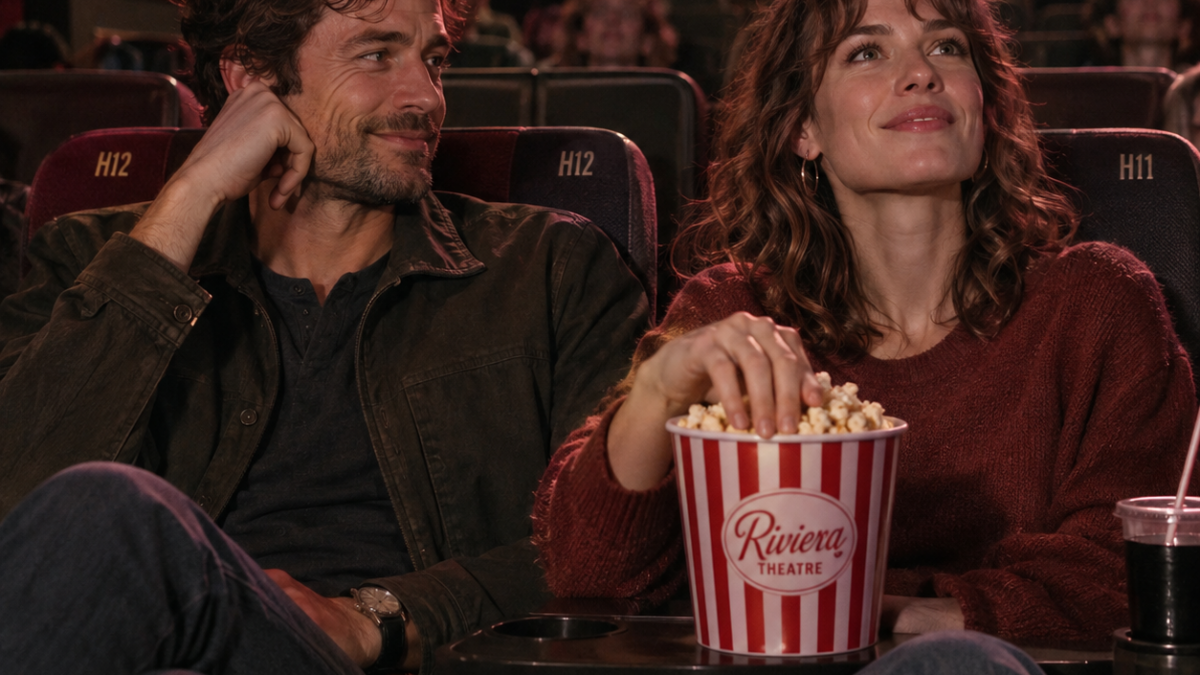
The beautiful woman in seat H11 had eaten half my popcorn before she even realized that the bucket belonged to me.
Every time something terrifying happened on the screen, her hand appeared in my bucket. And instead of stopping her, I quietly moved it closer.
I was thirty-nine, single, and apparently willing to surrender an entire large popcorn to a stranger with pretty eyes and a mischievous smile I could not ignore.
Then she spilled her soda, turned to find a napkin, and discovered a completely untouched bucket sitting on her other side.
She looked at mine, looked at hers, and went so red I could see it in the dark.
“Oh my god,” she whispered. “I’ve been eating your popcorn.”
I told her I was considering legal action. She laughed loudly enough to annoy the row ahead of us.
But the real surprise came after the movie, when she admitted she’d noticed me long before she sat down.
My name is Logan Mercer, and on that particular Saturday in Portland, Oregon, my romantic prospects were about as promising as a guitar with six broken strings.
I made custom acoustic guitars for a living, which meant I knew how to shape wood, judge tension, and repair tiny cracks other people couldn’t even see. None of those skills had been especially useful in dating.
I owned a modest workshop in Southeast Portland, drove a truck with sawdust in the floor mats, and could spend an hour discussing the difference between spruce and cedar without noticing my listener had stopped paying attention twenty minutes earlier.
My friend Eli liked to say I had the social instincts of a handsome filing cabinet. He called me handsome only because he wanted free guitar repairs. The filing cabinet part was probably fair.
Two years before that Saturday, my last serious relationship had ended. My girlfriend had wanted more travel, new possibilities, and a bigger life. I had wanted to stabilize my business before taking risks.
Neither of us was entirely wrong, but we spent so much time defending our positions that eventually there was no relationship left to defend.
Since then, I’d become very good at saying I was content alone. That was almost true.
What I missed were ordinary things: someone laughing in my kitchen, somebody asking how my day went, a hand reaching for mine without either of us needing a reason.
Eli had purchased two tickets for a horror movie at the Rosemont Cinema. At 6:15, he called and said his sister needed help carrying a sofa up three flights of stairs.
I asked whether this was an emergency. He said the sofa was stuck sideways in a landing and his sister was threatening to leave it there until Christmas.
I accused him of inventing a furniture crisis to avoid buying dinner. He promised photographic evidence, told me to use the extra ticket however I wanted, and announced that I should meet a woman at the movies.
“At a horror movie?” I asked. “What am I supposed to say? ‘Nice scream. Come here often?'”
“You make guitars, Logan. You can make a conversation.”
“Guitars don’t expect witty replies.”
“Neither do most people. Just go.”
I went.
The Rosemont was an old independent theater with a red neon marquee, dark green carpet, and a lobby that smelled of melted butter and nostalgia. Portland rain shone on the pavement outside.
Inside, a line curled around the concession counter. Ahead of me, an elderly man was trying to scan a ticket on his phone—holding it backward, then sideways, then much too close to the scanner.
The teenager at the counter looked one difficult customer away from quitting. I offered to help, turned up the screen brightness, and showed the man where to tap.
He thanked me three times.
When I bent to retrieve the ticket I’d dropped, I stood too quickly and knocked my shoulder against the counter. I apologized to the counter.
It was an automatic response, and I realized how absurd it sounded only when a woman behind me laughed.
She had chestnut hair that fell in loose waves around her shoulders, hazel eyes, and a dark green sweater beneath a black jacket. She was holding a paperback with a skull on the cover.
She didn’t laugh cruelly. Her expression was warm and mischievous, as if she had just seen something delightful.
“Did the counter accept your apology?” she asked.
“We’re negotiating,” I replied. “It was a misunderstanding.”
“You should probably get that in writing.”
I smiled. She laughed again. It was the sort of laugh that made me want to be funnier than I actually was.
I wanted to ask her name, but the cashier called me forward. Instead, I ordered a large popcorn and a soda.
When the cashier asked about butter, the woman behind me said, “Extra. Always extra.”
I told the cashier to follow the expert’s instructions. She gave me an approving nod.
I moved aside with my snacks and briefly considered waiting for her. Then I worried she’d think I was following her.
By the time I decided to introduce myself properly, another group had moved between us.
I went into theater four and located seat H12, feeling like a man who had just missed a very promising exit on the highway.
The Rosemont had wide reclining seats and narrow side trays. I put my popcorn on the tray to my left—between my chair and H11—and my soda in the cup holder on the right.
Previews were playing. I was trying to decide whether the theater would refund a ticket if I became genuinely frightened when someone stopped beside me.
“Excuse me, is that H11?”
I looked up and found the woman from concessions standing in the aisle with a large popcorn, a drink, a purse, and a jacket balanced in her arms.
She recognized me instantly.
“Oh, it’s the counter negotiator.”
“We reached an amicable settlement,” I said. “No further injuries.”
“Congratulations,” she smiled. “I’m Piper.”
“Logan. Nice to meet you, Logan. Can I squeeze past?”
I stood to let her through and nearly tipped my drink in the process.
“That seemed like an unfortunate omen.”
Piper was thirty-three, though I wouldn’t learn that until later. At the time, I knew only that she was beautiful, cheerful, and magnificently disorganized.
She found her seat, dropped her phone, caught it on one knee, and whispered, “Still got it.”
She tucked her purse underneath the chair, placed her large popcorn on the tray to her left, and draped her jacket over the armrest so that it partly covered the bucket.
Then she folded her ticket, put her phone away, and turned toward the screen with the determined expression of someone ready for an important sporting event.
“You a horror fan?” she asked.
“I’m more of a horror survivor. My friend picked this.”
“You might surprise yourself.”
“If I survive, I’ll count it as personal growth.”
“Good attitude. If there’s a creepy doll, I’m leaving, though.”
“Noted. I’ll alert the authorities.”
The lights dimmed. The movie was called The Guest in the Attic, which suggested to me that the owners needed a better inspection service.
On the screen, a young woman inherited an isolated farmhouse and immediately ignored every piece of reasonable advice she’d been given. Piper leaned forward, delighted.
Seven minutes in, while a character stood outside a locked bedroom listening to scratching noises, Piper reached toward her right and took a handful of my popcorn.
I saw the movement out of the corner of my eye. For a second, I assumed she had asked, or that I’d offered, or that some complicated social arrangement had been established while I was watching the farmhouse.
None of those things had happened. She simply ate the popcorn and kept staring at the screen.
I considered telling her she’d reached into the wrong bucket. Then she did it again.
The second handful was larger. This was puzzling. A person might take one piece accidentally. Two handfuls suggested either a startling degree of confidence or an innocent misunderstanding. I couldn’t decide which.
I looked at her, but her eyes never left the movie.
When the main character walked toward a dark basement, Piper whispered, “Don’t you dare.”
The character opened the door. Piper took more popcorn.
I tried to think of a graceful way to correct the mistake. “Excuse me, that’s mine” seemed possessive. “Would you like some?” seemed ridiculous considering she was already having some.
And if she was intentionally sharing the bucket as a flirtation, pointing out ownership might turn a sweet moment into a negotiation over corn.
I knew these were silly thoughts. Knowing didn’t make them go away.
The movie’s music rose. A pale face appeared in an upstairs window. Piper gasped and reached into the bucket again.
This time her hand knocked against my wrist. She whispered, “Sorry.”
I said it was fine. She smiled and immediately took another handful.
By then, I had eaten perhaps a dozen kernels. My beautiful neighbor was doing rather better.
Ten minutes later, I moved the bucket closer to myself so that I could reach the remaining popcorn. Piper’s hand searched the air in the wrong place, and she looked faintly confused.
I felt guilty—which was an absurd reaction to protecting my own snack. I moved the bucket back.
Her fingers found it. She whispered, “Thanks.”
And I experienced the very strange sensation of being praised for assisting in a theft.
I began enjoying the situation. There was no other explanation.
Every time a scary scene approached, I slid the bucket a little closer to her. She always found it.
A man on screen discovered muddy footprints leading into his bedroom, and she whispered that he needed to move immediately. I whispered that I’d leave the state.
She laughed softly, ate more popcorn, and settled into her chair. The whole thing felt like a private joke only one of us knew existed.
At forty-five minutes, a ghostly child appeared at the foot of a bed. Piper grabbed my forearm.
I jumped—not because of the ghost, but because her fingers were wrapped around my sleeve. She released me immediately, apologizing.
I said, “No harm done.”
She informed me she wasn’t frightened, merely dissatisfied with the director’s reliance on jump scares. I said her hand appeared to disagree.
She gave me an exaggerated look of offense, then reached into my popcorn to recover from the accusation. Several pieces spilled into my lap.
She leaned over, picked them from my jeans, and whispered, “Waste not, want not.”
I stared at the screen, fighting a laugh. Here was a woman whose name I’d learned less than an hour earlier, retrieving my popcorn from my pants with the confidence of a long-term girlfriend. I could barely remember what the ghost wanted.
The turning point came when Piper reached for her soda during a tense scene. Her fingers caught the rim. The cup tipped, and a cold splash landed across her jeans and the edge of her jacket.
She writhed with a muffled curse, then looked for napkins. I offered a packet of tissues from my jacket pocket.
She asked why a man carried tissues to a horror movie. I told her I believed in emergency preparedness and occasionally had to deal with glue at work.
She laughed, thanked me, and lifted the jacket she’d draped over her other armrest.
There was her popcorn: a completely full bucket sitting quietly on the left tray, as if it had been waiting all evening to testify.
Piper looked at it. Then she turned toward the half-empty bucket between our seats. Then she looked at me.
Even in the dim light from the screen, I watched the color climb into her cheeks.
“Logan,” she whispered slowly. “Whose popcorn is that?”
I glanced at the bucket.
“Well, the receipt says mine.”
Her eyes grew enormous.
“Oh my god, I’ve been eating your popcorn.”
The person in front of us turned around. Piper pressed a hand over her mouth, but her horror was now directed entirely at herself.
“I thought I put mine on this side,” she whispered.
“A reasonable mistake,” I said. “The room is dark. The evidence was concealed.”
“Why didn’t you tell me?”
I made my expression solemn.
“I was considering suing you for stealing my dinner. I needed enough evidence to establish a pattern.”
She stared at me, then burst into laughter so sudden and loud that three heads turned toward us. A man in the next row hissed.
“Shh,” I murmured.
“Sorry. Legal emergency.”
Which made her laugh harder.
She bent forward with both hands over her face, shoulders shaking, while I tried and failed to maintain judicial dignity.
“I’m so sorry,” she finally managed. “I have my own whole bucket, which raises difficult questions about motive.”
“Logan, I might be persuaded to settle out of court. What do you want?”
I looked at her and surprised myself by telling the truth.
“Honestly? You were having fun. I didn’t want to embarrass you.”
She stopped laughing. For a moment, the only sound was the movie’s ominous music.
“You let me keep eating because I looked happy?”
“That—and an unreasonable fear of awkward conversations.”
Her smile softened.
“That’s a very sweet answer. Please don’t tell Eli. He already thinks I’m hopeless.”
“Who’s Eli?”
“The friend who canceled on me tonight. He saved me from this movie and unknowingly delivered me into a robbery.”
She laughed again, quietly this time.
When a door slammed on screen, she startled and caught my hand. Neither of us moved.
She glanced at our fingers and raised one eyebrow.
“Do I need permission for this, too?”
“No,” I said, gently turning my hand in hers. “This part is complimentary.”
We watched the rest of the film holding hands. Piper still ate my popcorn, but now she asked first, making a grand ceremony of every handful. I told her the judge had approved shared custody.
The story on screen grew more ridiculous, and our whispered commentary became better than the movie itself.
When the final ghost was revealed, she leaned toward me and complained that the clue had been obvious. I said I’d missed most of the clues while conducting my investigation.
She grinned and squeezed my fingers.
When the credits rolled, we were among the last to stand. Piper uncovered her own untouched bucket, held it out to me, and declared it restitution.
I protested that I had already enjoyed more entertainment than the admission price justified. She informed me that financial compensation and emotional damages were separate categories.
I accepted the bucket—partly because she insisted, and partly because it was nice to have a reason to remain beside her.
In the lobby, we stood beneath a poster for an upcoming romantic comedy. A crowd passed around us, laughing about the horror film’s ending.
Piper glanced at the door and seemed about to say goodbye. I knew I would regret letting her leave without asking to see her again.
I cleared my throat and asked whether she’d like to get coffee.
She looked relieved rather than surprised.
“Actually,” she said, “I was hoping you’d ask. I owe you an explanation about the popcorn.”
“The jury has already reached a verdict.”
“Not about the popcorn. About why I was smiling at you in line.”
I tried not to look too pleased. “You remember that?”
“Of course I do. You helped an older man with his ticket, apologized to a counter, and looked like you’d rather be swallowed by the floor than ask me a question. I thought you were adorable.”
“My finest moment.”
“I nearly said something after you bought your snacks, but you disappeared. Then I found out you were sitting next to me. I was excited.”
She tilted her head.
“For the record, the popcorn mistake was completely accidental. I was not attempting an elaborate seduction using corn.”
“That’s a shame. It was working.”
Piper laughed, then looked at me long enough for the joke to settle into something gentler.
“Was it?”
“Yes,” I said. “But you didn’t need the popcorn.”
We walked out beneath the marquee. The evening rain had eased to a drizzle, and reflections of red neon stretched across the sidewalk.
Piper told me she’d arrived alone because she’d worked for eleven straight days on a book cover and needed two hours in which the most important decision was whether the monster lived in the attic or under the stairs.
She designed book jackets for independent publishers and occasionally larger houses, primarily mysteries and horror novels. She loved the work, but she found revisions exhausting when an editor said something like, “Make it haunting but more cheerful.”
“You make book covers?” I asked. “That’s a pretty incredible job.”
“I make people judge books by their covers professionally.”
“I make guitars so people can make noises their neighbors complain about.”
She laughed.
“Actually make them? From wood? With tools?”
“No wizardry involved.”
“That’s what a wizard would say.”
I described my workshop while we walked toward a late-night café. She asked questions about how guitar bodies were shaped and whether different wood really changed the sound.
I asked how a designer knew which image would make someone pick up a novel.
Her answer was surprisingly close to mine: she wanted the first impression to promise something the finished work could honestly deliver.
I liked that she cared about the relationship between appearance and substance. She liked that I understood the question.
At the café, we ordered coffee and hot chocolate, sat beside a window, and discovered we could talk for two hours without exhausting the subjects.
Piper told me she had thirty-seven monster figurines. I told her I had more clamps than any sane person needed. She said she was sure we’d both be considered highly desirable at a very specialized convention.
I asked whether she’d ever tried miniature golf. She announced that she was an excellent competitor and refused to clarify whether that meant she was good at playing.
She also admitted she was tired of dates where she felt required to perform a carefully edited version of herself. A former boyfriend had called her laugh too loud and her interests childish.
I told her that sounded like a man who hadn’t discovered joy.
The expression on her face changed, as if my casual remark had reached a place I hadn’t meant to touch. She thanked me, and I realized I wanted very badly to hear that laugh again.
When the café began closing, Piper checked the movie listings on her phone.
“I have a proposal,” she said. “I’m buying two tickets for next Saturday. Same seats.”
“You don’t have to buy my ticket.”
“I know. I’m doing it because I want to.”
She handed me the phone. I selected a perfectly terrible first date: a romantic comedy about a baker whose plans always collapsed in public.
Piper gave me an amused look, purchased the two seats, and showed me the confirmation.
“H11 and H12 again.”
“So,” I asked, “is this an apology or a date?”
Piper slipped her phone into her jacket.
“Depends on whether you’re willing to share your popcorn with your future girlfriend.”
There it was—an invitation dressed up as a joke, but with a small, real risk beneath it.
I reached for her hand.
“I agree. But this time, I get to pick the movie.”
“Deal,” she said, squeezing my fingers. “As long as you still sit next to me.”
I drove home in a state of disbelief.
Eli answered my call after the fourth ring, sounding sleepy and suspicious. I told him I’d met someone.
He asked whether she was real. I said she was very real and had robbed me of approximately twelve dollars in popcorn.
By the time I finished explaining, he was laughing so hard I heard his wife ask what was wrong.
He told her, “The couch saved Logan’s love life.”
I told him never to repeat that sentence to anyone. He promised to repeat it at my wedding.
The next week was a pleasant kind of chaos.
Piper texted me a picture of a horror cover with a ghost visible only in the reflection of a spoon. I sent her a photograph of a partly finished guitar, and she named it Sir Splinters.
She asked whether I could survive a haunted house if she held my hand. I replied that I’d make it outside faster than anyone she’d ever met.
She said speed was attractive, but loyalty mattered more. I told her I’d come back for her—provided she hadn’t stopped to eat the haunted popcorn.
Her answer contained a heart emoji, which I examined with the serious attention I normally reserved for costly tonewood.
We didn’t talk every hour. She had deadlines. I had customers. But when my phone lit up, I felt something lift inside me.
On Wednesday, she called after a frustrating client meeting and told me about a publisher who wanted a horror cover to look a little less frightening.
I suggested a smiling ghost wearing a cardigan. She laughed and said I should be her creative director. I told her I’d require payment in tacos. She said that seemed negotiable.
Saturday came. I changed shirts twice and arrived early, convinced I would somehow manage to ruin a promising second date.
Piper stood beneath the marquee wearing a burgundy dress under her dark coat, her hair pinned loosely behind one ear. She saw me, grinned, and walked directly into a hug.
I held her for a moment, feeling the cool evening air and the warmth of her cheek against my shoulder.
Then she stepped back and looked at me critically.
“You smell nice,” she said.
“That’s either a compliment or the beginning of a strange medical question.”
“Compliment. Definitely.”
At concessions, she ordered one large popcorn. I pretended to be surprised.
She explained that we were entering an era of intentional sharing and reasonable portion control. We both knew the second part was unlikely.
In our seats, she placed the bucket between us and offered a solemn handshake to establish joint ownership.
I shook her hand, but when she tried to withdraw it, I held on. She looked at me and smiled without making a joke. I liked that silence more than I expected.
The romantic comedy was silly and unexpectedly charming. Piper whispered criticism of the heroine’s improbable apartment and laughed when the baker tripped over a tray of cupcakes.
At one point, the hero tried to impress his date by making a speech in a crowded restaurant, only to discover the microphone had never been turned on.
Piper leaned toward me and said, “Please don’t ever do that.”
I promised any declaration from me would be conducted at a normal speaking volume and without amplification.
Afterward, we ate tacos at a food cart pod where strings of lights swayed gently over the tables.
She told me about her younger brother’s disastrous attempts to set her up with strangers. I told her about my last relationship—how I’d grown so cautious about the future that I’d stopped discussing one.
The conversation could have become heavy, but Piper listened without trying to repair me.
She asked whether I was happy with the person I was now. I thought about it before answering.
I liked my work, my friends, and my home, but I was trying to become someone who took more personal risks.
“How’s that going?” she asked.
“I came to a horror movie alone and let a stranger empty my popcorn. That’s practically extreme sports for me.”
She smiled, but there was no mockery in it.
“You didn’t have to let me.”
“I know. And you don’t have to keep seeing me just because I offered compensation.”
“I know that, too.”
“Good.”
Her eyes met mine.
“Because I’d like to see you again. Not as repayment.”
I put my hand on the table, palm up. She took it.
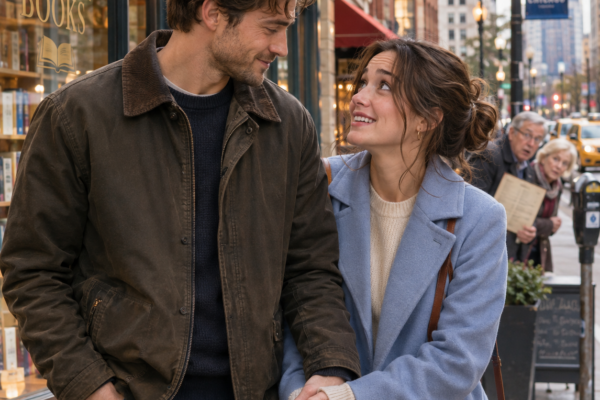
When we left, we wandered beneath the awnings of closed shops while the rain began again. In front of a bookstore window, she stopped and showed me a novel whose cover she’d designed.
I recognized the bold blue lettering and an almost invisible face reflected in a black window. I told her it was clever.
She looked pleased, then admitted it had taken five revisions to convince the publisher to preserve that detail.
At her car, neither of us wanted to say goodbye. I could tell because we’d already exchanged three good nights and were still standing there.
I asked whether I could kiss her.
Piper smiled and said, “I was about to ask whether you plan to keep making me wait.”
Our first kiss tasted faintly of cinnamon gum and the cold evening air. It was gentle, then a little less tentative when she reached for my jacket.
When we finally separated, she said that was worth every stolen kernel. I told her the lawsuit was officially dismissed.
Over the following month, we built an ordinary collection of extraordinary memories.
Piper lost two rounds of miniature golf and blamed a windmill for sabotage. I sat through a horror double feature and discovered that I could survive almost any jump scare if she was holding my hand.
We cooked pasta in my apartment, where she accidentally added enough red pepper to make us both cry. We walked through Powell’s Books on a rainy Sunday, comparing the most dramatic titles we could find.
She met Eli, who introduced himself as the man responsible for the sofa emergency. She thanked him with such solemnity that he nearly believed she’d brought him a medal.
The part I hadn’t expected was how naturally she fit into the quieter corners of my life.
She could work at my kitchen table while I read a repair manual, both of us content with occasional remarks. She didn’t mind when I needed an early morning in the workshop. I didn’t mind when she canceled a casual coffee to finish a cover.
We were both people who had built lives before meeting. It mattered to me that neither of us had to abandon those lives to make room for the other.
One afternoon, I invited her to Mercer Stringworks. I wanted to show her something I’d been building, though I was strangely nervous about revealing my workplace. It was more personal than my apartment.
The shop held mistakes I’d corrected, debts I’d paid, and projects that had kept me awake worrying.
Piper walked in, breathed the scent of wood shavings, and went still.
“This is beautiful,” she said.
I laughed. “It’s a shop.”
“It’s your shop.”
She walked toward a row of finished instruments and studied the careful curves.
“You made all of these?”
“Most of them.”
She gave me a look. “I think I’m going to need you to stop saying ‘most’ when you’re being modest.”
I showed her the braces inside an unfinished guitar and explained how wood grain could influence sound. She asked whether a tiny cosmetic imperfection made a piece unusable.
I told her some customers cared, but sometimes a beautifully unusual grain was the reason I’d selected it in the first place.
That idea made her thoughtful. She photographed a curved offcut of walnut, then asked whether she might borrow it for a cover composition. I told her to take it, provided she didn’t give it a monster’s name.
In the corner stood an old guitar with a cracked bridge and a dark stain near the sound hole. Piper stopped beside it.
I explained that it belonged to a teenager named Emma. Her father had played it to her when she was little, and after his death, she’d found it damaged in storage.
The repair wasn’t financially worthwhile, but the guitar meant something to her.
Piper didn’t make a dramatic speech. She gently touched the worn case and asked when Emma would get it back.
I told her next week, if the final adjustment held. She asked whether she could be there. I said, “Of course.”
Emma came with her mother the following Friday. She was a shy sixteen-year-old who kept twisting the strap of her backpack while I opened the case.
I’d replaced the bridge, straightened the neck, and cleaned the old finish without erasing the scratches that made the instrument recognizable.
I handed it to her and asked her to try a chord. The sound was warm and clear.
She played another, then a short melody. Her mother wiped her eyes.
Emma looked down at the guitar, smiled, and whispered that it sounded like her dad again. I had no answer for that. I simply told her to keep playing.
Piper stood near the door, giving them room. After they left, she slipped her hand into mine and said, “That’s why the little details matter, isn’t it?”
I nodded. She didn’t ask how much I’d charged. She already understood.
That evening, we returned to the Rosemont for a special screening. Near the entrance, a handwritten sign announced a community benefit to replace the theater’s aging projector.
The equipment had begun failing during shows, and the owners were trying to raise enough money for repairs without cutting staff or closing the second screen.
Piper stopped to read the sign. She loved that old theater with the fierce loyalty some people reserved for their hometown. I loved it, too, now for reasons that extended far beyond films.
The theater manager, Sadi, recognized Piper as the woman who always attended horror nights. Piper asked whether they needed help with the benefit.
Sadi explained that local artists were donating prints and small pieces for a silent auction. Piper immediately offered to design a poster.
Then she looked at me and asked, with one of those hopeful expressions that made me suspicious, whether I’d consider donating a guitar.
I had an unfinished travel guitar in the workshop, but finishing it would take time I hadn’t budgeted. I told Sadi I’d check my schedule before promising.
Piper accepted that answer without pushing. On the way out, she said she’d understand either way. I appreciated that, perhaps more than she knew.
Monday morning, I looked at my order calendar. There were three repairs due by Thursday and a custom instrument promised at the end of the month.
I could fit the travel guitar in if I worked several evenings. It wouldn’t be easy, but it was possible.
I called Sadi and committed to the donation. When I told Piper, she kissed me so enthusiastically I nearly dropped my phone.
She was already planning a poster with an old cinema seat, a beam of light, and a tiny piece of popcorn hidden in one corner.
“That’s our private signature,” she said.
I told her if anyone discovered it, she would have to explain her criminal history.
For the next two weeks, our relationship became a collaboration. Piper photographed my hands carving the guitar’s small decorative rosette. I watched her experiment with light and shadows for the poster.
She could turn an ordinary tray of popcorn into something magical by placing it beside a red velvet seat and catching a thin reflection of projector light.
She was funny when she worked, but she was also disciplined. She rejected her own first three layouts without complaint, studied the print samples, and negotiated a discount with the printer.
I admired how well she handled people. I admired that she asked my opinion and didn’t pretend to agree when she thought I was wrong.
Then my schedule tightened. A paying customer’s instrument arrived with a damaged neck two days before he needed it for a concert. I promised I’d do what I could, though I couldn’t guarantee a repair.
The work took longer than expected.
On Thursday, Piper was waiting for me to help collect the fundraiser posters from the print shop. I lost track of time and sent a hurried message fifteen minutes after we were supposed to meet.
She had already carried the boxes to her car herself.
When I called, she sounded calm—which was somehow worse than anger. She said the posters were fine and she was heading home.
I apologized and explained about the guitar. She said she understood the emergency, but she wished I’d told her earlier so she could make another plan.
I felt defensive. I’d been trying to keep my customer happy, honor the donation, and still see her.
“I thought you’d be okay handling the boxes,” I said.
There was a pause.
“I was okay,” she said. “That’s not what I’m talking about.”
I stopped moving. The workshop clock ticked above my head.
She continued, “I don’t need you to rescue me from cardboard boxes, Logan. I need to know when plans change. I can be flexible, but I can’t make decisions with information you haven’t given me.”
She was right. Worse, I recognized the habit. When work grew complicated, I disappeared into it and assumed the people around me would adapt. It was one of the reasons my previous relationship had struggled.
I had told myself I was being responsible, but responsibility also meant being honest about what I could and couldn’t do.
“I should have called before I started the repair,” I said. “You’re right. I’m sorry.”
“Thank you.” Her voice softened. “I know you care about your work. That’s one of the things I like about you. But I care about mine, too. And I care about us.”
“So do I,” I said, more firmly than I’d expected. “Can we have dinner tomorrow? I’ll make a real plan, and if something changes, you’ll hear it from me before the deadline.”
She laughed quietly. “A plan from you? That’s very romantic. It’s almost scandalous. Tomorrow sounds good.”
I completed the customer’s repair the next morning and called him with a realistic pickup time. Then I moved two optional jobs to the following week rather than promising impossible hours.
It was not a grand sacrifice. It was a correction to a poor schedule. I wanted Piper to see that I’d heard her.
That evening, I met her when I said I would, carrying takeout from her favorite Thai place. She greeted me with a smile and a kiss.
We talked through the fundraiser jobs, assigned ourselves manageable tasks, and agreed that either of us could say no to additional favors.
The relief I felt surprised me. Apparently, honesty wasn’t quite as dangerous as I’d imagined.
The benefit took place on a rainy Saturday. Sadi had decorated the Rosemont lobby with film reels, old posters, and little cards describing each donated item.
Piper’s design stood near the entrance: a glowing empty theater with a single bucket of popcorn between two seats. It made the familiar room feel both lonely and full of possibility.
I watched people stop to study it. One woman bought three prints. A teenager asked whether Piper had made the artwork herself. She smiled and explained her process without pretending it had been effortless.
Seeing her proud of her work made me prouder than I could explain.
My guitar sat in a glass-fronted display case near the silent auction table. I’d finished it with a warm walnut back and a subtle inlay shaped like a curling strip of film.
The bid sheet was already half full when Eli arrived, wearing a jacket he usually reserved for weddings. He examined the instrument and announced that I should have charged admission to watch him pretend to understand craftsmanship.
Then he saw Piper’s poster and whispered, “You two really did make something together.”
I looked across the lobby, where Piper was laughing with Sadi, and realized how true that was.
During the event, the projector failed briefly in the middle of a restored comedy screening. The audience groaned.
Sadi hurried toward the booth. Then someone began clapping in encouragement, and others joined in.
Piper stood beside me, fingers tight around mine. I leaned close and said, “Well, the fundraising message is certainly clear.”
She laughed despite her worry.
The picture returned a few minutes later, and the crowd cheered. The delay became part of the evening’s charm rather than its disaster.
By the end of the benefit, Sadi had raised a substantial portion of the repair cost. The owners still needed to cover the balance, but the donations had given them a realistic path forward.
My travel guitar went to a woman who planned to give it to her husband for their anniversary. Piper’s poster had sold out.
We helped fold chairs and stack boxes while the volunteers traded stories. Nothing about the night was glamorous, but it was deeply satisfying. We had contributed what we actually knew how to give, and people had responded.
After the last box was moved, Piper and I slipped into the empty theater. Sadi had given us permission to sit for a few minutes before closing.
The screen was blank. The aisle lights cast small pools of gold across the carpet. We found H11 and H12 by habit and sat down.
For the first time, there was no popcorn between us.
“This feels strange,” Piper said. “No movie, no bucket.”
I laughed. “Our relationship is clearly in crisis.”
She rested her head against my shoulder.
“You know, when we met, I didn’t expect any of this. The fundraiser, you, me—all of it.”
She sat up and looked at me.
“I thought you were cute at concessions. I thought maybe we’d flirt a little during the movie. Instead, I humiliated myself, and you made it feel like the funniest thing in the world.”
“It was the funniest thing in the world.”
“Logan.”
“Sorry. Continue.”
She smiled.
“You were patient with me before you knew me. And since then, you keep showing up in ways that matter. I like that we’re both a little ridiculous. I also like that when something goes wrong, we can say so and fix it.”
I took her hand.
“I didn’t know whether I was ready for another relationship. When I walked in here, I was afraid of making the same mistakes. But I don’t want fear making my decisions anymore.”
I paused, not because I lacked words, but because I wanted the next ones to be right.
“Piper, I love you. I love who you are when you’re laughing at a bad movie, and who you are when you’re working hard and telling me the truth I need to hear.”
Her eyes grew bright. She didn’t hide behind a joke this time.
“I love you, too, Logan. And I want to keep choosing this, even on the difficult days.”
I kissed her. It was slow and unhurried, and when we separated, she kept her hand against my cheek.
For a long moment, we sat together without speaking. The empty theater, the low lights, the faint smell of popcorn from the lobby—everything brought me back to the night she’d first reached into my bucket.
That accident had opened a door, but we were the ones who had chosen to walk through it.
On our next anniversary of that Saturday, we came back for a movie. By then, the projector had been replaced. The Rosemont was thriving, and Piper had two more beautiful covers in bookstores.
I still made guitars, still got sawdust on my jeans, and still sometimes needed a reminder not to overpromise. She still loved horror, still lost things in her enormous purse, and still laughed with her whole heart.
We weren’t perfect, but we were very good at finding each other after an ordinary hard day.
I bought one large popcorn with extra butter. When Piper reached for it, she stopped theatrically and asked, “Excuse me, sir. May I have some of your dinner?”
I looked at her and replied that the court had granted her permanent sharing rights.
She grinned, took a handful, and leaned close enough to kiss me.
The lights dimmed. A threatening noise came from the movie’s haunted house. Piper startled and reached toward the bucket, and I slid it closer without thinking.
She noticed. She always noticed now.
“You still do that?” she whispered.
“Do what?”
“Make sure I can reach it when I’m scared.”
I smiled. “Some habits are worth keeping.”
She tucked her hand into mine.
“Good. Because I plan on eating your popcorn for a very long time.”
“I’m counting on it.”
I used to think love would arrive only after I had my work perfectly balanced, my past neatly resolved, and the right words ready at exactly the right moment.
Instead, it arrived with a misplaced bucket, an embarrassing laugh, and a woman who was brave enough to ask for another date.
I didn’t need a flawless beginning. I needed someone whose happiness mattered to me, and someone who cared enough to tell me the truth.
Sometimes the best surprise isn’t the one on the movie screen. It’s the person who takes the seat beside you and makes you want to stay.