A Beautiful Woman Grabbed My Hand on a Busy Street… Then Whispered, “Just Play Along!”
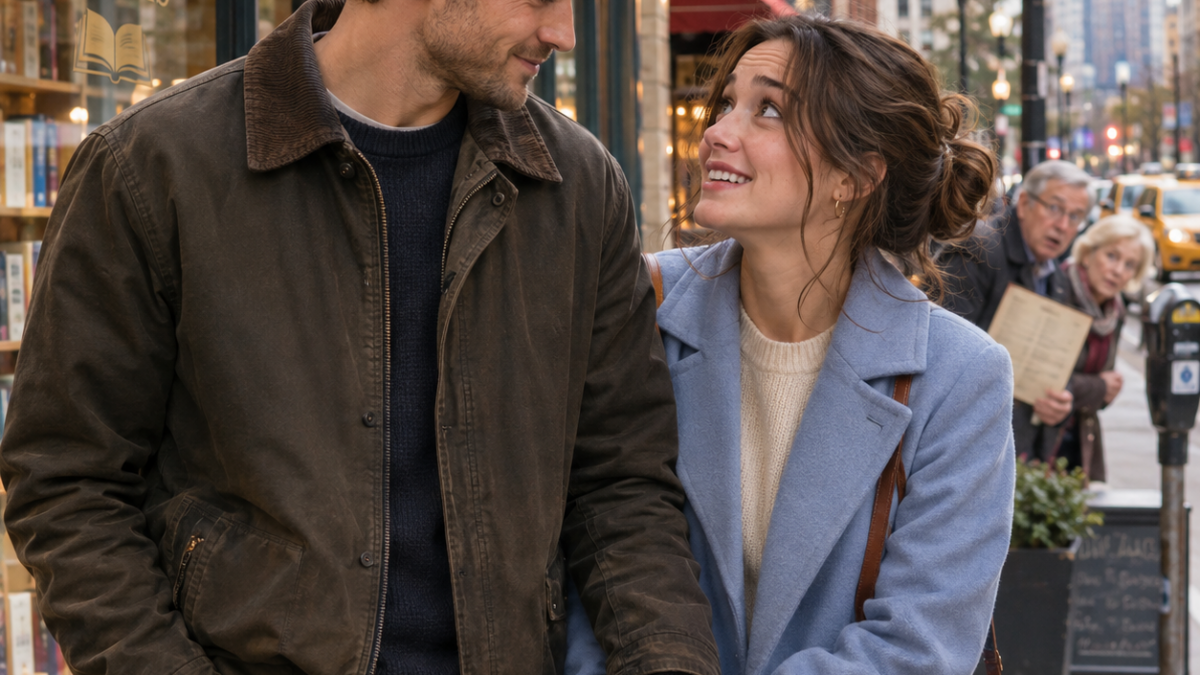
A Beautiful Woman Grabbed My Hand on a Busy Street… Then Whispered, “Just Play Along!”
A beautiful stranger grabbed my hand on a crowded Chicago sidewalk.
– Just play along, she whispered, lacing her fingers through mine.
She nodded toward a couple studying a menu across the street.
– Those are my parents. I told them I had a date. Now they’re following me.
The woman in the red scarf peered over the menu, while the man beside her ducked behind a parking meter that was half his width. I should have wished this stranger luck and continued to the hardware store; instead, I squeezed her hand and answered.
– Then we’d better make this look convincing.
Her relieved smile lasted exactly three seconds until her mother spotted us and began marching across the crosswalk.
– Oh, wonderful, the woman whispered. They’re coming over.
Before learning her name, I was meeting her parents—and what I didn’t know was that the lie would last only one afternoon, while the hand I was holding would change my life. Before I tell you how a stranger became someone I couldn’t imagine letting go of, like this video, subscribe, and tell me: would you have played along if someone asked you on a crowded street?
At 30, I thought I had a reasonable understanding of the risks involved in walking through downtown Chicago on a Saturday, yet being recruited as a stranger’s imaginary boyfriend wasn’t on the list. My name is Noah Bennett, and I restore old furniture for a living; I was carrying a small paper bag of brass cabinet handles when she intercepted me outside a bookstore on State Street—at least the bag made me look like I had somewhere to be.
– Your name, she hissed, smiling in the direction of the approaching couple. Please tell me your name.
– Noah.
– I’m Leah. If they ask, we’ve been seeing each other a few weeks.
– That’s ambitious. I learned your name four seconds ago.
– Two weeks, she amended desperately. And please don’t mention the furniture store bag.
– It’s a hardware store bag.
– That’s worse. They’ll think we’re moving in together.
She gave me a look that somehow combined terror and amusement, wearing a light blue coat over a cream sweater with dark hair slipping loose from a messy knot. I noticed that she held my hand firmly yet not carelessly—she’d taken a chance on me because she needed help, and she was prepared to let go if I pulled away, though I didn’t.
Her parents had reached the curb by then, the mother with an expression of practiced innocence and the father holding a folded city map that was at least 15 years out of date.
– Leah! her mother exclaimed. What an extraordinary coincidence.
– Mom, Leah said in the voice of someone greeting a tax auditor. Dad, what are you doing downtown?
– We thought we’d walk, her father said.
– From Evanston?
– The train helped, he admitted.
Her mother turned to me with a bright, appraising smile.
– And who’s this?
Feeling Leah’s fingers tense, I skipped inventing an absurd name or fake yacht and gave the one truthful answer available.
– I’m Noah. It’s nice to meet you.
– Denise Sullivan, her mother said, shaking my free hand. This is my husband, Curtis. Leah didn’t tell us much about you.
– I haven’t given her much reason to, I said. I’d rather show up on time than give a speech about myself.
Curtis chuckled, Denise’s smile widened, and beside me Leah looked as though she’d just watched me pass a test no one had explained—until Denise noticed our joined hands.
– How lovely. Are you two on a date?
– We’re spending the afternoon together, I said, which remained technically true.
– Where are you going? Denise asked.
Leah opened her mouth with no answer ready, still looking around as if the street might provide one, so I nodded toward a little cafe on the corner.
– We were deciding whether to get coffee first or find something to eat.
– Oh, we haven’t had lunch, Curtis said. Have we, Denise?
– No, we haven’t, she replied with the speed of a woman who had been waiting years for this opening.
Leah stared at them.
– You just happened to be hungry right here?
– Chicago is a city of surprises, Curtis said, folding his upside-down map.
I leaned toward Leah.
– We can tell them we have reservations.
– We don’t, she whispered.
– Good, I murmured. I’m a terrible liar.
Making a tiny, helpless sound that might have been a laugh, she stood beside me as I turned back to her parents.
– You’re welcome to join us for coffee. Just coffee, though—I’ve promised Leah the rest of the afternoon.
I had promised no such thing, yet the way her shoulders relaxed told me it was the right offer. Crossing to the cafe together, I spent the next 20 minutes learning that Curtis had spent 30 years teaching high school history, Denise had once managed a neighborhood community center, and neither of them knew how to pretend they hadn’t followed their daughter.
Denise asked gentle questions somehow more alarming than direct interrogation—whether I had siblings, enjoyed cooking, or had steady work—while Curtis asked whether a person could repair a chair without replacing the original wood, the first question all morning I could answer with real enthusiasm. Explaining how I repaired joints and preserved the marks that made a piece worth keeping, I watched Curtis listen and nod.
– So you don’t give up on something just because it has a few scratches, he said.
– Dad, Leah warned.
– I’m talking about chairs.
– Of course you are.
By the time coffee arrived, Leah had begun smiling for real—not the polished, anxious smile from the sidewalk, but one that reached her eyes—teasing Curtis about his map and warning Denise not to ask whether I wanted children before dessert, nearly making me choke on my coffee.
– I wasn’t going to ask that! Denise looked scandalized.
– You brought me a baby-name book last Sunday, Leah replied.
– It was a novel.
– It had 40 pages of names in the back.
– It was a very informative novel.
I laughed, earning a warning glance from Leah that didn’t seem especially serious, and when the bill came I picked up my share while Curtis insisted on buying coffee for everyone. When Denise tried to invite us to Sunday dinner, neither Leah nor I agreed—I told her we already had plans, then gently clarified “for our own Sunday,” catching Denise by surprise enough to make her stop pressing for the moment.
Outside, her parents hugged their daughter, waved to me, and walked toward the train until they disappeared around the corner—at which point Leah released my hand like she’d suddenly remembered the laws of physics.
– Oh, my gosh, I’m so sorry.
– It’s all right.
– No, you were shopping for cabinet handles, and I made you sit through an interview with the Sullivan family.
– Honestly, your dad’s questions about wood glue were excellent.
Pressing her fingers against her forehead, she admitted she couldn’t believe she had done that—not out of fear of them exactly, yet out of dread for another conversation where every answer about her life turned into a question about when she was getting married. Offering the paper bag I’d somehow managed not to lose, I reminded her I did have a solid answer about cabinet handles, drawing a full, surprised laugh that turned heads on the sidewalk.
– I owe you coffee that doesn’t include my parents, she said.
– You don’t owe me anything, but I’d be happy to have that coffee.
Her smile softened.
– You realize I don’t even know if you’re single.
– I am.
– Good. I mean, not good for you—just good for avoiding further complications.
– Leah, do you want to have coffee with me on Tuesday? A real invitation, no disguises and no audience.
Looking at me for a long second, she agreed—after taking a deep breath to tell me the truth first. She had lied to her parents because she had an appointment to look at a space for a studio she was trying to open, knowing they thought she worked too hard and always pushed her to focus on finding someone to share her life with instead.
– That’s a lot for one afternoon, I said.
– Tell me about it. I told them I had a date because I knew it was the one excuse they wouldn’t argue with.
– And then they followed you.
– Apparently, they’re terrible spies.
– Spectacularly bad, I said. But maybe you should tell them we weren’t actually dating.
– I will. I don’t want to keep using you as a shield.
– Good, because I prefer being invited to things for real.
We traded numbers, and she typed my name into her phone before holding up the screen with a grin—”Noah (not a professional boyfriend)”—while I told her my rate was too high for the profession anyway and she answered that she might be able to afford a coffee.
On Tuesday evening, I arrived 10 minutes early at a coffee shop in Lincoln Square—something I hadn’t done in years, which my best friend and shop partner Owen claimed proved I’d lost my senses.
– She grabbed your hand without knowing your name, Owen had said, and you willingly met her parents for coffee? You’re 30, not 15. People normally wait until a fifth date to be interrogated about children.
– They didn’t ask.
– That’s what you think.
When Leah arrived in a green cardigan with her hair down, pausing in the doorway to search the tables until her face lit up at seeing me, I forgot Owen’s warning entirely.
– I’m glad you’re real, she said as she came over. I kept thinking I’d made you up because I panicked.
– Technically, you made up our entire relationship.
– Fair point.
Sitting opposite me, she set a small envelope between us containing two tickets to an outdoor fall market with handmade goods, food stalls, and live music.
– Saturday, she said. A thank-you, not another assignment. You can say no.
– Are your parents coming?
– I checked. They’re visiting my aunt.
– Then yes. But this coffee is a date if that’s what you want.
Rubbing her thumb over the corner of the envelope, she admitted she’d like it to be, and we talked until the barista flipped the chairs onto the empty tables around us. At 26, Leah had spent five years designing workshops for a larger arts organization, loving teaching people to make things with their hands while growing tired of proposals that treated students like numbers on a spreadsheet—so she and her friend Sasha had found a narrow storefront for an adult art studio called Open Door, offering drawing, ceramics, and printmaking, and were negotiating the lease faster than expected.
– What does your family think? I asked.
– My dad says business is risky. Mom says I deserve a husband who’ll give me security. They both mean well, but sometimes I feel like I’m handing them the steering wheel.
– Have you told them that?
– Not without getting emotional.
– Getting emotional isn’t the same as being wrong.
Looking down into her cup and back up, she remarked that was a surprisingly useful thing for a cabinetmaker to say—and on the walk to the train, I told her about running Bennett and Birch with Owen, restoring furniture others had given up on, including the first rocking chair I rebuilt for an elderly woman whose husband had survived a house fire. Reaching her platform, she said she’d like to see my shop someday with just Owen there to impress, stepping onto her train with a small wave while I held back from reaching out—wanting the next time our hands met to be chosen by both of us.
Saturday at the market, Leah discovered my embarrassing fascination with handmade pottery as I examined bowls for balance, rim angle, and foot finish at a stall of mismatched mugs.
– You know other people just decide whether they like the blue one, she said.
– I like the blue one, I replied.
– You’ve been holding it for seven minutes.
– I’m building a relationship with it.
– Try asking it what it wants out of life.
– I already know—a nice shelf and occasional coffee.
Buying the mug and handing it to her, I ordered her to stop analyzing it—only for her to buy me a star-shaped spoon rest she’d admired, warming my cheeks when I realized she’d noticed. Stopping by an apple cider stand to listen to a street musician, she shared how her mother used to take her to fall markets and secretly slip ugly painted rocks into her purse after saying they had no room—showing a generosity that made her mother’s insistence on marriage feel even more complicated.
When I told her my own mother had died when I was 23 and my dad up in Wisconsin considered my shop a miracle simply because I still had all my fingers, Leah stopped walking to say how sorry she was and rested a quiet hand on my forearm.
– I shouldn’t complain about mine so much, she murmured.
– You can love your parents and need room from them, Leah. Both things can be true.
Nodding slowly, she wished someone had told her that a year ago. At a block-printing booth, I watched her shift from playful to focused as she asked about water-based inks and helped a beginner align and print a block—showing me why Open Door mattered so much to her, especially when she explained she wanted wider worktables so every student, including wheelchair users, could reach tools and move comfortably.
Offering to show her adjustable bench designs Owen and I had built for a community center—which she declared the second most romantic thing a man had ever said to her after carrying groceries upstairs—we agreed by the river to inspect her space Wednesday at a fair professional rate so kindness would never turn into debt. Just then her phone rang with “Mom” flashing on the screen, and with hands full of cider and market bags, she answered on speaker.
– Darling, how are you? Your father found a wonderful little restaurant for next Friday. I was thinking the four of us could go—casual dinner, no pressure.
– Mom, the words “no pressure” usually mean there’s pressure. Noah and I are getting to know each other. Please don’t start planning family holidays around us.
– You’re with him right now?
– Yes, Leah said, meeting my eyes. Because I want to be.
Those words landed more warmly than any elaborate compliment could have, and after hanging up with a sigh, she admitted she still hadn’t told her parents the full truth—wanting them to understand that whatever grew between us was her choice rather than the result of them following her.
– Then tell them exactly that, I said. It sounds like a pretty good sentence.
– Would you come with me when I do? she asked, slipping her phone into her bag.
– If you want me there—but I’ll let you do the talking.
She declared that had just beaten carrying groceries by a narrow margin, and as we walked beside the river in the orange afternoon light, she reached for my hand at a crossing without glancing around for her parents.
Wednesday evening, I arrived at the former florist shop she and Sasha were considering—large dusty windows with a faded floral outline on the sign, scuffed floors, and a back room smelling faintly of old potting soil, yet to Leah a kingdom waiting to open. Sasha, sharp-eyed with a yellow measuring tape around her neck, sized me up as “the sidewalk guy” before handing over a rough floor plan, where I measured doorways, checked uneven floors, and suggested lockable wheeled tables while shifting cardboard cutouts around with Leah—until Sasha teased that we looked like a couple planning a house together.
After Sasha left for a client meeting, we ate takeout dumplings sitting on the bare floor as Leah leaned back on her palms and asked quietly if I ever worried people would discover I was improvising.
– Every time I give someone a quote on a repair I’ve never attempted, I said honestly. Experience doesn’t erase uncertainty—it teaches you which questions to ask.
Standing by the front window, I helped her tape a paper sign inside the glass reading “Open Door Studio: Coming Soon,” and as we locked up afterward she asked me to Friday dinner—somewhere her parents didn’t know—before kissing my cheek briefly and thanking me for not treating the studio like a silly idea.
Friday dinner began with a small disaster when I discovered my restaurant reservation was accidentally booked for the following week, sending Leah laughing against the wall before we settled into a diner three blocks away over grilled cheese and tomato soup. Halfway through dessert, when she asked about my last relationship, I answered honestly about dating someone for three years until we realized we were better at playing a couple for other people’s approval than actually asking what either of us wanted.
Turning her spoon over, Leah promised she wouldn’t do that to me and decided to invite her parents to her apartment the next afternoon—just the four of us—asking me simply to be there so she wouldn’t fall back into pretending everything was fine. Outside her building under the awning, she hooked her arm through mine, told me plainly she liked me even without everything figured out, rose on her toes to kiss me lightly and decisively, and smiled as if surprised by her own courage.
Saturday afternoon, Denise and Curtis arrived at Leah’s apartment with homemade cookies and enough questions to fill a courthouse, sitting around four chairs at her dining table while an index card with three notes sat tucked under a coaster. After 10 minutes of small talk, Leah set her water glass down and cleared the air cleanly: she had lied about having a date because she had a studio appointment and feared another lecture about marriage, panicked when she saw them following her on State Street, and grabbed a complete stranger’s hand.
Curtis blinked, Denise set down her coffee, and after the kitchen clock clicked three times in silence, Curtis remarked mildly that it explained why I had looked surprised when asked how long we’d known each other. Listening steadily as Leah explained how constant questions about marriage made everything she was building feel invisible, Curtis owned up to buying train tickets and bringing an upside-down map, while Denise admitted she only wanted to stop worrying about Leah being alone.
– I’m not alone, Leah said. I have Sasha, friends, you, and Dad. I might have a partner someday, but I want him to be a person I choose, not proof that I’m doing life correctly.
When Denise looked toward me to ask where I stood, I set aside all jokes and spoke plainly: I had helped Leah that day because she asked, gone on a real date later because I wanted to, admired both her excitement and her grit when scared, and was genuinely getting to know her. Accepting Leah’s terms to visit the studio someday as guests rather than inspectors, her parents spent the rest of the afternoon talking about Open Door without a single mention of weddings—and once the door closed behind them, Leah laughed into my arms with no audience left to perform for.
Over the next week the studio took shape—lease signed, pottery instructor hired, sample prints hung, and two movable worktables under construction at Bennett and Birch under a formal written quote so affection never blurred business. Stopping by one afternoon with a wood sample to find Leah kneeling with blue paint on her nose, I handed her a tissue just as a text arrived from Denise asking whether to tell extended family that Noah would attend the studio opening.
Leah’s smile faded as she felt her parents turning her work into news about us again, and when I asked gently whether she wanted me at the opening as the guy delivering tables or someone she was dating, she went quiet with the paintbrush across her palm.
– Can I answer that later? she asked.
– Yes, I said, needing her to hear the whole truth. I won’t pretend to be the man your parents want. I also don’t want to be the man you keep hidden because you’re afraid they’ll make something of it. I’m not asking you to sort out everything tonight—I’m asking whether there’s room for me to be a real person while you do.
She admitted she didn’t know how to do that without letting them take over, and leaving the wood sample on the counter without pushing, I promised to deliver the tables on schedule—recognizing we had hit the first snag our humor couldn’t laugh away.
For two days we gave each other space while I sanded oak beside Owen, who pointed out quietly that I could be understanding without volunteering to be a placeholder, and that she could be scared without wanting to hurt me. Then on Friday, the day before the opening, I found a folded card tucked under my truck’s windshield wiper in Leah’s rapid, elegant handwriting: “Noah, I don’t want you to be my escape route. I want you to be my date. If you’re willing, come to the opening as both my friend and the man I want to keep getting to know. No pressure, no cover story. — Leah,” complete with a tiny drawing of a parking meter and a man hiding behind it.
Saturday morning brought steady rain that canceled outdoor sidewalk demonstrations, and arriving with Owen just after 9:00, I asked Leah what she needed rather than rushing in as a rescuer—moving the worktables by the front windows so passersby could watch printmaking inside and agreeing to host a 30-minute demonstration on repairing loose furniture joints. By noon, neighbors poured in out of the rain to fix stools, print crooked blue sunflowers, and paint postcards, and around two Curtis and Denise arrived with cookies and coffee—asking quietly where to set them, guiding guests to the restroom, and helping newcomers tear magazine collages without taking over once.
When Leah thanked the room at the end of the workshops holding up a visitor’s slightly crooked print, Curtis wiped his glasses and Denise smiled through tears—telling Leah afterward beside the front counter that she had been so busy imagining her daughter’s future she almost missed the one Leah was building, before shaking my hand without a trace of agenda and walking off with Curtis under one shared umbrella.
Alone in the studio afterward, Leah apologized for freezing when her parents’ voices drowned out her own, stepping close beside the unfinished welcome desk.
– Noah, I want a real relationship—not because my parents approve and not because you helped with this place, she said, because when something funny happens, you’re the first person I want to tell. When something scares me, I want to hear what you think. And when I picture an ordinary Saturday, I want you there.
Taking her hand, I told her that was what I wanted too, and as rain tapped the windows around the glowing new studio, she kissed me with no crowd to witness it—choosing truth while I chose to stay without pretending.
Three weeks later on a clear Saturday afternoon, walking down State Street toward lunch while Open Door thrived—with Curtis leading a workshop on restoring old family photos and Denise signed up for beginner pottery—Leah slowed at the corner where we’d met and pointed out the infamous parking meter. As the pedestrian signal changed, she slipped her hand into mine just as she had that first afternoon.
– Noah, she whispered, leaning close, just play along.
– With what? I turned toward her.
– With the idea that we’re two people who really like each other, going to lunch without an audience?
– I don’t have to play along with that, I grinned.
– Why not?
– Because it’s true.
Crossing the street hand in hand as she squeezed my fingers and smiled up at me, I knew the difference completely: back then she’d borrowed my hand because she needed somewhere to hide, and now she held it because she had somewhere she wanted to go—and wanted me beside her.
If this story made you smile, give it a like and subscribe for more heartwarming love stories, and tell me in the comments: have you ever met someone by complete accident who turned an ordinary day into something unforgettable? Sometimes the best love stories begin with the simplest, unexpected hello.