My Childhood Best Friend Came Back to Empty Her Old House. That Night, She Climbed Through My Window
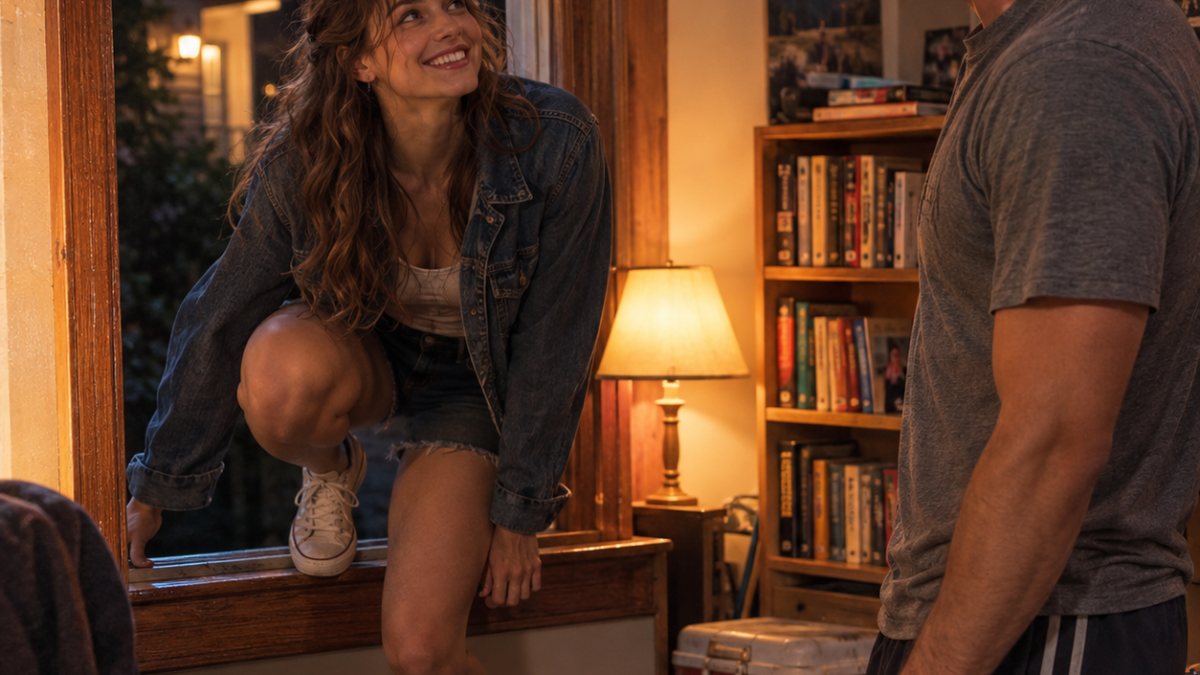
My Childhood Best Friend Came Back to Empty Her Old House. That Night, She Climbed Through My Window
The tap came at a quarter to eleven—three quick knocks and one slow one against the glass—and I knew the pattern before I had finished looking up from the shift schedules spread across my bed. When I pulled the curtain aside, Sabine Laurent was standing on the narrow side path between our houses, one hand raised and the porch light next door burning behind her hair. I had not seen her in person since the summer she turned 16, and she looked exactly like herself and nothing like the girl I remembered.
I pushed the sash up and it stuck halfway the way it always had, so she planted both palms on the sill and heaved it the rest of the way herself. She swung one leg over, ducked under the frame, and landed on my rug in a denim jacket and sneakers, breathing a little hard and grinning like she had gotten away with something. For a few seconds neither of us said anything, and I understood that the silence was the real difference.
At 16 and 17 we had crossed this sill a thousand times without once thinking about it, and she would have been halfway across the room complaining about my music by now. Tonight I was standing in a gray T-shirt and old basketball shorts, aware of the unmade bed behind me, while she stood very still with her hand resting on the frame as if waiting to see whether the room would let her stay. She looked at the bookshelf where my model planes used to sit—now holding paperbacks and a dented lunch cooler—and then at the ceiling where a crack she had once called the Allegheny River still ran toward the corner.
– It still sticks, she said, her voice coming out lower than I remembered.
– That’s the first thing you noticed, I said. Twelve years, and you went straight to the window.
– I noticed your light was on, she said. I got in this afternoon and I’ve been walking through my parents’ house, touching things and trying to decide what’s worth a box. And around 10:00, I saw your lamp through the gap in the fence and just kept looking at it.
She pushed her hair behind one ear, and I saw her decide to say the next part plainly.
– I’m not here because I need someone to help me carry furniture, Gideon, so don’t offer. I only have this week, and by tomorrow morning I’ll be buried in tape and trash bags, and I wanted to see you before that happened.
I told her most people use the front door or at least a phone and that I’d had her number for years without a single call, earning a short laugh before she explained that calling would just have made us say all the right things while she wanted to find out whether this still worked. I could have let that stand as a joke, yet having spent three years learning what it felt like to own the walls around me, I didn’t want her mistaking this for the room she remembered.
– It’s my house now, I said, keeping my voice easy. I bought it from my parents when they moved to Florida, and I fixed the roof and the porch steps, and I sleep in this room because I like it, not because I never left. I’m glad you climbed in, but I’d like you to know whose window it is.
Something moved across her face—I couldn’t tell if it was relief or embarrassment—before she answered quietly and then more brightly.
– Fair, she said. I’m sorry I didn’t knock on the front door like a person with sense.
Nodding toward the desk chair as the only seat in the room that wasn’t also a bed, I told her she could sit or climb back out without offending me either way, and she turned the chair around and straddled it with her arms folded over the back—just how she used to sit on my old beanbag, only with much more adult confidence behind it. Going to the kitchen and returning with two bottles of beer, I watched her take hers without asking what it was, which seemed like a small good sign.
She told me she worked as an admissions counselor at a community college outside Philadelphia talking nervous 18-year-olds out of panic from a cramped apartment with a great radiator and a bad landlord, while I shared that I supervised the second shift at a distribution warehouse across the river, knew every forklift driver and loading-schedule weakness, and mostly came home too exhausted to do anything beyond falling asleep on the couch. She said that sounded like the exact opposite of what a boy spending every summer afternoon building model planes would have chosen, and I told her the planes had never actually flown so I had adjusted.
Somewhere in there she kicked off her shoes and tucked one foot beneath her, and when I glanced at my nightstand clock it was past midnight and she had not once looked at the window. Standing up slowly as if wishing for a better reason to stay, she pushed her feet back into her sneakers, picked up her keys, and stopped at the sill looking back over her shoulder as cold air from the path slid around her ankles while I held my breath.
– Will it be open tomorrow? she asked, no longer smiling.
Instead of a casual “Sure” from when we were 17 letting old habits speak for me, I told her I wanted her to come, would leave the lamp on, and would open the window if she tapped—provided she wanted to be here rather than just following a route that was still there. Looking at me for a long moment, she nodded once and climbed out onto the path, and I stood at the open window until her back door closed next door, knowing tomorrow’s return wouldn’t be the same childhood invitation we’d once traded.
I kept the window shut all the next day and left it shut that evening with the lamp burning as a small act of discipline, spending the hour after dinner pretending to read a safety audit while listening for a sound I had no right to expect. She tapped at 10:00—three quick knocks and one slow one, the exact code we’d invented at 11 so my mother would know it was Sabine rather than a burglar—and I crossed the room and opened the sash, which slid up cleanly because I had waxed the track that afternoon without admitting why.
– My mother used to say you knocked like a woodpecker with a grudge, I told her.
– Your mother has never once been wrong about birds or people, she answered.
Climbing in more slowly than the night before with one hand on the frame, she stopped to look at the closed window behind her before turning around.
– You waited for me to knock, she said.
I told her she had treated my window like an appointment she never made and that I’d decided to be the sort of host who at least kept the calendar clear; laughing properly this time, she dropped into the desk chair and pulled a crushed bag of pretzel rods from her jacket pocket that she’d found in her old bedroom closet. Checking the date and agreeing they had expired before either of us could legally drive, we ate three each anyway and decided the pretzels were the first thing from her house worth keeping.
For the next hour we discovered how much we had changed in ordinary ways messages never capture: when she assumed I was still nursing my father’s old Buick, I told her it had died on the Liberty Bridge in spring 2019 in rush-hour traffic in front of a bus and been sent off to the scrapyard in favor of a reliable gray pickup, making her wince over spending a day picturing me from a Christmas card and a lawn chair—though I reminded her the lawn chair was real and her face had already softened with genuine interest rather than embarrassment.
When my turn came to listen, she spoke of Philadelphia like a place she had chosen—living three blocks from Saturday produce stalls where a man named Mr. Okafor saved her ugly tomatoes because they tasted better, and running a free Thursday workshop on financial-aid forms where a 50-year-old line cook had cried in the parking lot when his application went through. Saying it sounded like a life she’d hate to miss, I heard her agree without either of us shrinking the sentence, and noticed how hearing about it made me like her in a way that wasn’t entirely comfortable.
Having slid down onto the floor with my back against the bed frame as I always did when the chair was taken, I looked up when Sabine glanced at the empty carpet beside me and then at me.
– Is this spot still available? she asked.
At 16 she would have shoved my feet aside and complained about my elbows without me registering the movement; now she waited with one hand on the chair arm until I said yes, then lowered herself down beside me close enough that our shoulders nearly touched without letting me pretend it was accidental—a woman asking permission to sit on my floor affecting me more than it had any right to. Planning the next part all day, I still spoke less smoothly than I had rehearsed.
– I don’t have to be at the warehouse until 2:00 tomorrow, I said. Would you spend an hour with me in daylight with the front door and an actual sidewalk?
Turning her head with lifted eyebrows, she made me worry for a second I’d misjudged the whole week.
– You want to see me when the window isn’t doing half the work, she said.
– That’s exactly what I want, I admitted, because I’ve spent a long time with the girl who climbed through here and I’d like to meet the woman who climbed through it last night.
Looking down at the pretzel crumbs on her knee and back up at me, surprise crossed her face followed a second later by something warmer.
– Eleven, she said. I’ll even use the front door like a person with sense.
She stayed another half hour until the pretzels were gone and the radiator began its usual knocking, then stood, brushed crumbs from her jeans, turned back at the sill without asking if the window would be open, said she’d see me at 11:00, and pulled it shut from the outside—leaving me standing there as she crossed under the porch light, wondering what to say when there was no lamp, no dark glass, and nothing left of childhood to make talking easy.
She was on my front porch at 11:00 sharp—surprising me even more than the window had—and rang the bell like a stranger delivering a package, opening up to a green sweater, clean jeans, pulled-back hair, and two paper cups of coffee with my exact order of a little milk and no sugar.
– The Greek place on Marlow still opens at 6:00, she said, handing over my cup. I figured the one thing in this town that couldn’t have changed was a man who takes his coffee like a grandfather.
– The owner’s son runs it now and added oat milk, I told her, earning a look of offense on behalf of the entire neighborhood.
Walking down the block and around the corner with no destination, daylight made us both slower and more careful than the lamp had; Sabine paused to ask about my front door—repainted dark green last spring from brown—as well as the new porch steps and gutters I’d replaced myself, yet walked straight past her own house without slowing down despite the “Sale Pending” real-estate sign in the lawn, keeping her eyes on the sidewalk until we were three houses past while gripping her coffee cup harder than necessary. Letting her keep the silence, I turned left out of habit at the end of the block toward the creek path and old bakery until she placed a hand on my sleeve to stop me.
– I don’t want the tour, she said, laughing lightly at herself. If I wanted to walk through the past, I could have done it by myself this morning with a box cutter. Where do you actually go on a Tuesday?
Realizing I’d been guiding her through a version of the neighborhood frozen the summer she left, I turned us instead past the dry cleaner and hardware store toward the diner where I sat after night inventory reading a newspaper nobody else under 60 still bought. In a window booth, answering her curiosity about the door, I told her the full story of the house: ready to be listed three years ago when my parents moved to Florida, I had walked through with a flashlight one evening knowing every squeaky board and made them an offer the next week.
– I didn’t stay here to wait for anything, I said, keeping my eyes on my coffee so the sentence stayed plain and unromantic. I stayed because I liked the job and because I liked the street, and because I’d rather fix a roof than rent a view.
Nodding slowly, she said she’d never imagined I was waiting and had worried more about the opposite—that I’d built something good and she’d be the one walking in to track mud across it—before stating plainly without apology or head-tilt that Philadelphia was home, with her loud radiator apartment, produce stalls, and Thursday workshop no mere stopover back to somewhere else. I liked her saying it straight even as the sentence settled between us like a third person; splitting a plate of fries neither of us wanted, she stole the last fry the way she used to steal pretzels, paused halfway to offer it back, and fell quiet for a moment when I told her to keep it as we both recognized that while our ease was real, it couldn’t answer everything by itself.
Walking her back at 1:30 and leaving for work at 2:00, I spent the whole shift misrouting a pallet jack while replaying how she had said “home,” and by 10:00 that night I stopped pretending to read—leaving the lamp on, window shut, and curtain open a few inches as I sat on the edge of my bed with elbows on knees like a teenager waiting for a ride. She tapped at 10:05—three quick and one slow—yet stayed on the path with hands in her jacket pockets and the porch light behind her when I opened the sash, her face soft and uncertain.
– Can I come in? she asked. I’m not asking because it’s open. I’m asking because yesterday’s yes was yesterday’s, and I’d rather get a new one.
Dropping the smoother speech I’d rehearsed all afternoon, I spoke in my rougher, real voice.
– I want you to, I said. I’ve wanted you to since you stood on my rug and never once looked at the window, and I’m not interested in you coming in as a tradition. I’m interested in you.
Standing a second longer before putting one hand on the sill and swinging through, she let me take her elbow without thinking, and in the quiet with no jokes left, she stood close enough for me to smell cold air on her jacket and old coffee while saying my name quietly like a question already answered. Whether I kissed her or she kissed me, we leaned in together and stopped treating distance as a rule—slower and more deliberate than a childhood kiss, her fingers closing around my shirtfront and my hand finding the back of her neck until we broke apart with her eyes bright and a surprised laugh.
– I’m not going to say this fixes anything, she said, keeping her forehead against my shoulder. I don’t know what happens Sunday.
– I don’t know either, I told her. I’m not asking you to promise me anything tonight, and what I do know is that I want you here now, and I’m not going to dress it up as something it isn’t.
Lifting her head to study me for a moment, she took off her jacket, hung it over the desk chair, and stayed—lying on top of the blanket with the lamp on and talking low about nothing until her words slowed and she fell asleep loosely holding my hand while I stayed awake watching the shut window reflect the two of us small in the glass. In days a stranger would own the house across that path and her route would lead to someone else’s wall; tonight we had chosen each other without old habits, yet I felt how much of that choice still relied on her being one fence away and wondered if we’d keep choosing it once only a road lay between us.
Wednesday and Thursday nights looked the same on the surface yet felt different underneath: she tapped at 10:00—three quick and one slow—I opened the window, and a one-second look across the sill replaced asking, as we sat on the floor against the bed sharing pantry snacks, talking or sitting in silence, learning I kept keys in a coffee can by the door and slept through car chases while she hummed when thinking without realizing it. By Thursday morning I could read how far along she was in dismantling her parents’ house by how she held a mug, and when she texted at 8:00 for the first time inviting me over before my shift to see it before it was gone, I walked across the side yard and used her front door.
Meeting me in the hallway in a gray sweatshirt with dust in her hair, she sat on an upturned paint bucket and pointed me toward the radiator cover in a bare, echoing living room with flattened boxes and no kitchen table, noting evenly that a charity truck was coming Friday for the last furniture and buyers were walking through Monday with an inspector while glancing toward the sink window facing my bedroom wall. The house didn’t feel like a funeral so much as a place already finished with her—checked out of like a hotel room one last time—and up in her old bedroom, where four deep leg-dents remained in the carpet where her bed had been, she stood at the window looking at my glass, which in daylight looked like just another window.
Letting her keep her quiet room before she began talking easily about Monday—a 9:00 staff meeting, a noon transfer appeal, her Thursday workshop resuming to check on the line cook’s enrollment letter, Mr. Okafor’s stall, her radiator, and a friend named Priya with an apartment key—I noticed every Monday she described was complete without a single spot holding my name, not out of malice, simply because the week hadn’t asked her to picture me there.
– I’d like to see it, I said when she finished.
– What? she turned from the window.
– That, I said. Not a vacation version of it either, or the one you’d put in a brochure. I’d like to see the Saturday where Mr. Okafor saves you the ugly tomatoes and the workshop and the apartment with the radiator that you complain about with obvious affection. I’m not asking you to move your life around me and I’m not asking you to say anything big today. I’d just like to be somewhere in it that isn’t this window.
Watching her look at the carpet dents as if searching for the right sentence, I heard her answer carefully without rehearsal.
– I want to see you there, she said finally. I do, Gideon. That part isn’t hard to say. But I’m standing in a room I grew up in with a sale-pending sign in the yard, and I honestly can’t picture where you’d sit in my apartment. I don’t mean that as an insult. I mean, I haven’t gotten that far, and I’d rather tell you that than hand you a yes I’d have to take back.
Glad it wasn’t a graceful speech, I felt both disappointment and a steadier relief at knowing the true size of what she could offer.
– Okay, I said as an answer rather than surrender.
Looking at me hard as if unsure what to do with a calm reply, she heard me check my watch, say I had to be at the warehouse by 2:00, and head back across the side yard in flat bright sun—realizing on the walk that warm nights alone couldn’t argue for a future on their own. When she climbed through the sash that night and held on a beat longer as if testing whether morning’s talk stood between us, I didn’t push her away yet didn’t let closeness stop me thinking, earning a quiet look as she sat on the bed instead of the floor.
– You’re being careful, she said, picking at her sleeve hem.
– I’m being honest, I said, and sometimes it looks the same from where you’re standing.
She admitted she kept forgetting that leaving things open cost me more than it cost her, and without pretending everything was fine, I sat beside her with the lamp on and her head against my shoulder in a quiet built on honesty rather than comfort; by midnight, with the moving truck less than a day away and her car packed at the curb with folded back seats, I knew another night in this room couldn’t show us Sunday morning because the window got her inside without ever answering what came next.
The charity truck arrived Friday at 9:00, leaving her parents’ house empty and echoing by noon under the yard sign as I carried out the last two dining chairs to keep my hands busy while Sabine signed the receipt on the porch without looking up. Tapping at 10:00 that night, she was too worn out to talk and fell asleep on top of my blanket before 11:00 while I covered her with a closet quilt and stared at the ceiling crack I’d stopped calling a river around Wednesday.
On Saturday she cleaned—texting three photos of an empty kitchen cabinet, a mop bucket, and an unclaimed single sock under the radiator—while I spent my swapped Saturday shift (arranged Wednesday with a loader named Ruiz in exchange for a February night shift and silence) replacing a porch light fixture that didn’t need replacing and trimming a sentence against the garage wall. At 6:00 she texted simply, “Come out to the path,” and bringing two kitchen stools since her house had nowhere left to sit, I joined her in the green sweater on the narrow strip between houses with her parents’ back door locked behind her and my bedroom lamp throwing a yellow square onto dark gravel.
Setting the stools facing each other, she sat with elbows on knees and said the house was done—keys going into the lockbox in the morning, buyers now her parents’ business, only a sleeping bag and half-empty tape box left on the street—looking at my window rather than at me. Cutting the sentence down to what mattered, I spoke before doubt could talk me out of it.
– I’d like to come to Philadelphia next weekend, I told her. I can drive in Friday after my shift—it’s about five hours—and I’ll find my own place to stay if you’d rather I did. I’m not asking you to reconsider going home and I’m not asking you to rearrange anything for me. You’re going home and I’d like to see it, and I wanted to ask you out loud before you were in a car and it turned into something I’d have to say through a phone.
Sitting very still as the question landed somewhere apart from the window, she spoke while holding up one hand.
– I want to say yes, she said. I mean that. But next Saturday I’m staffing a transfer-night orientation until 2:00, and I have a Sunday brunch I promised Priya months ago, and I have never once had a man sit on my couch who knew my mother’s maiden name and the Buick story. I don’t know yet how you fit into the week that actually exists. If I say yes now, I’ll be saying it because you ask kindly and the porch light is pretty. I’d rather give you an answer I’ve walked through, so can I have tonight?
Recognizing the least comfortable and most honest thing she could have asked, I agreed with one clear boundary.
– You can have tonight, I said. I’d like to be clear about one thing, though, because I’d rather say it now than resent it later: if you come through that window, I want it to be because you want to be with me, and not because the window is the easiest way to avoid leaving.
– That’s not a punishment, I added as her jaw tightened fairly. It’s just the only way I know to keep this from turning into a week I had.
– I know it isn’t, she said after a moment, reaching across between the stools to take my hand like someone holding on for a real reason rather than crossing a sill. I was going to say it myself, actually. I want to sleep in my room tonight with the dents in the carpet and the bag on the floor because it’s the last night I get to. If I decide anything tonight, I want to decide it standing in the old place, and then see whether it still holds when I say it in the daylight.
We sat until streetlights came on at the corner, sharing easy silence alongside talk of the line cook’s enrollment letter and the cost of my Ruiz swap, before standing to lean her forehead against mine for a few seconds—warm breath and unspoken weight—and carrying both stools to the middle of the path side by side to leave for Monday’s new owners before she locked her back door and turned on her bedroom light. Inside my room with the lamp on and window shut, seeing both yellow squares of glass level across the path for the first time all week and watching her shadow cross the curtain once as she laid out a sleeping bag, I found I was willing to wait without knowing what morning would bring.
When the doorbell rang at ten to eight, I stood staring at the bedroom glass for a full second before realizing the sound came from the front of the house, having slept in my clothes with the lamp on and heard no knock all night. Opening the front door to Sabine in damp hair, a gray hoodie, and a lockbox key on one finger—looking like someone who had rehearsed a mirror speech and thrown most of it away—I smiled as she noted using the bell like a person with sense and hurried past laughter to speak before it got in the way.
– I slept in my room on the dents, and I decided something around 4:00 in the morning, and I still wanted it to be true when the sun came up, she said, counting off on one finger at a time. Next Friday you drive in after your shift and eat dinner at my place because I’ve already looked at the menu for the Ethiopian restaurant two blocks over. Saturday at 8:00 you meet me at the produce stalls because you can’t say you’ve seen my life until Mr. Okafor has handed you an ugly tomato. I’m at orientation until 2:00, so you can wait at the cafe across from campus where the coffee is bad and the chairs are comfortable and then we have the afternoon. Sunday is brunch with Priya, who has been told that a man exists and has threatened to interview you. You can have my couch or a hotel, whichever one you’d actually want, and I would honestly like you to say it out loud.
I told her I’d take the couch if the radiator was as loud as she claimed, bring a wrench and bleed key so I wouldn’t lie awake listening to something fixable, submit the Friday time-off request I’d drafted Wednesday before she hit the Ohio line, and leave Pittsburgh by 5:00 so she wouldn’t wonder if I’d make it. Watching her shoulders drop an inch after holding tight since 4:00 a.m., we made no promises about moving or next month and didn’t pretend five hours of highway cost nothing; standing with one foot on either side of the threshold, she said the window got us talking again yet shouldn’t have to do anything else, kissed me quickly—not like goodbye—and walked down the steps without turning around.
Her car was packed to the roof and both kitchen stools still sat side by side in the path; I carried one onto my porch and left the other, which was gone by Monday afternoon. The week after was both my easiest stretch of work and hardest to describe—exchanging photos of her radiator, produce stalls, and an unhappy parking ticket alongside a picture of my Ruiz swap sheet with a skull over my name, talking for two hours Wednesday night as she walked me through Monday’s meeting in unglamorous detail until I could picture her world and see how she was learning to picture me in it too.
Leaving Pittsburgh at 10:05 on Friday for five-plus hours of gray turnpike and unneeded coffee, I climbed three flights of a narrow brick rowhouse lined with bicycles carrying a wrench, bleed key, and gas-station pretzel rods—and at her door my knuckles knocked three quick knocks and one slow one before she opened up in a long sweater with loose hair against a warm yellow apartment.
– You know, you could just ring the bell, she said.
– I’ve been told that before by a woman with sense, I replied.
Reading the pretzel expiration date out loud as “disappointingly fresh” while the radiator clanked in the corner beside her couch, lamp, and enrollment forms, she took my arm and steered me across the room.
– I figured out where you’d sit, she said—left cushion away from the radiator and next to the lamp so you can read your safety audits with a clear conscience.
Sitting on the cushion she picked while she settled beside me shoulder-to-shoulder without asking if the spot was open, I pulled out my wrench to fix the radiator as promised while she sat cross-legged on the floor with chin in hand narrating the whole thing like a nature documentary. Looking back on that window, I see how little it actually did—putting a girl on my rug on a Monday night and giving us a few quiet nights—while everything that mattered happened with the lights on, one honest question at a time; I’d still leave it open for her, yet I’d rather she knocked on the front door.
So here is my question for you: if the thing that brought you together was borrowed from the past, would you trust it to carry you through or ask for something new? Tell me in the comments, and if this story kept you company tonight, please like the video and subscribe so you don’t miss the next one.