I Found My First Love Sleeping in Her Car – The Truth She Was Hiding Broke My Heart!
I Found My First Love Sleeping in Her Car – The Truth She Was Hiding Broke My Heart!
The first thing I noticed was the snow collecting on the windshield. The second was the woman asleep behind it, curled beneath a green coat in a car parked beside my woodworking shop. Burlington gets cold enough in December to make a bad decision dangerous.
So I knocked on the window.
She opened her eyes, and twenty-four years vanished. It was Celia Morgan—the girl who had once kissed me beside Lake Champlain, promised to write, and disappeared from my life before I learned how to say goodbye. Now she was forty-four, pale with exhaustion, and pretending that sleeping in a freezing car was perfectly ordinary.
When she rolled down the window, she gave me the same crooked smile I had loved at twenty-two.
“Adrien,” she said. “You still have terrible timing.”
I wanted to laugh. I wanted to ask where she had been. Mostly, I wanted to know why there was a toothbrush, a suitcase, and every piece of clothing she owned in her back seat.
Before I tell you what she was hiding, please like this story, subscribe, and tell me in the comments: would you help a first love who refused to admit she needed you?
I stood with my gloved hand on the top of the car door, trying to remember how breathing worked. Celia looked from me to the small mountain of snow on her hood, then back to me. Her hair, once dark brown and always escaping whatever clip she used, now had a few silver strands at the temples. Her eyes were unchanged. They still made it difficult to form a sensible sentence.
“Are you going to arrest me for loitering?” she asked.
“I was considering it, but Burlington’s criminal justice system is already overwhelmed by people who park crookedly.”
She glanced at the wheels, which were perfectly straight.
“Still making jokes when you’re nervous.”
“Still criticizing my parking lot management when you’re freezing.”
I had stayed late to finish a walnut dining table for a client in South Burlington. The machines were off. The shop was dark except for my office lamp, and the street behind our row of old brick buildings had emptied hours ago. I might have driven past her if I hadn’t returned for the keys I’d left on my workbench. That thought made my stomach tighten.
“Come inside,” I said. “I have heat and coffee.”
“Technically, I’m fine.”
“Your window has frost on the inside.”
“It gives the place character.”
“The place is a twelve-year-old Subaru.”
“Vintage character.”
The engine was off. Her scarf was wrapped around her knees, and she was holding a little hand warmer that had clearly stopped working. I knew that look on her face—chin raised, smile ready, fear hidden behind a joke. At twenty, she had worn it before every art school critique. At forty-four, it hurt to see it again.
“Ten minutes,” I said. “Warm up. You can insult my coffee and leave whenever you like.”
She considered me for a long moment.
“You’re not going to ask twenty-four years’ worth of questions?”
“Not before coffee. I have standards.”
That earned the first genuine laugh of the night. She took her keys, climbed carefully out of the car, and immediately wobbled on the icy pavement. I reached for her elbow. She caught my sleeve instead. For one breath, we stood very close, as if the years between us were a door neither had decided to open.
“I can walk,” she said softly.
“Good, because carrying you would do terrible things to my back.”
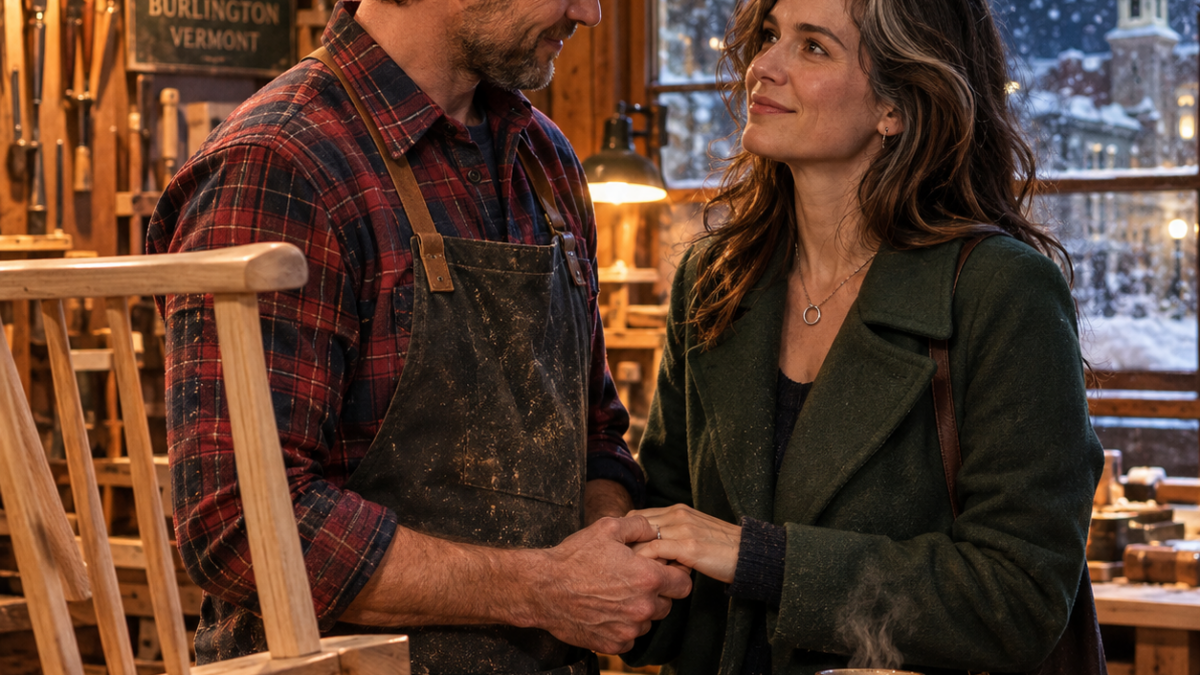
Inside, the shop smelled of sawdust, linseed oil, and the cedar shavings I never seemed to sweep completely away. I switched on the overhead lights. Celia looked around at the benches, clamps, and half-built cabinets before stopping beside a rocking chair I’d made from maple.
“You actually did it,” she said.
“Did what?”
“Opened your own shop. You used to draw furniture on napkins at the diner.”
“I still draw on napkins. The bank calls it poor accounting.”
Her fingers followed the curve of the chair arm without touching it.
“It’s beautiful, Adrien.”
The compliment caught me off guard. I made a living hearing people praise wood, but hearing it from her felt different. I had once built her a little wooden picture frame with a crooked corner and given it to her as if it were a masterpiece. She had put a photograph of us inside and declared the corner charming.
I led her into the office, where an old electric heater fought a losing battle against Vermont winter. The coffee in the pot had been brewed that morning. I poured it into two mugs and studied the surface.
“On second thought—tea?”
“Why is the coffee planning an escape?”
“I’m fairly sure it has developed a legal identity.”
I made tea. Celia wrapped both hands around the mug, closed her eyes, and let the warmth reach her fingers. We stayed quiet until she opened them again.
“So,” I said, sitting opposite her. “Burlington in December. In a car.”
“I’m traveling.”
“Most tourists choose hotels.”
“Most tourists lack imagination.”
“And their entire wardrobe in the back seat.”
She set down her cup. The joking light left her eyes so quickly that I wished I could take the sentence back.
“I didn’t know this was your shop,” she said.
The sign outside carried my full name. I let the contradiction pass. What mattered was the thin line of red where her coat cuff had rubbed her wrist and the way she was struggling not to shiver.
“You don’t owe me an explanation tonight,” I told her.
“Thank you.”
“But you can’t sleep in that car while the temperature drops.”
“I’ll find somewhere.”
“Find it tomorrow. There’s a guest room upstairs.”
She straightened. “Adrien—”
“It’s not a trap. There’s a separate entrance, a lock, and an unfortunate painting of a duck left by the previous tenant.”
“I didn’t come here looking for charity.”
“I didn’t offer any. I offered a warm room. You can pay me by telling the duck painting what you think of it.”
She almost smiled, then shook her head.
“One night. That’s all.”
I put a clean set of bedding in her arms and showed her the stairs. On the landing, she stopped, looked down toward me, and said:
“You were always kinder than was good for you.”
“Not always. I once charged my apprentice five dollars for calling mahogany ‘fancy brown wood.'”
“Good night, Adrien.”
“Good night, Celia.”
When her door closed, I went back outside to move the Subaru closer to the building. She had given me permission to use her keys because the street plow was coming through. In the passenger footwell, next to an umbrella with a broken rib, sat a plastic grocery bag containing two paperback novels and a jar of instant coffee. On the back seat were neatly folded towels, a small cooler, shoes arranged in a shoebox, and a document envelope labeled “important.”
This wasn’t luggage packed for an adventure. It was a life compressed until it would fit into a car.
I sat behind the wheel for a minute, staring through the glass at the snow. It wasn’t that she had lied. It was that she had believed she needed to lie to me.
I had been engaged once, nine years after Celia left. That relationship ended quietly over too many postponed conversations and a growing realization that we wanted different lives. Since then, my greatest romantic commitment had been to a table saw. A table saw was at least honest when it wanted your attention.
But Celia had returned, and the part of me I thought had retired from hoping was suddenly wide awake.
The next morning, I found her in the workshop at seven, wearing yesterday’s jeans and a borrowed flannel shirt. She was examining a cabinet door with the severe expression of a doctor considering an X-ray.
“Your hinges are wrong,” she said by way of greeting.
“Good morning to you, too.”
“They’re two millimeters off. The door will sag.”
I looked. She was right.
“I was waiting to see if anyone noticed.”
“That is the least convincing thing you’ve ever said. And I remember you claiming you enjoyed my college poetry.”
“You did enjoy my college poetry.”
“I enjoyed you. The poetry was an act of mercy.”
She smiled at the door, and I realized with a jolt how much I had missed the ordinary rhythm of talking with her. I had missed it without knowing I was still listening for it.
I offered breakfast. The refrigerator held half a lemon, mustard, and a suspicious quantity of shredded cheese. Celia inspected it, then looked at me in disbelief.
“You own a business, but you feed yourself like a raccoon with a credit card.”
“The raccoon has excellent reviews.”
She found eggs behind the cheese, discovered a loaf of bread in the freezer, and made scrambled eggs in the tiny upstairs kitchenette while I provided commentary from a safe distance. She refused to let me near the stove after I admitted I had once burned pasta.
“Pasta is boiled in water,” she said.
“Yes, I understand the theory.”
“How do you burn something in water?”
“The water left on purpose, probably.”
Over breakfast, she said she had an appointment that afternoon with a small design firm. She used to work in residential interiors, she explained, and had done everything from kitchen layouts to restoring old buildings. Her portfolio was on a laptop, and she was hoping Burlington might offer a fresh start.
I wanted to ask why she needed a fresh start and whether she had somewhere to go after her appointment. Instead, I asked about the firm, listened to her description of their projects, and offered to print her résumé on my office printer. She accepted the printer and declined a ride.
At the door, she turned around.
“Thank you for last night.”
“Really?”
“The duck says you’re welcome.”
She hesitated.
“I can pay you for the room.”
“I didn’t mention money.”
“I did.”
Her expression told me this was not a negotiation I would win by being generous.
“All right,” I said. “There’s a monthly rate if you want to stay longer. We can write it down, same as anyone else.”
“How much?”
I quoted what the previous tenant had paid for the small space—a modest rate, because the heating was temperamental and the plumbing made noise when it rained.
“That’s low,” she said.
“So is the ceiling above the bathroom. I can show you the bruise.”
“I’ll think about it.”
She left for the interview, and I spent the day sanding a table that had needed only half an hour of sanding. Every time a car passed, I looked up.
By five, sleet had replaced the snow. Celia returned with wet hair and a paper bag from the bakery across the street. She placed two cinnamon rolls on my workbench and said:
“The interview was very polite.”
“In what language does that mean bad?”
“Every language. They liked my portfolio, but they’re freezing hiring until spring.”
I pushed one cinnamon roll toward her.
“Then we eat carbohydrates and insult corporate planning.”
“And I rent your room for one month,” she said, “at the rate we discussed, with a written agreement. Also, I need a receipt.”
“You drive a hard bargain.”
“I learned from a man who used to charge extra for a perfectly level table.”
“That’s called craftsmanship.”
“That’s called gravity.”
I printed a simple rental agreement, including privacy, a thirty-day notice period, and the fact that she could leave whenever she found a place of her own. She read every line, asked me to change the wording about utilities, and signed with a steady hand. When I handed her the key, she closed her fingers around it as if it weighed more than it did.
“This doesn’t mean you get to ask questions about my life,” she said.
“Understood.”
“Or fix everything.”
“That’s a larger request.”
“I repair things for a living.”
“Try.”
“I can do that.”
For the first time since I had found her car, she seemed to believe me.
By the end of the week, Celia had reorganized the kitchenette, set up her laptop on a small desk, and attached a handwritten note to my refrigerator: “Vegetables are not decorations.”
I responded with a note on her door: “Woodworkers are not personal chefs.”
She crossed out the word “personal” and replaced it with “competent.”
My apprentice, Nate—twenty-seven and far too observant for his own good—noticed my new mood before I did.
“You’re smiling at a drawer,” he said one morning.
“It’s a well-made drawer.”
“You smiled when she called you an idiot for putting the spoons beside the power drill.”
“She was correct. We should have a system.”
“We have a system. It’s called chaos. You’ve been loyal to it for twelve years.”
Nate was finishing his carpentry certification and had a talent for telling the truth in ways that made me want to assign him heavy lifting. I told him Celia was a tenant, an old friend, and none of his business. He nodded solemnly, then drew two hearts on a scrap of plywood and left it on my bench. I docked him zero because the drawing was admittedly excellent.
Our first real collaboration began with an ugly kitchen. A couple named the Parkers had hired me to build cabinets for their century-old house. They loved the craftsmanship but couldn’t decide on a layout, and their designer had moved away. I had been sending drawings back and forth for weeks, each more confused than the last.
Celia glanced at the plan while carrying her tea downstairs.
“That refrigerator is blocking the only useful window.”
“It’s a refrigerator. It’s allowed to have hobbies.”
“You built a beautiful cabinet system around a mistake.”
“You’re enjoying this immensely.”
She sketched a new layout in six minutes, shifting the pantry wall and giving the old window room to breathe. It was smarter than any version I had made. I asked what she would charge to develop it professionally.
“Adrien, I was just looking—”
“And I was just watching twenty years of expertise save my project. Send me a proposal.”
She folded her arms. “No favors disguised as work.”
“Then charge your normal rate. I need your skill, not your gratitude.”
She studied me, suspicious but interested.
Three days later, she presented a full set of revised drawings and a proper invoice. I showed the Parkers the designs with her name on every sheet. They loved them, hired her to help select finishes, and offered me a contract for the cabinetry.
The check I wrote Celia that Friday was small by business standards. But her face changed when she saw it—not because she was surprised by the amount, but because it represented something she had done, not something someone had handed her.
“You’re a decent client,” she said.
“Don’t spread that rumor. It will ruin my reputation.”
“You should also stop using comic sans in your estimates.”
“That’s my brand identity.”
“Your brand identity is a cry for help.”
When she laughed, a little flour from the bakery cinnamon roll caught on her sleeve. I wanted, suddenly and without any right, to brush it away. Instead, I handed her a napkin. She took it, and her smile lingered on mine a second longer than necessary.
I went home that evening to the apartment above the other half of the shop, where I had lived alone for years. The wall between our spaces was thick enough that I never heard her moving around. But I knew she was there. A lamp glowed behind her curtains. Someone else was awake in the building. It was such a small change, yet it made the whole place feel different.
The next month was measured in ordinary surprises.
Celia knew the bakery owner, Bea, within three days. By the fifth, Bea was bringing over day-old bread and pretending not to be interested in our arrangement. Celia found a second freelance job designing a mudroom for a family in Essex. She spent afternoons sending applications and evenings at her desk, adjusting drawings until the angles were right.
Some days she was cheerful. On others, an unanswered email could make her quiet through dinner. I learned not to interpret every silence as a request for rescue.
One Sunday, we went to the hardware store because I needed cabinet poles and she wanted a desk lamp. The store clerk assumed we were married and asked whether we agreed on brass or black hardware.
Celia answered, “We’re not married, and we absolutely do not agree.”
I said, “I’ve spent twenty-four years preparing for this argument.”
The clerk laughed. Celia went red beneath her scarf, then tossed a package of black poles into my cart as if settling a score. At the checkout, she reached for a packet of sunflower seeds.
“My mother used to plant these every spring,” she said. She held the packet for a moment, then returned it to the rack.
“You have a window upstairs,” I said. “And a narrow shelf outside.”
“Not enough light in winter.”
“Spring isn’t far.”
Her smile was so faint I almost missed it. She bought the seeds.
Back at the shop, I built her a small planter from leftover cedar. She insisted on paying for the materials, so I charged her one dollar and a detailed critique of my construction. She gave the planter five stars, then deducted two for my attitude.
We grew comfortable in a way that made me careless. I began leaving two plates out at dinner even when we hadn’t made plans. She would text me from the bakery: “There are still no vegetables in your fridge.” And I would reply: “I have a green toolbox.”
Sometimes she came downstairs simply to talk while I worked. We discussed books, local gossip, the ridiculous prices of old houses, and the changes in Burlington since we had been young. Every so often, we would brush against a memory neither of us expected, and the laughter would become softer.
“Remember the dance at the college?” she asked one evening.
“You stepped on my shoe.”
“Your shoe attacked me first.”
“You apologized to it.”
“It looked more forgiving than you.”
She stood beside the table saw, running a thumb along the edge of a piece of cherry.
“You were a good dancer when you stopped counting.”
“I was a terrible dancer.”
“You were just very fond of me.”
She glanced at me. Maybe I was old enough to recognize an opening. I was also apparently old enough to panic and ask whether she wanted more tea. She said yes with an expression that suggested I’d failed a very simple test.
In late January, her Subaru began making a sound like a tin can full of gravel. Celia took it to a mechanic on North Avenue who told her the exhaust needed work and the battery was nearing its end. She returned with a written estimate and placed it beneath a stack of drawings.
I noticed her studying the numbers that night.
“I know a guy who can look at it,” I said.
“I’ve already had it looked at.”
“I mean for a second opinion.”
“I appreciate it. I’ll handle it.”
I should have stopped there. Instead, two mornings later, when her car wouldn’t start, I phoned my friend Paul, who ran a repair shop. I asked if he could tow it, inspect it, and bill me. In my head, I was solving a problem. I imagined Celia coming downstairs relieved, maybe teasing me about having a secret network of mechanics.
The real Celia came downstairs to find the tow truck outside and stared at it as though it had stolen something from her.
“Why is Paul here?” she asked.
“The car needs work.”
“Did you ask me?”
“I was trying to help.”
“Did you ask me?”
Paul, who possessed better survival instincts than I did, put down his clipboard and announced he would get coffee. Celia waited until he was out of earshot.
“You told someone to take my car without telling me.”
“It’s not like that.”
“It’s exactly like that. That’s my transportation, Adrien. That’s what gets me to interviews. That’s where my things were. I need to know where it is and what happens to it.”
Her voice shook on the last sentence. I felt the full weight of what I’d done. I’d mistaken proximity for permission. Worse, I had turned the one possession she could control into another decision someone else was making for her.
“You’re right,” I said. “I’m sorry. I should have asked. Paul hasn’t touched it. I’ll tell him to leave.”
“And please stop trying to pay for my life.”
“Okay.”
“You say that as if it’s easy.”
“It should be. I made it difficult.”
She looked away, pressed her lips together, and went upstairs. When Paul returned, I sent him home with an apology and bought two coffees I didn’t want. For the rest of the day, the shop felt colder than the street outside.
That evening, a knock came at my office door. Celia stood there carrying the estimate and a notebook. She looked tired but not angry.
“I owe you an explanation,” she said.
“No, you don’t.”
“I know. I’m choosing to give you one.”
She sat at the desk opposite me—the same place she’d held her tea on our first night. For a while, she looked at the scratched surface. Then she told me that her mother, Margaret, had suffered a severe stroke three years earlier. The stroke hadn’t taken her life, but it had taken her ability to manage most ordinary tasks.
Celia had moved back to New York State to care for her. At first, she worked remotely as a designer, taking calls between appointments and answering emails late at night. Then her mother’s needs grew more complicated.
“People say they understand caregiving,” she told me. “Some do. Most don’t understand that it’s a full-time job with no weekends, and you can still be doing it badly no matter how hard you try.”
She hired help when she could, but the expenses were relentless. Insurance covered parts of the medical care, not every hour of support her mother needed at home. Savings disappeared. Celia sold the small house she had purchased after years of work and used much of what remained to keep her mother comfortable and safe.
She didn’t sound ashamed of that choice. “I’d sell it again,” she said firmly. “She was my mom.”
Her mother had died eight months earlier. Soon after, the design firm where Celia worked cut several positions, including hers. She tried contract jobs, but a delayed payment and a rental lease ending at the wrong time put her in a hole she couldn’t climb out of quickly. A former coworker had mentioned possible work in Vermont. Celia drove north with her portfolio and the money she had left, hoping for a job before the winter weather got worse.
“How long were you living in the car?” I asked.
“A few weeks. Some nights in cheap motels, some with friends. Then the money got too tight.”
My chest ached. I thought of the frost inside the window, her careful rows of shoes, the hand warmer she’d held long after it was cold. I thought of a twenty-year-old girl daring me to skip a lecture so we could watch the lake change color—and how completely life could rearrange a person without taking away her smile.
“Why didn’t you call anyone?” I asked gently.
“I did. I called a housing assistance line. I talked to the people at the employment office. I’m not too proud to seek help, Adrien.”
Her chin lifted.
“I just wasn’t ready for you to know. I remembered the way you used to look at me, and I couldn’t stand the idea of seeing pity in those eyes.”
“Celia, that’s not what I see.”
“What do you see?”
I wanted to tell her that I saw the person who had rearranged my entire world at twenty-two. Instead, I gave her the truth I could defend.
“Someone who spent years taking care of another person, survived more than I knew, and still noticed my crooked hinges.”
Her eyes filled, though she smiled. “Those hinges really were awful.”
“We can agree on that.”
She wiped her cheek with the heel of her hand.
“When you arranged for the tow truck, I felt like I was losing control again. After my mom died, everybody had advice. Some of it was good. Some of it made me feel like a project. I don’t want to be anybody’s project.”
“You’re not mine. I want us to be friends—real friends. That means you don’t get to decide what I need.”
“Then I’ll ask, and I’ll listen to the answer.”
We sat with that for a moment. She eventually asked for Paul’s number. She called him herself, explained her budget, and arranged an inspection without authorizing repairs until he’d called with a price. When she finished, she looked almost surprised by how ordinary the solution had become.
“I’d still like to help with the ride to the mechanic,” I said. “If you want.”
“I do,” she answered. “Thank you for asking.”
That night, we ate grilled cheese sandwiches at the office desk. Mine was slightly too dark. Celia called it a controlled burn and ate it anyway. When she rose to leave, she touched my shoulder—a brief weight of warm fingers through my shirt.
“You didn’t say you were sorry about my mother,” she noted.
“I am sorry.”
“I know. I meant thank you for not making the whole conversation about how sad it is. You told me she loved sunflowers.”
“She did.”
“Tell me something funny about her.”
Celia’s face brightened. She told me about Margaret’s disastrous attempt to teach a terrier to carry a grocery bag. By the time she reached the part where the dog dragged an entire loaf of bread through the neighborhood, we were both laughing hard enough to hurt. I understood then that grief was not a single expression. It was all the things you missed about someone, including the ridiculous ones.
After that evening, I stopped measuring closeness by what Celia revealed. I measured it by what we could do together without either of us being afraid. She asked me to proofread a proposal. I asked her to tell me when a furniture design was ugly. She learned to accept a ride without treating it as a debt. I learned that an offer of help could be withdrawn without resentment.
In February, the Parkers invited us to see their finished kitchen. Sunlight fell across the pale cabinets and the long counter Celia had insisted should sit beneath the window. Mrs. Parker clasped Celia’s hands and said, “You gave this room back its view.” The praise made Celia laugh with a shyness I rarely saw.
On the way out, Mr. Parker handed her the number of a friend who was renovating a restaurant. We celebrated with takeout noodles at my dining table.
I raised a paper carton. “To professionally correct hinges.”
“And to men finally admitting that women can read measuring tapes.”
“You’re getting sentimental.”
“Don’t tell anyone.”
After dinner, a song came on my radio from a station that seemed committed to playing nothing recorded after 2005. Celia stopped stacking the empty cartons. It was the slow song we danced to the last night we saw each other twenty-four years ago.
Neither of us mentioned it at first.
“Do you remember?” she asked at last.
“The song, or the fact that you insulted my shoes?”
“They squeaked.”
“They were new.”
She offered her hand, half daring me. “Let’s see if you’ve learned anything.”
I took it. We moved awkwardly between the table and the kitchen counter, both laughing when I bumped a chair. She was close enough that I could smell the citrus soap she’d been using upstairs. For a few turns, I forgot every reason I had not touched her in all those years.
Then the song ended. We stood still, my hand resting lightly at her waist, her fingers against my shoulder.
“You’re not counting anymore,” she whispered.
“I have a better partner.”
She looked at me for a long second, then stepped back with a careful smile.
“Good night, Adrien.”
I watched her walk upstairs, aware that something had changed. It wasn’t a promise. It was the possibility of one, and neither of us yet knew whether we were brave enough to make it.
In early March, the first mild afternoon arrived as a surprise. Dirty snow retreated from the curb, and Celia came downstairs carrying her cedar planter and the packet of sunflower seeds. She wanted me to help attach a better bracket beneath the shelf outside her window.
I held the planter while she reached for a screw, and the delicate chain around her neck caught on a rough corner of wood.
“Hold on,” I said. “You’ll break it.”
“Too late.”
The clasp gave way, and a small silver ring slid down the front of her sweater. I caught it before it reached the floor. It was thin and slightly uneven, with a tiny wave carved across its surface. I knew every scratch on it. I had bought it from a silversmith at a summer market by Lake Champlain for Celia’s twentieth birthday, using money I had earned refinishing an old dresser. The artist had told me silver would last if we took care of it. I had believed he meant the metal.
I held it between my fingers.
“You kept this.”
Celia stopped moving. For once, she had no joke ready.
“I wore it on my hand for a long time,” she said. “Then it stopped fitting. I put it on a chain.”
“Twenty-four years.”
“I know how long it’s been, Adrien.”
We were standing by an open window with a planter between us, both suddenly back in the summer when we thought a kiss could settle a future. I laid the ring on my palm and waited. I had learned not to rush her truth.
“When my family moved,” she said, “I thought we’d figure it out. I wrote you from the new place. We moved again three months later because Dad found work. The last letter you sent was forwarded after I had already left. I never knew where to answer.”
“I sent a lot more than one.”
“I know. Years later, my mother found a packet that had been returned to our first address. By then, I heard you were engaged.”
“That was years afterward.”
“I know that now.”
She looked down.
“At twenty, silence felt like an answer. At thirty, finding you felt like interrupting a life. At forty, I told myself I’d missed my chance.”
“I could have found you, too,” I said. “I was scared you’d found somebody better—somebody who didn’t spend Friday nights gluing chairs.”
“Adrien, you were never competing with a chair.”
“You haven’t seen my best chair.”
She laughed through tears. I offered the ring back. Instead of taking it immediately, she closed my fingers over it for a moment.
“I kept it because that summer was real,” she said. “Even after everything else changed, I wanted to remember that.”
I wanted to kiss her. Every part of me leaned toward the idea. But she was still rebuilding the ground beneath her feet, and I didn’t want the first time I kissed her again to feel tangled with a room, a rent receipt, or a favor. So I helped repair the chain, gave the ring back, and held the planter steady while she fixed the bracket.
“It’s crooked,” she announced afterward.
“It is absolutely level.”
“I was talking about your smile.”
She kissed my cheek before she went inside. It lasted no more than a second, yet I spent the rest of that afternoon putting a shelf together twice because I kept measuring the wrong side.
The spring brought work for both of us. The restaurant project became a full design contract for Celia, and she spent three evenings a week meeting the owners and suppliers. A community center in Winooski asked her to consult on accessible storage and public spaces after seeing her portfolio. She won that work without my name on the proposal.
I was proud of her, but I was also learning how often pride could sound like ownership if you weren’t careful. When she told me the news, I simply asked how she wanted to celebrate.
“Dinner somewhere that doesn’t require a fire extinguisher,” she said.
We went to a little place downtown with windows facing Church Street and a waitress who called everyone “sweetheart.” Celia wore a blue dress and the silver ring on its repaired chain. I wore a shirt with a collar that Nate had insisted I iron.
The waitress brought two glasses of water, looked between us, and said, “First date?”
“Twenty-fourth anniversary of a very long misunderstanding,” Celia answered.
“We’re not sure what number to put on the cake,” I added.
The waitress grinned. “I’ll bring dessert and let you work it out.”
We talked about the years apart more honestly that evening. I told her about the engagement that had ended because neither of us wanted to disappoint the other enough to speak plainly. Celia told me she had loved people since me but had never found a partnership in which she felt fully herself. We didn’t pretend that our lives had frozen after college. That would have made the reunion easier to describe and harder to believe.
We had changed. What startled me was how much I liked the people we’d become.
When I walked her home, we stopped beneath the streetlight outside the shop. She slipped her hand into mine and held it as we looked at the dark windows. I thought of all the conversations we had avoided for years.
“Can I take you on a proper date?” I asked.
“Wasn’t dinner a date?”
“It was a professional celebration. You charged the dessert to your business.”
“It was research.”
“Then I’m asking for a date with no tax deductions.”
She smiled. “Yes. But I pick the restaurant.”
For the next several weeks, we dated in the cautious, delightful manner of two people who knew they could hurt each other and wanted very much not to. We walked along the waterfront when the ice melted. We visited a used bookstore where Celia found my old favorite novel and discovered that I’d underlined an embarrassingly sentimental sentence in my copy. We went to a maple festival where I bought too much candy and she declared me a danger to public health.
On rainy nights, we made dinner together, which usually meant Celia cooked and I washed the dishes while she supervised my technique like a difficult building inspector.
I began to understand that romance at forty-six had a different rhythm from romance at twenty-two. The excitement was still there. So was the urge to do foolish things. But the best moments were often quiet—Celia reading on the sofa while I worked through an estimate, or the two of us driving home without needing to fill every silence.
She no longer flinched when I offered help. I no longer assumed that accepting it meant she needed me to lead.
In May, Celia received an offer for a permanent position with a small architectural and interior design firm in Burlington. It included benefits, a salary she could plan around, and time to continue some of her independent projects. She showed me the offer letter, smiling so broadly that I forgot to be dignified and lifted her off the floor. She laughed and ordered me to put her down before I ruined my back.
We celebrated with champagne in the upstairs kitchenette and called Bea, who arrived with a cake that said, “Congratulations on being employable.” Bea claimed the bakery had run out of tasteful icing.
The following week, Celia told me she’d found an apartment of her own—a bright second-floor place a short walk from the waterfront. She had already applied, checked the lease, and arranged a viewing. I was genuinely happy for her. I had helped carry boxes into that little room when she owned almost nothing but what fit in the Subaru. I knew what having her own address would mean.
Still, somewhere beneath my happiness, a small, frightened voice said she was leaving again. I tried to ignore it. Instead, I became absurdly efficient. I offered to help pack, measured her new windows for curtains, and asked Nate to build a moving cart.
Celia watched me tape three empty boxes and finally said, “You’re behaving like a man trying to win an Olympic medal in avoidance.”
“Moving is serious business, Adrien.”
“I’ve labeled the kitchen utensils.”
“You labeled one box ‘things that may be spoons.'”
I set down the tape. She sat on the windowsill beside the sunflower seedlings, which had become sturdy little plants. The ring rested against her collarbone. I could have asked what her new apartment meant for us. Instead, I said I hoped the new place had a decent stove. She stared at me for a moment, disappointed, then said, “It does.”
For the next few days, our conversations grew polite—not cold exactly, but careful. She was busy with work, and I hid behind orders at the shop. One night, I saw the packing boxes stacked beside her door and felt the old ache of an ending I hadn’t chosen. But this time, I knew the problem wasn’t a missing letter. It was me failing to say the thing that mattered.
On the final Saturday of May, I found Celia in the yard behind the workshop trying to load the cedar planter into her car. She had strapped the pot into a seat belt as if transporting a particularly demanding passenger. The young sunflowers leaned toward the glass.
“They need a name,” I said.
“All six of them?”
“I suggest the board of directors.”
She smiled, but it didn’t reach her eyes.
“I’m almost finished packing. The moving company comes Monday.”
“I know.”
“You keep saying that because I do.”
She closed the car door gently.
“Then why do I feel like you’re saying goodbye?”
There it was. The question I’d been afraid of, asked simply and without accusation. I could hear Nate inside the shop moving lumber. Somewhere down the street, a bicycle bell rang. Life continued around us, indifferent to how difficult one sentence could be.
“Because I’m scared,” I admitted. “When you first came here, I thought I might lose you to the cold before I even had a chance to know you again. Then I watched you get your work back, find your feet, make plans. I wanted all of that for you. But every box you packed reminded me of the last time you left, and I acted as if you were leaving me instead of leaving a room.”
Celia’s eyes softened, though she didn’t move closer.
“I need my own place, Adrien. Not because I don’t love spending time with you, but because I need to know I can stand on my own.”
“I know. And I want you to have it. I don’t want you to stay because I gave you a key or because I happened to find your car that night.”
“Then what do you want?”
I took a breath. I had spent six months learning how not to fix her life. Now I had to be brave enough to ask whether she wanted to share part of it.
“I want to keep choosing you after you move,” I said. “I want you to have your own home and your own work. And I want to be the man who shows up when you ask and listens when you don’t. I want Sunday breakfasts and terrible dancing and a future we actually talk about.”
I looked at her.
“So, Celia—would you stay in my life this time as my girlfriend?”
She looked at me for so long that I heard every small sound in the yard. Then her mouth began to curve.
“That’s a pretty good offer,” she said.
“I’ve had twenty-four years to prepare the speech.”
“You could have used a few more minutes.”
I laughed nervously. “Is that a no?”
“It’s a yes, Adrien.”
She stepped close and took both my hands.
“But you have to promise me one thing.”
“Anything reasonable.”
“Never make that burned pasta again.”
“You drive a cruel bargain.”
“I remember the smoke alarm.”
“It remembers you, too.”
“Deal.”
I kissed her then—properly, with no years between the question and the answer. She was laughing when our lips met, and I was laughing by the time we pulled apart. I had imagined that if I ever got a second chance with Celia, it would feel like recovering something I’d lost. Instead, it felt like meeting her in the present and being welcomed there.
She moved into the apartment on Monday. I helped carry the desk, and she supervised where it went. We spent our first evening there eating takeout on the floor because the chairs hadn’t arrived. She hung the silver ring on a small hook beside her bedroom mirror, then caught me looking at it.
“I’m keeping it safe,” she said.
“I noticed.”
“Don’t get any ideas about replacing it with something expensive.”
“I was going to make you a shelf.”
“That’s more romantic.”
By June, the sunflowers were blooming in their cedar planter on her balcony. Celia had settled into her new job, and the restaurant she designed was preparing to open. She invited me to see the finished space. The owners praised the soft lighting and the careful way she’d preserved the old brick walls. I stood beside her, proud to be introduced simply as Adrien, her boyfriend.
I didn’t need to be her rescuer, her landlord, or the person who made her success possible. I was the man she had chosen to bring.
One warm evening, we returned to the workshop after a walk by the lake. Her Subaru was parked near the same place where I’d found it on the snowy night. Now its windows were clear. The back seat held grocery bags and a pair of hiking boots, and a little sunflower sticker decorated the corner of the rear glass.
Celia saw me looking at it.
“Do you ever think about that night?” she asked.
“Every time I see that parking space.”
“I was so embarrassed. I was so terrified you’d drive away.”
She took my hand.
“You know what I remember most? You didn’t demand my story. You opened a door and let me decide whether to walk through.”
“I made a few mistakes after that.”
“You did. So did I. We talked about them.”
We stood there in the fading light. I thought of the young man who had once believed love meant keeping someone close enough never to lose them, and of the older man who had learned that closeness meant very little without freedom. Celia squeezed my fingers, and we went upstairs to make dinner.
I was permitted to chop vegetables under supervision. She was permitted to complain about my knife skills. We were both exactly where we wanted to be.
I still have the wooden picture frame I made for Celia when we were young. The corner is crooked. The photograph inside has faded. But we put it on the shelf beside a new one, taken outside her apartment with the sunflowers behind us and both of us laughing. The old photograph reminds me that our first love was real. The new one reminds me that a second chance isn’t about living in the past. It’s about showing up for the person standing in front of you today.
And if this story made you think of someone you once loved, give it a like, subscribe for more stories of unexpected second chances, and tell me in the comments: if life brought your first love back after twenty-four years, would you dare to begin again?