My Roommate Heard Someone Try Our Door at 3 A.M. She Pulled Me Into Her Room: “Stay in Here.”
My Roommate Heard Someone Try Our Door at 3 A.M. She Pulled Me Into Her Room: “Stay in Here.”
At three in the morning, the front door knob turned slowly and patiently—the way a person turns it when he already suspects the door is locked. I had come out of my room because I heard it too, and I was standing in the dark hallway in a T-shirt and bare feet when Helena’s bedroom door opened and her hand closed around my wrist.
She pulled me across a threshold I had never once crossed in eight months, and she shut the door behind us with her shoulder. Her fingers were cold and shaking, and her voice came out low and fast.
— “Stay in here.”
My name is Oscar Lind. I manage a restaurant in Lake View, and I had been home from closing for barely an hour and a half. Helena Kuso rents the bedroom at the end of our short hallway and runs the children’s desk at a branch library, so she normally sleeps through anything after eleven because her mornings start at six. Tonight she had plainly not been sleeping, since her lamp was on and a paperback lay face down on the quilt as if she had dropped it mid-sentence.
The knob turned again, and the metal made a small, dry tick against the locked bolt. Helena flinched hard enough that I felt it through her grip.
— “That’s the third time,” she whispered. “The first one I thought was the building settling, and the second one I just lay here listening.”
I have spent fifteen years in kitchens and dining rooms, where the first rule of a bad moment is that somebody has to sound steady. So I said the steadiest thing I had.
— “Okay. Tell me what you want me to do, because it’s your room and I’m not going to run it for you.”
She let out a breath that was half a laugh and half something shakier.
— “I want to know the door is locked, and I don’t want you to open it.”
I told her I wouldn’t touch the knob, that I would look from the end of the hall, and that I would leave her door open so she could watch me the whole time. The distance from her bedroom to the front door is maybe fourteen feet, which I had never thought about until I walked it with every nerve awake.
The dead bolt was turned, and the chain Helena had installed in March—over my objection that it was decorative—hung unused in its track. Through the peephole, I saw an empty strip of corridor carpet and the brown door of the neighbor across from us. Somewhere beyond it, quick footsteps went down toward the stairwell, and a heavy fire door banged shut at the far end.
The building went quiet in a way that felt different from the quiet before, and when I turned around, Helena was standing in her doorway with the quilt around her shoulders, watching me like someone watching a man cross thin ice.
I did not go out to look for him. A man who tries other people’s doors at three in the morning is a problem for people with badges, not for a restaurant manager in bare feet. Helena had already pulled the building’s overnight number up on her phone, and between the two of us, we called it, and then the police non-emergency line. The dispatcher took the address and the time, said a patrol car would check the building within the hour, and told us to stay inside until it did.
When Helena hung up, she looked at the hallway, then at her own open doorway, then at me, and she seemed to need a moment to decide which of us to speak to.
— “I meant what I said before,” she told me. “Stay in here with me, at least until they come.”
Her room was the one place in our apartment I had never seen, and I took it in the way you take in a stranger’s kitchen. The shelves ran two books deep, mostly withdrawn library copies she could not bear to see go to the shredder. A radiator ticked under the window that faced the alley, and the whole room smelled faintly of paper and cedar.
Helena sat on the edge of the bed and then slid under the quilt on the side nearer the wall, leaving the other half of the mattress open without pointing at it. I stood in the middle of the rug with the particular awkwardness of a man who has never been invited anywhere so specifically.
— “Tell me where,” I said. “If I pick the wrong spot, you’re allowed to say so.”
She considered it for a second.
— “On top of the covers, not under them. I’m not that scared.”
I lay down on the outer edge with a folded blanket’s width of mattress between us and my hands on my chest like a guest at a very polite funeral, and she reached over and switched off the lamp. For a while, neither of us spoke.
A siren crossed a few blocks away without slowing down, and I listened to Helena listening to the apartment.
— “Go ahead and say it,” she finally murmured.
— “Say what?”
— “About the chain.”
I told her I would never—which was a lie—and she told me she could hear me composing it.
— “I was going to wait for daylight,” I admitted, “when you can’t throw a pillow with any accuracy.”
She laughed quietly, and the mattress carried the small movement across the gap to me.
— “It was decorative until about twenty minutes ago,” I conceded. “So I think it’s allowed a career change.”
Those were the same jokes we had been trading over the thermostat and the cabinet. Nobody closed all the way, but in the dark they came out smaller and slower, with long spaces after them in which neither of us pretended anything.
A little before four, a patrol car’s blue light slid across her ceiling and went out again, and Helena’s hand rested on the quilt near mine without moving any closer. I did not close the distance, and she did not either, and I understood that we were both counting it.
I must have slept for a stretch, because the next thing I knew, the window had turned the color of dishwater, and her phone alarm was rattling on the nightstand. Helena silenced it, sat up with her hair half flattened on one side, and looked at me as if the evening had been a long way off and she was working out how far.
— “There’s coffee,” she said in the exact voice she uses for the shared kitchen.
That voice was the old boundary speaking, and I could not tell whether she meant it as a request or only as a habit. I stood in her doorway, holding the frame, aware that I had never once been the person who had to decide how a door got left. I pulled it to behind me without letting the latch catch, which was the only answer I could think of that did not claim to know hers. Then I walked to the kitchen and started the coffee, listening the whole way down the hall for the click of it closing.
The property manager came on Thursday with a locksmith, a clipboard, and the particular apologetic cheerfulness of a man who has been told by his own boss to be nice. The locksmith replaced the cylinder on our front door and a second one on the stairwell door at the end of the corridor, which had never latched properly and had apparently been banging shut for years without anyone doing anything about it. The manager also promised a camera over the elevator by the end of the month and gave Helena a report number, which she wrote on an index card and stuck to the refrigerator with a magnet shaped like a lemon.
A patrol officer had already left a card with us the morning after, and the follow-up call from the precinct was polite, brief, and fairly clear that nobody expected to learn who had been on our landing. Helena listened to all of it, standing at the counter with her arms crossed. And when the call ended, she said it was a relief to be told the truth in a calm voice. I agreed, and we both took our coffee in separate directions.
After that, the apartment went back to its schedule, which is the part of our arrangement I had always counted as its genius. I work late shifts at the restaurant on most nights and fall asleep around two, while Helena is up at six for the library. So for eight months, the whole thing had run on a careful tide of one of us leaving as the other arrived. Only my Mondays and Tuesdays off and her Saturday mornings gave us any real overlap, and we had always filled those hours with a sort of tidy, friendly traffic around the kettle.
What had changed was small enough to be invisible to anyone else. When Helena reached for the mugs on the high shelf, I now knew exactly how she sounded when she whispered, and she now knew that I fall asleep on my back with my hands folded. Neither of us said so, but the knowledge sat in the kitchen like a third roommate who had moved in without signing the lease.
I noticed that she had started doing small experiments with the old rules. On Friday, she asked me what I wanted from the grocery store, which she had never done before. And on Saturday, she left the radio on in the kitchen instead of taking it into her room. I found myself answering in longer sentences than I used to, and I found myself leaving the shared space a few minutes later than I needed to.
The foolish part is that I kept waiting for one of us to explain it, as if a conversation about the weather had somehow left a bruise that required a doctor. Helena would look up from the counter with the same dry expression she uses on library patrons who argue about fines, and I would suddenly want to be thirty feet away and also exactly where I was standing. I had worked beside people for fifteen years without once having this problem, and it made me feel like an apprentice.
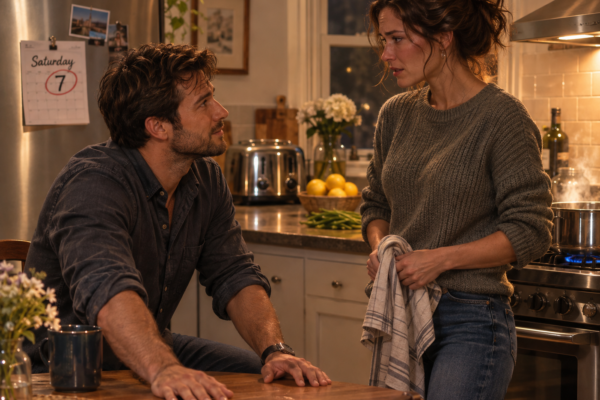
The following Tuesday, I was on the couch with my laptop open to a purchase order I had been pretending to read for an hour. Helena had gotten home at a quarter to six, and from the sound of it, she had put her bag down, run the tap, and gone to her room the way she always does.
Around eight, I looked up for no good reason and saw that her bedroom door was open. It was not wide open, and it was not the way it had been that first night when I walked out of it with the latch held in my fist. The gap was roughly a hand’s width, and through it a strip of lamp light lay across the hallway floorboards—pale gold against the gray, long enough that it nearly touched the foot of the couch.
I knew at once that it had not been left that way by accident, because Helena shuts that door each evening with the same small, decisive push that she gives the dishwasher.
I will admit that I read the whole situation wrong several times in the space of a minute. In the first, the open door was an invitation, and I was a coward for sitting on the couch. In the second, it was only a habit she had picked up after the scare, a way to hear the front of the apartment, and I was a fool for imagining anything else. The third version was that she was waiting to see what I would do, which was worse than the other two, because it made my choice into an answer to a question I did not know how to read.
What I finally settled on was the one I could defend in daylight. I had walked through that door once because she was afraid, and she had not asked me to walk through it tonight. So I stayed where I was, in the part of the apartment that belonged to both of us. And I read the same line of the purchase order six more times. My foot, I noticed, kept tapping against the floor—the way it does when a table’s order has been sitting too long.
At about eight, Helena appeared in her doorway holding a paperback against her chest, dressed in an old college sweatshirt, her hair pulled into a knot that was already giving up. She did not step out into the hall. She leaned on the frame with one shoulder, which put the lamp behind her and made it hard to see her face, and she asked whether the radiator in the hallway had been knocking in my room too.
I told her it had, a little, mostly around two in the morning when the building turned the heat down, and that I had been meaning to mention it to the manager.
— “It’s louder on my side,” she said. “I thought you might have a theory.”
I said my theory was that the pipes were old and the manager was optimistic, and that if it kept her up, she should tell me and I would send an email with a firmer tone.
She nodded, and for a moment she stayed where she was, one hand resting on the frame as though she had one more sentence to hand over and was weighing what it would cost.
— “Let me know if it’s still bothering you,” I said, and I kept my laptop on my knees and my feet on the floor. It was the sort of thing I would say to a coworker at the end of a long shift—polite and available and nowhere near close enough to touch.
Helena’s smile arrived about half a beat later than it should have, and her thumb moved once along the edge of the paperback.
— “Sure,” she said. “Thanks, Oscar.”
She went back into her room without closing the door, and the strip of light on the floorboards narrowed a little as she crossed in front of the lamp and then widened again. I stayed on the couch long after the purchase order stopped meaning anything.
I could not tell whether I had shown her the respect I meant to show or whether I had stood politely on my own side of the hall while she tried a second time to ask for something. The light stayed where it was until past midnight, when I finally closed the laptop and walked to my room along the edge of it, careful not to step into the gold. Before I shut my own door, I looked back down the hallway, and the gap in hers was still there, exactly as wide as it had been.
I lay awake, wondering whether she would say what she wanted if I gave her no excuse, and whether I would know what I was hearing when she did.
The door stayed open for six nights.
Each evening, Helena came home, ran the tap, and went down the hall. And each evening, the gap in her doorway appeared with its strip of lamp light across the floorboards—never any wider and never any narrower.
I did what I had decided to do, which was nothing, and I got very good at it. On Wednesday, I sent the property manager an email about the radiator with a firmer tone, as promised. And on Friday, a man came and bled the pipes.
By Monday, my night off, I had cooked a pot of pasta that was too large for one person and eaten two bowls of it standing at the counter, while Helena took a single bowl back to her room and said, “Thank you,” without quite looking at me.
At nine, I was rinsing the pot when I heard my name from the hallway.
— “Oscar.”
She was standing in her doorway in the college sweatshirt with a dish towel over her shoulder for no reason I could discover, and the lamp behind her made a pale edge around her hair. The building was quiet in the ordinary way, with a television murmuring somewhere upstairs and nothing at all on the landing, and I realized I had checked the deadbolt twice since dinner without admitting it.
— “Nothing is wrong,” she said in the tone of someone reading terms and conditions aloud. “I want to say that first, because I know exactly where your mind goes. Would you come in for a while?”
I dried my hands on my jeans, which is what a man does when he needs something to occupy them, and told her I would.
This time, I stopped at the threshold because there was no hand around my wrist and no reason I could point to for being there. Helena had already sat on the bed with her back against the headboard and her knees drawn up, and I noticed she had cleared a space on the quilt by moving a stack of withdrawn library books to the floor. The radiator ticked quietly under the window now that a man had bled it, and the whole room smelled of paper and cedar and faintly of whatever she had cooked for her own dinner.
I took the desk chair, which stood by the door, and turned it halfway around so that I could face her without looking like I was interviewing her.
— “Is that where you’re sitting?” she asked.
— “It has a clear route to the hallway,” I said.
And she told me that was the most restaurant thing I had ever said to her.
We talked the way we had in the dark, except that now the lamp was on and neither of us had a noise to listen for. She told me about a six-year-old at the desk that afternoon who had returned a book about sharks with a detailed written complaint that the shark did not actually die at the end. And I told her about a man who had sent back a steak for being too cooked, then sent back the replacement for being too raw.
At some point, she stretched her legs out across the quilt, and her bare feet stopped a foot from the chair. I noticed that I had turned my chair a little toward the door again, and that I kept glancing down the hall past her shoulder at the dark of the apartment. I noticed too that she was watching me do it with the dry, patient look she gives to a child who is clearly about to confess something.
— “You keep checking the exit,” Helena said.
I told her it was habit, and she said it was not a habit—it was a courtesy, and she had been trying to figure out all week whether I was being considerate or whether I was being gone.
— “Both can be true,” I offered, and she shook her head.
— “No. You do this thing where you leave me room to change my mind about everything, and I appreciate it, but I’m thirty-two years old, and I know where the door is.”
Her voice was level, and the little crease between her eyebrows had appeared, which meant she was irritated and had decided to be fair about it.
— “I asked you in here. If you keep acting as if every sentence has to be impersonal in case it turns out I’m wrong, then you’re making the decision for me. Just more politely.”
I had no practiced answer, and I think that was the only reason the true one came out.
— “I walked into this room once because you were scared,” I said. “I’ve been trying for a week not to confuse that with you wanting me here, and every time I get it straight in my head, you leave the door open again.”
She did not say anything for a moment, and the television upstairs went off.
— “So which one is it?” Helena asked, and her thumb had begun to move along the seam of the quilt.
— “I want to stay,” I told her. “I’ve wanted to for longer than I’d say out loud, and I don’t know what you want from me, and I’m not going to pretend I do.”
The sentence sat in the lamp light, and I felt the same flush I used to get as a line cook when the head chef tasted something I had made. Helena put her feet on the floor and stood, and for a second I thought she was about to show me out. Instead, she crossed the rug, took the dish towel off her shoulder with an expression of sudden embarrassment, and tossed it onto the desk beside me.
— “Move over,” she said, and when I looked up, she nodded at the bed. “The chair has a clear route to the hallway, and I’m tired of it.”
I got up and sat on the edge of the mattress at the opposite end from her, which she took as a personal insult and said so. We ended up side by side against the headboard with our shoulders an inch apart—exactly as far as we had been that first night, except that now the lamp was on and both of us knew it.
She leaned her head back and told me, to the ceiling, about the year she moved to Chicago, when she had lived in a place with a locked front door and a man downstairs who played the saxophone at four in the morning, and how the first time she had ever felt completely safe in a room was when a co-worker fell asleep on her couch and she could hear another person breathing.
I did not say anything clever. Her hand had come to rest on the quilt between us, and eventually, without looking, she laid two fingers across the back of my hand and left them there—light and deliberate. I turned my palm up under them, because it seemed the only answer that did not need words, and the room went very quiet.
I could feel her pulse in the tips of her fingers, quick and not frightened, and I knew the difference now. When she turned her face toward me, our heads were close enough that I could see the faint freckle at the edge of her lip, and she did not look away, and neither did I. We stayed like that for longer than a person stays by accident, and a breath that I would have called a sigh went out of her.
Whatever came next, I could feel it standing on the other side of the room like a third person who had arrived late, and I understood that I did not want to take it from her by guessing. The invitation had been for a while, and the while had been a good one, but she had said nothing about the rest of the night.
At a quarter to eleven, she yawned into her shoulder, and I stood up slowly enough that she could stop me if she wanted to, and she did not.
— “I should let you sleep,” I said, and she held on to my fingers a half second longer than the sentence needed before she let them go.
— “You should,” she agreed, though she looked a little as though she wished she had said something else. “Thanks for coming in.”
I told her the pleasure was mine, which sounded ridiculous and was also true, and she laughed softly and pulled the quilt up to her knees. At her door, I turned back, and she was watching me from the pillows with the lamp on her cheek.
— “Leave it the way it is,” she said, and for a moment I did not know whether she meant the door or the evening.
I left it exactly as I had found it—a hand’s width open. In my own room, I sat on the edge of the bed with the hallway light striping the floor, and I understood that Helena had told me, as plainly as she knew how, what she wanted for one evening. It was my turn, and for all my careful weeks, I had never once offered her something I had chosen on my own.
I spent the rest of that week doing something I had never done in the apartment, which was making a plan. At the restaurant, I can reorganize a Friday night dinner service in my head while a walk-in cooler dies behind me. But I rehearsed one sentence for four days and could not get it to sound like anything except a man holding a clipboard.
The gap in Helena’s doorway stayed exactly where it was every evening, and I walked past it each time with the uncomfortable feeling that I was being asked a question in a language I technically spoke. What I decided was that I would stop answering her door and start answering her.
On Saturday morning, I closed out the night at one, set an alarm for eight like a lunatic, and found Helena at the kitchen counter in her library cardigan with a mug of tea and a list she was pretending not to be reading.
— “I’m going to the market on Milwaukee Avenue,” I said, which came out more briskly than I had practiced. “I go most Saturdays when I’m awake, and I’d like you to come with me.”
Helena set the list face down and looked at me for what felt like a full table turn.
— “Is this a date, or is it a produce run?” she asked, and her voice was light enough that I could not tell how much weight was under it.
— “It’s two people going to a market,” I said, and I heard myself leave the door wide open for either answer out of habit.
She picked up her mug, took a sip, and nodded slowly.
— “Those are some of my favorite kinds of outings,” she said, and her smile showed up a full beat early this time, though she watched me over the rim of the cup as if she had noticed exactly what I had not said.
The market took up two blocks of a side street, with tents the color of old canvas and a man selling honey who knew me by name. Helena and I turned out to walk in completely different ways. She moved fast and read everything—the hand-lettered signs, the farm name stamped on crates, a laminated certificate on a cheese stand. While I stopped at every table, picked things up, and asked the vendors how their week had gone.
By the third stall, she was standing next to me with her arms folded and her eyebrows up.
— “You are auditing that peach,” she said, as I turned it over under the awning and pressed my thumb against the soft spot near the stem.
— “I’m interviewing it,” I told her.
— “It doesn’t seem to want the job.”
She snorted, and a few steps later, I caught her pulling a marker out of her bag and politely correcting the spelling of “tomatoes” on a chalkboard, while the farmer watched her with open delight.
By eleven, I had a bag of cherries, and she had a loaf of seeded bread, which she tore in two on the sidewalk and handed me half of without ceremony. We carried it toward the lake because neither of us wanted to go home yet, and neither of us said so.
On a bench near the water, with joggers coming past and a wind that smelled of cold stone, she asked me what I did on days off when nobody needed anything from me. I admitted that I usually cooked far too much food, and that when I ran out of that, I walked into other restaurants to see how they were run—which she told me was like a dentist visiting other dentists for fun. In return, she confessed that she rearranged the books on her shelf every few months by a system she changed on purpose so no one could ever find anything but her.
Our hands brushed once on the bench slats between us, and I did not take hers, and she glanced at my fingers with open interest, like a woman noticing a man declining dessert.
— “You say ‘not a date’ the way people read the terms and conditions,” she observed.
— “I’m trying to be careful with you,” I said.
— “I noticed,” she answered. “And I’m still deciding how I feel about it.”
We got back to the apartment a little after two, sunburned in the odd, patchy way of people who were not planning on the sun. Helena put the bread on the counter, and I put the cherries in a bowl, and the apartment looked the same as it always had, which felt strangely rude.
She said she wanted to borrow the small speaker from my room for her kitchen radio, which had been crackling all week, and she was already crossing the hall as she said it.
— “Could you knock?” I said, before I could examine the sentence, because my door had been closed for two years of habit and I had no vocabulary for anyone walking through it.
Helena stopped with one hand lifted, and the hurt crossed her face and was gone in about the time it takes a plate to land.
— “I wasn’t going to go in,” she said evenly. “I was going to ask you to get it. And I’d like it noted that I’ve been tiptoeing around your door since the first week because you sleep until noon.”
That was the first real argument we had ever had, and it lasted perhaps two minutes in the middle of the hall with a bag of bread behind us. I told her that my room after a closing shift was the only place in my life where no one asked me for a single thing, and that I was afraid of what it would mean if that stopped.
She told me that she had left her door open all week because it was the only way she knew to say something without a lecture, and that the plan had been working about as well as shouting down a well.
We both heard it at the same moment. I think if this turned into something, neither of us was going to stop needing a room that could be shut, because we still shared a lease, a refrigerator, and a landlord who answered email slowly.
Helena let out a breath, and I went into my room, found the speaker, and handed it to her at the doorway like a man returning a borrowed book.
— “Thank you,” she said, and this time she meant the knock.
That evening, her door was open—its usual hand’s width—and the lamp light lay across the floorboards, but I did not sit on the couch and stare at it. I walked to the kitchen where she was washing the knife we had used on the bread, and I said out loud and in the plain overhead light that I had enjoyed the day more than I had been able to say at the lake.
Helena turned off the tap and dried her hands on her sweatshirt.
— “I didn’t leave it open for you tonight,” she said. “I left it because I like the light. If I want something, I’ll say it in here, where you can hear me.”
I told her I had liked hearing it. And she told me she’d had a good day, too. And then she said she would like another one.
I said yes before the sentence had finished, and neither of us looked toward the hallway.
I lay awake for a long time afterward, listening to her radio through the wall, working perfectly. A second day was a plan, and a plan was easy. But I could feel that the next thing I asked her would need a name I had spent weeks refusing to say, and terms for what it would do to the apartment. Helena had stopped waiting for me to read her door, and I had stopped waiting for her to leave it open. What neither of us had worked out yet was how to ask for the thing itself, in words, when the hallway was quiet and nobody was afraid.
We got the second day on Sunday—a matinee of an old movie at a theater on Southport, where Helena whispered corrections to the trivia slides before the film started. By the time the credits ran, I had stopped pretending any of this was an errand.
We walked home without talking much, and the silence between us was the comfortable kind, which was exactly what made the next step so difficult. I had called one day a market trip and the other a movie, and the third thing I asked her for was going to need a real name.
That night, I stood in my own doorway at nine with my lamp on behind me, listening to Helena’s pages turn across the hall. Her door was open—its usual hand’s width—and I could see a slice of her at the desk with her hair clipped up and one sock half off. I did not cross the hall, because I wanted the question to be asked from my own side of it.
— “Helena.”
The pages stopped.
— “I’d like to take you to dinner on Tuesday, which is my night off. I mean it as a date, and I mean the whole word. If you’d rather not, that’s fine, and nothing about living here changes. We can say I asked about the thermostat and go on with our lives.”
She did not answer right away. The chair creaked, and she appeared in her doorway and leaned against the frame with her arms crossed in the posture she uses on patrons who say they returned the book last week.
— “Say the last part again,” she said.
I told her I was only trying to keep her from feeling cornered, that she did not owe me an answer tonight, and that I would be perfectly decent about it either way.
— “I believe that,” Helena said. “And I also think you built yourself an exit before you finished asking. If you ask me out, Oscar, you can’t have one foot out the door before I’ve said a word. It makes the question sound like something you could take back without it costing you anything.”
It stung because it was accurate. I had spent fifteen years learning to leave a customer a graceful way out of every awkward moment, and I had apparently carried the habit into the one conversation where it did not belong.
I stood there in my socks and tried again, slower.
— “I want to take you to dinner on Tuesday. I want you to say yes. And if you say no, I’ll be disappointed. I’ll still make the coffee on Wednesday morning, and you’ll still be comfortable in your own home. But I won’t pretend it didn’t matter.”
Helena’s mouth moved, and the dryness in her eyes gave way to something warmer.
— “Yes,” she said. “That was the version I wanted.”
I thought that was the end of it, but she held up one finger and went back into her room. She returned with the index card from the refrigerator—the one with the police report number—and turned it over to the blank side and clicked a pen.
— “Terms,” she said. “I’m not leaving a note on the fridge about our feelings, so don’t look like that. I just want one thing said out loud. Some nights I’m going to close this door because I want the room to myself, and it won’t be a verdict on you or on Tuesday.”
I nodded and told her mine, which was that after a closing shift, I need an hour behind my own shut door with nothing asked of me. I also told her that if I ever said I needed an evening alone, it would mean exactly that and nothing else.
She put the card in her pocket without writing a word, and the pen went behind her ear.
— “Good,” Helena said. “Then we both know what a closed door means, and we can stop interpreting the open ones.”
On Tuesday, I got ready in my room with the door shut, and I knocked on hers at ten to seven, even though it stood open. She came to the doorway in a dark green dress with her good coat over her arm and looked at my knuckles with open amusement.
— “You knocked on an open door,” she said.
— “You told me to knock,” I said.
And she said that was a ridiculous thing to do and she would be grateful to be knocked on for the rest of her life. I decided not to examine that sentence in the hallway.
We took the stairs, and the stairwell door at the end of the corridor swung shut behind us with a quiet, solid click that I had never heard it make before.
I had chosen a small Portuguese place in Andersonville where I did not know a single employee, so I could be a customer instead of a manager. It was the first time in years that I sat down in a dining room without counting the tables that had not been bussed. Helena noticed me not noticing, and she told me so over the bread, which I considered an unreasonable amount of attention to pay to a man’s hands.
She ordered for both of us after asking one question about shellfish, and she was right about every dish. Halfway through the meal, she reached across the table and took my hand—not by accident, and not with a glance toward me first. The way a woman signs a page she has read to the end.
I had been bracing for the night of the doorknob to come up, and I had half planned a gentle way of steering around it. Helena brought it up herself while she was cutting a piece of fish, with the same plain voice she uses for fines and overdue notices. She said she had not thought about the knob in nearly a week, and that she was a little surprised to notice it.
I admitted that I had checked the deadbolt twice every night since, and she asked without any edge whether I was going to keep doing that on dates.
— “It’s mine,” I said.
— “That’s good,” she replied. “I’m not here to be looked after, Oscar. And if I get tired, I’ll tell you, and if I want to go home, I’ll say that, too. For the record, I don’t want to go home.”
I told her that was the best thing anyone had said to me all year, and she looked pleased and slightly embarrassed to be told so.
We stayed until the staff began stacking chairs on the far tables, and I paid the check without a single competing offer from either of us. Outside, the wind had come up off the lake, and Helena slid her arm through mine as if she were testing a banister. She talked the whole length of Clark Street about a patron who had been trying to renew a library card in his dead brother’s name, and I listened with the particular focus I used to reserve for the hardest tables of the night.
Somewhere near the L stop, I realized I had not once thought about where the evening was supposed to end. She was not waiting to be protected on the sidewalk, and I was not waiting for her to tell me what she wanted. We were two adults walking home together because we had decided to.
The building lobby was warm and brightly lit, and the new camera over the elevator had finally arrived—a small black dome blinking a patient red. We rode up without saying much, and she kept her arm through mine until the doors opened. In the corridor, the stairwell door clicked into its frame behind us, and I turned the key in our front lock, which now moved so smoothly it felt like a different door.
Inside, the apartment was dark and still, with the radiator quiet and the coffee maker’s small green light glowing in the kitchen. Nobody had tried a single thing in the night, and nobody was going to.
Helena hung her coat on the hook beside mine and then stood very still in the hallway, which she had never done. Her door was open its usual hand’s width, and mine was closed, and the fourteen feet of floorboard between them looked longer than it had any right to. She was holding her keys against her palm, and I had no clipboard and no list—only the whole evening still warm on my skin.
We had said what a closed door meant and what an open one did not, and we had eaten a dinner that could not be taken back. What neither of us had worked out was which of us should move first now that the hallway was quiet and no one needed to be rescued, and which door either of us wanted to walk through.
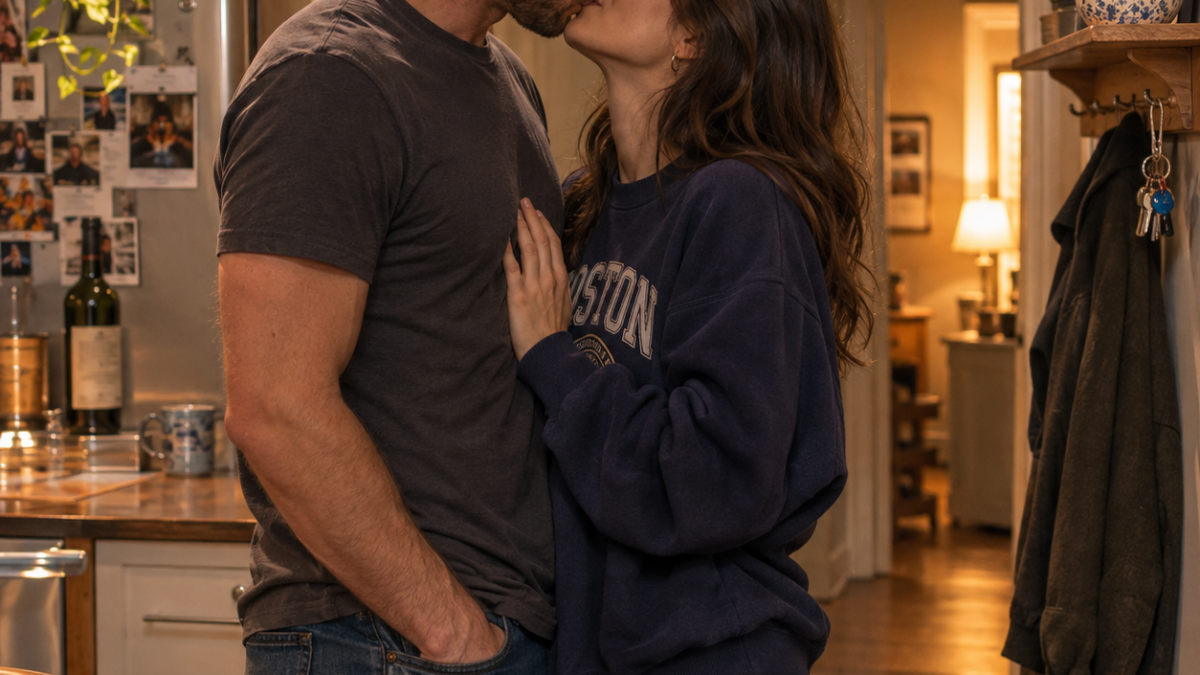
Helena moved first, though not toward either door. She crossed the hall to where I stood, set her keys on the shelf by the coats, and kissed me with one hand flat against my chest as if checking that I was real. It was brief and certain, and it tasted faintly of the coffee we had drunk after dinner.
When she stepped back, her cheeks were pink, and she looked pleased with herself.
— “That was the first thing I’ve done all night that I planned,” she said. “The next thing I’m planning is to close my door for an hour, because I’ve been charming since six, and I’d like to be a person alone for a while.”
She went down the hall and shut her door, and the latch made its small, ordinary click. Two weeks earlier, that sound would have sent me into a fresh argument with myself. And now it meant exactly what she had said it meant.
I washed the two glasses we had left in the sink, put the cherries in the refrigerator, and realized somewhere in the middle of it that I had not checked the deadbolt. I decided to leave that fact alone.
When the kitchen was clean, I stood in my own doorway and looked at my room the way a stranger would. The cookbooks on the shelf had broken spines. A blackout curtain covered the window, and the bed was unmade because I had slept there that morning like a man leaving a crime scene. Nobody had been inside it in eight months except me and the property manager, and he had only come to look at a vent.
I gave her the full hour, which was harder than any dinner rush I have run. At eleven, I walked down the hall and knocked on her closed door, which broke no rule, because I was asking and not entering.
When she opened it, she was in the college sweatshirt with her hair down and a paperback held against her hip.
— “My door is open,” I said. “I’ve never asked anyone into that room, and I’d like you to come in. I want you to say yes. And if you say no, I’ll be disappointed, and I’ll still make the coffee in the morning.”
Helena looked at me for a long moment with the little crease between her eyebrows, and then she slid a receipt into her book to hold the page.
— “That is a much better version than the one you rehearsed in the hallway,” she said. “Yes.”
She stopped at my threshold the way I had once stopped at hers, except that she was smiling. She took in the cookbooks, the framed menu from the first kitchen I ever worked in, and the dent in the pillow, and she sat down on the edge of the mattress and bounced once.
— “Your bed is as firm as a countertop,” she informed me.
— “It was sold to me as supportive,” I said.
— “By whom? A prison?” she asked.
I laughed harder than the joke deserved, mostly from relief, and she tucked one foot under her and patted the quilt beside her.
— “Nothing is wrong,” she said in the tone she had used on the night of the pasta. “Nobody is at the door, and I want you to know that before I say the rest. I’m not here to be kept safe, Oscar. I’m here because I’ve been walking past this door for eight months wondering what was behind it.”
I told her the answer was mostly laundry, and she said she was prepared to be disappointed and was not.
She pulled me down beside her, and for the first time there was no folded blanket’s width of mattress between us. My lamp stayed on, and her hand did not shake at all when she laid it against the side of my face.
We kissed for a long time—slowly, in the way two people do when neither is waiting for an alarm. Her fingers found the back of my neck, and I learned that I had been right to count that first quiet inch of mattress as a kind of fortune.
At some point, I said that I did not want one night to turn into a standing claim on either of our rooms, and that tomorrow she might want her own bed. And that was allowed.
— “I know,” Helena murmured against my jaw. “I wrote the terms, remember?”
Later, she reached over and turned off the lamp herself, and I noticed that the dark in my room was nothing like the dark in hers, because neither of us was listening for anything.
In the weeks that followed, the arrangement turned out to be a good deal less dramatic than either of us had feared—which I mean as a compliment.
Some nights I came home from a closing shift at one, found her door shut, and took my hour behind mine without a word spoken. And the next morning, she knocked on my frame with two mugs of coffee and asked whether I was accepting visitors.
— “Come in,” I said, and she sat on the end of my bed and told me she was spending the day in her room with a novel and the door closed. And I said I had inventory and would do the same.
At eleven, I heard her door click, and I thought it one of the warmer sounds in the apartment.
That Sunday evening, she stood in her doorway with the door pushed all the way back and the lamp bright behind her. She held out her hand and said:
— “Stay in here.”
The words were the same as on the worst night, but her fingers were warm and steady, and she was in no hurry at all.
— “For how long?” I asked.
— “Until one of us wants the door shut,” she said.
And I took her hand and walked in.
The chain is still on our front door, by the way, and it has never once been used, which I consider a perfectly respectable career for it.
I used to think a good home was a place where nothing was asked of you, and I had built eight months of careful quiet on that idea. It turns out the better thing is a place where you can ask, hear a real answer, and be glad of either one.
I am still the man who checks the deadbolt, but I do it out of habit now, and not out of dread. And I get to do it with someone’s hand in mine.
So here is my question for you: Have you ever had someone arrive in your life at the worst moment and had to find out whether you wanted them there when the danger was gone? Tell me in the comments what you would have done with that open door.
If this story kept you company tonight, like the video and subscribe, because there are plenty more late-night stories on the way.