A Barefoot Bridesmaid Knocked on My Cabin Door in the Fog. She Asked, “Can I Stay Until Morning?”

A Barefoot Bridesmaid Knocked on My Cabin Door in the Fog. She Asked, “Can I Stay Until Morning?”
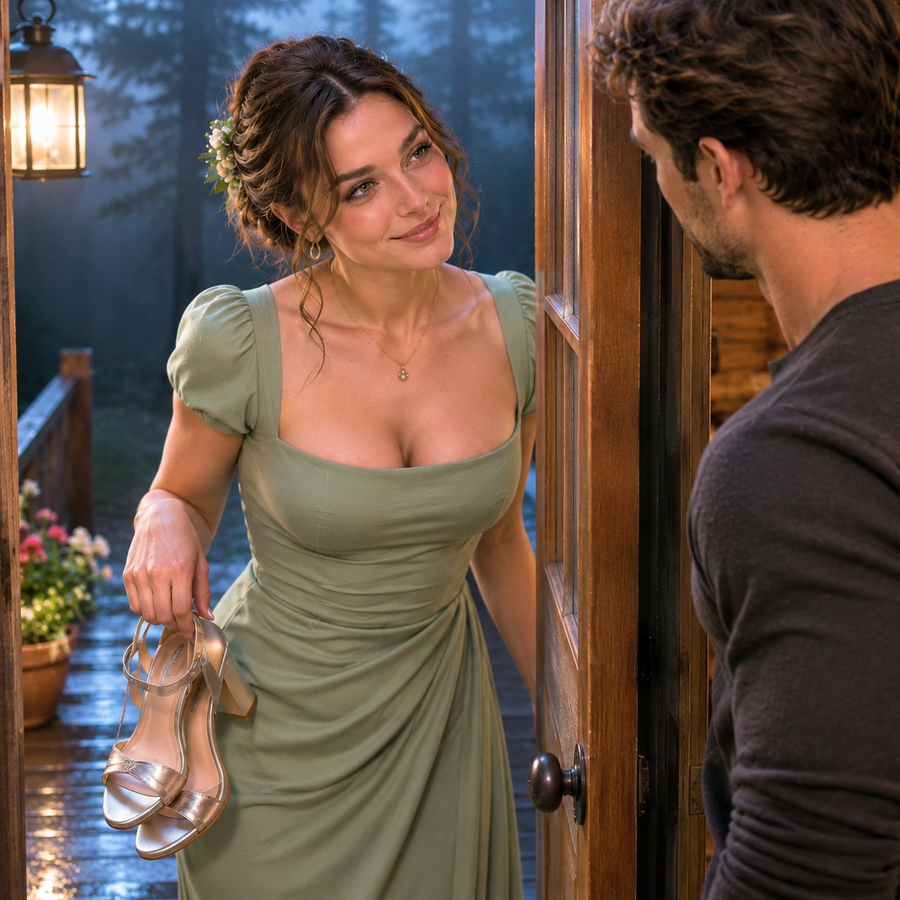
The knock came a little after 11:00, three light wraps that I almost mistook for the cabin settling.
When I opened the door, a woman in a green bridesmaid dress was standing on my porch barefoot with a pair of silver heels hanging from two fingers. Fog had come down the mountain so thickly that my porch light seemed to stop at her shoulders. Her hair was coming loose and her feet were wet with grass, and she wore the smile of someone who is embarrassed and has decided to be funny about it.
I know this is a lot to ask a stranger, she said, but can I stay until morning?
My name is Dario Mancini and I build and repair interiors for a living, which means I notice a person’s footing before I notice almost anything else.
Hers was fine, just cold. So I asked whether she was hurt, and she said the only damaged thing was her pride.
She told me she had stepped out of the wedding reception to breathe, then picked what looked like a shortcut back to the lawn from the lower trail. The fog had closed over the path behind her within a few minutes, and she had stopped when she saw my light because walking farther in the dark with no shoes seemed like a way to end up in a ravine.
Helena Price, she said, holding out the hand that wasn’t full of heels, and I shook it and stepped back from the doorway.
Fog followed her in like a dog that had decided the cabin was its own. I told her the truth about the place, which is that it has one main room, a wood stove, and a back room where I keep a day bed for the weekends my brother visits. The back room has a real door that I hung myself with a latch on the inside, and I said she could use it however she liked.
She asked to borrow a phone charger, and I found one in a kitchen drawer along with a towel and a pair of my wool socks that came halfway up her calves. While the stove caught, she called the bride and told her where she was and that she was safe, and I read her the number off my mailbox because that is the closest thing the lower has to a street address.
I heard the bride laugh loudly through the phone and then asked for a photo as proof and Helena turned the camera toward the woodstove and said the proof was a very serious man holding a kettle. I decided not to defend the kettle.
Over tea, Helena worked out quickly that I was not a guest and had never been on the wedding list, though I had replaced the railing on the resort’s back staircase in the spring.
So, you’re not part of any of this, she said, waving a hand at the mountain above us where the party was still going on in the fog.
I told her I was a carpenter who lived under the party and heard the bass line most summer weekends. She said that made us strangers in the cleanest possible sense and I agreed because it was true and because I liked how she said it without apology and without much worry. She asked how far it was back to the resort and I answered the way I always do.
It was 8/10 of a mile up the marked trail, I said, about 600 ft of climb with a left at the split by the birch tree with the orange tape. Helena looked at me over the rim of her mug for a long moment. I asked if you minded having a stranger in your living room, she said, and you told me about a birch tree.
I said the trail was a safer answer and she asked safer than what, so I got up to check the stove, which did not need checking. When I sat back down, she was grinning and she asked whether I ever just said what I wanted or whether I only gave people directions and let them find the rest themselves. I told her I wanted her to be warm and dry and able to sleep and that this was currently the full extent of my wants.
She nodded slowly like someone filing away a very specific answer and then said she was glad, team, mostly. The word sat between us for a second and neither of us touched it because she was wearing my socks in my cabin at midnight and we both knew that was not the moment for it.
She was an attractive woman with a quick mind and bare cold feet and I understood that if I acted on any of that tonight, I would be charging her rent for a roof she had asked to borrow. I think she understood the same thing because she picked up her heels from beside the door, set them on the hearth to dry, and said it was very nice to be somewhere nobody expected her to hold the mood together. I made up the day bed with the good blanket and checked that the latch worked, then showed her how to flip it from the inside.
She stood in the doorway for a moment with her tea, looking at the narrow bed and the jars of screws on the shelf behind it, and said it was the nicest storage room she had ever slept in.
I told her to knock on the wall if she needed anything, and she said she would, though she didn’t think she would need to.
The door closed softly, and I heard the latch slide into place, a clean little sound that I had made a thousand times without ever listening to it. I banked the stove and lay down on the couch with the lamp off, listening to the fog drip from the eaves. A thin line of light stayed under her door for a long while, and I thought about how at dawn the fog would lift and show her the trail plainly.
After that, she would have no reason at all to be anywhere near my porch, and I found I was already curious what she would do with that. I woke on the couch to sunlight on the floorboards and the sound of the latch sliding back. The fog had gone completely, as if it had never been there, and through the east window the mountain looked rinsed and ordinary.
Helena came out of the back room in the green dress with her hair finger-combed into something almost tidy, and she stopped to look at the room properly for the first time. Last night it had been a lit window in the dark, and now she could see the workbench along one wall and the stacked boards drying by the stove.
I put eggs on and toast under the broiler, and she took the mug of coffee I handed her without pretending she needed to be waited on. She sat at the counter and asked what a regular day looked like for me, and she said it the way people ask when they actually want the answer. I told her I was usually up at six and out by seven, headed for a farmhouse kitchen I was finishing in Waterbury and that the quickest way there was the county road to the feed store and then a right at the covered bridge.
I kept going, mentioning the construction detour on Route 100 and the fact that the back way added 11 minutes but saved the transmission. She waited until I ran out of road and said that was a very thorough description of how I got to work and no description at all of what I did once I got there.
I said the work was cabinets and trim mostly and that I liked it and she nodded the way you nod at a man who has just handed you a map when you asked for a story. I plated the eggs and noticed that I had not said anything about what I wanted my week to look like because it had not occurred to me that anyone would ask.
After breakfast, she took her heels off the hearth where they had dried stiff overnight and checked them for damage with a manager’s eye.
She handed back my wool socks folded in a square and said they had been the best part of her evening and I said I would tell them. Her phone had charged enough to show nine messages from the bridal party, mostly in capital letters, and she skimmed them with an expression of fond exasperation. The photo of my wood stove had apparently become a group joke and someone wanted to know whether the serious man with the kettle was single.
She read me that one out loud with a perfectly straight face and then put the phone away without answering, which I noticed and chose not to comment on. I walked her out a little before nine.
The trail looked completely different in the daylight, wide and mossy and so plainly marked that last night’s disaster seemed almost insulting to both of us.
Pine needles were still wet from the fog and the orange tape on the birch tree fluttered in a breeze she had not been able to feel in the dark. She found the whole thing funny because the shortcut she had trusted had turned out to be a deer path that ended at a drainage ditch, which I showed her from a safe distance.
Where the lower trail met the gravel service road at the junction. I stopped, because from there, the way uphill was obvious and graded, and maybe 10 minutes of easy walking. Helena sat on a stump and slid on the heels, said she could do 10 minutes in them if she had to, and that her sneakers were waiting in her room at the resort.
I did what I always do and pointed out the route. The marked trail went left, I said, and the way back down to my cabin was the same trail in reverse, with the split at the birch and the orange tape. And in daylight, it was a 20-minute walk even in flat shoes.
I heard myself say all of it in the same voice I would use to explain a staircase to an inspector. Helena stood up and smoothed her dress, and then she asked in a very mild tone whether that was a suggestion. I said it was information, and she asked what the difference was, and I told her the difference was that a suggestion would put me on one side of the question and her on the other.
She waited, perfectly patient, giving me every chance to put myself on a side. What I said instead was that she knew where the cabin was and that it was entirely up to her, which was true, and which was also a very careful way of not asking. She looked at me for about as long as she had over the tea mug, and I think she understood exactly what I had just done.
Okay, she said, and there was no edge in it, only a small, rueful pleasure, like someone who had figured out a puzzle and decided not to gloat. She thanked me for the roof and the socks and the proof of life for the bride, and she said I made a decent host for a man who gave directions like a county surveyor. Then she started up the gravel road in her silver heels, in the sun, with the green dress swinging around her calves.
She did not look back until she reached the bend where she turned and lifted one hand, and I lifted mine and felt immediately like a man waving at a train. I walked down to the cabin and loaded the truck with my tools and a box of hinges, then drove the county road out to Waterbury and hung cabinet doors for six hours.
It was good, steady work, and none of it needed me to think, which turned out to be the problem. Every time I checked a door for square, I found myself back at the junction, listening to a woman ask me what the difference was. She now knew the birch tree, the orange tape, the split in the trail, and the exact length of the walk, and I was the one who had put all of that in her hands with great care.
What I had not told her, and what I could not seem to stop turning over with a level in my hand, was whether I wanted her to use any of it. The knock came at two the next afternoon, while I was running a hand plane down a cherry mantel board that had been waiting all week for me to care about it. It was the same three wraps as the night before, but they were firmer now, the knock of someone who could see exactly where she was standing.
I set the plane down and opened the door, and Helena was on my porch in jeans, a loose white shirt, and a pair of scuffed sneakers, with her hair pinned up in a way that suggested a hairdresser was coming for it later. The sky behind her was a hard, clean blue, and the trail she had come down looked like a street. I had spent most of the morning telling myself that a woman with a wedding to attend would not walk 20 minutes downhill for a man who had given her a lecture on birch trees.
I said hello, like a man who had been expecting a delivery.
Before you ask, she said, I’m not lost.
Nobody is searching for me, and I wore real shoes. She leaned on the door frame and looked at me with the same patient expression she had used at the junction. I told her I had not been about to ask anything, and she said that was the most Dario thing I could have said.
She had a free window until the ceremony at six, and the bridesmaids were all upstairs having their faces painted, which she had decided she could survive without. Then she said the part I had been turning over in Waterbury with a level in my hand.
Last night I came here because I needed a roof.
Today I don’t need anything from you, and I wanted to see if I’d still want to come anyway.
I stepped aside, and she walked in past the wood stove as if she were checking on a room she had left in my care. It occurred to me that the honest answer was sitting right there, and that I could either hand it over or give her another landmark.
I hoped you would, I said, which came out rougher than I intended.
I didn’t ask because it didn’t seem fair to ask a woman who has a whole wedding going on to climb down a mountain for me.
Helena smiled slowly, the way she had when she caught me checking a stove that was fine. She said it was a very kind reason, and also a very convenient one, and that she had noticed the difference at the junction. I told her I was aware she had noticed and that I was working on it.
We did not stage anything. I had a mantel to finish and a screen door waiting for new hinges, and she said she would rather watch a person do his actual afternoon than be entertained for it. So I went back to the cherry board while she sat on the end of the workbench with a glass of water and asked about everything on the walls.
She wanted to know why every chisel hung inside a chalk outline, what the jar of mismatched drawer pulls was for, and who had left a child’s drawing of a horse pinned above the pegboard.
I told her my brother’s daughter had made it for me and that the horse was mostly a dog.
At some point I made sandwiches and we ate them on the porch steps where she took in the clearing, the wood pile, and the tomato plants I had planted in old paint buckets along the rail. She said it looked like a place where a man had made a lot of small decisions in a row, and all of them had held. I mentioned that I had to go into the village in the morning to pick up a stair tread order at the lumberyard and that I always stopped for coffee afterward, and I said it only as a fact about my Sunday.
Helena filed it away without a word. Around three, her phone started buzzing on the bench, and I assumed it was the bridal party again.
It was her sous chef in Providence calling about a produce order that had arrived short, and I watched her change in about four seconds.
She stood up, her voice dropped half a step, and she sorted out the substitution, the supplier’s apology, and a menu note in the time it took me to find a drill bit.
When she hung up, she was already putting the phone face down and rolling her shoulders as if she had stepped back into her own skin for a minute and found it fit.
I said she was very good at that, and she said it was the part of her job she would do for free, and the part she never wanted to do on a Saturday afternoon in someone else’s socks.
What I noticed was that she did not carry the call back into the room with her. She sat down again and let a whole quiet stretch go by while I sanded, and she was easy in it, with no performance and no jokes arriving on a timer. I had known her for less than a day, and I could already tell the quiet cost her nothing.
At 4:15, she checked the time, winced, and said hair was at five. I walked her out to the porch and handed her the sandwich plate to carry back, which she took as if it were a trophy. She asked me nothing about whether I wanted her to go, because by now she knew I would never answer it honestly that way, so I asked a different question.
When do you need to be back uphill? I said. Helena stopped halfway down the steps and turned around with one sneaker in the grass and one still on the porch.
You said when? She said.
Last night you would have said that I probably had to be going. Do you hear that? I told her I could hear it and that I was not entirely sure where it had come from, and she laughed and said that was fine because she was not either.
She came back up one step, which put us level, and the porch creaked under her. I like this, she said, nodding at the clearing, the bench and the screen door that was still missing a hinge.
I like it enough that I’m a little worried it’s only the weekend that makes it feel this good.
Then she told me that the ceremony was at 6:00, the reception would run late, and checkout was at noon the next day. And she said it plainly, like a woman putting a time on a table. She did not ask me for anything, and I did not offer her anything.
And I noticed that we were both being careful in exactly the same direction. She kissed me once on the cheek, quick and warm, and told me to put a hinge on that door before someone mistook it for a ghost.
I watched her take the trail up in the afternoon light, sneakers quiet on the needles, until the birch with the orange tape swallowed her. She had come down on her own for no reason except that she wanted to, and she had told me so out loud.
That made two visits in two days, and I understood that the cabin had been the easy part. Everything either of us wanted to say still depended on whether this place was the only room in the world where it could be said. I had put the hinge on the screen door at 10:00 the night before, after the baseline from the resort finally stopped, and I was a little embarrassed by how quickly I had done it.
By a quarter to 8:00 the next morning, the door swung level and quiet, and I was standing on the porch with the truck keys when Helena came down the trail in sneakers, jeans, and a gray hooded sweatshirt that said Rhode Island in faded letters. She looked like a woman who had danced until 1:00 and slept for 4 hours, and she was carrying a paper cup from the resort lobby. She stopped at the bottom step, looked at the door, and said the ghost had been evicted.
Then she told me she had heard there was a lumberyard and a cup of coffee on my Sunday, and she wanted to come along. The farewell brunch was at 11:00 and checkout was at noon, so she could be gone until about 10:30, and she wanted me to know she was not asking to be entertained or driven anywhere out of pity. My plan had been to drive straight to the lumber yard, load the stair treads, and be back by 9:00, because that was the plan I would have made for any Sunday.
I heard myself start to describe that plan to her with the route and the time, and I stopped halfway through the word lumber yard. Instead, I called Gill at the yard and told him I would be there closer to 10:00, and he said that would be fine, and that he would leave the treads under the awning.
Then I drove us down the county road and parked at the edge of the village green instead of at the loading dock so that we could walk. Helena watched me do all of this from the passenger seat with her coffee against her chin.
She did not say anything about it, but she finished the cup a little faster like someone who had just been told there was no hurry. Stow on a Sunday morning is mostly closed, which suited me. We walked past the white church and the hardware store with its sale rack of snow shovels, and she took the sidewalk side without being asked while I stayed nearer the street.
A woman walking a beagle said good morning to me by name, and Helena raised her eyebrows at me until I admitted that I had built the woman’s pantry two summers ago.
At the bakery on the corner, the girl behind the counter knew my order and looked at Helena with open curiosity, and I said we would take two of the large ones and a cinnamon roll to split. Helena said that was a very decisive thing to say for a man who could not tell me whether he wanted a stranger on his couch.
I told her the roll was a smaller commitment than the couch, and she laughed so loudly that the beagle woman looked back from across the street.
We took the coffee to a bench on the green where the grass was still dark with dew, and a man was setting up a table for a farmer’s market.
Without the trail and the birch tree between us, the teasing about directions kind of ran out of fuel, and she started asking real questions instead. She wanted to know what week looked like when I was not talking to her, and this time I did not start with a road.
I told her I had the Waterbury kitchen until the end of the month, that Thursday nights I ate dinner at my brother’s house in Burlington and fixed whatever his wife had been politely pointing at, and that the niece with the dog horse drawing was about to start
piano and wanted me to build her a bench that could hold three stuffed animals.
I told her I had kept the cabin and the local work because the work was steady, and because my brother family was a 40-minute drive away, and I liked being 40 minutes away. She listened with her chin on her fist, and when I finished, she said that was the first time I had told her a week instead of a route.
She told me about hers in return, and it was a different kind of life, quick and loud and full of other people’s evenings.
She ran the floor at a restaurant in Providence five nights a week with a dining room of 90 seats and a kitchen staff who treated her Tuesday off like a holiday they were privately afraid of. She had a small apartment with a fire escape she had made into a herb garden, a standing Wednesday lunch with her sister, and a crew she had trained for eight years that she was not ready to hand to anyone else.
She did not say it as a complaint or as a boast, only as a list of things she had chosen, and I recognized the tone because I used it myself about my wood pile. What I noticed most was that she never once said she was escaping any of it, even though she had every excuse to describe the weekend as a vacation from her real life.
She wanted the weekend and the life both, and she seemed to see no contradiction in that. It was a quarter after nine when I looked at my watch, and I did it before I could think about whether I wanted her to see me do it.
You told me 10:30, I said.
The lumber yard is 5 minutes from here, and I can have the treads loaded in 10 if Gil doesn’t want to chat, so you have a little room.
I had expected her to say she should head back, which would have been reasonable, and I had my face ready for that. What she did instead was look at the bakery, then at the green, then back at me.
She said she had room and she was going to use some of it, and she asked whether the stair tread order was big enough that I would need help carrying it. I said it was nine treads and one very long conversation with Gil, and she said she was good with long conversations, and we got up from the bench. Gil did want to chat.
He leaned on the counter and asked Helena three separate questions about where she was from while I loaded the truck, and she answered all of them like someone who had worked a dining room for a decade and found that charming. When I came back in for the paperwork, she was holding a pencil behind her ear and telling him how she ran a lunch rush, and he looked at me over her shoulder with an expression I did not care to examine.
We were in the truck by 10:00, driving back up the county road with the treads rattling under a tarp, and neither of us had mentioned that she had a drive to Providence in 2 hours. The road climbed into the trees, and the quiet that settled in the cab was not the easy kind from the afternoon before.
We had spent a morning being ordinary together in the middle of a town, and it had worked, and I could not find anything in it that could be blamed on fog. That made it harder to wave off because it left the real question where both of us could see it.
She lived in one state and I lived in another, and neither of us had said a word about the miles between them. Helena waited until the road had climbed out of the village traffic and into the trees, and then she turned in her seat to face me. I need to say something before we get to your birch tree, she said, and I need you not to hear it as goodbye.
I told her I would do my best, and she nodded at the windshield as if she were gathering her thoughts. She said the last 3 days had been the freest she had felt in a year because somebody else had paid for the room, her sous chef was covering the floor, and nothing on the mountain belonged to her to fix.
Nobody is themselves at a wedding, she said.
“I’m not either.
I like you, and that part I’m sure about, but I can’t treat a weekend like this is proof that we know each other.
I don’t know yet whether I like you on a Wednesday.”
I pulled onto a gravel turnout where the road bent above the valley, set the brake, and let the engine tick down. The treads shifted once under the tarp behind us and went still.
For three days I had managed every difficult moment with a landmark, and it had worked because nobody can say no to a direction. Helena had not pulled away from me, and she had not asked me for anything. She had simply put the real question on the dashboard where we could both look at it.
And I understood that I could either hand her another set of turns or say the thing plainly.
“I give directions because nobody ever turns one down,” I said.
“I’d like to find out about Wednesday.
I’m not asking you to move anything around, and I’m not asking for a promise.
I’m just saying it out loud so it’s been said.
” She did not answer right away.
She looked at me for about as long as she had over the tea mug that first night. And then she laughed quietly and shook her head.
She said that was almost a whole sentence with no landmarks in it, and that she was going to let me have it.
“Here’s what I can give you,” she said.
“My day off this week is Tuesday.
The restaurant is called Fenimore’s on Wickenden Street, and you already know what city I’m in.
So you know where I live in every way that matters right now.”
I said that sounded like a map, and she said it was a map with the last turn missing on purpose. She was not going to send me a pin or sit by a phone on Tuesday waiting for it to ring because she would be at the farmers market buying too many tomatoes either way.
“If you want my number, you ask me for it,” she said.
“I’m not turning this into a promise you haven’t decided to make.”
I started the truck again, and neither of us said much for the next mile, though it was not the heavy silence from before. It was the quiet of two people who have each put something on the table and are letting the other one look at it. The treads rattled under the tarp as we climbed back toward the lower trail and I caught myself rehearsing Tuesday in my head.
I would have to move the Waterbury homeowner who had been polite about everything so far and my brother’s Thursday dinner could survive on its own schedule.
I parked at the junction where the gravel road met the marked trail, the same stump sitting there in full sun and I noticed that I had said none of the logistics out loud. Helena noticed that I had not said them and she looked pleased about something she did not explain.
She got out of the truck with her paper coffee cup crushed flat in one hand and stood at the open door for a moment. Brunch was at 11:00, she told me. Checkout was at noon and she planned to be on the road to Providence by 1:00 at the latest.
She laid her hand on top of mine where it rested on the gear shift only briefly with her fingers warm from the cup.
I won’t look for you at this junction, she said.
I looked for you here once and I’d rather you come find me properly.
After that, she shut the door and walked up the gravel in her sneakers and she did not turn around at the bend. I understood that she was not being cold and that this time she was leaving the next move entirely in my hands without calling it a test. I drove back to the cabin and unloaded the stair treads one at a time into the shop, stacking them on stickers against the wall so the air could reach every side.
It was good oak, straight-grained, and I handled it more carefully than it needed. I kept thinking about how it had felt to stand at that junction on Friday morning, being told it was entirely up to her and how it had looked to her from the other side. She had taken it gracefully and I understood now that grace was not the same as being given what she wanted.
I had a possible Tuesday in front of me and a brother who would cheerfully cover for me and I had no one left to blame for the fact that I had not asked for either one. The last tread went onto the stack a little before 11:00. And I stood there with sawdust on my forearms and the shop door open to the clearing.
Up the mountain, the resort would be setting out brunch for people who were tired and happy and a little sunburned. And somewhere among them, a woman in a Rhode Island sweatshirt would be pretending not to check the clock.
I had shown Helena every inch of that trail, and I knew to the foot how far it was and how long the climb took. She had given me a day, a street, and an open question, and she had asked for nothing back. For the first time all weekend, the only person who could close the distance was me.
And I had until about 1:00 to decide whether I was going to walk up the trail I had been so careful to point out to her. I called the homeowner in Waterbury before I could talk myself out of it and asked whether Wednesday would work instead of Tuesday for the cabinet doors.
She said it would be no trouble and that I sounded winded. And I said I was about to go for a walk.
I washed the sawdust off my forearms at the utility sink, put on a clean shirt, and left the truck keys on the hook by the door. The marked trail started where it always had, with the left at the birch and the orange tape fluttering above it. I knew the distance to the foot, 8/10 of a mile and about 600 ft of climb, but I had never walked it for a reason of my own.
The needles were quiet underfoot, and I noticed that I was walking faster than the grade called for. The resort parking lot was full of people loading cars and hugging each other in the sun. And it was a little past noon when I came out of the trees.
Helena was at a small gray hatchback near the end of the row with the trunk open and a garment bag lying across her suitcase. Two bridesmaids stood beside her holding paper cups, and one of them saw me first and stopped talking Helena turned around, still in the Rhode Island sweatshirt, and I watched her face go through surprise, and then something warmer that she did not try to hide. I had not texted or called or sent kind of warning because for once I did not want a message to make the decision for me.
I walked straight across the asphalt and stopped about a yard from her, out of breath, and the bridesmaids found something urgent to do at the other end of the lot. You told me to ask for your number, I said.
I’d like to, and I’d like to ask for Tuesday while I’m at it.
She closed the trunk gently and leaned back against it with her arms crossed and her mouth already starting to give her away. I told her I had moved the Waterbury job to Wednesday, that I could leave Stow at 6:00 in the morning, and that I would be on Wickenham Street by 11:00.
I said I was not asking her to change anything about her day off, and I wanted to see the life she had described to me on that bench, the market and the fire escape and the dining room with 90 seats. Then I said the last part plainly with no turns in it.
I’m not offering you a route.
I’m inviting myself to your Tuesday and I’d like you to say yes.
She looked at me for about as long as she had over the tea mug on the first night, and I did not fill the silence. Is that a suggestion or information? She asked, and I told her it was a suggestion, the clearest one I had ever made.
She laughed, the loud kind that made the bridesmaids glance over from the far row of cars and said that 11 was fine and that I should find her at the farmers market where she would be buying too many tomatoes. She recited her number slowly like someone dictating a measurement to a carpenter, and I typed it into my phone and read it back digit by digit.
When I finished, she took the phone out of my hand, called herself from it, and handed it back while her own phone buzzed in the pocket of her jeans.
Now you’ve asked for it, she said.
That counts. Neither of us tried to make the goodbye into more it was.
She stepped in and kissed me, with one hand flat against my chest and the other still holding her keys. And it was warm and unhurried and exactly as long as we both wanted. When she stepped back, she was smiling and a little flushed and she said that four hours of highway would not get shorter because of it.
I said I knew and that I would be the one doing the driving. She got into the hatchback, rolled down the window and told me that the bride was going to demand a full report on the serious man with the kettle.
I watched her pull out of the lot and turn onto the resort road, and this time she lifted her hand at the first bend instead of the last one. I walked back down the trail in about 19 minutes, which was faster than I had ever managed it. And the birch with the orange tape looked like any other tree.
On Tuesday, I left the cabinet six with a thermos and the cherry mantel board wrapped in a blanket on the passenger seat because it had come out well and I wanted her to see it. I crossed into Massachusetts as the sun climbed, then Rhode Island under a flat bright sky, and I noticed that for four hours nobody had given me a single direction I could not handle.
Providence turned out to be tighter and louder than I had pictured, with brick row houses on a steep hill and a harbor smell on the wind. I called her from a side street when I could not find a place to park, and she told me to go left past the hydrant painted like a lobster and take the first open spot after the bakery.
When I asked whether that was a suggestion or information, she said she was standing at the corner watching me do it and that it was a very strong suggestion. She was waiting by a tomato stand at the market with two canvas bags that were already full and a third she was apparently planning to fill. She wore a yellow sundress and sandals and her hair was down, and I realized I had never seen her in a place that belonged to her.
She did not ask whether she could stay, and I did not offer her any directions. We bought peaches and basil and a loaf of bread that she insisted I carry, and she introduced me to the man at the egg stand as a friend who had driven down from Vermont.
After that, she walked me up Wicken’s Street past Fenimore’s, where her sous chef waved through the window with a spatula and passed the fire escape with the herb garden, which was real and slightly out of control.
By 1:00 we were eating lunch at a counter two blocks from her apartment. And before we finished, she told me that next time she would come north and that this time she expected to be asked first.
I said I could manage that, and I meant it. I I still have the speech I gave her in that parking lot memorized, and it is not a good speech, but it has no turns in it. For three days I had been so careful about how I pointed her toward my door that I almost forgot a door works in both directions.
THE END.