“Don’t You Dare Touch My Son!” She Slapped Mistress At Party – Photo Of The Boy Left Everyone Stunned
“Don’t You Dare Touch My Son!” She Slapped Mistress At Party – Photo Of The Boy Left Everyone Stunned
Maren barely slept.
At dawn, she sat on the floor of Eli’s enormous bedroom with the steel lunchbox open in her lap while pale sunlight crept across the carpet.
The lock hung loose.
There were no scratches around it and no bent metal, nothing to suggest it had been forced. Whoever opened it had used a key, the way you open a door you have every right to walk through.
She ran her fingers along the inside.
The lining was gray with years of dust except for one clean rectangle near the bottom, about the size of a deck of cards.
Something had rested there.
For five years, something had sat inside her husband’s lunchbox under her son’s bed, and neither of them had ever known.
Did Dad hide it, Mom?
Eli whispered from the doorway.
I don’t know, sweetheart.
Her voice was steadier than she felt. He never told me about this.
That was the part that frightened her most.
Danny had told her everything, or so she had always believed. At breakfast, Julian listened to the whole story with his coffee untouched and his brow creased in perfect concern.
He promised to look into it personally. The security cameras in the East Wing, he explained, had been down for maintenance that very night, an unfortunate coincidence.
Probably a night shift employee checking the windows, he said.
And honestly, he added with a gentle laugh, even if someone did touch that old lunchbox, I’m sure whatever was inside wasn’t worth stealing.
Maren set down her fork.
She had told him only that someone had been in Eli’s room.
Nobody had said a word about anything being taken.
She smiled and said nothing, and she folded the thought away like a letter she was not yet ready to read.
Julian turned to Eli and ruffled his curls. I know this house feels strange, champ, and I know you miss your dad.
I only ever knew his name, Danny Ellis. I wish I had known the man behind it.
Eli looked up at him and squinted the way he did when a math problem refused add up. He said nothing at all.
Celeste swept in a moment later with a leather folder under her arm, apologizing for interrupting, though she did not look sorry.
Her eyes slid across the room until they landed on the corner of the dining table where Eli had been building a bridge out of popsicle sticks.
It was nearly 2 ft long, the best he had ever made. She walked past it and her heel came down with a small, precise crack.
Oh dear, Celeste said softly.
Things built on nothing to tend to collapse. Then she turned to Julian with a dazzling smile.
The board is waiting, Jules.
Eli knelt and picked up the broken sticks one by one. He did not cry.
Marin felt her heart split down the middle.
She bent to help him, and he whispered so quietly she almost missed it.
It’s okay, mom.
I can make another one. The weeks turned into months and the house began to rearrange itself around Celeste.
Julian’s chair sat empty at dinner more often than not.
By spring, Celeste had moved her office into the east wing, three doors from his study, for efficiency. She chose the menus, the flowers, and the guest lists.
She gave orders to the staff and Marin’s hearing as if the lady of the house were another piece of furniture.
When Marin finally spoke up, Julian sighed and rubbed his temples.
Celeste has been with me 12 years.
You’re not going to make me choose between my wife and my right hand, are you?
Marin did not yet understand how carefully that question had been built. Then came the little things.
A faint smear of red on a white collar, a magazine photograph of a charity gala with Julian’s hand resting low on Celeste’s back at an event Marin had never been told about.
When she asked, Julian’s face hardened.
You’re being insecure.
Don’t turn everything into a tragedy.
He said it so often that she began to say it to herself. She stayed because Eli had finally stopped flinching at doorways.
She stayed because she told herself she would leave when she had proof. One afternoon in the rose garden, Margaret Hartwell, who had barely spoken to her since the wedding, looked up from her pruning shears without any warmth in her face.
My son was always ambitious, Maren. Be careful what you ask this house.
It tends to answer. She snipped a bloom from its stem.
And keep that boy close. That night, Maren went downstairs for a glass of water and found the study door ajar.
A thin line of lamplight cut across the marble floor.
She heard Julian’s voice low and tense, and she stopped breathing.
No, Celeste, the drive was damaged.
We recovered 8 minutes out of 30.
That’s nothing.
A pause. Danny made a second copy.
He always did. I knew him well enough to know that.
Maren pressed her hand against her mouth. Knew him, not his name, him.
Then it’s somewhere in this house.
Julian went on quieter now. Or with that woman or with the boy.
The boy has every single thing that man ever touched.
The floorboard under Maren’s foot gave a long, slow creak.
Inside the study, the voice stopped.
Then the desk chair scraped back and Julian’s footsteps started toward the door.
Julian Hartwell never walked into the shop empty-handed again. One week, it was a paper bag of warm pastries from the bakery on King Street.
The next, it was a library book about suspension bridges for Eli with a ribbon marking the chapter on steel cables. Eli, who usually took months to trust a grown-up, began watching the shop window every Thursday at 6:00.
Maren told herself it was only kindness. A man like Julian belonged in rooms full of chandeliers, not behind a counter crowded with spools of thread.
So one evening, while he waited for a button to be sewn back on, she finally said what had been sitting on her tongue.
Your company paid for my husband’s funeral.
Danny Ellis, he worked on one of your sites. Julian went very still for 2 seconds, no more.
The warmth drained out of his face.
Then he set down his cup and shook his head slowly. Hartwell has thousands of workers, Maren.
I’m ashamed to say I never met your husband.
I wish I had. He said it gently that she felt guilty for asking.
She smiled, told him it was all right and let the subject die. Much later she would replay that moment and count those two seconds again.
You’re the first person who ever charged me full price, he told her another night, laughing.
Everyone else wants something from me. You only want the sleeve to fit.
Marin felt her heart open a little wider. She had spent five years asking the world for nothing.
And here was a man who seemed to see that as a gift. The proposal came at Waterfront Park at sunset with no photographers and no violins, just a thin gold band and a plain box.
Marin’s hands flew to her mouth.
I can’t say yes without one condition, she whispered.
If Eli ever feels like a guest in your home, we walk out.
That’s all I ask.
Julian knelt and took her hands.
He will never be a guest.
He’ll be family.
I promise you.
She cried and she said yes.
Later that night, wrapped in the glow of it, she told him about the last thing Eli had of his father, a dented steel lunch box that lived under the boy’s bed.
Danny’s key to it had been lost years ago.
He sleeps beside it like it’s a teddy bear, she said, laughing softly.
Julian laughed too, but his thumb, which had been stroking her knuckles, stopped moving.
The wedding was small in a garden behind the courthouse.
Eli carried the rings with the terrible seriousness of a nine year old, or rather a seven year old in a suit Marin had sewn herself.
Julian’s mother, Margaret Hartwell, arrived late in a silver wrap, studied the bride from head to toe and said, So you’re the seamstress.
She did not say it unkindly.
She said it the way someone names an item on a receipt. Afterward they moved into Magnolia Hill, the Hartwell estate, 40 rooms behind iron gates where the fountain ran all night.
Eli’s new bedroom was larger than their entire old kitchen and sitting room combined.
He walked its edges slowly, touching the furniture as if it might bite.
Mom, he whispered, where are we actually allowed to sit? Marin knelt and straightened his collar.
Anywhere you like.
Money doesn’ change who we are.
Eli nodded and then very quietly slid the steel lunch box under his enormous new bed.
Celeste Whitlock came into their lives on the very first evening. Julian introduced her at dinner as the director of communications for Hartwell Development.
The woman who handles everything I’m too busy to remember.
She wore a tailored red dress and a smile like fresh paint.
She called him Jules. She knew he took his coffee black and hated cilantro.
When she passed his chair, she straightened his tie without being asked.
And Julian let her the way a man lets someone who has done it a hundred times before.
Then she turned to Eli.
Her eyes lingered on his dark curls on the squint he wore when he was thinking.
What a sturdy little boy, she said lightly.
Does he have his father’s eyes?
It was a perfectly ordinary question.
Marin couldn’t say why it made the back of her neck go cold.
Late that night while Marin slept a black car idled beneath the oak trees outside the estate gates.
Celeste sat in the passenger seat, her red nails drumming on the window.
Well, she said, does she have it?
She has no idea what she has, Julian answered, loosening the tie she had straightened.
Her son sleeps with it under his bed like a teddy bear.
Celeste let out a slow breath that was almost a laugh.
Five years we’ve kept this buried, Jules.
Don’t get sentimental now.
I’m not sentimental.
I’m patient.
He looked up at the dark windows of the house.
There’s a difference.
Hours later, Marin woke to the sound of small feet.
Eli stood in her doorway, hair wild, clutching his pillow, his face tight in the moonlight.
Mom, he whispered, somebody was in my room. She was out of bed before he finished.
Maybe you were dreaming, sweetheart.
I wasn’t.
His voice shook.
Dad’s lunch box was never open, not once, not ever.
But the lock is open now, mom, and it’s empty.
Marin stared at him. Then far down the dark hallway she heard a door click softly shut and the faint expensive trace of perfume drifted past her in the air.
Don’t you dare touch my son.
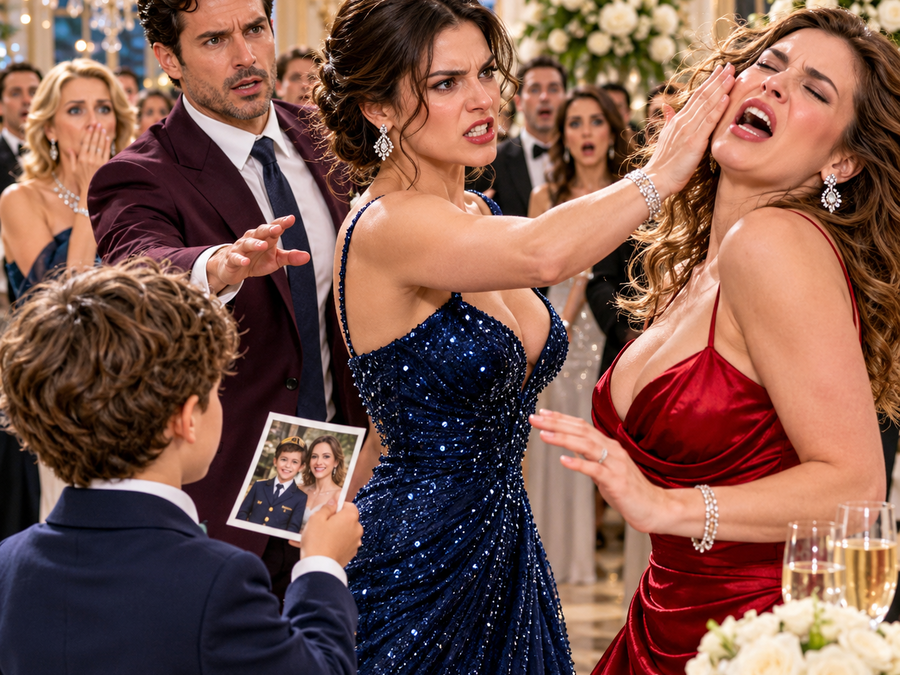
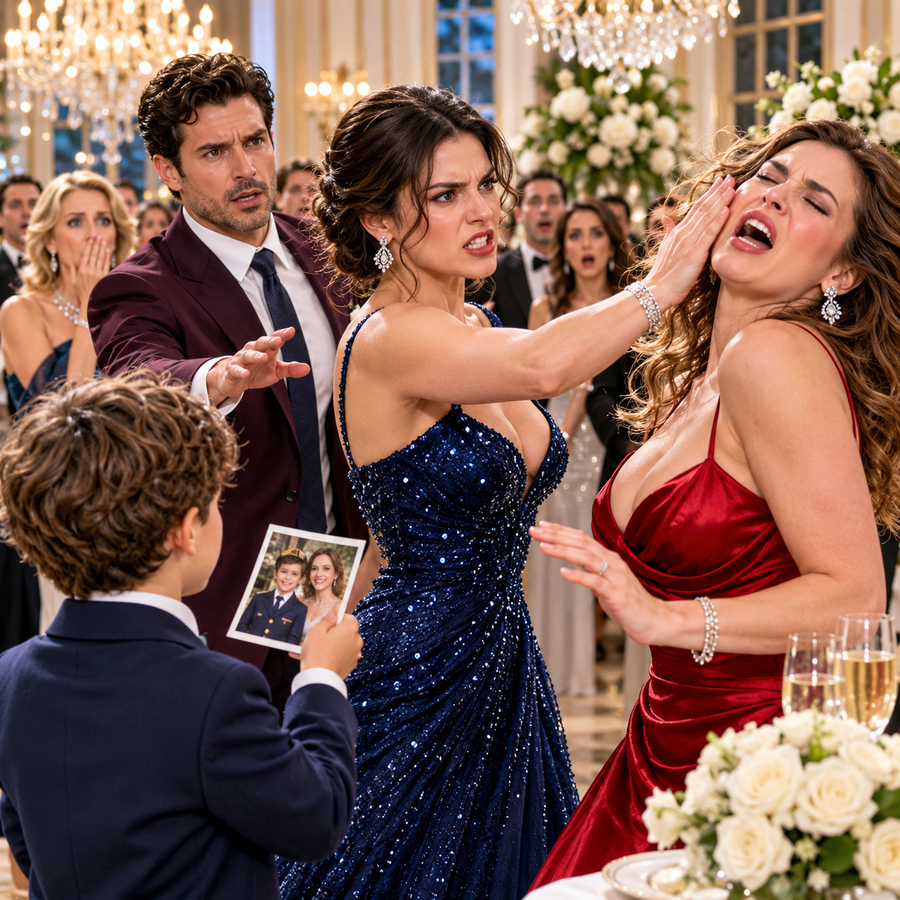
Marin Hartwell’s voice tore through the grand ballroom, and a heartbeat later, the crack of her palm against Celeste Whitlock’s cheek echoed beneath the crystal chandeliers.
More than 200 guests stopped breathing. The string quartet cut off mid-note.
A glass of champagne shattered on the marble and nobody even turned to look.
Every eye was fixed on the woman in the cream beaded gown, her chest heaving, her hand still hanging in the air. Celeste staggered back in her red sequined dress, one hand pressed to her burning face.
Behind her stood a pale blue birthday cake covered in golden stars, nine small candles still flickering. Nine candles for a boy who had turned nine that very day.
That boy, Eli, stood a few feet away in a navy blazer too big for him, clutching the edge of the gift table.
Seconds earlier, Celeste had gripped his shoulder and hissed that a charity case had no business near the cake.
Then, loud enough for the whole party to hear, she had told him his mother had married into this family for money and that guests who stayed too long got shown the door.
Eli hadn’t cried.
He had simply gone quiet, the way children do when they have heard too many cruel things too early.
Marin, Julian Hartwell, the millionaire host of the evening and Eli’s stepfather, shoved through the crowd with his jaw locked tight.
He did not look at the boy. He did not ask whether the child whose birthday this was had been hurt.
Instead, he cupped Celeste’s face and examined her cheek as if it were porcelain.
Have you lost your mind? Apologize to her right now.
Marin stared at her husband and something inside her went perfectly still. Every excuse she had ever made for him collapsed at once.
She opened her mouth to answer, but a small voice got there first.
Mom. Eli had slipped a hand into the pocket of his blazer.
He pulled out a creased photograph, its colors faded to warm yellow, and held it up with both hands, the way you hold something that might break.
Why is Julian in Dad’s last picture?
The photograph showed three people in white hard hats in front of a half-built tower.
In the middle, laughing at whoever held the camera, stood Danny Ellis, Marin’s late husband.
On his left, a hand on Danny’s shoulder stood a younger Julian Hartwell.
On his right, smiling thinly, stood Celeste. And in the corner glowed an orange date stamp that Marin recognized before she could even read it.
It was the day Danny died. You told me you never met my dad, Eli said, his voice shaking but clear.
You said you only knew his name.
Julian’s face lost all its color.
Celeste’s hand dropped from her cheek.
Near the cake, Julian’s mother pressed her fingers to her pearls.
And somewhere in the crowd, an old man in a black tuxedo whispered a single word.
Impossible.
Give me that, Celeste said, lunging forward, her voice cracking with something that was no longer anger.
It was fear.
Marin stepped between them, took the photograph from Eli’s trembling hands and pressed it against her chest.
What was hiding in a faded old photograph that could drain the color from a man who owned half of Charleston? Why would a woman who had just been slapped in public care more about a picture than her own pride?
And why had Julian Hartwell sworn the day he married Marin that he had never once met her
first husband?
If this story already has you holding your breath, subscribe and stay with me, because the truth is far darker than that photograph.
To understand how a quiet tailor ended up slapping the most dangerous woman in that ballroom, we have to go back a year and a half to the day Marin thought she had finally found someone to lean on. A year and a half earlier, Marin Ellis lived in a narrow rented house on the edge of Charleston, a few blocks from the little shop where she did tailoring and alterations.
The sign above the door read Ellis Alterations, painted years ago in her late husband’s careful handwriting.
She woke at 5:00 every morning and measured her life in hems, zippers, and the price of her son’s school shoes.
She never called herself unlucky.
She found joy in small things, like the way seven-year-old Eli lined up popsicle sticks on the kitchen table to build bridges far too ambitious to stand.
had his father’s dark curls and his habit of squinting when he thought hard.
He never asked for expensive toys. He had learned early the difference between what he wanted and what his mother could afford.
Danny had died when Eli was barely two. A fall at a construction site, the letter said.
An unfortunate accident, the company said. Hartwell Development had paid for the funeral, mailed a polite condolence card, and handed Marin a modest settlement along with a form she was too heartbroken to read twice.
She had signed it.
She had never asked questions because nobody had ever given her a reason to.
Then one cold Thursday evening, 10 minutes before closing, the bell above her door rang, and a tall man in a dark overcoat stepped inside with a tuxedo jacket over his arm.
I’m sorry to come in so late, he said, with a smile that apologized for the whole world.
I have a gala in an hour and I tore my sleeve on a car door.
His name was Julian Hartwell.
Marin recognized it from the business pages, and a second later from the letterhead of that old condolence card. But he said nothing and she decided it would be rude to ask.
She fixed the seam in 15 minutes.
He paid triple.
When he noticed Eli’s photo beside the register, he asked the boy’s name and remembered it.
He came back the next week and the week after, always with something small to mend, always with a question about Eli.
Slowly, her guard came down. She never noticed the one detail that should have warned her.
The tear in that first sleeve was far too clean, too straight to have come from any car door.
Julian Hartwell had not walked into her shop by accident.
He had come on purpose, and he had come for something that belonged to Danny. Marin did the only thing she could think of.
She slid sideways into the narrow alcove beside the staircase, pulled the heavy velvet drape across herself and stopped breathing. The study door swung open.
Lamplight spilled across the marble and through a gap in the fabric she could see one polished shoe in the long shadow of a man listening. Her pulse pounded so loudly in her ears that she was certain he could hear it too.
Who’s there?
Julian asked softly. Nothing answered him except the slow tap of a cane against stone.
It is nearly 1:00 in the morning.
Julian. Margaret Hartwell stood at the foot of the stairs in a silk robe, her silver hair loose around her shoulders.
Any business that cannot wait until daylight is rarely the kind that should be done at all. Julian smiled the easy smile he used on investors.
Only checking the locks, mother.
Then check them in the morning.
She did not blink. Go to bed.
He hesitated for one long moment.
Then the study door clicked shut and Margaret waited until the strip of light beneath it went dark.
She began to climb.
As she passed the alcove, she did not turn her head or slow her step. She only murmured in a voice no louder than a breath.
The third stair creaks.
Keep to the wall next time. Then she was gone and Marron slid down the wall with both hands pressed over her mouth.
She did not sleep that night.
She lay on her side of the enormous bed and Julian’s side stayed cold.
She turned the overheard words over like stones.
Knew him. Danny made a second copy.
The drive was damaged. 8 minutes recovered out of 30.
8 minutes of what? At dawn, she drove to the little shop on the edge of town, unlocked the back room and pulled down the shoebox where she had kept every paper from the worst month of her life.
At the bottom lay the settlement agreement, the one she had signed with a 2-year-old on her hip and a head full of fog.
She had never read past the first page.
Now she read every line.
Clause 7 bound her to permanent silence about her husband’s death under penalty of repaying every cent.
And on the last page beneath the company seal was a signature she now knew as well as her own.
J.
Hartwell.
It was not a lawyer or a clerk. Julian himself had approved the payout for a man he swore he had never met.
She sat very still among the spools of thread.
Then she found the funeral program and tucked inside it a sympathy card signed by Danny’s crew chief, Walt Dawkins.
He had carried the coffin and left Charleston within the month. His return address was in Folly Beach.
Walt lived in a faded blue cottage, one hand shaking around a cane. When he opened the door and saw her, he did not say hello.
He said, I wondered how long it would take you. And his eyes filled.
Over weak coffee at a crooked kitchen table, he told her everything.
Danny had never been careless. Danny had been the safety inspector on Harbor Crest Tower, the biggest project Hartwell Development had ever built.
Three weeks before he died, he discovered that the concrete in the load-bearing columns of the middle floors had been mixed far too weak and that the lab certificates had been forged by someone in Celeste Whitlock’s office.
He gave Julian one chance, Walt said.
Fix it or he’d go to the state on Monday.
On that final Friday morning, Julian and Celeste came to the site in white hard hats. Walt remembered it clearly because Danny asked him to take their picture together.
He said it was for the file, in case anyone ever forgot who stood where.
By 2:00 that afternoon, Danny was dead. The investigation closed in nine days.
A week later, Walt received an envelope of cash and a very firm suggestion to retire somewhere warm.
His safety line didn’t snap, Marin.
Walt’s voice cracked.
I saw the end of it.
It was cut clean.
Marin could not feel her hands. The photograph, she whispered.
Where is it now? Danny took the only print.
I never saw it again.
He pushed his cup aside and leaned closer. That tower opens to residents next month.
300 families, Marin. Kids, grandparents, all sleeping on top of columns that were never meant to hold them.
She gripped the edge of the table. It was no longer only about Danny.
was about every family who would soon unlock a front door in that building and believe they were safe.
Walt lowered his voice. The night before he died, Danny told me something strange.
He said if the first copy ever gets lost, the second is with the one person nobody would ever think to check. He said that person builds bridges.
Walt tried to smile. I laughed.
Your boy was barely two, but I think he meant the little toy bridge he carved for him that winter.
Spent months sanding it.
Marin stopped breathing. She could see it as clearly as if it sat in front of her.
A small oak bridge smooth as river stone with a hollow tower at each end.
Danny had carved it for Eli’s second birthday.
It had stood on a shelf in every room her son had ever slept in.
She was out of the cottage before Walt finished his sentence.
She drove home faster than she had ever driven in her life.
She ran through the marble hall up the stairs and into Eli’s enormous bedroom, her heart slamming against her ribs.
The shelf by the window was there. So was the pale outline in the dust where the little bridge had always stood.
The bridge was gone. Mom, Eli stood in the doorway with his school bag on one shoulder.
He looked at the empty shelf, then at her face, and for a moment he seemed far older than nine.
Don’t be mad, he said quietly.
I moved it.
It’s somewhere safe.
Eli, where? He squinted at her.
Exactly the way his father used to and said the words that made the room tilt.
Because it wasn’t a night shift worker who opened Dad’s lunch box, Mom.
I saw who it was.
Marin dropped to her knees in front of her son and took both his hands. They were ice cold.
Tell me what you saw, Eli. All of it.
He swallowed.
It was Miss Celeste.
The words came out small and flat the way a child says something he has rehearsed in the dark. I woke up around two because the floor creaked.
I kept my eyes almost shut. She was in my room, Mom, in her red nails and she smelled like that perfume.
She went right to Dad’s lunch box and opened it with tiny brass key.
Marin felt the floor tilt. A key?
It had a little dent on top.
I’ve seen it in dad’s old pictures hanging off his belt.
He looked up and his eyes were enormous.
That’s his key, mom, the one you said got lost.
It didn’t get lost.
Somebody kept it. Marin pressed her fist against her mouth.
Julian had kept Danny’s keys for five years quietly in a drawer somewhere in this very house.
He had slipped them into his pocket the day her husband died, and then he had walked into her shop with a torn sleeve and a smile.
She took out something black and flat wrapped in cloth. Eli went on.
She whispered into her phone, got it.
He’ll have it by morning.
Then she just stood over my bed for a really long time. His voice cracked on the last word.
I didn’t move.
I counted to 100 twice. Oh, baby.
Marin gathered him against her chest.
Why didn’t you tell me?
Because Julian said it was a night shift worker, and he was smiling when he said it. And grandma Margaret told you to keep me close, he sniffed.
And because you looked so scared, I thought if I said it out loud, it would be worse. Marin held him until his breathing slowed.
Then she asked the question that had been burning in her since the cottage in Folly Beach.
Eli, your father’s little oak bridge.
Walt said dad hid something in it.
He pulled back and for the first time that morning she saw a flicker of pride.
I know.
3 weeks ago after Miss Celeste stepped on my popsicle bridge, I went to dad’s bridge to feel better, and one of the towers was wobbly.
I opened it with a butter knife.
There was a hollow place inside, mom.
And in the hollow was a tiny black card no bigger than a stamp and a note folded really small. Where are they now?
Mr.Oakforth’s workshop at school.
I put the whole bridge inside the model sailboat we’re building under the false deck.
Nobody looks in there. Marin laughed, a shaky wet laugh because Danny would have loved that.
His son had hidden evidence inside a toy boat.
Do you remember what the note said? Eli closed his eyes and recited it slowly like a prayer he had memorized in the dark.
To whoever finds this, the concrete and Harbor Crest’s middle floors is weak and the lab reports are forged.
The full recording of the meeting is on this card.
Take it to Ruth Alvarez at the State Building Safety Office.
Do not give it to anyone who takes a Hartwell paycheck.
Marin, if it comes to this, I’m sorry.
I love you both more than anything.
Danny.
Tears ran down Marin’s face before she knew she was crying.
Eli wiped them with his sleeve the same way she had wiped his a thousand times.
What she did not know and what he did not say was that the tower had held a third thing, a small folded photograph that he had looked at every night for three weeks.
He kept that one back on purpose.
He had seen what the lunch box did to his mother’s face and in his small stubborn heart he had decided to carry this part alone until he was sure.
Marin found the number on her phone within minutes.
She stepped into the dressing room, closed the door and dialed with shaking fingers.
State Building Safety Office. Ruth Alvarez.
My name is Marin Ellis.
My husband was Daniel Ellis. He There was a long silence.
When the voice returned, it had changed.
Mrs.Ellis, your husband called me the night before he died. He said if anything happened, his wife would eventually call.
I have kept this line open for five years.
Marin slid down the wall and wept. Ruth let her cry.
Then she spoke carefully.
Listen to me.
A recording alone isn’t enough.
Hartwell’s lawyers will say it was edited.
I need something that places Julian Hartwell physically on that site the morning your husband died.
Without that, the tower opens to residents and they’ll walk away clean.
A photograph, Marin whispered, remembering Walt.
There was one, but Danny took the only print.
It’s gone.
On the other side of the door, Eli stood very still with his hand pressed flat against the pocket of his pajamas, saying nothing at all. One more thing, Ruth said, someone from Hartwell Development called this office an hour ago.
They said a grieving widow might phone with wild accusations and that she was emotionally unwell.
Mrs.Ellis, they are already one step ahead of you. The call ended.
Marin stared at the wall, her mind spinning when her phone buzzed with a message from Celeste.
Eli’s party is Saturday.
I’ve invited 300 guests.
Do remind him to bring that sweet little wooden bridge his father made.
Julian would love to display it beside the cake.
See you there.
See Marin read it three times.
Slowly she lifted her eyes to her son who had gone white as paper. Mom, Eli whispered.
I never told anybody that bridge was missing.
How does she know? Marin read the message a fourth time and the words did not change.
Not once in all these months had Celeste mentioned the little oak bridge. Nobody in the house had.
It was one toy among a hundred on a shelf in a boy’s bedroom.
And in the space of an hour it had become the most dangerous object in Charleston. I only said it in my room.
Eli whispered.
I only told you. Marin raised one finger to her lips.
Then she crossed the carpet slowly as though the floor itself were listening and stopped in front of the empty shelf.
Beside the pale outline where the bridge used to stand sat a small framed photograph of Danny with baby Eli on his shoulders.
She lifted the frame. Pressed into the wood behind it no bigger than a shirt button was a black disk with a pinhole in its center.
Her stomach dropped.
Every word spoken in this room since breakfast had traveled straight into somebody’s ear.
The sailboat. The workshop.
Ruth Alvarez’s name.
The note, line by line in her son’s trembling voice.
She set the frame back exactly as she had found it and caught Eli’s wrist before he could speak.
On the back of a receipt she wrote in letters that shook. They can hear us.
Say nothing.
Eli read it. His eyes went wide and then hard and he nodded once.
Then Marin straightened and said in the bright tired voice of a woman with nothing to hide.
Oh sweetheart, I’m sorry about the bridge.
It must have been lost when we moved.
Let’s tell Miss Celeste it broke and I’ll buy you party shoes instead.
Eli, who had been brave in a hundred small ways since his father died, sighed like a disappointed child and said, okay, mom. They walked out of that room hand in hand and neither of them looked back.
They never made it to the shoe store. Marin drove across the Ashley River with her knuckles white on the wheel, running two yellow lights because she knew how fast a woman in red nails could move once she had heard the words sailboat.
They reached Pine Crest Elementary as the lunch bell rang and she hurried Eli around the back of the building to a drafty shed that smelled of sawdust and varnish. Mr.Okafor, a broad man with a gray beard and sawdust in his eyebrows, stood in front of a half-finished sailboat with his arms crossed like a bouncer.
Mrs.Hartwell.
Eli, thank goodness. What happened?
Marin asked.
A woman came about 40 minutes ago in a navy suit, he said.
Said she was from Hartwell Development, here to collect the boat for the birthday party.
She had a letter with Mr.Hartwell’s signature and a very polished smile.
He scratched his beard.
Now I’ve taught Eli for two years and three weeks ago that boy made me promise hand on heart that this boat goes home with him or his mother and nobody else.
So I told her school property doesn’t leave without a guardian.
She did not enjoy that.
She said she’d be back with the principal’s signature.
Eli was already on his knees. He pressed a hidden latch beneath the false deck and drew out the little oak bridge, scarred and smooth as river stone with a hollow tower at each end.
Inside one tower lay a black card no bigger than a postage stamp and a note folded into a tight square.
Marin closed her fingers around both and for a moment she could almost feel her husband’s hand reaching across five years to close them for her.
You saved us, she whispered.
Eli shrugged though his chin was trembling and one small hand drifted as it had so often lately to the inside pocket of his jacket.
Marin, dizzy with relief, did not notice they did not go home.
She drove to Ellis Alterations, locked the door and drew the blinds. On the rack hung the cream gown she had been stitching for Saturday, silk with hand-sewn beads, the most beautiful thing she had ever made.
She turned up the hem, slid the black card between two layers of lining and closed it with stitches so small that no eye on earth could find them.
The note went in beside it. Her hands steadied the moment they began to work.
The Hartwells could search her house, her car and her purse, but they could not search a dress she planned to wear in front of 300 guests.
It was past 6:00 when they returned to the estate. The great house glowed gold against a bruised sky, and every window seemed to be watching them.
Inside the marble foyer, Julian stood at the foot of the stairs with his hands in his pockets.
Beside him waited a thin man in a charcoal vest holding a leather medical bag. Marin, darling.
Julian crossed the floor and kissed her forehead, and she felt Eli flinch behind her.
We’ve been so worried.
This is Dr.Price.
I don’t understand.
Of course you don’t.
That’s what concerns us.
His voice was warm as bath water.
A mother who creeps around at 1:00 in the morning hiding behind curtains, listening at doors. He tilted his head.
The front hall camera is excellent quality, Marin.
I watched you for quite some time.
The room turned cold.
At the top of the stairs a shadow shifted, and Marin saw Margaret Hartwell standing perfectly still with one hand on the rail.
Dr.Price will examine you tonight, Julian went on, and you’ll sign a few papers so that by Saturday you’re resting somewhere quiet.
Eli will stay right here with family.
He smiled.
Or you can refuse, and I’ll tell a judge exactly what a woman like you might do to a little boy.
Marin looked at the doctor’s bag, at her son’s white face, at the front door 100 feet away.
She understood that she had until morning to run or to fight. And behind her, Eli stood perfectly still in the shadow of her coat, slowly his fist around the one thing in that house Julian Hartwell had never thought to search for.
Marin did not move.
The death certificate was still open in her hands, and the name at the bottom of it was now knocking on her door in the middle of the night. Through the woods she could hear ragged breathing, the breathing of a man who had carried something heavy up too many stairs.
She opened the door six inches.
Dr.Howard Price stood in the corridor with his coat buttoned wrong and his tie hanging loose like a thread coming undone.
Behind him, the same young maid from the linen closet twisted her apron in both hands.
Price’s gaze dropped to the paper Marin was holding, to his own signature at the bottom of it, and he closed his eyes.
Mrs.Hartwell, he began.
Then he shook his head.
No, Mrs.Ellis, that’s the name on the certificate I falsified.
I owe you that much at least.
The air left the room.
Marin let him in and turned the lock behind him.
He did not sit. He laid a battered brown envelope on the dressing table and flattened both palms over it as though it might blow away.
Hours after the ambulance brought your husband in, Celeste Whitlock walked into my office, he said.
A woman in a red coat.
She knew my name. She knew about a patient I had lost two years earlier on a night I was exhausted and careless and how I rewrote the chart afterward to hide it.
She never raised her voice. She simply set a copy of that chart beside my coffee.
He swallowed.
Before she arrived, I had already examined Danny.
I wrote everything by hand, the way I always do.
A deep wound at the back of his skull from something narrow and heavy struck before he fell.
Fresh bruises around both wrists shaped like fingers. A safety line cut clean through.
A man who falls from that height does not land with the back of his head crushed and his face untouched.
His voice cracked. I wrote the truth.
Then at dawn I wrote the lie she asked for.
Accidental fall, and she paid me an envelope thicker than my yearly salary. I took it.
That is who I am.
Marin sat on the edge of the bed because her knees had stopped listening to her.
Why now?
Tonight Julian Hartwell handed me a pen and an envelope and asked me to certify a woman I had never examined.
laughed, there was no humor in it.
pen, envelope. your son looked at me from behind your coat squinting.
And I remembered something I have spent years refusing to remember.
A year before he died, one of your husband’s crew lay in my ward with a crushed hand.
Danny slept in a plastic chair beside that bed for three nights and brought coffee to the nurses. He learned my name.
Nobody learns a doctor’s name.
He wiped his face with the back of his hand.
I have a granddaughter turning nine in June.
I can’t keep being the man in that room.
He tore open the envelope.
Inside lay six yellowed pages of cramped blue handwriting, stamped with a date Marin would have known in her sleep.
Clipped behind them were a typed legal petition and a printed airline itinerary.
The first is the truth.
These are Julian’s plans.
Price tapped the petition.
An emergency order to commit you for psychiatric observation, already signed in advance by me.
It’s dated Saturday night, the moment the party ends.
The second it’s filed, Julian becomes Eli’s temporary guardian.
His finger moved to the itinerary.
And this is a boarding school outside Zurich.
One child, one escort departing Sunday at 6:00 in the morning.
Marin read the passenger line and the page began to shake.
Ellis Eli, age nine.
By breakfast on Sunday, he’ll be over the Atlantic, Price said softly.
And you’ll be in a locked room with a sedative and a lawyer explaining why you can’t be trusted with scissors.
Saturday is the only night you have. Why would I believe you?
You shouldn’t.
He met her eyes for the first time.
I’ve been a coward for years.
I’m asking for one day to try being something else.
If Ruth Alvarez is in that ballroom, I’ll stand up in front of her and say every word of this out loud.
Marin was reaching for the pages when the sound came from the corridor.
The slow, precise tick of heels on marble growing closer. Price went the color of ash.
Marin seized his sleeve, shoved him into the walk-in closet among the winter coats and eased the door shut just as three soft knocks landed on the bedroom door.
Marin, darling, I saw your light. She slid the envelope under the mattress, counted to three, and unlocked the door.
Celeste stood in the corridor in a red silk robe with her hair loose, looking like a woman who had never needed sleep. She drifted past without waiting to be invited, her gaze sweeping the room once lazily, the way a cat surveys a garden.
It came to rest on the cream gown which Marin had carried home over her arm that evening and hung on the wardrobe door.
Celeste crossed to it slowly. One red fingernail traced the beaded hem stitch by stitch.
What tiny stitches, she murmured.
You could hide an entire life and work like that.
Marin’s heart stopped, then restarted, and she answered in the flattest voice she had ever heard come out of her own mouth.
I was taught to sew carefully.
I’m sure you were.
Celeste smiled. Wear it Saturday.
Cream is so unforgiving. It shows everything.
She turned toward the door and paused with one hand on the frame.
Oh, and Marin, do tell the good doctor the back stairs are the second door on the left. He has always preferred to leave quietly.
The door closed.
The heels faded down the corridor.
Inside the closet, something small and frightened let out a breath. Marin stood frozen while the envelope burned beneath the mattress, and one thought crawled up her spine.
Celeste had known.
She had known about Price, about the pages, perhaps about every word, and she had still let him walk through that door.
If Celeste had wanted her to read those papers, then what exactly did she want Marin to do with them?
Marin stood absolutely still until the heels faded down the corridor. Then she opened the closet door and found Dr.Price sitting among her winter coats with his face in his hands.
She let me walk right in, he whispered. She did, Marin said, and she wanted me to know it.
It had taken her a long minute to see the shape of it. Celeste Whitlock did not slip in the middle of the night.
She had stood in this room and touched that hem on purpose, and she had said the words, hide an entire life with a smile. She did not know where the card was, but she suspected.
And she wanted Maron to spend a whole day afraid of her own sewing basket, jumping at every footstep and growing more desperate by the hour. A desperate woman makes mistakes.
A desperate woman in front of 300 phones can be made to scream.
Maron crossed to the gown and turned the hem toward the lamp. One bead near the seam sat crooked.
Someone had pressed it back with careless fingers.
She felt for the card and found it still safe under the silk.
Then she took her scissors and in 12 quiet minutes she unpicked it and stitched it somewhere new into the lining of Eli’s little navy blazer, the one he would wear to his own party.
Nobody searches a 9-year-old’s
jacket.
Hear me, she told Price.
You leave by the back stairs with Daphne.
She’ll take you to Margaret’s lawyer.
You stay hidden until Saturday night.
Then you stand up in that ballroom and tell the truth. And you?
I give them the scene they want. Maron looked at him steadily.
Just not the ending they wrote.
Saturday arrived in a blaze of white flowers and gold light.
Florists swarmed the ballroom.
Sound technicians threaded cables behind the stage, and above the dance floor hung an enormous screen, black and waiting, where Julian planned to unveil Harbor Crest Tower in front of the mayor and the press.
A young man in a headset worked the sound desk.
His name was Marcus.
He was Daphne’s cousin, and since midnight he had known exactly what he was going to play on that screen.
And when by 7:00 the guests were flowing in, diamonds, silk, and old money, and Maron stood at the top of the staircase in her cream gown with Eli’s hand in hers.
Down the stairs a small figure in a rented tuxedo that did not fit him was working his way along the wall.
Walt Dawkins had driven all the way from Folly Beach. He caught her eye and gave one slow nod.
Near the cake, Margaret Hartwell sat very upright in a high-back chair, pearls at her throat, her gaze never leaving her son.
And somewhere in the crowd in a plain gray dress, a woman with sharp eyes and a retired school teacher’s name tag was watching the room like someone who read it for a living.
Everyone she needed was here, and nothing had gone wrong.
That was exactly what frightened her. Julian gave a toast with a glass of champagne and a speech about family legacy in the future.
He did not look at Eli once.
Then the lights dimmed, and a candlelit cake with nine small flames rolled out across the marble, pale blue and scattered with golden stars. Applause rippled through the ballroom.
Eli stood beside it very straight, his hands shaking only a little.
Celeste drifted over in her red sequined gown, glass in hand. She stopped beside the boy and rested her fingers on his shoulder, just lightly enough to look like affection.
Smile, sweetheart, she said, and then loud enough for the guests nearest the table to hear.
Some children simply don’t know their place.
Charity cases rarely do.
A few heads turned.
Maren felt her pulse climbing, but she did not move.
Margaret’s words played in her head.
Do not give them the satisfaction. Celeste bent lower.
And his mother married into this house for the money, she announced with a little laugh.
And honestly, who could blame her?
Then she dipped her mouth to Eli’s ear and whispered something very soft, something only the boy and the three people closest could hear.
Maren saw Eli’s face go gray.
She heard it too, a single sentence spoken like a lullaby.
Your daddy was exactly like you, little man, always touching things that weren’t his.
And look how that ended.
The glass in Maren’s hand slipped onto the marble.
She did not remember crossing the floor.
She remembered only a roar in her ears and Celeste’s fingers tightening on her son’s shoulder, and then the sound of her own voice, raw and enormous, tearing across the ballroom.
Don’t you dare touch my son.
The slap landed like a gunshot. Celeste staggered back with her hand against her cheek, and the whole room froze.
200 guests stopped mid-breath, the quartet silent, glasses suspended in the air.
In the corner of the stage, a tiny red light blinked on the videographer’s camera, and behind the hand pressed to her face, Marin saw it.
Celeste was smiling.
She had wanted this. She had built every minute of it, right down to the whisper.
Julian was already plowing through the crowd, his face dark with performance, but before he reached them, a small voice cut the air.
Mom?
Eli had pulled something from the inside pocket of his blazer, something thin and faded and yellow with age.
Celeste’s smile did not fade so much as shatter.
Her face emptied.
For the first time since Marin had known her, she looked frightened because she recognized that photograph.
She had been standing in it.
The photograph trembled in Eli’s small hands, and for a long moment, nobody in that ballroom made a sound.
That’s a snapshot from a construction site, Julian said at last, and the polish had gone out of his voice.
I own hundreds of sites.
It proves nothing. It proves you lied to me, Marin said.
She did not raise her voice. She did not need to.
You swore you never met my husband. The date stamped in that corner is the morning he died, and you are standing right beside him.
Celeste lunged for the picture, red nails outstretched, and Marin stepped between them. Security.
Celeste cried. Take this woman out.
She’s unwell.
Two men in black suits started across the marble. They managed four steps before Margaret Hartwell rose from her chair, planted her cane, and spoke in a voice that carried to the back of the room.
This is my house, and that child is under my protection.
Nobody touches him.
The guards stopped. You wanted a scene, Marin said quietly to Celeste.
Here it is.
She knelt, took the hem of Eli’s navy blazer in both hands and tore the lining open.
The little black card slid into her palm, no bigger than a stamp.
She held it up toward the stage. Marcus, at the sound desk, a young man in a headset nodded once and slotted the card into place.
The enormous screen above the dance floor, the one meant for Harbor Crest’s glittering unveiling, flickered and the ballroom filled with a voice.
Mr.Hartwell, the lab certificates for the middle columns don’t match what’s in the ground.
Those floors won’t hold.
You have until Monday to fix it. Eli went rigid.
He had been two years old the last time he heard that voice. He did not remember it, but something inside him did.
Dad, he whispered. Then came Julian, cold and unmistakable through every speaker.
Or you walk away with a very large bonus, Danny, or you don’t walk at all.
And then Celeste, soft as silk. Sites are dangerous places, Jules.
Accidents happen every day.
Marcus did not stop there. He tapped one more key and the room heard a sentence from only minutes earlier, caught by the floral microphone beside the cake that nobody had thought to switch off.
It was Celeste’s own lullaby voice.
Your daddy always touched things that weren’t his.
And look how that ended.
Celeste’s mask finally cracked.
Julian’s glass slipped from his fingers and shattered on the marble, and nobody even glanced at the shards.
The woman in the plain gray dress stepped forward and peeled off her name tag.
Beneath it was a state badge.
Ruth Alvarez, State Building Safety Office.
At 4:00 this afternoon, I obtained an emergency order halting occupancy of Harbor Crest Tower. The detectives at your doors have been waiting for the rest.
Dr.Price pushed out of the crowd with a battered brown envelope in his shaking hands. I wrote what I found that morning before I was paid to write something else, he said hoarsely.
A crushed skull, bruised wrists, and a safety line cut clean.
Beside him, an old man in a borrowed tuxedo leaned on a cane. I held the camera that day, Walt Dawkins said.
I saw that rope. Margaret opened her handbag and laid six pages on the cake table.
The real laboratory reports, locked in a safe for five years. I hid the truth to protect a surname, she told her son.
I am done protecting it.
Julian looked from face to face, then at the mayor who had quietly taken three steps away.
Mother, he said, you’re destroying this family.
No, Julian.
I’m only saying out loud what it already is.
Celeste ran.
She reached the garden doors before two officers caught her arms.
And as they turned her around, her gaze fell on the cream gown, on its hem and its tiny beads.
All those stitches, she breathed. Hiding in plain sight.
I was taught to sew carefully, Marin said. They led Julian out through the foyer where he had once kissed her forehead, past the staircase where he had waited with a doctor and a leather bag, past the hall camera that now recorded his own wrists in handcuffs.
He did not look back at the boy. Marin knelt in front of her son.
I told you we’d walk out of this house if you ever felt like a guest, she whispered.
I know, Eli said. And he slipped his hand into hers.
Together they walked out through the great front doors and into the cool Charleston night.
Eight months later, Harbor Crest Tower stood empty and wrapped in scaffolding while engineers tore out every week column and poured the right ones under Ruth Alvarez’s watch.
Not one family ever slept inside.
Julian and Celeste were convicted of fraud, falsifying records, and the murder of Daniel Ellis. Dr.Price testified against them, surrendered his license, and faced his own sentence with his head held high.
Margaret signed Magnolia Hill over to a fund called the Daniel Ellis Safety Foundation so that no worker would ever again be silenced for telling the truth.
On the edge of Charleston, the sign above a small shop was freshly repainted in Danny’s careful handwriting.
On a shelf behind the register stood a little oak bridge with a tower at each end, and beside it a newer one built from popsicle sticks, so strong it held 50 lb at the school science fair. Celeste had once told a boy that things built on nothing collapse.
She was right. She just never imagined whose lies she was describing.
A fortune can bury the truth for years, but it takes only one small stubborn promise kept by a child with a butter knife and a toy boat to carry it all the way back into the light because in the end only what is built on the truth was ever built to hold. Marin stood absolutely still until the heels faded down the corridor.
Then she opened the closet door and found Dr.Price sitting among her winter coats with his face in his hands.
She let me walk right in, he whispered.
She did, Marin said, and she wanted me to know it. It had taken her a long minute to see the shape of it.
Celeste Whitlock did not slip in the middle of the night.
She had stood in this room and touched that hem on purpose and she had said the words, hide an entire life with a smile. She did not know where the card was, but she suspected and she wanted Marin to spend a whole day afraid of her own sewing basket, jumping at every footstep and growing more desperate by the hour.
A desperate woman makes mistakes.
A desperate woman in front of 300 phones can be made to scream. Marin crossed to the gown and turned the hem toward the lamp.
One bead near the seam sat crooked. Someone had pressed it back with careless fingers.
She felt for the card and found it still safe under the silk.
Then she took her scissors and in 12 quiet minutes she unpicked it and stitched it somewhere new into the lining of Eli’s little navy blazer, the one he would wear to his own party.
Nobody searches a nine-year-old’s
jacket.
Hear me, she told Price.
You leave by the back stairs with Daphne.
She’ll take you to Margaret’s lawyer.
You stay hidden until Saturday night.
Then you stand up in that ballroom and tell the truth. And you?
I give them the scene they want.
Marin looked at him steadily.
Just not the ending they wrote.
Saturday arrived in a blaze of white flowers and gold light.
Florists swarmed the ballroom. Sound technicians threaded cables behind the stage and above the dance floor hung an enormous screen, black and waiting, where Julian planned to unveil Harborcrest Tower in front of the mayor and the press.
A young man and a headset worked the sound desk.
His name was Marcus.
He was Daphne’s cousin, and since midnight he had known exactly what he was going to play on that screen.
And when by 7:00 the guests were flowing in, diamonds, silk, and old money.
And Maren stood at the top of the staircase in her cream gown with Eli’s hand in hers.
Down the stairs a small figure in a rented tuxedo that did not fit him was working his way along the wall. Walt Dawkins had driven all the way from Folly Beach.
He caught her eye and gave one slow nod.
Near the cake, Margaret Hartwell sat very upright in a high-backed chair, pearls at her throat, her gaze never leaving her son.
And somewhere in the crowd in a plain gray dress, a woman with sharp eyes and a retired school teacher’s name tag was watching the room like someone who read it for a living.
Everyone she needed was here, and nothing had gone wrong.
That was exactly what frightened her. Julian gave a toast with a glass of champagne and a speech about family legacy in the future.
He did not look at Eli once.
Then the lights dimmed, and a candlelit cake with nine small flames rolled out across the marble, pale blue and scattered with golden stars. Applause rippled through the ballroom.
Eli stood beside it very straight, his hands shaking only a little. Celeste drifted over in her red sequined gown, glass in hand.
She stopped beside the boy and rested her fingers on his shoulder, just lightly enough to look like affection.
Smile, sweetheart, she said, and then loud enough for the guests nearest the table to hear.
Some children simply don’t know their place.
Charity cases rarely do.
A few heads turned.
Maren felt her pulse climbing, but she did not move.
Margaret’s words played in her head.
Do not give them the satisfaction. Celeste bent lower.
And his mother married into this house for the money, she announced with a little laugh. And honestly, who could blame her?
Then she dipped her mouth to Eli’s ear and whispered something very soft, something only the boy and the three people closest could hear.
Marin saw Eli’s face go gray.
She heard it too, a single sentence spoken like a lullaby.
Your daddy was exactly like you, little man, always touching things that weren’t his.
And look how that ended.
The glass in Marin’s hand slipped onto the marble.
She did not remember crossing the floor.
She remembered only a roar in her ears and Celeste’s fingers tightening on her son’s shoulder, and then the sound of her own voice, raw and enormous, tearing across the ballroom.
Don’t you dare touch my son.
The slap landed like a gunshot. Celeste staggered back with her hand against her cheek, and the whole room froze.
200 guests stopped mid breath. The quartet silent.
Glasses suspended in the air.
In the corner of the stage, a tiny red light blinked on the videographer’s camera.
And behind the hand pressed to her face, Marin saw it. Celeste was smiling.
She had wanted this.
She had built every minute of it, right down to the whisper. Julian was already plowing through the crowd, his face dark with performance.
But before he reached them, a small voice cut the air. Mom.
Eli had pulled something from the inside pocket of his blazer, something thin and faded and yellow with age.
Celeste’s smile did not fade so much as shatter.
Her face emptied.
For the first time since Marin had known her, she looked frightened because she recognized that photograph.
She had been standing in it.
The photograph trembled in Eli’s small hands, and for a long moment, nobody in that ballroom made a sound.
That’s a snapshot from a construction site, Julian said at last, and the polish had gone out of his voice.
I own hundreds of sites. It proves nothing.
It proves you lied to me, Marin said. She did not raise her voice.
She did not need to. You swore you never met my husband.
The date stamped in that corner is the morning he died, and you are standing right beside him. Celeste lunged for the picture, red nails outstretched, and Marin stepped between them.
Security.
Celeste cried.
Take this woman out.
She’s unwell.
Two men in black suits started across the marble. They managed four steps before Margaret Hartwell rose from her chair, planted her cane and spoke in a voice that carried to the back of the room.
This is my house and that child is under my protection.
Somebody touches him. The guards stopped.
You wanted a scene. Marin said quietly to Celeste.
Here it is.
She knelt, took the hem of Eli’s navy blazer in both hands and tore the lining open.
The little black card slid into her palm, no bigger than a stamp.
She held it up toward the stage. Marcus at the sound desk, a young man in a headset nodded once and slotted the card into place.
The enormous screen above the dance floor the one meant for Harbor Crest’s glittering unveiling flickered and the ballroom filled with a voice.
Mr.Hartwell, the lab certificates for the middle columns don’t match what’s in the ground.
Those floors won’t hold.
You have until Monday to fix it. Eli went rigid.
He had been two years old the last time he heard that voice.
He did not remember it, but something inside him did.
Dad, he whispered.
Then came Julian, cold and unmistakable through every speaker.
Or you walk away with a very large bonus, Danny or you don’t walk at all.
And then Celeste, soft as silk.
Sights are dangerous places, Jules. Accidents happen every day.
Marcus did not stop there.
He tapped one more key and the room heard a sentence from only minutes earlier, caught by the floral microphone beside the cake that nobody had thought to switch off.
It was Celeste’s own lullaby voice.
Your daddy always touched things that weren’t his.
And look how that ended.
Celeste’s mask finally cracked.
Julian’s glass slipped from his fingers and shattered on the marble, and nobody even glanced at the shards.
The woman in the plain gray dress stepped forward and peeled off her name tag. Beneath it was a state badge.
Ruth Alvarez, State Building Safety Office. At 4:00 this afternoon, I obtained an emergency order halting occupancy of Harbor Crest Tower.
The detectives at your doors have been waiting for the rest. Dr.Price pushed out of the crowd with a battered brown envelope in his shaking hands.
I wrote what I found that morning before I was paid to write something else, he said hoarsely. A crushed skull, bruised wrists, and a safety line cut clean.
Beside him, an old man in a borrowed tuxedo leaned on a cane.
I held the camera that day, Walt Dawkins said.
I saw that rope. Margaret opened her handbag and laid six pages on the cake table.
The real laboratory reports, locked in a safe for five years. I hid the truth to protect a surname, she told her son.
I am done protecting it. Julian looked from face to face, then at the mayor who had quietly taken three steps away.
Mother, he said, you’re destroying this family.
No, Julian.
I’m only saying out loud what it already is, Celeste ran.
She reached the garden doors before two officers caught her arms. And as they turned her around, her gaze fell on the cream gown, on its hem and its tiny beads.
All those stitches, she breathed.
Hiding in plain sight.
I was taught to sew carefully, Marin said.
They led Julian out through the foyer where he had once kissed her forehead, past the staircase where he had waited with a doctor and a leather bag, past the hall camera that now recorded his own wrists in handcuffs.
He did not look back at the boy. Marin knelt in front of her son.
I told you we’d walk out of this house if you ever felt like a guest, she whispered.
I know, Eli said. And he slipped his hand into hers.
Together they walked out through the great front doors and into the cool Charleston night.
Eight months later, Harbor Crest Tower stood empty and wrapped in scaffolding while engineers tore out every week column and poured the right ones under Ruth Alvarez’s watch.
Not one family ever slept inside. Julian and Celeste were convicted of fraud, falsifying records, and the murder of Daniel Ellis.
Dr.Price testified against them, surrendered his license, and faced his own sentence with his head held high.
Margaret signed Magnolia Hill over to a fund called the Daniel Ellis Safety Foundation so that no worker would ever again be silenced for telling the truth.
On the edge of Charleston, the sign above a small shop was freshly repainted in Danny’s careful handwriting.
On a shelf behind the register stood a little oak bridge with a tower at each end and beside it a newer one built from popsicle sticks, so strong it held 50 lbs at the school science fair.
Celeste had once told a boy that things built on nothing collapse.
She was right. She just never imagined whose lies she was describing.
A fortune can bury the truth for years, but it takes only one small stubborn promise kept by a child with a butter knife and a toy boat to carry it all the way back into the light because in the end only what is built on the truth was ever built to hold.