I Was House-Sitting When a Woman Let Herself In. She Looked Me Over and Unpacked Anyway

I Was House-Sitting When a Woman Let Herself In. She Looked Me Over and Unpacked Anyway

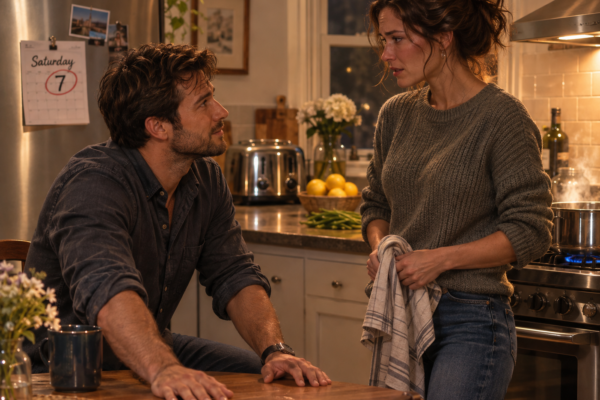
The key turned in the front door of Patrick Fisk’s lake house at a quarter past four on Saturday, and I was standing at the stove with a wooden spoon in one hand and a dish towel over my shoulder.
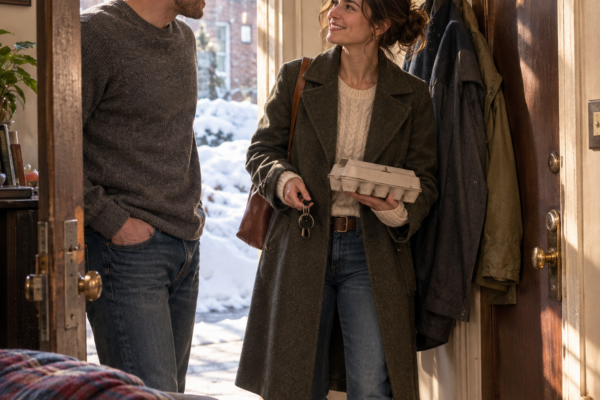
I assumed it was the neighbor returning my ladder. The door swung open, and a woman in a gray coat dragged a wheeled suitcase across the threshold, stopped when she saw me, and looked at the spoon as if it might be a weapon or an explanation. She looked to be in her mid thirties with dark hair held up by a clip that was losing its fight and the composed, tired face of someone who had driven a long way and rehearsed being alone at the end of it.
I’m going to assume you’re not a burglar, she said, since burglars rarely stop to make chili.
I told her I was Calvin Donnelly, that Patrick had asked me to watch the place for the week, and that I had a feeling he had asked her something too. Adriana Varella, she said.
She did not offer her hand, and she did not move her suitcase out of the doorway either. He told me the house would be empty.
She took out her phone and held it up so I could read Patrick’s text sent 11 days earlier.
It said the lake house was hers all week. The key code was where she remembered and she should stay as long as she needed. I showed her mine, which said Saturday to Saturday, the beer in the garage fridge was fair game, and I was not to let the dock rot.
Both messages were from Patrick and neither mentioned the other person. I called him while she watched and it went straight to a voicemail greeting saying he was traveling and would return calls when he landed.
She tried her own phone with the same result and lowered it slowly. Over the Atlantic, she said, which is a very convenient place for him to be. I told her he had been my friend 15 years, and she said he had been hers for ten, and we stood there in his kitchen briefly united in wanting to throttle him.
My instinct on a job site is to fix whatever feels awkward as fast as possible, and the fastest fix here was to carry my duffel to the truck and apologize on the way out. I could tell from the set of her shoulders that this would hand her a decision while a stranger stood next to her luggage.
So I did something slower.
I told her I had a one bedroom in Syracuse and a spare key to a friend’s couch in town, and that I could be gone within the hour if she wanted the house to herself.
I also said I would rather she decide that after she had seen the place than while I hovered, and that I would be down on the dock if she needed anything. Then I turned off the burner, put the towel on the counter, and walked out the back door before either of us could be polite about it.
From the dock, I could see most of the back of the house through the kitchen windows, which meant I watched a stranger decide whether to trust my existence. She opened the refrigerator and closed it again, then crossed to the stairs, and a few minutes later, the lights came on in the big upstairs bedroom with the lake window. I had a cleat on the end of the dock that had been working loose since Saturday morning, so I went at it with a socket wrench from the garage and tried not to look up more than twice a minute.
When I did look, she was standing at the upstairs window with her arms crossed, studying the water, and later she was sitting on the edge of the bed, pressing one hand into the mattress. She spent nearly 20 minutes up there. When she finally came down the lawn with her coat buttoned against the wind off the lake, I had tightened the cleat twice and was pretending to inspect it a third time.
Which room are you in? She asked. I told her the small one off the kitchen, that I had not touched anything upstairs, and that I had been planning to leave the big bedroom for whoever turned out to want it.
That’s what I’m going to want, she said.
I’m unpacking, and I’d like to be clear that you did not make a good case for it because you didn’t make a case at all, which I noticed.
I said I had been told my case making skills were limited to the words, that should hold. She almost smiled and then put it away.
Patrick promised me this week, and if I leave now, I’m leaving because a man is standing in the kitchen with a spoon, and I’ve done enough of arranging my life around other people’s presence.
I nodded and said I could live with being the reason she stayed for that. We worked out the terms on the dock, and they came out sounding like a tenancy agreement drafted by two people trying not to sound foolish. She would keep the upstairs room, and I would keep the one off the kitchen, and the kitchen, the porch, and the lake would belong to both of us without anyone needing to announce it.
Either of us could reconsider at any time without giving a reason, and the other would not argue.
If you change your mind about me, I said, I’ll be gone by morning and I won’t ask why.
She said the same went for her, except that she would probably ask, and I said that was fair. Then she told me something I had not asked for in the flat voice of a woman who had decided in advance exactly how much to say.
She had ended an engagement nine days earlier, she told me, which was why she wanted the house empty, and she was not looking for advice about it. I said the only advice I gave professionally concerned breaker panels, and I could keep it to those.
She asked whether I was about to offer to carry her suitcase up the stairs, and I admitted that I was since she had caught me with the offer halfway out of my mouth. I can carry it, she said.
I said then I would hold the door, and she looked at me for a moment, weighing it before letting me. At the top of the stairs, she took the bag from the landing and went into the blue walled room alone. And I went back down to the kitchen.
And found the chili had settled into something better than I deserved. She came down an hour later in a sweater, ate a bowl at the counter without saying anything about it. Asked for the salt.
And took the shaker from me without comment. We said good night like people closing a shop for the evening. And her door shut upstairs with a polite, deliberate click.
I lay in the small room off the kitchen listening to the floorboards above me shift. As she unpacked and moved around.
And the house sounded different than it had that morning. Our terms covered the doors, the kitchen, the porch.
And what either of us could say if we wanted to leave.
They did not cover what either of us would do if one of us started listening for the other one’s footsteps.
I was fairly sure I had just done exactly that. And I was just as sure that we had agreed not to talk about it. Sunday morning I learned how Adriana took her coffee from the evidence she left behind.
Which was one mug rinsed and upside down on the rack. And the good filters moved to the counter where she could reach them. She had been up before me.
And I found her on the porch in her coat with her feet on the railing. She lifted her mug an inch when I came out. A gesture that covered good morning.
And I see you and please do not sit down. I took my own coffee to the dock.
And left her the porch.
Around 9:00 Patrick’s text landed on both our phones at once.
Saying he had touched down in Lisbon and begging us not to be mad. Adriana walked to the kitchen window and held her phone up to me through the glass with one eyebrow raised.
And I held mine up in return. Neither of us answered him.
And And felt like the first thing we had agreed on without negotiating. The next two days ran the way our terms said they would, mostly without ceremony.
She read on the porch in the mornings while I worked through the list of small things that Patrick’s house had been collecting for years, including a screen door that screamed on its hinges and a three-way switch in the mud room that someone had wired out of spite.
She watched me pull the cover plate off and asked whether I narrated my work to myself. I said only when the splice was particularly bad, and she said she had heard me mutter at it twice.
On Sunday afternoon, I offered to drive into town for groceries, and she said she would rather go herself because she wanted to see the town. I said I would happily drive, and she said, I know you would. I have a car.
I said, Fair enough, and set the keys back on the hook. And when I came back from the garage, she was studying me with a faint frown. You took that well, she said.
I told her it had been a car, not a kidney, and she laughed once before she remembered to be careful about it. On Monday, I made a mistake that I considered a kindness.
She had been in the house for two days with a man she barely knew clattering around the mud room, and it occurred to me that a woman who had come here for quiet might be tired of me by now. After lunch, I told her I was going to drive over to Watkins Glen for the afternoon and give her the house.
She was drying a plate, and she set it down on the counter very deliberately before answering.
That’s the second time you’ve decided what I need, she said.
You decided I want the house empty, and you called it a courtesy.
If I wanted you gone, I’d say so, and I think I’ve shown I’m not shy about it.
I said I had been guessing, and she said a guest dressed up as an announcement was still an announcement. Then she told me to try it again as a question.
So I asked whether she wanted the house to herself that afternoon. And she said no. She said she was going to finish her book on the porch.
And I was going to finish making that screen door stop screaming. It stung for about a minute and then it felt like a relief.
Because for the first time since the key turned in the door, I knew exactly where I stood. I fixed the screen door and the hinges stopped complaining by four.
By evening I was drying dishes at the kitchen sink with the window open to the cold smell of the lake.
When Adriana appeared in the doorway holding two glasses and a bottle of Patrick’s good red.
Would you sit on the porch with me? She asked.
I’m not asking because the house requires it.
I said yes before I could add anything useful, which I considered progress.
We took the two Adirondack chairs and she pulled a blanket over her knees and the water went from pewter to black while the neighbor’s dock light came on across the cove.
She poured for both of us and held hers without drinking it. And she did not look at me while she talked.
She told me his name did not matter. Only that he was a decent man whom everyone in her life approved of.
The wedding had been planned for October. And over the previous year the rest of it had been arranged around her as well. They would live near his family in a house they had already half chosen.
And she would take a calmer job once she had slowed down. Every piece of it had been reasonable.
And she had agreed to each one in turn. Then one night I was lying there trying to remember a single decision in that whole future that I had made. She said.
And I couldn’t find one.
Nine days ago she had told him in a parking lot. And what she felt afterward was relief.
Which she said was a good deal worse than being sad. I wanted to hand her something to do about it, a plan or a phone number or at least a list. And my hands tightened around the glass instead.
I told her it sounded like it had taken more nerve than staying would have.
And she pointed one finger at me and said, Don’t call it brave.
I said it sounded expensive then. And she laughed properly for the first time since she arrived.
She said she was not asking me to promise anything. And she was not asking me to understand the whole thing because it had mostly been something she needed to say out loud once to someone who was not going to rearrange her furniture. I told her I did not rearrange furniture without checking first.
You were about to ask if I wanted the porch light off, she said. And I admitted I had been. And she said it was fine as it was.
The conversation drifted away from her engagement after that. And I was glad to follow it. She told me about the worst Friday service she had ever managed when a walk-in cooler failed during a rehearsal dinner.
And I told her about the afternoon a city bus had taken down a pole I was working on, and the whole street had applauded when the lights came back. The bottle was nearly empty, and the wind had picked up when I noticed I had been listening for an hour without once wondering how to make her feel better. She had stayed because she was enjoying herself.
And when I said I should probably go in, she told me plainly that she was. I stood up and took both glasses. And I had my hand on the repaired screen door, which opened without a sound when she said my name.
She asked me what I was doing tomorrow. And I said I had a doc to inspect and a promise to keep.
And she said that was not what she meant.
I’m driving into the town at the end of the lake, she said.
I’d like to walk around and eat something I didn’t cook or manage.
Do you want to come?
Not because Patrick’s house has you stuck with me, and not because you’re worried I’ll fall apart, but because I’d like the company.
I felt the old reflex rise, the offer to drive or to find a restaurant or to look into the parking, and I let it go by without taking it. I said yes, and I said I would like that, and I said nothing else at all. She looked at me for a second as if she had noticed the missing offer, and then she nodded and told me she would drive and I could navigate.
I washed the glasses and went to bed in the small room off the kitchen. I lay there thinking that everything we had done so far had a reason attached because the house was shared and the kitchen was shared and the dock needed work.
Tomorrow had no such reason. She had asked and I had said yes, and it would be the first time we spent a day together that nobody had arranged for us. Adriana chose the restaurant before we backed out of the driveway, and she announced it the way she would have announced a seating chart.
It was a place on the main street of Watkins Glen that a regional magazine had praised for its wine list and a patio that supposedly looked over the water. I navigated with my phone on my knee while she drove with both hands on the wheel, and I decided not to mention that she was doing exactly the speed limit. The town was a long, pretty strip of storefronts and docks with the lake running north behind it like a blade.
The restaurant had a 40-minute wait, heavy linen napkins, and a hostess who kept glancing at a manager who kept glancing at the door. Adriana stood in the entryway with her arms folded and watched a server carry three plates in one hand, and I could see her stop being a customer and start being a general manager.
They’re short of food runner, she said under her breath.
The kitchen is drowning, and the table by the window has been waiting on a check for 10 minutes. I asked if she wanted to stay, and she said that was exactly the problem because she would spend the whole meal fixing it in her head. I had a preference, and for once I said it as one instead of as a rescue.
I told her I had spotted a fish fry window at the marina on the drive in, that I would honestly rather eat out of a paper boat on a bench than under a tablecloth, and that I was happy to stay if she wanted the patio, but wanted her to know which way I leaned. She studied the sentence for a second, the way she had studied every offer I made that week and seemed to find nothing tucked inside it. You would really rather eat fried perch on a bench, she said.
I said I would rather that than anything served with a reduction, and she laughed and told the hostess we had changed our minds. She had wanted the lake, and the marina had the lake, so we kept our half of the plane and dropped the napkins. The perch came in a cardboard tray with a lemon wedge and more fries than either of us could finish, and we ate on a bench with the gulls lined up on the piling like customers waiting for a table.
Adriana stole my fries without asking and defended the theft by pointing out that I had ordered the larger size. Afterward, we walked the length of the harbor, and she stopped at a shop selling local wine and asked whether I wanted to do a tasting. I told her I would rather not because I could not tell a good Riesling from a bad one and did not enjoy pretending.
She turned and gave me a long look. You have preferences, she said. I had started to think you were just agreeable.
I said I was agreeable about the things I did not care about, and she said it was good to know where the line was, so we went into the hardware store next door instead. She waited patiently by the register while I held a three-way switch up to the light.
And she told me I looked happier than I had at any point since Saturday. What I noticed that afternoon was how much room she was making.
She had told me she wanted a day of nothing she had to manage. And she was spending it beside a man she had known for four days, shortening her stride on the pier so I would not have to lengthen mine.
Nothing about the shared house explained it anymore because the house was 20 minutes behind us and neither of us had mentioned it since lunch. We argued about whether the lighthouse at the end of the breakwater was real or decorative.
And she bought two ice creams after losing the argument. We sat on the seawall to eat them while the light slid toward gold.
And her hair clip finally gave up. And she let it fall without comment.
I realized I was watching her instead of the water. And that I had no idea what I was going to do about that. By late afternoon, we had walked back out to the end of the pier where the wind had a bite and the lake had gone the color of brushed steel.
I said I was glad the day had worked out, that it was a nice, easy way to spend a Tuesday, and that nobody needed to make anything bigger of it than it was. I meant it as a courtesy.
And I could hear how it sounded half a second after it left my mouth. Adriana stopped walking and turned to face me with her hands pushed into her coat pockets. Easy, she said.
Is that what this is? A harmless afternoon?
I looked at the water for a moment and then I looked at her because she deserved better than the water. No, I said. I said it because it was the safe thing to say.
I would like to kiss you. And I have wanted to since the porch, probably before that. I told her I was not going to guess whether she wanted the same thing.
Not with her engagement barely 12 days behind her and a borrowed house, a long drive, and a day off, all working in my favor. If she did not want it, I could live with that. And if she did, I wanted to hear it from her.
She did not answer right away. And I made myself stand there and let her not answer.
The wind pulled at her hair, and a halyard clanged against the mast somewhere in the marina behind us. Here is what I know, she said finally.
I decided in the car this morning, before the restaurant and before the fish. And it has nothing to do with him or with how sad I am.
It’s because you get genuinely annoyed at screen doors, and you took the keys back to the hook without sulking.
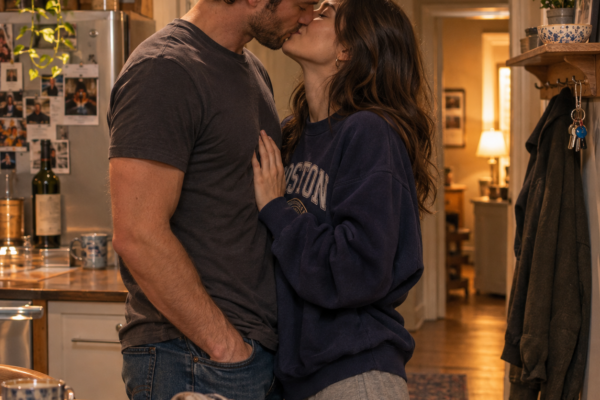
She said that if she was wrong about herself, then she would be wrong on her own account. And that was a thing she was allowed to do. Then she took her hands out of her pockets, took hold of the front of my jacket, and kissed me.
It was brief at first, and then it was not. And she tasted like lemon and cold air.
And I forgot to be careful about where I put my hands. When she stepped back, she kept hold of my jacket for a moment, as if to confirm it was still there.
That isn’t a promise, she said, a little out of breath.
I told her I had not asked for one, and she said that was one of the things she had noticed about me. We drove back in the last of the light with the radio on low. And the silence in the car was easy in a way it had not been on Saturday.
Her hand rested on the gear shift between us. And I did not take it. And she did not offer it because neither of us wanted to turn the pier into a plan.
At the house, she locked the door behind us and hung her coat on the hook beside mine. And we stood at the bottom of the stairs in the dim kitchen light.
I’m going up to my room, she said, and I’d like you to know it’s not because I’m unsure about the last hour.
I want to keep one thing about this week that I decided slowly. I said that was a good reason and that I would be glad to know where she was when I listened to the floorboards.
She laughed softly, touched two fingers to my sleeve and went up. Her door closed with the same deliberate click as the first night, except that tonight it sounded like something we had both chosen.
I lay in the small room off the kitchen with the lake wind rattling the repaired screen door and counted the days on my fingers, which took no time at all. It was Tuesday and Saturday would arrive whether or not either of us said a word about it. The terms we had made on the dock covered the doors, the kitchen, the porch, and what either of us could say when we wanted to leave.
They were written for two strangers sharing a roof and they had nothing to say about what two people who had kissed on a pier should do when the key went back under the mat. Wednesday and Thursday passed with the same easy rhythm as the first days, except that the kitchen now felt smaller whenever she walked through it. She kissed me once on the porch Wednesday night, briefly and on purpose, and then said good night and went upstairs, and I did not follow her with so much as a sentence.
Thursday morning she sat across from me at the counter with her laptop open and a list in her own handwriting, and she went through it like a woman running a pre-shift meeting. She had spoken to her assistant manager. She was back on the floor Monday and she planned to leave the lake house at 10:00 on Saturday morning and take the long way home through Ithaca.
I’m driving myself, she said, looking at the list instead of at me.
I’m not putting you in the car and I’m not putting you in whatever comes after this week, because I honestly don’t know yet what that is.
I told her that was a clear answer, and that I had not asked for a different one. She glanced up as if checking the sentence for a hidden clause, found none, and went back to her list with a small, satisfied nod. Friday morning I made my mistake, and the worst part was how reasonable it felt while I was making it.
Patrick had promised her this house, and I had been occupying a third of her week with a socket wrench and a bad habit of humming. She had come to the lake to be alone, and she had spent four of her seven days with me instead, by her own choice, but still in a house that was supposed to be hers. It seemed to me that the decent thing was to give her the last night the way Patrick had first offered it, with nobody else in the building.
I texted my friend Marcus, who had a couch in Watkins Glen and an open invitation, and he sent back a thumbs up before I had finished my coffee. I told myself I would explain it to her at dinner, which was the same thing I told myself every time I made up my mind for someone else.
Around two, with Adriana out running errands in town, I stripped the bed in the small room off the kitchen, folded the sheets into a square, and zipped my duffle on the mattress. I heard her car in the gravel while I was lining my tool bag up beside the door.
She came in through the kitchen with two paper sacks from the market, set them on the counter, and stopped in the doorway of my room, where she took in the bare mattress, the duffle, and the folded sheets. Are you going somewhere? she asked.
I said I was going to sleep at Marcus’s tonight and come back in the morning to lock up after she left, so she would have the house to herself for her last evening.
She did not say anything for a moment, and then she walked back to the counter and began taking things out of the sacks one at a time. There were two salmon fillets, a bundle of asparagus, a loaf of bread from the bakery on Franklin Street, and a bottle of the cheap white wine I had once said I preferred. I bought dinner for two, she said, lining the items up with more precision than they needed.
I came home thinking about how to cook this, and you have already moved out of my last night without asking whether I wanted you to. I started to explain, and I heard the reasoning coming out of my mouth in the same tidy order it had come together in my head. She cut it off gently by holding up one hand, the way she would have stopped a server who was about to recite a special nobody wanted.
The first two times were small, and I let them go, she said.
This one is my last night here, and you’ve made a plan for it and told me about it after you packed.
I told her she was right, and that I should have asked before I stripped a bed. She waited because she had learned in the last five days that I tended to stop one sentence short, and I made myself say the next one.
I don’t want to go, I said.
I dressed it up as doing you a favor because that was easier than telling you I would rather be here than on Marcus’s couch.
That has nothing to do with Patrick or the house or what you came here for. I want to spend tonight with you, and I want you to be able to say no.
Adriana looked at the salmon for a while and rubbed the bridge of her nose with two fingers.
I’ve been watching you, she said, and I don’t think I’ve been fair about it.
She said that since Tuesday she had been waiting to see whether I would ask her what she wanted instead of working it out on my own, and that every time I got it right she had quietly filed it away like a score. She had not told me once, in plain words, that she wanted me in the house on her last night because part of her wanted to find out whether I would ask without being told.
That’s a test, she said.
And it’s a lousy way to treat someone who has been taking no for an answer all week.
She turned around and leaned against the counter with her arms crossed, and she looked more embarrassed than I had seen her since the day she arrived.
So I’m telling you now, I would like you here tonight in this house for dinner and for whatever comes after it, which does not include rearranging the sleeping arrangements.
I said that sounded like the best offer I had heard all week, including the one from the man at the marina who wanted to sell me a boat. She laughed, and the whole kitchen seemed to loosen. And she picked up the bottle and handed me the corkscrew without saying anything.
I unpacked the duffel while she changed her shoes, and I put the sheets back on the mattress myself, and I texted Marcus that I would see him another time. He wrote back asking whether the couch had been the problem, and I told him it had been me. We cooked together in the narrow kitchen, which meant she told me how long to leave the salmon on the pan, and I told her she was overcooking the asparagus, and each of us ignored the other with great confidence.
We ate on the porch with blankets over our knees and the neighbor’s dock light making a long yellow line across the cove.
Somewhere near the second glass, she said that she would still be leaving at 10 and driving herself, and that she did not want me carrying her suitcase down the stairs or standing in the driveway looking meaningful. I said I would hold the door and nothing else, and she said that would do. Around 11 she stood and took her plate to the sink, and I washed while she dried, and neither of us hurried.
She stopped at the bottom of the stairs where we had stood on Tuesday and rested her palm flat against my chest for a moment as though checking that I there. Separate rooms, she said.
Still my choice.
And I’d like you to know it’s the same reason as before.
I told her I knew and that I was glad she had set it out loud. And she kissed me once, slowly, before she went up. Her door closed with the same polite click as always, and I stood in the kitchen listening to the refrigerator hum until the floorboards above me stopped moving.
I lay down in the small room off the kitchen on the sheets I had put back myself. And I thought about the one thing I had not said.
Adriana had told me twice that she wasn’t carrying me into her life and she had said it fairly and without apology.
She had also said that she did not know what came after this and that was not the same as saying nothing would. In the morning, she would drive off toward Ithaca with her coat on the passenger seat. And I would lock the lake house and go home to my own apartment.
If I wanted to see her again, I would have to ask in plain words with no shared address and no borrowed week to lean on and with her entirely free to say no. Adriana came downstairs at 9:40 on Saturday morning with her suitcase already in her hand. And she carried it down every step herself as she had said she would.
I held the front door open and did nothing else, which turned out to be harder than rewiring the mud room. She loaded the trunk, checked the passenger seat for her coat, and came back up the porch steps to return the spare key to the hook inside because she wanted it in the house when she left.
I had my own list for the morning since Patrick had asked me to leave the place the way I found it. That meant stripping the small bed, running the dishwasher, taking the trash to the road, and checking the dock cleat I had tightened three times.
Neither of us suggested that the other change a single item on those lists to prove anything, and that felt like its own kind of respect. At 10:00 exactly, she stood beside her car with the keys in her hand and the lake flat and bright behind her. I had decided overnight that I would ask in plain words, with nothing dressed up as a favor, and I discovered that plain words were the hardest kind to start.
Adriana, I said, when we’re both home, would it be all right if I called you?
She looked at me for a long moment, the way she had looked at the spoon in my hand a week earlier, and I made myself stay quiet while she thought.
You can call me Sunday evening, she said, after I’ve slept in my own bed and found out what it feels like.
She told me she was not promising an answer to anything beyond picking up the phone, and I said that was all I was asking for. She kissed me once, briefly and on purpose, got into the car, and pulled out of the gravel drive at the speed limit.
I watched her tail lights until the road bent toward Ithaca, and then I went back inside to the work I had agreed to do. The house sounded different with only one person in it, and I noticed the quiet more than I had expected to.
I wiped down the counters and ran the dishwasher, and I hauled the bags to the road. Before I left, I wrote Patrick a note on the back of a lumber receipt saying the screen door no longer screamed, the dock would last another year, and he owed two people a very long dinner.
I left it under the bowl on the kitchen table where he would find it, locked the front door, and set the key where it belonged. The drive back to Syracuse took a little over an hour, and my apartment smelled like a place no one had opened in a week. By Saturday night, I had picked up my phone four times to call her, and each time I put it down because she had named Sunday, and Sunday was hers to give.
Sunday evening at 7:00 I called, standing at my own kitchen window with the city lights coming on across the parking lot. She picked up on the third ring, and I could hear a television murmuring in the background and the clink of a plate.
You’re punctual for a man with a one bedroom, she said.
And I told her that I was an electrician, and that we tended to respect schedules because we had seen what happens otherwise. She laughed, and the sound crossed 40 miles of cell signal and landed somewhere under my ribs. She said she had slept 11 hours in her own bed and woken up unsure which side of it was hers, which was a relief to admit to someone who was not her mother.
I let her finish, and then I said what I had practiced in the truck, only shorter and less smooth.
I’d like to take you to dinner, a real one, with no lake and no Patrick and no borrowed week.
I’m not asking to be part of getting over anything.
I want to know what you’re like on an ordinary Thursday when nobody’s hiding from anybody.
She was quiet long enough that I heard the television go silent as if she had walked into another room to answer. Let me choose where, she said. And I said that was what I had hoped she would say.
She told me there was a Peruvian chicken place six blocks from her apartment in Binghamton with paper placemats and a line out the door on weekends. And she said she wanted to see how I behaved somewhere she did not have to manage.
She suggested Thursday at 7:00, and I told her I would be on call for the city that night and could get pulled away by a downed line. I said Friday at 7:00 would suit me better, and that I would otherwise be glad to come to her neighborhood on any night she picked.
Friday it is, she said. And then, after a pause, say it like that every time.
I like knowing what you actually want. I told her I would, and we spent another 20 minutes talking about nothing, which was how I knew it had already started to matter. On Friday, I left Syracuse at 4:30, drove down through the hills with the radio off, and parked on her block 20 minutes before 7:00.
The restaurant was the kind of place with a rotisserie window, a handwritten specials board, and a family at the corner table celebrating something with a sheet cake. I took a table by the wall where I could see the door, ordered nothing, and did not rehearse anything, since I had already said the true thing on the phone.
At 2 minutes to 7:00, she came in out of the evening wearing her gray coat, with her hair clipped up again, and a small paper bag in one hand.
She paused inside the door and looked at me the same way she had looked at me in Patrick’s kitchen, taking in the whole of me before she decided anything.
Then she crossed the room, hung her coat on the back of the chair across from mine, and sat down as if she had every intention of staying. No wooden spoon, she said, and I told her I had left it at the lake in case she needed it to evaluate other men.
She slid the paper bag across the table and told me it was a gift from the corner bakery, which turned out to be a loaf of the same bread she had bought on Franklin Street. I said that was an extremely specific present, and she said she was an extremely specific person.
She admitted that she had sat in her car for 10 minutes down the block, thinking about driving home and ordering soup. She said she had gone through the whole argument for leaving and then realized that all of it was fear and none of it was a reason, so she had turned off the engine.
I’m here because I want to be, she said.
Nobody gave me this table and nobody told me you’d be at it.
I said I would have understood if she not come, and she said she knew that, and that it was exactly why she had. We ordered a whole chicken, a heap of fries, and a green sauce she warned me about, and I ate anyway.
She stole fries from my side of the tray without asking, and defended the theft by pointing out that I had ordered the larger size, and I did not say a word about the pier. She told me about her first week back on the floor when a line cook had asked her whether she was all right, and she had answered truthfully for once that she was figuring it out.
I told her about the transformer that had blown on Monday, and the old woman who had stood on her porch in a bathrobe and made the whole crew a pot of coffee while we worked. At some point in the second hour, I noticed that no one in this room knew we had ever shared a roof, and that we were still talking as easily as we had on the porch.
Patrick texted us both from Lisbon around 9:00 asking whether he was forgiven, and we turned our phones face down at exactly the same moment. We stepped out onto the sidewalk after 10:00 into cold air that smelled like wood smoke and rain. She told me her building was six blocks east, and I said I knew because she had mentioned it twice already, and she hit my arm lightly with the bakery bag.
She asked whether I wanted to walk her home or whether I would rather she walked me to my truck, and I understood that the question was a real one offered with both answers open. I said I would like to walk her to her door and then take myself to the truck, and she said that sounded like a plan she could have made herself.
At the steps of her building, she did not invite me up, and I did not ask, and she kissed me under the porch light with her hand flat against my jacket.
Next Friday, she said, same place, and this time I’m picking the wine.
I told her I would bring my own opinion about it, and she smiled and went inside. Nothing had been promised that night, but we had gotten there by two separate choices, and neither of us had made the others.
I think a lot about the key turning in that door, and how easily either of us could have turned around. A week under a borrowed roof can feel like a whole life when you are inside it, and the real test of it came on an ordinary street when no one had arranged anything for us.
THE END.