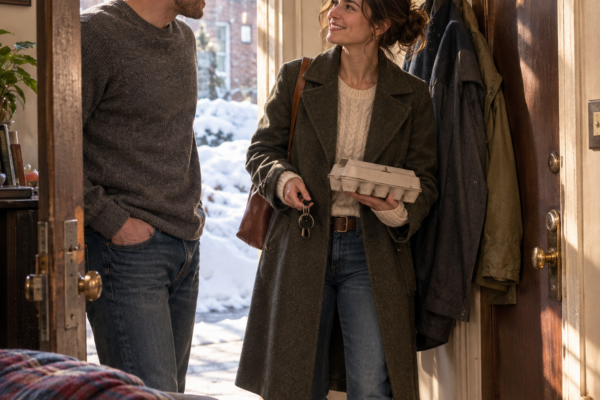
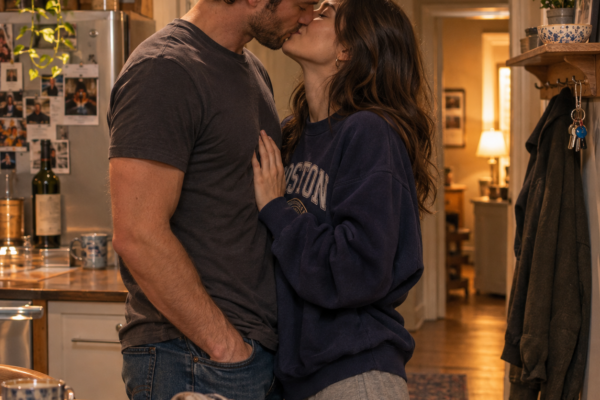
My Childhood Friend Needed Help Babysitting Her Nephew. Once He Slept: “Is This What We’d Be Like?”
My Childhood Friend Needed Help Babysitting Her Nephew. Once He Slept: “Is This What We’d Be Like?”
Lydia slid a red plastic fire truck across the rug with two fingers and whispered, “Basket, and don’t let the ladder rattle.” I caught it an inch before it hit the leg of the coffee table and lowered it into the canvas bin between my knees.
Down the hall, Oliver’s door stood open a hand’s width, and his nightlight laid a small yellow wedge across the carpet. Lydia sat back on her heels and looked at the two of us kneeling in her living room at nine, with a bin of trucks between us and one lamp turned low. Her face went quiet in a way I almost never saw.
— “Is this what we’d be like?” she asked.
She laughed almost before the words were finished—a short, bright sound she muffled against her wrist so it wouldn’t carry down the hall.
— “Forget it, Evan. I’m punchy,” she said. “Four-year-olds do that to a person. Pretend I said something about the trucks.”
Her half of the routine had always been the joke, and mine was the groan that told her it had landed, and we had done it a thousand times. I didn’t groan. I kept the fire truck on my knee and looked at her, and I watched her notice that I wasn’t going to help.
— “Are you talking about the babysitting?” I asked. “Or about us?”
She didn’t answer right away. She reached into the bin, took out a wooden block I had put away two minutes earlier, and set it on the rug as if it still belonged on the list. Then she picked it up and held it in both hands. The two feet of floor between us was the same distance there had always been on porches and tailgates and the back seats of other people’s cars. But tonight it seemed to have an edge.
— “I didn’t plan to ask something that big,” she said. “You were holding that truck like it might go off, and it just came out.”
Lydia Barrett had been telling me when I was wrong since we were kids three streets apart, and now she pointed the block at me.
— “Evan Prescott, you are not supposed to look at me like that.”
— “It’s a very serious truck,” I said, and she smiled—a real one this time, which made things harder instead of easier.
I could have left it there. The easy move was to say it had been a long day and let the lamp and the hour take the blame, and we both knew where that road went because we had taken it before over smaller things.
Instead, I told her the truth as plainly as I could manage it.
— “I’d be lying if I said I’d never pictured it,” I said. “I can see it—and not just because of the trucks. What I can’t tell you is whether you can, and I’m not going to act like I know.”
She let out a breath and sat all the way down on the rug, her back against the couch. I understood then that she was waiting for me to say something about her. Something like, “I always knew you wanted this,” and I was glad I hadn’t.
The evening had put her in my head for a different reason. She had called me at a quarter to six, sounding like someone who had lost an argument with a bath towel. Oliver had been asking for his mother since Friday afternoon, when Susan left for her weekend away, and he had refused his pasta and cried when the bath water ran a degree too warm. Lydia had been trying to manage dinner, the bath, and a missing stuffed rabbit all at once.
When I got there, she told me, “Don’t take over. Just hold the towel.”
So I held the towel. I spend my days stitching headliners and cutting vinyl in a shop where somebody always wants to learn the job themselves, and I have found that the best help is handing over the tool and keeping my mouth shut.
By the end of the night, she had found the rabbit under the radiator herself, read the dinosaur book three times in a voice that got steadily lower, and sat on the edge of the bed until his breathing changed. I had stood in the hallway with the towel over my shoulder and watched her do all of it. I hadn’t thought of her as a mother exactly. I had thought that she was irritated, funny, tired, and stubborn about it, and that I wanted to stay in whatever room she was in.
That was the piece I had not said out loud, and I wasn’t about to start by explaining it to the top of her head.
— “I’m tired,” she said to the block in her hands. “You were good with him, and it’s late, and the house is quiet. This is exactly how people end up confusing two different things.”
— “Maybe,” I said. “I’m not asking you to figure it out tonight.”
She looked up, and I saw that she had expected me to hand her the out—the one we had both been using for years. I didn’t offer it, and I didn’t push either. I just went on collecting the last of the cars one at a time while she watched my hands, and the silence between us was the kind that has something in it.
When the bin was finally full, she stood and dragged it into the corner under the window, and I pulled my jacket off the arm of the couch. At the door, she held the knob without turning it, and the porch light made a pale square on the floor between her feet and mine.
— “Come back tomorrow,” she said, keeping her voice low for Oliver’s sake. “Lunch before Susan picks him up. He’ll want pancakes, and I’ll want somebody who can tell me when the pan is too hot.”
— “I’ll bring the good bread,” I said. “Noon.”
— “Noon,” she said. And then, a beat too late: “It’s not a date. It’s just lunch.”
— “I know it’s lunch,” I said.
And she let her forehead tip toward the doorframe and laughed at herself quietly.
I didn’t ask to stay, and she didn’t ask me to. I stepped out into the warm May dark, and the screen door clicked shut behind me with a sound she would have winced at because of the sleeping boy. Sprinklers ticked across lawns all along the block, and somebody three houses down was still cutting wood or a late-night board with a saw.
Her porch light stayed on until I turned the corner at the end of her street. It took me the full three blocks to see what she had done. She had asked me whether this was what we’d be like, and then she had invited me back into exactly this—the same kitchen, the same boy, the same sister arriving in the afternoon to collect him.
Maybe she wanted to hold the possibility up to the daylight and see whether it survived. Or maybe she only wanted the evening to go back to what it had been before the question. By the time I reached my own door, I had stopped trying to guess, and I decided to go back at noon and pay attention to which one she meant.
Noon on Sunday found me on Lydia’s porch with a loaf of sourdough from the bakery on Fourth and a firm plan to act normal. Oliver opened the door before she could reach it, wearing pajama bottoms and one sock, and announced that pancakes were happening.
The kitchen smelled of butter and scorched edges. Lydia stood at the stove in a faded Ohio State shirt, moving fast the way she does when she has decided nothing is wrong. She told me over her shoulder that the pan was probably fine.
It was not fine. So I turned the burner down a notch. She said she had been about to do that. I said I knew, and she handed me the spatula anyway.
We ate at her small table by the window, with Oliver’s booster seat pulled up to the end. For as long as I could remember, I would have taken the chair across from Lydia and left the one beside her empty for whoever needed it. This time I sat down next to her without thinking about it. And I saw her glance at the chair, then at me, and then pass me the butter without a word.
Oliver was no part of any of this. He ate the middles of his pancakes and left the edges in a neat ring, and every few minutes he asked whether Mommy was coming yet. Lydia answered “after lunch” each time in exactly the same cheerful voice. He had also decided that the red fire truck and the rabbit were riding home in his backpack, and he rejected the green truck she offered as a substitute with dignity. I understood.
Susan pulled up at half past one. She is thirty-six and has known me since I was a kid on a bike cutting across her lawn. So she walked in without knocking, scooped Oliver off the floor, and took in the kitchen in one sweep. Lydia was washing the skillet, and I was drying, and the bread knife was already back in its drawer because I had put it there.
Oliver ran off to find his backpack, and Susan leaned against the counter and watched us for a few seconds.
— “What are you two these days?” she asked.
She said it evenly, with no smirk—the way she might ask what time something started.
— “Old friends,” Lydia said, much too fast. “Same as always.”
I stood there holding the dish towel. I did not tell Susan her sister was wrong, because that was not mine to announce in a kitchen with soap on the counter. I also did not make the joke that would have propped up the answer—the one where I roll my eyes and say, “Yeah, hopeless.”
Susan looked at me for a moment and said, “Okay.”
And that was the whole of it. She asked where the rabbit had been hiding, listened to the radiator story, buckled her son into his seat, and left without asking again. I noticed that it was the not-asking-again that stayed in the room.
When the car had backed out, Lydia kept her hands in the sink a while longer.
— “I said that like a reflex,” she told the water. “It’s what I always say.”
— “It’s also what you could say with your sister standing there,” I said.
She turned around then, and I think she read my face, because I had gone careful the way I do with a customer’s leather when I am not sure it will take the stitch.
— “You’re being careful,” she said.
— “I’m being careful,” I agreed, and I dried the last plate and set it on the rack.
That week, she found reasons.
On Monday night, she sent a photo of a green armchair at a consignment shop on Parsons with a message asking whether I thought the frame was solid, since apparently that is what I am for. On Wednesday afternoon, she texted that she had made a whole pan of lasagna for one person again and that it would be a crime to throw it out.
Neither message was unreasonable, and a month earlier, I would have answered both on my way to her door with a flashlight and a screwdriver. I wrote back that I would come eat, but that the chair could wait until the weekend. I told her I was not coming over to look at furniture. I was coming to see her.
She sent a thumbs-up, and a minute later, a second message: “Fine. Bring nothing.”
When I arrived that evening, she had cleared a stack of mail off the chair beside hers and set two places at the corner of the table where the light was better. The armchair question sat unresolved in a photo on her phone, and she did not mention it once. We ate slowly and argued about whether lasagna improves overnight, which she says it does, and I say is a story people tell about leftovers.
Afterward, she reached into the cabinet for plates at the same moment I did. Her shoulder landed against my arm, and we both stopped there—a plate in each of her hands, close enough that I could see she had gone pink along the jaw. A week earlier, one of us would have made a crack about the narrow kitchen, and neither of us said a word.
I asked her over the last of the dishes, while she was drying a fork much longer than a fork requires. I said I wanted to take her to dinner on Friday, at a restaurant, with me picking her up at the door and calling it what it was.
She put the fork down and looked at me for a long moment.
— “Yes,” she said. “I’m choosing the place, though.”
— “Fair,” I said.
She hesitated, and then she said it was the other thing she needed from me.
— “Please don’t say it’s finally happening, or that we finally got around to it. People will say that. Susan will say it, and it makes it sound like we’ve been standing in the same hallway waiting. We weren’t. You had your life and I had mine, and I’d like this to count as something we’re choosing now.”
— “I won’t,” I said, and I meant it, because the idea had been sitting in my mouth and she had just taken it out.
She told me the name of a small place off North High that neither of us had ever been inside. I had walked past it on my way to the post office and never gone in, and she had apparently done the same.
I walked home the long way, past the dark yards and the sprinklers shut off for the night. It struck me that for as long as I had known her, this was the first time I was going somewhere with Lydia that neither of us already knew by heart.
On Friday, I drove the three blocks, which felt ridiculous, and I rang her bell instead of walking in the way I had for most of my adult life. Lydia opened the door in a dark green dress with her hair down, holding her keys in one hand and her jacket in the other. And for a second, neither of us knew what to say.
Our usual greeting had always been an insult about the weather or my shoes, and tonight it sat on my tongue like a coin from the wrong country.
— “Hey,” she said.
— “Hey,” I said. And then I asked if I could kiss her cheek, because it seemed better to ask than to guess. She said yes in a small voice. And I did. And she smelled like soap and something warm I couldn’t name.
— “You rang the bell,” she said, locking the door behind her.
— “I figured it was time I stopped walking in,” I told her, and she laughed, and the ridiculous feeling eased a little.
The restaurant off North High had eight tables, a chalkboard menu, and a cook who waved at us through the pass without looking up from his pan. Lydia had picked the booth by the window before the hostess could suggest anything else. Because neither of us had ever sat in that room, there were no old jokes to lean on, and we ended up asking each other questions like two people on a first date—which I suppose we were.
She told me her favorite kind of day was one where the plan could fall apart at four and nobody would be hurt by it. She said she had spent a whole spring building a life where she could say, “Actually, no,” without checking with anyone, and she liked it more than she let on.
I told her about the house I was saving for—a small one with a porch and a garage big enough for my frame stands—and that I did not want to spend every free evening on my knees sanding someone else’s trim.
— “I’ve been fixing things for other people my whole life,” I said. “I’d like one place where I get to leave something broken for a week and not feel bad about it.”
Over the second half of the bread basket, Lydia looked at her plate and told me something I could tell she had been carrying since Saturday. At some point during the weekend, she said—around the third time—Oliver had called her name from the bath. She had wanted him to stop. She had wanted it to be quiet for ten minutes. And then she had felt like a terrible person for wanting it.
— “He’s four,” she said. “He misses his mother. And I stood in that hallway thinking, ‘Please, just one minute where nobody needs anything from me.'”
I didn’t tell her she was a wonderful aunt, which was what she was braced for, and she would have thrown a roll at me if I had. What I said was that I had been patient with Oliver partly because I knew I could walk out the door at nine and sleep in on Sunday.
— “You were doing it with no exit,” I said. “That’s a different job.”
She looked up at me with an expression I hadn’t seen before—surprised and a little relieved, as if I’d handed her the right tool without making a show of it.
We split a slice of lemon cake neither of us needed, and I paid before she could argue, and we stepped out into a cool, clear night. Halfway to the truck, she reached over and took my hand—not shyly and not as a joke, but the way a person takes a railing she has already decided to trust. I drove back with the windows cracked and the radio low, and her thumb moved once across my knuckles at a red light.
When we reached her porch, I walked her up the steps and stood there with my hands in my pockets, because I wanted her to make the next move if there was going to be one. She stepped in close, put one hand flat on my chest, and kissed me. It was a real kiss, slow and sure, and it didn’t have a fire truck or a sleeping boy anywhere near it. Nobody’s phone rang. No door creaked down a hallway. And when we finally stopped, the only sound was the cicadas starting up in the dark.
I should have left it there, and part of me knew it. But I was happy, and happy makes me talkative, and the thing I’d been turning over since Saturday came out of my mouth before I’d weighed it.
I said I’d always figured she wanted a house and a family—the whole picture—and that watching her with Oliver had made me think we wanted the same things and were just coming at them from different streets. It felt like I was seeing where we’d end up. I said it like it was already there and I was only catching up to it.
Her hand dropped from my chest. She didn’t step back, but I felt the air change between us.
— “Evan,” she said, “I might want kids someday. I honestly don’t know when, or with whom, or if I’ll feel the same way in two years. I said yes to dinner with you. I didn’t say yes to a seat in last weekend’s picture.”
My first instinct was to tell her I knew her better than almost anyone alive. And I’m glad I heard how that would sound before I said it. It was true that I had known her since we were kids, but it was also exactly the argument that had made me stop asking questions.
— “That’s fair,” I said. “I filled in the blanks myself and called it knowing you.”
She nodded slowly, and she didn’t take back the kiss or the date, which I noticed and held on to.
— “I don’t want you to use how well we know each other as the answer,” she said. “I want to be the one who says what I want, even when it’s messy or I haven’t figured it out yet. If you guess for me, I’ll let you because it’s easy, and then I’ll resent it.”
I told her I understood, and I asked her what she wanted next—not from the weekend, or the wedding, or the rest of her life, only from the next few days. She opened her mouth, closed it, and finally shook her head with an unsteady laugh.
— “I don’t have a whole answer yet,” she said. “I’m sorry.”
— “Don’t be,” I said, and I meant it, though it was strange to stand there with a good kiss still warm on my mouth and nothing settled.
She squeezed my hand once, told me she still wanted to see me, and went inside, and the porch light stayed on while I walked back to the truck.
I sat behind the wheel for a minute without turning the key. Everything I knew about Lydia Barrett had been collected on porches and tailgates—the best of it before either of us could legally rent a car. I could tell you her favorite flavor of ice cream at ten and her least favorite teacher at fifteen. And I had no idea whether she wanted a quiet year or a loud one, or what she’d want from a man on a Tuesday in October.
The woman who had just told me no was one I’d met for the first time tonight. And I understood that if I wanted a second date, I had better start asking her things I didn’t already know.
I started Saturday evening by asking Lydia a question I did not know the answer to, which was a new habit and a little uncomfortable. I called her a little after six, standing in my kitchen with a bowl of cereal, and asked what the best part of her day had been. She said it was a two-hour nap with her phone in another room, and she sounded surprised that I had wanted to know.
We talked for twenty minutes about nothing much, including the consignment shop’s return policy and a patient at her clinic who had filed a complaint about the parking lot in rhyme. I liked hearing her tell it without any shorthand, as if I were someone who had to be filled in.
Near the end of the call, I mentioned the house, because it was on my calendar and because keeping it from her would have felt like its own kind of statement. A small brick bungalow was listed in Clintonville, and the agent was letting me in at two on Sunday afternoon. I said it had a porch and a detached garage and that the photos made the garage look bigger than it probably was.
Then I did what I had done for years with every decision that mattered, which was to ask her to come along and tell me what she thought. It came out easily, and a second later, I heard how it sounded after Friday night.
The line went quiet, and I could hear a cabinet door close on her end.
— “I don’t think I should, Evan,” she said carefully, like someone setting down something full. “I would walk through that house and start having opinions about where things go, and then it would feel like I was picking out your life. I don’t want to be asked to choose a paint color for it.”
I told her that was fine, and I found that I meant it. There was a small sting in it, but the sting belonged to me, and it didn’t change what I was going to do on Sunday, so I went alone.
The agent, a brisk woman with a lanyard and a stack of flyers, led me into a house that smelled like old carpet and somebody else’s cooking. The porch was deeper than the photos suggested, and the garage was exactly as small as I had feared, though the frame stands would fit if I gave up the bench along the back wall. I stood in the empty kitchen for a few minutes imagining a mug on the sill, and then deliberately stopped imagining it. I told the agent I would think about it, drove home, and was parking in front of my place at a quarter to four when I saw Lydia sitting on my front steps with her elbows on her knees.
She stood up too fast when I got out of the truck.
— “I walked,” she said, as if that explained something. And then she launched into it before I had my keys out. The green armchair was still at the consignment shop, she told me, and they had agreed to hold it until Monday. She was thinking of buying it, but she had a worry about the back leg. And she wondered whether I could come look at the frame with her tomorrow—or maybe tonight, if—
She stopped partway through the sentence and looked at her own hands.
— “No,” she said. “That’s not why I came. I had that ready on the way over, and it’s a lie, and you’d have said yes.”
She looked up at me.
— “Are you angry that I didn’t come with you today? I’d rather ask you than spend the whole night guessing.”
I unlocked the door and held it open, and we stood in my kitchen because neither of us seemed willing to go farther into the apartment.
— “I’m not angry that you said no,” I told her. “You were right to, and I’d have been annoyed if you’d come along just so I wouldn’t feel bad.”
I leaned against the counter and made myself say the rest of it in order, the way I would lay out a job for a customer who needed to hear the price before I started.
— “What gets me is this. You pull me in close—a chair, or a lasagna, or a hand on the walk back to the truck. And every time it gets near something real, you take a step back and call me your friend. Last Sunday, it was in front of your sister, and tonight it was the chair. I like being the person you call. I just can’t keep guessing which version of me you’re calling.”
She did not answer right away, and she did not make a joke, which I counted as the first real evidence that she had heard me. She pulled out one of my kitchen chairs and sat sideways in it with her knees pointed toward the wall.
— “I think I wanted both,” she said slowly. “I wanted to find out if this could be real, and I wanted to keep the part where if it wasn’t, nobody had to say anything. You’re so easy to be around that I kept leaning on it.”
She rubbed her thumb along the seam of her jeans.
— “I’m not going to promise I’ll stop being scared by Tuesday, but I can stop pretending that the safe version doesn’t have a cost—because it does, and you’re the one paying it.”
She stood up then, and she had the look of someone who has decided to do something before the nerve goes.
— “Next Saturday,” she said, “I want to come to my place—your place—and cook all of it. The groceries and the plan and the dishes afterward. I want it to be a night with a purpose. And I want the purpose to be you. No armchair, no errands, nobody’s birthday, and no four-year-old waiting for his mother. Seven o’clock. You don’t fix anything. You don’t offer to help unless I ask.”
— “That’s a hard one,” I admitted, and she smiled for the first time since she had sat down.
— “I know,” she said. “That’s why I’m asking.”
She crossed the kitchen and stopped in front of me, close enough that I could smell the outdoors on her jacket.
— “Can I kiss you?” she asked very quietly.
I said yes, and she did—one hand against my collar and the other holding on to the counter beside my hip. It was gentler than the porch had been, and slower, and she kept her eyes open for the first second as if she wanted to see that it was really me. She had asked, I thought, and she had meant to be answered, and that mattered more than the kiss did.
When she drew back, I kept my hands at my sides for a moment before I put one against her jaw, and she leaned into it with a breath that wasn’t quite a laugh.
— “This isn’t the answer to anything, you know,” I said, and I watched her take it in. “I want it to be, and I’m not saying it so I sound noble. You’re allowed to kiss me and still not know, and I’m allowed to like it without pretending it settles the thing.”
She nodded, her forehead against my shoulder.
— “That’s fair,” she said into my shirt, and I thought it was probably the most honest she’d been all week.
She stayed another half hour—long enough to drink a glass of water and read the back of my cereal box aloud in a radio announcer’s voice. And then she walked home as she had come, because she said she needed the three blocks.
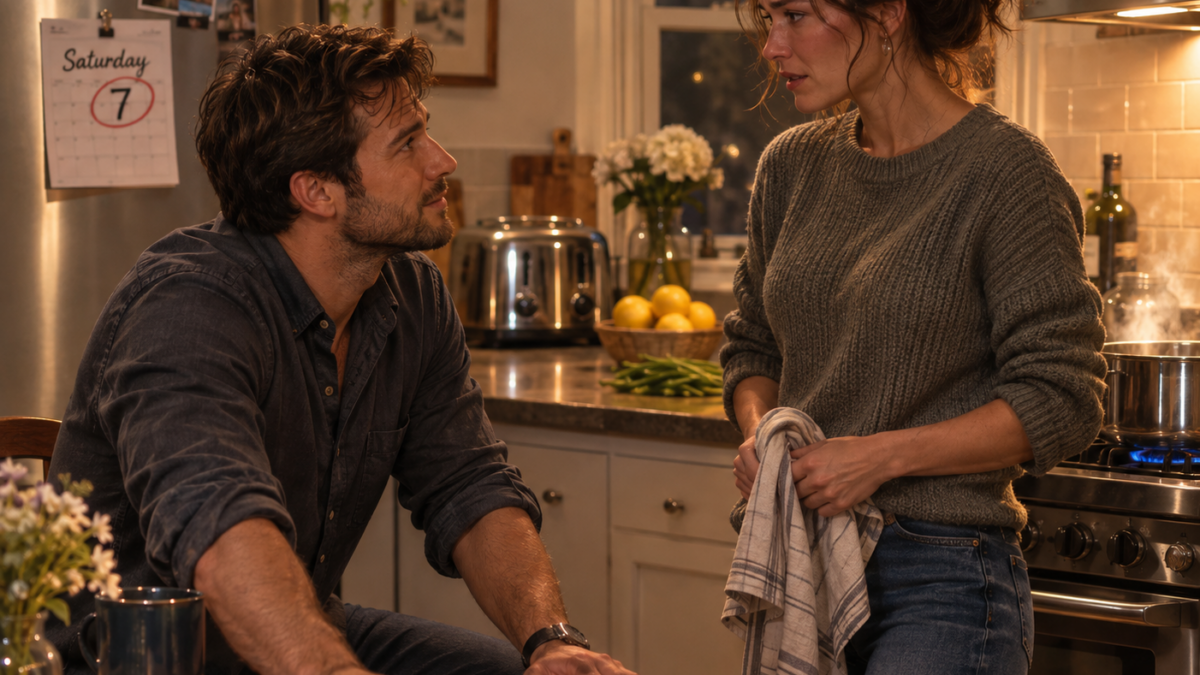
I put a note on the calendar by the refrigerator that night. It said “Saturday 7” in my handwriting, and under it I added nothing, which was strange, because I had never had a date on that calendar that didn’t come with a task.
A little after ten, my phone buzzed with a message from Lydia. It read: “Bring nothing. Fix nothing. I’ll handle all of it.”
I read it twice and stood there with the phone in my hand, wondering whether “all of it” included an answer or only dinner—and knowing she probably had not decided yet either.
I didn’t call Lydia on Monday, and it was harder than I would have admitted to anyone at the shop. She had a standing dinner with two women from her clinic that she refused to move for anyone, and she texted that morning to say she was keeping it. I wrote back that she should, and I meant it, although I held the phone a long moment before I pressed send.
A few weeks earlier, I would have read a message like that as a door closing, and I would have spent the evening building theories about it. Instead, I stayed late finishing a bench seat for a man with a 1968 Chevelle, went home, and ate scrambled eggs standing at the counter. She called at ten to tell me one of her friends had cried over a cheese plate. And on Tuesday, she reported that the green armchair was still on the floor of the consignment shop, and she was still deciding.
Nobody had asked anybody to be available all week, and I liked it better than I had expected to.
On Wednesday, she texted that she wanted to see me, and I told her I had a softball game at seven but could meet her at a quarter to five. The old Evan would have skipped the game, and I could tell she knew that, because her reply managed to sound pleased and a little annoyed at the same time.
We sat in a diner a block from her clinic, me still in my work boots, with forty minutes and a basket of fries between us. Under the table, her knee settled against mine and stayed there, and neither of us mentioned it.
She asked about the bungalow, and I told her I wasn’t putting in an offer because the garage really was too small and I wanted to see more houses. Then I said the plan didn’t depend on her answer.
— “I’m not saving for a house with a spot already held for somebody,” I told her. “I’d like the somebody to be you. If it isn’t, I’ll still buy a house, and I’ll still be fine, and it’ll just be a quieter one.”
She studied me for a while and said that was the least flattering and most reassuring thing she had heard all month.
After that, she told me what had been underneath her hesitation all week. If we tried and it went badly, she said, she would not only lose a boyfriend—she would lose the person she called from the shoulder of the highway, the one who knew where her spare key lived, and her sister’s holiday table would turn into a place where everybody had to be careful.
I asked if she wanted me to say that wouldn’t happen, and she said yes, very quietly.
I didn’t say it.
— “I can’t promise that,” I told her. “I’d work hard to keep you in my life, but people who split up are usually careful around each other for a long time, and I won’t pretend we’d be the exception.”
She did not like the answer, and she also did not look surprised by it. She reached across and took a fry from my side of the basket, which in our language meant she had heard me.
I made the game with six minutes to spare and went two for three, which I put down entirely to being scared.
On Thursday, she asked me to come by at six for a drink on her porch, because Susan was stopping at half past to collect the things Oliver had left behind. Susan arrived on time and took a pair of rain boots and the dinosaur book out of the basket by the door. Then she stood on the top step with the boots under her arm.
— “We’re doing the zoo on Saturday afternoon. All of us,” she said to Lydia. Then, to me: “Should I invite Evan? I’d like to know before I tell Oliver, because he repeats everything.”
Lydia set her glass on the porch rail.
— “Don’t ask me to answer for him,” she said. “He’s sitting right there.”
Susan raised her eyebrows at me, but Lydia kept going before I could speak.
— “And when you asked what we were in my kitchen, I said ‘old friends.’ That was a reflex, and it wasn’t true anymore. We’re trying dating. Seriously. I think we haven’t worked out what that looks like, so please don’t turn it into an announcement.”
Susan looked from her to me and back again.
— “That’s all I wanted to know,” she said. She told me the zoo opened at one if I felt like coming—no pressure either way—and then she kissed her sister’s cheek and went down the walk with the boots.
Lydia dropped into the porch chair as if she had run up a hill. She apologized for speaking over me, and then for not asking me first, and then she said she would ask me now, properly.
I thought about it honestly, because I do like Oliver and I wanted to see him again. But Saturday night already had a seven o’clock on it, and that seven o’clock was supposed to belong to the two of us.
— “Not this Saturday,” I said. “I’d like to be at a zoo with your family someday as myself, when it isn’t the warm-up for something else.”
She nodded slowly and said she would go with them and be home by four, and that she didn’t want the evening to have anybody’s sticky hands anywhere near it. We agreed that the zoo would stay the zoo and the night would stay ours, and neither of us had to treat a boundary as a rejection.
On Friday, I stopped at her porch for ten minutes on my way home, with nothing in my hands, as instructed. I told her I had run into a woman at the hardware store the morning before—a woman named Carla I had gone out with for a few months two summers ago—and that we had said hello in the paint aisle. I told her because I would rather she heard it from me than from somebody who had seen us.
— “Was she nice?” Lydia asked, much faster than she meant to.
— “She was fine. And we’re not in touch. Are you seeing her?”
— “No.”
Lydia looked at her knees.
— “I don’t have any right to ask you that,” she said. “And I hated hearing it anyway.” She gave a short laugh that wasn’t amused. “That’s the worst part. I want you not to be on anybody’s porch but mine, and I haven’t risked one thing to earn wanting that.”
I told her I wasn’t seeing anyone and wasn’t looking, and that I would rather say the rest of what I thought tomorrow at my own table than on her steps in the dark.
She nodded, and for once did not reach for a joke. When I stood to go, she walked me down to the bottom step and stopped there with her arms crossed against the evening cool.
— “Tomorrow, I’m not bringing a chair to look at, or a casserole I can’t finish, or Oliver’s rabbit,” she said. “I’m not bringing a joke to hide behind either. I’ve been making a list of what I’m leaving at home.”
— “And what are you bringing instead?” I asked.
She looked down the street toward the corner where I would turn, and her mouth moved as if she were trying a sentence and putting it back. Then she reached up and straightened the collar of my shirt, which didn’t need it, and left her hand there a second longer than the job required.
— “I’m still working on that,” she said.
I walked home with my hands empty in my pockets, and part of me wanted to turn around and ask for the answer anyway, but I kept walking.
Lydia knocked at seven exactly, which I knew because I had been standing in my kitchen watching the stove clock for ten minutes. She came in with two canvas grocery bags, a sunburn across her nose from the zoo, and a face she had clearly arranged on the walk over.
Her instructions were to sit at the table and keep my hands to myself.
So I sat, and she took over my kitchen the way she takes over anything she has decided to do properly. She moved my salt to the other side of the stove, hung my good wooden spoon on the wrong hook, and lined up the pasta, the lemons, and a bag of green beans in the order she planned to use them. I opened my mouth about the spoon and closed it again. She caught me doing it in the reflection of the toaster and said nothing—only smiled at the cutting board.
Over the sound of the faucet, she told me that Oliver had fed a goat a paper cup and then cried the whole way back to the car because the goat didn’t wave goodbye. She also said Susan had not mentioned me once all afternoon, which Lydia insisted was louder than any question.
I had spent most of my life walking into her kitchen and rearranging things without asking, and I sat with my palms flat on the table and understood that it had been one of the quieter ways I decided things for her.
She had barely gotten the water on to boil when she turned the burner down and faced me with the dish towel still in her fist.
— “I’m saying it now,” she told me, “because if I wait until after dinner, I’ll talk myself out of it, and I know exactly which joke I’d use.”
I put my elbows on the table and waited.
— “I want to date you. I mean, seriously—with a name for it, and not a version where I can still say we’re just friends if my sister looks at me funny. I asked you a question on my living room floor two weeks ago and then tried to take it back. I’m not taking it back.”
Her voice shook once on the word “seriously,” and she carried on past it anyway, which was the part I noticed most. She kept going before I could answer, her eyes on the towel.
— “There’s a lot I can’t promise, and I need you to hear that part, too. I don’t know when I’d want a kid, or if I’d want one with anyone. I don’t know about living together or a house with a porch. I can’t promise it’ll be easy just because we’ve known each other since we were small—because I think that’s part of what I’ve been hiding behind.”
She twisted the towel once and said the last piece more quietly. She was afraid that the moment she said yes, everyone she loved would start planning her life for her, and that she would let them because it would be easier than arguing.
Then she looked up—frightened and steady at once, which on her is a very particular face.
— “That’s what I’m bringing. It’s not much of a casserole.”
I had spent two weeks learning not to answer for her. And now I had to answer for myself, which turned out to be harder than I had guessed.
I started with Carla, since I’d promised her the rest of it, and I said it plainly. I wasn’t seeing anyone. I didn’t want to. And I wanted to be the only person on her porch, and for her to be the only one on mine.
Then I stood up so I wouldn’t be speaking to her from a chair and said the rest.
— “I’m not going to treat what you said on that floor as a yes to anything down the road. No house, no kids, no schedule. I do still want something that lasts, and I won’t pretend I don’t, because you’d see through that in a day. But I’d rather build it with the person you are now than with the one I kept filling in for you.”
Lydia asked, “What would happen if we found out we didn’t want the same things?”
— “Then we’ll have a hard conversation,” I said. “And I’ll hate it, and we’ll still have been honest.”
She set the towel down on the counter and crossed to me, and I asked if I could say something and have her tell me whether it was too soon. She nodded once.
— “I’d like tonight to be my girlfriend’s night. She does the cooking. I stay out of the way, and I find out something about her that I don’t already know.”
I watched her mouth go through the old reflex—the first half of the joke—and I watched her put it down on purpose.
— “Yes,” she said, a little breathless. “Okay. Say it again so I can hear what it sounds like.”
I said it again, and she laughed under her breath—a real laugh, with nothing hidden in it. I asked whether I could pull her in, and she said yes before I’d finished the question, and the kiss was warm and unhurried and tasted faintly of lemon. Neither of us treated it as the answer, because the answer had already been spoken and the kiss only agreed with it.
Dinner took longer than it should have, since she kept stopping to taste things and frowning at my dull knives. The pasta was better than I had told her it would be, and the green beans were underdone in a way she defended with real heat. When I suggested another two minutes in the pan, she said she liked them with a snap and that I could have my soft ones at my own table on another night. I started to apologize and caught myself, because she had said what she wanted and nothing about it needed fixing.
She told me she had not slept well all week. I told her I had slept fine, and she called me insufferable and reached across to steal a bean off my plate.
When we finished, I stood up and started stacking dishes by reflex, and she told me to sit back down. I said they’d be harder to wash in the morning.
— “I don’t care about the morning,” she said. “I want to sit on your couch with my feet up and be bored with you. Leave them.”
A month earlier, I would have guessed what she wanted and been so sure of myself that she’d have given in. Instead, I stood there with a plate in each hand and asked whether she meant it, and she said she did. So I rinsed the two plates anyway and left the pot, which she declared a fair compromise.
I think about that night more than the one with the fire truck—although I never did stop liking the fire truck. On the living room floor, I could picture a life with Lydia, and it was a nice picture, and it asked nothing of either of us. Loving her started later, in my own kitchen, when she told me what she did not know and I stayed.