Her Parents Sold Her Home and Left Her a $1 Barn — They Never Read the Deed Hidden Inside It
Her Parents Sold Her Home and Left Her a $1 Barn — They Never Read the Deed Hidden Inside It
At 19, Ren Doyle had learned to say yes to people who loved her loudly and listened to her rarely.
So when her parents sold the only home she had ever known and drove her out to a leaning dairy barn they called her share, she thanked them and let them take her phone, her car keys, $5,100 from two summers at an ice cream window, and the little tin box that held her grandmothers thimble. The barn stood 14 mi from the nearest town at the end of 3 mi of mud.
On her second night there, the rain came down on the tin roof, and a smell of apples and wet earth rose through the cracked stone floor of the milkhouse, and the starving greyhound that had followed her in, lay down on one stone, and would not move.
Beneath it was a root seller and a deed her parents had held in their own hands and never read to the last page. To understand what she found, you have to start with the morning they took her home.
It was the 3rd of May, a Monday, and a soft gray rain was falling on the porch roof.
The kitchen smelled of packing tape and cold coffee. Cardboard boxes stood against every wall, and out on the lawn, under the maple with the tire swing, a sign on a metal stake read, Sold.
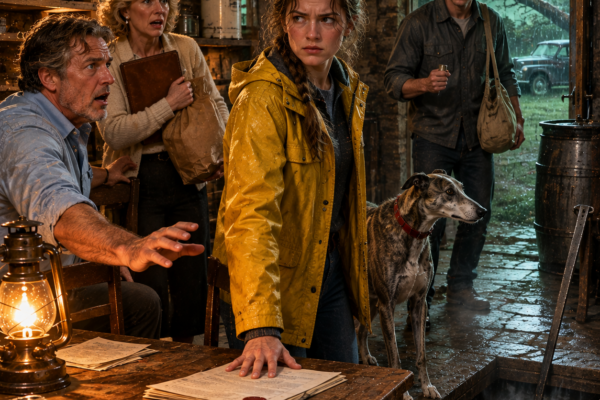
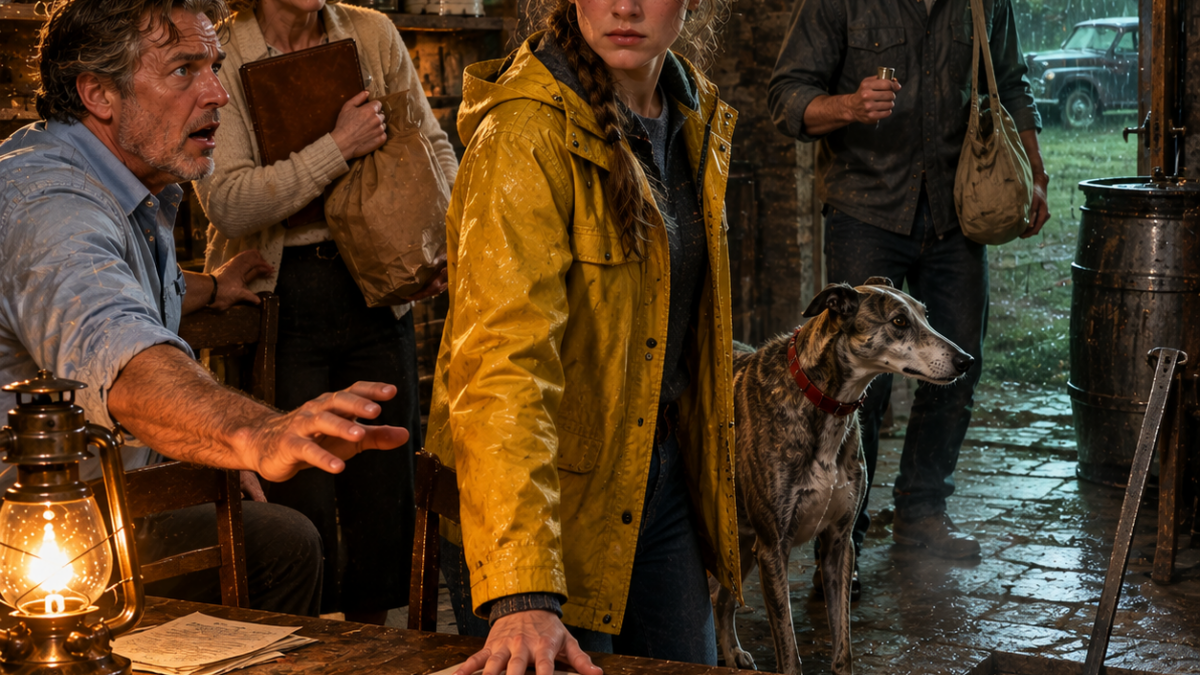
Rens stood at the counter in her yellow rain jacket, looking at it through the window as if it might change its mind. Her father sat at the table with his hands folded.
Glenn Doyle was 52, a big, ruddy, comfortable man with thinning sandy hair, and he had a way of nodding while you spoke slowly, as though your words were weights he was glad to carry.
He had sold campers to half the county. He was never loud.
He was only kind in a way that left you nothing to push against.
Its done, Ren. He said, We signed Friday.
Closing is the 1st of June, and theres no sense dragging it out.
Your mother and I have an apartment in town and its small and honestly there isnt room.
You said I could stay until I figured out what I wanted to do. We said a lot of things when we thought wed have the house.
He nodded gently.
But look at the bright side. Grandpa did leave you something.
The barn.
The barn lot. Two acres and a roof.
Her mother set down a roll of tape and came around the counter. Carol Doyle was 50, slim and sleek, with a honeyccoled bob and pearl earrings, and she touched peoples arms when she spoke to them lightly, the way you touch a sleeping child, to see if she is warm.
Daddy had the lawyer put it in your name years ago, for $1, the way old men do.
Its the only thing he ever gave you outright, sweetheart. Its yours.
You can go out there and have a place of your own while you get on your feet.
It has no electricity, said Ren.
It has a roof, said Carol. Mostly.
Ren looked at them both. Her grandfather Everett had died in February at 84, and she had not stopped hearing his voice in that house, slow, dry, with a laugh at the end of it.
He had worked the dairy barn for 51 years, and called it the only honest building in the county.
The last time she saw him in the hospital, he had told her to be sure she read all the way through.
She had thought he meant a book.
Let me get my things, she said. Weve already packed them, said Carol.
It took them 4 minutes.
Ren would count them afterward in the dark, and it always came to four. First, her phone.
It was on her mothers family plan and her mother held out one hand for it and said that the signal was terrible past the ridge and the bill had gone up and they would sort it out and in any case the phone would only be a temptation.
Ren put it in the hand. Then the keys to the old hatchback because her father needed the car for the move and had always paid the insurance which was only fair.
She slipped the little cloth owl off the ring first.
a prize her brother had won her at a fair.
Her father did not notice. And the account, Carol said, Your savings, well move it over to the family account so its safe through the closing.
Its only prudent.
Ren, a 19-year-old with $5,000 and no address, is a 19-year-old who gets robbed.
$5,100 earned at a walk up window on the lake road.
Scooping vanilla for tourists in a paper hat, she had the passbook in her jacket, she handed it over, and her mother tucked it into her white leather handbag and patted the bag twice. Let us keep it safe for you, said Carol.
It was not the words that made Rens stomach go cold. It was the voice.
It was soft and reasonable, and a half second early, the voice of a woman who has never once been told no, and does not intend to begin. Last of all came the tin box.
It had sat on the mantle for as long as Ren could remember, a small dented thing with faded blue roses on the lid, her grandmother, Adas sewing tin. Inside were a card of buttons and a silver thimble engraved with an A on one side and a W on the other worn smooth at the rim.
Ada had meant it for the first girl in the family named for a bird and that had turned out to be Ren. Luke came in from the porch to take it.
He was 23, 6 ft, and 1 in of elbows and unckempt brown hair, with a gray work shirt from her fathers dealership, and a nervous way of picking at the edge of his thumbnail.
He stood in the kitchen door with the rain behind him. He looked at the tin box in his mothers hand, and at his sister, and at the floor.
Luke, put that in the truck, said Carol. Luke took it.
For one second his green eyes found rens and there was something in them she could not read and then it was gone.
He carried the box out through the rain without a word.
Her father could take a house. It was her brother who had let him.
The drive took 40 minutes. Her father drove.
Her mother held the handbag in her lap and Luke followed in his own truck with the duffles and the tin. They went through Fenwick corners, past the diner and the little brick post office with its flag hanging wet and out onto a gravel track not much more than two ruts in the grass.
The gravel turned to mud. The mud went on for 3 miles.
The barn came up out of the weeds all at once.
It was a tall dairy barn from 1924 under a sagging gamrell roof, painted red once, long ago, and now gone to a rusty pink stre by the rain, a rusted weather vein tilted on the peak, the big sliding doors hung crooked off their track. In the whole wet sweep of fields, there was no other roof in sight.
Well, said Glenn, setting the break.
He came around and opened her door for her, which he had not done since she was little, and held an umbrella over them both, nodding warm as a hearth.
Its only for a month.
Well come Sunday with groceries.
Youve got a bag of food and a rain barrel, and your grandfather kept a lantern in the milkhouse.
Youre a smart girl. Youre leaving me out here.
Im giving you a place, Glenn said kindly.
Its not the same thing, Ren.
Someday youll see that. Her mother kissed her cheek.
Luke set the duffles on the step and stood a moment longer than he needed to, picking at his thumb, and Ren waited for him to say something. He had once taught her to ride a bicycle by running behind it for a mile and a half.
Luke, their father called from the car.
Luke went. The two vehicles turned in the weeds and rolled away down the lane, tail lights going red in the rain, and then small and then gone, and they did not slow at the bend.
Ren stood in the doorway of a barn she had visited perhaps five times in her life, and listened until the only sound was the rain on the roof. In the grocery bag, she found four bananas, a loaf of bread, a block of cheese, a jar of applesauce, a tin of sardines, six eggs, and a box of crackers.
Her father had counted out a week. A person who leaves a week of food expects to find you exactly where he put you.
She dragged the sliding door open another foot.
The barn was vast and dim and smelled of old hay, and slatted light came down through the boards in long gray bars. A concrete milking aisle ran between rows of iron stansions rusted the color of cinnamon.
At the far end, a low door led into the milkhouse, and in the corner, under a tangle of cobwebs, a squat iron cream separator stood like a small headless man. It has a roof, Ren said aloud.
Mostly.
She had barely turned from the doorway when she heard a scrape behind her. Nails on concrete, slow and uneven, one foot dragging.
A dog stood in the big doorway with the gray rain behind her.
She was tall, much taller than Ren would have guessed, and so thin that her ribs showed in a ladder under a coat the color of wet slate, striped darker gray. She had a long narrow head, a deep chest, and legs like a deers.
A faded red collar hung loose on her neck with no tag. She held her left hind leg a little off the ground, and her dark eyes rested on Ren without fear and without hope, the way a person looks at a door she has knocked on before.
Hello, Ren said softly.
Where did you come from? There was a block of cheese and a week of food and a girl who knew what it was to count.
She did the arithmetic and then she did what the arithmetic did not recommend. She broke the cheese in half and held out a piece flat on her palm.
The greyhound crossed the floor on three good legs and one bad one and took it so gently that Ren felt only the warm breath.
She took the second piece too and licked the palm clean. Then she lowered herself onto the concrete with a long shudder like a tent collapsing and rested her chin on Rens boot.
Ill call you Moss, Ren said.
Youre the color of the barn when its wet. It was the smallest kindness she would do that week, and it would be repaid in time in a coin she could not yet imagine.
With the daylight going, she learned how much of a roof was mostly. In the loft, the rain came through a hole the size of a card table and ran down in a bright stream onto the barn floor.
She found a stiff feed sack tarp and a coil of bailing cord, dragged a ladder across the aisle, and lashed the tarp over the hole knot by knot, the way her grandfather had once shown her to tie a load.
It took an hour. When she came down, her hands were skinned and shaking, and the pond on the floor had stopped growing.
Then water. By the milkhouse stood an iron hand pump rusted to the shoulder.
She primed it with a cup from the rain barrel and worked the handle for 10 minutes while it coughed brown air, then rust, then water so clear and cold that her teeth achd. She drank from her cupped hand, standing in the rain, and laughed out loud for the first time that day.
She made camp in the milkhouse, a small, dry, stonefloored room with a window the size of a book. She found her grandfathers lantern on a hook half full of oil and a camp stove in a crate, and spread her sleeping bag on a pallet of feed sacks.
Moss lay on the stones beside her.
The rain drumed on the tin, soft and unhurried. It was not a cold night.
It was only dark and a long way from anyone.
On Tuesday the rain thickened, and she worked all day because working kept her from thinking. At noon she walked the aisle with the lantern and read the names her grandfather had burned into the stallboards.
Clover, Hattie, Big Bess, nine cows, each with a date. By evening, Moss had eaten two scrambled eggs and stopped shaking and lay in the milkhouse door like a gray statue, watching the lane.
It was after 9, with the lantern turned low, when the smell began. Ren was writing the days tally on the back of a feed receipt when she caught it at the back of her throat.
Not the barn, something sweet and cool, like an orchard in October, like a pie left on a sill, and under it the dark mineral smell of wet earth.
It came from the floor.
The milkhouse was paved with big flat fieldstones. In the center, where they met in a rough square, a faint cool vapor was lifting from the seams and curling into the lantern light.
Moss rose and limped across the room. She stopped over the square and lowered her long gray head until her nose almost touched the stone and let out a low, thin wine Ren had never heard from any animal.
Then she lay down on that very spot with her chest against it and would not be moved.
What is it, girl? Ren knelt and laid her palm over the seam.
The air moved against her skin, steady and slow, as if something under the barn were breathing out. A barn floor does not breathe.
She ran her fingers along the stones until she found a seam deeper than the others and clean. The mortar newer than the rest, a line much too straight to be an accident.
At the corner of the square, half buried in a century of grease and straw, lay an iron ring.
She took her grandfathers flat pryar down from its nail, set the end under the ring, braced her boots, and leaned with all of her weight. For a moment nothing happened.
Then something gave with a long dry crack, and a slab of stone as big as a cellar door lifted a fingers width on a hinge she could not see.
And the cool air poured up over her wrists, sweet with apples, and the lantern flame leaned over and fluttered and stood up again as if it had been told a secret.
The slab came up slowly on hinges that somebody had oiled once, with great care.
It was heavier than it looked, 4 in of field stone set in an iron frame, and Ren had to lever it with the pryar and walk it up on her knees until it stood open against the milkhouse wall. The cool air came out in a long, slow breath, as though the barn had been holding it for a hundred years.
Below lay a square of black and in the black a stair stone steps worn into shallow dishes at the middle going down. Moss got up.
She stood at the edge with her ears forward and her nose working.
And then with the tired confidence of a dog entering her own kitchen, she started down the first step, stopped, looked back, and waited. Ren took the lantern from its hook.
eight steps.
She counted them because counting was what she did when she was afraid. At the bottom her boots found a floor of flat brick, and she held the lantern high, and the room came out of the dark around her.
It was a cellar, but not like any she had been in.
The walls were fieldstone laid tight and whitewashed, and the ceiling curved overhead in a low barrel vault of brick, so that the whole room had the look of a small tunnel. It was perhaps 15 ft long.
It was dry. It was cool, not cold, with that sweet, clean smell of apples hanging in the air.
And along both walls stood plank shelves crowded with glass jars, hundreds of them, gold and amber and red in the lamplight. Three iron cotss stood folded against one wall with gray blankets stacked on them.
In the center was a plank table with a lamp on it and a stool.
And at the far end, set into a niche in the brick, sat a small black iron strong box, no bigger than a bread box with a brass plate on the lid and a keyhole beneath it.
Over the foot of the stairs, a single oak beam ran across the vault. Something had been carved into the underside of it, deep and square, the letters black with age.
Read to the last page.
Ren stood very still.
She had the strangest feeling that she had walked into a sentence her grandfather had been saying for a long time and had only just now come around to the end of it.
Then Moss padded to the table and lay down beside the stool, and Ren set the lantern on the planks and saw what lay under the glass chimney of the table lamp. A thick book bound in green cloth.
its corners worn through to the board and on top of it an envelope with her name on it in a square upright hand she would have known anywhere.
Ren. She sat on the stool.
Her hands were not as steady as she would have liked.
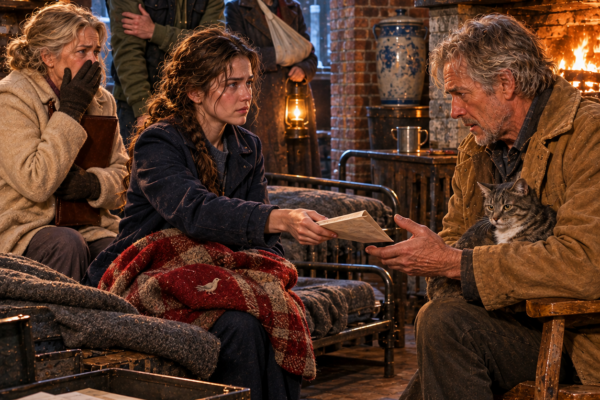
She slit the envelope with her thumbnail and read, Dear Ren, if you are reading this, I am gone and somebody has carried you out to my barn and left you there. I am not surprised.
I only hope to be wrong. I was never a man who said things aloud, so I will write them.
You were the only one in this family who ever sat on the milkhouse stool as a little girl and asked me what the cows were thinking. I decided that day that you would get the part of me I kept back from the rest.
You were not an afterthought, kid.
You were the one I was saving it for. This cellar was dug in 1924 by my father the same summer as the barn to keep apples and cream through the dry months and a family through the bad weather.
Your grandmother put up the jars. Eat what you need.
The red lids are applesauce and the gold lids are apple butter.
The blue lids you leave be until you have read to the end.
The green book on this table is my field diary.
It is 51 years of weather, prices, and one mans opinions.
It will tell you what I could not say with your father in the room. Read it all.
Do not stop at the first page of a thing, and do not stop at the first page of a person.
The strong box has a key. The key sleeps where the cream is made.
There is also a woman on the male route named Bernice Hatch who knows more about me than my own son and who will not ask you why you came. Your father read the first page.
Be kind to him, but do not let him carry one more thing of yours.
Your grandfather, Everett, she read it twice.
The second time her eyes blurred on the line about the milkhouse stool.
She had been six years old in a pair of rubber boots two sizes too big and she had asked him what big Bess was thinking and he had stopped with a pale in each hand and said, I expect shes thinking about lunch.
She had forgotten it entirely. He had not.
She folded the letter along its creases and held it against her knee. And for a while the only sounds in the cellar were the dogs breathing and the rain on the barn far overhead soft as a hand on a window.
She did what the letter said first because it was something to do.
She trimmed the wick of the table lamp and lit it and a low gold glow filled the vault.
She shook out two gray blankets and found them dry and smelling of cedar. She carried the sleeping bag down from the milkhouse and the camp stove, and then step by step, with a great deal of patient effort, she coaxed all 50 odd pounds of moss down the stairs in her arms, the old racer going stiff as a board, and then halfway relaxing with a long sigh against Rens neck.
She laid her on a folded blanket at the foot of the stairs. Moss put her chin on her paws and her tail thumped once on the brick.
Some people leave a fortune behind and some leave a note in the margin.
She opened a red litted jar and ate applesauce with a spoon from the table drawer.
standing up cold and sweet and exactly like the August of her childhood and tears ran down her face and she let them. Then she sat down and opened the green book.
The first page was dated the 4th of March 1976 in a young mans hand.
Rain a fraction of an inch sold 12 cans at $180.
Ada says the heer is off her feed.
The hand grew heavier and shurer with every page, entry after entry, a line or two a day.
A mans whole life measured in weather and milk and prices, and now and then a sentence that came out of nowhere and made her sit back.
March the 14th, 2008. A girl, Ren.
Ada put the thimble on the mantle and said it was hers when she was big enough to lose it.
October 2012, Adahs last good day told the cows first.
She read until the lamp needed trimming and then she trimmed it and read on.
She found the day he bought the first milking machine and the day he sold it back because Ada said the cows did not care for the noise and neither did she. She found the winter of 1981 when the creek froze to the bottom and he carried water from the pump in two buckets for 11 days.
She found a line that said only Glenn walked today and another 3 years on that said, Glenn says the barn is a hole in the ground with a roof on it.
She read that one twice. There was no anger in it.
He had simply written it down the way he wrote down the rain because it had happened and because a man who keeps a diary for 50 years learns not to leave out the weather.
Then she found her own name over and over in small plain entries she had never known existed.
Ren sat on the milkhouse stool and asked what the cows were thinking. Ren four fell asleep in the straw and Ada would not let me move her.
Ren lost a tooth in the apple butter. Ren did not come this Sunday.
Her mother says there was a recital.
Ren did not come this Sunday.
Ren did not come.
And then in a year she could count on her fingers. The entries about her thinned out and stopped.
And there was a sentence beneath the last of them that she had to hold the book closer to the lamp to read.
I understand it was not her choice. Ren closed her eyes.
It was not her choice. It had not been ever, and somebody had known it, and had written it down, and had kept it for her in a cellar where no one could take it away.
When she opened her eyes again, she looked at the strong box in its niche, small and black and square, with its brass plate and its patient keyhole. The key is where the cream is made.
She did not know what that meant. Not yet.
But she knew it was a sentence an old man had written for her alone.
And for the first time in 2 days, she was not afraid of a single thing in the dark. She read slowly.
Moss slept.
At some point she noticed that she was not afraid anymore. Then because the book was very long and the lantern was low and she was 19, she turned to the funeral.
It had been the last Saturday in February. They had held the lunch afterward in the church basement, and Mr.Reyes, her grandfathers lawyer, a small gray man with round glasses and a tweed jacket, had come across the room with a manila folder, and had asked her father if he might have 5 minutes at the end of the table.
Ren had been sitting with Luke.
She remembered the ham sandwiches. She remembered that her father had already taken his seat before the lawyer reached him.
Its only a formality, Glenn. Mr.Reyes had said Everett wished you to witness this and have a copy.
Its a deed.
The barn and its lot to Ren for a dollar signed years ago.
Its two pages. Glenn had taken the first page and read it with his lips moving a little and nodded and smiled.
A dollar for the barn, he said.
Thats dad all over. There is a second page, said Mr.Reyes.
You may want to read both.
Im sure its the legal description, said Glenn, and signed where he was shown. Tobias, Ive known this man my whole life.
If there was something on page two, Id know it. Mr.Reus had looked at him for a moment, and then at Ren over the top of his glasses, with an expression she could not name, and had not thought of since, he had folded the second page back under the first.
He had said in a very quiet voice to no one, As you like. She sat now in the lamplight and understood with a small slow drop in her chest that she was the only person left alive who had seen that look.
She turned back to the diary. The last entries were crowded and slanting, written by a hand that was clearly tired.
September 2026. Glenn brought a man to the porch today named Vale with a shiny jacket and a folder.
They stood in the yard and looked at the lakeside.
They did not look at me. They did not ask after my health.
November.
The lawyer says it is all in order. It is all on the last page.
I have stopped being angry.
It is a good deal easier to be sure.
The last entry was dated the 4th of February in a hand that wandered and recovered.
It was only three lines. Ren, the key is where the cream is made.
Bernice will help you. Do not sign anything your father brings you before you have read the whole of it.
Below it, the last page of the book had been folded in half and sealed shut with a blob of red wax. And across the seal, in pencil, in her grandfathers square hand, were four words.
Not yet.
Soon Ed D Ren put her hand flat on the book.
Overhead the rain was easing and through the open hatch she could hear water running off the barn roof into the barrel, a small bright sound like something being counted.
And on the brick beside her, in her sleep, Moss lifted her long gray head and looked up the stairs toward the milkhouse toward the iron cream separator, standing in the dark with its secret, as if she, too knew where the key was kept, and was only waiting to be asked. Wednesday was the quietest day of Rens life, and the fullest.
She slept in the cellar on one of the iron cotss with moss on the bricks beside her and woke at first light not knowing where she was. Then she smelled the apples and knew.
She spent the morning counting. There were 312 jars on the shelves, red lids and gold lids and the blue ones she had been told to leave alone.
Each one labeled in the same square hand with a season and a year.
She ate a spoonful of apple butter from a gold lid, and it tasted like October, and she cried a little.
On the back of a feed receipt, she wrote one name, Bernice.
She did not know who Bernice was. She knew only that people do not write the names of strangers in their last three lines.
On Thursday morning, she walked out to find her. The lane ran three mi through wet pasture to the county road, and she walked it with moss limping at her knee.
At the end of the lane, where the gravel met the blacktop, stood a dented mailbox on a leaning post, and on the side of it, in faded paint, was a single word, Doyle.
She sat down on the culvert to wait. It was 9:30 when the truck came over the rise.
a small white truck with a blue stripe, the driver sitting on the right hand side so that she could reach the boxes without getting out.
It stopped. A window rolled down and a woman in a navy jacket leaned out and looked at Ren and at the dog for a long moment without saying anything at all.
She was past 60, sturdy and weathered with short silver hair under a blue cap and warm brown eyes that had not been surprised in years.
Well, she said, there you are. Im sorry, said Ren.
Ren Doyle.
You have your grandmothers way of standing on one foot. She turned off the engine.
Im Bernice Hatch. Ive carried the mail on this road for 24 years, and your grandfather told me in the middle of February that you would come to this box sometime after the first week of May with a dog.
I told him Id believe it when I saw it.
Id like it noted that I was wrong to doubt him.
Ren found that she could not speak.
Moss limped to the side of the truck and put her long head in through the open window and rested her chin on Bernices knee. Oh, you poor thing, said Bernice softly, and her whole weathered face changed.
Somebodys been feeding you, she looked up. Thats Everetts dog.
Moss?
He never called her anything.
He said, A creature ought to be allowed to tell you her name in her own time.
Bernice scratched behind the dogs ear with one gloved finger. She came off a trailer on this road in October.
A racing greyhound somebody didnt want anymore with a bad leg, and she walked straight up that lane.
Your grandfather found her at the barn door the next morning. He set a pan of scraps on the step every evening at 5:00 after that, and he never once reached out to touch her.
He said that was her business to decide. After he went into the hospital, I left biscuits on top of the mailbox, and she came for them.
Ren put her hand on the gray head.
Moss had not been astray at all. She had been waiting for 4 months for someone to come back to the barn.
Get in, said Bernice. You look as though you havent eaten since Monday.
Ill take you to Lornas and you will not say a word about money.
I cant pay. They took everything.
I know, said Bernice.
Glenns mail comes through me.
She put the truck in gear.
I only carry the envelopes, Ren.
But a woman cant help what she sees. They rode with the window down and Mosss head between them on the seat.
Bernice drove with one hand and told the story the way people tell it, who have told it often, and are not tired of it. The river had risen 4 ft in a night in March of 1936, she said, and taken the bridge at Fenwick Corners and cut 41 families off from the town for 9 weeks.
Your greatgrandfather was Hollis Doyle, she said.
a hard, quiet man with a barn full of cows and a cellar full of the thing hed put by.
When the bridge went, he opened that barn to the whole valley.
Milk every morning, and apples and jars handed out the door by the ladle. Nobody paid, nobody was asked.
When the water went down, the children in the valley called that barn by a new name. They called it the Larder.
Nobody ever told me that, said Ren.
Your father never cared for the story, Bernice said mildly.
It doesnt sell campers. The diner stood on the corner of Maine and Mill in Fenwick corners.
A small white building with green awnings. A woman with a gray braid stood behind the counter pouring cups, and four old men sat at a round table by the window in the attitude of a jury.
Everyone looked up when the bell rang. Everyone looked at the dog.
Lorna said Bernice.
This is Ren Doyle.
Shell have the pancakes and two eggs, and the dog will have whatever you can find that isnt a bone.
Doyle, said one of the old men slowly.
Everetts girl? Everetts granddaughter?
One of the men took off his cap and held it in both hands for the length of a breath and put it back on.
Ren was given a stool at the counter and a plate of pancakes the size of a hubcap and a glass of milk so cold it hurt her teeth.
She ate without speaking.
Under the stool, Moss ate a plate of scrambled eggs and gravy with the astonished gravity of an animal who has begun to suspect she is safe.
When Ren had cleaned the plate, Bernice leaned close and spoke in a voice that carried no farther than the cream pitcher. I cant talk about it here, but Ill tell you what I can.
Your grandfather made me promise two things. One was that Id get you your breakfast.
She smiled.
The other was that Id tell you he kept every promise he ever made to you, even the ones he couldnt say out loud.
He wrote me, said Ren.
just as quietly.
Theres a letter and a diary. He told me to read to the last page.
Something went across Bernices face very quickly, like a birds shadow. He said that to me, too, over that mailbox.
Id guess a hundred times, she said. Read to the last page.
I took it for an old mans habit. Ive been thinking about it since the funeral because of what I saw at your grandfathers farmhouse.
The Tuesday after the funeral, there was a gray car in the yard.
A man in a shiny jacket was standing on the porch with your father, and the two of them were looking out toward the lakeside, not at the house.
Your father kept nodding. Ive known Glenn Doyle since he was a boy.
And he nods when hes frightened.
Who was he? His name is Preston Vale.
I know because he gave me his card on the porch and asked whether I knew who owned the shoreline. Bernices mouth thinned.
I told him I only carried the mail. Ren put down her fork.
Anything else?
Glenn sold his boat in March, the big one with the cabin that he kept at the marina.
Sold it for half what it was worth to a man from the city in a week for cash.
And last month I carried three envelopes to his office from a lender in the capital with red stamps on the front.
The kind they print when a thing is already late.
She shrugged one shoulder. I dont know what any of it means.
 [Tap here for the Next Part ]