Racist Cop Throws Coffee on Black Woman — Then the Courtroom Learns She’s the U.S. Attorney General
Racist Cop Throws Coffee on Black Woman — Then the Courtroom Learns She’s the U.S. Attorney General
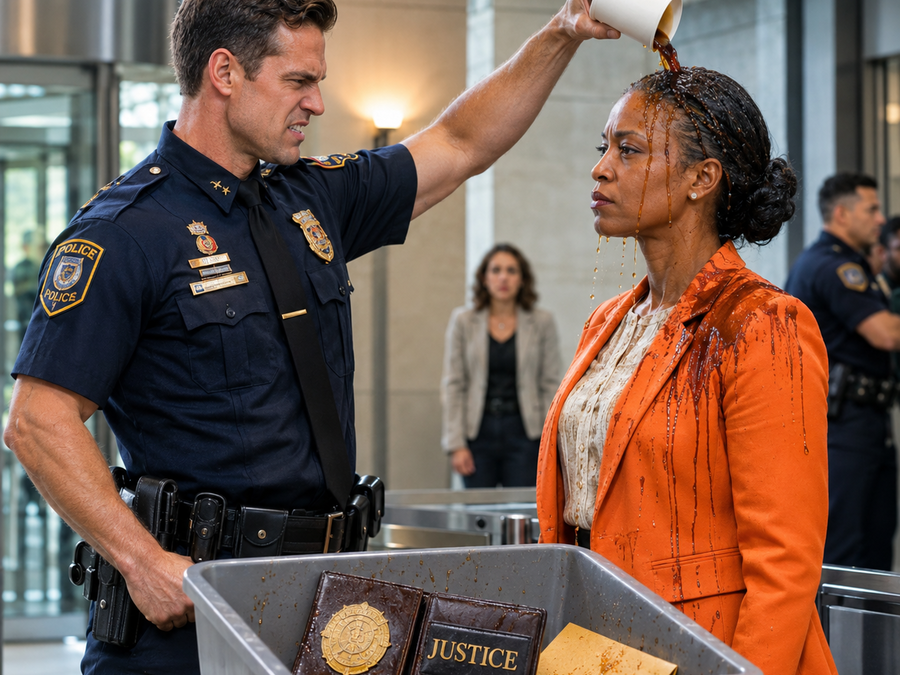
The paper cup tipped in the lieutenant’s raised left hand.
Hot coffee ran over the woman’s low bun, down her face, and onto the shoulders of her tangerine orange suit.
Behind her, a whole line of jurors stopped breathing. Her leather wallet had fallen open in a gray plastic screening bin, and coffee splashed across a round gold seal.
She did not step back.
She did not wipe her eyes.
The lieutenant looked her up and down and smiled.
“Jur use the front door,” he said.
You don’t look like a juror.
Somebody in the line whispered that this was not right.
Nobody moved. And Lieutenant Dne Thorne had no idea that the woman dripping coffee on his marble floor had been sworn in 8 months earlier as the attorney general of the United States.
Tyrone Soul had folded his jury summons twice.
The way his mother folded important letters.
It was the first one of his life. At 8:00 on that gray Monday morning, he stood in the jury line at the Ridgefield County Courthouse in Queensbridge, Maryland, and held the yellow card against his chest like a ticket.
The line moved slowly toward the X-ray belt, where a police lieutenant stood sipping coffee and studying every face that came through the doors.
Behind him, a woman in her 50s set a black leather tote into a gray plastic bin. She wore a tangerine orange tailored suit over a cream silk blouse, low black pumps, and small gold drop earrings.
Her hair was pulled into a low bun with silver at the temples.
First time?
Yes, ma’am.
Tyrone said, “My mother ironed my shirt for it.”
She smiled. Mine would have done the same.
I drive a forklift at Harbor Point Distribution, he said.
My boss almost didn’t let me come.
He said, tell them you’re busy.
I told him you can’t tell a judge you’re busy.
You can’t.
She agreed.
And you shouldn’t want to.
This is the one place where your voice counts the same as anybody’s.
That’s what my mother said, word for word.
Then your mother is a wise woman. The lieutenant at the belt wore a navy shortsleeve police uniform shirt with a black tie, gold bars on his collar, a gold badge, a gold name plate that read thorn.
He held a white paper cup of coffee in one hand.
With the other he pointed, “You,” he said to a young black man three places ahead side hallway.
The young man went. A minute later, Thorne pointed again at another young black man.
You, side hallway. Then his finger found Tyrone.
You, side hallway. Tyrone held up his summons.
Sir, I’m a juror.
What’s the reason?
Thorne did not answer.
He reached out, snatched the yellow card from Tyrone’s hand, and crushed it in his fist.
Then he took Tyrone by the arm, and pulled him out of the line. The woman in orange spoke loud enough for the whole lobby to hear.
Why is it only young black men going in there?
The line went quiet. Thorne turned.
He looked at her from her shoes to her silver temples slowly, the way a man looks at something he has already decided about. Then he lifted his paper cup with his left hand, tipped it over her head, and let the coffee run.
Jurors use the front door, he said.
You don’t look like a juror.
Coffee splashed into the gray bin. Her leather wallet had fallen open beside her keys.
Inside it was a round gold seal and behind the seal a yellowed paper folded in four. Only Tyrone saw it.
He saw the seal and he saw the paper and he did not understand either one.
The woman looked down at the bin. She closed the wallet with two fingers.
Then she looked at Tyrone very softly.
Not today.
The paper was her late mother’s jury summons from 1971 from this same courthouse.
Her mother had been turned away at a side door and never saw the inside of a courtroom.
Her daughter carried that summons every time her own name was called. A woman in a babel blazer near the metal rail lifted her phone.
She had auburn hair to her shoulders and a black leather briefcase at her feet. Thorne caught her eye.
“Put it away, counselor,” he said.
“Or I’ll put it away for you.”
Gemma Calbertt lowered the phone. An older woman in the line opened her mouth to speak.
A young officer with a buzzcut stepped in front of her.
His silver badge read Dempsey.
“Ma’am, please keep moving.”
Officer Ree Dempsey said without looking at her face.
That man poured coffee on her.
The older woman said, “Please keep moving, ma’am.”
Nobody else lifted a phone.
Thorne waved his cup toward a gray door marked secondary screening.
“Both of you now.
” The hallway behind it was narrow and white with a steel bench along one wall and a small security desk at the far end.
There was no camera on the ceiling. Tyrone noticed that.
He did not know yet why it mattered.
He pulled his phone from his jacket.
I’m recording this.
He said, “No, you’re not.”
Thorne said, “Dempy.
” Ree took Tyrone by the wrist, turned him, and cuffed him to the steel bench.
The cuffs bit into his skin. Tyrone sat down hard.
“I didn’t do anything,” Tyrone said.
“I’m here for jury duty.
You’re being screened,” Thorne said.
The woman in orange stood very still, coffee still dripping from her chin onto the white floor. Lieutenant, he showed you his summons.
What is the reason for the cuffs?
Officer safety.
He was holding a piece of paper and now he’s holding a bench.
Thorne smiled at his own joke.
You want to keep talking or you want to go home?
I want to serve, she said.
Same as him.
Then you’ll do what I tell you.
He turned to Tyrone, both of you.
Tyrone looked at her. She gave him one small nod, the kind a teacher gives a nervous child before a test.
Hold still.
Breathe. It will be written down.
Reese walked to the security desk.
He opened a thin binder labeled restallogi and wrote Tyrone’s name, the date, and the reason in neat block letters.
He did it because the rules made him, and because he had never once skipped it. Thorne set a two-part carbon form on the bench in front of the woman.
It said voluntary secondary screen across the top.
Sign it, he said.
Or sit in the hallway till noon. Sign it, Thorne said again, tapping the form with one thick finger.
Or sit in the hallway till noon. The woman in orange looked at the paper for a long moment.
Coffee had dried into a sticky line along her jaw.
She took the pen from the bench.
I’ll sign, she said.
I’ll keep my copy.
Keep whatever you want.
She signed her name the way she had signed thousands of papers in her life, slowly and clearly. See Holmes.
Then she handed the pen back to him.
Thorne bent over the form. In the box marked reason for sachary screening, he wrote one word in thick block letters.
Fram in the box marked screening officer. He initialed it.
DT.
Then his pen moved down one line to the books marked approving supervisor. And he initialed that one too.
DT. Random, he said aloud as if he were reading a weather report.
Signed and approved. She saw it.
Two boxes, one man.
the same two letters written by the same hand a few seconds apart.
She said nothing.
Thorne tore the form along the perforated line and held out the pink bottom copy without looking at her. She folded it once and slid it into the inside pocket of her wet blazer against the cream silk of her blouse bag.
He said she lifted the black leather tote onto the bench.
Thorne opened it and began to go through it.
He did not hurry. He took out a pair of reading glasses and set them down.
He took out a pocket calendar and turned every page.
He unzipped a small inside pocket, looked into it, and zipped it closed again.
Every few seconds, his eyes went up to the round clock on the wall above the security desk.
Find what you’re looking for, Lieutenant?
She asked.
Still looking.
For what?
I’ll know it when I see it.
From the steel bench, Tyrone lifted his cuffed wrist an inch.
The chain rattled against the metal. Sir, can I ask you something?
You can ask why am I under arrest? Thorne laughed.
It was a short dry sound.
Nobody’s under arrest, son.
You’re being screened.
Then why am I chained to a bench?
Because I said so.
That’s not a reason, sir.
In this hallway, Thorne said, it’s the only reason there is.
Reese Dempsey stood by the door with his hands folded in front of his belt.
His eyes were on the floor. He did not look at Tyrone.
And he did not look at the woman, and he did not look at the lieutenant.
Officer,” the woman said to him quietly.
“How long have you worked here?”
Reese glanced up, surprised.
A little over a year, ma’am.
Do you do this every Monday? He opened his mouth.
Thorne turned his head just slightly.
Reys closed his mouth and looked back at the floor. The minute hand on the clock crept forward.
It touched the six.
Half 8. Thorne looked at the clock.
Then he looked at the woman and for the first time all morning he smiled with his whole face.
Today you’re marked late,” he said.
Then he nodded at Ree.
“Let him go.”
Reese unlocked the cuffs. Tyrone rubbed his wrists.
Two red lines ran across the skin where the steel had pressed, sharp and angry, like somebody had drawn on him with a marker. Thorne zipped the tote shut and pushed it across the bench.
You’re both free to go upstairs.
Have a nice day.
The jury assembly room was on the second floor at the end of a long hall with a carpet the color of weak tea.
The double doors were closed.
A sign taped to the glass read, “Doors close at 8:30.”
No exceptions. Behind a wooden counter beside the doors, sat a woman in a navy cardigan with short silver hair and reading glasses hanging from a beaded chain around her neck.
A blue ink pen was clipped to her collar.
A brass name plate on the counter read Muriel Danbury jury office. She looked at the coffee stains on the orange suit.
She looked at the red marks on Tyrone’s wrists.
Her face did not change, but her eyes stayed on them a moment longer than they needed to.
Doors close at 8:30, ma’am.
Muriel said, “I don’t make the clock.
We were here at 8.”
Tyrone said, “We were in line.”
The lieutenant pulled us out. I believe you, young man.
Then can’t you let us in?
If I let you in, I have to let everybody in.
That’s the rule.
I’ve kept that rule 22 years.
She unclipped the blue pen from her collar.
Names, please. Tyrone Soil, Cassandra Holmes.
Muriel opened a long ledger with a green cloth cover. At the top of the page, someone had typed late Ara.
Below it ran a column of names in blue ink, all in the same neat rounded hand.
Muriel added two more.
You’ll both be moved to the next term, she said.
3 weeks from today, you’ll get a new card in the mail.
That’s the rule, and it’s a fair rule most days.
Most days, the woman asked. Muriel capped her pen.
She did not look up. She spoke the next sentence to the ledger.
The way a person speaks to a diary.
On Monday, most of my late ones come up from the side hallway.
Then she closed the green book and turned to the next person in line. Next, please.
They walked back down the wide staircase together. In the lobby, the line was gone.
The X-ray belt hummed with nothing on it.
Thorne was nowhere in sight.
Where did he go?
Tyrone asked. Wherever men like that go when the work is done, she said.
Back to the coffee machine.
probably.
The woman stopped in front of a glass case on the wall where the day’s court calendar was pinned behind a sheet of plastic.
She read it slowly.
One line near the middle said, “State versus write out.
Jury selection, courtroom 3.”
Clipped to the corner of that same sheet was a small white plastic card.
The kind jurors wear on a cord around their necks printed on it in black letters.
“Jur 13,” Tyrone frowned.
“I thought a jury was 12.
” It is, she said, and she looked at the little card for a long time.
There is no juror 13.
Nobody in the building could later say who had put it there.
Tyrone stood beside her with his crushed yellow summons in one hand.
He looked at the woman’s wet orange sleeve and then he looked at her face.
“Ma’am,” he said quietly.
“What was that seal?”
She did not answer right away. She took a folded tissue from her pocket and wiped a dried streak of coffee from her cheek.
“Who are you?”
Tyrone asked again.
Today, she said, a juror.
With respect, ma’am.
Jurors don’t carry gold seals in their wallets.
Some do. I saw the paper, too.
The old yellow one.
She was quiet for a moment.
Then she said, “Walk with me, please.
” He looked down at his summons.
It was crushed into a ball the size of a walnut.
The yellow card soft and torn at one corner where Thorne’s fist had closed on it.
He flattened it against his leg. Then he looked back at her, at the coffee in her hair, at the calm on her face, and he followed her.
The parking lot behind the courthouse was half empty. At the far end, beside a black sedan, stood a tall man in a dark overcoat with a thin cord running from his ear into his collar.
He had been standing there since 7:30 that morning. He straightened as they came closer.
That morning before she went in, she had told him the same thing she had told him every time her name came up for anything ordinary.
Today I’m a citizen.
Wait for me here. He had argued quietly and politely, the way he always did.
She had refused an escort inside the way she always did. Now he saw her blazer.
He saw the brown stain spread across the orange shoulders. His hand went to the radio clipped to his belt.
“Ma’am,” he said.
“What happened in there?”
She shook her head. Not on the radio.
Ma’am, if somebody put hands on you.
Nobody put hands on me. He poured a cup of coffee.
That’s an assault.
It’s an incident, she said.
And it’s going to be handled the way it would be handled for anyone else.
That’s what I need from you today.
Can you give me that? The agent looked at Tyrone.
Then he looked back at her. His jaw moved, but he took his hand off the radio.
Yes, ma’am.
Tyrone stared at the two of them. He works for you.
He works for the country, she said.
Some days that means standing in a parking lot.
Her name was Cassandra Holmes. She was 52 years old.
For 11 years she had been a prosecutor in this very county.
And 8 months earlier she had been sworn in as the attorney general of the United States.
She still kept her voter registration at the little brick house her mother left her on the east side of Queensbridge.
And so the jury summons had come to her mailbox the way it came to everybody else’s.
She took out her phone and dialed her deputy. Good morning.
I need you to write something down, word for word, and put it in the file today.
On the other end, a man’s voice said, “Go ahead.
Starting now, the Department of Justice stays away from anything involving me and the Ridgefield County Courthouse. No calls, no letters, no help.
If this is going anywhere, it goes the way it would for anyone.”
Understood. Do you want me to notify?
No, nobody.
Thank you.
She ended the call. The agent cleared his throat.
“Ma’am, should I report this up the chain?”
“No,” she said.
“Not today.”
Behind them, quick footsteps clicked across the asphalt. The woman in the beige blazer was hurrying toward them, her black briefcase banging against her knee, her auburn hair blowing loose in the wind.
“Excuse me.
Excuse me, please.
I’m sorry.”
She was out of breath.
“My name is Gemma Calvert.
I’m a public defender.
I was in the lobby.
I saw all of it.
You had your phone up,” Cassandra said.
for about 3 seconds. Then he looked at me.
Gemma’s face colored.
I put it away.
I’m not proud of that.
You had a client to protect.
Cassandra said you couldn’t help him from a holding cell.
Gemma turned to Tyrone.
Can I see your wrists?
He held them out.
The red marks were already turning purple at the edges.
Gemma took out her phone and photographed each wrist twice.
Once close, once from farther back with his green jacket sleeve in the frame. Does it hurt?
Not as much as being called a liar is going to,” Tyrone said.
“Nobody’s calling you anything yet,” Gemma said gently.
“Can I have both your numbers?
I’ve got a case up in courtroom 3.”
“That jury line this morning was supposed to be for my client.”
“They traded numbers.”
Gemma wrote Cassandra’s down without asking her last name, and Cassandra did not offer it.
When Gemma had gone back inside, Tyrone stood beside the sedan with his hands in his jacket pockets.
“Ma’am, I’m sorry I looked in your wallet.
I didn’t mean to.
It just fell open.
You didn’t do anything wrong.
I won’t tell anybody.
That’s exactly what I wanted to ask you.
Please don’t tell anyone who I am.
Not yet. Why not?
If they knew, that lieutenant would be finished by lunch.
PART 2
That’s the problem.
She looked back at the courthouse at the tall front doors and the small gray side door beside them.
If I say it now, they’ll fix this one morning.
Not the others. What others?
I don’t know yet, she said.
That’s why I have to find out the slow way.
Most people in this country would not recognize their own attorney general if she stood behind them in a grocery line.
Lieutenant Dne Thorne was no different.
He had read C. Holmes on a pink carbon copy and thought nothing more about it.
Tyrone rode the bus home with the flattened summons on his knee.
Halfway there, his phone buzzed in his pocket. It was a text from his warehouse manager.
Heard you got pulled at the courthouse.
Don’t make it a habit.
That Monday afternoon in the narcotics office at the Queensbridge Police Station, Lieutenant Dne Thorne sat down at his computer and began to type. He typed with two fingers hard, the way some men knock on doors.
Subject Holmes became hostile during routine secondary screening and threw coffee at the officer, he wrote. Juror Soil refused screening and left the building.
He read it back once out loud under his breath.
Then he pressed send. Ross Dempsey stood behind his chair with a cup of water he had forgotten to drink.
Lieutenant, Ross said. I put it in the restraint log.
Name and time.
Like always.
Good for you.
It’s just that the report says he left.
And the log says he was on the bench. Thorne did not turn around.
The log is a binder, Dempsey. Nobody reads the binder.
The rules say The rules say a lot of things. Thorne opened a new document.
Now be quiet a minute.
I’ve got one more.
This one was a letter to the county jury commissioner. Thorne typed it slower, choosing each word.
During screening this morning, a juror named Holmes was observed coaching another juror in the side hallway, instructing him on what to say.
I recommend both jurors be reviewed before any future service. Ree watched the words appear on the screen.
He opened his mouth. He thought about the woman standing in the hallway with coffee dripping from her chin, telling Thorne she wanted to serve.
He thought about the young man on the bench, saying, “I didn’t do anything.”
Then he closed his mouth and drank his water.
At 4:00, Captain Maramman called the narcotics team into his office.
It was a corner room with a window that looked out on the parking lot, and a long wall of framed photographs, men in uniform shaking hands, men in uniform holding plaques, men in uniform standing behind tables covered in seized cash and plastic bags.
Maramman was a heavy man with a gray mustache and a voice like a car that needed a new muffler. He stood behind his desk and spread his hands.
Gentlemen, I just got off the phone with the state’s attorney.
Two years. Not one case lost in front of a jury.
Not one. The team clapped.
Somebody whistled.
And the federal grant comes up for renewal next spring. Marramman went on.
With numbers like ours, it’s not a question of if, it’s a question of how much.
More clapping. Marramman pointed across the room.
And while I’m handing out good news, Dne, your name is at the top of the list for Captain.
I’m not supposed to tell you that, so you didn’t hear it from me.
Thorne smiled and lifted his coffee cup an inch like a toast.
Two years earlier, a jury in this same courthouse had found a man not guilty because they did not believe Thorne’s sworn story about seeing drugs in plain view on a car seat.
Four of the 12 jurors had been black. Thorne had sat in the front row while the verdict was read, his face going red from the collar up.
And within a month, he had volunteered for extra duty, running courthouse security on Monday mornings. When the meeting ended, he walked out into the hallway with Ree beside him.
“Captain,” Ree said.
“That’s great, Lieutenant.
Congratulations.”
“Not yet, but soon.”
Thorne stopped at the water fountain and bent to drink.
When he straightened, he wiped his mouth with the back of his hand. You know what wins a case, Dempsey?
Not evidence, not lawyers, 12 people in a box. Yes, sir.
12 people decide if my case is hold.
He tapped his own chest. I decide who walks in.
Reese looked at him.
Sir, the woman with the coffee.
What if she files something?
Let her file. Thorne started walking again.
She’ll learn which door is her.
That evening, when Tyrone got home from his shift, there was an envelope on the kitchen table with the county seal printed in the corner.
His mother had set it there without opening it, the way she always did with his mail.
He tore it open. A single page note of fasure to appear.
The court had been informed that he had left the building without completing service. He could be fined.
He could be called in to explain himself before a judge.
He read it twice, standing up, still wearing his green work jacket.
“That’s not what happened,” he said to the empty kitchen.
The next evening, as he walked out through the gate at Harbor Point Distribution, a police car rolled up beside him on the shoulder of the road.
It moved slowly, matching his steps.
The window came down. Thorne was behind the wheel.
Evening, juror, he said. Tyrone kept walking.
Evening. Heard you left the courthouse early yesterday.
I didn’t leave.
You know I didn’t leave.
Your officer had me chained to a bench.
That’s not what the paperwork says.
Thorne let the car roll another few feet. You seem like a smart kid.
Smart kids figure things out.
You’ll learn which door is yours.
Tyrone stopped walking.
He turned and looked straight into the car. I already know which door is mine, sir.
It had my name on it.
For a second, Thorne’s smile slipped.
Then the window rolled up and the car pulled away into the dusk. At home, his mother had the ironing board set up in the living room.
She was pressing his crushed summons with the iron on its lowest setting.
A damp dish towel laid over the yellow card to protect it.
Mama, you don’t have to do that.
I know I don’t.
She lifted the iron, checked the card, set the iron down again.
When I was 20, I stood in a line 3 hours long to vote for the first time.
My feet hurt so bad I took my shoes off.
A man behind me told me I was holding up the line, and I told him I’d been holding it up my whole life, and I wasn’t about to stop now.
Tyrone laughed softly.
She slid the flattened summons between two heavy books on the shelf, a Bible, and a dictionary, and pressed down on them with both hands.
“There,” she said, “good as new.”
Tyrone said nothing. He just stood there and looked at the shelf.
Late that night, Cassandra’s phone rang in her mother’s kitchen.
It was Gemma.
I’m sorry to call so late.
I’m awake.
What is it?
The jury selection for my client didn’t finish today.
They didn’t have enough people.
Too many late. Gemma paused.
They’ve set a second round for next Monday.
Same courtroom, same time.
And at the door, same lutinant, Gemma said.
Same lobby.
On Tuesday morning, Cassandra sat at her mother’s kitchen table in a deep plum wool coat over a gray turtleneck with a cup of tea going cold beside her laptop.
The kitchen had not changed much in 40 years. The same yellow curtains, the same clock shaped like a rooster, the same little radio on the window sill that her mother used to turn up for gospel on Sunday mornings.
On the screen was the county’s website.
She clicked past the parking information and the holiday schedule until she found a document called Cor Tusiki procedures. It was long and dull, the way the most important documents usually are.
She read every line. Halfway down, she stopped.
She read one paragraph twice.
Every secondary screening must be recorded in the screening log.
Every entry must list a reason.
Every entry must carry the initials of a supervisor.
A copy of the log is to be filed each month with the Office of Court Administration.
She sat back in her chair. There it is, she said softly to nobody.
An hour later, she stood at the counter of the office of court administration on the first floor of the courthouse in the same building where her coffee had been poured.
She did not go through the side hallway this time. She went through the front door like every other citizen, and nobody stopped her.
Behind the counter sat a young clerk with a pencil behind her ear and a stack of folders in front of her.
“Good morning,” Cassandra said.
I’d like to file a request for administrative records, please.
The clerk pulled a form from a drawer.
Which records? The secondary screening log for the main lobby.
The monthly copies on file with your office.
Going back as far as you keep them.
The clerk’s pencil stopped.
She looked up at Cassandra at the plum coat and the silver at her temples. Are you a reporter?
No, a lawyer.
I’m a citizen with a question, Cassandra said.
I’m not asking for a favor.
I’m asking for a form.
The clerk slid the form across the counter. You fill out the top part.
We have a few business days to respond.
It might take longer if it’s a lot of pages.
I’ll wait.
Cassandra filled it out in neat block letters.
The clerk stamped it, tore off a receipt, and handed it to her. Can I ask you something?
The clerk said, “Of course.
I’ve worked here 3 years.
Nobody has ever asked for that log. Not once.
I didn’t even know we kept it until I looked it up just now.”
Well, Cassandra said, “Somebody kept it.
That’s what matters.”
She wrote the name of the form and the receipt number in her pocket calendar on the page for that Tuesday in small, careful letters.
The public defender’s office was on the third floor of an old brick building two blocks from the courthouse.
The hallway smelled like burnt coffee and copier toner.
Gemma’s office was the size of a closet with files stacked on the floor, on the windows sill, and on the only spare chair.
Gemma moved the stack off the chair.
Sorry.
Sit, please.
Cassandra sat.
She folded her hands on her knee.
“Tell me everything,” Gemma said minute by minute.
“Don’t leave anything out, even if it seems small.”
So Cassandra told her the line at 8:00.
The three young black men pointed at one by one the crushed summons.
The cup tipped over her head, the side hallway with no camera, the cuff, the form marked Fram, the two boxes initialed by the same hand, the clock on the wall, the ledger upstairs, the blue ink. Gemma typed as fast as she could.
When Cassandra finished, Gemma printed the statement, three pages long, and slid it across the desk with a pen. Read it.
If it’s right, sign it.
You’re swearing this is true.
Cassandra read it. She corrected one word.
Then she signed at the bottom of the last page in her full name.
Gemma took the pages back.
Her eyes went to the signature at the bottom. She read it once.
Then she read it again. Slowly, she looked up.
I know that name, Gemma said.
Cassandra held her gaze.
Then let the record ask me.
For a moment, the only sound in the little office was the radiator ticking under the window.
Okay, Gemma said finally quietly.
Okay.
Is that going to be a problem for your client?
No, actually, no.
Gemma turned to her computer and pulled up the court rules.
People who’ve been summoned for jury duty are listed by juror number in court papers, not by name.
It’s to protect them.
So, your statement gets filed under your juror number.
No name on the front page. Nobody sees who you are unless the judge calls you to the stand.
Good, Cassandra said. Then the paper speaks first.
Gemma began to type a new document.
At the top, she wrote, “Emergency motion to stay jury selection.”
“Tell me about your client,” Cassandra said.
Gemma kept typing while she talked.
“His name is Sylvester Ride Out.
He’s 44.
He fixes cars, has his own little shop on the east side, two bays, and a vending machine that only takes quarters.”
Thorne’s team stopped his truck in the spring, and says they found a bag of drugs on the passenger seat.
In plain view, Sylvester says it wasn’t his, and he never saw it before.
He’s been sitting in the county jail ever since.
Waiting for trial because he couldn’t make bail.
How long?
7 months.
Gemma stopped typing.
I’ve been doing this job 9 years.
I have never once had a jury that looked like Sylvester’s neighborhood.
Not once. I used to think that was just bad luck.
And now Gemma did not answer.
She went back to typing.
At 5 minutes to 5 that afternoon, she filed the emergency motion with the clerk of the court along with the sworn statement of a juror identified only by number. 10 minutes later, her email chimed.
It was from the state’s attorney’s office.
She read it and then she called Cassandra.
Lieutenant Thorne, Gemma said, is going to sit at the prosecution table on Monday as their lead investigator.
The following Monday at 10 minutes to 8 in the morning, Lieutenant Dne Thorne stood in the lobby of the Ridgefield County Courthouse with a fresh white paper cup in his hand and watched the new jury line shuffle toward the X-ray belt. He watched at the way a farmer watches a field.
A young black man in a hooded sweatshirt came through the doors.
Thorne’s eyes followed him.
His hand started to rise.
Then he looked at the big clock over the entrance and let his hand fall again. Not today, he muttered.
Got somewhere to be. At 9:00, he handed the lobby to Rrist Dempsey.
You know how I like it, he said. Reese nodded.
He did not say yes.
Thorne went into the locker room and came out wearing his navy dress uniform jacket over the same shirt and black tie, the gold buttons polished, the lieutenant bars bright on his collar. He took the elevator to the second floor and walked into courtroom 3 like a man walking into his own living room.
Courtroom 3 was old and tall with dark wood paneling, long wooden benches like church pews, and a high bench at the front where the judge sat beneath the state seal.
Morning light came in through tall windows and lay in pale stripes across the floor.
At the defense table, Sylvester Ride Out sat beside Gemma Calvert. He wore a light blue dress shirt that was a little too big in the shoulders.
Gemma had borrowed it from her brother the night before.
His hands were folded on the table in front of him and his thumbs kept rubbing against each other.
“You okay?”
Gemma whispered.
“I’ve been in jail 7 months for something I didn’t do.”
Sylvester whispered back, “I’m sitting in a chair.
I’m okay.”
Across the aisle, Thorne took his seat at the prosecution table beside assistant states attorney Strayer. A thin man with rimless glasses and a gray suit.
In the very last row of the gallery sat Tyrone Soil in his dark forest green work jacket.
He had taken the morning off without pay.
His manager had told him not to come back if he did it again.
All rise, the baiff called. The court is now in session.
The Honorable Annabelle Veland presiding.
Judge Annabelle Veland came in through the door behind the bench. She was 64, small and straightbacked with short white hair and wire reading glasses.
She had been a judge for 20 years and had a reputation for saying very little and missing nothing.
Be seated.
We’re here on the defense’s emergency motion to stay jury selection in state versus write out.
Mr.Strayer. Strayer stood.
Your honor, the state opposes this motion in the strongest terms.
With respect to Miss Calvert, this motion is a fishing trip. It is based on the sworn statement of one unnamed juror who was unhappy about being screened.
Jurors get screened every day.
It’s called security.
Miss Calvert.
Gemma Rose.
Your honor, we’d ask the court to hear from that juror directly.
She’s here.
She’s ready.
Judge Veland looked over her glasses at Strayer, then at Gemma. Call your witness.
The defense calls the juror who signed the statement.
The door at the back of the courtroom opened. Cassandra Holmes walked in.
She wore a charcoal gray skirt suit with a white blouse, and her hair was pulled back into the same low bun.
She walked down the center aisle at an even pace, past Tyrone in the last row, past the reporter’s bench where two people sat with notebooks, past the prosecution table.
Thorne looked up. He saw her face and he knew it at once.
The woman from the lobby, the woman with the coffee.
He let out a short breath through his nose that was almost a laugh.
Then he leaned over to Strayer and whispered something behind his hand.
Strayer looked at Cassandra and smiled. She stepped up into the witness box.
The baiff held out a worn black Bible.
She placed her left hand on it and raised her right. Do you swear that the testimony you are about to give is the truth, the whole truth, and nothing but the truth?
I do.
Be seated. Judge Veland turned toward her.
Please state your name and occupation for the record. Cassandra leaned toward the microphone.
Cassandra Holmes, she said.
I’m the attorney general of the United States.
Nobody said anything.
The court reporter’s fingers stopped above her keys.
One of the two reporters on the bench dropped her pen and it rolled under the seat in front of her and she did not reach for it. Strayer turned his head slowly toward Thorne.
Thorne was staring at the table at the grain of the wood. At his own hands flat on the surface, the knuckles going white.
In the last row, Tyrone let out a breath he had been holding for a week. Then Thorne was on his feet, his chair scraped back across the floor.
This is a setup, he said.
His voice was too loud for the room.
Your honor, this is a setup.
PART 3
She came into my courthouse, too. Cassandra did not turn her head.
She kept her eyes on the judge.
No, Lieutenant, she said.
It’s a summons.
Judge Veland brought her gavvel down once hard.
Lieutenant Thorne, “Sit down, your honor.
I said, sit down.
You are not a party to this motion. You will not speak in my courtroom unless you are called.
Is that clear?”
Thorne sat. His face had gone the deep red of a brick.
Judge Veland turned back to the witness box. Madame Attorney General, Miss Holmes is fine, your honor.
I’m here as a juror.
Very well, Miss Holmes. Please tell the court what happened.
Cassandra spoke for about 10 minutes. She did not raise her voice.
She did not use a single word that a person would need a law degree to understand. I was in the jury line at 8:00 in the morning a week ago today.
I watched the lieutenant point at three young black men. one after the other and send them to the side hallway.
When I asked why, he poured his coffee over my head.
He told me jurors use the front door and I didn’t look like one.
He took me and a young juror into a hallway with no camera.
The young man was cuffed to a bench. I was given a form to sign in the box for a reason.
The lieutenant wrote one word, random. He initialed it as the screening officer.
Then he initialed it again as the supervisor who approved it.
He held us there until the clock passed 8:30.
Then he told me I was marked late. Do you have that form?
I have my copy, your honor.
She drew a folded pink carbon from her jacket pocket and handed it to the baiff.
It still has coffee on it.
The baiff carried it to the bench. Judge Veland unfolded it and looked at it for a long time.
She looked at the two sets of initials.
Then she looked over her glasses at the prosecution table.
Mr.Strayer. Does the state have any questions for this witness?
Strayer stood up halfway, then sat back down. Not at this time, your honor.
Miss Holmes, one more question. Is the Department of Justice involved in this matter in any way?
No, your honor.
On the day it happened, I put in writing that the department must stay out of anything involving me and this courthouse.
I’m not here as anybody’s lawyer.
I’m here because my name came in the mail, the same as everybody else in that line.
Judge Veland set the pink copy down on the bench and placed her palm flat on top of it. The motion is granted in part.
Jury selection in state versus ride out is stayed.
I am ordering the courthouse security office to preserve and file with this court the full secondary screening log, every page of it. I am ordering the preservation of all lobby camera footage still in existence.
And I am ordering the jury office to produce its attendance records and its late lists.
Nothing gets thrown away. Nothing gets written over.
We will hold a full hearing on this matter three weeks from today. She took off her reading glasses and folded them in her hand.
She looked out over the courtroom at the reporters, at Sylvester in his borrowed shirt, at Tyrone in the last row.
I’ll say one more thing and then we’re adjourned, she said.
If the highest law officer in this country can find the time to answer a summons, anyone can. And nobody gets kept from it at a side door.
The gavvel came down out in the hallway.
People moved past Thorne without looking at him.
He stood by the window with his dress jacket still buttoned, staring at the parking lot below.
In his pocket, his phone began to buzz.
It buzzed again and again. He pulled it out.
The screen was full of messages. The one at the top was from Captain Maramman.
My office now. And bring that binder.
Captain Marman did not ask him to sit.
He slapped the morning paper flat on his desk so hard the pen cup jumped.
Under the headline was a photograph of a woman in a charcoal suit.
Her right hand raised in courtroom 3.
Did you know who she was? Lieutenant Dne Thorne looked at the photograph.
Then he looked up.
Would it have mattered, Captain? The room went very quiet.
Down the hall, a phone rang and rang.
Think hard before you say anything else.
Marramman said.
That answer is going to sound a lot worse in front of a judge than it does in this office. I treated her like anybody else in that line.
That’s exactly what I’m afraid of.
Maramman came around the desk slow and heavy.
Do you know what my phone has done since 6:00 this morning?
The mayor, the state’s attorney, two congressmen, a man from the grant office who used the word review four times in one sentence.
It’ll blow over, captain.
A cup of coffee blows over. The attorney general of the United States under oath in my courthouse does not blow over.
She was in a jury line in an orange suit with a paper summons.
She looked like everybody else. Everybody else.
Maramman repeated. You keep saying that like it helps you, Dne.
It doesn’t.
He went to the window and looked down at the parking lot for a long moment.
Tell me about the book. The secondary screening log.
It’s in the security office.
Lock drawer. Every line by the book.
Then bring it to me today before lunch. Yes, sir.
Thorne nodded the way a good soldier nods.
He walked out down the stairs past the front desk.
He did not go to the security office.
He went to his truck, sat behind the wheel, and called the president of the police union.
Dne, I’ve been watching the news all morning.
Tell me you’ve got something.
I’ve got a woman who walked into my courthouse without saying who she was.
She stood in my line, let me do my job, and then ran to a judge.
That’s not a juror.
That’s a setup.
The papers say you poured coffee on her.
The papers weren’t there.
Thorne leaned his head back. She came into my lobby to make a scene.
Now she’s got one.
The union president laughed short and dry. Okay, I can work with that.
Washington sends a big shot to play regular citizen.
She picks a fight with a local cop and the next day she’s on every channel.
People have seen that movie before. Write it up.
I’ll stand behind it.
We’ll have a statement out tonight.
Keep your head down and your mouth shut. Inside at the security desk, Officer Ree Dempsey was alone.
He had pulled open the bottom drawer looking for visitor badges, and his fingers had stopped on something thick.
A brown binder swollen with paper, two rubber bands around it, on the spine in black marker, one word, secondary.
I’ll take that.
Thorne was at his shoulder.
Ree had not heard him come in.
Sir, the captain asked. I know what the captain asked.
I’m bringing it to him.
Thorne lifted the binder out and tucked it under his arm like a newspaper. He turned toward the side exit, the one that opened onto the parking lot.
Ree stood up so fast his chair hit the wall.
Lieutenant Thorne kept walking.
Lieutenant, what about the cuff log from October 19th? Thorne stopped.
He turned around slowly.
What about it?
Reese swallowed.
It’s not in the drawer, sir.
It went up to the court administrator’s office with last month’s copies.
Every log at this desk goes up on the first of the month.
That’s the rule.
Who told you to send it? Nobody told me, sir.
It’s the rule.
You taught it to me my first week. For a few seconds, Thorne said nothing at all.
Only his jaw moved once like a man biting down on something hard.
Then he pushed through the side door.
Through the narrow window, Ree watched the truck back out and turned toward the east side of town.
That evening, Cassandra Holmes sat on the front porch of her mother’s house.
A deep plum wool coat wrapped around her against the cold. A screen door banged next door.
The widow from next door came across the yard in her slippers.
Carrying a covered pot with both hands, chicken and rice.
Your mama would have made you eat, so I’m making you eat.
You didn’t have to do that.
Honey, you’re on the television, every channel.
My grandson called from Ohio to ask if I knew you. I told him I knew you when you were stealing peaches off my tree.
Cassandra smiled for the first time all day.
I was only there for jury duty.
That’s all I went to do.
Mhm.
Your mama got one of those papers once long time ago.
She never did talk about what happened. I know, Cassandra said quietly.
I’m starting to find out when the neighbor had gone.
Cassandra’s phone lit up on the step.
A message from Tyrone So.
My manager wants me in his office tomorrow morning. First thing, what do I say?
She could picture him on the edge of his bed, still in his work boots, waiting.
She typed slowly, “Go tell the truth, nothing else.
” He sent back one word.
“Okay.”
Close to midnight, the phone buzzed again.
Her chief of staff in Washington, the message was only a link in four words.
“You need to see this.”
She opened it. A photograph of a typed page taken at an angle, a desk corner showing police department letter head.
and across the top in capital letters, a title someone clearly wanted the world to read.
Ay stunt dealer’s defense.
By 7:00 Tuesday morning, the memo was the top story on a national news site. It called the attorney general a stunt artist protecting a drug dealer.
It called the coffee an accident she turned into a weapon.
Cassandra read it standing at her mother’s kitchen counter.
Her phone would not stop shaking against the countertop. She turned it face down.
Then it rang with the one number she always answered. Her chief of staff in Washington.
Ma’am, the press office wants to put out a statement today.
Something strong.
They’ve drafted three versions.
No statement.
Ma’am, they’re calling you a stunt artist on every network.
Let them.
I’m a witness in a county case.
A witness doesn’t hold press conferences about her own testimony.
The minute this office speaks, Mr.Ride Out’s hearing becomes about me.
And that young man loses. And if they come after the department, then the department answers for itself.
Not through me.
She paused.
And nobody from our building calls that courthouse.
Nobody, not the judge, not the clerk, not the state’s attorney.
If I hear one call was made, the person who made it can clean out their desk.
Understood, ma’am.
Are you all right?
Cassandra looked at the coffee stain still faint on the cuff of her tangerine blazer hanging by the back door.
I’ve been better, she said.
But I’ve been much worse, too.
At 10, the union came to the courthouse steps with a podium and two dozen officers standing in a line behind it like a wall. The union president stepped up, a broad man with a gray mustache and a voice made for a crowd.
Lieutenant Dne Thorne has served this county with honor for his whole career.
He has put dangerous people behind bars. He has kept this courthouse safe.
And yesterday, a politician from Washington decided to make him the villain of her little show. A few people clapped.
Let me be very clear.
Washington doesn’t get to walk into our courthouse and pick a jury.
More clapping now. Louder.
We are calling on the attorney general to apologize to Lieutenant Thorne publicly.
Today, near the back, an older white woman in a quilted green jacket had been listening with her lips pressed tight. She had stood three places behind the woman in the bright orange suit on the morning of October 19th.
That’s not what happened, she said.
Nobody heard her, so she said it louder.
That’s not what happened.
I was there. I saw that cup.
He poured it on her. She never touched him.
A reporter swung a camera toward her.
Ma’am, ma’am, can you say that again for us?
Two officers at the end of the line turned their heads. They did not move.
They did not speak.
They only looked at her steady and long.
The woman’s mouth closed.
“I I I have to go,” she said.
And she clutched her bag to her chest and walked quickly away down the sidewalk without looking back.
That afternoon, an envelope came with the county seal in the corner.
“A office of the jury commissioner.”
The letter mentioned, “A formal complaint regarding possible juror interference, and near the bottom, in a sentence all by itself, you’re excused from service in this county permanently.
” Cassandra put on her coat and drove to the courthouse.
The commissioner was a thin man with reading glasses on a chain.
He stood up when she came in, then seemed unsure he should have.
Mrs.Holmes, I wasn’t expecting.
I received your letter. Yes.
Well, he picked up a copy from his desk as if reading it aloud would make it easier.
You’re excused from service in this county.
Permanently, given the circumstances, we felt then excuse the others with me.
He blinked over his glasses.
I’m sorry.
The others, the ones sent down the side hallway, the ones marked late when they came early.
If you’re excusing people from this courthouse, commissioner, don’t stop with me.
Put their names on a letter, too. Sign under all of them.
I don’t know what you’re talking about.
No, she said.
I don’t think you do.
Not yet. She laid his letter back on the desk, squared it with the edge, and walked out.
Across town at Harbor Point Distribution, Tyrone Soil sat in a small office with no window. His manager did not look at him.
It’s just a week with pay.
Call it court business.
The people upstairs think it’s better if you take some time.
I didn’t do anything wrong.
Nobody saying you did. Then why am I going home?
The manager finally looked up tired and a little ashamed because the phone started ringing this morning.
Tyrone and I don’t get to decide who calls.
Who’s calling?
People who don’t leave their names and you’re going to let them run this place?
Tyrone, I’ve got two kids and a mortgage.
I’m not the hero in this story.
Go home. Come back next Monday, please.
On the warehouse floor, the man he had worked beside for 3 years were suddenly very busy. Nobody said goodbye.
In the parking lot, his phone rang. Gemma Calvert, I wanted you to hear it from me.
The states’s attorney’s office filed two motions this morning.
They want to delay Mr.ride out’s full hearing and they want Mrs.Holmes’s testimony thrown out.
They’re calling it a conflict of interest.
Can they do that?
They can ask.
Judge Veland hasn’t answered yet.
How are you holding up? They sent me home.
I’m sorry, Tyrone.
Don’t be sorry, he said.
Just when at his building, he stopped at the row of metal mailboxes, a power bill, and one long white envelope with the county seal, a new jury summons, his name, a date 3 weeks away.
He frowned.
They were not supposed to call him again this soon.
He tore it open. The summons slid out and behind it something small and hard slid into his palm.
A white plastic card, no name, no seal, just two words in plain black letters. Drawer 13.
Tyrone did not call first.
He drove straight to the east side and knocked on the door of the old house with the porch light. Cassandra opened it in her plum coat, reading glasses pushed up into her hair.
She looked at his face and then at his hand. Come in, she said.
They sat at her mother’s kitchen table.
He set the white card down between them carefully, the way a man sets down something that might break. Cassandra picked it up by the edges and turned it under the hanging lamp.
Front, back again.
No signature, no stamp, no seal, just the two words.
Juror 13. Who sent this?
Tyrone asked.
Cassandra kept turning it in the light. Somebody who counts to 13.
What does that even mean?
It means somebody knows a jury has 12 seats.
She said 12 sit and the 13th. The 13th watches.
Watches who?
Us or him?
I’d like to think both.
She said and somebody is telling us there’s one more person in the room.
One who isn’t sitting.
One who’s watching.
Tyrone stared at her.
Ma’am, that’s not making me feel better.
It wasn’t meant to.
She set the card down.
But I don’t think it’s a threat, Tyrone.
I’ve seen threats.
Threats want you to know who’s angry.
This one doesn’t want you to know anything except that you’re not alone.
She stood up, went to the hallway closet, and came back with an old shoe box. The cardboard was soft at the corners.
She lifted the lid. Inside lay a folded yellow paper with a gold seal.
Her mother’s summons, and beside it, another small white card identical to his.
Somebody tucked that one into the calendar in the jury lobby, she said.
The morning everything started.
I found it after the coffee. Tyrone picked it up and held the two cards side by side.
Same size, same plain letters.
“So, who is it?”
“I don’t know,” Cassandra said.
“And I’m not going to guess out loud.
Guessing gets people hurt.
” She laid both cards in the box on top of her mother’s summons and closed the lid.
Tyrone rubbed his face with both hands.
“They sent me home today,” he said.
“One week with pay.
That’s what they said.
But I know how it works. One week turns into a month.
A month turns into we don’t need you anymore.
If I stand up in that courtroom and say what I saw, I might not have a job at the end of it.
That’s true, she said.
You might not. He looked at her a little surprised she had not argued.
Could you call somebody?
You know people. One phone call from you and my manager.
No. She said it gently, but she said it without a pause.
That’s the one thing I can’t do for you, Tyrone, and the one thing I won’t.
The minute I pick up that phone, everything you say on that witness stand belongs to me.
They’ll say I bought you.
PART 4
They’ll say I scared your boss and they’ll be right.
Your truth has to stay yours.
He was quiet for a long time.
“My mama’s making supper,” he finally said.
“You eat yet?”
“Mrs.Soul lived four blocks over in a narrow brick house with plastic covers on the good chairs.
She had pork chops in the skillet and greens on the back burner.
And she hugged Cassandra at the door like she had known her for years.
I saw you on the news, she said.
I said, “Lord, that’s the girl who used to sing in the junior choir at Ash Street.
That was a long time ago, Mrs.Soul.
Not to me it wasn’t.”
They ate.
They talked about the church and the old shoe store that had closed and the pothole on Fourth Street that the county had promised to fix for 11 years.
Then Tyrone told his mother about the card and about the side hallway and the conversation got quiet.
Mrs.Soil set her fork down. You know when I was a young woman, people over here used to get those summons papers all the time.
Folks would put on their church clothes and take the bus downtown.
And half the time they’d get there and a man at the door would say, “The list is full.
Go on home.
We’ll call you.
” “Did they call?”
Cassandra asked.
“Not that I ever heard.”
Mrs.Soel shook her head slowly.
Folks thought it was bad luck.
Thought maybe they came on the wrong day.
She reached across the table and put her hand on her son’s arm.
That door was there before you were born, baby.
They just painted it a different color.
Cassandra opened her bag.
She took out the yellow summons and unfolded it on the tablecloth between the greens and the cornbread.
This was my mother’s, she said.
1971. Mrs.Soel wiped her fingers on her napkin before she touched it.
She smoothed it flat with her palm.
Then she turned it over.
On the back in faded print ran a short sample list of names from that week’s jury pool, the way the county used to print them.
Her finger stopped halfway down.
I know that name, she whispered.
That’s the family that lived two doors down from us on Ash Street.
Mister used to fix everybody’s radios.
She looked up and her eyes were wet. He got one of these, too.
He told my daddy he went all the way downtown. They sent him home at the door.
Nobody said anything for a while.
After supper, Tyrone stood at his mother’s ironing board in the back room.
He took his own summons out of his jacket, the one from the October panel, creased and bent from being carried everywhere. He pressed it flat with the warm iron, one slow pass, and then another.
Then he slid it between the pages of his mother’s big Bible and closed the cover over it.
He came back into the kitchen.
I’m going to testify, he said.
Whatever happens, his mother did not argue. She just nodded once, the way her own mother used to.
Cassandra drove home a little after 10:00.
She turned onto her mother’s street and slowed.
Two patrol cars were parked across from the house, headlights off, engines running. She could see the faint glow of the dashboard screens and the shapes of men inside.
She pulled into the driveway.
She turned off her own engine. She sat there, hands on the wheel, waiting.
Nobody got out.
The patrol car stayed until the sky turned gray. A little after 6, the first one pulled away and the second followed with its lights off.
Cassandra photographed both license plates as they passed under the street light.
She wrote them in words in the small notebook in her coat pocket with the date and time beside them.
She did not send them to anyone. Some things were worth more kept quiet until the right day.
Her phone rang at 7. Washington again.
Ma’am, we heard about the cars.
The security detail can be there in 2 hours.
No, ma’am.
With respect, I refused an escort the day I walked into that courthouse because that day I was a citizen.
I’m still a citizen.
If I put federal agents on my mother’s porch, every man in that patrol car gets to say Washington came down here with an army.
And if those cars come back tonight, then I’ll make a cup of tea and write down their plates again.
They were parked on a public street.
They didn’t get out.
Nobody broke a law.
You’re very calm about this, ma’am.
I grew up on this street.
I learned to be calm about patrol cars before I learned to ride a bicycle.
At the east side station, Lieutenant Dne Thorne found officer Reese Dempsey at the coffee machine with me. He led him into an empty interview room and shut the door.
Neither of them sat. Fix the time on on that cuff log.
It’s already filed, sir.
I know it’s filed.
files get corrected. You wrote the cuffs came off at a certain time.
You wrote it wrong.
Go to the administrator’s office, say you need to fix a clerical error, and fix it.
I didn’t write it wrong, Lieutenant.
Thorne stepped closer.
He did not raise his voice.
You’re still on probation, Dempsey.
11 more months.
You know what an officer on probation needs to keep his job?
A supervisor who says he’s a team player.
Ree said nothing.
How’s your mother doing?
I heard she’s been sick.
hospital bills.
That’s a lot for a young man to carry.
Be ashamed to carry it without a paycheck.
Please leave my mother out of this, sir.
I’m not the one who put her in it.
You did when you wrote that log. Ree pressed his shaking hands flat against his trousers so it would not show.
I wrote what happened, Lieutenant.
That’s all the form asks.
That’s your final answer.
That’s the only answer I’ve got, sir.
Thorne smiled, small and cold, and opened the door. Get back to work, officer.
Ree made it all the way to the men’s room before he had to grip the sink with both hands and wait for his breathing to slow.
That afternoon, Thorne climbed to the jury office. Muriel Danbury was at her desk behind the counter the way she had been for 22 years, reading glasses, oatmeal cardigan, a blue ink pen in her hand.
Lieutenant Mrs.Danbury, I need to see some lists from last spring.
The late arrivals, Monday panels mostly. Those go to the commissioner every week.
Have for as long as I’ve been here.
If you want them, ask him.
I’m asking you.
And I just told you where they are.
You keep copies, Muriel. Everybody knows you keep copies.
Everybody knows a lot of things, Lieutenant.
Most of it isn’t true.
I’m trying to protect this office.
If those lists end up in the wrong hands, people are going to say this whole courthouse is crooked, including you.
I’ve been in this office since you were in grade school, Lieutenant.
Nobody has ever called me crooked.
I’d like to keep it that way.
He leaned forward and placed his hand flat on her desk right on top of her forms.
Be careful who you help, Muriel.
She looked at his hand, then at his face.
She said nothing at all.
After a few seconds, he took his hand away and walked out.
Muriel sat alone for a long time.
She looked down at the blue pen in her fingers. For 22 years, Muriel Danbury had written the late list in blue ink every single Monday, and she had never once thrown a single page away.
She capped the pen, put it in her cardigan pocket, and went back to work.
At 4:00, Gemma Calvert called, “Mrs.Holmes, I’ve got the ruling.
Go ahead. The motion to delay is denied.
The motion to throw out your testimony is denied.”
The judge wrote, and I’m quoting, “The witness is a citizen who saw what she saw, and her job does not erase her eyes.
The full hearing stays on November 16th.”
Cassandra let out a long breath.
That’s good news.
There’s more.
Not as good. The police department sent the court a letter this morning.
Very polite. Very sorry.
The secondary screening binder from the security office has been misplaced. Misplaced?
That’s their word.
They’re looking for it.
They regret any inconvenience. Gemma, do you know who carried that binder out of the building?
I can guess.
Don’t guess.
Not in writing. Not yet.
So, the judge is with us.
The judge is with the rules.
That’s better.
A judge who’s with you can change her mind.
A judge who’s with the rules can’t.
Then what do we do without it? Let me think.
Cassandra said. Binders get lost.
Paper that’s already been filed somewhere else is harder to lose.
She hung up and sat until the light outside went orange, then purple.
Then she walked down the driveway to her mother’s mailbox, the way she did every evening.
Now inside was a large Manila envelope, thick and heavy, from the office of the court administrator, and crossed the flap, pressed into the paper, a round red seal, certified.
Cassandra carried the envelope inside, locked the door, and laid it on her mother’s kitchen table under the hanging lamp.
She slit the flap with a butter knife. A cover letter slid out first.
Certified true copies.
Monthly filings from the courthouse security desk. 7 months.
Behind it was a stack of photocopied pages, ruled lines, and block capital letters almost 2 in thick.
She picked up her phone and called Gemma Calvert.
It’s late, Gemma said.
Is something wrong? The administrator sent the log, the monthly copies, the ones the department says are misplaced.
You’re kidding me.
They had them the whole time. every page stamped and certified.
Gemma, I need you to stay on the line with me.
I don’t want to be the only one who hears this.
I’m here.
I’m not going anywhere.
Tell me what you see.
Cassandra put the phone on speaker and set it against the sugar bowl.
She took a wooden ruler and a yellow pencil from the drawer by the stove. Each line is one person, she said.
A date, a name, an address, a reason, the screening officer, and the supervisor who approved it.
How many lines?
I’m going to count them out loud.
Don’t let me lose my place.
Mrs.Holmes, that could take all night, then it takes all night. My mother counted change at the corner store, one penny at a time.
Nobody ever cheated her twice. So she counted.
She laid the ruler under each line and made a small tick at the edge.
Gemma listened.
Every so often she said, “Still here.”
And Cassandra said, “Still counting.”
The clock over the stove moved past 10, then past 11. At last, Cassandra set the pencil down.
96, she said. 96 what?
96 people walked down the side hallway in 7 months.
The hallway with no camera. Gemma did not answer right away.
What does it say? She asked finally.
The reason column.
What does it say?
Cassandra ran her finger down the column one more time, page after page, though she already knew. Random 96 times.
The silence on the line went on so long that Cassandra checked the screen to see if the call had dropped.
It had not.
She could hear a radiator knocking somewhere in Gemma’s apartment.
Not once anything else, Gemma said quietly.
Not an alarm, not a bag, not once.
Same word, same block.
The man never got tired. Mrs.Holmes, I asked the department for screening records months ago.
They wrote back that no such document exists.
Well, it exists.
It’s sitting next to my mother’s sugar bowl.
Who signed the certification?
The court administrator’s office.
Red seal on every page. Nobody can call this a copy of a copy.
Who is the screening officer? DT and the supervisor who approved it.
Cassandra looked at the two columns side by side.
The same initials. The same slant.
The same small hook at the bottom of the T.
DT. He approved himself.
He didn’t hide it.
He signed it twice.
Lord have mercy.
Gemma whispered.
He signed his own permission slip 96 times.
Hold on.
There’s an address column, too.
Cassandra read some of them aloud. Ash Street, Fourth Street.
Ash Street again. Fourth.
Fourth. Ash.
That’s the east side.
That’s my mother’s street.
Gem.
That’s the church I was baptized in.
Give me a minute. She carried the pages into the front room.
An old county map still hung on the wall beside the television where her mother had kept it for 40 years.
Cassandra found a box of push pins in the hall closet and began pressing one into each address.
What are you doing? Gemma asked through the speaker.
Putting pins in my mother’s map.
And Cassandra stepped back.
The east side looks like somebody shook a jar of red pepper over it. The west side where the new houses are has three pins, maybe four.
That’s the motion right there.
That’s the whole hearing.
No, it isn’t.
Not yet.
Cassandra came back to the table. A list shows what he did.
It doesn’t show why.
Strayer will stand up and say a busy officer cut corners on his paperwork. Sloppy, not crooked.
And half the courtroom will nod.
Then what are we missing?
Read the dates with me.
I’ll call them out.
You write them down. Go.
Cassandra read them one by one.
Gemma wrote. After a while, Gemma stopped her.
Wait.
Say those last few again.
Cassandra did.
Mrs.Holmes. Those are all Mondays.
I know. Every single date.
Not one Tuesday, not one Friday. Seven months and nothing but Mondays.
Every Monday.
That’s the strange part.
Cassandra pulled her mother’s wall calendar from the drawer and checked it against the list.
Some Mondays have eight names. Some have 11.
And some Mondays whole weeks of them have nothing at all.
Not one line. So the side hallway just closed for the day.
Apparently it takes holidays.
Cassandra said a man who stops people at random stops them any day of the week.
He doesn’t take whole Mondays off.
So, what’s different about those Mondays?
That’s the question, isn’t it?
Do you want me to come over?
No, get some sleep.
Tomorrow, I’m going to need you awake.
She paused. Thank you for staying on, Gemma.
Thank you for counting, Gemma said.
Nobody ever counted them before. When the call ended, the house was very quiet.
Cassandra picked up the pencil one last time. On the margin of the final page, below the last line, she wrote a question in small, neat letters.
What else happens on those Mondays?
The clerk’s office opened at 8:30.
Cassandra was at the counter before the lock turned. The young clerk behind the glass blinked at her.
Morning, ma’am.
Filing something?
I’d like to use the public records terminal, please.
It’s all yours.
Nobody uses it but lawyers, and they never come before 10:00. In the corner sat an old computer with a yellowed keyboard.
Cassandra sat down in her plum coat and gray turtleneck, opened her notebook, laid her list of Mondays beside it, and typed the first date, the little hourglass turned.
Then a list of every hearing that day came up.
Traffic matters, a landlord dispute, and in the middle, a criminal case, jury selection, courtroom three, witness for the state, Lieutenant D.
Thorne. She wrote it down, then she typed the second Monday.
Excuse me, ma’am.
The clerk called after a while.
If you tell me what case you need, I can pull it faster from back here.
I don’t need one case, Cassandra said.
I need all of them.
One Monday at a time.
All of them. Since when?
Since spring?
That’s a lot of Mondays.
It is.
I’ve got time.
The second Monday.
Jury selection. Witness for the state.
Lieutenant Dthornne. The third Monday.
The same.
The fourth. The same.
By 10:00, her hand was cramping. By noon, the clerk came around the partition holding a paper cup of water.
You’ve been here 4 hours, ma’am.
Cassandra took the cup and smiled up at her.
The docket’s been here 7 months.
The clerk laughed a little unsure.
Then she looked closer at Cassandra’s face and her eyes went wide.
Oh. Oh.
Oh, you’re I saw you on the news today.
I’m just a lady at a computer.
Can I ask what you’re looking for?
You don’t have to tell me.
I’m looking for a pattern, Cassandra said.
Every Monday on this list, a police lieutenant pulled people out of the jury line downstairs.
I want to know what else happened on those same mornings. And what did happen?
Look for yourself.
Cassandra turned the notebook. That column is the screening log.
This column is the courtroom calendar.
Every Monday in the log, there was a jury picked that same morning. And every one of those juries was for a case where he was the main witness.
The clerk read down the page slowly.
Everyone, everyone.
I’ve checked twice.
Maybe it’s just because he’s in so many cases.
That’s a fair thought, Cassandra said.
So, let’s test it.
Read me the Mondays that are missing from the log.
The empty ones. The clerk sat on the edge of the next chair and read them out.
Cassandra typed each one in.
Jury selection. Cassandra said burglary case.
Who’s the state’s witness?
A detective.
Somebody else. Next.
Jury selection.
Car theft.
Witness is a state trooper. Next, assault case.
witness is not him either. They did nine of them.
Then the clerk stopped reading and simply stared at the screen.
On the Mondays, he didn’t have a case, she said slowly.
Nobody got pulled out of line.
Nobody. The side hallway was empty.
Nobody was random those days.
Nobody was marked late.
But on the days his own cases were picking a jury.
People from the east side went down that hallway. They came back late.
They were marked late.
and they were sent home, rolled to the next term, while the jury that would decide his case filled up with people from somewhere else.
The clerk put her hand over her mouth.
“That’s how he never loses,” she whispered.
“My uncle said that lieutenant hasn’t lost a trial in 2 years.
He said it like it was a good thing.
Everybody did, Cassandra said.
His captain did. The grant committee did.
She drew two neat columns on a fresh page.
Secondary screening Thorne’s cases.
She filled them line by line until they fit together like the teeth of a zipper. Then she closed the notebook.
It’s not random.
It’s a calendar.
The clerk was quiet for a moment. What happens now?
She asked.
PART 5
Now I give this to the lawyer who’s been fighting this case from the start.
It’s her hearing, not mine.
Is it going to be enough?
It’s going to be a start.
Cassandra stood and handed back the empty cup.
Thank you for reading with me.
You were a better assistant than some I’ve paid.
The clerk blushed.
“Good luck, ma’am,” she said very softly.
“Please be careful.”
“Out by the water fountain, Cassandra called Gemma.”
“Where are you?”
Gemma asked.
“I’ve been calling since 10 at the clerk’s terminal.
Gemma, I found what happens on those Mondays.
Tell me.”
Every Monday in the log is a jury selection for one of his own cases. Every Monday without his case, the log is empty.
Not one exception. There was a long breath on the line.
He was picking his own juries.
He was taking the east side out of them, one random stop at a time.
Can you bring me the notebook tonight?
I’ll bring it to your office.
But Gemma, you asked the questions at that hearing. Not me.
I’m a witness.
I stay a witness. Understood.
Gemma’s voice softened.
Mrs.Holmes, thank you.
Thank a ruler from my mother’s kitchen drawer and a young clerk who read the dates with me.
They did most of the work.
Cassandra pushed open the door of the clerk’s office and stepped out into the long marble hallway.
She stopped.
At the far end, where the hall turned toward the stairs, a man stood in the middle of the floor, feet planted, the way a man stands when he means to block a road. Lieutenant Dne Thorne, and in his left hand held loosely at his side, a white paper cup of coffee.
Lieutenant Dneth Thorne did not move out of the way.
He stood at the end of the clerk’s hallway with a white paper cup in his hand.
the same kind of cup. And he let Cassandra walk right up to him before he turned and fell into step beside her.
They went out through the front doors together onto the cold stone steps and the reporters closed in fast. Thorne raised his voice just enough for every microphone to catch it.
You should have told me who you were.
Cassandra stopped on the third step. She turned and looked at him calm, her deep plum wool coat buttoned to the throat, her hands at her sides.
You should have let me through the front door.
The camera swung toward him.
For one second, Thorne looked like a man who had stepped onto ice.
Then he set his jaw and smiled for the lens.
I followed courthouse security policy, he said.
Secondary screening is random.
It’s been random every day I’ve run that lobby.
Nobody gets special treatment. Not you, not anybody.
Random?
Cassandra said, “Would you like to say that under oath, Lieutenant?”
He did not answer.
He took a sip from the paper cup instead.
Madam Attorney General, another reporter called out, “Are you using your office to interfere with a local criminal case?
People are saying you came here to get a drug dealer off.
” Cassandra turned to face the report orders.
She did not hurry. My department stepped away from anything that touches me on the first day, she said in writing.
I’m not here as anyone’s lawyer.
I’m a witness.
The same as Tyrone So, the same as the others who were sent down that side hallway on a Monday morning. How many others?
A man shouted. The court will hear that, she said.
Not the steps.
Then why are you still here?
The first reporter asked.
You could go back to Washington tonight.
You could make this go away with one phone call. Cassandra looked past the reporter at the bus stop where people from the east side were watching.
I came here to sit on a jury, she said.
I’d still like to.
The steps went quiet.
At the bus stop, a woman with a grocery bag put her hand over her mouth. Thorne leaned closer to her.
His voice dropped so low that only she could hear it. Enjoy, Washington.
Cassandra did not look at him.
She kept her eyes on the people at the bus stop.
Then a man’s voice came from the sidewalk, loud and rough.
An older man in a work jacket with a lunch pail in his hand.
Let her in.
Heads turned. The man said it again louder.
Let her in.
A young woman beside him picked it up.
Then the woman with the grocery bag. only six or seven people waiting for a bus, but every camera turned to catch them.
“Let her in.
Let her in.”
Thorne’s face went red to the collar.
He turned to the nearest reporter.
“This is exactly what I’m talking about,” he said.
“She shows up and suddenly there’s a show.”
“That’s not justice.
That’s theater.”
“Lieutenant,” the reporter said.
“Did you pour coffee on her?”
Thorne looked at the reporter for a long second.
“No comment.
Is that a no?”
I said, “No comment, Lieutenant.
The lobby has a camera.
Does the footage show you pouring it?
Ask my lawyer.
Do you have a lawyer?
I’ve got a union.
Thorne snapped.
And I’ve got 14 years of service.
Write that down.
He went down the steps fast. Nobody at the bus stop moved out of his way.
Cassandra watched him go. Then she looked up.
At the top of the steps, Captain Maramman stood in the doorway with his arms folded.
He had heard every word. He did not say anything.
He turned around and went back inside. The woman with the grocery bag came up the first two steps and stopped unsure.
She was maybe 60 with gray braids under a knit hat.
“Ma’am,” she said quietly.
“My grandson got one of those papers, the late ones, back in the spring.”
Cassandra came down to her.
“What’s your grandson’s name?”
the woman told her. Cassandra did not write it down.
She only nodded.
“Tell him to keep that paper,” she said.
“Don’t throw it away.
Don’t let anybody tell him it doesn’t matter.
Does it matter?
It’s going to.”
He said they told him he was late.
He wasn’t late.
He’s never been late a day in his life.
I believe you, Cassandra said. And soon somebody with a gavvel is going to have to say whether they believe him, too.
The bus came and through the window, the woman raised one hand. By the time Cassandra reached the parking lot, her phone was ringing.
It was Tyrone.
Ma’am, I just saw you on the news.
On my break.
The whole breakroom saw it.
I hope I didn’t get you in trouble.
No, ma’am.
You said my name.
Tyrone Soil. He laughed a little shaky.
You said it right.
Most people say it wrong.
It’s your name.
Cassandra said.
I’ll say it right every time.
My supervisor came over after.
He asked me if that was true about the cuffs.
What did you tell him? I told him the truth.
I told him I was early. He paused.
He didn’t say anything.
He just walked away.
I don’t know if that’s good or bad.
Neither do I, Cassandra said. But you told the truth.
Keep doing that, Tyrone.
It’s the one thing they can’t take off your record.
Yes, ma’am.
That evening, the clip played on a national news network and in kitchens all over the country. Most people did not remember what the lieutenant said.
They remembered one tired woman in a plum coat.
At 9:40 that night, Gemma Calbertt was still at her desk in the public defender’s office, eating crackers out of a sleeve and reading the court rules for the third time.
Her phone buzzed on the stack of files. It was a number she did not know.
The message was short. My name is in your log.
I was told I was late.
I was early.
Gemma did not sleep much that night.
At 7:00 the next morning, with a cup of tea going cold beside her keyboard, she called the strange number back. It rang five times.
Then a small, careful voice answered. Hello.
Good morning. My name is Gemma Calbertt.
I’m a public defender in Ridgefield County.
You sent me a message last night. There was a long pause.
Gemma could hear a kettle on the other end and a radio playing low. I did, the woman said.
My granddaughter typed it for me.
I’m not good with the phone.
That’s all right.
Can you tell me your name, ma’am?
Bernardine Co.
Mrs.Bernardine Co.
I’m 74 years old and I have never been late for anything in my life.
Gemma pulled a legal pad toward her. Tell me what happened, Mrs.Co.
It was July, a Monday.
I had my jury paper and I was proud of it. You understand?
My late husband served on a jury once and he talked about it for years.
So I took the first bus. I was at that courthouse at a/4 to 8.
The doors weren’t even busy yet.
What happened at the doors? A police officer stopped me.
A tall one with brown hair.
He said I had to go down the side hallway for a second check.
He asked for my paper. Then he asked for it again.
Then a younger officer asked for it a third time.
Her voice tightened.
By the time they let me go upstairs, the lady at the desk said the doors had closed.
She was kind about it, but she said she had to write me down as late. Were you fined?
Yes, ma’am.
I paid it out of my grocery money that month.
I ate a lot of rice.
She laughed a little, but it was not a happy sound.
I thought it was my fault. I thought maybe my old watch was slow.
Then I saw that lady on the news last night, that lady in the purple coat, and I thought, Bernardine, your watch was never slow. Gemma wrote one line on the legal pad and underlined it twice.
Mrs.Co, would you be willing to say that in front of a judge if the court needs it? Another long pause.
I’m an old woman, Bernardine said.
I’ve been scared of police my whole life, but I’ll say it.
I’ll wear my good hat.
That same morning, across town, two officers from the Queensbridge Police Department walked into the jury office of the Ridgefield County Courthouse without knocking. security inspection.
The first one said he was heavy and red-faced and he did not look at anyone when he spoke.
We’ve had reports of documents going missing from this building.
We need to check the cabinets.
Muriel Danbury stood up from her desk.
She was wearing her navy cardigan, her glasses hanging on their beaded chain, a blue ink pen clipped to her collar. This office belongs to the jury commissioner, she said.
Not the police department.
We’re just looking, ma’am.
Then look, Muriel said, “But you’ll touch nothing without a court paper, and I’ll write down every drawer you open.”
She did exactly that.
While the two officers pulled open the tall gray filing cabinets and thumbed through folders, Muriel stood beside them with a notepad and her blue pen, writing in small, neat letters, “Cabinet one, top drawer.
Cabinet one, second drawer.
Cabinet two.”
The red-faced officer finally slammed a drawer shut.
“Nothing here,” he said.
No, Muriel said.
They left. The office was quiet.
Then the young clerk at the next desk, a girl who had only worked there since August, came over and spoke in a whisper. Mrs.Danbury, that lady on the news, the attorney general.
You’ve got the late lists.
You could just give it to her.
Muriel took off her glasses and let them hang on the chain. I could, she said.
That’s why I won’t.
The girl blinked.
I don’t understand.
Muriel sat down. She folded her hands on the desk.
Those lists don’t belong to me, honey.
They belong to the jury commissioner and they belong to the court. If I hand them to anybody on my own, even a good woman, even the right woman, then a lawyer stands up in that courtroom and says they were stolen, says they were changed, says Muriel Danbury, picked aside, she shook her head, and every name on them is thrown out with me.
So, what do you do? I wait for an order.
Muriel tapped the desk once with her pen. I keep the list.
The court decides who reads it.
When the girl had gone back to her desk, Muriel bent down and unlocked the bottom drawer, the one nobody else ever opened. Inside, stacked flat, were the late lists.
22 years of them, each year tied with its own piece of white string, every name written in the same blue ink.
Muriel lifted out this year’s bundle and untied the string.
She turned the pages slowly, one Monday at a time, April, May, June, July, all the way to October. She did not skip a page.
She checked that every page was there and every page was.
Then she tied the string again in the same knot and locked the drawer.
Just before noon, the office door opened. Cassandra Holmes came in in her deep plum wool coat over a gray turtleneck holding a folded paper.
Good morning, Mrs.Danbury.
I’m returning my juror forms.
I was told to bring them back in person.
Muriel took the forms.
She checked the name. She checked the date.
She stamped the corner the same way she had stamped 10,000 forms before.
Then she looked up at Cassandra for a long time, longer than a clerk usually looks at anyone.
“Your mother’s name is in the old books,” Muriel said quietly.
“1971 is before my time, but I read the old ones.”
Cassandra’s throat moved.
“She did not say anything for a moment.”
“Thank you,” she said at last.
“I didn’t do anything,” Muriel said.
“I only read.”
At 4 that afternoon, Gemma called.
Cassandra was sitting in her rented car outside the courthouse, watching the light go orange on the stone steps. It came through, Gemma said, and Cassandra could hear her smiling.
The judge signed it. The order for the attendance lists has been served on the jury office every Monday back to April.
When are they due? Friday, Gemma said.
By 5:00 Friday. On Thursday evening, Reverend Elden Gray unlocked the side door of the fellowship hall at the church on Ash Street and switched on the lights.
He was a broad man near 70 with a white beard and a gray cardigan. I set out 30 chairs, he told Gemma.
I hope that’s not too many.
I don’t know how many will come, Gemma said.
Mrs.Co told her friends.
Her friends told their friends.
That’s all I know.
Then we<unkll find out together, the reverend said.
Are you nervous, counselor?
Very good. The nervous ones listen better.
By 7:00, every one of the 30 chairs was full, and four more people were standing along the back wall under the bulletin board.
Grandmothers in church hats, a young father with a sleeping baby on his chest, a nurse in blue scrubs straight from her shift, and every one of them held a piece of paper, summones, fine notices, letters that began.
“Our records show that you failed to appear.”
Cassandra sat in the front row in her deep plum wool coat beside Tyrone. She did not sit at the table.
She had asked not to.
Reverend Gray stood and raised one hand and the room went quiet.
Friends, he said, we are not here to make trouble. We are here to tell the truth.
That’s all the Lord has ever asked of us.
Mrs.Co, would you go first?
Bernardine Co stood up slowly, holding the back of the chair in front of her. She wore her good hat, a navy one with a small feather.
I got there early, she said.
To 8. I want everybody to hear that early.
A police officer sent me down the side hallway. He asked me for my paper three times.
Three times like I was a liar. And then a nice lady upstairs told me I was late.
Her voice shook. I paid my fine with my grocery money.
I didn’t tell my children.
I was ashamed.
I’ve been ashamed since July.
A woman across the aisle said softly.
Me too, baby. Me too.
Bernardine looked at her.
Then she looked around the room at all the papers in all the hands.
Well, she said, “I’m not ashamed anymore.”
She sat down. Somebody patted her shoulder.
One after another, people stood.
A young mother had been laughed at.
A retired male carrier with a cane had been told to take off his belt in front of the others.
31 years I carried mail in this county, he said. Every house, rain or snow.
And that young officer looked at me like I’d come to steal something.
Then a young man near the back stood up.
He was maybe 20 in a gray sweatshirt, his arms crossed tight over his chest. Can I say something?
Go ahead, son.
The reverend said, “This is nice.
Everybody talking, but my uncle got one of those letters 5 years ago. My cousin got one last spring.
Nobody listened then.
” He looked straight at Cassandra.
Why would they listen to us now? The room turned toward her.
Cassandra stood up. She did not go to the front.
She stayed where she was so that she was standing among them, not over them.
“Because now it’s written down,” she said.
The young man frowned.
What’s written down?
Your name in a book of late lists kept in blue ink by a woman who never skipped a page and your uncle’s name and your cousins in a different book.
Kept by the police officer who sent them down that hallway. She looked around the room.
For years it was your word against a uniform.
Now it’s two books and two books can be laid side by side in front of a judge.
The young man uncrossed his arms.
He sat down slowly. Cassandra reached into her coat and took out a folded piece of paper.
It was brown at the edges and soft from being opened and closed for 50 years. She held it up so the room could see the faded gold seal.
“This was my mother’s jury summons,” she said.
1971. She put on her best dress and her best gloves and took two buses to that courthouse.
And at that same side door, a man in a uniform told her the jury room was full.
It wasn’t full.
She came home and folded this paper and put it in her Bible and she never got called again. The fellowship hall was so quiet that Gemma could hear the baby breathing.
PART 6
“My mother was turned away at that side door in 1971.”
Cassandra said, “I’m not asking for her seat back.
I’m asking for yours.”
The nurse in blue scrubs put her hand over her heart. An old woman in the second row began to cry without making a sound.
“Now I need to be clear,” Cassandra said more quietly.
I’m not anybody’s lawyer here.
I’m not representing anyone.
I’m a witness like you.
Miss Calvert is the one who will write down your names and only if you want her to. Nobody has to.
Gemma stood up with her clipboard.
If you’d be willing to tell the court what you just told this room, she said, “Come see me before you go.”
For a moment, nobody moved. Then Bernardine Co stood up again, holding her chair and walked to Gemma first.
Tyrone was standing at the back now against the wall.
his forest green work jacket zipped up. Reverend Gray caught his eye and nodded and Tyrone came forward.
Some of you know me, he said. I drive a forklift at Harbor Point.
On the 19th of October, I got to that courthouse early like Mrs.Co.
I had my summons in my hand and they put cuffs on me.
He held up his wrists right here in front of everybody for showing up.
An old man in a brown suit got up from the third row.
He walked over to Tyrone with his hand out.
And when Tyrone took it, the old man held on and did not let go.
“You showed up, son,” the old man said.
“That’s all any of us ever did.”
Somebody began to clap.
Then the whole room was clapping, standing up, papers still in their hands.
It was past 9 when Gemma walked out with 26 names on her clipboard.
Reverend Gray walked her out.
“You got what you came for?”
“More than I hoped,” Gemma said.
“Thank you for opening the doors.
” “Doors are what churches are for,” he said.
Drive safe now. She was almost to her car when she saw it.
A white slip of paper was tucked under her windshield wiper, a parking ticket. She pulled it out and held it under the street light.
Parked within 15 ft of a fire hydrant.
There was no fire hydrant anywhere on that block.
At the bottom, in a hard slanted hand, was the officer’s signature and unit narcotics division.
Gemma paid the parking ticket the next morning at the county window.
She did not argue.
She only asked for a copy of the ticket with the signature on it.
And when the clerk handed it over, she photographed it twice and slipped it into a clear plastic sleeve.
“You’re paying it?”
Tyrone asked her on the phone.
“There wasn’t even a hydrant.”
“I know there wasn’t,” Gemma said.
“If I fight it, it’s a parking fight.
If I pay it and keep the signature, it’s a narcotics officer writing a fake ticket outside a church meeting about his lieutenant that goes in the file.”
At 10 minutes to 5 on Friday, a court runner carried a gray box into the public defender’s office and set it on Gemma’s desk.
The lid had a strip of red tape across it and the seal of the Ridgefield County Circuit Court.
Inside were the attendance lists, Muriel Danbury’s pages.
Every Monday from April to October, copied and stamped, each page marked as a true copy of the original in blue ink.
Gemma stood looking at the box for a long moment.
She didn’t skip anything, she said.
No, Cassandra said from the doorway.
She wouldn’t.
They worked in the small back conference room, the one with the broken blinds and a coffee machine that only made half a cup.
Cassandra rolled up the sleeves of her gray turtleneck.
The certified copy of Thorn’s screening log in front of her.
“Here’s how we’ll do it,” Gemma said.
“You read me a name from his log.
I find it on her list.
If it’s there, I mark it.”
“Not the times?
Not yet.”
Cassandra opened the screening log to the first page.
Thorne’s handwriting ran down the columns in black ink hard and fast.
The same initials DT in two boxes on every line.
First name.
Cassandra said Bernardine Co. July.
Gemma turned to July in the late lists and ran her finger down the page. Co Bernardine, she read marked late blue ink.
She picked up a yellow highlighter and drew a line through the name. Yes.
Cassandra read the second name.
A man from the east side.
Hold on. Gemma paused, then nodded.
“Got him.”
“Yes,” they went on.
“The 10th name, yes.
The 20th name, yes.”
At the 29th name, Gemma could not find it, and both of them went still. Then she turned the page and found it at the top of the next one, and she let out a breath that was almost a laugh.
“Yes,” she said.
Around 10:00, Gemma set down her highlighter and rubbed her eyes.
“You know what his lawyer will do,” she said.
He’ll say the clocks were wrong.
He’ll say the lobby clock runs fast or the jury office clock runs slow or somebody wrote down a time wrong.
He’ll make the jury argue about minutes for 3 days.
Cassandra nodded.
That’s exactly what he’ll do.
I’ve watched good defense lawyers do it for years.
I used to be the one standing on the other side of it. Times can be argued, Gemma said.
Cassandra put her finger on the next line in Thorn’s log.
Names can’t, she said.
Gemma looked at her.
Then she pushed the stack of times aside, the copied clock record she had pulled from the lobby and set them on the floor.
Then we don’t touch the clocks, she said.
We just match names, nothing else.
They kept going.
Cassandra’s voice stayed steady and low, the way she might have read names at a memorial.
50, she said.
Yes.
This one’s hard to read.
He writes fast when he’s angry.
Spell it. Cassandra spelled it.
Gemma found it. Yes, Lord.
She has beautiful handwriting. Muriel, I mean, not him.
Muriel writes like she expects somebody to read it someday. Somebody is, Gemma said.
At midnight, Cassandra made a half cup of coffee and did not drink it.
You’re not drinking that, Gemma said.
I’ve gone off coffee lately, Cassandra said.
And for the first time all night, they both laughed.
At 1:00, Gemma’s hand cramped and she shook it out and kept going.
70, Cassandra said.
Yes.
80.
Yes.
At a few minutes before 2:00 in the morning, Cassandra turned to the last page of the screening log.
There was one name left at the bottom written on Monday the 12th of October, one week before her own. Last one, she said.
She read it out.
Gemma found it on the October list.
Her highlighter hovered.
Then she drew the yellow line slowly all the way across. Yes, every name on his list is on hers, she said quietly.
Every single ankle. All 96.
Cassandra closed the log. She laid her hand flat on its cover.
96 people sent down that hallway, she said.
And 96 people written down as late.
Nobody pulled aside and then let in on time. Gemma said not one.
I’m going to ask for a subpoena tomorrow.
Gemma said for officer Reese Dempsey.
He stood in that hallway with Thorne.
He signed things.
And I want the restraint log from the security desk.
The one he wrote on the morning of the 19th.
He might not tell the truth, Cassandra said. Then the log will, Gemma said.
He wrote it before he knew who you were.
Cassandra drove back to her rented room at 3:00 in the morning.
She slept for 4 hours.
At 7:30 on Saturday, her phone rang.
It was Tyrone.
His voice was low and tight.
The voice of a man trying hard to sound calm.
Ma’am, I’m sorry to call so early.
It’s all right, Tyrone.
What is it?
I got a letter from Harbor Point, from the warehouse. He stopped and she heard paper rustle.
It says the full hearing is on a shift day.
It says if I miss my shift for any reason not approved in advance, I’m done.
Terminated. He took a breath.
I asked for the day off 2 weeks ago. They never answered.
Now they sent this.
Tyrone Soil sat on his mother’s front steps on Saturday morning with the letter from Harbor Point in his hands.
His mother came out in her house coat and sat down beside him slowly, one hand on the railing.
You’ve been out here an hour.
She said, “I’m thinking, mama, that job.”
Tyrone said, “That job pays this house, mama.
The lights, your medicine. If I go to that hearing, they let me go.
If I don’t go, then what was all of it for?
The cuffs?
The church?”
Mrs.Co in her good hat.
Baby, she said, “Do you remember what was in your hand that morning?”
“My summons.”
“Your summons,” she said, with your name typed on it.
Before anybody put cuffs on you, before anybody wrote you down as late before any of this, your name was on that summons first.
Tyrone looked at her for a long moment. Then he called Cassandra.
Ma’am, he said, I read you the letter.
I need to ask you something, and I’m sorry to ask it.
Ask it.
You’re the attorney general.
You know people, big people.
His voice cracked a little.
Can’t you make one phone call to the warehouse to anybody just so I can keep my job and still tell the truth?
Tyrone, if I make that call, I’m the reason they win.
He did not answer.
Listen to me, she said.
The first thing that Lieutenant’s lawyer will do on Monday is stand up and say the attorney general is pulling strings in this case, that she’s calling bosses and judges and police chiefs to get her way.
If I call Harbor Point, even once, even for you, he’ll be right.
And then every name in that book becomes my favor, not the truth.
Tyrone closed his eyes.
Miss Calbertt can ask the court to protect a subpoenaed witness.
Cassandra went on. There are rules for that.
They’re slow and they’re not perfect, but they’re the rules everybody else gets.
I’m not going to give you something Mrs.Co could never get.
I understand. Tyrone said at last.
I don’t like it, but I understand.
I know you don’t like it, Cassandra said.
I don’t like it either.
That night, in the back room of the police union hall, Lieutenant Dne Thorne stood at the bar in a gray sweater and tapped his glass with his car key until the room went quiet.
“Gentlemen,” he said.
“Ladies, I just want to say thank you for standing with me.
It’s been a long few weeks.”
A few men nodded.
Somebody said, “Here, here.”
Thorne raised his glass higher.
“Monday, I testify,” he said.
Tuesday, everybody forgets her.
He drank. About half the room drank with him.
The other half did not.
A woman sergeant set her glass down full.
An old gay-haired sergeant near the door did not raise his cup at all. When Thorne went outside for air, the old sergeant followed him into the parking lot.
“Dane,” he said.
“I need to ask you something, and I want a straight answer.”
“Sure, go ahead.”
The old sergeant did not smile.
“Is it true you signed both boxes on the screening log?”
“Screening officer and approving supervisor, your own initials twice on every line.”
Thorne shrugged.
That’s procedure.
I’m the senior man in the lobby.
Who else is going to approve it? Your captain, the sergeant said.
Anybody but you.
That’s the whole point of the second box.
It’s paperwork.
It’s 96 people, Dne.
The sergeant shook his head slowly.
I’ve got a granddaughter.
I’m going home.
He drove away. Thorne stood alone in the parking lot.
On the north side, Officer Ree Dempsey sat in his car outside his mother’s house with the engine off.
On the passenger seat lay the subpoena.
Under it lay a photocopy of the restraint log from the security desk. The page from the morning of the 19th of October.
His own handwriting. His own signature at the bottom.
Restraint applied. Male juror.
No resistant.
Released no charge. He had written those words himself before anybody knew who the woman in the orange suit was.
There was a knock on the window. His mother stood there in her slippers, a sweater over her shoulders.
He rolled the window down.
Rise.
You’ve been out here half an hour.
Your supper’s cold.
Sorry, Mom.
I’m coming.
She looked at the papers on the seat. Is that the court thing?
Yeah.
Are you in trouble? He was quiet a moment.
I don’t know yet.
Depends what I say. On Monday.
What did you see? I saw a woman get coffee poured on her head.
I saw a young man get cuffed for standing in line. He swallowed.
And I wrote down that he didn’t fight because he didn’t.
His mother put her hand on the window frame.
Then that’s what you say, honey.
What you wrote?
Your father always said, “A man is only as good as what he signs.”
Dad wasn’t a cop.
No, he was a mailman. Same rule.
She tapped the door twice. Come eat.
In her rented room near the courthouse.
Cassandra Holmes stood at an ironing board with the sleeves of her gray turtleneck pushed up. On the board lay the tangerine orange tailored suit, the coffee stain cleaned away.
She ironed it slowly, the way her mother had taught her, collar first, and hung it on the closet door. Then she opened a plain manila folder and placed two pieces of paper inside.
The first was her mother’s summons from 1971, soft and brown at the edges.
The second was the pink bottom copy of a screening form, folded once, still stiff where the coffee had dried on it.
Lieutenant Thorne had torn it off and held it out without looking at her. One word was written across it in thick block letters.
She closed the folder and laid it on top of her tote bag by the door.
Then her phone buzzed.
It was Gemma.
Are you still up?
I’m ironing.
Cassandra said at 11 at night.
My mother ironed the night before every important day of her life.
I’m not going to stop now.
Gemma laughed softly. Then she said, Tyrone called me.
He’s coming Monday.
He told the warehouse he’s going.
Cassandra sat very still.
He told them.
He said, quote, “My name was on that summons first.”
I don’t know what that means.
I do, Cassandra said.
Thank you for telling me. Go to sleep, Gemma.
You, too.
Across the city, two people went to bed knowing the same thing. On Monday morning in courtroom 3, a judge would decide who gets through the front door of that courthouse and who does not.
On Monday morning, Cassandra walked into the lobby of the Ridgefield County Courthouse at a/4 to 8. the line of jurors already stretched back from the metal detector.
She looked to her left toward the side hallway.
At the side door, an officer she had never seen before stood with his arm raised. He was pointing his finger straight at a young black man in a work jacket near the back of the line.
“You,” the officer said.
“Over here.”
Cassandra did not stop to think.
She set her tote on the gray belt, walked past the scanner, and went straight to the side door where the strange officer had his hand on a young man’s elbow.
The young man was maybe 20.
He wore a clean white shirt buttoned to the collar, the kind a mother irons the night before. A folded summons shook a little in his fingers.
“Officer,” Cassandra said quietly.
There’s a hearing upstairs about that door.
The officer looked at her.
He looked at the orange suit, at the steady face, at the line forming behind her, his hand loosened.
“I was told to screen him, ma’am.”
“Then you’ll want to hear what the judge says about who told you,” she said.
“It starts at 9.”
He let go.
He took one step back as if the door itself had grown warm.
The young man stood very still for a moment.
Then he turned, walked to the front entrance, and passed through it with everyone else.
Nobody in the line said a word, but an older woman near the scanner put her hand on her chest and let out a long breath, and two men behind her nodded to each other. Cassandra picked up her tote and went upstairs.
Courtroom 3 was full before the doors even opened.
Every seat in the gallery was taken. People stood along the back wall, holding coats over their arms.
The families from the east side sat together in the last three rows, and almost every one of them held a piece of paper, a summons, a late notice, a fine they had paid with money meant for something else. Bernardine Co sat on the aisle in her church hat.
Reverend Elden Grace sat beside her.
Tyrone’s mother sat two seats down, her hands folded over her purse.
Cassandra wore the same tangerine orange tailored suit, cleaned and pressed over a white blouse. The coffee stains were gone.
She took her seat in the first row behind the defense table next to Tyrone and placed a plain paper folder on her lap. Tyrone leaned toward her.
“You came in the front?”
“I always will,” she said.
At the defense table, Gemma Calvert squared a stack of exhibits.
Sylvester Ride out sat beside her in the borrowed blue shirt, his big mechanic’s hands flat on the table, trying not to look at the back rows.
At the other table, assistant states attorney Strayer opened his briefcase.
behind him in a navy dress uniform jacket over the same shirt and tie. Lieutenant Dne Thorne sat with his chin up and his arms crossed.
All rise.
Judge Annabelle Veland came in, her silver bob neat above the black rope.
She took her seat and looked out at the crowded room for a long quiet moment.
Be seated. We are here on the defense motion challenging the composition of the jury panel in state of Maryland versus Sylvester Ride out.
This court has ordered the security log, the lobby camera footage, and the jury offic’s attendance records produced.
Miss Calvert, call your first witness.
The defense calls Lieutenant Dne Thorne. A low murmur moved through the gallery.
Thorne stood, buttoned his jacket, and walked to the stand like a man who had done it a hundred times. He raised his right hand, and swore to tell the truth.
Gemma did not rush.
PART 7
She walked to the lectern and looked at him.
Lieutenant, you supervise courthouse security under the county’s contract with your department.
I do. And you also lead the narcotics unit on the east side.
That’s correct.
I’ve done both since the county signed the contract.
Tell the court what secondary screening is.
Thorne turned slightly toward the judge, the way experienced witnesses do.
It’s a standard security procedure, your honor.
Neutral and random.
Certain people entering the building receive an additional check. It protects jurors, staff, everyone.
How are those people chosen?
He didn’t hesitate.
Secondary screening picks every 10th person through the door. Every tenth person, Gemma repeated.
Every tenth.
It’s random by design.
Thank you. She nodded to the clerk.
Defense exhibit 4, please.
The screen beside the witness stand lit up. She showed a certified copy of a lined page, then another.
rows of names, addresses, dates, and in the column marked reason, the same word in block letters over and over.
Stram lieutenant, do you recognize this document?
It’s the secondary screening log.
How many entries does it contain since the spring?
Thorne glanced at the screen.
I’d have to count.
You don’t?
I did. 96 people were sent down the side hallway.
Every reason reads random. Do you agree?
If that’s what it says.
It is what it says.
Lieutenant, if a machine picked every 10th person, would you expect those 96 people to come from all over the county?
I’d expect them to come from wherever they come from.
From the north side, from the lake towns, from the farms out by the county line. Sure, anybody can be the 10th person.
Then let’s see where they came from.
Gemma held up one page. Almost every address in your log is on the east side.
A handful of zip codes the same streets your unit patrols. Thorne shrugged.
People from the east side get something like anybody else. They do.
Gemma said they just don’t get sent to the front door like anybody else.
In the back row, Bernardine Co whispered something to the reverend. He patted her hand.
Gemma clicked to the next exhibit.
Beside the log appeared a hand ruled table, two columns written in careful ink and then typed for the court. On the left, dates.
On the right, case names.
Defense exhibit 5.
This is a comparison prepared from the clerk’s public docket.
On the left are the dates in your log. On the right, what happened in this building on each of those dates?
She pointed at the first row. On this Monday, jury selection began in a narcotics case.
You were listed as a witness. She moved down.
Jury selection.
You a witness.
Down again.
This one.
Same.
The gallery had gone silent.
Even Strayer had stopped writing. Lieutenant, on every single Monday in your screening log, a jury was being chosen for a case in which you were a witness.
And on the Mondays you had no case, the log is empty.
Thorne uncrossed his arms. Mondays are busy days.
Our units cases get scheduled on Mondays.
That’s a coincidence of the duty calendar.
Then why does your 10th of person only come on Mondays? He opened his mouth and closed it.
It’s a coincidence, he said again.
A coincidence that happened every Monday since the spring. Our case load is heavy, counselor.
You don’t know what it’s like on the east side.
I know what it’s like in this lobby, Gemma said.
So does everyone in the back of this room. Gemma let the word sit in the room for a while.
Then she said it more slowly so that the people in the back row could hear every syllable. Why does your 10th person only come on Mondays?
Somebody in the gallery laughed once, short and bitter, and the baiff turned his head.
Judge Vland raised one hand, and the room went still again. Gemma clicked once more.
The screen zoomed in on the right side of the log. Two narrow columns, one-headed screening officer, one headed approving supervisor.
In both columns, on every line, the same two initials.
DTDT.
The countyy’s security policy requires each secondary screening to be approved by a supervisor.
Gemma said, “Who approved your screenings, Lieutenant?”
“A supervisor?”
“Which one?”
Thorne said nothing, his jaw tightened. Behind him, someone in the third row of the Eastside families sat forward.
Strayer rose.
“Objection, your honor.
Council is badgering the witness over a clerical formality.”
“Over,” said Judge Veland.
“The policy is the counties, Mr.Strayer, not councils.
The witness will answer the question. Thorne looked at the judge, then at the screen, then down at his own hands.
I was the senior officer present, he said.
So you screened them, Gemma said.
And then you approved your own screening. I was the senior officer present, he repeated.
Did anyone above you ever see this log, Lieutenant?
It was available.
Available to whom? To anyone who asked.
And did anyone ask?
Thorne’s eyes went to the back of the room for half a second.
Not that I recall. Cassandra did not move in her seat.
Tyrone glanced at her and saw that she was watching Thorne’s hands, not his face.
They had closed into fists on his knees.
Gemma walked back to the defense table and picked up a small black case.
She did not open it yet. She turned to the bench.
Your honor, the defense would like to play the lobby footage from October 19th. Judge Veland nodded once.
You may play it, Miss Calvert.
Mr.Straer, you have seen this footage.
We have your honor.
The state objects to its weight, not its admission, noted. Go ahead.
The clerk dimmed the lights at the front of the room.
The screen beside the witness stand flickered, and then the lobby of the Ridgefield Corair House appeared from above, gray and grainy.
The way every security camera in America sees the world.
There was the long line. There was the scanner.
There was the gray plastic bin on the belt.
And there was Cassandra Holmes in her tangerine orange suit, standing perfectly still with her hands at her sides. The gallery leaned forward as one body on the screen.
Thorne stepped close to her.
He said something nobody could hear. Then he lifted a paper cup and tipped it slowly over her head.
The coffee ran down her hair, down her face, down the front of the orange jacket, and dripped onto the white tiles.
Cassandra did not raise a hand. She did not step back.
She did not throw anything.
She simply stood there wet and silent while the line of people behind her stared at the floor.
Somebody in the back row whispered, “Lord have mercy.”
The clip ended.
The lights came back up.
For a moment, nobody in courtroom 3 seemed to breathe. Gemma walked to the lectern with a single sheet of paper.
Lieutenant, this is your incident report from that morning.
I’d like you to listen while I read your own words.
She held it at arms length and read slowly. Subject Holmes threw coffee at the officer.
She lowered the page and looked at him.
Where, Lieutenant?
Thorne cleared his throat. The footage is blurry.
Blurry?
It’s an old camera.
You can’t see everything from that angle.
I could see the coffee going down, Gemma said.
Could you see anything going up?
He didn’t answer.
Lieutenant, in that footage, does Ms.Holmes ever lift her hands?
I can’t tell from that angle.
Then let’s play it again for you.
She turned to the clerk.
That won’t be necessary, Thorne said quickly.
I think it might be, said Judge Veland. Play it once more.
They played it once more. The same paper cup, the same slow pour.
The same woman standing still in an orange suit.
This time, a few people in the gallery shook their heads before it was even over. Nothing further for this witness at this time, your honor, Gemma said.
The defense calls officer Reese Dempsey. A side door opened and a young officer walked in.
He wore a navy short-sleeve uniform shirt and black tie, silver badge, buzzcut.
He looked like he hadn’t slept.
He kept his eyes on the floor until he reached the witness stand, then lifted them, swore the oath, and sat down very straight.
Thorne did not look at him. He looked at the wall.
“Officer Dempsey,” Gemma began.
“How long have you worked courthouse security?”
“Not long, ma’am.
Before that patrol, who is your supervisor?”
Lieutenant Thorne, were you on duty in the lobby on Monday, October 19th?
Yes, ma’am.
Did you also work the side hallway that morning?
The hallway with no camera?
Yes, ma’am.
Part of the morning, Gemma held up a thin bound book with a green cover.
Do you recognize this?
That’s the restraint log.
It stays at the security desk. Anytime an officer puts restraints on a person in the building, it gets written down.
Who, where, when, why, and the officer signs it.
Will you read the entry marked October 19th? The clerk brought him the book.
Ree opened it to a marked page. His hands were steady, but his voice came out low at first, and the judge asked him to speak up.
He started again.
October 19th.
Restrained Tyrone.
So, location side hallway bench during secondary screening.
Reason refused to remove jacket released when screening ended. No charges.
He paused. Signed.
Whose initials are those?
Mine, ma’am.
In the first row, Tyrone sat up very slowly. His mother reached over and gripped his arm.
Gemma picked up another sheet.
Now, here is the official report filed by your lieutenant about that same morning.
It says, and I quote, “Juror Soul refused screening and left the building.”
She set it down beside the log.
“Officer, did Mr.Soul leave the building?”
Reese looked at the paper. Then he looked up.
“No, ma’am.
He was cuffed to that bench, ma’am.”
I cuffed him. A sound went through the gallery, low and long, like wind under a door.
Why did you write it down?
Because the form says to write it down.
He swallowed every time.
Did the lieutenant know you wrote it?
I don’t think he ever opened the book, ma’am.
Gemma let a moment pass.
Then she asked the question the whole room had come to hear.
Officer Dempsey, who chose the people sent down that hallway?
Ree turned his head.
For the first time since he had walked in, he looked directly at Thorne.
It lasted only a second.
Thorne’s face did not move.
Ree turned back to the lawyer.
The lieutenant gave us zip codes.
Nobody in the courtroom made a sound now.
Can you explain what you mean?
Monday mornings before the doors opened, he’d hand us a card, a handful of zip codes on it.
He’d say, “Anybody from these side hallway?”
He said it was a tip about contraband. He said the log should always say random.
Did you ever see contraband found on any of those jurors?
No, ma’am.
Not once. What did you think the card was for?
Reese was quiet for a moment.
At first, I believed him, ma’am.
He’s been on the job a long time.
I’m still new.
But after a few Mondays, I noticed the people on the bench all looked the same.
Older ladies in church clothes, young men in work boots, grandfathers with canes, nobody from the lake towns, nobody from the north side. Did you say anything?
I asked him once. He told me to keep my head down and my log clean.
Ree looked at the green book in his hands, so I kept my log clean.
I just kept it true, too.
Officer, who chose the people sent down that hallway?
Ree answered it exactly the same way, and this time his voice didn’t shake at all.
The lieutenant gave us zip codes.
Strayer rose for cross-examination.
He buttoned his jacket and walked toward the witness stand with a friendly face.
Officer Dempsey, you were reprimanded last spring, weren’t you?
For a late report?
Yes, sir.
reprimanded by Lieutenant Thorne. Yes, sir.
So, you have a reason to be angry with him.
You might even say a grudge.
Ree looked at the prosecutor for a long moment as if trying to understand the question. Sir, I wrote what happened.
That’s all the form asks.
But you’d like to see him in trouble.
I’d like the book to be right, sir.
That’s all.
Strayer tried again.
You followed his orders for months. Why speak up now?
Reys’s ears went red.
because I watched a woman stand there with coffee in her hair, sir.
And then I read a report that said she threw it, and I knew what I’d written on the 19th.
I couldn’t make both of them true.
Strayer opened his mouth, closed it, and sat down. No further questions.
The gallery let out a long breath, almost a sigh altogether.
In the middle of it, Thorne pushed back his chair, and stood up.
He took one step away from his table toward the witness stand. The baiff stepped forward at once.
One hand raised, palm open, thorn stopped.
He looked at the baiff, then at the judge, then at the rows of people watching him.
Slowly, he sat back down.
He did not uncross his arms again. Officer Dempsey, Judge Veland said quietly.
You may step down.
Thank you for your honesty.
Ree walked past the defense table.
As he passed the first row, Tyrone looked up at him.
Neither of them said anything. Ree gave one small nod, the kind a man gives when he is ashamed and sorry at the same time, and kept walking.
Cassandra watched him go. Then she turned back to the front of the room and opened her paper folder.
Gemma looked toward the back wall where a gray-haired woman in a navy cardigan sat very still.
A blue ink pen clipped to her collar. Your honor, the defense calls the clerk of the jury office.
She turned and spoke gently.
Miss Danbury, please take the stand and bring your lists.
Muriel Danbury rose from the back row and walked down the center aisle.
She wore a navy cardigan, reading glasses on a beaded chain, short silver hair, a blue ink pen clipped to her collar.
Under one arm, she carried a stack of folders held together with two thick rubber bands. She had run the jury office for more than 20 years.
Most of the people in the gallery had handed her a summons at one time or another. Some of them had paid her a fine.
She swore the oath and sat down. Her hands rested on the folders like they were something that might get away.
Danbury Gemma said softly.
What is your job? I keep the jury records.
Who’s called?
Who comes?
Who doesn’t?
And what happens to someone who doesn’t come?
If they’re not checked in by 8:30, they go on the late list.
If they’re on the late list twice, the judge can issue a fine or a bench warrant.
Who writes the late list?
I do by hand every Monday.
Gemma nodded toward the folders. Are those the lists?
Yes.
Muriel slipped off the rubber bands and opened the top folder. Inside were pages of lined paper, each one covered in careful blue handwriting.
Names one per line, and beside each name a single word, late Miss Danbury, would you read the top of the list for Monday, October 19th? Muriel put on her reading glasses.
she read in a quiet even voice. Holmes, Cassandra, late Soul, Tyrone.
Late? She kept going.
Seven more names.
Every one of them followed by the same word. Were those people late?
Muriel took off her glasses and held them in her lap.
I didn’t know.
I wasn’t in the lobby.
Security would call up and say who hadn’t cleared yet, and I’d write them down.
When they finally got upstairs, the morning panel was already seated. So, on paper, they were late.
Did you notice anything about the Monday lists?
The old woman was quiet for a long moment.
When she spoke again, her voice had gone thin.
They were long, much longer than other days, and the addresses were mostly from the east side.
I even said it out loud once to a new clerk.
I told her most of my late ones come up from the side hallway.
I said it like it was the weather. She looked down at the blue ink.
I keep the list. I never asked why it was so long on Mondays.
I should have. In the gallery, Bernardine Co.
pressed a handkerchief to her mouth.
Thank you, Miss Danbury.
That’s all.
Straer stood, looked at the old clerk, and seemed to decide something.
No questions, your honor. Muriel gathered her folders and stepped down.
As she passed the first row, she stopped in front of Cassandra for a second, as if she wanted to say something.
She didn’t.
She only touched the blue pen on her collar, nodded, and went back to her seat.
Nobody had to say the word black. All it took was a pen, a list, and one word late.
The defense calls Tyrone soil.
Tyrone stood. He wore a dark forest green work jacket over a gray hoodie, dark jeans, tan work boots, a folded yellow jury summons card in his hand.
He had not let go of that card all morning.
It was still creased from the day Thorne had crushed it in his fist.
At the stand, he raised his right hand so fast the clerk had to ask him to wait for the words.
“Mr.So old.
Gemma said, “Why did you come to the courthouse on October 19th?”
Tyrone unfolded the yellow card and smoothed it flat on the rail with his palm twice before he held it up.
Because of this, my summons, his voice cracked a little, and he cleared it. It had my name on it.
First time in my life.
Nobody ever asked me to decide anything that mattered.
And then this came in the mail and said, “Tyrone, your county needs you.”
A few people in the back nodded slowly. What happened when you got there?
They sent me down the hallway, said, “Take off my jacket.
” I asked why.
Real polite.
And the next thing, I’m on a bench with my wrists cuffed to a metal bar.
How long were you there? Long enough that when they let me go, the jury room was full.
They told me I was late. Gemma lifted a photograph and handed it to the clerk.
It came up on the screen, two wrists held out side by side. Red marks in a ring around each one raised and angry.
Is this you?
That’s me.
Miss Calvert took it that same afternoon.
Out on the courthouse steps.
PART 8
In the first row, his mother bowed her head. Thank you, Mr.Soil.
Strayer did not stand at all this time.
No questions. Tyrone folded his yellow card back into a neat square and walked back to his seat.
Cassandra moved her tote so he could sit. And as he did, she put her hand on his shoulder for just a moment.
Then Gemma turned. The defense calls Cassandra Holmes.
The room changed.
Everyone in it knew who she was by now.
The newspapers had printed it.
The television had shown her face.
But the woman who walked to the witness stand in her tangerine orange suit did not walk like someone important. She walked like a juror.
She swore the oath and sat.
Please state your name for the record. Cassandra Holmes.
And why were you in the courthouse on October 19th? I was summoned for jury duty like everyone else on that list.
Gemma stepped back from the lectern.
Mims Holmes, you’ve brought something with you.
Cassandra opened her plain paper folder.
First, she took out a small slip of pink carbon paper. It was wrinkled and stained brown along one edge.
This is the screening slip the lieutenant gave me in the lobby that morning.
She said, “You can still see the coffee.”
She turned it toward the judge, “Rason random, and initialed twice, DT and DT.
” She laid the slip on the rail of the witness stand and the clerk’s camera picked it up.
On the screen, the stain looked like a dark river crossing the page.
Then Cassandra reached into the folder again and took out something older, a sheet of yellowed paper soft at the folds with a gold seal pressed into one corner.
And this, she said, is my mother’s jury summons from this same county.
1971.
She laid it on the rail the bet slip.
The two papers sat side by side on the screen, one yellow with age, one stained with coffee, a lifetime apart.
My mother was sent to that side door in 1971.
I was sent there on a Monday.
For a moment, the only sound in courtroom 3 was the hum of the projector.
My mother never got to serve.
She told me about it once when I was a little girl.
She said she put on her best church dress and her good shoes, and they walked her past the jury room and out a back door. She kept this paper for the rest of her life.
Now I keep it.
Cassandra looked at Judge Veland.
I didn’t come here to be anybody special.
I came because the county asked me to.
That’s all any of those 96 people did.
Thank you, Miss Holmes, Gemma said.
Nothing further. Strayer stood, then sat again without a word.
Judge Veland looked at the two papers on the screen for a long time.
Then she took off her reading glasses and folded her hands. This court has heard enough, she said.
The motion is granted.
The jury panel in state of Maryland versus Sylvester Ride Out is quashed. A new panel will be drawn from the full county list and every sum juror will enter through the front door of this building.
At the defense table, Sylvester put his face in his big hands. Gemma laid a hand on his back.
Further, the judge continued, “This court is referring the sworn testimony of Lieutenant Dne Thorne to the state prosecutor for review.”
The gallery stirred. Thorne stared straight ahead.
The judge turned toward the witness stand where Cassandra still sat.
Is there anything else, Madam Attorney General?
Cassandra shook her head gently. Just Miss Holmes today, your honor.
I’m a juror.
Somebody in the back row started to clap, then stopped, embarrassed.
Judge Veland let the silence settle and did not reprimand anyone.
We are adjourned.
The gavl came down. People rose slowly as if nobody wanted to be the first to leave.
Thorne pushed through the low gate before anyone else and walked fast up the center aisle, his eyes fixed on the double doors.
He shoved them open and stepped into the hallway.
A tall man in a gray captain’s uniform was already standing there waiting with two officers at his shoulders.
Behind them, at the far end of the corridor, a television camera had its red light on.
Captain Maramman did not raise his voice. He simply held out his open hand.
Badge and weapon. Lieutenant Thorne stared at the open hand.
For a moment, he didn’t move at all.
People were coming out of courtroom 3 behind him now. Slowing down, stopping along the wall, he lifted his chin.
You signed off on my numbers, Captain.
Maramman didn’t blink.
I signed off on your results, not your door.
Every month, my unit’s report went across your desk.
Every arrest, every conviction, you put your name under all of it.
I put my name under arrests and convictions. Lieutenant, you never wrote down how you picked the jury.
You wrote down random.
Maramman’s hand stayed where it was, steady as a shelf.
Beige and weapon. Lieutenant by the book.
The hallway had gone quiet. Somewhere down the corridor, the television camera was still rolling.
Thorne looked at the camera.
Then he looked back at the captain. Slowly, he reached up and unpinned the badge from the left chest of his Navy dress uniform jacket.
It caught the light as he turned it over once in his fingers.
He laid it in Maramman’s palm.
Then he unsnapped the holster at his hip, drew the gun with two fingers, checked it, and handed it over grip first, the way he had been taught at the academy.
Thank you, Maramman said. He passed both to the officer beside him.
You’ll be contacted by internal affairs.
Go home, Dne.
You were going to make me captain, Thorne said, low enough that only the front of the crowd could hear.
I was going to promote the man in your reports, Maramman said.
I never met him. Go home.
Thorne turned to go.
And there by the drinking fountain was Cassandra Holmes. She stood with her paper folder held against her orange suit.
Tyrone stepped behind her.
She hadn’t come to watch.
She had simply come out of the courtroom like everyone else.
And this was where the hallway went. Thorne stopped in front of her.
For a long moment, neither of them spoke.
He looked at her face, at the clean collar of the blouse where the coffee had been. She looked back at him without anger and without pity, just the way she had looked at him in the lobby.
He didn’t say he was sorry.
She didn’t ask him to.
Then he walked past her, down the stairs, through the lobby, and out the front door of the Ridgefield County Courthouse.
Tyrone let out a breath he seemed to have held for a month.
That’s it.
He just walks out.
He walks out the front, Cassandra said quietly.
same as everybody else. That afternoon, a maintenance man came up from the basement with a toolbox.
He changed the lock on the side door marked secondary screening and tested the handle twice.
“That one’s not opening again unless the judge says so,” he told the clerk.
Then the clerk taped a white sheet of paper to the glass at eye level.
“All jurors enter through the main doors by order of the court.”
Bernardine Co stood in front of that paper for a long time, reading it over and over. her church hat in her hands.
“Miss Co.”
Reverend Gray said gently.
“The car’s out front.
Give me one more minute, Reverend.
Take all the time you need.
I want to remember what it looks like,” she said.
Closed.
“Tyrone came down the stairs and stopped beside them.”
“He read the notice, too, then tried the handle just to feel it not turn.
” “My mama told me about a door like this,” he said.
“When she was a girl, she said they always find another one.”
“Then we’ll keep reading the signs,” said the reverend.
and we’ll keep coming in the front.
Late that afternoon, the police chief held a press conference on the front steps of headquarters.
He stood behind a wooden podium with flags on both sides. He called the screenings the act of one officer.
He promised a full review of procedures. He thanked the court for its diligence.
Chief, one reporter called, “Will the narcotics unit keep its federal grant?
The grant is under discussion. Our officers do important work.
Chief, will the department apologize to the jurors?
The court has addressed the jurors.
We respect the court’s process.
Nobody asked him what he knew or when.
He took one more question about overtime and went back inside. Gemma watched it on her phone in the parking lot.
Then she walked over to where Cassandra was standing by her car.
I just got off the line with the state’s attorney’s office.
Gemma said they’re putting the old convictions under review.
every case where the lieutenant testified in front of one of those Monday juries.
Under review, Cassandra repeated, “That’s the phrase, placed under review.
Nobody’s being released yet.
Not one person.
Not today.
Maybe not this year.”
Cassandra looked back at the courthouse. The windows on the second floor caught the late son.
“Then we’re not done,” she said.
“They are.”
Gemma almost smiled.
“That’s what I was going to say.
You just said it better.
How many names are on that review list?”
more than I want to count tonight. Then count them tomorrow, Cassandra said.
And call me with everyone.
You’re going back to Washington.
Phones work in Washington. Inside the building, two deputies walked Sylvester right out back down to the holding cells to wait for the new jury draw.
He had heard every word.
In the elevator, one of the deputies glanced at him and noticed something he had never seen on that man’s face in all the months of hearings.
Sylvester Ride Out was smiling.
Something funny, right out?
No, sir.
Sylvester said something fair.
First time in a while.
Three weeks went by.
The news trucks left. The television stations moved on to other stories.
The side door stayed locked and the white paper on the glass began to curl at the corners.
On a gray Saturday morning, Tyrone Soil came home from the warehouse and found a long white envelope in the mailbox. In the top corner was the seal of the Ridgefield County Circuit Court.
His heart dropped. The last envelope from the court had carried a fine and a threat.
He tore it open right there on the porch. Inside was a fresh yellow summons with his name on it, and behind it a folded letter on heavy paper.
Tyrone unfolded it.
The first two words stopped him cold. We apologize.
Tyrone read the letter standing on the porch, then read it again, sitting on the top step. Dear Mr.Sooul, it said.
We apologize. The record of your failure to appear on October 19th has been withdrawn.
The fine has been cancelled and any money paid will be returned. The court regrets that you were prevented from serving.
We respectfully invite you to report for jury service on the date below. It was signed by Judge Annabelle Veland.
His mother came out onto the porch in her apron. What is it, baby?
Not another fine.
Tyrone held it up so she could see.
They’re asking me back, mama.
They said sorry.
She took the letter in both hands and read it with her lips moving.
Then she sat down on the step beside him and didn’t say anything for a while.
“You going back?”
she finally asked.
“You think I should, baby?”
They cuffed you to a bench the last time.
“I know, mama.
” He folded the letter along its creases, but the last time nobody wrote, “We apologize.
I want to see what it looks like when they let me in.”
She patted his knee. Then you wear your good boots.
Across the east side that same week, 96 envelopes like it went out to grandmothers and bus drivers and cooks and young men in work boots.
Some of them were framed, some were read aloud at the kitchen table.
One was taped to the door of a barber shop on Ash Street where every customer who came in stopped to read it.
“We apologize,” the barber would say before they could even sit down.
“Took them long enough, but they wrote it.”
That winter, Dne Thorne stood before the state prosecutor and pleaded guilty to perjury and misconduct in office, and he lost the right to wear any police badge in the state again.
Bernardine Co was the first of the 96 to go back.
She put on her best blue dress and her church hat.
She walked up the front steps of the courthouse on her own without anyone holding her arm and through the main doors.
“Good morning, Miss Co,” said the young officer at the scanner.
“It is,” she said.
It surely is.
Do you need any help finding the jury room, ma’am?
No, son. I know exactly where it is.
She smiled at him.
I’ve been trying to get there since July.
She was chosen for a civil jury in a dispute over a roof. She took notes in a little spiral notebook the whole time.
When it was over, she mailed a card to Cassandra Holmes.
On the front was a painting of a church window.
Inside, she had written only three lines. I went in the front.
They asked my opinion. I gave it.
Tyrone reported on a Monday. He wore the dark forest green work jacket and his clean boots.
At the scanner, he laid his keys in the gray bin, walked through, and picked them up on the other side. Nobody touched his elbow.
Nobody pointed down a hallway.
He stood in the lobby for a second and took out his phone. He typed with his thumb.
Front door, mama. Front door.
Her answer came back before he reached the stairs. A row of little hearts.
And then, I knew it. That afternoon, he was seated on a jury in a car theft case.
He listened to every witness.
When it was time to deliberate, an older juror pushed the notepad across the table to him.
“You asked the best questions out there, young man.
You start.”
Tyrone looked at the pad.
“Me?
You were paying attention.
That’s all this job is.”
Tyrone picked up the pen.
“All right,” he said.
“Let’s go through it slow.
Somebody’s whole life is on that table.”
Cassandra’s own letter came a few days later.
It was from the county jury commissioner on plain office paper. It said her permanent excusal from jury service in Ridgefield County would remain in place.
She called his office. He picked up himself.
Madame Attorney General, he said polite and careful.
I understand you’re disappointed, but your position creates a conflict in every case in this county.
You can’t serve here again, Miss Holmes.
Cassandra looked out the window of her mother’s kitchen at the bare maple tree in the yard.
Then I’ll sit in the gallery, she said.
There was a pause on the line.
That’s your right, ma’am.
I know it is, she said. I wanted you to hear me say it.
May I ask why, ma’am?
You’ve already won.
I didn’t win anything, sir.
96 people got their letters.
That’s not winning.
That’s the county doing what it should have done in the first place.
And the gallery. Somebody should be watching the next time a list gets long on a Monday.
She said it might as well be me. That night, the television was on in the living room.
A man in a dark suit on a cable panel was telling half the country that the whole thing had been staged.
“This was a political stunt, folks,” he said, tapping the desk.
A setup.
An attorney general goes looking for a fight, finds one, and suddenly she’s a hero.
Ask yourself who benefits.
Cassandra watched for a minute, then she picked up the remote and turned it off. The house was very quiet.
She carried her mother’s old coffee cup to the sink.
It was white with a chipped blue rim, the one her mother had used every single morning of Cassandra’s life.
She washed it slowly, dried it with a dish towel, and set it back on its hook. A week later, Cassandra sat in the third row of the gallery in courtroom 3.
She wore a deep plum wool coat over a gray turtleneck, black trousers, hair, and a low bun. Nobody in the room called her madam attorney general.
Most of them didn’t even look twice.
At the defense table, Sylvester Ride Out sat up straight in a new blue shirt that fit him.
Gemma Calvert sat beside him.
The jury door opened and the new panel filed in.
An old white man with a farmer’s tan.
A young Latina nurse still in her scrubs.
A black school bus driver. A Korean grosser.
A woman in a wheelchair. A college student with his backpack.
One by one, from every corner of the county, they came in and took their seats. Gemma turned in her chair and found Cassandra in the third row.
She mouthed two words.
Front door. Cassandra nodded once.
Sylvester leaned toward his lawyer. Is that her back there?
That’s her.
Gemma whispered.
Just watching today. Tell her thank you.
She’d tell you she was only a juror.
Cassandra counted them under her breath. 12 people, every color, every street.
She folded her hands in her lap and watched them sit down.
On the last morning, Cassandra locked the front door of her mother’s house and tested the knob twice, the way her mother always had.
She wore a deep plum wool coat over a gray turtleneck, black trousers, hair, and a low bun. Her suitcase was already in the trunk.
The orange suit hung in a garment bag across the back seat, cleaned one last time.
Next door, the old neighbor was out on his porch with his newspaper and his coffee. He had known her since she was in pigtails.
Leaving already, he called.
Cassandra smiled and lifted her keys. Somebody has to answer the next summons.
He laughed and shook his head.
Your mama would have said the exact same thing.
Where do you think I got it?
You coming back for Christmas?
If the country lets me keep an eye on the house for me?
Always have, he said, and raised his cup to her. She turned back toward the car.
That was when she saw it. On the second step of the porch, leaning against the railing, lay a black envelope.
It had no stamp. It had no return address.
PART 9
It had not been there when she carried out her suitcase a moment before.
Across the front in blue ink, someone had written her name, Cassandra Holmes. The letters were small and careful and perfectly even.
The handwriting of someone who had spent many years writing names on lines.
She picked it up and looked up and down the street. A school bus rumbled past.
A dog barked somewhere. Nobody else was there.
Did you see who left this? she called over to the neighbor.
He leaned over his railing and squinted.
Left what?
An envelope on my mother’s step.
Haven’t seen a soul all morning except the paper boy.
And he throat.
He doesn’t climb steps.
He frowned.
Black envelope.
That’s a strange color for good news.
Maybe, Cassandra said.
Maybe not. You want me to call somebody?
No, she said.
I think whoever sent it already knows where to find me.
She sat down on the step and opened it.
Inside was a white plastic badge.
the kind jurors clipped to their coats.
Printed across the front in bold black letters were the words juror 13in.
She turned it over. On the back in that same careful blue ink were four words.
12 sit one watches.
Behind the badge was a single folded sheet of cream paper. She opened it and read it.
In the cold morning air, “Miss Holmes, most people who are pushed to the side door never tell anyone.
They pay the fine. They go home and they believe the word on the paper.
You didn’t.
You walked back in the front and asked who wrote it. There are other doors in other courouses and other lists that grow long on certain days.
Some of us have been watching them for a long time.
Quietly from the second floor.
We are not asking for anything today. At the bottom, one line stood apart from the rest.
When you’re ready, we rise.
Project rise.
Cassandra read the letter twice. Then she read the last line out loud very softly as if testing the weight of it.
When you’re ready.
Everything all right over there? The neighbor called.
Everything’s fine, she said.
Somebody just wanted to say thank you in their own way. She looked again at the blue ink on the envelope.
Small, careful letters, everyone the same height. She thought of a stack of folders bound with rubber bands.
She thought of pages and pages of names written in blue, each one followed by a single word.
She didn’t take out her phone.
She didn’t call anyone or ask anyone.
Not today.
she whispered to the empty street.
She went back and said the house one more time, opened the drawer of her mother’s old desk, and took out the yellowed summons with the gold seal from 1971.
She laid the white badge on top of it, folded the cream letter around them both, and put all three into the inside pocket of her plum coat, close to her heart.
Then she locked the door again, and got into the car.
Here is what that courthouse taught a whole county.
A jury seat does not belong to the powerful.
It doesn’t belong to judges or lieutenants or even to an attorney general.
It belongs to whoever walks through the front door with a summon in their hand.
A grandmother in her church hat who said, “I went in the front.
They asked my opinion.
I gave it.”
A young man in work boots who texted his mother, “Front door mama.
Front door.
” A clerk who finally said out loud, “I never asked why it was so long on Mondays.
I should have.”
And sometimes the crulest injustice in the world doesn’t look like a fist or a weapon.
Sometimes it looks like a neat column of handwriting and a single word that nobody questions. Late, random, refused.
One small word written again and again until a whole neighborhood disappears from the jury box without anyone ever saying why.
Cassandra Holmes did not win that fight by telling everyone who she was.
When the judge offered her the title, she said, “Just Holmes today, your honor.
I’m a juror.
She won it by standing still, keeping every piece of paper and making the record ask the questions. Now, picture yourself standing in that lobby with your own summons in your hand.
You watch a stranger get pulled toward a side door and nobody explains why. Do you keep walking toward the front door?
Or do you stop and say, “Officer, why that door?”
Tell us honestly in the comments.
There’s no wrong answer, only a true one.
Cassandra pulled away from the curb.
At the corner, she turned onto Court Street and the Ridgefield County Courthouse slid past on her right gray stone in the morning light.
She glanced in the rear view mirror. On the second floor, in a window above the jury office, a gray-haired woman stood looking down at the street.
As the car passed, the woman slowly lifted one hand.
In it was a blue ink pen.
Then she drew the curtain closed.
Do you know somebody with a jury summons on the kitchen table right now?
Send Cassandra’s story to them today.