Off-Duty Cops Cornered Her at a Gas Station—She Was Their New Captain
Off-Duty Cops Cornered Her at a Gas Station—She Was Their New Captain
Hands where I can see them.
Your vehicle matches a stolen report.
It’s a rental.
I picked it up yesterday at the airport. Which agency filed the report?
Give me a case number.
Hargrove and his lackeys let out a mocking laugh at Amira as though her demand for a case number were ridiculous.
I’ll give you a case number.
Case number is shut your mouth.
You’re off duty, officer.
You’re not in uniform.
Before this goes any further, I want to know what legal justification you have for detaining me.
You roll in here with your plates from who knows where and you ask me questions?
Lady, nobody asks me questions.
Let’s finish this.
$500 call it a release fee.
You pay it and nobody remembers your face.
And if I don’t?
Then you’ll spend your morning in the back of my truck.
We’ll find something to charge you with.
What Hargrove and the other cops didn’t know was that the woman they were trying to extort was their new police captain and her first day hadn’t even begun.
Amira Brightwater had spent 22 years learning one lesson.
Stay calm when everyone around you loses their head. In two days, she would walk into the Eastside precinct as its new captain.
Right now, she was just a woman at pump six filling a rental SUV at 6:40 on a Saturday morning with a cup of bad coffee going cold on the roof.
She had come in last night tired from the long drive and slept in a motel.
She wanted one quiet morning in Redfield Ridge before the job swallowed her whole.
She wanted to see the town the way regular people saw it.
She was about to get her wish. A black pickup swung into the lot too fast.
It didn’t pull up to a pump.
It stopped across the back of her SUV, so close the bumpers almost kissed. A second vehicle, a gray sedan, slid in at her front fender.
Doors opened. Three men climbed out.
Amira didn’t turn right away.
She finished pumping.
She heard the nozzle click off.
Then she hung it up nice and slow and faced them.
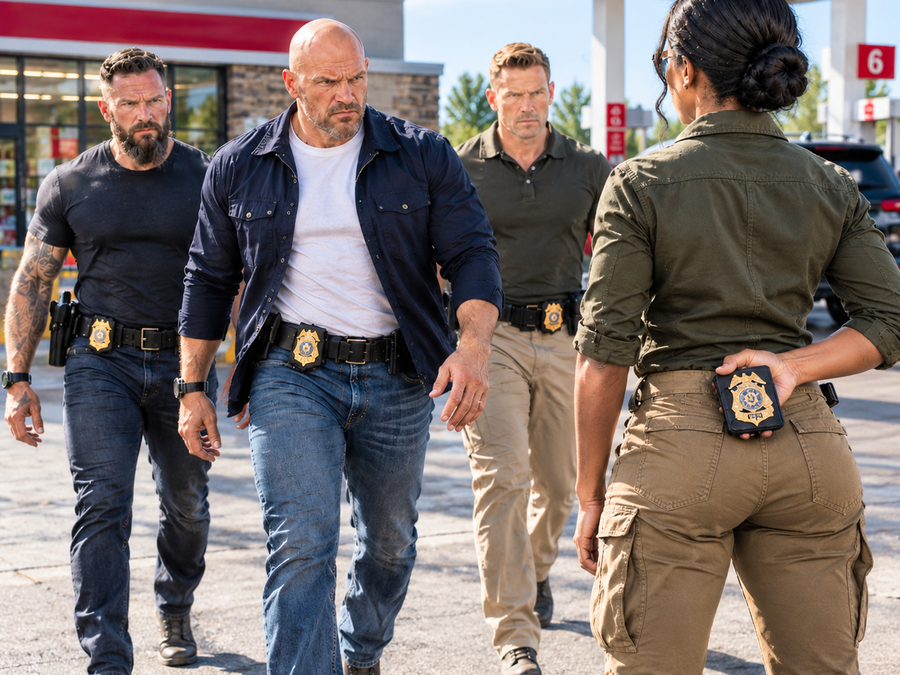
The big one in front was bald, thick through the neck, with a jaw like a cinder block. He walked like he owned the ground.
The man beside him was clean-cut with a small notebook already in his hand.
The third was bearded, covered in tattoos down one arm, and he cracked his knuckles like he’d been waiting all week for this.
Each one wore a gold badge on his belt.
“Morning, sweetheart.
” the bald man said.
“Hands where I can see them.”
“Good morning.”
Amira said.
“Is there a problem?”
“Yeah, you.”
He grinned.
“I’m Lieutenant Hargrove.
This is Sergeant Deckard.
That’s Officer Galvin.
Your vehicle matches a stolen report.”
Amira kept her face flat. Behind the glass of the store, a woman with gray hair and a name tag stood very still at the register.
She was watching. She was not moving.
She looked like someone who had seen this before and knew how it ended.
Over her heart, in her shirt pocket, Amira’s phone sat with its camera lens peeking out.
She had tapped record the second the black pickup turned in.
Old habit. 22 years of it.
“What stolen report?”
she asked.
“The one I’m telling you about,” Hargrove said.
“It’s a rental, out-of-state plates.
I picked it up yesterday at the airport.”
“Which agency filed the report?
Give me a case number.”
Galvin laughed, low and ugly.
“She wants a case number.”
“I’ll give you a case number,” Hargrove said, stepping closer.
“Case number is shut your mouth.
License, keys, and your phone.”
“My phone?”
“You heard me.”
Amira tilted her head.
“You’re off duty, Lieutenant.
No uniform, no marked car, no radio on your belt that I can see.
So, I’m asking you plainly, what authority do you have to detain me?”
For a moment, nobody spoke. A truck rumbled by on the road.
The sun was barely up, and the lot lights still buzzed overhead. Deckard wrote something in his notebook.
The scratch of his pen was the only sound.
Hargrove’s grin slid off his face.
It left something colder underneath.
“Let me explain how this works,” he said.
“My authority is whatever I decide it is.
This is my side of town.
These are my pumps.
You roll in here with your plates from who knows where, parking like you belong, and you ask me questions.”
He leaned in until she could smell his cigarette breath.
“Lady, nobody asks me questions.”
“I just did,” Amira said.
Galvin took a step toward her.
“She’s got a mouth on her.”
“Most of them do at first,” Hargrove said.
He didn’t look away from her.
“Then they learn.”
Amira’s heart beat hard, steady, and slow.
She did not feel fear. She felt something sharper.
She had read the files before she took this job. Complaints that vanished.
Drivers who said they’d been stopped, searched, and robbed, then never said it again.
Every one of them had been shrugged off by the people in charge.
Now, she was standing in the middle of one.
“I’d like to call this in,” she said.
“To dispatch, so we can clear up the report.”
“No calls.”
Hargrove’s voice dropped.
“Nobody calls anybody.”
“Then I’ll be leaving.”
“You’ll be leaving when I say.”
She reached for her car door.
Galvin moved.
He slid around behind her, close and heavy, and stood between her and the only open lane out of the lot.
His shadow fell across her back.
“Not so fast,” he said, grinning.
Amira stopped.
She did not turn around. In front of her, Hargrove held out one thick hand, palm up, like a man waiting for a tip.
“Keys,” he said.
“Now.”
Amira did not hand over the keys. She kept them in her fist, down by her hip, and she looked Hargrove dead in the eye.
The sun was barely up. Nobody else was close enough to help.
“No,” she said.
Hargrove stared at her. A slow red flush crawled up his thick neck.
“No?”
He laughed, but there was no joy in it.
“You hear that, boys?
She said no.”
“I heard,” Galvin said from behind her.
“Do you know how many people have told me no on this lot?”
Hargrove asked.
“Zero.
Not one. You know why?
Because they like walking out of here with their teeth. Is that a threat, Lieutenant?
It’s a weather report.
He snapped his fingers. Galvin, get her phone.
Amira felt a hand clamp onto her arm. Hard enough to hurt.
Then, another hand dug into her shirt pocket.
She twisted, but Galvin was big and he’d done this before.
He ripped the phone free and held it up like a prize.
Got it, boss.
Amira’s stomach tightened.
The screen was still lit.
The little red dot was still glowing.
But Galvin never looked at it.
He just shoved the phone into his back pocket, camera side out, and wiped his hand on his jeans like she’d made it dirty.
Let go of my arm, Amira said.
Or what? Galvin squeezed harder.
I’ll say it once.
Her voice stayed low and even.
Let go. He grinned and squeezed again.
She didn’t fight him.
She did not give them the fight they wanted.
Instead, she turned her head and looked straight past him across the lot at the store window. Donna Fenwick was standing right where she had been.
One hand flat on the counter.
Above her head, a small black camera sat in the corner of the ceiling. Its red light blinking.
Amira nodded at it. Just once.
Then, at pump four, something caught her eye. A man in a work jacket had pulled in with his two kids in the backseat.
He climbed out and walked toward Deckard without being called.
He didn’t say a word.
He pulled a fold of bills from his pocket and pressed it into the sergeant’s Deckard thumbed through it, nodded, and wrote a line in his notebook.
The driver got back in his truck. His hands were shaking.
He pulled out so fast his tires chirped.
Amira watched it all.
She understood now.
This wasn’t a stop.
This was a business.
“That’s what this is.”
She said softly.
“A tax.”
Hargrove followed her eyes and smiled.
It was the first honest thing she had seen on his face.
“Smart girl.
Most of them take longer to figure it out.”
“Every Thursday?”
She asked.
Deckard’s pen stopped.
A flicker crossed his face.
Hargrove didn’t notice.
“Thursdays, Saturdays, whenever the mood hits.”
Hargrove said.
“People pull in here, they don’t know the rules.
They don’t know their rights.
We teach them for a small fee.”
“And you want a fee from me?”
“Five hundred dollars.”
He said it like he was reading a menu.
“Call it a release fee.
You pay it, you drive off, and nobody remembers your face.
Simple.”
“And if I don’t?”
Hargrove jerked his thumb at the black pickup.
“Then you spend your morning in the back of my truck.
We’ll find something to charge you with.
We always do.
Drugs, resisting, whatever.”
He shrugged.
“Judge will believe a lieutenant over a woman with out-of-state plates?”
“He’ll believe it every time.
” Deckard said quietly.
He didn’t look up from his notebook.
Galvin chuckled.
“Nobody’s going to miss you, lady.”
That one landed. Amira felt it in her chest, the way you feel a door slam in an empty house.
How many people had stood where she stood? How many had heard those words and believed them?
She did not shake.
She did not beg.
“I want to be sure I have this right.”
She said loud enough to carry.
“You are demanding $500 from me in cash or you’ll arrest me on charges you plan to invent.”
“Sure.”
Hargrove said.
“Write it down, Deckard.”
“I’m good.”
Deckard muttered.
“Then let me say your names for the record.”
Amira said.
She turned her whole body toward the store window, toward the little black camera. She stood straight and spoke slowly, like a teacher reading roll.
“Lieutenant Wade Hargrove, Sergeant Lance Deckard, Officer Tyler Galvin, Redfield Ridge Police Department.
It is 6:47 on Saturday morning.
You are demanding money from me at pump six of the Pump and Pantry.”
Hargrove’s face twisted.
“What are you doing?”
“Making sure everybody knows who you are.
” Galvin snorted.
“She thinks that camera matters.”
“Let her think.”
Hargrove said. He took one heavy step forward, so close his chest nearly touched her.
“Here’s the thing, sweetheart.
That camera belongs to a gas station. I own this block.
You can talk to it all day.
It won’t say a word.”
“Then you won’t mind me talking to it.
” “I mind your face.”
His voice cracked like a whip.
“I mind you standing there like you’re better than me.
Like you’ve got a right to be here.
You don’t know who runs this town.
You don’t know what I can do to you.”
“I think I’m learning.
You think you’re smart.
He bared his teeth.
You’re nothing.
You’re a stranger with a nice mouth and no friends.
And I could make you disappear before breakfast.
Who’d even ask?
Amira held his gaze.
Her pulse hammered, but her voice never wavered.
Somebody would.
Hargrove stared at her for three long seconds.
Then something inside him snapped. He had been polite in his way.
He was done being polite.
Lady, he snarled, you’re done.
His hand shot out and closed around her wrist.
Hargrove’s grip was like a steel clamp.
His fingers dug into the bones of her wrist. Amira did not pull away.
She did not flinch. She looked down at his hand then up at his face.
Take your hand off me, Lieutenant.
Or what? He leaned in.
You going to cry?
Call your mommy? Check my back pocket.
Hargrove blinked.
What? My back pocket.
Go on. Galvin had let go of her arm after he grabbed the phone.
He’d stepped off to her side, bored, thinking the hard part was over.
Nobody had noticed her left hand.
It had been drifting behind her for the last minute while the men stared at her face.
Slowly, she brought it around. A small leather case sat in her palm.
She flipped it open. Gold caught the morning light.
A shield, heavy and real, with a nameplate and one word stamped across the bottom.
Captain.
For 1 second, nobody breathed.
Then Hargrove threw his head back and laughed.
It was a big, ugly sound that bounced off the pumps.
Oh, that’s good.
That’s real good.
He looked at his men.
You see this? She bought a toy badge online.
Probably cost her 12 bucks.
It’s a prop, Calvin said grinning.
Look at it.
It’s shiny.
Captain of what? Hargrove snorted.
The Girl Scouts? He let go of her wrist and snatched at the badge.
Give me that.
Impersonating an officer.
That’s a felony, sweetheart.
You just made my morning easy.
His thick fingers closed on the leather.
Amira didn’t let go.
I’d think about that if I were you.
I’m thinking about handcuffs, he said.
Tires crunched on gravel.
A marked patrol car turned into the lot. It was white with blue stripes and Redfield Ridge police on the door.
The light bar was dark, but the engine was running smooth and the driver was in full uniform. He parked beside the pumps and stepped out with a coffee in one hand.
He was young.
Maybe 25.
He had a fresh haircut and a tight collar.
And he was halfway through a yawn when he looked up and saw the scene. Then he saw her.
The yawn died on his face.
His coffee tilted.
A few drops splashed onto the pavement.
And he didn’t notice.
He had seen that face before.
It had been on a poster in the briefing room just last week. Meet your new Eastside Captain.
He dropped the cup. His heels snapped together.
Captain Brightwater, ma’am.
The words rang across the lot. Nobody moved.
The pumps hummed.
Somewhere behind the glass, Donna Fenwick pressed her hand over her mouth.
Hargrove’s fingers were still wrapped around the leather case.
Slowly, very slowly, he looked at the young officer.
Then he looked at the woman in front of him. Then he looked down at his own hand, still reaching for her badge.
“Lieutenant,” Amira said quietly.
“You may let go.”
He let go. It was like watching a man touch a hot stove.
All the color drained out of Deckard’s face.
His notebook hung open in his hand, and his pen had stopped mid-word. Galvin took one step back, then another, until his boots scraped against the curb.
“That’s not” Hargrove’s voice came out thin and dry.
“She’s not” “Marsh said the new captain didn’t start until Monday.
” “I don’t,” Amira said.
“I start Monday.
Today, I’m a woman buying gas.”
“You didn’t say who you were.”
“You didn’t ask.”
She let that sit for a moment.
“You never once asked me who I was.
You just decided I was nobody.”
Her voice stayed calm, but there was iron under it now.
“You grabbed my arm.
You took my phone. You demanded $500 and threatened to frame me for drugs.
And you did it in front of a camera and a witness who doesn’t work for you.”
She glanced at the young officer, who still stood at attention like a statue.
“At ease, officer.”
“Yes, ma’am,” he said.
But he didn’t relax.
Hargrove wet his lips. His mouth worked, but nothing came out.
This was a man who had never had to look for words. He looked for them now, and the cupboard was bare.
Amira took three small white cards from her pocket. She stepped forward and held one out to each man.
They took them without a word, like children handed a note from the principal.
“Monday, 8:00 a.m.” she said.
“My office, East Side Precinct.
Don’t be late.”
“Captain, I can explain.”
Deckard began.
“I’m sure you’ll try.”
She turned to Galvan.
“My phone.”
Galvan didn’t move.
“Officer Galvan, my phone.”
His jaw clenched. Slowly, he reached for his back pocket.
Amira was faster. She pinched the edge of the phone between two fingers and drew it out like a dirty tissue.
The screen was still lit. The red dot still glowed.
She tapped it.
The recording stopped. Then she walked to her SUV, got in, and shut the door.
A moment later, a soft knock rapped on the glass. Donna stood there, gray hair mussed, holding a paper cup with both hands.
Her fingers trembled. Her eyes were wet.
Amira rolled down the window. Donna passed the coffee through without a word.
It was hot and strong.
It tasted like the best thing she had ever had.
When Donna walked away, Amira looked down at her phone.
A small notice slid across the top of the screen.
“Video uploaded, 11 minutes, 4 seconds.”
The black pickup tore out of the lot first.
The gray sedan followed.
Galvan’s tires squealed as he turned onto the road, like a kid throwing a fit.
Nobody looked back. Nobody said a word.
The young patrol officer stayed behind, still stiff as a post. Amira got out of her SUV and told him to write down what he had seen, every detail, and to put the time on it.
He nodded fast.
He asked if he was in trouble.
She said no, he had done nothing wrong. And that was the point.
Then he got back in his car and drove off, and the lot went quiet.
It was 7:30 on a Saturday morning. Amira carried her cold coffee and her hot anger across the lot and pushed open the door of the Pump and Pantry.
A little bell rang.
Donna Fenwick stood behind the counter with both hands flat on the wood, like she was holding it down.
“You’re not going to arrest me, are you?”
Donna asked. Her voice was thin.
“For what?”
“For not saying anything.”
Donna’s chin shook.
“Six years, honey.
Six years I’ve stood behind this counter and watched them take money from people.
Truckers, nurses, a man with two kids in the backseat.
I watched and I rang up gum and lottery tickets like nothing was wrong.
” “Why?”
“Because the last clerk who complained got fired the next day, and her son got a traffic ticket every week for a year.”
Donna wiped her eyes with her sleeve.
“I’m 61.
I need this job.
I told myself it wasn’t my fight.”
Amira didn’t say it was okay.
It wasn’t okay, and Donna knew it.
She just waited. After a moment, Donna jerked her head toward the back.
“Come here.”
The back office smelled like old coffee and dust.
PART 2
A beat-up gray box sat on a metal shelf with a tangle of cables running down the wall to a small screen.
A label on the front said DVR in faded marker.
“The camera in the corner feeds this.”
Donna said.
“It’s old.
Nobody’s touched it in years.
But it never stops.
” She tapped a button.
Grainy video flickered to life. A man in a work jacket handing cash to Deckard.
A woman in scrubs doing the same. A date stamp, then another, then another.
Amira watched in silence. Her throat felt tight.
“They’ve never once told me to turn it off.”
Donna whispered.
“Never.
They don’t think a woman like me would ever do anything.
” “Donna.”
Amira turned to face her.
“I need you to do something hard.
Tell nobody about this. Not your boss, not your neighbors, not a soul.
If they find out you showed me, they’ll come for you.”
“I know.
And I’m not going to take anything today.
If I walk out with that footage, they’ll say I stole it.
I need to do this the right way.
” Donna studied her for a long moment.
“You think you can beat them?”
“I think they just made a mistake.”
Amira said.
“They touched me on camera.
Now they have to decide how scared to be.”
She left the store with her coffee refilled and her mind racing. The rest of the weekend was quiet.
Too quiet. Amira sat in her motel room with a legal pad and wrote down every name, every time, every word she could remember.
She wrote Deckard’s notebook and underlined it twice.
A man doesn’t write down a crime unless he plans to keep track of the profit.
On Sunday afternoon at 3:15, her phone buzzed. It was a number from the police union.
She let it ring, then listened to the message.
A man’s voice, stiff and loud.
A formal complaint had been filed against Captain Amira Brightwater.
It claimed she had assaulted Officer Tyler Galvin at the Pump and Pantry.
There were photos.
There was a bruise.
Amira put the phone down and stared at it. So, that was their move.
Not shame, not fear. A lie, dressed up in a uniform.
At 6:50 that evening, the phone rang again.
The screen read, “Chief Marsh.
” She answered.
“Captain Brightwater.”
“Amira?”
The voice was warm as a bath.
Silver smooth and easy, like an old friend calling to check on the family.
“Cornelius Marsh, how are you settling in?”
“I’m fine, Chief.”
“Good.
Good.
I just heard about this little misunderstanding.”
He chuckled softly.
“Boys will be boys, you know.
Hargrove’s a bit of a hothead, but he’s one of my best.
A good man.
Loyal.”
“He put his hands on me.”
“I’m sure it looked that way.”
Marsh’s voice never lost its smile.
“But you’re new.
You don’t know how things work here yet.
Why don’t we make this go away before Monday?
You drop whatever you’re planning, Galvin drops his complaint, we all shake hands, nobody’s career gets hurt.
” “Whose career?”
A pause. Just a hair too long.
“Everyone’s, Amira.”
Marsh said gently.
Everyone’s.
She heard it then, under the sugar.
A hand resting on her shoulder, gentle and heavy and ready to push.
I’ll see you in the morning, Chief, she said.
She ended the call and sat very still.
Then she opened the video on her phone and watched the playback bar creep along.
Hargrove’s voice filled the room.
Nobody asks me questions. Six years of fear, she said to the empty room.
I’m done being the first to blink.
Monday morning came gray and cold. At 7:55, Amira Brightwater walked through the front doors of the Eastside Precinct for her first official day as captain.
The lobby went quiet. Officers froze at their desks.
A few nodded. Most just stared.
She could feel the whole building holding its breath, waiting to see which way the wind would blow.
She walked straight to the briefing room, where the three men she had invited should have been waiting.
The chairs were empty.
Where are Lieutenant Hargrove, Sergeant Deckard, and Officer Galvan? she asked the desk sergeant.
He cleared his throat.
Out sick, ma’am.
All three. Called in at the same time.
All three at the same time?
Yes, ma’am.
What a coincidence, Amira said. Thank you.
She walked up the stairs to the captain’s office on the second floor.
The door stood open.
Inside, the desk was bare.
The filing cabinets hung open and the drawers were empty.
Not a folder, not a sticky note, nothing. Her predecessor had left behind years of case files, complaint logs, and duty rosters.
Every piece of paper was gone.
She stood there a moment, then she set down her bag and sat in the chair like it was her own.
Somebody was busy this weekend, she said quietly. At 8:20, the door swung wide and Chief Cornelius Marsh walked in without knocking.
He was tall with silver hair and a tan suit that looked fresh from the cleaners. His smile was already on.
He held out his hand like he’d known her for years.
Captain Brightwater, welcome home.
She shook it. His palm was dry and cool.
Chief, I see the office needs some work, he said, glancing around. Records are being digitized.
Terrible timing, I know.
We’ll get you set up.
He lowered himself into the chair across from her and crossed one leg over the other.
Now, let’s talk about Saturday.
Let’s.
I’ve spoken to Lieutenant Hargrove.
He tells me there was a misunderstanding. A stolen vehicle report.
A mix-up with the plates.
You were upset. Emotions ran high.
There was no report. There was, in his mind.
Marsh spread his hands.
I’m not saying he handled it perfectly, but he’s been with this department 19 years.
He has a lot of friends, a lot of loyalty.
If you push this, you won’t just hurt one man.
You’ll split the whole precinct down the middle.
And you’ve only just arrived.
Chief, are you asking me to forget it?
I’m asking you to be wise.
His smile stayed in place, but his eyes went flat. Drop the matter.
For the good of the department.
I’ll make sure Galvin withdraws his complaint.
Everyone moves on. No.
The word hung in the air.
Marsh’s smile didn’t fade.
It just stopped meaning anything.
I beg your pardon?
I said no, Chief. Amira kept her tone polite.
Three officers detained me without cause, took my property, and demanded money. I have a witness.
I have a recording.
I’m not going to forget something just because it makes people uncomfortable.
You have a recording? His voice softened.
Of course you do.
May I ask what’s on it?
11 minutes of the truth.
For a half second, something flickered behind his eyes.
It wasn’t anger.
It was a calculation, quick as a car dealer’s hand.
Well, he said standing. He buttoned his jacket.
You’ll have your chance to explain it.
Galvin’s union rep has requested a hearing on the assault complaint.
1:00 this afternoon.
I’ve approved it.
Today?
Justice shouldn’t wait.
He paused at the door.
Do be careful, Captain. A new broom sweeps clean, but it can also break.
He left. The door clicked shut.
Amira let out a slow breath.
Her hands were steady.
Her stomach wasn’t.
Captain? A man stood in the doorway.
She hadn’t noticed him enter.
He was thin, 40-ish, in a rumpled brown suit with a lanyard around his neck.
His glasses were smudged.
He held a thin folder against his chest like a shield. Sergeant Ezekiel Sandoval, he said.
Internal Affairs. Come in, sir.
He stepped inside and glanced over his shoulder.
Then he closed the door and lowered his voice.
“Ma’am, I wasn’t sure you’d survive that.
Most people don’t.”
“Survive what?”
“The Chief’s handshake.”
He gave a small, tired smile.
“I’ve been in this building 11 years.
I filed 14 reports on Lieutenant Hargrove.
Do you know how many got past the Chief’s desk?
None.
None.”
His eyes met hers.
They were red-rimmed and sharp.
“I’ve been waiting a long time for someone who wouldn’t fold.
When you said no just now, I was standing in the hall.
I heard it.”
Amira studied him. He could be a trap.
Marsh might have sent him to see how she’d react.
But his hands were shaking, and his shoes were scuffed, and nobody that tired could fake it.
“Sergeant,” she said, “what do you have?”
“Not yet.”
He glanced at the clock.
“Not here.
Too many ears.
But when you can, find me.
Anywhere but this building.”
“And the hearing?”
“Be careful, Ma’am.
They’ll tell their story first.
They’re good at it.”
He left the way he’d come, quietly, like a ghost.
At 12:55, Amira straightened her jacket and walked down the long hallway to the hearing room.
She stopped at the double doors. Through the narrow window, she could see the long table, the folding chairs, the American flag in the corner.
And at the far end of the table, sitting tall in his full dress uniform with his arms crossed and a smirk on his face, sat Lieutenant Wade Hargrove.
He had not been sick at all.
She pushed open the doors.
The hearing room smelled like floor wax and stale coffee.
A long table ran down the middle.
At the head sat a union rep named in the file only as Mr.Pruitt, a wide man with a pink face and a pen he kept clicking.
Amira took the chair across from Hargrove. He did not stand.
He just smiled at her, slow and lazy, like a cat watching a bird.
“Let’s begin,” Pruitt said.
“The union has received a formal complaint that Captain Brightwater physically assaulted Officer Tyler Galvin on Saturday morning at the Pump and Pantry.
Officer Galvin will present evidence.”
Galvin walked in then.
He was in uniform, sleeve rolled up on his tattooed arm. He turned and showed the room a purple mark on his forearm the size of a thumb.
“She grabbed me,” he said.
His voice was soft, wounded. It was a good act.
“I was just trying to help her.
She was upset.
Next thing I know, she’s twisting my arm and screaming about her badge.”
Amira did not blink.
“That’s not how it happened,” she said.
“You’ll get your turn,” Pruitt snapped.
Hargrove leaned back and folded his hands over his belly.
“Mr.Pruitt, if I may.
Captain Brightwater is new.
Nobody here blames her for getting confused. She showed up in a rental car, in work pants, no ID in sight.
Galvin and I thought she might be a runaway or worse. We tried to check on her.
She turned it into a circus.”
“You tried to check on me,” Amira said.
“That’s right.”
“By blocking my car with a truck, taking my phone, demanding $500.
” Hargrove laughed out loud.
He looked around the table like he was inviting everyone in on the joke.
“$500?
You hear this?
Captain, I’ve got 22 commendations.
I’ve pulled kids out of burning cars, and you’re going to sit there and call me a thief because you got your feelings hurt at a gas pump?”
“She’s lying,” Galvin said.
“Probably cooked up the whole thing to scare us before her first day.”
“Power trip.”
“Typical,” Hargrove said.
“They give some of these women a title and it goes straight to their heads.”
Pruitt nodded along.
“The union takes these claims seriously, Captain.
We’d like to hear your response, and frankly, we’d like to see this so-called recording you’ve been bragging about.
” Everyone looked at her.
Amira reached into her jacket. Her hand rested on her phone.
The video was right there.
11 minutes of Hargrove’s own voice.
She could end this in one click. But Marsh had asked about the recording that morning.
He wanted to see it. He wanted to know what it showed so he could pick it apart, claim it was edited, and bury it before it mattered.
She let her hand fall away.
“I won’t be playing it today.”
Pruitt frowned.
“Excuse me?”
“This hearing is about whether I assaulted Officer Galvin.
I didn’t.
I’m not going to hand my evidence to the men who are accused in it.”
She folded her hands.
“But I do have one question for the lieutenant.”
“Ask,” Hargrove said, spreading his arms.
“I’ve got nothing to hide.”
Amira looked at him steadily. The room seemed to shrink around the two of them.
“How many Thursdays?”
Silence.
Hargrove’s smile twitched.
It was a tiny thing, a muscle in the corner of his mouth.
“I don’t follow.”
“Thursdays, Lieutenant.”
“How many have you worked the pump and pantry?
10?
100?
6 years’ worth?”
“I don’t know what you’re talking about.
” “Do you know what a Thursday detail is, Officer Galvin?”
Galvin opened his mouth. Then he glanced at Hargrove, and he closed it.
“Sergeant Deckard isn’t here today.”
Amira went on, quiet and slow.
“Sick, I’m told.
But I wonder what’s in his notebook.
I wonder how many pages it takes to write down 6 years of Thursdays.
” Behind Hargrove, in the back row, a chair scraped.
Deckard had come after all.
He had slipped in late, in plain clothes, and sat in the shadows. Now he stared at his lap.
His hands folded over his knees trembled.
Nobody else saw it.
Amira did.
Hargrove’s face went through three expressions: surprise, anger, then something else, quick and ugly.
It looked like fear.
“This is out of line.”
Pruitt said, clicking his pen faster.
“The captain is making wild insinuations that have nothing to do with the complaint.”
“Is it wild?”
Amira asked.
“Lieutenant, just answer.
Yes or no.
Do you know what I mean by Thursdays?”
“No.”
Hargrove’s voice came out hoarse.
He cleared his throat.
“No, I don’t.”
Interesting, she said. Because Sergeant Decker does.
Every head in the room turned toward the back.
Decker’s face had gone the color of paper.
I move for a recess, Pruitt blurted, immediately.
We need to consult.
Chief Marsh should be informed. Seconded, said another rep.
Granted, Pruitt said, already standing. The hearing is suspended.
No finding has been made against Captain Brightwater at this time.
Chairs scraped. The room emptied fast.
Galvin shot her a look that could burn paint. Hargrove walked out last.
And as he passed her chair, he bent close.
You’ve made a big mistake, he whispered.
I’ve made a few, Amira said.
That wasn’t one.
His hand clenched at his side.
Then he was gone.
She stayed in her seat for a long moment.
Her heart was pounding now that nobody could see it.
No charge, no finding.
And for the first time, Hargrove had looked afraid.
Down the hall, a door slammed.
Marsh’s voice, muffled and sharp.
She spent the afternoon at her empty desk, writing out a plan on a yellow pad.
At 6:00, she signed her first order as captain. At 7:00, she drove away from the precinct.
She did not go to her motel.
She turned toward the Pump and Pantry. Donna Fenwick had said 6 years was long enough.
It was time to ask her how to end it.
The Pump and Pantry glowed in the dark like a ship at sea. It was 7:30, Monday night.
Only one car sat at the pumps, a delivery van with its engine running.
Amira parked at the far edge of the lot and watched the road in her mirror for five full minutes.
No black pickup, no gray sedan. When she was sure, she walked inside.
The bell rang. Donna Fenwick looked up from the register and her whole face changed.
Relief, then worry, then something close to hope.
“Give me 10 minutes.”
Donna told the delivery driver who was buying chips.
She rang him up fast, locked the front door behind him, and flipped the sign to back in 15 minutes.
“You heard about today?”
Amira asked.
“Honey, everybody’s heard.”
Donna led her toward the back.
“My cousin’s husband works dispatch.
He says the whole building is buzzing.
They say you stood up in front of the union and asked Hargrove about Thursdays.”
“I did.”
“And he didn’t hit you?”
“Not yet.”
Donna gave a short, dry laugh.
It was the first Amira had heard from her. In the back office, Donna pulled the chair out for her and sat on an upside-down milk crate.
The old DVR hummed on its shelf. She pressed the button and the little screen flickered on again.
A man in a gray hoodie.
Two bills slid into Deckert’s palm.
A date stamp from last spring.
“I’ve been thinking all weekend.”
Donna said.
“About what you said.
About doing it the right way.”
“And?”
“And I’m scared.
But I’m more scared of dying on that stool with nothing to show for it.”
She folded her hands in her lap.
“That’s 6 years of footage.
Every Thursday.
Sometimes Saturdays when they got greedy.”
Amira leaned in studying the screen.
Is this all of it? The whole 6 years?
This is what the machine keeps.
Donna’s eyes slid away for a second.
It records over itself after a while. I mean, it only holds so much.
Amira noticed that.
She also noticed Donna’s hand drift toward a small steel safe bolted under the desk.
A black box with a dial.
The kind stores use for cash drops. Fridays are my drop day, Donna said, as if reading her mind.
I count the week’s cash, lock the deposit bag in there, and the armored truck comes Saturday morning.
Everything goes in the safe, receipts, paperwork, all my records. Records, Amira repeated.
That’s all I’m saying.
Donna patted the safe once, lightly. Like a dog.
Just so you know where I keep things.
Amira looked at her for a long moment.
She didn’t push.
People who’ve been quiet for 6 years don’t open all at once.
They open a crack at a time. Donna, listen to me.
If they come for you, I need you to call me first.
She wrote her private number on a gas receipt.
Not the police. Me.
Do you understand? I understand.
And keep doing exactly what you’ve always done.
Smile.
Ring up the gum.
Don’t change a thing.
I’ve had plenty of practice, Donna said.
Amira stood. Her legs felt heavy.
She had been on her feet and under fire for 14 hours, and she was tired in her bones.
She drove back to the motel and slept like a stone. Tuesday dawned cold and bright.
At 7:45, she was in her rental SUV again, parked across the road from the Pump & Pantry, a coffee in her hand. She told herself she was just checking on Donna.
She did not tell herself why her stomach felt tight. At exactly 8:00, a white van pulled into the lot.
A man in a pressed shirt climbed out of the passenger side. He wore a name badge that read regional manager.
PART 3
He was followed by two big guys in navy work jackets with no logos.
They walked straight into the store without looking at anything.
Amira set her coffee down. Through the front window, she watched the manager hand Donna a sheet of paper.
Donna read it. She shook her head.
The manager pointed to the back. His voice was loud enough that Amira could see his lips move.
Corporate order. System upgrade.
Today.
Donna said something.
The manager shook his head again. Then the two big men walked into the back office.
They came out 4 minutes later. One of them carried the gray DVR in both arms, its cables trailing like a pulled root.
The other held the little screen.
They loaded both into the van and slammed the doors.
Amira’s hands curled around the wheel.
She wanted to cross the road. She wanted to badge them, stop them, demand a warrant.
But she had no standing. This was a private business and the paperwork looked clean.
Someone had been careful.
Marsh.
It had his fingerprints all over it.
He didn’t know what was on the recording, but he knew it existed.
A call from the chief’s office to the franchise owner was all it would take.
System upgrade. A fine, polite lie.
The van pulled out. Donna stood at the door and watched it go.
She didn’t wave.
She didn’t cry.
Then she looked across the road, straight at Amira’s SUV.
She held her eyes for a long second.
Her face was calm and unreadable.
Very slowly, she pressed one palm flat against her apron over her heart. Then she went back inside and turned the sign to open.
Amira didn’t understand.
Not yet. She started the engine.
Her best proof had just been driven off in a van, and every minute counted. She pulled into the road, heading for the precinct and for whatever Marsh would try next.
In the mirror, the little gas station grew smaller. Somewhere behind its walls, a woman with a steel safe was keeping a secret.
Amira got to the precinct at 8:40 on Tuesday morning.
She did not tell anyone about the van.
She went up to her bare office, sat down, and stared at the empty filing cabinets until her anger turned cold and useful.
At 9:00, a soft knock came at the door.
Sergeant Ezekiel Sandoval slipped in and turned the lock behind him.
He still wore the rumpled brown suit.
He looked like he hadn’t slept.
“The chief is across town at a budget meeting until noon,” he said.
“Hargrove’s crew is still sick.
This is the safest hour I’m going to get.
” “Then talk, sergeant.”
He set the thin folder on her desk and opened it. His fingers shook a little.
“Last year, Internal Affairs opened a quiet inquiry into Hargrove.
It went nowhere, but it gave me legal access to certain phone records.
Friday night, 3 days ago, I was checking an old number, and I saw something.
So, I checked it again, and again.
He slid a page toward her. A list of calls and texts with times down the side.
This line belongs to the chief’s front office.
At 9:12 on Friday night, it texted Lieutenant Hargrove.
Here’s what it said.
He tapped the line.
Suspicious out-of-state SUV, Pump & Pantry, Pump 6, early Saturday. Make her uncomfortable.
Amira read it twice.
Her mouth went dry. The department booked my rental, she said slowly.
Through the city account. It was in my travel papers.
Marsh’s office signed off on those papers.
They had your plate, your hotel, everything. Your motel is two blocks from that station.
Sandoval swallowed.
He didn’t need to know your face.
He only needed to know where you’d be.
So, he sent his dogs to scare me.
He sent them to scare you into quitting before you ever took command.
If you ran, he’d win.
If you stayed quiet, he’d win.
He never thought you’d check their back pockets.
He almost smiled.
He’s been trying to clean up that mistake ever since.
Amira stood and walked to the window.
Down in the lot, a patrol car pulled out.
Everything looked ordinary. That was the worst part.
The chief of police set me up to be robbed, she said.
There’s more.
Sandoval turned to a second page.
The Thursday detail isn’t just Hargrove’s pocket money.
The cash is picked up every Friday.
It goes into something called the Redfield Ridge Benevolent Fund. The chief runs it.
It’s supposed to help widows and sick officers.
And does it?
I found two widows in 6 years.
Both got a check for a $100.
His voice dropped.
The rest I can’t trace yet.
But I know where it starts.
It starts at a gas pump in the hands of a man who takes it from people who can’t fight back.
Amira closed her eyes. She thought about the man with two kids in the backseat.
His shaking hands.
Is this the only copy?
No, ma’am.
He pulled a small black flash drive from his sock and held it up. I made this last night.
It stays with me. If they raid my desk, they get nothing.
Smart.
Scared, he corrected.
But I’m trying.
He left a few minutes later, unlocking the door and slipping out like he’d never been there.
The rest of the day crawled.
Marsh did not return to the precinct. Hargrove, Galvin, and Deckard stayed away.
Amira spent hours at her desk writing down everything Sandoval had told her in her own handwriting in a notebook she kept in her coat.
She ate a sandwich at her desk. She did not go home until after dark.
At 8:10, she walked down to the underground parking garage, the keys cold in her hand.
The garage was nearly empty. Fluorescent lights buzzed overhead.
Her SUV sat in the far corner, alone.
A shape stepped out from behind a concrete pillar.
Amira stopped.
Her hand went to her coat, to the pepper spray she’d carried for 22 years.
Captain, a voice said, please, it’s just me.
Sergeant Lance Deckard stepped into the light. He looked 10 years older than he had on Saturday.
His collar was loose and his eyes were red.
You shouldn’t be here, she said.
I know. He glanced at the stairwell.
Nobody followed me.
I waited for an hour. What do you want, Sergeant?
I want out. The words came out of him in a rush.
I can’t do it anymore.
Every Thursday, I stand there and watch people hand over their grocery money. Hargrove laughs about it.
Last month, he took $40 from a woman who couldn’t pay her electric bill.
He said she should be grateful he didn’t take her kids’ shoes.
Then say that in a statement.
I can’t.
His voice cracked. Not yet.
You don’t know what he does to men who talk.
He knows where my daughter goes to school.
Amira’s jaw tightened.
She did not say it was okay.
I wrote everything down, Captain, Deckard whispered.
Every date, every pump, every dollar. I told myself it was just for me, in case I ever needed proof that I was only following orders.
He laughed, a small broken sound.
Pretty stupid, huh?
No, it might be the smartest thing you ever did. Is it enough to save me?
I can’t promise that.
She held his eyes.
I can tell you this, your notebook may be the only thing standing between you and the men you’ve been standing next to.
It’s the only thing that makes you a witness instead of a criminal.
He nodded slowly, over and over, like a man trying to make his head believe it.
“I need to think,” he said.
“Don’t think too long.”
Deckard turned and walked toward the stairwell.
At the door, he paused, one hand on the cold metal.
He didn’t look back.
Then the door swung shut behind him, and the garage was quiet again. Wednesday morning, Amira walked into the East Side Precinct at 7:50.
She did not make it to her office. The desk sergeant stopped her at the stairs.
He wouldn’t look her in the eye.
He held out a sealed envelope.
“From the chief, ma’am.
Came in at 6:00.”
She tore it open and read it standing up.
“Effective immediately, Captain Amira Brightwater is placed on temporary administrative reassignment pending review of the Galvin complaint.
She is relieved of all command authority. Her new post is the records desk, basement level.
Signed, Chief Cornelius Marsh.
” Under the signature, in blue ink, someone had added a small smiley face.
Amira folded the paper once and slid it into her pocket. Around her, officers stared at their boots.
Nobody said a word.
“Where’s the records desk?”
she asked.
“Down the hall, ma’am, past the boiler room.”
“Of course it is.”
The basement was cold and smelled like old paper. A single metal desk sat under a flickering light.
A stack of forms sat on top with a sticky note.
“Sort these.”
“CM” She sat down.
She did not touch the forms.
She knew exactly what this was.
Marsh couldn’t fire her, not yet.
So, he was burying her where nobody could see.
At 11:20, her phone buzzed. It was the number she had written on a gas receipt.
Captain?
Donna’s voice was a whisper.
He’s here.
Who?
Galvin.
He’s parked his truck right in front of the door.
He’s just sitting there with the window down.
He’s glaring at every customer who tries to come in.
Three people have already turned around and left. Is he saying anything?
He said if I call the police, he’ll be the one who answers.
Then he laughed.
Donna’s breath shook.
Honey, I don’t know what to do.
Stay inside. Lock the register.
I’m coming.
You can’t.
You’re not in charge anymore.
I heard it on the scanner.
I know, Amira said.
I’m coming as a person.
She left the basement without telling anyone. She did not take her badge.
She did not take her department car. She took a cab to the parking garage, got into her rental SUV, and drove.
The black pickup sat across the front of the Pump ‘n Pantry like a dog guarding a bone.
Galvin lounged behind the wheel, his tattooed arm dangling out the window, a toothpick in his mouth.
He grinned the moment he saw her.
She parked at pump two, got out, and walked straight to his window.
Well, look at that, Galvin drawled. The records clerk.
Lost your way to the basement, Captain?
You’re blocking a business entrance, officer.
Am I?
Funny.
I’m off duty.
Free country.
He shrugged. Maybe you should file a report.
Oh, wait.
You can’t.
Move the truck. Or what?
You’ll twist my arm again?
He raised his voice so it carried.
Hey everybody.
This lady attacks cops. A man at pump three looked over.
A woman in a minivan slowed down.
Galvin was playing to the crowd now.
Amira did not rise to it.
She stepped closer.
Her voice dropped so low only he could hear.
I’ve read your file, Tyler.
Four use of force complaints, all closed in a day.
You think the man who protects you will be around forever? His grin slipped.
You’re a tool, she said.
A big, loud tool.
And when it all comes down, Hargrove will hand you to the wolves and walk away clean.
He’s already working on it.
You don’t know anything.
I know you’re sweating.
He was.
A bead ran down his temple.
His hand twitched toward the gearshift. For one long moment, the two of them stared at each other.
Then the truck rumbled to life. Galvin backed out of the entrance and squealed away down the road.
Amira let out a breath.
It was a small win, but it felt big.
A driver at pump three lowered his phone. He had filmed the whole thing.
He gave her an awkward nod and drove off.
She thought nothing of it. That was her mistake.
By 4:00, the clip was everywhere. It had been cut.
The first part, where Galvin blocked the door and taunted her, was gone. What was left was Amira walking up to a truck window, leaning in close, her face hard, her voice too low to hear.
Across the top ran a bold headline from the local news site. Suspended captain harasses off-duty officer at gas station.
Below it, a quote from a department source.
“We’re deeply concerned about her conduct.”
The phone in Amira’s pocket would not stop buzzing.
She turned it off.
At 6:00, Donna called again.
She was crying quietly, the way people cry when they have run out of other ways.
“They’re calling the store,” she said.
“Strangers.
They say awful things.
I’m closing early.
I can’t stand here.”
“Go home, Donna.
Lock your doors.”
“I’m scared, Captain.”
Donna sniffled, then her voice firmed, “But I’m not quitting.
I want you to know that.”
“I know you’re not.”
At 8:30, Amira sat in the back booth of a diner on the edge of town, a plate of untouched pie in front of her. Across the table, Sandoval had his laptop open.
On the small screen, the edited clip played in a loop.
Her face, her hard stare. Harasses.
“It’s a good cut,” Sandoval said tiredly.
“I’ll give them that.
Marsha’s media friends move fast.
They always do.”
His phone buzzed.
He glanced at it, and his eyes widened.
“What is it?”
“A friend at the county records office.
I asked for the benevolent funds bank files 2 weeks ago, before you even arrived.”
He tapped the screen.
“They just came through.”
He turned the laptop around.
The laptop screen glowed in the dim diner.
Rows of numbers stacked down the page. Sandoval pushed his glasses up his nose and began to scroll.
“Bank statements for the Redfield Ridge Benevolent Fund,” he said.
“6 years.
I’m lining them up against the Thursdays.”
Amira slid in beside him. Outside, rain tapped the window.
The waitress topped off their coffee and left without a word.
For an hour, neither of them spoke. Sandoval typed dates into a second window.
Amira read aloud from Deckard’s old duty rosters, the ones she had copied in her own notebook.
Every Thursday matched. Every Friday morning, a cash deposit landed in the fund.
The amounts rose and fell like a heartbeat.
“Here,” Sandoval said, his voice rough.
“Every month, a large transfer leaves the fund.
It goes to something called Harlan Ridge Holdings.
It isn’t licensed.
It’s a shell.
I pulled the owner’s name.
” He swallowed.
“Dante Pell.
Marsh’s brother-in-law.”
“Of course it is.”
“That’s not all.”
He scrolled lower.
“Twice a year, a lump sum goes out to a campaign committee.
Council member Rosalind Vera.
Last election, she got $40,000 from Pell’s account.”
Amira sat back.
30 years of other people’s pockets, and the money ended in a politician’s hands.
“So, the chief isn’t just skimming,” she said.
“He’s buying votes.
He’s buying protection.
If the council owes him, nobody looks too hard.”
Sandoval closed the laptop.
“Captain, this is bigger than the department now.
It’s a crime for the state.”
“Then we take it to the state.”
He nodded.
“I know someone at the attorney general’s office, investigators who don’t answer to Marsh.
If I file the referral tonight, they could be here in a day.”
“File it.”
It was almost midnight when they parted.
Amira drove to her motel and did not sleep. She lay on top of the covers and stared at the ceiling and listened to her own heartbeat.
Thursday morning, Sandoval called at 7:30. He sounded breathless.
Done. They read the referral.
Two investigators agreed to come quietly.
They’ll attend tomorrow’s public safety ceremony on the courthouse steps as guests of the council.
They won’t act until they see the proof for themselves.
Tomorrow, Amira said. Friday at 9:00, Marsh is giving the speech.
It’s live-streamed.
He paused. If we can get a council member on our side, they might demand action in front of everyone.
Who do we trust?
Not Vera, but there are two who voted against Marsh’s budget before.
Councilwoman Odessa Trent and Councilman Fitch Alder. I called both.
They’ll meet us today.
3:00, the council chamber, before the building closes. At 3:00, Amira stood in the empty council chamber.
It was a grand room with a high ceiling and rows of polished wood. The sun slanted through tall windows.
Councilwoman Trent was small and sharp with silver glasses and a firm handshake. Councilman Alder was older, heavy, with a worn blue tie.
They sat at the long table and watched her without smiling.
Captain, Trent said, you’re the one on the news, the harassment clip.
That clip was cut to lie, Amira said. I have the full footage on my phone.
I’d like you to see the real thing.
She set the phone on the the and pressed play. The 11-minute video filled the silence.
Hargrove’s voice rose from the speaker, ugly and clear.
“Nobody asks me questions.
My authority is whatever I decide it is.”
Then the demand for $500.
Then Galvin’s grip.
Then the badge and the sudden stunned quiet.
Trent’s mouth thinned.
Alder’s face turned a dull red.
When it ended, Amira scrolled to her photos.
She had taken pictures of Donna’s DVR screen on Monday before it vanished.
The stills showed drivers passing money to Deckard with dates stamped in the corner.
“That’s 6 years of this,” she said.
“And this is where the money goes.”
She slid Sandoval’s printed bank pages across the wood.
“The benevolent fund?
Harlan Ridge Holdings?
Donte Pell?”
Alder picked up the page.
He read it. He read it again.
His hands trembled.
“I voted for this man’s budget twice,” he said quietly.
“So did a lot of people,” Trent murmured.
She took off her glasses and rubbed her eyes.
“Captain, why didn’t you go to the press?”
“Because the press runs his clips.
I wanted someone who could act.”
Trent stood. She smoothed her jacket.
Her eyes were hard and bright.
“We’ll move on Friday,” she said.
“At the ceremony, in front of the cameras, with the state people watching.
If he’s guilty, he can answer to the whole town.”
“You’ll demand it?”
“I’ll demand it,” Alder said.
“On the record.”
Amira’s chest loosened.
It felt like setting down something heavy she had carried for years.
“Thank you,” she said.
She shook both their hands.
She walked out of the chamber and down the marble hall, and the afternoon sun hit her face as she pushed through the front doors.
The courthouse steps spread below her, wide and white. Tomorrow, the whole town would stand there.
She pictured Marsh at the podium, his silver smile fading as the truth rolled out.
For the first time in 4 days, she let herself breathe easy.
She got into her SUV. Her phone showed no new messages, no threats, no clips.
PART 4
The town felt strangely calm, the way the air gets calm before a storm.
She noticed the calm.
She chose not to question it.
She drove back to her motel, ate a real dinner for the first time all week, and called Sandoval to say thank you.
He laughed, a tired, happy laugh. They made plans to meet at 8:00 the next morning, an hour before the ceremony.
“We did it, Captain,” he said.
“Not yet,” Amira said, but she was smiling.
She set her alarm and fell asleep with the lights on, the badge on the nightstand beside her. It was 8:50 Thursday night.
Outside the motel window, headlights swung into the lot.
The knock came at 9:05 on Thursday night.
It was not a polite knock.
Amira was already awake. She had slept for maybe 15 minutes before the headlights swept across the curtains.
She pulled on her jacket, crossed the room, and looked through the peephole.
Two uniformed officers stood outside. Behind them sat a marked car with its lights off.
She did not know their faces. She opened the door on the chain.
Yes?
Amira Brightwater? The taller one held up a paper.
By order of Chief Marsh, you are relieved of duty effective now. You are to surrender your department badge, your ID, and any department property.
You are not to enter any precinct building or speak for the department.
On what grounds?
Conduct unbecoming. The harassment video.
And a second complaint just came in. From who?
It’s not our job to say, ma’am.
She stared at them. They looked tired and ashamed, like men doing a dirty chore.
She thought about arguing.
She thought about the badge on her nightstand.
She went and got it. She did not hand it over.
She held it up so they could see it. And then she closed her hand around it.
This was issued to me by the city, she said. If the chief wants it back, he can send me a letter.
A real one with a real reason.
The tall one hesitated.
Ma’am, we can take it.
You can try. Do you want to be the officer who put hands on a captain?
I hear that’s going around.
They looked at each other. The tall one lowered the paper.
We’ll note that you were served, he said quietly.
They walked back to their car. That was the last easy moment of the night.
Her phone began to buzz at 9:20. The first message was from Sandoval, and it was one line.
They’re at my door, suspended.
Unauthorized access.
They took my laptop.
She called him.
It rang and rang.
Nothing.
At 9:35 a news alert lit her screen.
Chief Marsh, Captain’s gas station video doctored.
Department says footage was edited to damage officers. A photo of Marsh at a podium, hand over his heart, looking wounded and brave.
At 9:50, the department email went out to every officer in the city.
She read it in the blue light of the motel room.
Captain Brightwater has been found unfit for command. Any officer contacted by her should report it immediately.
Her statements are not to be trusted. She read it three times.
The words did not change.
At 10:00, she called Councilwoman Trent. Voicemail.
She called Councilman Alder.
It rang four times and went to a recording. She tried again.
The line clicked off.
She sat on the edge of the bed with the phone in her hand.
It was 10:15.
Then Donna’s number lit the screen and Amira grabbed it.
Donna?
A man’s voice answered.
Ma’am, this is Officer Wills with the Fire Marshal’s office.
Ms.Fenwick can’t come to the phone.
What happened?
The Pump ‘n’ Pantry failed a safety inspection tonight.
It’s closed pending review.
Ms.Fenwick is being questioned about an anonymous tip regarding stolen cash.
There’s no stolen cash.
That’s what the questioning is for.
He hung up. Amira dropped the phone on the blanket.
She pressed both palms against her eyes. Every door was closing at once.
The store shut. Donna taken.
Sandoval silenced.
The council quiet.
Her name mud.
The DVR gone. Marsh had waited until the last possible hour, and then he had hit every one of them at once.
It was perfect. It was cruel.
It was exactly what a man does when he’s been doing this for 20 years.
She had been so sure. She walked out of the motel at 11:30.
She did not go anywhere in particular.
She got into her SUV, and her hands drove her down the same road she had driven all week until she was parked in the lot of the Pump & Pantry. It was dark.
The pumps had been taped off with yellow tape.
A red notice was stuck to the glass door. The kiosk camera hung dead in the corner.
Its little light finally out.
She parked at pump six. The night was cold and silent.
She sat with the engine off and the badge in her lap. The gold caught a little light from the street.
Captain. 22 years.
She had never been beaten like this.
Not by a stranger with a gun, not by a bad boss, not by a bad case. Marsh had done it with a phone call and a stack of paper.
She thought about quitting.
She let herself think it all the way through because lying to yourself about the dark is how you lose in the dark.
Then she thought about Donna behind the counter for 6 years. About the man with the shaking hands and the kids in the backseat.
About the woman who couldn’t pay her electric bill.
Her fingers tightened around the badge. Something Donna had said came back to her.
Quiet and sudden.
Not from the office. From the day before.
Fridays are my drop day. I lock the deposit bag in there.
Everything goes in the safe.
Receipts, paperwork, all my records, all my records. Her breath caught.
She remembered Donna’s palm pressed flat against her apron across the road that Tuesday morning as the van drove away with the DVR.
Not fear, a message.
They took the DVR.
They never asked where the drive goes on Fridays. She sat up straight.
Her phone buzzed on the seat beside her.
It was midnight.
The screen showed a number she did not know.
She opened the message.
It was three short lines.
I’ll be there tomorrow, 9:00.
I’m bringing the notebook.
L.
D.
Amira did not sleep.
She sat in her SUV at pump six until the sky turned from black to gray with the badge in her lap and Deckard’s text open on her phone.
I’ll be there tomorrow.
9:00.
I’m bringing the notebook.
She read it once more, then she put the phone away. One man had decided.
That was one more than yesterday.
At 5:30 on Friday morning, headlights turned into the lot. A small blue hatchback stopped beside her.
The door opened and Donna Fenwick climbed out. She looked 10 years older.
Her gray hair was flat on one side and her apron was gone.
She wore a thin coat over her work shirt and she clutched a paper coffee cup in both hands. Amira was out of the SUV before the door closed.
Donna, they let you go? Around 4:00.
Donna’s voice was rough.
No charges.
They asked me the same questions for 6 hours.
Where’s the missing cash?
Who did I give it to?”
Over and over. She shook her head.
“There is no missing cash, honey.
They just wanted me scared and tired.”
“Are you hurt?”
“I’m angry.
It’s a lot like being hurt, but it stands up straighter.”
Amira almost laughed.
She didn’t.
“Donna, they took the DVR.
They closed the store.
I think You think it’s over?
I did.
For about an hour last night.
Donna looked at the dark glass doors, the yellow tape, the red notice. Then she looked back at Amira, and her eyes were clear.
“Captain, I’m 61 years old.
I’ve been a clerk at this place for 19 years.
Do you think I’d trust my whole life to one old machine in the back room?”
Amira went still.
Donna reached into her coat pocket.
She pulled out a coffee sleeve, the cardboard kind, and held it out. Three numbers were written on the inside in blue pen.
“The DVR only keeps a few months before it records over itself,” Donna said.
“I told you that, but every Friday for 6 years, I copied the week onto a little backup drive.
Before the Saturday armored truck, every Friday, like brushing my teeth.
Then I locked it in the safe with the deposit bag. The drive that goes in the safe on Fridays.
Nobody ever asked me where it goes.”
Donna’s mouth trembled into a small fierce smile.
“They never thought I’d be smart enough to have one.”
Amira’s eyes burned.
She took the sleeve with both hands, the way you hold something that could blow away.
“Why didn’t you tell me Monday?
I wanted to see if you’d run.
Donna shrugged.
Everybody else did.
I’m not everybody else.
I know.
That’s why I’m here.
The front door was locked and the notice was stuck to it. But Donna had a ring of keys on her belt and one of them fit the side entrance.
She pushed it open with her shoulder.
The air inside smelled like cold coffee and floor cleaner. They did not turn on the lights.
Donna walked them through the dark by memory. Past the empty counter, past the dead coffee machine, to the back office.
The shelf where the DVR had sat was bare.
A few cables dangled like cut vines. The steel safe sat under the desk, bolted to the floor, just where it had always been.
Hold the flashlight, Donna said.
Amira clicked on her phone light.
Donna knelt, her knees cracking, and spun the dial. Right.
Left. Right.
The bolt slid back with a heavy clunk.
Inside lay a stack of deposit slips, a rubber-banded roll of ones, and under them all, wrapped in a gray cloth, a small black hard drive no bigger than a paperback. Donna lifted it out.
She held it for a moment before she handed it over. It was heavy for its size.
Six years of Thursdays, she said. Every date is in the file name, every one.
Amira took it.
Her hands were steady now.
They’ll say it’s fake, she said.
Marsh already called my video doctored.
Your video, sure, but they can’t say all of it is fake.
Not when Decker’s notebook says the same dates.
Not when Sandoval’s bank records say the same dates.
Donna folded her arms. Three things that all say the same thing.
That’s not a lie, honey.
That’s a pattern.
Amira stared at her. Then she laughed once, a short and surprised sound.
You should have been a detective.
I’ve been watching these jerks for 6 years.
That’s the same thing without the pay.
Amira pulled out her phone and called Sandoval’s personal number.
This time, it connected on the fourth ring. Captain?
His voice was low and rough, like a man whispering under a blanket. They took my laptop.
They didn’t take the drive.
It was in my sock.
You wear that sock a lot.
It’s the safest place a man can keep a thing.
He coughed.
I have the benevolent fund records and the call logs. All of it.
I’m suspended, so I can’t walk into the building.
But I can walk onto the courthouse steps like any citizen.
Then meet us there.
8:30. Side entrance by the flagpole.
Yes, ma’am.
She hung up.
Donna was watching her.
You’re not on the program, Donna said.
I heard it on the radio.
The chief’s got the whole ceremony laid out.
He doesn’t have you in it.
I know.
Then how do we get up there? Amira looked down at her hand.
She was still holding the badge.
She had been holding it all night.
She turned it over and the gold flashed.
Then she pinned it to her jacket, right over her heart.
It was forbidden.
She had been ordered not to wear it. She wore it anyway.
We walk up the steps, she said, like we belong there.
At 7:45, the little blue hatchback pulled out of the lot with Amira’s SUV behind it.
Donna was in the passenger seat of the SUV now, the backup drive wrapped in a gray cloth on her lap, her hands folded over it. She did not say a word the whole way to the courthouse.
She did not need to.
By 8:50 on Friday morning, the Redfield Ridge courthouse steps were packed. Folding chairs sat in neat rows.
Red, white, and blue bunting hung from the stone pillars. Two news vans had parked at the curb and a man in a headset was counting down for the live stream.
Amira stood at the side entrance by the flagpole with Donna beside her. Her badge was pinned to her jacket.
The backup drive was in a canvas bag on Donna’s shoulder.
Sandoval came hurrying around the corner at 8:35, his brown suit wrinkled, his glasses crooked. He had a flash drive in his fist like a man holding a live coal.
“They didn’t stop me,” he panted.
“Nobody looked at me twice.”
“Nobody looks at the man who’s been quiet for 11 years,” Amira said.
He gave her a shaky grin.
“That’s the plan.”
Through the crowd, she spotted the patrol officer from the gas station.
He stood near the aisle in his crisp uniform, hands behind his back.
When he saw her badge, his eyes went wide. Then he gave her the smallest nod she had ever seen.
At the front, the council sat in a row of high-backed chairs.
Councilwoman Trent and Councilman Alder were on the left. Neither looked at Amira.
Trent kept her eyes on her lap.
Alder’s tie was crooked and his hands were clenched.
Behind them sat two strangers in gray suits, a man and a woman. They had no badges showing and no notebooks out.
They watched everything. The state investigators.
At exactly 9:00 a drum rolled and Chief Cornelius Marsh walked to the podium.
He wore his dress blues with gold braid on the shoulders and a chest full of ribbons. His silver hair gleamed.
He lifted both hands and the crowd rose and clapped. Behind him stood three men in dress uniform.
Hargrove, tall and broad with his chin high. Galvin, his tattooed neck hidden by a stiff collar.
And Deckard, at the end of the line, pale as chalk, staring straight ahead.
Amira’s eyes met Deckard’s across the crowd.
He did not blink. But his hand moved just once to his jacket pocket.
She saw the square shape of a notebook there.
“Friends, neighbors, fellow citizens.”
Marsh began, his voice rich and warm.
“Today we honor those who protect this community.
Those who give everything for you.
A department built on integrity, trust, and courage.
” He paused for applause.
The crowd gave it.
Amira felt Donna’s hand slip into hers.
It was cold and trembling.
“I can’t do this.”
Donna whispered.
“Everybody’s looking.”
“You don’t have to talk.
Just stand next to me.”
“I’ll try.”
“That’s all anyone’s ever done.”
Marsh went on.
He praised the department’s record.
He spoke of the sacrifice of officers. He even mentioned the benevolent fund and how it had helped so many widows.
A few people in the crowd dabbed their eyes.
Amira’s jaw tightened until her teeth ached.
Widows. Two of them.
A hundred dollars each. When Marsh reached the end of his speech, he stepped back and smiled.
The announcer leaned toward the microphone.
And now, if there is any member of the public who wishes to speak, the floor is open for brief comments.
It was a formality. Nobody ever stepped up.
The microphone stood in the aisle, dark and lonely.
Amira let go of Donna’s hand.
She walked.
She went through the crowd. People turned.
A murmur rippled behind her. She kept her back straight and her eyes ahead.
And she did not hurry.
Her boots rang on the stone.
The patrol officer stepped aside to let her pass. She reached the microphone and stood in front of it.
The whole courthouse seemed to lean toward her.
Somewhere a camera swung around.
Marsh’s smile froze.
For half a second, nothing moved on his face at all.
Then he leaned toward one of the aids near the podium and whispered. The aid nodded and started down the steps.
“Ladies and gentlemen,” Marsh said smoothly into his mic, “I believe this is a suspended officer.
Out of respect for the proceedings, I’d ask security to escort her.”
“My name is Amira Brightwater,” she said.
Her voice rolled out across the steps, steady and strong.
“I am the captain of the East Side Precinct.
I was appointed by this city, and I have something to say.
Two security guards moved toward her. The crowd stirred.
“Chief Marsh,” she said, “I have 6 years of Thursdays.”
The guards stopped.
The words hung over the steps like thunder.
A woman in the second row gasped.
Councilwoman Trent finally looked up.
Alder stood.
Marsh’s smile slipped.
It did not fall.
It slid slow and sick like wax in a hot room.
“I don’t know what she’s talking about,” he said, his voice thinner now.
“Officers, please.”
“6 years of Thursdays at the Pump and Pantry,” Amira continued, cutting him off.
“Drivers paying cash to your officers, cash that went into your benevolent fund, and from there to your brother-in-law, and to a council campaign.
I have the proof.
All of it.
Right now.”
At the back of the crowd, a small gray-haired woman lifted a canvas bag.
Donna Fenwick walked forward. Her knees were shaking.
Her chin was up.
Besides her walked a thin man in a rumpled brown suit, a flash drive held high.
They went up the center aisle together, past every staring face, and stopped at the foot of the podium.
Donna reached into the bag. She pulled out the little black drive and held it up to the cameras.
“This is my drive,” she said loud and clear.
“I kept it for 6 years, and I’m done being quiet.”
Sandoval stepped to the console beside the giant public display screen.
He took the drive from her hands, bowed his head once, and plugged it in.
The big screen behind the podium flickered. For 1 second, it showed only blue.
Then a file list popped up and Sandoval clicked the first one. A grainy picture filled the screen, 40 ft wide.
A gas station lot, a date stamp in the corner. A man in a work jacket walked up to Sergeant Lance Deckard and pressed folded bills into his hand.
Nobody on the courthouse steps made a sound. Sandoval clicked again.
A woman in scrubs, another date. Then a trucker.
PART 5
Then a teenager in a school hoodie counting out crumpled ones with shaking fingers.
Hargrove stood in each frame, arms crossed, grinning.
“Turn that off.”
Marsh snapped into the microphone. His voice cracked.
“That footage is fake.
It’s been tampered with.”
“Is it?”
Amira said.
“Then let’s check it.”
She turned and looked down the line of men in dress blues.
“Sergeant Deckard, step forward.”
Deckard did not move. His face had gone the color of old paper.
Hargrove beside him turned his head very slowly.
“Don’t.”
Hargrove said, so low the microphones almost missed it.
“Lance, don’t you dare.”
“Sergeant.”
Amira said again.
“You wrote everything down.”
For three long seconds, Deckard stood frozen.
Then he reached into his jacket and pulled out a small black notebook, its corners worn soft.
He walked out of the line. His legs trembled.
Every step sounded loud on the stone.
“You’re finished, Lance.”
Hargrove hissed.
“You hear me?”
“You and your kid.”
Deckard stopped. He turned and looked at the man who had owned him for 9 years.
“My daughter’s going to read about this one day, he said, and his voice shook, but it did not break.
I’d like her to read that I stopped.
He stepped to the microphone. He opened the notebook.
Thursday, March 14th, pump four.
$40, a woman in a blue minivan.
Thursday, March 21st, pump two, $60, a delivery driver. On the screen behind him, Sandoval pulled up the footage.
A woman in a blue minivan, $40, a delivery driver, $60.
The dates matched, the pumps matched, the amounts matched. Deckard kept reading, page after page, year after year.
Every time he named a date, the screen showed it.
The crowd began to murmur. A man in the third row stood up, then a woman, then a whole row, staring at the wall of proof.
“That’s me,” someone said, a gray-haired man near the aisle, his voice breaking.
“That’s me on the screen.
I paid that.
I thought I did something wrong.”
“You didn’t,” Donna said gently from the foot of the podium.
Marsh clutched the sides of the podium. His knuckles had gone white.
He looked left and right for help and found none.
“Cut the feed,” he barked at the man in the headset.
“Cut it now.
” The man in the headset stared at him.
Slowly, he took off the headset and set it on the ground.
Sandoval stepped forward, and he did not look nervous anymore. He held up his own flash drive.
“I have the bank records of the Redfield Ridge Benevolent Fund,” he said, “six years.
Every Friday after a Thursday, a cash deposit.
Every month, a transfer to Harlan Ridge Holdings owned by Dante Pell, Chief Marsh’s brother-in-law.
He clicked.
The statements flashed up beside the video.
Numbers, dates, signatures.
And twice a year, he went on, to the campaign fund of councilwoman Rosalind Vera. A gasp rippled through the council row.
Vera, a stout woman in a red suit, shot to her feet.
That’s a lie.
I never Sit down, Rosalind, councilwoman Trent said, cold as ice.
She rose from her own chair.
Chief Marsh, the people of this city are watching you.
Answer the question.
I don’t have to answer to Chief Marsh, Councilman Alder stood, too, his blue tie crooked, his voice booming.
I voted for your budget twice.
I’ll never forgive myself for that.
But I will tell you this. I demand your arrest.
Right here. Right now.
You can’t demand I just did.
A roar went up from the crowd. It was not cheering.
It was something older and deeper. Six years of swallowed anger finding its voice at last.
Behind Marsh, Galvin’s face twisted.
His big hands curled into fists.
He looked at the screen, at the grinning Hargrove, at the line of citizens rising from their chairs.
Then something snapped. This is garbage, he roared.
He lunged for the podium, straight toward Amira.
I’ll shut your mouth.
He didn’t make it.
A figure stepped into his path.
The young patrol officer from pump six planted his feet, caught Galvin’s arm in a firm hold, and spun him around.
He was half Galvin’s size.
He did not let go.
“Officer Galvin,” he said, steady and clear, “you’re under my control.
Stop.”
“Get off me, kid.”
“Not today, sir.”
Galvin tried to wrench free. Two more officers from the crowd, men who had stood silent for years, rushed in.
They took his other arm. Hargrove saw it all fall apart.
His broad face went from gray to purple. He stepped to the edge of the stage, and the words burst out of him, loud, cracked, and raw.
“Everyone did it.
You hear me?”
He pointed at the council.
“Half of you took your cut.
Marsh signed every check.
I just collected.
You think you’re clean?
You’re all dirty.
Every one of you.
” The cameras caught every word.
The microphone caught every breath.
For a long moment, the only sound on the courthouse steps was Hargrove’s own ragged breathing.
Then a voice behind the council rose, calm and crisp.
“Thank you, Lieutenant.
That will be enough.”
The two strangers in gray suits had stood up. The woman reached into her jacket, and metal glinted.
The man held up a leather wallet with a state seal.
“State Attorney General’s Office,” he said.
“Nobody leave.”
Both of them started down the steps, handcuffs in hand. The state investigators reached the podium in seconds.
Nobody tried to stop them.
Marsh did not run. He just stood there, gripping the wood, as if the podium could still hold him up.
His silver hair was no longer neat.
Sweat shown on his forehead.
“This is a misunderstanding,” he said.
His voice had lost its warmth. It came out thin and flat.
“I’ve served this city for 26 years.
You can’t do this.”
“We can, sir.”
The woman in the gray suit said.
“We have a referral, a bank trail, and about 40,000 witnesses who just watched you try to cut the feed.
” “I want my lawyer.”
“You’ll get one.”
The man in the gray suit took Marsh’s wrist.
He pulled it behind his back.
The cuffs clicked.
And the sound carried across the silent steps, sharp as a gunshot. Marsh looked at the cameras.
He looked at the crowd.
For the first time in his life, nobody smiled back.
“Chief Cornelius Marsh,” the woman said, “you are under arrest for theft of public funds, bribery, and conspiracy.
” A cheer began at the back.
It rolled forward like a wave, louder and louder, until the whole courthouse seemed to shake. Two more officers took Hargrove.
He did not fight.
Something in him had gone out, like air from a tire. He stood with his big shoulders sagging and his head down while the cuffs closed on his thick wrists.
Amira walked up to him. He lifted his eyes.
They were red and wet and full of hate.
“You think you won?”
he rasped.
“I know I did.”
“You’re nobody.
You came in here with a rental car and a bad attitude.”
“Lieutenant?”
She kept her voice quiet.
“Six years ago, somebody pulled into that gas station with two kids in the backseat.
You looked at him and decided he was nobody.
You were wrong then, too.
He opened his mouth. Nothing came out.
Nobody asks me questions, she said softly. Do you remember saying that?
His jaw worked. Then he looked away.
Take him, she said. They led him down the steps.
Galvin followed still in the grip of three officers, his tattooed arm trembling.
He glared at Amira.
She met his stare until he dropped his eyes first.
Deckard stood by the microphone.
He had set down his notebook.
His hands hung at his sides. A state investigator stepped up to him.
Sergeant Deckard, we’ll need you to come with us.
I know.
He held out his wrists.
I’m not going to fight it.
I took the money. I stood there and watched.
I want to answer for it. Your statement today will count, Sergeant.
So will that notebook.
You’ll be treated as a cooperating witness.
Deckard nodded. His eyes were wet.
He turned to Amira. Thank you, Captain.
Don’t thank me.
She shook her head. Thank the man who finally told the truth.
He walked away with the investigators, his back straighter than she had ever seen it. Councilwoman Trent called the council into session right there on the steps.
Cameras still rolled. She spoke fast and clear.
And the vote took 4 minutes.
Council member Vera was removed from the chamber pending investigation. The Redfield Ridge Benevolent Fund was frozen.
Every account, every dollar.
Chief Marsh was suspended without pay, effective at once. And the suspension of Captain Amira Brightwater was reversed.
Captain Trent said, turning to her, on behalf of this city, we apologize. We should have listened sooner.
You listened when it counted, Amira said. Sandoval stood at her elbow, still holding his flash drive.
Trent faced him next. Sergeant Sandoval, your suspension is lifted.
Your files will be entered into the record, and you will lead the internal review of the East Side Precinct. His mouth fell open.
He pushed up his crooked glasses and could not seem to find any words.
11 years, he finally said. 11 years and nobody ever I know, Trent said gently.
He turned to Amira.
From his coat pocket, he pulled out something that glittered.
Her badge.
Someone had picked it up in the chaos and he had found it. He pressed it into her hand.
I think this belongs to you, ma’am.
She pinned it back over her heart.
This time, nobody told her not to. Last, Amira walked to the foot of the podium where a small gray-haired woman was standing, still clutching a canvas bag.
Donna had not spoken since the screen went dark.
Her eyes were red. She was smiling and crying at once.
Honey, she whispered. Did we do it?
You did it.
I just wrote dates on a drive. For 6 years while everyone else looked away.
Amira took her hands. Donna Fenwick, you are the bravest person I have ever met.
A man in a business suit pushed through the crowd. He was the owner of the gas station chain and he looked very pale.
Ms.Fenwick, he said, “I’m so sorry.
I had no idea.
I’d like to reopen your store today.
And I’d like to offer you the new security and compliance contract for all our stations in the county with a raise and an apology.”
Donna looked at Amira.
“Say yes,” Amira said.
“I’ll think about it,” Donna said and winked.
That afternoon at 3:00, the Pump & Pantry opened its doors again. The yellow tape was gone.
The red notice had been torn down.
A new camera was already bolted to the ceiling, its little light blinking. Amira pulled in at pump six.
She got out, stretched, and walked inside. The bell rang.
Donna stood behind the counter with a fresh pot of coffee.
“First cups on the house,” she said.
Amira took it. It was hot and strong and it tasted like her first real morning in Redfield Ridge.
She looked up at the camera, then at Donna.
“You’re keeping that running?”
“Every day.”
Donna tapped the counter.
“Just in case.”
Amira smiled with the badge on her belt and the sun low over the lot.
“Six years of Thursdays,” she said, “and it ended on a Friday.”