Part 3: The Neighbor Whispered, “Don’t Sell It” — What Was on His $2 Old Farm?
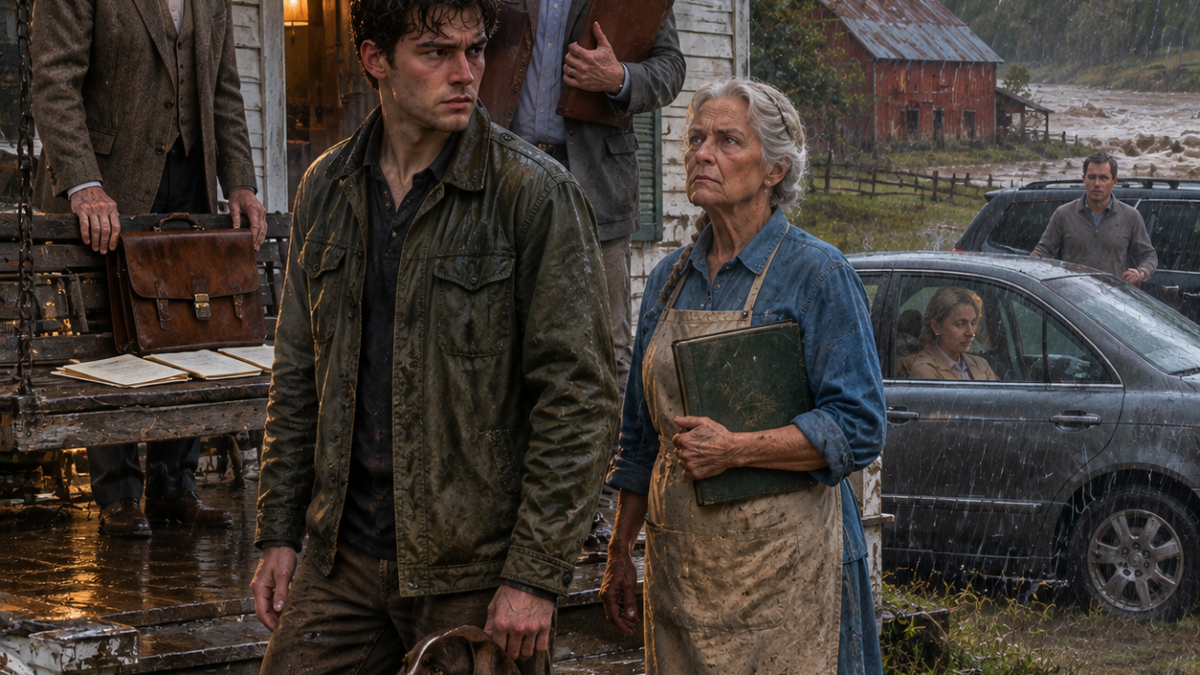
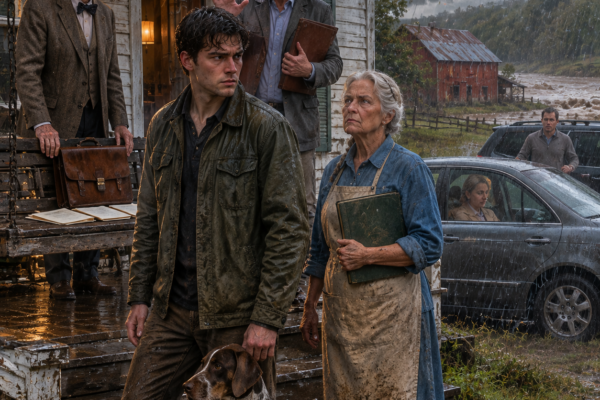
That is why I asked you here, and not to my office. He set the satchel on the porch rail and took out three documents and laid them side by side on the swing, squared to the edge.
A will dated the 14th of April 2021, signed by your father before two witnesses and a notary, leaving the Hollow Farm and everything he owned to Nathan.
A title order opened on the 3rd of May, naming Nathan as the seller of a property he did not yet own. And a sworn statement filed in your fathers probate, in which you declared that you knew of no later will.
He straightened. One of the witnesses is standing on this porch.
She would be glad to tell you where she signed it. On the hood of a truck, said Lenore, after a ham sandwich.
Marvin looked at the will.
He did not touch it. Nate watched his father read his own name in that square, careful hand, my love, which he has always had whether he asked for it or not, and watched the color go out of his face by degrees, from the forehead down, like water leaving a glass.
He wasnt himself, Marvin said. He was an old man.
Anyone could. He asked me what makes a will valid, Telford said, and then he made one.
It is self-proved. A court will admit it on my petition and a very short hearing.
I am sorry, Marvin.
I would have preferred to say this somewhere softer.
In the SUV, Ward Tillman had opened his door and stepped out, slowly, and stood with one white sneaker in the grass. Mr.Ketter, he said, to the air above everyones head.
Bridgeway doesnt acquire a contested title.
Im withdrawing the offer. Ill put it in writing.
He looked at the sky, which had gone the color of a bruise.
Id like to be on the road before this.
You wont be, said Lenore, not unkindly. Not over that Ford.
Nate came down off the porch. He had thought about this for four days, and he had expected to be angry, and instead, he felt very steady, as steady as the old iron pump in the well house, and he stopped on the bottom step so that his father had to look down at him.
Im not going to argue with you, he said.
Im not signing anything. Not a release, not a sale.
You put your name on a paper for $2, and Im keeping what I paid for. He kept his voice level.
You took my phone and my keys.
You took 3 years of wages and $3,640 out of my dresser, and you said you were holding it. Youll give it all back, every dollar, and Mr.Telford will set the schedule.
Thats all Im asking. Thats all Im going to ask.
It was very quiet on the porch. The dog got up from the boards and stood against his knee.
Nate, his father said. It was almost a whisper.
Son.
I wasnt your son in April, said Nate. I was a signature.
The wind came then.
It laid the grass flat all the way down the hollow, and the tin roof boomed, and the rain came sideways in a gray curtain that took the barn, and then the far field, and then the ridge. They went inside because there was nowhere else to go.
By 4:00, the Ford was a brown river 40 ft wide. Nate went down with Lenore under an oilcloth and found the third stone gone, and the fourth, and the creek tearing at the roots of the willows on the near bank, and he thought of a line in the sixth jar written in a pencil that pressed hard into the paper.
Stay dry, it had said, and wait it out. There was no road.
There was no phone. Three cars sat nose to tail in the yard like animals with their heads down, and nothing was going to to that water until it let them.
At 6:00, the kitchen ceiling came down.
It came in one soft piece, plaster and lath and a hundred years of dust onto the table where Nate had eaten rice and peaches and Beth Ketter, who had come in last and was standing by the stove with her coat still buttoned, did not scream. She put her hand to her mouth.
Water was already coming through in three places in the front room as well, a drip, a thread, a stream into the stew pot and then the stew pot was full.
The back stairs, Nate said, everybody bring the lamp. Marvin stopped on the landing.
The little door in the knee wall stood open the way Nate had left it and the cedar smell came out of it, warm and dry in the wet house. Nate stooped through first and lit the hurricane lamps along the beam, one, two, three, until the room went the gold of the inside of a pear and the dog lay down on the floor by the cot as though she had been told to.
Lenore sat on the bench and said, Well, here it is, as if introducing an old friend.
Telford sat very upright on a cot with the satchel on his knees.
Ward Tillman, soaked to the knee, stood by the door with his arms crossed over his chest and when Nate handed him a gray wool blanket, he took it without a word.
Marvin was last. He came through the door, bent nearly double and straightened and stood in the middle of that room with his shoulders just below the rafters and his hands hanging and turned slowly once around.
The cots, the quilts, the water jugs with their corks, the quarts of peaches marked August 2025, the 12 jars on the plank shelf with their strips of tape in the old mans capitals. Dad built this, Marvin said.
In 2011, said Lenore, after the Gerlach roof.
I walked past that wall. He stopped.
I stood in that bedroom with a flashlight twice. He made it so a man could Lenore said.
Nobody spoke. The rain beat on the roof and it could not touch them.
They ate what there was. Rice and beans from the lidded pail cooked on the cookstove Nate had banked in the kitchen before the ceiling fell and the peaches passed hand to hand in a quart jar, a half a piece with a fork going around.
Ward Tillman ate his half and said quietly, Thats the best thing Ive had in a month.
And then looked as though he wished he had not said it. About 9:00 with the wind gone to a long moan in the eaves, Beth got up from the cot and crossed the little room and sat down on the floor beside Nate with her back against the cedar.
She looked older than she had at the dinner, smaller. She opened her handbag and took out a wad of tissue and unfolded it in her lap.
It was the silver watch, dented on one side, stopped at 10:04. He put it in his coat, she said very low, the night of the dinner.
He meant to take it to a pawnshop in Harlan on Monday and he didnt think I saw. I took it out of the pocket on Sunday while he was in the shower.
She turned the watch over once in her fingers. I have carried it for 6 days.
I didnt know what else to do. I couldnt say a word at that table, Nate.
I tried.
I couldnt make my mouth go. Her voice broke and mended.
I saw the paper in May, the title order.
It lay on the desk in his office for a week. I never asked him a single question about it.
Nate took the watch. It was warm from her bag and light, and he closed his hand around it.
Im not saying it makes any of it right. Beth said.
No. said Nate.
It doesnt. He looked at the watch.
But thank you for the watch.
She nodded and kept nodding a little and did not cry. Marvin had been sitting on the end of the third cot with his hands between his knees and he said to the floor, Beth, you took it.
And when she did not answer, he said it again differently, the way a man says a thing he has finally understood.
Then he lifted his head and looked at his son across the lamplight and what Nate saw in his face was nothing like the smile.
Ill tell it once.
Marvin said. You can believe it or not.
Nobody moved. I grew up in that house.
The roof leaked in the front room and my mother put a pan on the floor and in winter, we ate beans four nights out of seven and he never once said we were poor. He said we were fine.
I was nine before I understood that fine was just a word he used. I swore I would never be a man who put a pan on the floor.
He wiped his mouth with the back of his hand.
I built the store out of that promise and then the big chain came to Harlem and the numbers went the wrong way and I signed a paper to keep it alive and then another and by last winter, I couldnt sleep.
I thought if I had the farm, I could fix it. I told myself I was holding it for you.
I told myself that so many times, Nate, that I stopped hearing it.
His voice cracked. Thats all it is.
I was afraid. It doesnt make it right.
I know it doesnt. No.
said Nate.
I know. Marvin looked at the lamp.
Im not asking you to say anything else. The rain thinned toward midnight and the creeks voice dropped from a roar to a rush.
Nate lay on the cot by the door with the dog on his feet and sometime past one he took out the watch and wound it slowly, 10 turns, because winding it no longer felt like deciding something.
It felt like finishing. The second hand moved and in the quieter of the cedar room he could hear it tick.
At first light the ford was a brown field with a green line down it and the third stone stood out of the water with a wet shine like a seals back.
Nate went out on the porch.
The air was washed and cold and smelled of clover. Behind him the screen door opened and closed.
He turned and held out the sealed envelope with one word on it. His father looked at it for a long time before he took it.
Its yours to read. Nate said.
Im not going to ask what it says. Marvin carried it to the end of the porch and sat down on the top step where 40 years before a boy had sat to wait for his fathers truck.
Nate did not watch him open it.
He stood with his hand on the dogs head and watched the light climb the ridge and when he looked at last his father had folded the letter very small and was holding it against his chest with both hands, with his head down and his shoulders were moving.
Telfords petition went in on Monday.
In July the court admitted the will without a word of dissent. Ward Tillman, true to his written word, sent a one-line letter and Bridgeway built its distribution center on a field 3 miles east and the new frontage road ran along the far side of the hollow farm fence and never once touched it.
In August, Marvin sold the store building to the grain co-op, paid the bank what he owed, and from what was left, he paid his son back in full with the phone, the keys, and a bank draft for the wages, and for the $3,640, which he counted out again in 10s and 20s, because he said it ought to be the same kind of money.
He took a job at the co-op in September, keeping the stock room under a manager who had once been a boy behind his counter.
He did not ask for anything.
On the last Sunday of each month, he and Beth drove out and stayed for coffee, and sat on the porch, and talked about the weather.
The door was not wide open.
It was not shut. Nate roofed the house that summer with Lenores nephew and a borrowed truck, rebuilt the kitchen ceiling, and left the wall in the upstairs bedroom exactly as it was.
At the bottom of the lane, above the ford, where the road ran closest to the creek, he built a second room, cedar-lined, 8 ft by 10, with three cots, a shelf of jars and a lantern, and he left it unlocked. Over the door, on a board planed smooth, he cut a single line with a chisel in square capitals, because he had learned the hand from a calendar.
Keep one dry corner for whoevers roof gives out. On the second Monday of every month, it was Nate who carried the pie, and Lenore told him it was too sweet, and ate the whole slice.
He sold a few shares every spring for the roofs and the pump and the winter feed, and gave a little to the co-op scholarship fund under no name at all. The gold stayed in Telfords safe, all but one coin, which he carried in his shirt pocket and never spent.
On the 27th of May, 2028, a Saturday, a little before 8:00 in the evening, it rained.
It was a soft gray rain out of a low sky, the kind that sits in and means it, and Nate was standing at the kitchen window with a dish towel over his shoulder when the dog got up from the rug.
Sage was older now, grayer about the muzzle, slower on the stairs.
She went to the screen door and stood with her ears up and her nose to the crack and made a low sound in her throat that was not a bark. He took down the lantern and went out.
At the gate, at the end of 2 mi of gravel and a creek that ran brown and loud over the stones, a woman stood in the road with one old suitcase held in both hands. She was 63, as it turned out, with iron-gray hair cut short and a thin raincoat that had given up some time ago, and she was looking up the lane at the house with the face of someone who has walked a long way on the strength of a rumor and no longer trusts it.
I was told, she said when he came down, and her voice shook and she stopped and began again.
A man at the filling station in Pickett Mills said there was a place up here, a room. He said not to knock, that Id be She looked at the lantern and the dog, and her chin came up.
Im not asking for charity.
It isnt charity, said Nate.
He took the suitcase from her hands. Its a dry room.
Its been waiting. He did not ask her name.
He did not ask where she had come from or what had been taken or who had done it. He put the kettle on the stove and set a bowl of beans and a heel of Lenores bread in front of her, and she ate with her coat still on, with the dogs chin on her shoe.
When her hands had stopped shaking, he led her up the back stairs and opened the little door in the knee wall and lit the lamps, and the room went the gold of the inside of a pear.
She stood in the doorway a long while.
Take the cot by the door, Nate said.
Theres wool socks in the blanket. The matches are in the tin.
He set the lantern on its nail. Keep one dry corner for whoevers roof gives out.
Thats what my grandfather said. Its about the only thing I know that nobody had to teach me.
She turned then and looked at him properly. Im Marlene, she said.
Marlene Kovac.
Nate.
Thank you, Nate.
He closed the door softly behind her and went down and sat on the porch step with the lantern beside him and the dog against his knee as the rain went on over the roof and over the hollow and over the ford where a green stone stood out of the brown water and a light burned in a window at the end of a long wet road.
After a while, he took the silver watch from his pocket and held it open in his palm. It was a quarter past eight, and it was running.