My Best Friend’s Sister and I Got Snowed In. Under One Blanket: “Come Closer, I’m Still Shaking.”
My Best Friend’s Sister and I Got Snowed In. Under One Blanket: “Come Closer, I’m Still Shaking.”
The fireplace had filled the living room with smoke twice, so I shut the damper, cracked a window, and accepted that the cabin had no heat left to give us. Petra Faulk was sitting on the bed in the back room—the only room with insulated walls and a door that closed—with the last dry wool blanket draped over her shoulders and one corner held open, her breath showing faintly in the glow of my phone. Having just come in from hauling the last armload of logs we would never burn, the cold had gotten into her hands.
– Come closer. I’m still shaking, she said, keeping the corner of the blanket lifted while looking straight at me.
My name is Quentyn Bower. I’m 35, and I spend my working days telling bus drivers which routes are closed, so I had known the road was gone long before the county’s recorded message confirmed it. I had driven Petra up that afternoon so she could collect her things before her parents sold the cabin, and by dusk the snow had buried the lower switchbacks.
The power went out at six, and the closure notice said nothing useful about tomorrow. My plan had been simple—keep the fire going, take the couch, and leave at first light—until Petra took one look at the smoke rolling out of the firebox and delivered her assessment.
– Your plan was the fire, she’d said, and the fire has filed an objection.
I told her the plan was good until reality weighed in, and she said that was true of most plans I made, which was fair. Now I stood in the doorway with a stack of coats I had no use for and asked the only question that seemed worth asking.
– Is this you being cold, or you asking?
She didn’t answer quickly, and I appreciated that because a quick answer would have let both of us pretend it was a joke.
– Both, she said. But if all I needed was warmth, I’d put on a second pair of socks. I’m asking you.
That was direct enough that I felt it at the back of my neck. Crossing the room, I sat down beside her, and she pulled the blanket around both of us and tucked the edge under my arm with the brisk efficiency of someone securing a tarp—her shoulder pressing against mine through two layers of fleece as a faint tremor ran through her that took a long time to ease.
– Assessment, I said, because it was what we always did. This is warmer than the couch.
– It’s also the least romantic thing anyone has ever said under a blanket, she answered, and I conceded the point.
Neither of us laughed for long, though, and neither of us moved. Her hair rested against my jaw, smelling like cedar smoke and some drugstore shampoo I would never be able to walk past again, and I noticed our old teasing rhythm had slowed to something quieter—as if both of us were listening for what the next sentence would cost.
I had known Petra for years, ever since Stefan—her older brother and my best friend—started dragging me to family barbecues. Early on I made myself a rule that she was his little sister and therefore off the table, keeping it so long I stopped thinking of it as a decision and started treating it as a fact about me. It held at Stefan’s birthday cookouts where I found reasons to stand at the grill, and at his wedding where she danced with me twice and I kept my eyes on the cake table afterward like a man guarding evidence.
Over the last year, the rule had taken more effort than I admitted, and I had never once asked whether she had agreed to it. Sitting there with her weight settling against my side, I understood she had probably felt every careful inch of that distance.
At a quarter to eight, her phone buzzed against the floorboards and Stefan’s name lit the screen. She answered on speaker without leaving the blanket, and I felt her glance at me as she did it.
– Tell me you two aren’t frozen, Stefan said, his voice carrying the same low worry it had carried since they were kids.
Petra told him the fireplace was dead, that we were in the back room, and that we had the good blanket and our coats, while I added that the road was closed at the lower gate and the plows would not reach us before tomorrow afternoon. All of it was true, and I stayed inside the truth, though I noticed how much of it was shaped to be reassuring.
– Good. Okay, make sure she eats something, Stefan said.
Petra reminded him she was 31 and had been feeding herself for a while now, making him laugh before he told me I was in charge of the sensible half of the trip.
– I’ll do my best, I said in the same easy voice I had used for years, and it sounded wrong coming out of me.
Those words had always felt like a promise to a friend; tonight they felt borrowed, like a jacket that no longer quite fit across the shoulders. When the call ended, Petra set the phone face down on the floor and let the quiet stand for a moment.
– He means well, she said.
– He does, I said.
– That’s the annoying part, she murmured, and I could hear her almost smile.
My arm had settled around her at some point without my deciding to put it there, and I discovered I had no intention of taking it back. The power company had promised nothing until morning, when the heat would likely return and take away the one explanation we had said out loud—and as Petra’s breathing slowed against my shoulder, I lay awake in the dark counting what we would have left to say once the cold stopped being a reason.
The furnace kicked on a little after seven with a shudder in the floor vents, and every light I had forgotten to switch off came back at once. I woke with a stiff neck and Petra’s head still on my shoulder, neither of us moving for a few seconds while the kitchen refrigerator started its old rattle and the microwave clock began blinking the wrong time.
– Heat’s back, Petra said in the flat voice of someone reading a gauge.
– So I see, I said.
Neither of us pulled away until she finally sat up and untucked the blanket from under my arm, looking at the corner of it for a second before folding it over the footboard—a moment I decided I was not meant to comment on. While she went to wash her face, I checked the county roads site, which had updated overnight to show the lower switchbacks still closed while plows cleared the state highway first—refreshing the page three times out of work habit, which has never once made a road open sooner.
When Petra came back with her hair tied up and her sleeves pushed to her elbows, I told her the earliest realistic guess was tomorrow afternoon and maybe later.
– Your professional opinion? she asked.
– My professional opinion is that I have no control over any of this, I said, and she told me that sounded healthy for me.
The reason she had come was spread across the living room floor, where she had left three empty boxes and a roll of packing tape before the storm hit. Her parents were selling the cabin at the end of the month, and she had told them she would take what mattered to her and leave the rest for the estate cleaners. Standing in the doorway holding my coffee, I made the mistake of offering a plan.
– I could start on the bookshelves while you do the closet, I said, and we’d be done by noon.
Petra looked at me over the top of a cardboard box with the patience of a woman waiting out a toddler.
– I know which books are mine, she said. I’ve known for about 20 years. If I want a second set of hands, I’ll tell you which hands and where.
I said that was reasonable, she said she knew it was—which was the point—so I gave her the room. Carrying my coffee into the kitchen, I found half a carton of eggs that had survived the outage and cooked them badly on the stove while listening to tape squeal and paperbacks thump into cardboard.
When she wanted the heavy trunk moved, she called my name once from the hallway, and I moved it exactly where she pointed without suggesting a better spot. She kept her father’s old record player, left her brother’s rusted fishing gear alone entirely, and set aside a chipped blue mug from the cabinet—holding it up for a second before wrapping it in a dish towel without explaining, so I carried the plate of eggs to the table and said nothing.
She ate standing up at first with one hand on a box lid while I ate sitting down with the county page open beside my plate, until past 10:00 when she looked toward the hallway and the back room where we had slept.
– You don’t have to hover in the kitchen like the cabin’s night manager, she said.
– I’m not hovering—I’m giving you space, I said, and she told me that from where she stood the two looked identical.
After a moment, she added more quietly that she would like it if I sat in the room while she sorted, so long as I did not help. Taking the armchair by the window with a magazine lying there since some summer before last, I found out that sitting near a person without managing anything is its own kind of work.
The old rhythm came back faster than expected: she held up a teenage ski jacket for my assessment, I called it a wearable biohazard, she reminded me I had been a wearable biohazard at Stefan’s 30th, and I owned up to the glitter incident none of us had ever fully explained before she tossed the jacket into the donate pile with a flourish.
It was the same dry back-and-forth we had always had, feeling solid under me yet making the gaps easier to see—neither of us mentioning the blanket, the way I had held her until her breathing slowed, or what I had counted in the dark. Once, when she reached for a box on a high shelf and I stood up without thinking, she glanced at me and said, “Please,” and when I took it down our hands did not touch, though I felt the attention in that small exchange as plainly as if they had.
By early afternoon, the sun came out hard on the snow, making the whole cabin look unreasonably cheerful through the glare. Checking the road page again and calling the county line, I heard a recorded voice confirm the closure would remain through at least tomorrow evening, and relayed it to Petra as she sat with an open box of photographs in her lap, holding one up to the light.
– Another night, then, she said.
– At least one, yes, I said, and she nodded and slid the photograph back into the stack without looking up.
With the furnace running steady and the lights on, there was no longer a single practical reason to share a blanket—meaning from here on, anything we did would be chosen, though neither of us had said what we meant to choose.
Petra finished the closet a little before four, taping and labeling everything in her blocky capitals—three boxes for her apartment, one for her parents, and a small one marked with her brother’s name set apart with some ceremony. Sitting on the floor with her back against the couch, she held the empty chipped blue mug in both hands even though the room was perfectly warm, while I stayed in the armchair where the magazine in my lap had long stopped pretending to be read.
– I learned to drink coffee out of this on the porch when I was 15, she said. My dad wouldn’t let me have a mug of my own until I could finish a whole one without making a face, and I spent a week getting there on pure spite.
– That sounds like you, I said, and turning the mug a quarter turn in her hands, she called that the nicest thing I had said all day.
I could have left it there and spent another easy evening calling it friendship while managing a rule nobody but me had ever agreed to. Instead, I set the magazine on the chair arm and said what I had been carrying for most of a year.
– I noticed you before this trip, I said. A long while before. I decided not to do anything about it, and I told myself that decision was just how things were.
Petra did not look surprised, yet went still in a way that told me she was listening to every word.
– How long is a long while? she asked.
– Stefan’s wedding at least, I said. Probably before that, if I’m honest—and I’m trying to be.
She remembered I had spent the half hour after our second dance staring at the cake table as if it owed me money, and I told her the cake had been under suspicion. Setting the mug on the floor beside her, she finally met my eyes.
– Can I correct something? she asked. You think your distance was neutral—that you were being careful and nobody got hurt by it.
I admitted that had been my working theory, and she called it a bad one, explaining she had felt it every time we were in the same room without knowing whether it meant I wasn’t interested or was being loyal to Stefan—two things that looked identical from where she stood. When I told her it had never been a lack of interest, she said dryly that would have been useful information a few years ago, the dryness thinning enough to show what the waiting had cost her.
Rising from the armchair, I crossed the room and sat down on the floor a couple of feet from her rather than right beside her, giving her the choice to close the distance without Stefan in the room or in my head.
– I’d like to kiss you, I said. Not because it’s cold and not because of the storm. Is that something you want?
Petra tilted her head and studied me with open, unhurried attention.
– Yes, she said. I was about to ask you myself, and I would have been annoyed if you’d made me do it.
She closed the last foot with one hand flat against the front of my sweater, and I met her halfway—not a long kiss at first, careful and slightly out of practice as if both of us were checking that the other meant it, followed by a second kiss that was longer as her fingers curled into the wool and the whole afternoon, along with the better part of a year, finally went quiet. When we pulled apart, her forehead stayed against mine and neither of us said anything clever while the furnace ticked in the vents and a strip of low sun lay across the floorboards behind us.
– Well, Petra said eventually, a little out of breath. That answers one question.
When I asked which one, she explained she had wondered whether it would feel like a mistake in plain daylight with the heat running, and it didn’t—though sitting back far enough to look at me properly, she admitted it didn’t answer what we would do once the road opened, refusing to pretend she knew just because the moment was nice. I told her I didn’t know either and had no idea what to say to her brother, and while she agreed we didn’t have to settle that on a cabin floor on a Tuesday, agreeing didn’t shrink the question.
Going back to work felt oddly ordinary: she handed me the tape gun and pointed at boxes by the door for me to stack on the porch without suggesting a better arrangement, and when I returned she had put on her father’s scratchy folk record, humming along while wrapping glass candleholders in newspaper and scolding my terrible humming as a crime in itself—the same teasing as before, except neither of us was holding back anymore. At one point, passing me toward the kitchen, she rested her hand on my shoulder for just as long as it took to walk by, leaving me holding a box like a man who had forgotten what it was for.
We ate canned soup at the kitchen table after seven with both phones plugged in at the counter and the window turning blue behind her, hers sitting face up beside the salt shaker while neither of us mentioned the hour. Stefan had called at eight the night before, and tonight I would be speaking to my best friend with Petra’s taste still on my mouth, unsure what kind of friend I intended to be when it rang.
Washing the pot and two bowls together—Petra scrubbing and me drying—I caught myself saying “we” repeatedly since lunch: we should shovel the porch before it freezes, we’re fine on firewood, we’ll start the car at first light. None of it was untrue, yet I was speaking like a man with a standing arrangement, and when I handed her the dish towel her almost-sympathetic look told me she had been counting pronouns too.
Stefan called at eight on the dot, and Petra set the phone on the table on speaker, filling the kitchen with his tired, careful voice. He asked about the road first, and after I gave him the county update, he asked whether Petra had what she needed—and I started answering before she could open her mouth.
– She’s fine. We’re fine. The heat’s back, and we’ve got plenty of food, and she’s got most of her things boxed already, so you don’t have to worry about—
Petra lifted the phone off the table, switched off speaker, and held it to her ear with calm, friendly eyes on me.
– Stefan, it’s me, she said. I can answer that one.
Standing there drying an already-dry bowl, I listened as she gave him an accurate account of herself—three boxes hers, one his with his old baseball glove and college yearbook, warm, fed, and able to call him herself if anything changed—without mentioning the blanket or the afternoon, yet without telling a single false word. Through the phone’s leftover hum came Stefan’s relieved “Okay, I just like knowing,” followed by his thanks for getting her up the mountain safely, which Petra repeated neutrally, landing in my chest like a stone dropped into a well.
When the call ended and she set the phone face down beside the salt shaker, the kitchen went very quiet.
– That wasn’t about the soup pot, she said, and it wasn’t about him either, really.
– Say it plainly, I told her. I’m prepared to hear it.
– I like that he checks on me, she said. I’m not asking him to stop and I’m not asking you to be cold to him. But when somebody asks how I’m doing, I’m the one who answers—and you were already halfway through answering for both of us.
My first instinct was to explain I only wanted to keep him from worrying, yet getting as far as the word “I” made me hear how it sounded—so I closed my mouth, folded the towel over the oven handle, and said she was right. Surprised I left it there, some stiffness left her shoulders as she noted she could have taken the phone after my first sentence instead of letting me finish three, and I admitted I had noticed my own pronoun habit over the dishes an hour earlier.
– It’s in the way, she said without heat, showing me how many years I had spent mistaking speaking up for people with respecting them.
Moving to the living room couch with a respectable cushion of space between us, I looked out at snow blowing sideways through the porch light and thought of the glove and yearbook in their box.
– I don’t want to sit across from your brother at some future cookout and say nothing about this, I said. I’m not saying tonight, and I’m definitely not saying on the phone from a cabin, but I want to be straight with him because he’s my friend and he’d see through anything else anyway. So I’d like to know what you’d want him to hear, and from which of us—I’m asking, not telling.
Taking a long time with it, she answered carefully while picking at a loose cushion thread.
– I don’t want to be the news you deliver, she said finally. I don’t want him hearing it first from you as if it’s yours to hand over, and I don’t want it to turn into a confession where he gets to pass sentence either. I also don’t want to hide it because that would turn it into the kind of thing we’d have to hide. I don’t know the order yet, or the words, or how he’ll take it.
I told her I didn’t know either and could live with not knowing for one more night, and she asked me to ask her again tomorrow before carrying the chipped blue mug to the kitchen sink—leaving me listening to the pipes knock and knowing Stefan’s thanks wouldn’t grow any lighter by being ignored.
Petra finished the last of her sorting before I finished my first cup of coffee, checking off an envelope list with a pen in her teeth until only the trunk, record player, and box of her father’s records remained for two people to carry. Setting each down exactly where she pointed without suggesting a better spot while she wrapped and packed the chipped blue mug herself, I checked the county page and found the plows had reached the lower gate overnight, with the switchbacks scheduled for clearing first thing tomorrow if temperatures held.
When I told her, Petra stopped with the tape roll in her hand, looking at the labeled boxes by the door as if the news were written on them.
– So, tomorrow, she said.
– Probably by mid-morning, I said, if nothing freezes over again.
Suddenly the hours left in the cabin carried a number, and setting the tape on the couch arm, she sat at the other end with one leg tucked under her.
– Before you ask me what I want to say to Stefan—and I know you were going to—I want to say something else first, she said. I don’t want this to become a story we tell in a year—the one where the snow made us stupid and we were very sorry afterward. That kiss was mine, and so was the blanket. If we go down that mountain and act like it never happened, I will be furious with both of us.
She refused to promise it would be painless with her brother—acknowledging he had a right to feel hurt, just not to decide for us—and I found most of the speech I’d rehearsed since last night unnecessary.
– I want to see you when we get down, I said. I don’t mean a text that says we should grab coffee sometime. I mean dinner at a table with a working furnace and nobody’s brother on speaker.
Asked about Stefan, I told her I had decided while stacking boxes to speak to him myself as his friend about my own choices without asking him to approve or handing him her side to carry—and if he was angry at me, that belonged to me. Studying me with the same open attention from the cabin floor, she smiled softly.
– That’s a better plan than the fire, she said at last, adding quietly she had noticed I never once said she’d have to wait for him to come around.
Laughing at how easy that had become once I stopped treating her as part of “the situation,” she reached across the cushion and pressed two fingers briefly against the back of my hand—the first deliberate touch all day. Recognizing the temptation to treat our last night as permission to stall over soup, folk records, and the blanket, Petra spoke first.
– I don’t want to spend tonight pretending the cabin is the whole world, she said, and I also don’t want it to be a goodbye party.
We agreed tonight wouldn’t stand in for deciding anything, and however we sat together after dark, we would choose it as two people intending to have dinner on Friday.
By seven, the steady furnace was background noise and the cabin felt like somewhere we were already leaving, with Petra tucked onto one end of the couch beside her face-up phone while the folk record played low. Knowing exactly where our careful distance used to sit, I skipped the armchair, crossed the floor, and sat beside her close enough for our shoulders to touch with no blanket or cold to blame.
– Assessment, she said without turning her head.
– This is a choice, I said.
Shifting until her head rested on my shoulder as deliberately as she had lifted the blanket that first night, she spent the next 40 minutes working out our plan before Stefan’s call: she would tell him about her own decision in her own words, I would speak for myself as his friend about my choices and years of silence, and neither of us would preview the other’s words so we wouldn’t edit them—shaking hands on an agreement with no script.
At eight on the dot, Stefan’s name lit the screen; letting it ring twice, Petra took a breath I felt through my arm and answered on speaker so I would hear every word. After hearing the plows had reached the lower gate for a morning departure, Stefan relaxed—until Petra spoke into the hum.
– Stefan, I need to tell you something, and I need you to let me finish. Quentyn and I are going to see each other when we get home. I mean that we’re together—or we’re trying to be. And I’m not telling you because I need your permission. I’m telling you because you matter to me and I didn’t want you to find out sideways.
Through a silence long enough to check the signal, Petra kept her eyes on the dark window and her hand flat on her knee before turning to me.
– Quentyn wants to say something to you if you’ll hear it.
Holding the phone in both hands, I spoke plainly.
– Stefan, it’s me. I’m not going to tell you it was the storm, because it wasn’t, and I’m not going to tell you it just happened. I’ve thought about your sister for a long time—longer than I ever told you—and I should have said something to you years ago instead of hiding behind a rule I made up. That’s mine to answer for, and it isn’t hers. I care about you, and I’m going to take her to dinner on Friday, and I would rather you hear that from me than work it out on your own.
A long breath crackled through the speaker.
– I didn’t see this coming, he said, his voice flat with hard thought. I’m not going to pretend I’m fine with it. I’m also not going to say I’m not, because honestly, I don’t know yet.
Asking for time to think without telling me to stay away or saying it was all right, he added in a rougher voice after a pause that we’d better drive carefully tomorrow—and after saying good night to Petra as he always had, the line went dead while the record hissed softly in its groove. Feeling her hands trembling again—not from cold this time—I put my arm around her as she leaned in by degrees.
– That wasn’t a blessing, she said.
– No, I said, and it wasn’t a threat either.
Saying she could live with that—and more than she’d expected a week ago—she made the first plan of ours that had nothing to do with a road report: Friday at 7:00 at the Polish place four blocks from her apartment where the pierogi were worth any parking hassle, insisting on walking in on her own two feet to find me waiting at the bar making a fool of myself early. Turning off the lamp after 10:00, we lay down in the back room under the same blanket because we had both decided to, and I fell asleep listening to her heartbeat under my palm.
The plow came up the switchbacks just after nine the next morning—a steady scrape that sounded like the cabin being unwrapped—and the county page listed the road open with caution. After Petra checked her envelope list, tucked the chipped blue mug into her bag, and stood quietly in the back-room doorway before handing me the house keys to hold, we started down between walls of bright snow—Petra riding with her boots on the dash until I glanced over, then resting her palm upward on the console around the second switchback for me to take.
Refusing to slide back into polite chauffeur and delivered little sister—”We’re not doing the other version,” she declared—we talked honestly about giving Stefan space while keeping our own ordinary routines with him, neither promising a painless outcome nor pausing our lives to wait for it. At the bottom of the mountain, Petra texted Stefan that we were down safely and received an immediate reply—”Glad you made it. I’ll call soon”—before we unloaded her boxes into her apartment above a bakery in the old part of town.
Standing in her sunlit hallway with no closed road, no broken furnace, and no reason left to stay, I faced the real test of the trip.
– Friday at 7:00, I said. The Polish place.
– I remember, she said, promising not to cancel, and I kissed her once quickly and on purpose in the doorway before walking down the stairs lighter than I had felt in years.
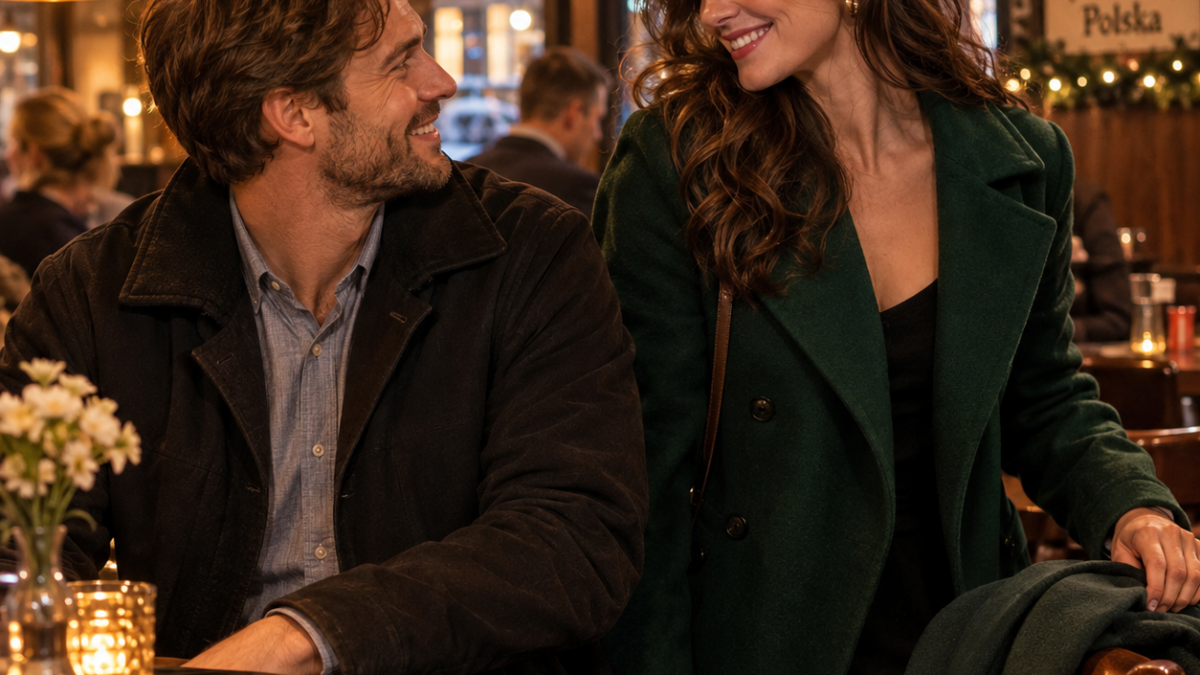
On Friday I arrived 20 minutes early, rereading the same line about cabbage rolls at the bar until the bartender asked if I was waiting for someone and I told him I had been waiting a long time. At 7:00 sharp, Petra walked in on her own two feet wearing a green coat I had never seen with snowmelt still in her hair, spotted me at the bar, hung her coat on the next stool, and slid the menu out of my hand.
– Assessment, she said.
Confirming with the bartender that I had arrived early and made a fool of myself as promised, she declared that the right amount of effort—and promptly stole half my potato pancake citing cabin rationing rules. Sitting in a warm room on a wobbly stool beside a woman who could have gone anywhere in town that night, I laughed without holding my breath for the first time in years until halfway through dinner she set down her fork and held my eyes.
– Come closer, she said, and I felt it all the way down. I’m not shaking.
Moving my stool until our knees touched under the bar, neither of us reached for a clever line. Anyone can get close in a storm because the storm does half the work; the real answer comes later when the road is open, the heat is on, and someone sits down beside you anyway—and I am grateful she was braver than a rule I had no business making alone.
So here is my question for you: if you cared about someone your best friend loved too, would you tell your friend first or let the other person decide how and when? If this story stayed with you, leave a comment and tell me what you would have done—and if you enjoyed it, like the video and subscribe so you don’t miss the next one.