She Accidentally Bid $40,000 on a Date With Boston’s Most Eligible Billionaire
She Accidentally Bid $40,000 on a Date With Boston’s Most Eligible Billionaire
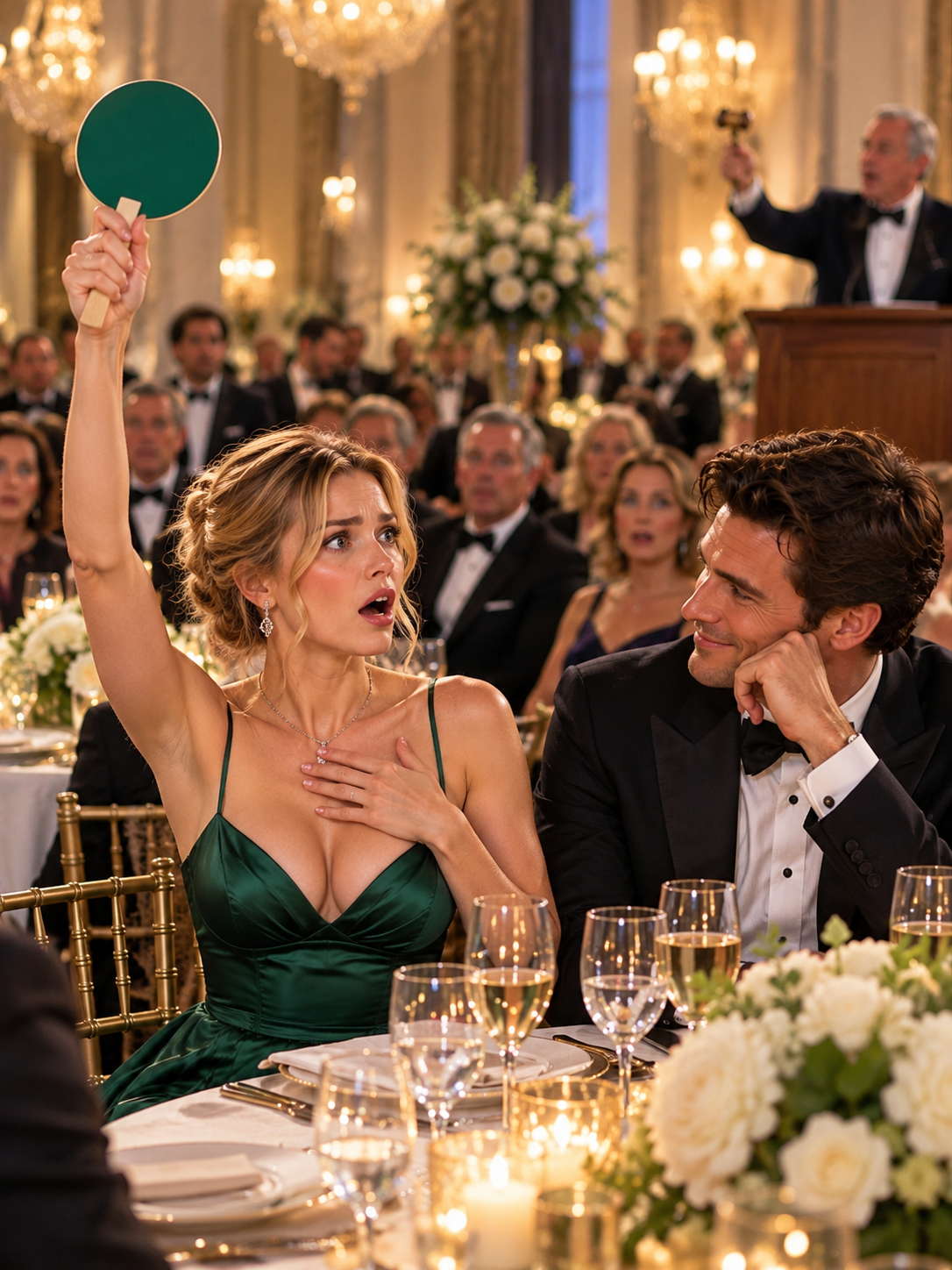
========== PART 1 ==========
Molly Finch was only waving at her friend.
That was what she would tell people afterward.
That was what she would tell her landlord and her mother in Gloucester and the reporter from the Boston Herald and eventually a great many strangers on the internet.
She was only waving at her friend. It was a Saturday night in October in the great marble hall of the Boston Public Library at the annual library foundation gala.
There were 500 people in evening dress. There were crystal chandeliers and silver trays and a string quartet.
There was a camera crew from Channel 5 filming the auction for the late news.
And there was Molly in a borrowed green dress that was a little too long standing at the very back of the room beside the coat check because she wasn’t a guest.
She was staff.
She’d been handing out programs at the door since 6:00.
The auction was nearly over. They had sold a week in a villa in Tuscanyany, a signed Red Sox jersey, and dinner for eight with a famous chef.
And now the auctioneer, a large, cheerful man in a velvet jacket named Barnaby Leadeds, was announcing the final lot of the night.
Ladies and gentlemen, Boom Barnaby, the moment you’ve been waiting for.
Lot 30, six Saturdays with Boston’s most eligible bachelor.
Six dates planned and paid for by the gentleman himself.
all proceeds to the library foundation.
Please welcome Mr.Hugh Thornton. The room burst into applause.
A man walked out onto the little stage and Molly at the very back of the room stopped folding programs. She knew who he was.
Everybody in Boston knew who he was.
Hugh Thornton, 38, founder of Thornon Marine, the shipyard in Charles Town that built the fastest sailing yachts in the world.
a billionaire who never gave interviews, never went to parties, and had never once been photographed with a woman. The newspapers called him the ghost of Charles Town.
In person, he was taller than she expected and much more uncomfortable.
He stood in the middle of the stage in a black dinner jacket with his hands clasped behind his back like a man waiting to be shot.
He had dark, slightly unruly hair, a strong jaw, and gray green eyes that looked out over the crowd as if searching for the nearest exit.
The bidding began at $5,000. It went up very fast.
At the front of the room, a tall blonde woman in silver sequins raised her paddle again and again and again. Her name was Cresa Peton.
Molly knew that because Cresa had been rude to her at the coch two hours earlier.
And because every person in the room seemed to know two things about her. Her father, Harold Peton, was the chairman of the library foundation.
And Cresa Peton, had been trying to marry Hugh Thornton for 2 years. 35,000?
Cried Barnaby. 35,000 to the lovely Ms.Peton.
Do I hear 36?
36 came from a woman by the window. 38 came from Cresa.
without even looking.
On the stage, Hugh Thornton’s face had gone very still, like a man watching a large wave come toward his boat.
And at that exact moment, Molly’s best friend, Jojo, who also worked at the Doorchester Branch Library and who was supposed to be helping with coats, appeared on the far side of the hall by the dessert table, holding up two cream puffs and grinning.
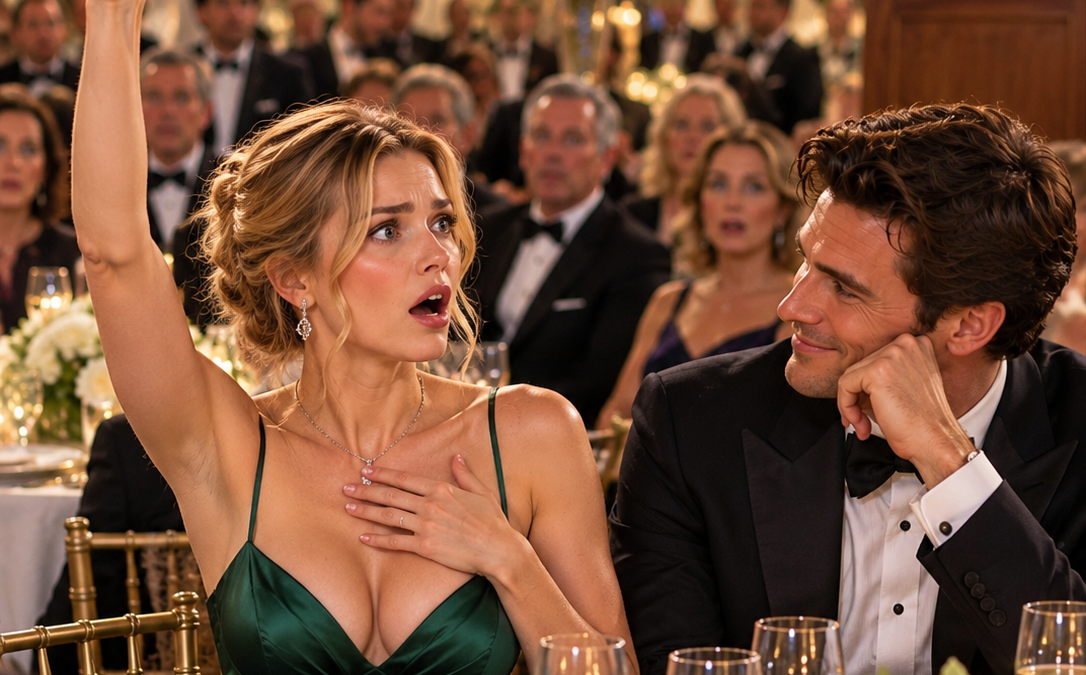
Molly, who had not eaten since lunch, raised her hand high in the air and waved. She was holding something in that hand.
She didn’t even think about it.
It was a green bidding paddle number 47 that a guest had left on the coat check counter.
40,000 roared Barnaby Leadeds.
$40,000 to the lady in green at the back. 500 heads turned.
Molly froze with her arm in the air.
No, she said.
No, no, I was just 40,000 going once, cried Barnaby. Going twice.
At the front of the room, Cresa Peton was turning purple. Her paddle was halfway up.
And on the stage, for one tiny second, so small that almost nobody in the room noticed it, Hugh Thornton looked at the auctioneer and nodded.
Sold. Barnaby brought the gavvel down with a crack like a pistol.
sold for $40,000 to the lady in green. The room erupted.
People cheered. People laughed.
The string quartet played a little fanfare. And the camera crew from Channel 5 swung around, lights blazing and pointed their camera straight at Molly Finch, librarian, who earned $51,000 a year, and who was standing at the coat check in a borrowed dress with a green paddle in her hand and her mouth wide open.
On the far side of the hall, Jojo dropped both cream puffs.
The next 10 minutes were the longest of Molly’s life.
She tried to explain.
She tried to explain to the young woman with the clipboard who came rushing over to take her credit card details.
She tried to explain to the photographer. She tried to explain to Ruth Delaney, the head of the Dorchester Branch Library, her boss of seven years, who came pushing through the crowd with her reading glasses swinging on their chain and her face white.
I was waving at Jojo, said Molly.
Ruth, I was waving at Jojo.
I can’t pay $40,000.
I can’t pay $4,000.
I’ve got $216 in my checking account, and my car needs tires.
Then tell them,” said Ruth.
“Tell them it was a mistake.
They’ll give it to the Peton woman.”
Molly turned.
Cresa Peton was already marching toward the stage like a battleship.
And then a voice said from right beside her, “Excuse me, I believe you’ve just bought me.”
She turned around.
Hugh Thornton was standing there. Up close, he was even taller.
He smelled of cold air and something like cedar.
He did not smile, but there was something in his gray green eyes behind the stiffness that looked very much like relief.
“Mr.Thornton,” said Molly, “I’m so sorry.
There’s been a terrible mistake.
I was waving at my friend. She had cream puffs.
I’ll go up and tell them right now, and Miss Peton can.”
“Please don’t,” said Hugh Thornton.
Molly blinked.
“I mean,” he said and cleared his throat and looked briefly at the ceiling.
It would be very embarrassing for the foundation on camera to reverse the last sale of the night. He paused.
What do you do, Miss Finch?
Molly Finch.
I’m a librarian at the Doorchester branch.
She swallowed. I run the adult literacy program.
Second chapter.
We teach grown-ups to read.
It’s being cut in January.
Something moved in his face just for a second.
Then it was gone. How much would it take, said Hugh, to keep it open?
$40,000, said Ruth Delaney before Molly could open her mouth.
For two years, I’ve been begging the city for 18 months.
Hugh Thornon looked at Ruth. Then he looked at Molly.
Then, without another word, he turned and walked back up onto the stage, took the microphone from a very surprised Barnaby Leads, and spoke to the room for the first time that night.
Ms.Finch’s bid stands, he said.
His voice was low and a little rough, as if he wasn’t used to using it in public.
I’ll cover it myself, and I’ll match it for the Doorchester branch’s adult reading program.
$80,000, he paused. On one condition, she goes on all six Saturdays.
That was the lot.
A deal is a deal.
The room went wild. The camera swung back to Molly.
Ruth Delaney took both of her hands and squeezed them so hard her rings hurt and whispered, “Molly, Molly, please.
40 people, Teddy, Mrs.Alvarez, all of them.”
And Molly Finch, librarian, who had come to the gala to hand out programs, stood at the coat check in her borrowed green dress, and understood that she had just been sold to a billionaire for six Saturdays, and that she could not possibly say no.
“Fine,” she said faintly.
six Saturdays.
At the front of the room, Cresa Peton snapped her paddle in half.
Molly didn’t see what happened next.
Almost nobody did. Cresa walked straight to her father, the chairman, at the head table, and bent down and whispered in his ear.
And Harold Peton, a heavy silver-haired man who had never in his life refused his only daughter anything, frowned and nodded and beckoned the foundation’s lawyer over with one finger.
It was on the 11:00 news. Of course it was.
Librarians accidental wave wins date with billionaire, said the caption at the bottom of the screen under a slow motion replay of Molly’s arm going up, her face falling, and her mouth forming the word no.
By Sunday morning, the clip had been watched 200,000 times. By Sunday afternoon, someone had said it to music.
On Monday, a card arrived at the library. Heavy cream paper engraved with a small blue sailboat.
The handwriting was strange. Very large, very careful.
The letters printed one at a time, like the handwriting of someone who had copied it from something.
Saturday, 10:00 a.m.Helicopter from Logan to Nantucket. Lunch at the Wawanet.
Dress warmly.
H.
Thornton. Molly read it.
Then she took out a pen and wrote on the back of it in her own neat librarian’s handwriting.
No helicopters.
It’s my Saturday.
I’ll choose.
10:00 a.m.Lucky Strike Lanes, Dorchester Avenue.
Wear something you can bowl in.
M.
Finch. She mailed it to Thornton Marine.
She expected to hear nothing at all. On Saturday morning at 10:00 exactly, a long black car pulled up outside Lucky Strike Lanes on Dorchester Avenue.
A small, shabby, beloved candle pin bowling alley that had been there since 1952.
The back door opened and Hugh Thornton got out in a navy sweater, jeans that looked as if they’d been ironed, and a brand new pair of white sneakers with the price tag still hanging from one lace.
He walked over to Molly, who was waiting by the door with her arms folded and stopped.
“I’ve never bowled,” he said.
I could tell from the sneakers. He looked down.
He saw the tag.
He went faintly pink. Molly reached down, snapped it off, and handed it to him.
“Rule one,” she said.
“In Doorchester, we don’t show off how new our shoes are.
” “Candle pin bowling,” it turned out, is extremely difficult.
The balls are small, the pins are thin, and you get three throws instead of two.
Hugh Thornton was terrible at it. Spectacularly, gloriously terrible.
His first ball went into the gutter.
His second ball went into the next lane.
His third ball somehow bounced, rolled backward, and came to rest gently against Molly’s foot.
The man behind the counter, a bald gentleman of about 70 named S, laughed so hard he had to sit down.
But Hugh did not give up.
He watched her throw. He asked questions, short ones, precise ones.
How much weight on the front foot? Where do you look?
He studied her the way she imagined he studied the hull of a boat.
And on the fourth frame, he knocked down nine pins out of 10 and turned around with an expression of such pure boyish astonishment that Molly laughed out loud before she could stop herself. They went to the diner next door for lunch.
A waitress named Bev slapped two laminated menus down on the table. Molly ordered the tuna melt and a chocolate milkshake.
Hugh looked at his menu for a long moment very seriously and then closed it.
“The same as her,” he said.
“You don’t like tuna,” said Molly.
“I saw your face.”
“I’m adventurous,” said Hugh.
He ate the entire tuna melt with the expression of a man doing his duty. Molly watched him across the table and found to her deep annoyance that she was starting to like him.
“Can I ask you something?”
she said. Why did you do it at the auction?
Cover my bid. Double it.
You could have just let them give you to Miss Peton.
Hugh put down his milkshake.
He looked out the window at Dorchester Avenue.
Cresa Peton has asked me to dinner 11 times in two years.
He said, “She sent a cake to my office on my birthday shaped like my face.
She once followed me onto a ferry.”
He paused.
When you raised your hand, I was very relieved.
That’s the truth.
It was the truth.
It just wasn’t all of it.
And Molly, who had read 10,000 books and should have noticed a sentence with something missing from the end, didn’t notice at all.
So, I was an escape route, she said.
Sorry.
Nothing.
She smiled into her milkshake. One down, five to go.
Mr.Thornton. Hugh?
He said. Mr.Thornton said Molly is a lot I want at auction.
He laughed.
It was rusty and surprised as if he didn’t do it very often.
And for one long moment in the cracked red booth of the diner on Dorchester Avenue, neither of them could look away.
The second Saturday was his choice.
The Boston Symphony Orchestra, a private box. Molly had never been to the symphony.
She had never been in a private box.
She wore the same borrowed green dress because it was the only nice dress she had.
And Hugh noticed and said nothing except that it was a beautiful color.
The concert was bronze.
It was very long.
And about 40 minutes into the second movement, Molly, who had worked a double shift at the library that week, leaned toward Hugh and whispered, “Is it supposed to be this slow?
It sounds like the cellos are walking home in the rain.”
Hugh’s mouth twitched.
5 minutes after that, she whispered, “If the Tony player doesn’t do something soon, I think he’s going to fall asleep.
Look at him.
He’s resting his chin on his drum.”
And Hugh Thornton, billionaire, the ghost of Charles Town, who had never laughed in public in his life, put his face in his hands in a private box at Symphony Hall and shook with silent, helpless laughter until a very small, very elegant, elderly woman in the next box, leaned over the rail and said, “Sho loudly that half the orchestra heard.
” They were asked to leave at the intermission, politely, by an usher who was trying very hard not to laugh himself.
They walked along the Charles River in the dark instead under the trees with the lights of Cambridge shimmering on the black water.
I’ve been a member of that symphony for 9 years, said Hugh.
I’ve never been thrown out before.
Did you enjoy it?
I’ve never enjoyed it more, he said, and meant it.
She told him about second chapter that night. The 40 grown-ups who came to the little room at the back of the Doorchester library twice a week.
The bus driver who’d hidden it for 30 years.
The grandmother who wanted to read the labels on her own medicine.
And Teddy Mensah, 58, a retired bus mechanic who’d come in a year ago with a shoe box full of letters his wife had written him when they were young, which he had never been able to read.
He’s on the third letter now, said Molly.
He reads one sentence a week slowly. He cried at the end of the first one.
Then he laughed because she’d spelled his name wrong.
Hugh didn’t say anything.
He just walked beside her with his hands in his coat pockets looking at the water.
But Molly noticed that he’d gone very quiet and stayed quiet for a long time.
The third Saturday was hers. The friends of the library annual book sale in the basement of the Doorchester branch.
Thousands of donated books on folding tables. volunteers in aprons.
“You want me to work?”
said Hugh.
“I want you to sort,” said Molly and handed him an apron that said, “Friends of the library in faded red letters.
Fiction on the left, non-fiction on the right, cookbooks at the back.
Can a billionaire handle that?”
He could not, as it turned out, handle it at all. An hour later, Molly went to check on him and found that he had carefully shelved 12 cookbooks in True Crime, a biography of Abraham Lincoln in Romance, and a book called Knitting for Beginners in the section labeled Military History.
The friends of the library thought it was hilarious. A lady named Mrs.Alvarez bought Knitting for Beginners from Military History just so she could tell the story at church.
Hugh laughed along.
But Molly saw his face just for a second when he realized what he’d done.
It wasn’t embarrassment.
It was something much older and much deeper.
Something like fear. That was when she first wondered.
It was a small thing, a librarian’s thing.
She thought about the menu at the diner, closed after one long, serious look, the same as her. She thought about the large, careful letters on his card, as if each one had been copied.
She thought about the program at the symphony, which he’d held all night and never opened.
And she thought about the people in her Thursday night class who ordered what the person next to them was having.
But it couldn’t be.
He was a billionaire. He built the fastest boats in the world.
Teddy Mensah came down the basement stairs at that moment. A big gentle man with gray hair and enormous hands carrying a box of donations.
He saw Hugh in the apron and stopped. and his face did something very strange.
It looked for just a second as though he recognized him.
Then it closed like a door.
“Afternoon,” said Teddy to nobody in particular and put down his box and went back up the stairs very fast.
Molly frowned after him. But then Jojo called her to the cash box and the moment passed.
The fourth Saturday, Hugh took her sailing.
It was his favorite thing in the world. He told her so.
He’d built the boat himself, a 40-foot sloop called Second Wind, all honeycoled wood and white sails kept at a moing in Gloucester Harbor.
Molly hadn’t told him she was from Gloucester.
She hadn’t told him her father had been a lobsterman there for 35 years.
She hadn’t told him that she’d been handling a tiller since she was 7 years old.
It was a bright, blowing November day. The sea was still blue and choppy, and the wind came hard off the water.
And 20 minutes out of the harbor, Hugh Thornton, who built the fastest sailing yachts on Earth, went a delicate shade of green.
“I’m fine,” he said.
“You’re not fine.
It’s just the chop.
I’m usually on bigger boats with stabilizers.
I’m usually designing them, not standing on them.”
He swallowed hard.
I’m fine.
Molly looked at him. Then she looked at the sails.
👉 [Tap here for the Next Part ] 👈