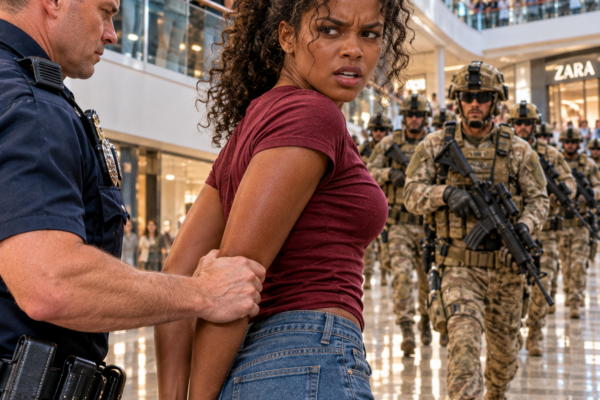
Cop Arrested Woman At The Mall—Then 15 Navy SEALs Walked In And Silently Stood Behind Her
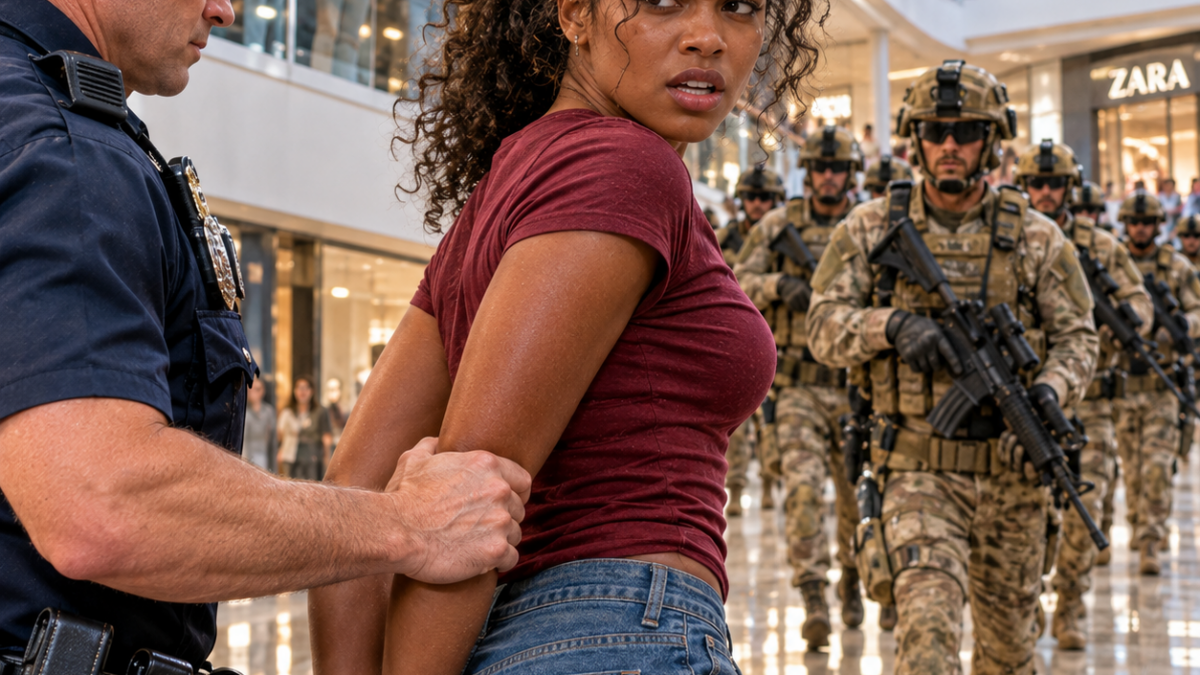
Cop Arrested Woman At The Mall—Then 15 Navy SEALs Walked In And Silently Stood Behind Her
put the bag down and turn around. Ruth Anne Dalton, 63 years old, set the little ribbon bag on the tile at her feet.
Inside it lay a pocket watch with a deep green face.
She turned slowly, hands open, and heard the steel click shut around her wrists, one side and then the other.
All along the corridor, people stopped walking. A small boy tugged his mothers sleeve and asked in a clear voice why the lady was in trouble.
Nobody answered him. Behind the officer at the end of the hall, the big atrium doors were about to open on something he had no idea was coming.
But that was the afternoon.
The morning had been quiet.
It began, as most of her mornings did, in the kitchen of the yellow house in Branick, Ohio, with a mug of black coffee going lukewarm while she stood at the window. Out on the porch, the swing Walt had built 12 summers ago moved a little in the wind, as though someone had only just stood up from it.
She had stopped finding that sad some time ago.
Now it felt more like company. On the refrigerator, held up by a magnet shaped like a pineapple, hung Josies newest drawing.
A lighthouse, tall and crooked, red stripes, a yellow beam shooting off the edge of the paper and into the corner of the refrigerator door.
Her granddaughter was nine and had decided that lighouses were the finest things humans ever built.
Across the bottom in careful pencil, she had written, Grandma, this one is for your speech. Ruth Anne touched the corner of the paper and smiled.
The speech she would have to give it at 6:00 tonight in front of 300 people, and she would rather have crawled through a field again. The phone buzzed against the counter.
Carla.
Mom, are you eating something?
Coffee? Thats not eating.
It has beans in it.
Beans are food.
Her daughter laughed.
And then the laugh went careful. Youll do fine tonight.
You know that.
You ran a whole trauma ward. You can say a few words about a scholarship.
The ward did not have a microphone. Josie says to tell you the lighthouse has a light on top so you can find your way.
She wanted me to say that exactly.
Ruth Anne looked at the drawing again. Tell her I got the message.
After they hung up, she did what she did every day before leaving the house.
She took the small gray notebook from her purse, flipped to a clean page, and wrote the date.
Tuesday, October 14th, and the time 7:52. 26 years in the Navy as a hospital corman had taught her one rule.
And she had said it so often to so many young students that it came out of her sometimes in her sleep.
Write it down.
Time it.
Sign it.
If something happens, you put it on paper while it is fresh. If you wait, memory starts to polish things.
She had never needed the notebook for anything more dramatic than a grocery list and the occasional blood pressure reading.
But she carried it anyway, the way some people carry a lucky coin.
She tucked it back in her purse between her reading glasses and a roll of peppermints.
Then she put on her white cotton blouse, her good jeans, and her sneakers because her feet were 632, and she was not about to spend a long day on a mall floor in anything else. Silver Lake Galleria sat at the edge of town beside a retention pond that the city liked to call a lake.
At 10:00 in the morning, the parking lot was nearly empty, and the central atrium was half-dressed for the evening. Round tables stood naked without their cloths.
Volunteers on ladders hung banners along the balcony rails.
Deep blue letters on white.
The Danny Reyas second win scholarship. Beneath them, smaller for the children of those who did not come home.
She stopped for a moment under that name.
Lieutenant Danny Reyes, killed in 2013.
She had been the one kneeling beside him.
She had done everything right, and it had not been enough.
And she had never told anyone how that felt.
Not Walt, not Carla.
She had only said yes when the scholarship committee asked her to coordinate the volunteers because it seemed the one honest way to carry him. The fountain in the middle of the atrium splashed on, cheerful and indifferent.
The smell of cinnamon pretzels drifted over from the food court.
And high above the fountain, mounted on the far wall, the giant screen played its endless advertisement for a mattress. A pair of cartoon sheep spinning round and round a pillow.
Youd think they could pick a different sheep, said a voice.
A young man in a Channel 9 jacket was crouched beside a tripod, a camera rig, and a tangle of cables.
He looked 19 at the most with a lanyard that said Jaylen Moss and he had the tired, eager face of a kid who had been awake since 5 to be useful. Mrs.Dalton, Im Jaylen.
WBRK. Were streaming the whole dinner tonight.
So, I wanted to test angles with you if thats okay.
Youll be standing right about there. He walked her to a spot near the fountain and had her say a few words while he adjusted the lens.
She said her name, the date, and the weather.
He frowned at the little monitor, moved a foot to the left, and nodded.
Its a good rig.
Streams live to the station, but it also records to its own laptop right here. He patted a battered gray laptop on a folding table, totally separate from the mall system, The stations rule.
If the internet drops, we still have everything. He tore a small card from his notepad, wrote a passcode on it, and held it out.
In case Im in the bathroom and somebody needs the footage, Please dont lose it.
I never lose paper, Ruth Anne said and slid the card into her notebook. She thought nothing more of it.
It was a nice young man doing his job carefully, and she liked him for that. By 11, she had checked the volunteer list twice, counted the folding chairs, and run out of reasons to stay.
There was one more errand, and it was the one she cared about most. In 2009, home on leave and stubborn, she had collapsed in a hospital parking lot, bleeding where no one should bleed.
A surgeon named Amos Puit had come down in the middle of his own supper to meet her on the table. 7 hours he had worked.
He told her afterward that he had never prayed so hard over a stranger and then he blushed because he was not that sort of man. He was 70 now.
Tonight was his retirement, folded into the dinner, and she wanted him to leave with something that said what a thank you card could not. Kesler and daughters jewelers occupied a corner of the first floor, all glass and soft lamps.
A bell chimed when she came in.
The young woman behind the counter had a name tag that read Brenda and the sort of two straight posture that belongs to someone on her third week of work. Her eyes went to Ruth Annes sneakers first, then her jeans, then her face, and a polite little distance came down between them.
Can I help you? Id like to see your pocket watches, please.
Brenda showed her three. The third was the one silver case, plain and solid, and a face the deep green of a pine forest at dusk.
Ruth Anne held it in her palm and felt it tick against her skin, patient and steady, the way a good pulse does.
May I have it engraved today?
We can do it while you wait. Its 4250.
Then engrave this on the back. Ruth Anne said it slowly so there would be no mistake.
Steady hands, warm heart. Brenda wrote it down.
The pen paused over the second sentence and for a second the stiffness left her face. Then it came back.
The card machine took a long time to think. Ruth Anne put her license on the counter without being asked because she knew how this went.
Brenda studied it, looked at Ruth Anne, looked at the card again. She tapped at a screen.
She frowned and tapped some more. A telephone sat at her elbow, and her eyes slid to it twice.
Its a large amount, Brenda said.
We have to be careful.
Of course.
At last, the machine gave a small satisfied chirp. Approved.
Brenda let out a breath that she tried to hide, and the watch went into a black velvet box, the box into a ribbon bag, and the bag into Ruth Anne hand.
The words had been cut into the back of the case so cleanly that they looked as if they had always been there. Thank you for your patience, Ruth Anne said.
Have a nice day, maam. The voice was flat now, the warmth gone out of it like heat from a stove.
As Ruth Anne walked toward the door, she did not look back, but she saw in the dark glass of a display case Brendas hand reaching for the phone.
She told herself it was nothing.
People called their managers all the time, and a new girl with a big sale would want to be sure she had done it properly.
Still, the little cold feeling stayed with her all the way to the door. The corridor outside was bright and busy.
A woman pushed a stroller past.
Two teenagers argued over a phone.
From the food court came that warm smell of cinnamon and sugar.
And she thought of Walt, who could never walk by a pretzel stand without buying one and pretending it was for her. 10 steps, 15.
The ribbon bag swung lightly from her fingers.
20 steps down the corridor, she heard it behind her. Heavy footsteps, quick and even, the kind that were not strolling.
They came closer and a belt creaked with the weight of everything hanging from it. Maam, a mans voice said.
Stop right there. Ruth Anne turned.
The officer stood two paces away, tall and square in his dark uniform, and his hand was already resting on his handcuffs. Ruth Anne turned all the way around.
The officer stood three paces off, one hand resting on the cuffs at his belt, the way a man rests his hand on a dog he has not yet decided to trust. His name plate read Price.
On his shoulder, a patch said Bran Police and a small number 31 was stitched below it.
Maam, Im Officer Price, patrol unit 31, he said.
I need to know what you bought in that store.
Good afternoon, officer, she said. A pocket watch.
A pocket watch? He said it slowly as if tasting it.
$4,000 worth.
$4,250 to be exact. It is a gift.
Behind her, the fountain splashed on. Somewhere to her left, a pretzel stand sent out its cinnamon sweetness, and the whole atrium smelled like a county fair.
It was a strange smell to carry into a moment like this one. And she noticed it anyway, noticing was what she did.
License, Price said, And whatever paper they gave you. She reached into her purse slowly so that he could see every move her hands made.
Her fingers passed the small gray notebook and found her wallet.
She drew out her drivers license, then the folded receipt from Kesler and daughters and held both out together.
He took them. He glanced at the license for about the time it takes to blink twice.
The receipt he did not read at all.
He simply held it folded like a man holding a ticket to somebody elses show. Officer Ruth Anne said in the same even voice she had once used on a ward full of frightened 19year-olds.
The store cleared my card at 223. The receipt has the time on it.
If you like, you can call the number on the back of my card.
The bank will confirm the payment in about 30 seconds. Ill decide what I like.
Of course, I only mean that it would be quick.
Prices jaw moved side to side.
She watched it. A small muscle near the hinge kept jumping and the jumping did not stop.
By now, the atrium had begun to notice them. People do that.
They slow down first, pretending to look at a shop window, and then they stop pretending.
A girl in a paper hat leaned out from the pretzel stand with a tray still in her hands.
A young father stopped his stroller beside a potted palm, and the baby inside it kept right on chewing a plastic giraffe. And from the bench by the fountain rose a small, straightbacked woman in a lavender cardigan with a cane hooked over her arm.
Ruth Anne knew her. Everybody in Branic of a certain age knew Mrs.Odell Hines, who had taught 8th grade English for 38 years, and had never once let a comma go unpunished.
Officer, Mrs.Hines called in her classroom voice.
Is there some trouble?
Maam, step back, please. Police business.
I can see that it is police business.
I am asking what kind, maam. Mrs.Hines stepped back exactly one step.
Ruth Anne gave her the smallest nod. The kind that says, I am fine.
Please stay out of it.
It did not seem to be taken that way.
Price turned toward the crowd and for a moment he stood a little taller like a man who has found an audience. Ive been doing this 11 years, he said loud enough for them all.
I know when something doesnt look right. I understand, Ruth Anne said quietly.
And she did understand.
She had read faces for 26 years, and she read his the way she had once read men on stretchers. His breathing was high in his chest and quick.
The skin along his neck had gone red.
His eyes did not look at her, only past her, at some picture already painted in his head.
This was not a man collecting facts. This was a man who had decided first and who now needed the afternoon to agree with him.
She had treated that kind of patient before, the ones who would not be told. You did not argue with them.
You kept your hands slow and your voice low, and you waited for the real problem to show itself. Waiting was a thing she had learned from Walt.
She thought of him then, without wanting to, standing in the hallway of Bran Middle School on a cold night some 20 years back. A budget meeting had gone sour.
A man had stood up and shouted that shop class was a waste of the taxpayerss money, and Walts ears had turned red as brick.
Ruth Anne, home on leave in her dress blues, had felt his big hand tighten around hers.
Count to 10, she had whispered.
Im counting to a hundred, he had whispered back. Later in the car, he had laughed until he wheezed.
You hold your tongue better than anyone I know, he said. how do you do it?
And she had told him the honest truth that the loudest person in a room is usually the one who is most afraid and that you cannot fix fear by shouting back at it.
He had kissed her knuckles at the next red light.
He had never forgotten it, and neither had she.
The memory passed through her in the space of a breath, and then she was back in the atrium under the high glass ceiling with the fountain going and the officers face a little too close.
The radio on Prices shoulder crackled.
A mans voice came out of it, flat and half chewed up by static.
Ruth Anne could not make out the words.
Price turned his head, pressed the button with his chin, and said something low.
Then he walked three steps away toward the planter by the escalator, and stood with his back half turned, listening.
She watched his shoulders. They rose just slightly, and they stayed up.
Whatever he was hearing, he did not like it.
And yet, when he walked back, he did not look like a man who had been corrected.
He looked like a man who had been given a reason to dig in his heels. Maam, he said, and the word came out harder now, with an edge on it that had not been there before.
Turn around and put your hands behind your back. Officer, I have done nothing.
Im going to count to three. The father with the stroller said, Hey, come on.
Not very loud.
No one else said anything at all.
One, Price said.
Ruth Anne looked at the green and white tile beneath her sneakers. She thought of the watch safe in its small velvet bag in her purse, and of Dr.Puits steady hands, and of the 6:00 dinner that would start without its coordinator if this went on much longer.
Two, she turned. She did it herself so that nobody would have to turn her.
And she held out both wrists behind her, side by side, the way she had once shown a hundred young students how a frightened man should do it when he wants to stay safe. Palms out, fingers open, nothing hidden.
Three, said Price a little late, the cuffs closed. She felt the cold steel bite.
He did not ease them to the second click and stop as a careful man does.
He ratcheted them down, one tooth after another, and then one tooth more, until the metal pressed hard into the thin bones of her right wrist, and she felt the skin begin to pinch.
She breathed in through her nose.
She did not wse. Those are tight, officer, she said.
I would ask you to check them.
Theyre fine. They are not fine, but I will not argue it here.
She turned her head just far enough that he could hear her without the crowd hearing. I want you to know something though so that you cannot say later that no one told you.
This building has cameras, many of them.
The television station has one set up by the big screen at the center of the atrium.
Whatever happens today is being recorded by more than one machine. I would simply ask that you remember that.
For half a second, his hand tightened on her arm.
Then he laughed short and dry. Everybodys an expert, he said.
Walk. They walked.
It was a long way, longer than the building had ever seemed, past the shoe store and the phone kiosk toward the dim hallway where the security office sat behind a plain brown door.
Price kept one hand clamped above her elbow, the cuffs rubbed at every step, her wrists burned, and the burn climbed slowly toward her forearm.
But the burn was not the worst of it.
The worst of it was the faces. She had walked through crowds before.
She had walked across a flight deck in a gale and down a hospital corridor with a strangers blood drying on her sleeves, and nobody had looked at her then, the way they looked at her now. A woman with a shopping bag pulled her little boy closer.
Two teenagers lifted their phones. An older man in a ball cap shook his head, and Ruth Anne could not tell whether it was for her or for the officer, and that was its own kind of sting.
Her cheeks went hot.
63 years old with a spotless record and a chest full of ribbons she never wore. And she was being marched across a shopping center like a thief in a picture book.
Hold your head up, she told herself.
You know who you are. Let them wonder.
Maam, it was Mrs.Hines somewhere behind, her voice cracking across the tile. Ruth Anne Dalton, are you all right?
Ruth Anne did not trust her voice just then, so she only turned her face a little, enough to show that she had heard and nodd at once.
They passed the fountain. Water rose and fell in its stone basin, glittering, utterly unconcerned, and a few bright pennies lay on the bottom, each one somebodys wish.
The pretzel smell followed them, warm and buttery, and cinnamon sweet, so ordinary that it made her throat ache. Above the central stage hung the great screen 40 ft across and on it a smiling couple bounced happily on a mattress, spinning slowly over and over beneath the words, Sleep like you mean it.
Nobody on that screen knew a thing about her. Then from behind them, from the far side of the atrium, there came a sound, a heavy double thump, the sound of a pair of tall glass doors being pushed open at once.
And then the footsteps.
Not one set, not a few. A great many, steady and even, falling together in a rhythm that no crowd of shoppers ever keeps.
Ruth Anne stopped walking before she knew she had stopped. She had heard that cadence on a 100 mornings, on a 100 gravel lots under a gray Virginia sky.
She would have known it anywhere, and she counted without meaning to the way she counted everything. 15.
The atrium doors swung open, and the sound that came through them was not the sound of shoppers.
It was the sound of 15 pairs of boots and good shoes landing on the tile at the very same moment. Left foot, right foot, left foot, steady as a drum.
Ruth Anne Dalton had her back half turned to the entrance, her wrists locked behind her, and she did not need to look. She had heard that cadence on a gravel parade ground in Virginia more times than she could count.
Then she looked anyway.
15 men came in out of the October sunlight wearing plain shirts, work jackets, and ordinary jeans as if they had been picked at random off a street corner. Nobody picks 15 men off a street corner who walk like that.
Their shoulders were level. Their hands hung open and easy at their sides.
They did not hurry, and they did not look around like men who were lost. They looked like men who knew exactly where they were going.
The cinnamon pretzel smell drifted on and the fountain went on splashing, but the shoppers stopped.
A woman with a stroller stopped.
Two teenagers with paper cups stopped.
Even the spinning mattress on the big atrium screen seemed to turn a little more quietly. At the front of the group walked a tall man with gray coming in at his temples and a calm, unhurried face.
He swept his eyes across the atrium the way a man reads a room, and they landed on Ruth Anne. He took one more step.
Then his face changed. It was not a large change.
His jaw loosened and something went across his eyes that she had last seen on a stretcher 13 years and many miles ago. Senior Chief Dalton Calvin Boyd said very quietly.
Officer Gordon Price stepped sideways directly between them and put one hand up flat like a man stopping traffic.
His other hand stayed on Ruth Annes elbow. Sir, I need you to stop right there.
This is a police matter.
Boyd stopped. He stopped the way a ship stops all at once and without any drama.
Behind him, 14 men stopped, too, without a single shoe scuffing. Officer, Boyd said in a soft Georgia draw that did not climb or hurry.
Im not here to cause any trouble.
Id just like to know what Senior Chief Dalton is being charged with.
I dont have to tell you that. No, sir.
You may not have to. Im asking politely and Im telling you politely to step back.
Prices voice had an edge on it and it was getting sharper by the second.
Shes being detained.
You interfere with that. Youre looking at obstruction.
All of you.
Do you understand me?
Boyds eyes went to Ruth Annes wrists, to the steel cuffs, and the angry red marks they had already left in her skin. His hands, she noticed, did not move, but the muscle along his jaw did.
She looked straight at him.
She did not speak.
She only moved her head.
A tiny shake left and right.
No more than half an inch.
It was the same shake she had given a hundred students who wanted to rush in when they ought to be waiting.
Not yet. Not like this.
Let it be. Boyd read it.
She watched him read it. A breath went out of him, slow and controlled, and his shoulders came back down.
Yes, senior chief, he said, almost to himself. Price frowned.
He had seen something go between them, and he did not like not knowing what it was.
Ruth Anne did not look away from Boyds face, and for a moment the atrium, the phones, the pretzel smell, and the cold bite of the steel all slid away from her, and she was somewhere hot and loud and brown.
It had been Helmond Province in the summer of 2011 in the back of a helicopter that shook like a washing machine on its last cycle. The dust came in through every seam.
She had knelt on a wet metal floor with a strangers blood soaking through the knees of her trousers.
And the stranger was Calvin Boyd, a young senior chief then, with a wound in his side that should have ended him before the rotors even spun up. 40 minutes.
That was the flight. And that was the fight.
She remembered the number because she had written it down afterward, the way she wrote everything down. 40 minutes with her hands inside the worst hour of a mans life.
pressing, packing, pressing again, talking to him the whole time in a flat, easy voice, about nothing. About her husbands tomatoes, about a porch swing in Ohio.
You stay right here with me, senior chief.
You hear me?
Stay right here. He had stayed.
He had stayed all the way down onto the pad and through the doors and into the arms of the surgeons.
What she did not tell anyone then or since was that she had been fighting two battles in that helicopter. The second one had nothing to do with Boyd.
Two years before, a young lieutenant named Dany Reyes had bled out under her hands on a different flight, and nothing she did had been enough. She had not been able to save him.
So in that helicopter, with her palms slick and her arms shaking, she had made herself a promise. Not this one.
Not this time.
And somehow that time it had held.
She came back to the atrium with the faint tingle of the cuffs in her fingertips. Officer, Boyd was saying, and his voice was still gentle.
With respect, Ill tell you why were here, and then Ill stand wherever you want me to stand. We came to honor this woman.
Thats all.
She taught most of the men behind me. She kept me alive once.
We came to say thank you. Price heard one word out of that sentence, and it was the wrong one.
She saw it land. His eyes flicked over the 15 men, over their shoulders and their stillness, and the hand on her elbow twitched.
Seals, he said, half under his breath. Youre telling me youre seals?
Some of us are still serving, sir. Some of us are retired.
Boyd said it as plainly as a man giving his shoe size. We were her students.
Then, without a word of command, without a nod or a hand signal that Ruth Anne could see, the 14 men behind him moved. They did not rush.
They fanned out and came forward in a slow line, and they took their places behind her, shoulderto-shoulder, in a curved row that followed the edge of the fountain.
Every man kept his hands in plain sight, open and low.
Every man left exactly the same gap between himself and the next. If she had measured it with a ruler, she thought it would have come out even.
She knew them one after another.
Dne Okaphor, 32, who had once set an entire training class laughing in the middle of a freezing river drill, was not laughing now. He stood with his chin up and his face carefully empty, and only his eyes were warm.
Next to him stood Eli Vance, the youngest of them, 27, with the same worried crease between his brows that he had worn at 21 when he had fainted at his first simulated amputation. He was gripping nothing, and yet he looked as though he were gripping something very hard.
And at the far end, a head taller than the rest, with a gray beard like a snowdrift, stood big Tom Haskell, 46, arms folded loosely, a mountain that had decided to be gentle for the afternoon. Matteo Ruiz was there, too, steady and square.
The others she would greet properly later. For now she let her eyes pass over them and feel what she had not felt since before noon.
She was not alone.
The atrium had gone quiet. Not the polite quiet of a library, but the held breath quiet of a place where everyone has realized at once that something is happening.
Even the fountain seemed to splash more softly. Near the pretzel stand, a phone came up and then another and then a dozen small bright screens were pointed at the scene like candles lit in a dark church.
Price saw them.
He saw the phones and he saw the line and she watched his pride take hold of him like a hand around the throat.
This is intimidation, he said loud enough for the crowd. That is what this is.
You people are standing behind a detained suspect trying to intimidate a police officer.
Boyd looked around the atrium slowly from the fountain to the escalators to the great glowing screen. He looked back.
Officer, he said mildly. Theres about 30 ft of open floor between you and the nearest one of us.
Id say youve got plenty of room. Someone in the crowd made a small sound that was not quite a laugh.
Prices face went a dull red.
Ruth Anne kept her own face still. She had a rule for rooms like this one, a rule she had taught to every student who ever stood in front of her.
And she said it now silently, the way she might have said a prayer, hands visible, voices low, and let the facts walk in.
A frightened man wanted you to shout because shouting gave him an excuse. A frightened man wanted you to reach because reaching gave him a reason.
If you gave him neither, sooner or later, there was only the truth left in the room, and the truth was heavier than any badge.
She felt it in her bones.
These men would not move unless she moved, and she would not move. Brandt Price barked over his shoulder.
And she saw a figure in a security jacket at the edge of the crowd flinch and stand straighter.
Get your people over here.
I want a clear path to your office right now.
I want this crowd back and I want these men out of my way. Two mall guards in gray polo shirts began half-heartedly waving the shoppers back.
The path opened.
A long lane of bare tile passed the fountain and the dark shop windows toward a glass fronted door at the far side of the atrium. Price tightened his grip on her arm.
Lets go, maam.
Of course, officer, Ruth Anne said in the same tone she might have used to ask a nurse to pass the gauze. She walked behind her.
The 15 men walked too with the pace and the distance of an honor guard, not one step closer than they should be and not one step farther away. Their footsteps fell together again on the tile, and the sound went ahead of them across the atrium like a slow, patient drum beat.
It was a long way to that door. The cuffs bit into her wrist, and the bruise was waking up, and she counted her breaths the way she always did.
In for four, out for four, past the fountain, past the pretzel stand and the faces, past the spinning mattress, turning and turning on its enormous screen, selling sleep to no one.
Price shouldered the door open. Beyond the glass, in a bright, cold little room of screens and filing cabinets.
A man in a navy blazer was already smiling, as if he had been expecting them. The door opened before they reached it, and the man in the navy blazer stepped out with his hand already stretched toward Officer Price.
Gordon, he said, as warmly as if they had met at a church picnic. Lyle, Price answered.
Something passed between them.
A quick tilt of the chin, and Brandts mouth twitched around a joke that neither man finished.
It was the kind of look two people share when they have laughed at the same story many times.
Ruth Anne saw it, said nothing, and set it down in her mind the way she would set down a pulse rate. Time, place, who looked at whom.
Come in, maam, Brandt said, turning to her at last.
Lets get this sorted out.
The security office was smaller than it had looked through the glass. A wall of monitors flickered in gray and green, showing the parking deck, the loading dock, the fountain, a woman pushing a stroller past the cinnamon pretzel stand.
The desk was scarred and ringed with old coffee stains, and a paper cup sat in the middle of them, cold with a skin on top.
Behind the chair hung a framed photograph of two grinning men holding up a catfish the size of a child. One of them was Brandt.
The other in a green cap was unmistakably Price. Ruth Anne looked at the fish for exactly as long as it took to read the date in the corner of the frame.
Then she looked at the floor as a tired woman might.
Price steered her toward a plastic chair by the wall. Her wrists, still locked together behind her, knocked against the chair back, and she drew a slow breath through her nose.
Lets start with a phone call, Brandt said. He lowered himself into his own chair, found a number on a sticky note, and punched it into the desk phone.
He pressed the speaker button with a flourish, like a man opening a curtain. It rang three times.
Kesler and daughters, this is Brenda, said a thin voice. Brenda, this is Lyall Brandt, mall security.
We spoke earlier.
I need you to tell me again about the card payment from this afternoon.
The watch. There was a pause long enough for Ruth Anne to hear a shop bell ring faintly in the background.
Oh, yes, sir. It um it went through.
It was approved.
All of it. 4,250.
The bank cleared it.
I have the slip right here. And Mr.Kesler said he said the voice wobbled.
Im sorry. Is something wrong?
Did I do something wrong? No, Brenda, you did fine.
Thank you. Brandt pressed the button and the line went dead.
He let the silence sit, then folded his hands over his stomach.
Well, thats that. Payments good.
Price looked at the ceiling.
Gordon, Brandt said without turning his head.
Take the cuffs off the lady.
Price did it slowly with a long sigh.
The steel ratcheted open, and Ruth Anne brought her hands around in front of her and laid them in her lap like two things she had been handed to hold. Blood came back into her fingers in a hot rush.
Around her right wrist ran a raw red band, and under the heel of her hand, a dark patch was already spreading, plum colored at the center. Walt would have called it a mean piece of work.
She turned the wrist over, looked at it with the flat attention of a woman who had examined a great many injuries, and said only, Thank you. Now, Brandt said.
He leaned forward, and his voice took on a smoothness that was somehow worse than the roughness had been.
 [Tap here for the Next Part ]