Grandpa Left Him a $1 Ghost Town, With Something Locked Inside
Grandpa Left Him a $1 Ghost Town, With Something Locked Inside
At 20, Cody Hale had learned not to flinch when his brothers laughed. So when their grandfathers will left him a dead mining town worth $1 and Dalton laughed loud enough to rattle the window, Cody only folded his hands.
Two days later, Dalton drove him up to it. He kept Codys phone.
He kept the keys to Grandpas truck, the $1,800 Cody had saved from a winter of feedlot work, Grandpas saddle, and Grandpas silver harmonica, and he drove back down the mountain without once touching the brakes. The nearest town was 31 miles away.
On the third night, every shelf in the old general store had frozen white except one, and that one was trembling, and behind it warm air was breathing out of the mountain from a shelf his brothers had walked past every time they came up to dig.
To understand what was behind it, you have to start with the morning they read the will. The lawyers office in Pine Notch was hot and close and smelled of coffee and wet wool.
Miriam Coldiron read the will in a dry, even voice without looking up the way a judge reads a sentence. The Hale ranch, 2,000 acres, the house, the barns, and the cattle to Dalton and Reed Hale in equal shares, and to Cody Augustus Hale, the town of Silver Load, together with all its contents, conveyed to the testator for the sum of $1 in the year 1971.
There was a short silence. Then Dalton laughed, a big, easy, warm laugh, and he put his hand on Codys shoulder while he did it and squeezed.
Well, he said, Grandpa always did love a joke.
Crystal, his wife, laughed too behind one long red fingernail.
Reed did not laugh. Reed looked at his boots and turned his wedding ring around and around and said nothing all.
Cody sat very still in his one good shirt and folded his hands on his knees.
His grandfather had raised him since he was twelve after his mother and father were gone and Gus Hale had taught him two things above all. Keep your hands busy, keep your face still.
Silver Load, he knew the name.
Everybody did. A silver camp from the 1890s, eleven wooden buildings on one street empty since before the first war.
Guss folly, people called it.
The old man had bought it for a dollar from a mining company tired of paying the taxes and for 50 years he had driven up there twice a month and never once said what he did. Cody, Dalton said kindly after the lawyer had gone out.
Grandpa would want you to stand on your own two feet. You know that.
He always said it. Youve been living in his back bedroom since you were a kid and that was fine, but youre 20 now.
So heres what well do.
Dalton spread his big hands. You take a couple of months up at Silver Load, get a feel for the place, see what its like to be your own man.
Reed and I will look after things down here. Your savings, your stuff, well hold on to all of it so nothing walks off while youre gone.
Its Grandpas truck, Cody said. Its ranch property, Dalton said gently, and the ranch is ours now.
He smiled. Were honoring what he wanted, Cody.
Thats all this is.
That was the voice Dalton used for everything. Calm, warm, reasonable.
It was the voice he had used to tell Cody at 14 that Grandpa had only taken him in out of pity. Dalton never raised it.
He had never once needed to.
Two days later, on the 8th of January, Dalton drove him up. The road to Silver Load left the county highway 12 miles above Pine Notch and climbed for 19 more through black pine and switchbacks and drifts higher than the trucks hood.
Dalton drove the ranchs chained plow truck fast with the heater roaring, Crystal in the middle and Cody against the door.
At the last switchback the trees opened and there it was, a single street buried to the window sills under a pewter sky, 11 weathered buildings with tall false fronts, porches sagging, windows boarded, a leaning saloon, a two-story general store with silver load mercantile fading across its front. Beside it, a narrow red brick bank, the only brick building on the street.
Its arched front doorway caved in under a slope of rubble and snow.
Home sweet home, Crystal said. Dalton parked at the end of the street and did not turn off the engine.
He got out and carried Codys duffel to the mercantile porch himself and kicked the snow off the door until it would open. Then his phone buzzed and he walked to the far side of the truck and talked low with his back turned.
Cody heard only one phrase on the wind.
30 more days, Ron. Thats all Im asking.
When he came back, the warm smile was back in place. Phone, he said and held out his hand.
Theres no signal up here anyway, Cody said.
Whats it matter?
Then you wont miss it. Ill keep it charged for you.
Dalton hand stayed out, open and patient, and Cody thought of Grandpas harmonica, which Dalton had picked up off the kitchen table the night of the funeral and slipped into his own pocket. Ill keep it safe, Cody.
He put the phone in his brothers hand. Crystal leaned out the window and passed him a paper sack.
Inside were three cans of beans, a box of saltines, and a bag of beef jerky.
Every item had a yellow markdown sticker on it.
Cody looked at the stickers. Crystal Hale had never in her life bought a thing on markdown.
Youll be fine, she said.
Your grandpa camped up here all the time. He drove up here in a truck, Cody said.
Well, Dalton said, youre young. Back in a few weeks.
Stay warm, little brother.
He climbed into the plow truck and pulled the door shut, and the truck backed and turned in the deep snow and started down the street, past the bank, past the saloon, around the last switchback, and Cody stood on the mercantile porch with the paper sack in his arms and watched the tail lights flare red once at the turn. They did not stop.
Nobody looked back. He listened to the engine until he could not hear it.
Then there was only the wind, high up in the pines, and the tick of snow against the false fronts, and the light going blue and then gray. It was 4° below zero by the old thermometer nailed to the mercantile door.
It would be colder by morning. He went inside.
The mercantile was a long, dim room that smelled of dust and cold iron and old tobacco.
A counter ran down one side with a brass cash register on it.
Behind the counter, shelves climbed to the ceiling, floor to rafters, crowded with faded tins and brown bottles and bolts of cloth gone gray, all of it furred with frost.
In the middle of the floor stood a pot-bellied iron stove with a pipe running up through the ceiling, and beside it a wooden crate, and in the crate split and stacked enough pine for a few nights. Somebody had stacked that wood recently.
The cut ends were still pale.
Cody did not let himself think about that yet.
He took off his gloves and opened the stove and cleaned the cold ash out with his bare hands, the way Gus had taught him in the ranch house kitchen the winter he was 13.
In his coat pocket was a box of kitchen matches, the one thing Dalton had not thought to take.
Nine.
He tore the sardine box flap into strips, shaved a pine stick into curls with his pocket knife, built the curls into a little tent and struck the first match. It flared and died.
second caught the cardboard and the cardboard caught the curls and he lay on the cold floor with his cheek against the boards and blew on it, slow and steady, until the flame climbed into the pine and held.
He fed it one stick, then another.
He sat back on his heels with seven matches left and his hands shaking and he let himself breathe. He ate half a can of cold beans and two pieces of jerky, sitting with his back against the warm iron.
He saved the rest. He spread his coat on the counter and lay on top of it with the duffle for a pillow and fed the stove every two hours and did not sleep much.
In the morning, the cold had found every crack in the room.
Frost had grown in the night along the shelves behind the counter, feathered and white, a quarter inch thick on every bottle and tin. The stove had gone down to coals.
He built it back up. Then he took the empty bean can and went out into the street for snow to melt and that was when he heard the howl.
It came from the saloon, long and thin and broken at the end and then a scratching against wood. He went across the street with his knife open in his hand, breaking a trail through snow to his thighs.
The saloon door hung by one hinge.
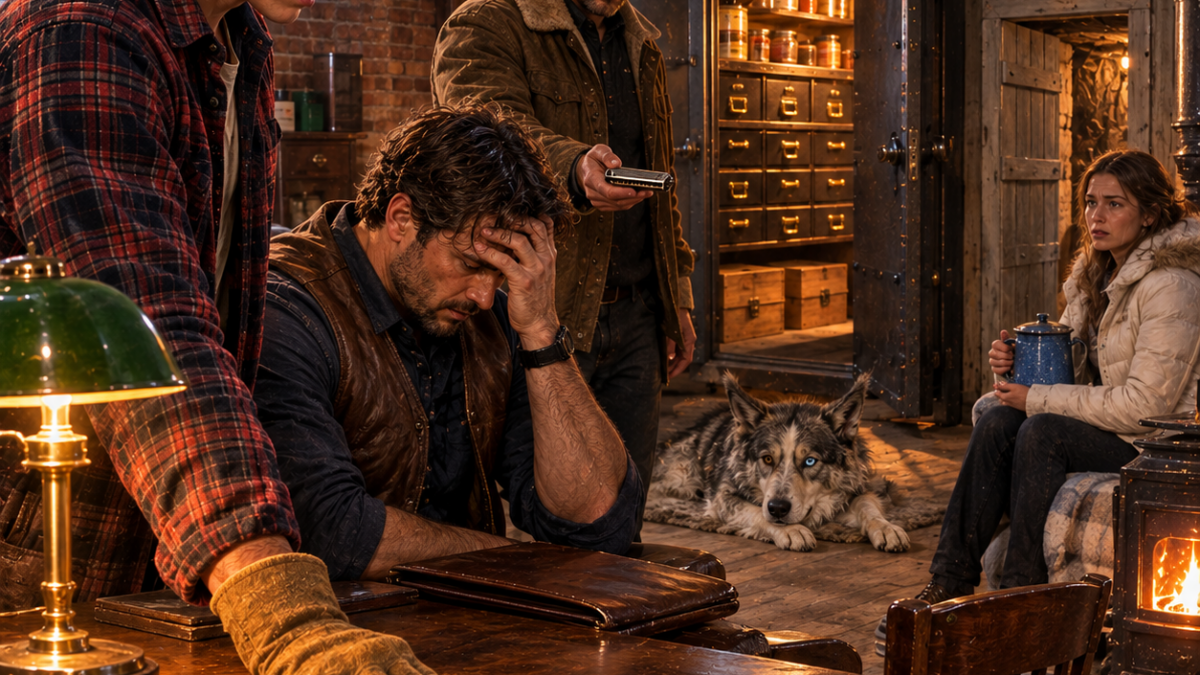
Inside, it was dark and dusted with snow that had blown through a broken window and at the far end, under the long bar, something gray was curled against the wall. A dog, a big one, or it had been, a rangy gray and white animal with a thick coat matted with ice and a broad wolfish face, the kind of dog that came down from Sled Stock somewhere back in its line.
It was thin. It lifted its head when he came close and he saw that its eyes did not match.
One was brown, one was the pale, startling blue of glacier ice. It did not growl.
It looked at him the way a man looks at the first stranger after a long walk, deciding. There was a frayed leather collar around its neck, no tag.
Hey, Cody said softly.
Hey buddy, somebody left you too, huh?
He had four strips of jerky left in his coat. He knew exactly what four strips of jerky were worth, 31 miles from town.
He crouched and held one out on his flat palm. The dog stretched its neck and took it so gently Cody barely felt the teeth.
He gave it a second, then a third. Then the dog stood up on unsteady legs and walked the length of the bar and leaned its whole weight against his knees and stayed there, breathing.
Cody put his hand on its head.
Under the ice, the fur was warm. All right, he said.
Come on then.
The dog followed him back across the street and into the mercantile and lay down in front of the stove as if it had lain there many times before and slept. Cody melted snow in a pan on the stove and gave it water.
He gave it the rest of the beans from the open can.
He sat beside it for a long time with his hand on its ribs, feeling them rise and fall, and for the first time since the lawyers office, he was not alone. The next day he spent surviving.
He found a handsaw under the counter and cut a fallen pine into stove lengths until his arms shook, the dog walking beside him the whole way. He melted snow, he rationed the beans, he counted his matches again three times, though he knew the number, seven.
He talked to the dog while he worked and the dog listened with its head on one side, which was more than anyone had done in a long while. That night, his third in Silver Load, the temperature fell to 19 below.
He woke around midnight with the stove gone low and the The standing beside the counter, stiff-legged, its hackles up along its spine and a low growl going in its chest.
It was staring at the back of the room, at the tall storeroom shelf that stood against the far wall behind the counter. What is it?
Cody whispered. He struck one of his last matches.
In its small light he saw the shelves.
Everyone had grown frost, thick and white. Everyone but the storeroom shelf.
That shelf was bare, dark, dry wood, not a crystal of frost on it from top to bottom in a room so cold his breath hung in front of his face.
And as he watched, before the match burned his fingers, the whole shelf trembled just slightly and the cans on it ticked against each other like teeth.
He dropped the match.
In the dark he put his hand out toward the shelf and he felt it, warm air breathing out between the shelf and the wall, slow and steady from somewhere behind it.
It smelled of kerosene and old brick and very faintly of pipe tobacco, the cherry kind his grandfather had smoked on the porch every evening of Codys life.
The dog whined and pushed its nose into the gap.
Cody got his fingers around the edge of the shelf.
He braced his boots on the frozen floor and he pulled and the whole shelf swung toward him on hidden hinges with a long, low groan.
And behind it there was a doorway in the wall and darkness and the warm breath of the mountain coming out of it.
The dog went first. It slipped past his legs and into the dark before he could catch its collar and he heard its nails clicking away on brick and then stop and then nothing.
Cody struck another match.
Behind the shelf was a passage, narrow and low, walled in old red brick on one side and raw gray rock on the other.
It ran maybe 20 ft. At the end of it he could see the edge of a doorway and the dogs tail waving slowly, the way a dogs tail waves when it has come home.
The air grew warmer with every step.
Inside the doorway, his fingers found a shelf and on it a flashlight. He clicked it on.
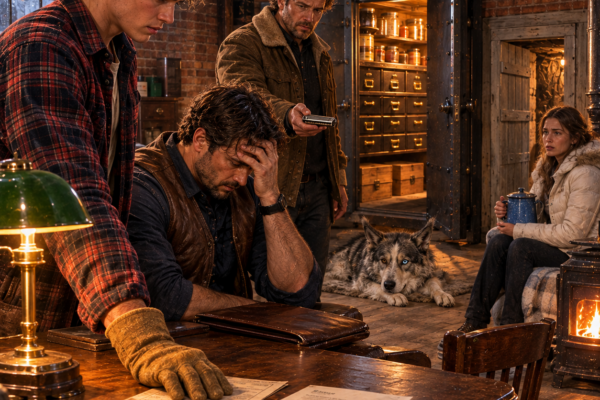
It was a room, a small square room with a tin ceiling and walls of the same red brick and a floor of wide pine boards worn pale by a great many years of boots.
A roll-top desk stood against one wall with a green shaded lamp on it.
Two iron cots stood against another, each made up tight with gray wool blankets and a pillow in a feed sack case.
There was a little wood stove in the corner with a stack of split pine beside it and above the stove, shelves, canned peaches and beef, coffee, oatmeal, four red cans of kerosene, candles, and an unopened bag of dog food. And in the back wall, beside the cots, was a door of heavy gray planks that did not belong to the bank at all.
It was set straight into the rock and warm air breathed through its cracks, steady and damp.
Cody knew what it was. Every child in Pine Notch knew the old silver mines held 50° in the dark all year round, a mine tunnel driven into the mountain from the back of the bank.
The mountain had been breathing into this room for 130 years.
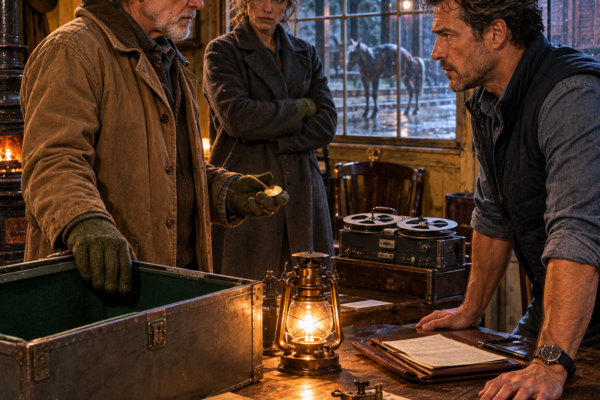
The flashlight beam swung across the far end of the room and stopped. The vault door filled the whole end wall, black steel, taller than he was, with a great brass dial and gold leaf lettering arched across the top, Silver Load Miners Bank, MD CCC, and carved into the brick beside it at the height of a tall mans eyes, cut deep with a cold chisel and rubbed black with stove soot so it would show were two lines in square capital letters.
A town isnt the buildings, its who you let in from the cold.
He knew that lettering.
His grandfather had cut it.
The dog had already found the stove.
It lay down on a braided rug in front of it, sighed, and put its chin on its paws, and looked up at Cody with its two different eyes, as if to ask what took him so long. Cody sat down slowly on the edge of a cot.
He found he could not stand up.
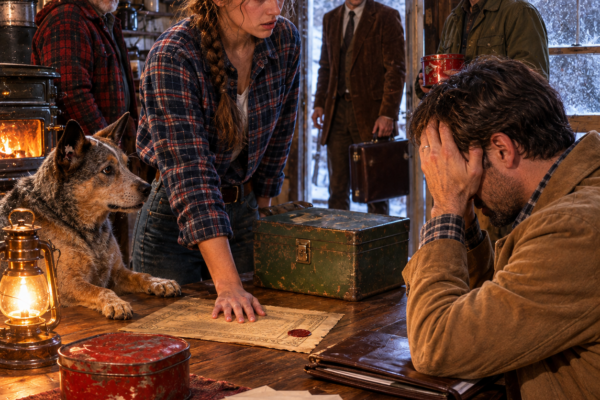
On the roll top desk, squared to the edge, lay a notebook, a plain black carving ledger with a pencil tied to its spine with bailing twine. The kind Gus had kept in his shirt pocket all Codys life.
On the cover, in pencil, it said Cody. Read in order.
He lit the lamp and opened it.
Cody, if you are reading this, I am gone, and somebody has finally brought you up here, or you came on your own. Either way, you found the shelf.
Good.
I knew you would.
You always did notice what the frost was doing.
I am going to tell you three things, and then I am going to tell you how to keep this room running, because I am a practical man, and you are a practical boy, and neither one of us likes a speech.
First thing, whatever your brothers told you or will tell you about why I took you in is wrong. I did not take you in out of pity.
I took you in because the day of your mother and fathers funeral, you stood in my kitchen and asked me if there was anything you could do to help, and you were twelve, and nobody else in that house had asked me that in twenty years. You were never the leftover Cody.
You were the one I saved for last, the way you saved the best part of the pie.
Cody stopped reading. He put the notebook down on his knee and looked at the vault door for a while.
Dalton had said it at fourteen at the supper table, while Gus was out checking calves.
Grandpa only keeps you around because he feels sorry for Cody.
Dont make it weird. And Cody had believed it for six years because Gus Hale did not say things.
He fixed things and fed things and left. He picked the notebook back up.
Second thing, this room was the back office of the bank.
The front fell in under the snow in 1952 before I ever saw the place.
When I bought the town, I found this office hole and the vault hole and the mine door behind them breathing warm air like a sleeping horse. I cut the passage through from the mercantile and built the shelf to hide it.
I have kept this room stocked for 50 years and never told anyone. A man needs one place in the world where nobody can find him and a boy needs to know there is one place in the world where he can always be found.
Third thing, your brothers will come up here looking for what I left you. Dalton most of all.
He knows there is something because he reads my mail.
Let him look. He will dig at the bank front because that is where a bank keeps its money and he will find rubble.
He will never think to look behind a shelf of canned peas.
Dalton never in his life looked behind anything. Now the practical part.
The stove draws better with the damper half shut. Kerosene is behind the cots.
Dont use more than one lamp at a time.
Water comes from the seep inside the mine door, 10 steps in on the left.
It is clean.
Do not go past the timber set with the red paint on it.
The tunnel beyond is not safe and I never fixed it. There is dog food on the shelf.
If there is a gray dog up here with one blue eye, he is yours.
I have been feeding him since July when he turned up thin as a rail.
I did not name him. I figured you would want to.
Leave the mine door open a hands width at night.
The mountain will keep you warm. It kept me warm for 50 winters.
That was the end of the first page.
Cody read it twice.
Then he closed the notebook on his finger and sat in the warm room, listening to the stove tick and the mountain breathe.
And he did a thing he had not done at the funeral or at the reading of the will or on the long drive up with his brothers hand on his shoulder.
He put his face in his hands and he let it come, the whole four months of it, all at once, while the dog got up off the rug and came and leaned against his shins and did not move. When it was done, he wiped his face on his sleeve and stood up because his grandfather had written him a list and a list was meant to be done.
He opened the mind door a hands width. Warm air rolled across the floor.
He stood in the warm draft a moment longer. Then he walked ten steps into the dark with the flashlight and found the seep, a thin silver thread of water running down the rock into a basin somebody had chiseled out to catch it.
And he filled a pan and carried it back and set it on the stove.
He measured dog food into a tin bowl that said no name on the side in Guss pencil. And the dog ate every piece and licked the bowl across the floor until it rang against the cot leg.
Then he went back through the passage to the mercantile where the little pot-bellied stove had gone out and the frost was growing on the shelves again. And he carried his duffel and the paper sack of markdown cans back through the gap and swung the storeroom shelf shut behind him.
It moved like a door in a good house.
The hinges had been oiled. He sat down at the roll-top desk with the lamp beside him and turned to the second page.
The second page was not a letter. It was a list of dates.
One line for every year since Cody turned twelve, and beside each year, a few words in pencil. Year one, he asked to help.
I let him drive the feed truck in the pasture.
He did not hit anything. Year two, the blizzard.
Three days. I would not be writing this if not for him.
Year three, he fixed the windmill pump himself. Did not ask anybody.
Did not tell anybody.
I saw the new leathers.
Year four, Dalton told him he was not college material. He believed it.
I should have said something. I did not.
That is on me. Year five, he bought me a new harmonica for my birthday with feed lot money and pretended it was from the feed store raffle.
I knew.
I let him think I didnt. Year six, he sat with me every night of the hospital week.
Read me the cattle report out loud so I could sleep. Never once looked at his phone.
Year seven, I am tired and I have not told him where any of this is and I am running out of years to do it.
Year eight was blank.
Cody sat at the desk with his finger on the empty line for a long time. He remembered the harmonica.
He had paid sixty-two dollars for it at a music store down in the valley and told Gus he had won it in a raffle at the feed store because Gus Hale would never in this world have accepted a sixty-two dollar present from a boy who made eleven dollars an hour.
Gus had looked at it and turned it over in his big cracked hands and put it to his mouth and played four bars of a song Cody did not know and said, Well, Ill be lucky ticket.
And carried it in his shirt pocket every day after that, right up until the last one.
The harmonica that Dalton had picked up off the kitchen table the night of the funeral and put in his own pocket.
Ill keep it safe, Cody.
He remembered the blizzard too.
Year two, he had been thirteen. He sat back in the old desk chair and let himself look around the room properly for the first time.
On the wall above the desk hung a calendar from the Pine Notch Feed Store, still turned to the September Gus died. Beside it, tacked up with a horseshoe nail, was a photograph Cody had never seen.
A tall old man and a skinny thirteen year old boy, both in sheepskin coats, standing in front of the ranch barn in deep snow. The boy was grinning.
The old man was not looking at the camera. He was looking at the boy.
He pulled open the top drawer of the roll top desk, pencils, a pocket tally book, a tin of cherry pipe tobacco, half full, and underneath them a stack of long white envelopes, all addressed to Augustus Hale at the ranch, all opened neatly along the top with a knife, all empty. Everyone carried the same return address, printed in blue in the corner, Powder Ridge Resorts, Shareholder Services.
There were forty or fifty of them.
The oldest had yellowed to the color of weak tea. The newest was dated last spring.
Cody turned one over in his hands.
Powder Ridge was the big ski resort on the other side of the range, the one with the gondola and the lodge with the glass front and the parking lot full of out of state plates every winter. He had never in his life heard his grandfather say its name, our shareholder.
He did not know what that meant to a man who drove a 1990 pickup and darned his own socks. He put the envelopes back exactly as he had found them.
He turned to the third page.
It was short, three lines in a hand that had begun to shake. Everything else is in the vault.
The combination is the three days you saved me. Youll know it when you remember it.
I never once forgot. Cody looked up at the great black door across the room, at the brass dial its hundred tiny numbers glinting in the lamplight, and he tried to remember the blizzard, the actual days of it.
He remembered the snow, he remembered the barn and the cold and the sound his grandfather had made. He remembered the fear.
He did not remember the dates, not one of them.
The dog lifted its head off the rug and looked at the vault and then at him and thumped its tail once on the floor as if it had all the time in the world to wait.
He slept that night on one of his grandfathers cots, under his grandfathers blankets, with the mine door open a hands width and the mountain breathing warm air across the floor, and the gray dog curled against the backs of his knees. He did not wake once.
It was the first full nights sleep he had had since September. In the morning he went through the passage to the mercantile to see what the weather was doing.
He had just swung the shelf shut behind him when he heard the engine. It was not the plow truck.
It was higher and thinner, a whining, sawing sound coming up the switchbacks, and it grew until it filled the street. Cody went to the frosted window and scraped a hole in it with his thumbnail and looked out.
A snowmobile came around the last bend, towing a little sled behind it, and stopped in front of the mercantile in a spray of powder.
The rider swung a leg off and pulled off a helmet.
A short, sturdy woman of about 60 in a red barn coat with cropped gray hair and a stethoscope around her neck. She looked at the smoke coming out of the mercantile chimney.
She looked at the trail Cody had broken across the street to the saloon. Then she looked straight at the hole in the frosted window and at his eye behind it and put her hands on her hips.
Well, she called, youre either a lost hunter or youre the grandson.
And a hunter would have had the sense to stay in the saloon where theres a bar. Cody opened the door.
The gray dog shot past his legs down the porch steps and across the snow and threw himself against the womans knees so hard she staggered and she laughed out loud and caught his big wolfish head in both her mittens. Nickel, she said, you fool.
Look at you.
You found him. Nickel, Cody said, thats whats on his chart.
She came up the steps with the dog plastered to her side and held out a mittened hand.
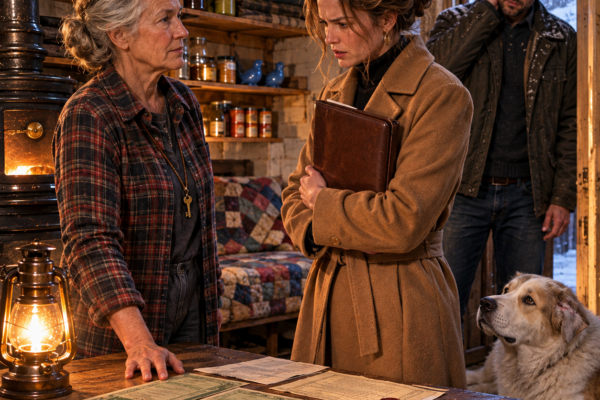
June Pettybone, Im the vet in Pine Notch.
Youd be Cody. He shook her hand.
How do you know? Because your grandfather showed me your picture about 40 times.
She looked him over, the stubble and the dirty coat and the red hands and something in her face settled as if she had made up her mind about him and was not going to tell him what shed decided.
Let me guess.
Your brother drove you up here and left you with a sack of groceries and a lecture. Cody said nothing.
That was answer enough. June Pettybone did not ask anything else.
She went back to her sled, unstrapped a bundle of split pine and a sack of dog food and a cardboard box and carried them into the mercantile without being asked and set them by the cold stove. In the box were a loaf of bread, a pound of butter in wax paper, a dozen eggs packed in a coffee can of oats, two oranges and a thermos.
Coffee, she said, drink it while its hot.
Then well talk about the wood. He drank it standing at the counter and it was the best thing he had ever tasted.
You stacked that wood, he said, by the stove.
It was fresh cut. Every two weeks since September and the dog food in the bank.
She saw his face change and nodded. I know about the shelf.
Im the only one who does now. Gus made me promise.
He came into the clinic in July carrying this one under his arm like a sack of feed, all ribs and burrs.
Hed found him up here eating snow behind the livery. He paid for the shots in nickels out of a pickle jar.
Said that was all the change he had on him, and I said thats all right, Gus.
Ill put him down as nickel.
And he looked at me like Id hung the moon.
She shook her head. He never did name him.
Said that was for you. Cody looked at the dog lying in front of the dead stove with his chin on his paws, watching them both with one blue eye and one brown.
Nickel, he said.
The dogs tail thumped once on the floor. Hes been coming back here every day since September, June said.
I took him down to the clinic twice. Both times he slipped his collar and walked the 31 miles back up the mountain.
Second time it took him four days.
I figured out he wasnt waiting for me. She looked at Cody.
Gus asked me, the last time I saw him, to keep the wood stacked and the dog fed until you came. I said, Gus, what if he doesnt come?
And he said, hell come. Theyll send him up here thinking its a punishment.
Dalton will see to that. Cody set down the cup.
He knew, he said.
He knew Dalton would do this. Your grandfather, June Pettibone said, knew a great deal more than he ever let on.
It was the most aggravating thing about him.
She held out her hand.
Youll muck my kennels Saturday. Thats for the coffee and the wood and the eggs.
Were square, and I dont want to hear another word about it. Now get your coat.
Youre coming down to town.
I cant leave him.
Hes coming too. He rides in the sled.
He loves it. He did.
The big dog climbed into the little sled behind the snowmobile and sat bolt upright like a passenger on a train. And Cody climbed on behind June Pettibone and held on.
And they went down the mountain in a long white roar.
31 miles of switchbacks and pine and then open country, with the sky clearing blue above them and the cold so sharp it made his teeth ache.
Pine Notch was one long street of log and brick storefronts under the peaks, with snowbanks higher than the parked pickups, a cafe with steamed windows, a feed store, a hardware store, the vet clinic in an old white house at the end of the block with a sign that said Pettybone Animal Hospital and a smaller sign under it that said, Pay what you can, ask me. June parked behind the clinic and took them in the back door and sat Cody down at her kitchen table and made him eggs and toast and bacon, a lot of it, and did not watch him eat.
He told me about the blizzard, she said, while he ate, the one that shut the county down. Youd have been 13.
Cody looked up.
He fell on the ice by the barn, going out to check the heifers, June said. Couldnt get up.
The phone lines were down and the road was gone and your brothers were away at a stock show in the city with your uncles family.
It was you and him and three days of wind. He told me you got him into the tack room on a calf sled, that you kept the little stove in there going for three days and nights straight and fed him and talked to him and didnt sleep and every time he told you to go to the house and leave him, you said, No, sir, and put another stick on.
She shook her head.
He said that was the week he understood hed been wrong about something for a very long time.
Cody remembered the tack room, the smell of leather and liniment and smoke, the sound the wind made in the barn eaves for three days without stopping. His grandfathers voice, low and rough, telling him stories about Silver Load he had not understood at the time and had forgotten afterward.
He remembered being so tired the walls moved.
He did not remember what day it had started or what day the plow finally came. It had been January.
That was all. A long white smear of January.
I dont remember much of it, he said. No, June said.
I dont suppose you would. He remembered all of it.
Then she told him about Guss folly. Everybody in the countys got a theory, she said.
Some said he had a girl up there.
Some said he was hiding from the tax man. Some said he was looking for the old silver vein the company never found.
50 years he drove up there, twice a month, every month, and came back down with nothing in the truck and never said a word.
The hail boys used to joke he was building himself a coffin.
She poured him more coffee. Your brother Dalton went up there himself in October, after the funeral.
Took a backhoe on a flatbed, dug out the whole front of the old bank, spent three days at it, and came back down with nothing but a cracked hydraulic line and a bad temper.
He was looking for the vault, Cody said. June Pettybones eyebrows went up.
She did not ask how he knew.
He was looking for something, she said. Hes been looking for something since about August.
Thats when the bank in Sheridan Falls called his feedlot loan.
Cody put down his fork. I dont spread talk, June said.
Im only telling you what this whole town already knows, so you hear it from somebody who isnt enjoying it.
 [Tap here for the Next Part ]