Part 3: All Grandpa Left Her Was a $1 Sheep Ranch, Until the Old Dog Led Her to the Well…
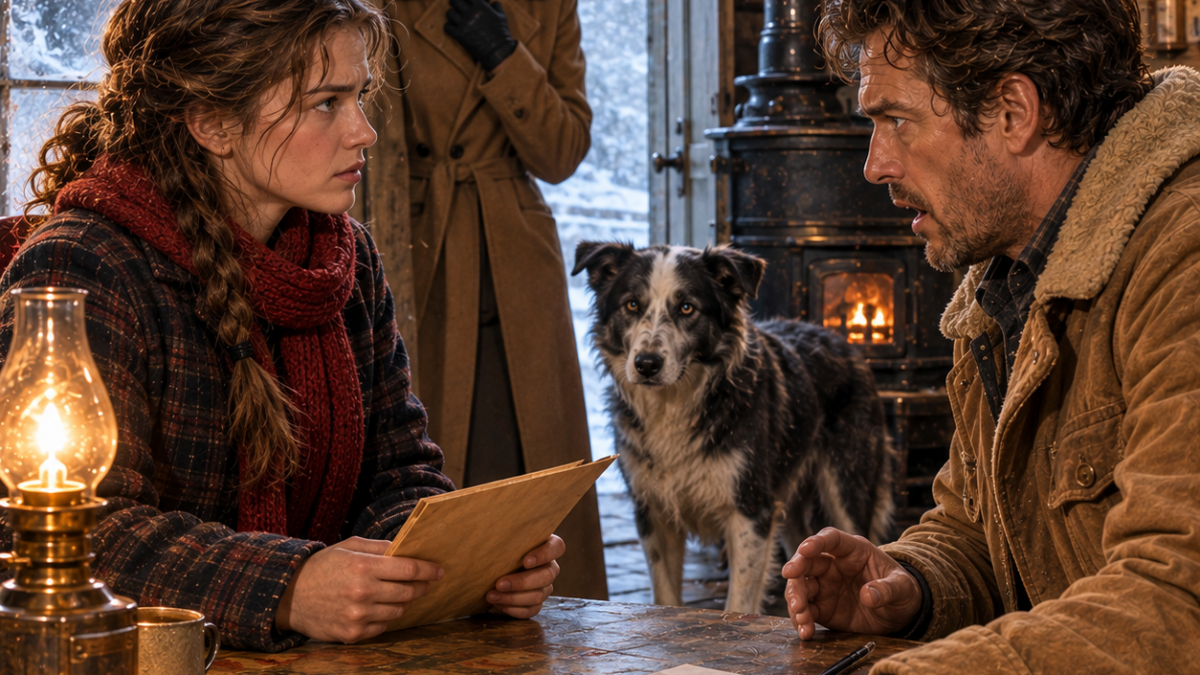
The thermometer read 48 degrees. Within an hour, it read 60.
Nobody said much at first. Maisie heated the two cans of soup on the stove and split them three ways in tin cups and gave Tuck the heel of a biscuit from Ozzies sack.
Her mother sat on the edge of the cot with her coat still buttoned, holding the cup in both hands and looking around her like someone walking into a church she had not known was there.
Curtis did not sit.
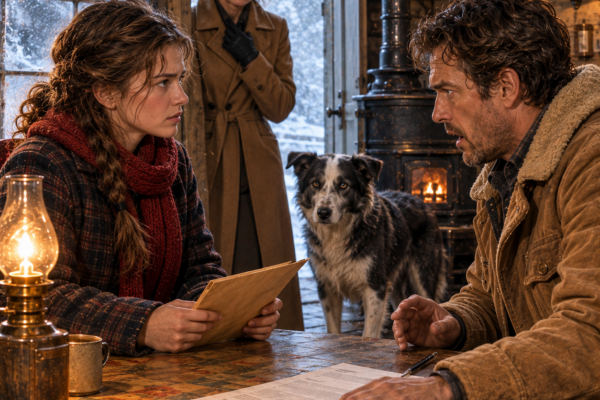
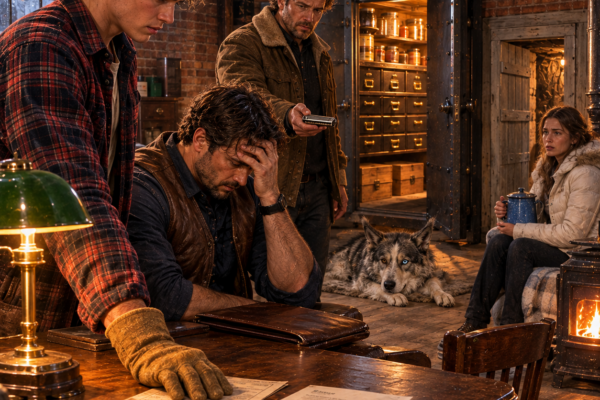
He walked the room slowly, the way he had walked lots and yards all his life, sizing things up. He looked up at the words cut into the lintel over the door, and then he stopped at the far wall, at the back of the room where the lamplight did not quite reach, and stood there for a long time.
Tacked to the railroad ties in neat rows were newspaper clippings, yellowed and curled at the corners. Every one of them was from the Hartsel Paper, the middle school honor roll, with one name underlined twice in pencil.
A photograph of the girls cross country team, third place at district, with a small pencil arrow pointing at the end of the second row. Her high school graduation list, four columns of names and one of them circled, and at the very end, cut from the classified page, a small advertisement for the truck stop cafe on the south of Hartsel with a grainy photograph of a waitress refilling a coffee cup at the counter.
The waitresss face was turned half away, but it was her. Curtis stood looking at that wall for a long time.
He kept all of it, he said at last. He did not turn around.
Seventy miles away, every bit of it. It was her mother who moved first.
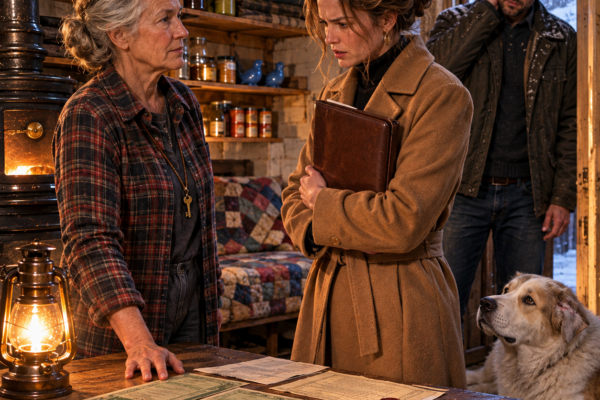
She set her cup down on the floor beside the cot. Then she opened her camel coat and reached into the inside pocket and took out two things and held them in her lap.
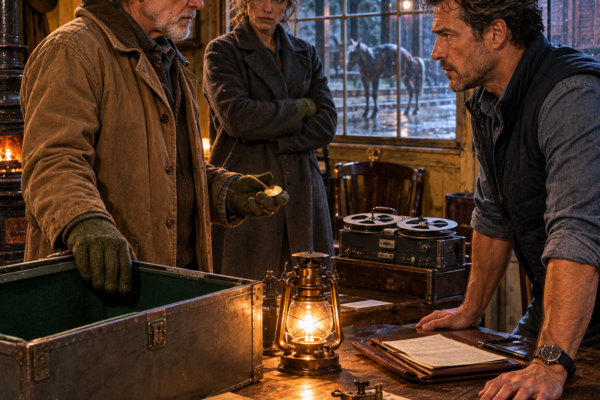
The first was a small brass compass.
Maisie could not breathe. He gave it to me Tuesday night, her mother said.
She did not look at Curtis. She looked at the compass.
He told me to take it to the pawn shop in Ridley. I put it in my coat instead and told him Id done it.
She held it out. Im sorry.
Im sorry it took this long to give back. Maisie took it.
It was warm from her mothers body. She opened the lid and tilted it to the lamp and there were the words, true north, and the needle swung once and settled.
Theres something else, her mother said. Her voice had begun to shake.
She held out the second thing. It was a small box wrapped in brown paper that had gone soft and creased with handling.
And on the paper, in a hard slanting pencil hand, was written Maisie, 16.
He left it on the step, Joanne said, the day he came.
Curtis threw it in the trash can by the garage. I took it out that night after everybody was asleep and I hid it in the bottom of my sewing basket and I never opened it.
Ive kept it three years.
She pressed her lips together hard.
I should have said something in that truck on Tuesday. I should have said something three years ago.
Im not asking you to forget that I didnt. Maisie took the box in both hands.
Curtis had turned around now and was looking at his wife as if he had never seen her before. She untied the string.
Inside the brown paper was a small cardboard box, and inside the box, on a square of cotton wool, lay a silver dollar. It was old and heavy and worn soft at the rim, and the date on it was 1921.
Under it was a folded slip of paper. When you are grown, they will tell you the wolf place is not worth a dollar.
Here is your first one from it. Keep it and remember they were wrong.
Maisie sat on the dirt floor of her grandfathers room with the compass in one hand and the silver dollar in the other.
And for a long time she did not say anything at all. Then she reached out and took her mothers hand.
She did not say it was all right.
It was not all right, and they both knew it.
But she held on, and her mother held on back, and that was as far as either of them could go that night.
It was a door left open. It was not yet a door walked through.
The storm blew for 19 hours.
They slept by turns. Tuck stretched across the doorway as if he had been told to guard it.
At 10:00 on Sunday morning, Maisie heard an engine and then a voice bellowing her name down the shaft.
She climbed up into blinding sunlight, and a world scoured smooth and white. And there was Ozzie Barnhart on the seat of a tractor with a plow blade on the front.
And behind him on a second tractor, Bud Hadley.
I told you to call me, Ozzie said.
His voice was rough. He did not let go of her shoulder for some time.
They pulled Curtiss pickup out of the drift at the gate. Curtis drove her mother home that afternoon without another word.
In the weeks that followed, the rest of it came out slowly. Highlines attorney spoke to Ruth Ellery and then to Curtis.
And in February, Curtis sold one of his last two trucks and paid back their $20,000. In March, an envelope came to Ruths office with Maisies name on it and $2,300 inside in twenties and no note.
Highline came to Maisie directly after that and offered $3,800,000 for her water. She told them it was not for sale.
Instead, with Ruths help, she signed leases with three neighboring ranchers, Bud Hadley among them, to use part of her water in the dry years at a fair price, and she kept the rest the way her grandfather had kept it. The leases were enough, enough for a new stovepipe and a new elbow, enough for a man from Garnet Flats to climb the windmill and put new bearings in its wheel so that by April it was turning again, creaking and steady in the spring wind, enough for 40 ewes in the lambing pens, the first sheep on Wolf Cooley in six years.
She tried to pay Aussies tab in April. He took the folded check, looked at it, tore it in half, and put both halves in his coveralls pocket.
Abels tab, he said, not yours.
Yours hasnt even started. Her mother wrote in March, then again in April.
In May she drove out alone in her own small car and sat on the porch steps for an afternoon and watched the lambs and did not say very much, and Maisie let her. When she left, Maisie stood on the porch and watched her go, and this time, at the bottom of the rise, her mothers car slowed and stopped, and the window came down, and a hand came out and waved.
The first hard snow of the next winter came on the 6th of January, a year to the day. Maisie was splitting wood by the shearing shed in the late afternoon with smoke going up from the forge chimney because she kept the room under the well warm all winter now, the way her grandfather had.
She was 20. Her fathers compass was in her jacket pocket.
On the kitchen window sill, where the light came through in the mornings, sat a silver dollar from 1921. Tuck lifted his head first.
He was 12 now, gray all the way up to his ears, but heavier, his coat thick and shining. He had been lying on the well lid where frost never settled.
He stood up and looked south down the ranch track. Someone was walking up it.
It was an old man, tall and stooped, in a thin brown corduroy jacket that was no match for the wind. He carried a battered tan suitcase in one hand and a plastic grocery bag in the other, and he walked the way people walk when they have been walking a long time and are no longer sure why.
He stopped at the edge of the yard when he saw her and stood there as if he were waiting to be told to leave.
Tuck went down the track to meet him, not running, walking straight with his tail swinging low, the way he had once walked across this same yard to Aussie Barnhardt. Maisie set down the axe.
His name was Ansel Ruiz, he said when he could say anything. He was 71 years old.
His car had slid off the county road 6 miles back.
3 days ago, his daughters husband had told him there was no more room in the house.
He had seen the smoke from the road and thought there might be someone who would let him sit by a stove for an hour.
She did not ask him any questions. She took the suitcase out of his hand.
She brought him inside and sat him by the cook stove, which drew clean and hot now through its new pipe, and put coffee from the blue tin in his hands and a plate of ham and biscuits in front of him and wound a red wool scarf twice around his neck.
When he tried to tell her he could pay her back someday, she shook her head.
My grandfather had a saying, she said, keep a little back in the dry years because somebody always comes thirsty.
He kept a little back for me. This year, I guess youre the somebody.
Ansel Ruiz looked at her for a long moment over the rim of the cup.
Then he looked down, and his shoulders shook once, and he did not try to say anything else. Later, when he was asleep in the back bedroom with Tuck across the doorway, Maisie went back up and stood on the porch in the falling snow.
The ranch track ran away south between the drifts, the same track where, one year before, two red tail lights had grown small and disappeared without once looking back.
There were tracks on it now, a single line of footprints filling slowly with snow. They were not going away.
They were coming toward the house.
Maisie stood on her grandfathers porch with her hand closed around her fathers compass, and the needle inside it pointed where it always had, and she watched the snow come down on Wolf Cooley until the last of the light was gone.
Somewhere under her feet, the well was breathing. It always would.