A Navy SEAL Ducked In for Coffee… Then Froze When He Heard a Familiar Voice Behind the Counter
THE LETTER UNDER THE PIE CASE
The first thing I noticed about Luke Mercer was that he still drank his coffee black.
The second was that he still looked at a room as if he were counting every exit.
The third was that, after fourteen years, my heart apparently had not learned a single useful thing about him.
“Coffee?”
He stood at the counter wearing a faded gray T-shirt, jeans, and a pair of boots that looked as though they had crossed half the country. His hair was shorter than I remembered, his shoulders broader, and there were lines at the corners of his eyes that hadn’t been there when we were twenty.
“Black, thanks. I’ve only got a five on me.”
“Then it’s a five-dollar cup.”
He gave me a faint smile.
“Inflation?”
“Survival.”
I poured the coffee.
A regular customer at the end of the counter raised his mug. “Bless you, honey. Thank you.”
“Don’t thank me, sugar. Thank the cook.”
The man laughed. Luke didn’t.
He was looking at me.
Nobody said that anymore. Not since my father died. It was one of those little sayings Frank Dawson had carried around for so long that it had practically become part of the restaurant. Dad used to say it whenever someone complimented the food, even if he had been the one standing over the stove for twelve hours.
I set the coffee down.
“Claire Dawson,” I said.
“Luke Mercer.”
“I know who you are.”
“I was hoping you might.”
For a few seconds, we just stood there.
Then I noticed the small scar near his jaw. I wondered where he’d gotten it. I wondered how many other things had happened to him that I would never know about.
“Fourteen years, buddy,” I said at last.
“Fourteen.”
“Did you save me the last slice?”
He glanced toward the pie case.
“Wouldn’t be a proper visit without asking.”
“Homework first. Refill before you go back out in that.”
I looked toward the windows. Rain had started falling over Laurel Vale, turning the parking lot into a dark mirror.
Luke wrapped both hands around his coffee.
“You’re still here.”
“Someone has to keep the lights on.”
“Your dad would be proud.”
I looked away before he could see what that did to me.
“Luke?”
He turned.
“You’re still in the Navy?”
“Still Navy. SEAL team out of Virginia Beach.”
“And you’re in Laurel Vale because…”
“Two weeks of leave. A buddy has a cabin up the mountain.”
“Two weeks.”
“That’s what I was given.”
I nodded as though that information meant nothing.
It meant everything.
Two weeks was long enough to remember someone. It wasn’t long enough to find out what fourteen years had done to them.
Before I could answer, a voice came from the kitchen.
“Claire, I need you.”
“Take your break, Rose. Ten minutes.”
Rose appeared in the doorway, took one look at Luke, and stopped.
“Well,” she said. “I’ll be.”
“Rose.”
“I said ten minutes, not ten years.”
She disappeared before I could throw a dish towel at her.
Luke smiled into his coffee.
“Some things don’t change.”
“More than you’d think.”
He took a sip.
“Still terrible.”
I blinked.
“What?”
“The coffee. It’s terrible.”
“That’s Rose’s coffee.”
“I know.”
I shook my head.
“You used to complain about it every Tuesday.”
“And every Tuesday your dad told me to make it myself.”
“He said you burned the hash browns.”
“Once.”
“Every Tuesday.”
Luke laughed.
It was an easy sound. Familiar enough to hurt.
I reached for the coffee pot, mostly to give my hands something to do.
“How long have you been back?”
“Four days.”
“Four days?”
“Four days you’ve come in for the same black coffee.”
“You’re keeping track?”
“You’re difficult to forget.”
I hated how quickly my heart responded.
I hated it even more because I had spent fourteen years convincing myself I no longer cared.
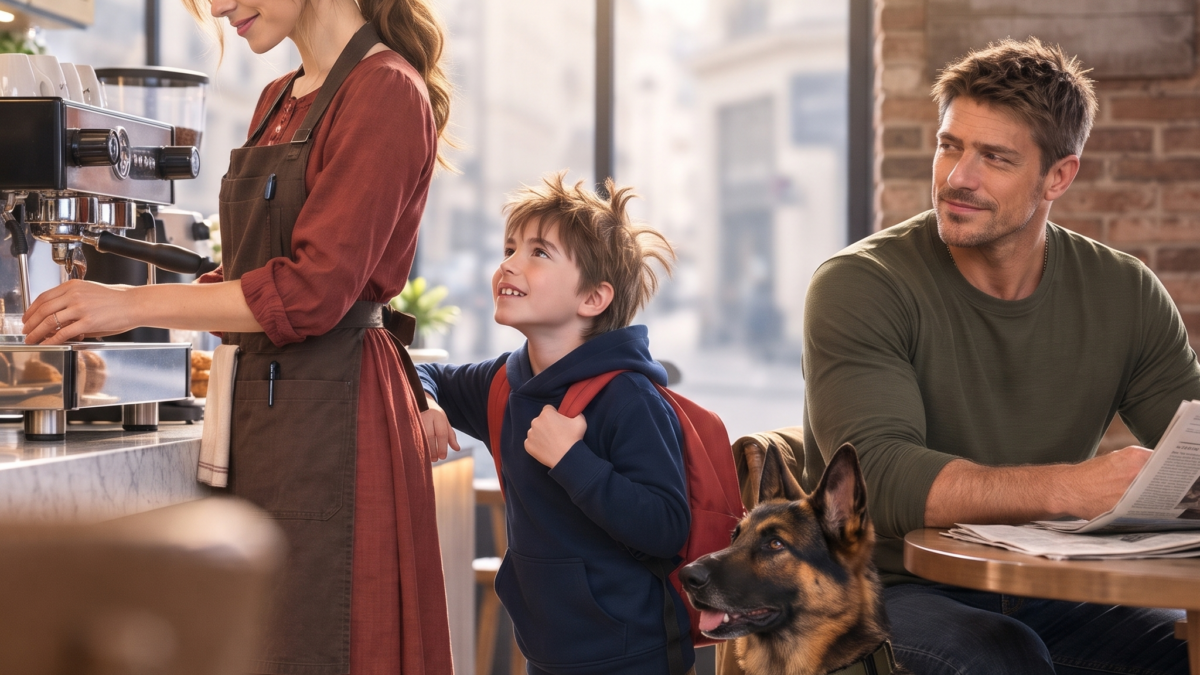
The door opened behind him, and a boy came rushing through the rain with a baseball glove tucked under his arm.
“Aunt Claire!”
“Easy, Toby. You’re dripping on my floor.”
He stopped at the counter and looked at Luke.
Then he looked at the dog sitting quietly beside his chair.
“Can I pet him?”
“Ask first.”
Luke crouched beside the dog.
“This is Atlas. Let him smell your hand first. Keep it low, like this. Let him come to you.”
Toby followed his instructions. Atlas sniffed his fingers, then pushed his nose against the boy’s palm.
“He’s huge.”
“He’s friendly.”
“Is he a police dog?”
“Used to be. He went to school for it, but they sent him home.”
“Why?”
“Too friendly. Apparently, he’d rather lick a bad guy than chase him.”
Toby grinned.
“That’s my kind of dog.”
“Mine too.”
I folded my arms.
“Luke, this is my nephew, Toby. He’s been with me three years.”
“Your nephew?”
“He’s Danny’s boy.”
Luke’s smile faded.
“Danny?”
I nodded.
“Three winters ago. Black ice on Highway 221. He lost control coming down the hill.”
Luke looked toward the window.
“I worked that grill beside him for five years.”
“I know.”
For a moment, I saw the young man who used to sit beside my brother after closing, listening to Danny complain about the local baseball team and arguing about whether a perfect breakfast required sausage or bacon.
“I’m sorry, Claire.”
“Thank you.”
“How old is Toby?”
“Ten.”
Toby had already decided Atlas was his new best friend. He was scratching behind the dog’s ears and talking to him as if they had known each other for years.
Luke watched them.
“He’s a good-looking kid.”
“He gets that from his father.”
“Does he play ball?”
“Every chance he gets.”
Toby looked up.
“I pitch.”
“Sometimes,” I corrected.
“Most of the time.”
“Your control would improve if you stopped trying to throw every pitch through the backstop.”
Luke smiled.
“Got an arm, kid?”
Toby straightened.
“I do.”
“Maybe I’ll see it sometime.”
“You should.”
“That’s settled, then.”
I looked at Luke.
He looked at me.
Neither of us said what we were thinking.
Fourteen years ago, there had been a whole life we expected to have.
Now there was a boy, a dog, a diner, and a man who had returned with two weeks of leave.
I wondered whether that was enough to make a beginning.
I wondered whether it was enough to survive another goodbye.
My father used to say that a diner was a place where people came to eat, but they stayed because somebody remembered their names.
Dawson’s Grill had been doing that for almost sixty years.
The building sat at the bend of Laurel Vale’s main road, between an old hardware store and a pharmacy that had changed owners so many times nobody remembered the original name. The sign above the entrance still showed a red coffee cup with a little white line of steam curling over it. The paint was peeling, the neon letters flickered in winter, and the front door had a habit of sticking whenever it rained.
Dad had refused to replace it.
“People know how to open this door,” he’d say whenever I suggested fixing it.
The truth was that Dad hated spending money on anything that wasn’t going into the kitchen.
He had bought the place when I was six and spent the rest of his life building it into the center of town. Farmers came in before sunrise. Schoolteachers stopped after work. Truck drivers knew which table had the best view of the road. People who had nowhere else to go could sit at the counter and order a cup of coffee for an hour without anyone asking them to leave.
My brother Danny had worked beside him for years.
And Luke had been part of the place, too.
He was seventeen when he first walked in looking for work. Dad hired him because he could lift a flour sack and didn’t complain when the kitchen got hot.
He learned to flip eggs, operate the grill, and make pie crusts without turning them into cardboard. He was terrible at washing dishes, too impatient to scrub anything properly, but Dad kept him around because he could make customers laugh.
For two years, Dad called him “the boy.”
Luke complained about it constantly.
“What’s it going to take to get you to call me by my name?” he asked once.
Dad slid a plate of hash browns across the counter.
“Earn it.”
“I work six days a week.”
“Seven, if you’re counting the days you burned breakfast.”
“I didn’t burn breakfast.”
“You burned it on Monday.”
“That was one skillet.”
“Then Tuesday.”
“That was the wrong pan.”
“And Wednesday.”
“That was a misunderstanding.”
Dad looked at me.
“You hear this nonsense?”
I laughed.
Luke shook his head.
“One day, Frank Dawson, I’m going to own a restaurant just to fire you.”
Dad pointed the spatula at him.
“First, learn to cook.”
Luke never did own a restaurant.
Instead, he enlisted in the Navy.
I didn’t know that was what he planned to do until the day he left.
Or, more accurately, I didn’t know he was leaving until years later, when the truth finally found its way to me.
Back then, I thought we were building a life.
We weren’t officially a couple. We had never sat down and decided what to call ourselves. We simply spent every spare minute together.
After closing, Luke and I did the books on Tuesdays. We divided the leftover pie and drank coffee that Dad had forgotten to turn off. Sometimes we sat on the hood of his truck and watched the town go dark.
He told me he wanted to see the world.
I told him I wanted to keep the diner.
He said we could do both.
I believed him.
He was twenty-one when the Navy gave him his training date. He told my father that afternoon and planned to tell me after work.
But that evening, Dad collapsed.
I was the one who found him.
One moment he was standing near the grill, complaining about the new refrigerator. The next, he was on the floor, one hand still holding a kitchen towel.
The ambulance took him to Ashworth Medical Center.
I went with him.
My phone disappeared somewhere between the emergency room and the waiting area. I didn’t realize it was missing until hours later. By then, Dad had suffered a severe stroke, and my attention had narrowed to doctors, tests, and the terrible uncertainty of whether my father would ever speak again.
I bought a new phone.
I had lost every number on the old one.
Luke’s number was among them.
The diner stayed closed for six weeks.
When we reopened, I was so exhausted that the only thing I could remember clearly was Dad’s voice before the stroke. He had asked whether I had ordered more flour. He had complained about the weather. He had told me to remind Luke not to leave wet towels beside the freezer.
Then he couldn’t form a complete sentence.
He died in November.
Luke had called during those weeks, but the diner phone rang in an empty building. He had tried my apartment, but I had moved temporarily to stay with my aunt. He had no new number for me.
I never received his call.
He never received mine.
And neither of us knew the other was trying.
I learned months later that Luke had gone to the Navy. A woman at the post office mentioned seeing his name on a letter that had been returned from Great Lakes. She thought I might want to know.
By then, I had already decided that he had left without saying goodbye.
It was easier than admitting that I had no idea why he had disappeared.
I never went looking for him.
Not because I didn’t care.
Because I believed I had already been given my answer.
Luke came back to Dawson’s every morning.
Sometimes he sat at the counter. Sometimes he took his coffee to the booth near the front window, where he could watch the road. He never asked for anything complicated. Black coffee, a slice of pie if there was any left, and occasionally a grilled sandwich when he had missed breakfast.
Atlas liked him.
Toby adored him.
And I had no idea what to do with either fact.
On his fifth morning, Toby came into the diner carrying his baseball glove.
“Is he here?”
I looked toward the window.
Luke was sitting in his usual booth.
“Who?”
Toby gave me a look.
“Aunt Claire.”
“What?”
“You know who.”
I lowered my voice.
“You’re not supposed to bother customers.”
“I’m not bothering him. I’m asking him if he can throw.”
“Then ask after he finishes his coffee.”
Toby headed toward the booth.
Luke saw him coming and put down his mug.
“Morning, champ.”
“Do you want to play catch?”
“Right now?”
“We have ten minutes before school.”
Luke looked at me.
I pretended to be interested in the register.
“Your aunt says you’re not allowed to bother customers,” he said.
“I’m not bothering you.”
“Fair point.”
He stood.
“Five throws.”
“Ten.”
“Seven.”
“Eight.”
“Deal.”
They went outside.
I watched through the front window as Luke took the glove from Toby and tossed the ball lightly between them. He adjusted the boy’s grip, pointed to his elbow, and showed him how to keep his shoulders aligned.
Toby listened.
He didn’t always listen to me.
He listened to Luke.
After a few minutes, Luke stepped back.
“All right. Show me.”
Toby threw.
The ball sailed wide.
Luke caught it, walked over, and spoke to him quietly. Then he returned to his spot.
Toby tried again.
This time the ball landed in Luke’s glove.
The boy threw both arms into the air.
“Did you see that?”
“I saw it.”
“Did I tell you I had an arm?”
“You did.”
“Do you believe me now?”
“Starting to.”
I smiled before I could stop myself.
Atlas sat beside the door, tail thumping against the concrete.
For a moment, the scene looked so ordinary that I could almost believe Luke had never left.
Then he glanced through the glass and caught me watching.
The feeling vanished.
He returned the ball to Toby and came inside.
“He’s got potential,” he said.
“He has enthusiasm.”
“That counts.”
“Not when he’s aiming at my windows.”
Luke leaned against the counter.
“How’s the diner doing?”
“Fine.”
He looked at the ceiling.
A small water stain marked the corner above the kitchen entrance.
“Fine?”
“Good enough.”
He glanced at the pie case.
Its compressor had started making an unpleasant rattling sound the previous summer. One side of the case leaned slightly, and the refrigeration unit struggled to maintain a stable temperature.
“Still haven’t fixed that?”
“I’m getting around to it.”
“That’s what you said last time.”
“Last time was fourteen years ago.”
His expression softened.
“Yeah.”
I busied myself with a receipt.
He looked around the restaurant.
“What about the roof?”
“Still a roof.”
“That’s not what I asked.”
“It’s been patched.”
“How many times?”
“Luke.”
“Claire.”
I looked up.
He wasn’t smiling.
“You’re having trouble keeping up with it,” he said.
“I’m keeping up.”
“With what? The roof, the wiring, the compressor, the plumbing?”
I folded my arms.
“Are you inspecting my restaurant?”
“Just looking.”
“Well, stop.”
He held up both hands.
“All right.”
The bell over the door rang, and an elderly woman came in.
Luke stepped aside to let her pass.
She looked at him, then at me.
“Isn’t that the Mercer boy?”
“That’s him.”
She smiled.
“Lord, look at you. Still alive.”
“Doing my best, Mrs. Bailey.”
She ordered eggs and sat near the window.
Luke finished his coffee.
“See you tomorrow?”
I shouldn’t have asked.
He shouldn’t have smiled.
But he did.
“If you’re here.”
“I own the place.”
“Then I’ll probably see you.”
He left with Atlas walking beside him.
I watched them go.
For the rest of the morning, I couldn’t concentrate on anything.
That afternoon, I found Toby sitting at the kitchen table doing his math homework.
The dog had stretched out beneath his chair.
“How was school?”
“Good.”
“Anything happen?”
“Luke said he’ll come to my game Saturday.”
I set a stack of plates on the counter.
“He did?”
“Yep.”
“Did you invite him?”
“Obviously.”
I tried not to smile.
“Your father would have liked him.”
Toby looked up.
“You mean Luke?”
“I mean your dad would have liked Luke.”
“Did they know each other?”
“Very well.”
“Was Luke in the Navy then?”
“No. He was working here.”
“Why did he leave?”
I turned toward the sink.
“Sometimes people think they have to go somewhere else to figure out what they want.”
“Did he figure it out?”
I didn’t answer immediately.
“I don’t know.”
Toby went back to his homework.
“Maybe he did.”
I rinsed a plate.
“Maybe.”
A few minutes later, he looked up again.
“Can Atlas come to the game?”
“Atlas can come if you keep him on a leash.”
“Luke says he’s friendly.”
“Luke also says he’s terrible at washing dishes.”
“Was he?”
“The worst.”
Toby laughed.
I dried the plate.
I had spent three years trying to keep life predictable for him. Since Danny died, I had taken over the guardianship, the school runs, the doctor appointments, and every little thing that came with raising a boy who had lost his father too early.
I didn’t want Toby to grow up feeling that everyone he loved eventually left.
That was why Luke’s presence made me nervous.
It was one thing for him to drink coffee and talk about baseball.
It was another to let Toby get attached.
I couldn’t control what happened to Luke after his leave ended.
And I couldn’t bear the idea of explaining another disappearance to a child who had already lost too much.
The next morning, Luke arrived earlier than usual.
I was wiping down the counter when he came through the door.
“Morning.”
“You’re early.”
“Couldn’t sleep.”
“Military habit?”
“Partly.”
I poured his coffee.
He looked toward the door.
“Can we talk?”
I set the pot down.
“About what?”
“Us.”
I wiped my hands on a towel.
“There isn’t an us.”
“That’s a pretty quick answer.”
“It’s been fourteen years.”
“I noticed.”
“You came back for two weeks, Luke. You’re going to leave again.”
He nodded.
“Eventually.”
I looked at him.
“Then what is there to talk about?”
He didn’t answer immediately.
Instead, he glanced at the small silver ring hanging from a chain around my neck.
I had worn it for years, tucked beneath my clothes. It was the ring he had bought at the county fair when we were twenty. It had cost almost nothing. He had insisted it looked expensive, and I had told him it looked like something that came out of a vending machine.
He had laughed and put it in my palm.
“Keep it,” he had said. “For when I get rich.”
I had never taken it off.
Luke nodded toward it.
“Somebody waiting for you?”
I looked down.
“No.”
“Never married?”
“Never.”
He studied me.
“Then whose ring is it?”
I touched the chain.
“Somebody who never said yes.”
His expression changed slightly.
“She missed out.”
I gave him a tired smile.
“Maybe.”
He took a sip of coffee.
“Did you ever think about leaving Laurel Vale?”
“Once or twice.”
“Where would you go?”
“Somewhere I didn’t know every pothole by name.”
He smiled.
“That sounds like a reasonable dream.”
“What about you?”
“Virginia Beach. Deployment. Training. Whatever comes next.”
“Do you ever think about coming back?”
He looked at the rain outside.
“Every October.”
“Why October?”
“Leaves change. The air gets cold. I smell a flat-top grill somewhere, and suddenly I’m twenty again.”
I swallowed.
“And then?”
“Then I remind myself there was nothing to come back to.”
I stared at him.
“That’s what you think?”
He looked at me.
“Isn’t it?”
Before I could answer, Rose called from the kitchen.
“Claire! The supplier is here.”
I turned away.
“Two minutes.”
Luke watched me.
“Claire—”
“I need to work.”
He nodded.
“All right.”
He left his coffee money on the counter.
I didn’t look at it until he was gone.
There were two extra dollars beneath the five.
A tip.
I hated that it made me smile.
On Friday, I received the offer.
The representative from a drive-through coffee chain had visited the property twice. The company’s investors wanted the corner lot because of its position along the highway. They were willing to pay considerably more than the land was worth on paper.
The offer was enough to settle the diner’s outstanding bills, replace my savings, and leave me with money to move somewhere smaller.
It was a good offer.
It was also the last thing I wanted.
I read it twice at the kitchen table after closing.
Toby was doing homework in the booth. Rose had gone home. The rain had stopped, leaving the windows streaked with water.
I could hear the refrigerator compressor struggling behind me.
The diner had become more than a business. It was the last place that still held my father, my brother, and the best years of my life.
But memories did not pay electricians.
The wiring dated back to 1971. The roof needed replacing. The pie case was dying. The plumbing under the kitchen sink had started leaking again, and the heating unit made a noise like a tractor trying to start in January.
I had used most of my savings to keep the place open.
I had used the rest to care for Toby.
I couldn’t keep pretending money would appear because I loved the building.
The offer expired Friday.
I was supposed to give them an answer by then.
Toby looked up from his homework.
“What’s that?”
“Paperwork.”
“Bad paperwork?”
“Expensive paperwork.”
He considered that.
“Is that worse?”
“Usually.”
He returned to his math.
I folded the document and put it away.
The bell rang.
Luke stood in the doorway.
He looked from me to the papers on the table.
“Did I interrupt something?”
“No.”
He came closer.
“What’s that?”
“An offer.”
“For what?”
“The property.”
His eyes moved around the restaurant.
“You’re selling?”
“Possibly.”
He stared at me.
“To whom?”
“A coffee chain. They want a drive-through.”
He looked at the counter, the booths, the old pie case.
“You’re going to let them take it?”
“I’m considering the offer.”
“Claire.”
“What?”
“This place belongs to you.”
“It also comes with bills.”
“I can help.”
I shook my head.
“No.”
“You haven’t heard what I’m offering.”
“I don’t need to.”
“Let me finish.”
“I’m not a charity case, Luke.”
“I didn’t say you were.”
“And you’re not a bank.”
He took a slow breath.
“Then make it a loan.”
I crossed my arms.
“A loan?”
“In writing. With interest. With a due date. Whatever terms you want.”
I stared at him.
“Why?”
“Because I have money.”
“That isn’t a reason.”
“Because I’ve had nothing to spend it on.”
“Still not a reason.”
He looked around the diner again.
“Because this place mattered to me.”
I didn’t know what to say.
He pulled out a chair.
“Your dad gave me a job when nobody else would. He taught me how to work. He let me sit at this counter when I didn’t have anywhere else to go.”
I lowered my eyes.
“He liked you.”
“I know.”
“He said you were the only boy in Laurel Vale who could burn an egg in a dry skillet.”
Luke smiled.
“That sounds like him.”
“Don’t make this about Dad.”
“I’m not.”
He looked at me.
“I’m making it about you.”
I felt my throat tighten.
“I need terms.”
“Good.”
“The diner’s mine. The recipes are mine. You don’t get to make decisions for me.”
“Agreed.”
“You don’t get a share of the business.”
“Agreed.”
“You don’t get to turn up and tell me how to run the kitchen.”
He smiled.
“That one might be difficult.”
“Then we’ll put it in writing.”
He nodded.
“Deal.”
I looked at the old pie case.
The compressor rattled again.
I sighed.
“All right.”
Luke held out his hand.
I shook it.
Toby looked up from his homework.
“Does this mean Luke is buying the diner?”
“No,” I said. “He’s lending me money.”
Toby considered that.
“Does that mean he’s staying?”
Luke looked at him.
“For a little while.”
Toby nodded as though he had received an acceptable answer.
“Can Atlas come tomorrow?”
Luke smiled.
“Absolutely.”
The following morning, Luke returned with a contractor.
I had expected him to send someone. I hadn’t expected him to arrive carrying a toolbox.
He walked into the diner, looked at the ceiling, and said, “Where’s the leak?”
“Good morning to you, too.”
“Morning. Where?”
I pointed toward the back hallway.
The contractor introduced himself as Boone. He had worked in Laurel Vale for years and knew the building’s history.
He inspected the roof, checked the electrical panel, and crawled beneath the kitchen counter.
Luke followed him around with a notebook.
I watched them from the doorway.
“You’re taking this very seriously.”
Luke looked up.
“It’s a serious loan.”
“You’re not paying for repairs.”
“I’m making sure the money goes where it should.”
Boone came back from the kitchen.
“The compressor needs replacing. The wiring is old, but it can be brought up to code. Roof needs a proper repair, not another patch.”
I nodded.
“Can you do it?”
“Sure. I’ve got an opening next week.”
I looked at Luke.
He handed me a folded list.
“Every contractor’s number, the part number for the compressor, and the electrician in Marion. He’s honest.”
“How do you know?”
“Worked with him before.”
I looked at the list.
“Thank you.”
Luke shrugged.
“You’re welcome.”
He turned to leave, then stopped.
“I’ll level the pie case before I go.”
“You don’t have to.”
“I know.”
I looked at him.
“Why do you keep doing that?”
“Doing what?”
“Acting as though you still belong here.”
He was quiet for a moment.
“Maybe I never stopped.”
He left before I could answer.
By the end of the week, I had signed the loan agreement.
It was written exactly as I had requested, with interest, a repayment schedule, and clear terms establishing that the diner and its recipes remained mine.
Luke had not argued about a single clause.
Boone had started the electrical work. The compressor was ordered. A roofing crew was scheduled for Monday.
For the first time in years, I could look at the building without mentally calculating how much it would cost to fix.
Luke still came in every morning.
Sometimes he helped Toby with baseball. Sometimes he washed dishes when Rose was short-handed. He never complained when I corrected his work.
He did complain when I served him the wrong pie.
“That’s apple.”
“I can read.”
“I ordered peach.”
“We’re out.”
“Then why is there peach pie in the case?”
“That’s for customers.”
He stared at me.
“I am a customer.”
“You’re a problem.”
He laughed.
Toby watched us from the booth.
“Are you two always like this?”
I looked at him.
“Like what?”
“Like you know each other.”
Luke lowered his eyes to his coffee.
“We used to.”
Toby shrugged.
“Seems like you still do.”
Children could say things adults spent years trying not to.
On the sixth day of Luke’s leave, his phone rang while he was sitting at the counter.
He looked at the screen.
Something changed in his face.
He stood, stepped outside, and answered.
I watched him through the window.
He walked away from the entrance, one hand pressed to his ear. His posture straightened. His expression became unreadable.
When he came back, he didn’t sit down.
“Everything okay?” I asked.
He glanced toward Toby.
“Can you take him out back for a bit?”
Toby looked up.
“Why?”
“Need to make a call.”
“You just did.”
I gave him a look.
He sighed and took Atlas outside.
Luke waited until they were gone.
“Orders changed.”
I set down the towel.
“What happened?”
“Leaves are canceled. We deploy early.”
“Early?”
“Team room Wednesday. Eighteen hundred. I report tomorrow morning.”
I stared at him.
“Tomorrow?”
“Five o’clock.”
“How long?”
“Seven months. Maybe more.”
The room seemed to grow smaller.
I looked toward the windows.
The rain had begun again.
“When were you going to tell me?”
He rubbed the back of his neck.
“I was going to lock up on my way out and drop the key through the slot.”
I went very still.
“What?”
“Claire—”
“Through the slot? With a note?”
He looked at me.
I heard my own voice become colder.
“Like last time?”
He swallowed.
“Last time I never got an answer.”
“Because I never got the letter.”
“I know that now.”
“Then why would you do it again?”
He didn’t answer.
I stepped closer.
“Fourteen years, Luke. Fourteen years of thinking you walked out without saying a word. And now you’re planning to do the same thing?”
“I have orders.”
“I know.”
“I can’t tell you where we’re going or when I’ll be able to call.”
“I know.”
“I’m not going to ask you to sit beside a phone for seven months.”
There it was.
The same decision.
He had already decided what I could carry, what I could understand, and what I could survive.
I looked at him.
“You’re doing it again.”
“Doing what?”
“Deciding what I can handle.”
He opened his mouth.
I didn’t let him speak.
“You don’t get to make that decision for me, Luke. You don’t get to tell yourself you’re protecting me by disappearing before I can say anything.”
“I don’t want you waiting.”
“Then don’t ask me to wait. But don’t decide for me.”
He looked down.
I felt the old anger rising.
It wasn’t just the morning he had left. It was the years after that, the unanswered questions, the empty space where I had thought he belonged.
I had built a life around the belief that he never wanted me enough to say goodbye properly.
Now he was standing in front of me, about to repeat the same mistake.
“Toby,” I called.
The boy appeared in the doorway with Atlas.
“We’re going.”
Toby looked between us.
“Already?”
“Yes.”
I grabbed my coat.
Luke moved toward the door.
“Claire.”
I stopped.
He looked at me.
“I’ll explain.”
“You have until five tomorrow.”
I walked out with Toby.
Behind us, the diner door swung shut.
It opened inward.
I remembered the detail years later.
That morning, I was too angry to notice.
I didn’t sleep that night.
Toby had asked whether Luke was leaving. I told him yes.
He asked whether Luke would come back.
I told him I didn’t know.
Then he asked whether we could keep Atlas at the diner.
I promised him the dog could stay as long as Luke allowed it.
Toby accepted that, though I could tell he was disappointed.
After he went to bed, I sat at the kitchen table with the old loan papers in front of me.
The diner was quiet.
The refrigerator was running properly for the first time in years. The roof held against the rain. The pie case stood level.
Luke had done exactly what he promised.
He had never once asked me to thank him.
I looked down at the silver ring on my chain.
For fourteen years, I had kept it there because it was the last thing he had given me.
Sometimes I had considered taking it off.
Sometimes I had wondered whether he even remembered buying it.
Now I knew he did.
He had looked at it.
He had asked about it.
And I had given him an answer that sounded like a joke because the truth was too painful.
The ring belonged to someone who had never received an answer.
At five the next morning, I heard an engine outside.
I got out of bed and went to the window.
Luke’s truck was parked beside the diner.
He was standing on the sidewalk with a small bag over his shoulder.
The porch light was on.
I looked at the clock.
Four forty.
He had said five.
I pulled on my coat.
Toby was asleep, but I left a note on the kitchen table and went downstairs.
Luke turned when I opened the door.
“You came.”
“Last time you were gone before the sun came up.”
He looked toward the parking lot.
“I wasn’t going to let that happen again.”
I opened the diner door.
“Then come inside.”
He followed me.
For a moment, neither of us spoke.
The building smelled of coffee, warm wood, and the faint sweetness of yesterday’s peach pie.
Luke looked around.
“Still feels the same.”
“Some things do.”
He set his bag on the chair.
“I owe you an explanation.”
“Yes.”
He looked toward the back of the restaurant.
“Do you remember the night I left?”
“Unfortunately.”
“I came back after closing. It was around ten-thirty. I had my date. Six in the morning, Charlotte, then a flight to Great Lakes.”
I sat at the counter.
He remained standing.
“I told your father that afternoon. He let me off early so I could pack. I came back because I wanted to tell you myself.”
“Why didn’t you?”
“The place was dark. I called you twice. Voicemail. I drove by your apartment. Dark, too. I had to be on the road by four, so I wrote it down.”
I looked at him.
“You wrote a letter?”
He nodded.
“I put it through the slot with my keys.”
I remembered the door.
It had always been temperamental. The mail slot was low, and the door opened inward. Anything pushed through often fell behind the lower frame instead of landing on the floor.
I had told Dad a hundred times that we needed to fix it.
He had said the door ate the mail.
Luke looked toward the pie case.
“Where was it?”
I followed his gaze.
For the first time, I noticed that the pie case had been shifted slightly away from the wall.
Luke stepped around it and crouched.
He reached underneath.
His fingers brushed something.
Then he pulled out a yellowed envelope.
The paper was worn and gray around the edges. There was a small oil stain on one corner.
My name was written across the front.
Claire.
I stared.
Luke held it carefully.
“Fourteen years.”
I couldn’t move.
“The door opens in,” he said. “I pushed it under. It must have slipped behind the case.”
I took the envelope.
My hands were shaking.
“I never knew.”
“I know.”
I turned it over.
The flap was still sealed.
“Have you read it?”
“No.”
“You wrote it.”
“Yes. But it was for you.”
I looked at him.
“Then why didn’t you open another one?”
“I thought the first one had answered the question.”
“What question?”
He looked toward the window.
“Read it.”
I slipped a finger beneath the flap.
The paper crackled as I opened it.
Luke’s handwriting was familiar. A little uneven, slanted, written in a hurry.
The first line made my throat tighten.
Claire, they gave me my date today. I report at six tomorrow morning.
I read on.
I never told you I signed up because I didn’t want to say it out loud until it was real. It’s real now.
I asked your dad this afternoon if I could marry you. He said yes.
I stopped.
Luke was watching me.
I continued.
He laughed and told me you would make me wait for an answer, so I should ask early.
I have a ring. It isn’t much, but I bought it because I couldn’t think about going without asking you first.
Graduation is in December at Great Lakes. If you’re in the bleachers, that’s yes. If you’re not, I’ll understand. I won’t ask again.
I love you. I’m sorry I couldn’t say this to your face.
Luke.
The letter blurred.
I read it again.
Then once more.
All those years.
All those times I had wondered what had happened.
He hadn’t walked away.
He had asked my father for permission to marry me.
He had written a letter.
He had left with a ring and a hope that I would meet him in the bleachers.
And I had never known.
I looked up.
“You looked for me?”
Luke nodded.
“Every face in that drill hall. Twice.”
His voice was steady, but his hands weren’t.
“I was the only one in my division nobody came for.”
I pressed the letter against my chest.
“I was packing Dad’s things.”
“I know that now.”
“I didn’t know there was a seat for me.”
He looked at the floor.
“I thought you didn’t want one.”
I shook my head.
“I would have come.”
“Maybe.”
“Luke, I would have come.”
He nodded.
“I know.”
I wanted to cross the room and hold him. I wanted to ask why neither of us had kept trying. I wanted to go back and find that envelope before the years swallowed it.
But there was no way back.
Only the room we were standing in.
Only the man who had returned.
Only the letter that had been waiting underneath a pie case while our lives moved on without it.
I placed it on the counter.
“Your father knew?” I asked.
He nodded.
“Frank knew I loved you. He knew I was leaving. He said he was sorry I had to go so suddenly.”
I wiped my cheeks.
“When Dad had the stroke, he kept saying something. The doctors couldn’t understand him.”
Luke looked at me.
“He kept saying, ‘The boy answer.'”
Luke closed his eyes.
“That’s what he said?”
“Over and over. I thought he was asking where you were. Sometimes I thought he was confused.”
Luke shook his head.
“He wasn’t confused.”
“What do you mean?”
“I asked him that afternoon. He said yes. I told him I’d ask you.”
Luke looked toward the kitchen.
“After I left, I used to wonder whether he remembered. Whether he thought I had asked you. Whether he was waiting for me to tell him you said yes.”
I sat down.
“He was asking if you had answered me.”
Luke nodded.
“He was.”
The room went quiet.
I thought about my father lying in the hospital bed, struggling to speak. I thought about the one sentence he kept repeating, and how I had never been able to understand it.
He had known.
He had been waiting for the boy to answer.
I covered my mouth.
Luke came closer.
“Claire.”
I looked at him.
He had a small box in his hand.
Inside was a simple gold ring.
It wasn’t elaborate. It wasn’t expensive. But it had been chosen by a young man who had planned to ask me to share his life.
The ring on my chain suddenly felt heavier.
“You kept it?” I whispered.
“I brought it with me.”
“All this time?”
“I never found a reason to throw it away.”
I looked at him.
“Why didn’t you tell me?”
“I tried.”
“Not after that.”
He looked down.
“After the first call, I tried the diner. It rang and rang. When you came back, I didn’t know where you were living. I wrote to your apartment in California.”
“I wasn’t there.”
“The letter came back. Moved, no forwarding address.”
I closed my eyes.
“I thought you had chosen the Navy over me.”
“I thought you’d decided not to answer.”
“We were both wrong.”
“Yeah.”
He sat beside me.
For a moment, his shoulder touched mine.
Then he said quietly, “I don’t know what to do with fourteen years.”
“Neither do I.”
“I don’t want to pretend they didn’t happen.”
“Don’t.”
“I don’t want to ask you to erase any of it.”
“I won’t.”
He looked at me.
“But I still love you.”
I stared at him.
“Luke…”
“I never stopped.”
I took his hand.
I had imagined hearing those words once, when we were young. I had imagined him saying them in the kitchen after closing, or at the county fair, or beneath the old oak tree behind the restaurant.
I had not imagined hearing them fourteen years later, beside a pie case that needed replacing.
But the words were still true.
And so was the answer I had never been allowed to give.
“I loved you when I read this letter,” I said.
He closed his eyes.
“I know.”
“I would have said yes.”
He nodded.
“I know that now.”
I looked at the clock.
“You have to leave.”
His hand tightened around mine.
“Yes.”
“Seven months.”
“Maybe more.”
“You don’t know where you’ll be.”
“No.”
“You won’t be able to call whenever you want.”
“No.”
“And you don’t want me sitting by a phone.”
He gave a small, weary smile.
“I don’t.”
I looked at the ring.
“Then don’t ask me now.”
He went still.
“What?”
“Not on a dusty floor at five in the morning with your truck packed. You come home and ask me properly.”
He searched my face.
“In front of Toby?”
“In front of Toby.”
“Top row?”
“Top row.”
His smile grew.
“That’s seven months.”
“I waited fourteen years for a letter I didn’t know existed. I can wait seven months for a question I know is coming.”
He leaned closer.
“I love you, Claire Dawson.”
I touched his cheek.
“I know. I’m in the bleachers, Luke. I’m just fourteen years late.”
Luke left at five.
This time, he did not leave a key through the slot.
He put it in my hand.
He did not leave a letter on the counter.
He gave me a kiss and told me when he was allowed to call.
Toby woke just before six.
He came downstairs in his pajamas, carrying Atlas’s leash.
“Where’s Luke?”
“He’s gone.”
Toby stopped.
“For good?”
“No. He’s going away for work.”
“How long?”
“Seven months. Maybe more.”
He looked at Atlas.
“Is Atlas staying?”
I nodded.
“Luke asked me to look after him.”
Toby sat on the bottom step.
“Will he come back?”
I knelt beside him.
“That’s the plan.”
“Can he come to my games when he gets back?”
I smiled.
“He said you should save him a seat.”
Toby looked up.
“Where?”
“Top row.”
He nodded.
“That’s where Aunt Claire sits.”
“Then I guess you’ll have two people yelling at you.”
“Three. Atlas barks.”
I laughed.
I pulled him into a hug.
“Three, then.”
The first month was the hardest.
I had expected the diner to be busy. The repairs were finished, the new compressor worked perfectly, and business had improved since the road crews started coming through town.
I had not expected the quiet.
Luke had become part of my mornings so quickly that I only noticed the absence when I set out an extra mug.
Atlas slept beside the front door.
Toby asked about Luke nearly every day.
Sometimes he wanted to know what the Navy was doing. Sometimes he wanted to know whether Luke was eating well. Sometimes he asked if the dog could recognize Luke’s footsteps.
I answered as best I could.
Luke called when he was able.
The calls were short.
Sometimes he could only ask about Toby’s schoolwork and whether Atlas had eaten. Sometimes he told me about the weather. He never gave details about where he was or what he was doing.
I didn’t ask.
I had learned that some questions were not meant to be answered over a telephone.
I did ask whether he was sleeping.
He always said yes.
I never believed him.
Toby began writing letters.
His first one was mostly about baseball.
Dear Luke,
I pitched three innings. I got two strikeouts. Coach says my fastball is getting better. Atlas chewed one of my socks but I think he misses you.
When you get back, I want to play catch.
Toby.
He made me read it twice to check the spelling.
Luke replied several weeks later.
His letter was short, written in careful block capitals.
He told Toby he was proud of him. He told him to keep practicing. He told him that Atlas probably hadn’t chewed the sock because he was upset, but because Atlas was a dog.
Toby put the letter in a drawer beside his baseball cards.
Then he took it out again at bedtime.
I began writing, too.
At first, I only told Luke about the diner. The new orders, the customers, the repaired roof, and the day the town council finally approved a replacement sign.
Then I started telling him about the smaller things.
A customer who had brought a jar of homemade preserves.
A little girl who had dropped her ice cream and cried until Rose made her a new one.
The first frost on the mountains.
The way October smelled in Laurel Vale.
I didn’t know whether the letters reached him quickly. I didn’t know whether he had time to read them.
But I wrote.
And every time I sealed an envelope, I made sure it was addressed properly.
November came.
The leaves turned red and gold along Highway 221. The mountains looked as though someone had set fire to the hills, though the air was cold enough to make my breath visible.
I found myself remembering the first time Luke had taken me up the mountain.
We had skipped work for half a day and driven to the overlook in his old truck. He had brought sandwiches from the diner and a thermos of coffee.
We sat on the hood and watched the valley.
He told me he wanted to see more than Laurel Vale.
I told him I wanted to see what happened if I stayed.
He had looked at me.
“Maybe we can do both.”
I remembered that sentence all winter.
The diner was doing better.
The drive-through chain had approached us again, offering a larger payment for the lot. I turned them down without hesitation.
I used the money from the improved business to pay the first installment on Luke’s loan.
The agreement was clear. He had lent me money, and I was repaying it.
I would not let our relationship become another debt he could carry on my behalf.
He had never complained.
When I mentioned the payment in a letter, he wrote back:
I know how contracts work, Claire. I read the one you made me sign.
I laughed for the first time that week.
Then I tucked the letter into the tin box beneath my desk, alongside the original note that had been trapped under the pie case.
I couldn’t bear to put it away.
December brought snow.
Toby’s team had an indoor training session at the community center, and I sat in the bleachers while he practiced. Atlas rested at my feet.
Halfway through the session, my phone buzzed.
Luke.
I stepped into the hallway.
“Hey.”
“Hey, yourself.”
“How are you?”
“Good.”
“That’s a terrible answer.”
He laughed softly.
“I’m tired. Cold. Ready to be home.”
I leaned against the wall.
“How much longer?”
“Hard to say.”
I closed my eyes.
“All right.”
“How’s Toby?”
“He’s getting better.”
“Tell him I said keep his elbow up.”
“He’ll love hearing that.”
A pause.
Then Luke said, “How’s the diner?”
“Busy.”
“Pie case?”
“Behaving.”
“Door?”
“Still eating the mail.”
He laughed.
“Some things never change.”
I smiled.
Then he said, “Do you still have the letter?”
I looked through the doorway toward Toby.
“Always.”
“Good.”
His voice became quieter.
“I’ve read it in my head a hundred times. I keep thinking about what might’ve happened if you had found it.”
“We can’t change it.”
“I know.”
“We can change what happens next.”
He was silent for a moment.
Then he said, “That’s what I needed to hear.”
We talked until he had to go.
Before he hung up, he said, “Save me a seat.”
“Top row.”
“Good.”
I returned to the bleachers.
Toby saw my face.
“Was that Luke?”
“Yes.”
“Did he say when he’s coming back?”
“Not yet.”
Toby looked toward the court.
“Tell him I got two strikeouts.”
“I will.”
He grinned.
“Three last week.”
“I’ll tell him that, too.”
January passed.
Then February.
There were days when I woke up angry at how much time we had lost. I was angry at the mail slot, the lost phone, the bad timing, and every assumption we had made because we were too young to understand how easily a silence could become permanent.
But the anger did not last.
I had a diner to run.
A boy to raise.
A dog to walk.
And a man who had promised to come home.
By March, Toby had grown taller.
Atlas had developed a habit of sleeping beside the front window every afternoon. He seemed to recognize the sound of Luke’s old truck, though the truck wasn’t there.
I began keeping the parking space beside the front door clear.
I told myself it was for suppliers.
Rose knew better.
She never said anything.
One afternoon, while we were closing, she found me looking at the empty counter.
“You miss him.”
I looked up.
“Who?”
She gave me a look.
“Don’t insult me.”
I laughed.
“Is it that obvious?”
“Claire, you pour the second coffee every morning.”
I glanced at the empty mug.
I hadn’t noticed.
Rose leaned against the counter.
“You going to marry that man?”
I looked at her.
“He’s not asked me yet.”
“Then he’s an idiot.”
“He has seven months to become smarter.”
She smiled.
“Good. Because I’m not working another decade with you pretending you don’t love him.”
I laughed.
Then I picked up the extra mug and put it away.
April arrived with rain.
The baseball season began again, and Toby’s first game was scheduled for a Saturday afternoon.
He was nervous.
He checked his glove, his shoes, and his cap three times before we left.
“Did Luke write?” he asked.
“Thursday.”
“What’s it say?”
“He says he’s proud of you. And he says to keep your eye on the ball.”
Toby nodded.
“That’s what you say.”
“Maybe Luke and I are right.”
He smiled.
The game was close.
Toby pitched two innings, allowed one run, and struck out a batter who was almost twice his size.
When he came off the field, he looked toward the top row.
It was empty.
I waved.
He gave me a small smile, then looked back toward the field.
I understood.
Some promises were harder to keep when the person who made them wasn’t there.
After the game, he sat beside me on the bench.
“Do you think Luke is coming home?”
I put an arm around him.
“Yes.”
“Really?”
“Really.”
He looked toward the empty field.
“Then I’ll save him a seat.”
I kissed the top of his head.
“That’s what he asked for.”
May came with warm evenings and long days.
The diner was busier than it had been in years. We added two new people to the kitchen and started selling pies by the whole tin. Customers came from neighboring towns because they’d heard about the peach pie.
I had finally mastered Dad’s recipe.
It took months.
Rose said I had been making it wrong because I was rushing the crust. She was right.
The first pie that came out properly had a golden top, a thick filling, and a crust that flaked instead of crumbling.
I set one aside.
Toby came into the kitchen.
“Is that for Luke?”
“Maybe.”
He smiled.
“Can we eat it?”
“Not yet.”
He groaned.
I laughed.
The phone rang.
I answered.
“Good morning, Dawson’s Grill.”
A familiar voice said, “You still making that terrible coffee?”
My heart stopped.
“Luke?”
“That’s me.”
I gripped the counter.
“Where are you?”
“Virginia. Waiting on the last paperwork.”
“You’re home?”
“Not quite. But soon.”
I closed my eyes.
He continued.
“Can you get Toby?”
“He’s right here.”
“Put him on.”
I handed him the phone.
Toby took it with both hands.
“Luke?”
I watched his face change.
“You’re coming back?”
He listened.
“When?”
Another pause.
“Tomorrow?”
His voice rose.
“Tomorrow?”
He turned to me, eyes wide.
“Tomorrow!”
I laughed.
Luke was still speaking.
Toby nodded furiously.
“Yes! I’ll be there. Top row!”
He handed me the phone.
“He’s coming.”
“I heard.”
I pressed it to my ear.
“Luke?”
“Yeah.”
“You’d better mean it.”
“I do.”
“Good.”
There was a pause.
Then he said, “Claire?”
“Yes?”
“I’ve got one more question.”
I looked toward Toby.
He was already running toward the door, shouting that Luke was coming home.
“You’re going to ask it properly,” I said.
“I am.”
“In person.”
“In person.”
“In front of Toby.”
“Top row.”
I smiled.
“Then I’ll see you tomorrow.”
Luke came through the door just after eight the next morning.
He wasn’t wearing his uniform. He wore jeans, a dark shirt, and the same old boots.
He looked tired.
He also looked like he belonged.
Toby ran straight into him.
Luke caught him around the shoulders.
“Easy, champ.”
“You’re back!”
“I’m back.”
“You missed my game.”
“I know.”
“I got three strikeouts.”
“I heard.”
“And one hit.”
“That’s good.”
“And Atlas missed you.”
Luke looked down.
Atlas was circling his legs, tail moving so hard that the dog’s entire back end swayed.
“Hey, buddy.”
He crouched and rubbed Atlas’s head.
Toby stepped back to give them room.
Then Luke looked at me.
For a moment, the whole diner disappeared.
There was no coffee machine, no kitchen noise, no rain tapping against the windows.
Just Luke.
And me.
Fourteen years of questions.
Seven months of waiting.
And a letter that had finally found its way into my hands.
He came closer.
“Morning, Claire Dawson.”
I smiled.
“Morning, Luke Mercer.”
He looked at the ring on the chain around my neck.
Then he reached into his pocket.
I recognized the small box.
The one from the old letter.
He opened it.
The gold ring rested inside.
Luke took a breath.
“I asked your dad fourteen years ago.”
I nodded.
“I remember.”
“I came here thinking I’d be gone by morning. I wrote you a letter because I didn’t know how to say everything I wanted to say while I was still standing in front of you.”
He glanced at the pie case.
“Apparently, I should have checked the floor.”
I laughed through the tears.
He took my hand.
“I don’t want to do that again. I don’t want another letter stuck under a piece of furniture. I don’t want to make decisions for you because I’m afraid of what you might say.”
His voice caught slightly.
“I know we’ve lost time. I know we can’t get it back. But I don’t want to spend whatever comes next wondering what I should have asked.”
He lowered himself onto one knee.
Toby’s mouth fell open.
Atlas barked once.
Luke looked up at me.
“Claire Dawson, I asked your father fourteen years ago. I’m asking you now.”
He opened the box.
“Will you marry me?”
I looked at the ring.
Then at the man holding it.
It had been a long time since I had allowed myself to imagine this moment.
I had imagined it when I was twenty-one, sitting on the counter after closing. I had imagined it when I was twenty-five, trying to rebuild the diner after Dad died. I had imagined it in the quiet years when I told myself I was better off not waiting for anyone.
But I had never imagined it would happen in front of the pie case, with a boy holding a baseball glove and a dog barking at the door.
And somehow, that made it perfect.
“Yes,” I said.
Luke blinked.
“Yes?”
I laughed.
“Yes, Luke.”
He slid the ring onto my finger.
I looked at him.
“It was yes fourteen years ago.”
His eyes shone.
“I know.”
“It just got stuck under the pie case.”
He laughed, and I pulled him up to kiss him.
Toby shouted from the other side of the counter.
“Did you say yes?”
I turned toward him.
“Yes!”
He threw both hands into the air.
“Then let’s go!”
“Go where?” I asked.
“To the ball field. Luke said he was coming to my game.”
Luke looked at his watch.
“He’s right. We have time.”
I shook my head.
“You’ve been home for five minutes.”
“Seven, actually.”
“And you’re already making plans?”
He smiled.
“Wouldn’t want to waste the day.”
I reached for his hand.
“All right. But we’re bringing pie.”
He looked toward the kitchen.
“Peach?”
“Of course.”
“Good.”
I glanced toward the pie case.
The old machine hummed steadily. The new compressor worked perfectly, and the case stood level.
For fourteen years, a letter had rested beneath it.
A letter that carried a question.
A letter that held a promise.
A letter that had waited longer than either of us knew how to wait.
I used to think the diner had swallowed something and refused to give it back.
Dad had always said the door ate the mail.
He was right.
But the old place had held on to one thing that mattered.
And now, at last, it had given it back.
The baseball field was crowded when we arrived.
Toby ran ahead, carrying his glove.
Luke walked beside me, his hand wrapped around mine.
The boy pointed toward the bleachers.
“Top row!”
We climbed the steps and took our places.
Luke sat on my left.
Toby looked back once before running toward his teammates.
“You coming next week?” he called.
Luke nodded.
“Save me a seat.”
Toby grinned.
“Always.”
The game started.
I watched Toby take his position, then glanced at Luke. He was leaning forward, elbows on his knees, eyes fixed on the field.
He looked so much like the young man I remembered that my chest ached.
But he wasn’t that boy anymore.
Neither was I.
We had both lived whole lives in the years between.
There would be hard days ahead. His work would still take him away sometimes. The diner would still need repairs. Toby would grow up, become restless, and eventually want a life beyond Laurel Vale.
Nothing about saying yes could promise that everything would be easy.
But I had learned something from the years I spent waiting for a letter I didn’t know existed.
Love wasn’t the absence of distance.
It was the choice to keep showing up when distance made things difficult.
Luke glanced at me.
“What?”
“Nothing.”
“You’re staring.”
“Just checking.”
“Checking what?”
“That you’re really here.”
He took my hand.
“I’m here.”
On the field, Toby lifted his glove.
The pitcher threw.
Toby swung.
The ball sailed high over the infield.
He ran.
Luke stood, shouting encouragement.
I stood beside him.
“Eye on the ball, Toby!” I yelled.
Toby reached first base safely.
He turned toward the bleachers and grinned.
Luke laughed.
“That’s my boy.”
I looked at him.
“He’s Danny’s boy.”
“I know.”
He squeezed my hand.
“But I hope he knows he’s got me, too.”
I leaned my head against his shoulder.
“He does.”
We stayed until the last inning.
Afterward, Toby ran toward us, flushed and breathless.
“Did you see it?”
“We saw,” Luke said.
“Did I do good?”
“You did great.”
Toby looked at me.
“Did you see my hit?”
“I saw everything.”
He looked down at the ring on my finger.
“So you’re married now?”
I laughed.
“Not quite. We’re engaged.”
“What’s the difference?”
Luke considered the question.
“About three months of your aunt telling me what kind of wedding she wants.”
I nudged him.
“That’s optimistic. I haven’t decided yet.”
Toby grinned.
“Can I be best man?”
I looked at Luke.
He nodded.
“Absolutely.”
Toby threw his arms around both of us.
Atlas barked from the truck.
The afternoon sun warmed the field, and the mountains beyond the town were turning green.
For the first time in fourteen years, I wasn’t counting the days until Luke left.
I was thinking about the ones ahead.
We walked down from the bleachers together.
When we reached the parking lot, Luke stopped beside the truck.
“Claire?”
“Yes?”
“Thank you for waiting.”
I looked at him.
“I didn’t wait the way you think.”
He frowned.
“What do you mean?”
“I lived. I worked. I raised Toby. I kept the diner open. I made a life.”
I touched the ring on my finger.
“But I never stopped hoping there was an answer.”
He nodded.
“And now?”
“Now I have one.”
He smiled.
Toby climbed into the truck with Atlas.
“Are you coming?”
“Coming,” I called.
Luke opened the passenger door for me.
I climbed inside, and he closed it gently.
As he walked around the front of the truck, I looked back toward the mountains.
Fourteen years ago, I had believed the man I loved had left without a word.
For a long time, that silence had been the only answer I thought I would ever get.
But the truth had been waiting in the same place where my father kept the recipes, where my brother had made breakfast, and where Luke had learned how to flip an egg without breaking the yolk.
It had been waiting under the pie case.
And when it finally reached me, I was ready to say yes.
This time, there would be no letter.
No missed call.
No empty seat in the bleachers.
Just a man coming home, a boy saving his place, and a diner with its lights on.
I had spent fourteen years wondering why Luke Mercer hadn’t said goodbye.
Now I knew.
He had been trying to say hello to the rest of our lives.
And I was finally there to hear him.