He Abandoned His Wheelchair-Bound Wife on an Empty Highway… But He Never Saw What Came Next!
THE WOMAN WHO STOPPED THE MAIL TRUCK
The first thing I did when Glenn Gaines turned north instead of south was check the clock.
9:08 a.m.
My appointment at Mercy Neurology was at ten. We had made the drive from our house dozens of times, and I knew the route well enough to recognize every turn. South on Route 9, past the old feed store, over Millbrook Bridge, then west toward the hospital. It was a little over an hour if traffic was light.
But Glenn had just passed the turn.
“Glenn, we’re going north. This isn’t the way to Mercy.”
He kept his eyes on the road.
“We’re not going to Mercy.”
I looked at him.
“What do you mean?”
“Your appointment’s canceled.”
“Canceled by whom?”
“By me.”
I stared at him, waiting for the smile that would tell me this was some kind of bad joke. It never came.
“What are you talking about? My appointment is at ten.”
“They’re fixing Route 40. I told you we’d go another day.”
“No, you told me we’d leave at nine. You said we’d allow extra time because of the roadwork.”
He turned onto a narrow road bordered by fields and trees.
“Glenn, where are we going?”
“Just somewhere we can talk.”
“Then we can talk at home.”
He didn’t answer.
I reached for my phone in the pocket of my cardigan.
My fingers found only fabric.
“Where’s my phone?”
“Put your hands down.”
“Glenn?”
“Stop making this difficult.”
I leaned forward and checked the seat beside me. Nothing. Then I reached toward the center console.
He glanced at me.
“Don’t.”
I looked at him.
“Give me my phone.”
He pressed his foot harder against the accelerator.
“Thirty years, Helen. Thirty years I’ve given you. The last nine months, I’ve pushed this chair, made your meals, helped you dress, taken you to appointments. I’m done pushing it.”
My stomach tightened.
“Glenn, what are you saying?”
“I’m saying I’m finished.”
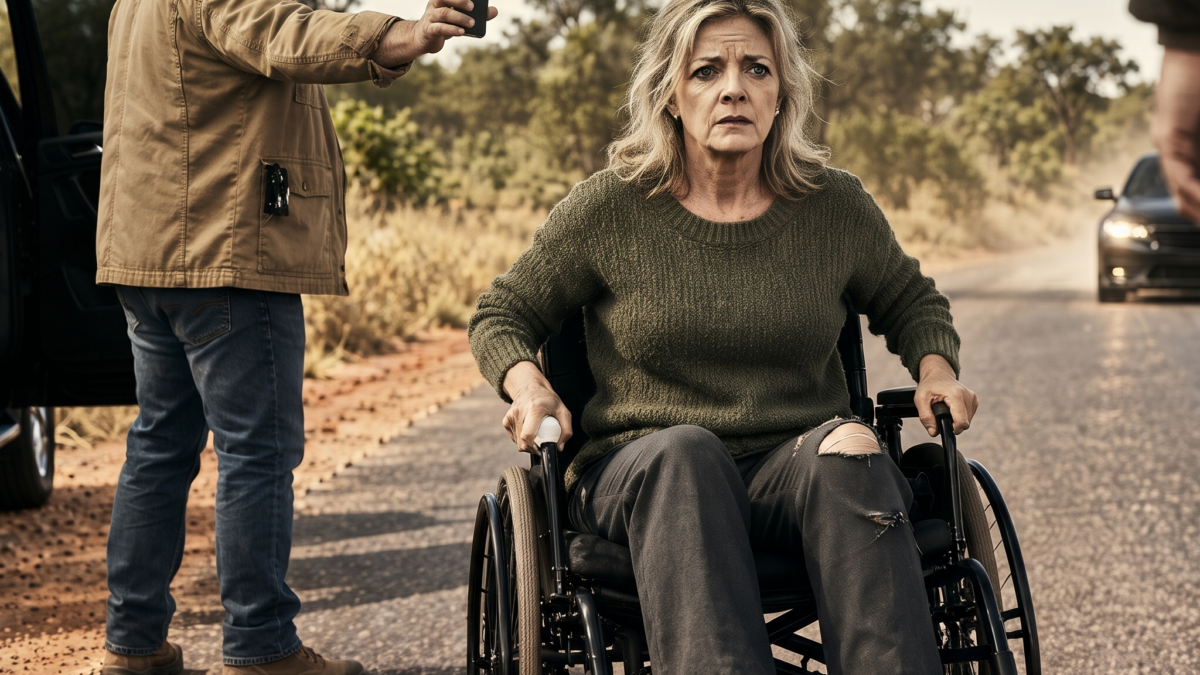
He turned into a gravel turnout beside the highway. There was no building, no gas station, no farmhouse. Only a roadside marker, a stretch of yellow grass, and a line of trees beyond the ditch.
Mile marker 47.
He put the car in park.
“Get out.”
I stared at him.
“Excuse me?”
“You heard me.”
“Glenn, stop it. You’re scaring me.”
He opened his door.
“Get out, Helen.”
“I can’t just get out. You know I can’t.”
He reached around me and opened the passenger door.
My wheelchair was folded in the back. He pulled it out, unfolded it, and set the brakes.
For a few seconds, I thought he was going to help me transfer into it.
Instead, he took my phone from his jacket pocket, slipped it into his own, and stepped back.
“Glenn, please.”
He looked at me.
“Thirty years. I think I’ve earned the right to have a life of my own.”
Then he pushed the wheelchair down the ramp.
I grabbed the wheels.
He released his grip.
The chair settled on the gravel, one wheel catching in a shallow rut.
“Glenn!”
He walked back to the car.
I tried to turn, but the gravel made the wheels difficult to control.
“Glenn, wait! Please!”
He closed the passenger door.
The engine started.
I watched him pull away.
He didn’t look back.
I sat there beside Route 9, listening to the traffic and trying to understand how a man I’d shared thirty years with could leave me on the side of a road as though I were something he no longer wanted to carry.
I checked the time again.
9:12.
I said it aloud.
“Thursday, October eighth. Nine twelve. Mile marker forty-seven.”
My right hand still worked reasonably well. The stroke had left weakness on my left side, but I could write if I went slowly. I found a small notebook in my handbag and began recording what had happened.
Glenn drove me north.
He took my phone.
He left me at mile marker 47.
My appointment was at Mercy Neurology at ten.
I wrote the date twice.
Then I looked toward the road.
Two cars passed.
Neither slowed down.
I raised my hand for the second one, but it continued toward the bend.
The sun was already warming the pavement. My left leg ached where it rested on the footplate, and I could feel sweat gathering beneath my collar.
I tried to turn the wheelchair toward the shade, but one wheel kept catching in the gravel.
I thought about my mother.
The house where Glenn and I lived had belonged to her. She had left it to me, along with the small farm she and my father had owned outside town. I had sold the farm after their deaths, and the money from that sale—four hundred and ten thousand dollars—was still in my account.
I thought about Glenn’s hands on the steering wheel.
I thought about the phone in his pocket.
And for the first time, I wondered whether the appointment at Mercy had ever been about my health.
I looked down at my notebook.
9:18.
I added another line.
Glenn has left me here. I do not know why.
Then I heard a truck slowing behind me.
A white delivery van pulled onto the shoulder.
The driver stepped out, wearing a faded blue uniform and a mail satchel over one shoulder.
She was an older woman with short silver hair, a broad face, and eyes that seemed to take in everything at once.
“Honey, what in the world are you doing out here?”
I tried to answer, but my throat had gone dry.
She came closer.
“Easy. Don’t try to stand up. I’m Maybelle Whitlock. Most folks call me May. What’s your name?”
“Helen Gaines.”
“All right, Helen. You hurt?”
I shook my head.
“Did someone leave you here?”
I looked at her.
“My husband.”
May’s expression changed.
She crouched beside my chair.
“Who can I call? Your children? A sister? Anybody?”
“My folks are gone. We never had children. It’s just Glenn.”
She looked toward the road.
“How long have you been here?”
“Since nine twelve.”
She glanced at her watch.
“That’s twenty minutes.”
“Two cars went right by me.”
“Well, this one’s stopping.”
She took off her satchel and placed it in the van.
“Do you have a phone?”
“He took it.”
“Your husband?”
I nodded.
May looked at me for a moment.
“Do you know his number?”
I gave it to her.
She brought out her own phone and dialed.
The call rang several times before a man answered.
“Hello?”
“Is this Helen’s husband?”
“Yes. Who is this?”
“My name is Maybelle Whitlock. I carry the mail out on Route 9. I’ve got your wife here at mile marker forty-seven.”
There was a pause.
Then Glenn sounded relieved.
“Oh, thank God. She left her phone here at the house. She had a stroke. She gets confused sometimes. Please, just stay right where you are. I’m calling the sheriff to come get her.”
May looked at me.
I shook my head.
“That’s not what happened.”
Glenn continued.
“She’s probably wandered off again. Please don’t let her try to move anywhere. Just wait there.”
I reached for May’s sleeve.
“You took it out of my purse, Glenn,” I said loudly. “You drove me here.”
The line went quiet.
Then he spoke again.
“See? That’s what I mean. Just wait there.”
May lowered the phone.
“I don’t think I will.”
She ended the call.
I stared at her.
“Do you believe me?”
She looked me in the eye.
“Honey, a man who’s worried sick doesn’t tell a stranger to wait for the sheriff while his wife is sitting in a ditch. He gets in his car.”
I let out a breath I hadn’t realized I was holding.
“Where were you headed?” she asked.
“Mercy Neurology. Dr. Anand. Ten o’clock.”
May checked her watch.
“We’ve got time.”
“He canceled my appointment.”
“Then we’ll see whether the doctor agrees.”
She helped me position the wheelchair beside her van.
“Can you transfer with a little support?”
“Yes, but slowly.”
“Then we’ll take it slow.”
She secured the chair and helped me into the passenger seat. Before she closed the door, she retrieved my notebook from my handbag.
“Mind if I see this?”
I handed it to her.
She read the page carefully.
“Good.”
“What?”
“Write it down, Helen. Time first, then what happened. Keep doing that.”
She gave it back.
“Now let’s find your doctor.”
Mercy Neurology was more than an hour away.
May drove with both hands on the steering wheel, the van rattling whenever we crossed a rough patch of road. She didn’t ask me a hundred questions. She let me sit quietly and look through the window.
After a few miles, she reached for her radio and turned it down.
“You said Dr. Anand?”
“Yes.”
“Have you been seeing him since your stroke?”
“Nine months.”
“How often?”
“Every few weeks at first. Now every month.”
“Good doctor?”
“Yes.”
“Then let’s call him.”
She pulled into a gas station, parked, and looked up the hospital number.
A receptionist answered.
“Mercy Neurology.”
“Hello. I’ve got Helen Gaines here. She had an appointment with Dr. Anand at ten.”
“Let me check.”
May waited.
“Her husband called first thing this morning and canceled,” the receptionist said. “He told us she wasn’t feeling well.”
I looked at May.
She raised an eyebrow.
“Can Dr. Anand see her today?”
“He’s booked, but he may be able to squeeze her in at one. After that, the next opening is six weeks out.”
“That won’t work,” I said.
The receptionist asked why.
I hesitated.
May answered.
“There’s a court date next Friday. This appointment is important.”
There was a short pause.
“I’ll speak to his nurse.”
We waited.
A minute later, the receptionist returned.
“Dr. Anand can see her at one.”
“Thank you,” May said. “We’ll be there.”
She ended the call.
I looked at her.
“How did you know about the court date?”
“You mentioned it earlier.”
“I did?”
“You said something about missing it. I figured there was a reason.”
I lowered my eyes.
“That’s not just a medical appointment.”
“No?”
“It’s the capacity evaluation for Glenn’s guardianship petition.”
May’s hands tightened around the steering wheel.
“He’s trying to make himself your guardian?”
I nodded.
“He says I can’t manage my affairs. He wants the court to give him control over everything.”
“Does he have a lawyer?”
“Yes.”
“And you?”
“I don’t know.”
May looked at me.
“Honey, we’re going to need to know a little more about this.”
I told her what I could.
Nine months earlier, I had suffered a stroke. I had been in the hospital for three weeks, followed by rehabilitation. I had regained much of my speech and most of my memory, but the left side of my body remained weak. I could transfer with help, stand briefly with support, and walk only a few steps using parallel bars.
Glenn had been my primary caregiver since I came home.
At first, I was grateful.
He prepared meals, drove me to appointments, and helped me with the things I could no longer do alone. I knew it wasn’t easy. I knew the life we’d had before the stroke had changed.
But somewhere along the way, his help had become control.
He answered questions before I could speak.
He read letters before handing them to me.
He kept my medication in a locked cabinet because he said I might take the wrong dose.
And when I asked about the bank account, he told me not to worry.
I had allowed a lot of that because I wanted to believe we were working through a difficult period together.
Then the guardianship papers arrived.
Or, more accurately, they were apparently delivered.
I had never seen them.
May listened without interrupting.
When I finished, she glanced at the road.
“Sounds like we’ve got more than a doctor’s appointment today.”
“Please don’t get involved in this because of me.”
She gave a short laugh.
“Honey, I carry the mail. Getting involved is how I know when something’s wrong.”
At Mercy, May wheeled me through the entrance and asked the receptionist to confirm my appointment.
A nurse came out to meet us.
“Helen Gaines?”
“Yes.”
“I’m Dr. Anand’s nurse. We’ve been expecting you.”
She looked at May.
“Will you be accompanying her?”
I glanced toward May.
“I’d like her to stay.”
The nurse nodded.
“That’s fine.”
We were taken to a quiet room on the second floor.
Dr. Anand arrived a few minutes later.
He was in his early fifties, with dark hair and a calm, thoughtful manner. He had been treating me since my stroke, and I trusted him.
“Helen,” he said, shaking my hand. “I’m glad you made it.”
“So am I.”
He glanced at May.
“And you are?”
“Maybelle Whitlock. I found Helen on Route 9.”
He looked at me.
“Found you?”
I swallowed.
“My husband left me there.”
Dr. Anand became very still.
“Would you like to tell me what happened?”
I explained.
He listened carefully, then closed the door.
“Helen, there’s something you need to understand. Today’s appointment isn’t just a routine checkup.”
I looked at him.
“What is it?”
“It’s a capacity evaluation. Your husband requested one as part of his petition to become your legal guardian.”
I stared at him.
“What?”
“The court ordered an independent assessment. Your husband submitted the request. The hearing is scheduled for next Friday.”
I shook my head.
“I never agreed to that.”
“Your agreement isn’t required for the petition to be filed. But you have the right to be heard.”
“I never received anything from the court.”
Dr. Anand glanced at his file.
“The notice was delivered to your home three weeks ago by certified mail. Someone signed for it.”
May spoke quietly.
“I carry those green cards every day.”
She looked at me.
“He signed for it, honey. For you.”
I looked at the doctor.
“Can I see the paperwork?”
“We’ll request a copy for you. For now, I’d like to begin the evaluation.”
He pulled a chair closer.
“May I ask you some questions?”
“Yes.”
“What is today’s date?”
“Thursday, October eighth.”
“What year?”
I answered.
He asked me where I was, who had brought me, and why I was there.
I answered each question.
He placed a blank sheet of paper on the table.
“Draw me a clock. Put the numbers in the correct places, and set the hands at ten eleven.”
I took the pencil.
My left hand was still weak, so I used my right.
I drew the circle, placed the numbers, and set the hands.
He watched without offering help.
Then he asked me to remember three words.
After several minutes, he asked me to repeat them.
I did.
He gave me a simple problem involving money and asked how I would handle an unpaid bill.
I explained the steps.
Finally, he sat back.
“All right, Helen. One last question.”
I looked at him.
“What do you want?”
I almost laughed.
“Nine months.”
He waited.
“Every doctor I’ve seen asks Glenn that question. They ask him what I need, what I want, what I can do, and what I can’t do. He answers every time.”
My voice shook.
“You’re the first person who’s asked me.”
Dr. Anand nodded.
“I’m asking you now.”
I looked at the window.
Outside, the parking lot was full. People were coming and going, carrying coffee and paperwork, pushing wheelchairs, helping relatives through the doors.
I thought about my mother’s house.
I thought about the farm money.
I thought about the life I had before Glenn began deciding what I was allowed to remember.
“I want to go home,” I said. “To my house. And I want to make my own decisions.”
Dr. Anand closed the file.
“Your memory is intact. Your judgment is sound. Your orientation is normal. Your cognitive function is within the expected range. Your stroke has affected your mobility, but it hasn’t taken away your ability to understand your life or make decisions about it.”
I stared at him.
“So I don’t need a guardian?”
“Based on this evaluation, I see no medical basis for one.”
I felt tears rise.
He continued.
“And what happened to you this morning is something I have to report.”
May nodded.
“Deputy Pike needs to hear this.”
Dr. Anand looked toward the door.
“Then let’s make sure he does.”
Deputy Pike arrived shortly after two.
He was a middle-aged man with a broad face and a tired expression. He listened while I described what Glenn had done.
May sat beside me.
I showed him the notebook.
He read the page I had written at mile marker 47.
“Nine twelve,” he said.
“Yes.”
“Thursday, October eighth.”
“Yes.”
“Where exactly?”
“Route 9, mile marker forty-seven.”
He nodded.
“I’ll write this up. Adult Protective Services will open a case. We’ll also document the call to your husband and the circumstances surrounding the appointment.”
He looked toward May.
“Thank you for bringing her here.”
May shrugged.
“She needed to see her doctor.”
Deputy Pike turned back to me.
“Mrs. Gaines, your husband has called asking where you are. He’s been told you’re safe.”
I gripped the arms of my wheelchair.
“He’s coming?”
“Yes.”
May’s expression hardened.
“She’s not going anywhere with him.”
The deputy looked at her.
“I understand your concern. But the guardianship petition is pending. There are limits to what I can do today.”
I looked at May.
“Take me home.”
She leaned closer.
“Back to him?”
“It’s my mother’s house. My name is on the deed. I’m not leaving it to him.”
She studied my face.
Then she nodded.
“Yes, ma’am.”
Deputy Pike stepped away to make a call.
I looked toward May.
“Are you going to get in trouble?”
“Probably.”
“Your job?”
“Maybe.”
“Your pension?”
“Let’s get you home first.”
She looked toward the door.
“I’ve been carrying mail for thirty years, Helen. I’ve seen people hide bills, hide letters, hide notices. I’ve watched people ignore the things they don’t want to deal with. I don’t intend to leave you on the side of a road because one more person wants me to look the other way.”
I took her hand.
“Thank you.”
She squeezed mine.
“Save it. We have work to do.”
Glenn was waiting in the hospital parking lot.
He stood beside his car with his hands on his hips.
When he saw us, he hurried forward.
“Helen. Thank God.”
I looked at him.
He came toward my wheelchair.
“Are you all right? I’ve been worried sick.”
I didn’t answer.
He turned to Deputy Pike.
“Officer, my wife gets confused. She’s been like this since the stroke. I told her not to go anywhere alone.”
Deputy Pike held up a hand.
“Mr. Gaines, her evaluation today was completely normal.”
Glenn blinked.
“Today?”
“Yes.”
He looked at me.
“Honey, you’re tired. Let’s go home.”
“Where’s my phone?”
“It’s on the kitchen counter. You forgot it.”
“No, I didn’t.”
“Let’s not do this here.”
“I want my phone.”
“I’ll give it to you at home.”
Deputy Pike watched him.
“Mr. Gaines, we’d like you to answer a few questions about this morning.”
“Of course. Whatever you need. I just want to take my wife home.”
The deputy glanced at me.
“Right now, it’s your word against his. With a guardianship petition already before the court, I can’t arrest him on the information we have today. And nobody is putting him out of your home before that hearing.”
I looked down.
“But it’s on paper now,” he added. “The incident, your statement, and the doctor’s evaluation. Adult Protective Services will follow up.”
Glenn reached for my wheelchair.
I moved my hand away.
“Take me home, May.”
She looked at me.
Then she took hold of the handles.
“All right.”
Glenn stared.
“Helen, I’m your husband.”
“And I’m going home.”
May wheeled me toward her van.
Deputy Pike stopped Glenn when he tried to follow.
“Give her some room, sir.”
I didn’t look back.
May’s van was an old white delivery vehicle with a faded postal emblem on the side. There were stacks of mail trays behind the driver’s seat, an insulated lunch bag on the floor, and a thermos wedged beside the handbrake.
She secured my wheelchair.
Then she sat behind the wheel and rested her hands there for a moment.
“I’m sorry,” she said.
“For what?”
“For not seeing what was happening sooner.”
“You only met me today.”
“Doesn’t change the fact that I should’ve stopped.”
I looked at her.
“Two cars passed me.”
“That doesn’t make it better.”
“No.”
She turned the key.
We drove home in silence.
When we reached my driveway, Glenn was already standing on the porch.
May helped me out of the van and wheeled me toward the front entrance.
Glenn stepped forward.
“Maybelle, I appreciate what you did, but this is a family matter.”
May stopped.
“She’s my passenger, Mr. Gaines. I brought her home.”
“You’ve already done enough.”
“Then we’re even.”
He looked at me.
“Helen, come inside.”
I nodded.
May pushed me through the door.
Glenn followed.
I looked toward the hall where the family photographs hung. One showed us on our wedding day, thirty years earlier. Another showed us standing beside my parents on the farm.
I had once thought those pictures were proof of a life we had built together.
Now they looked like evidence from another person’s home.
“May, can you stay?”
She looked at me.
“Of course.”
Glenn’s jaw tightened.
“For how long?”
May glanced at her watch.
“Long enough.”
May stayed that evening.
She took the couch in the living room and left her mail satchel beside the front door.
I slept badly.
Every time I closed my eyes, I saw Glenn standing beside the car, taking my phone and walking away.
At six the next morning, I woke to the sound of the kitchen cupboard.
May was already making coffee.
I wheeled into the doorway.
“You’re up early.”
“Thirty years of getting up before the sun. It’s hard to change.”
She handed me a mug.
“Where’s Glenn?”
“Shower.”
I looked at the cup.
“Thank you.”
“Don’t thank me. Thank the cook.”
I smiled.
The old phrase sounded strange coming from someone who had never met my husband until yesterday.
May sat across from me.
“Have you got a lawyer?”
“No.”
“Then we need to find one.”
“I don’t have access to my money.”
“How much do you have?”
“Four hundred and ten thousand from the sale of my parents’ farm.”
May raised her eyebrows.
“That’s a good deal of money.”
“It was meant to be my retirement.”
“Whose name is on the account?”
“Mine.”
“Then we start there.”
I looked at her.
“Glenn has the phone. All the bank codes go there.”
“Can you get a new phone?”
“The bank requires either a code sent to my number or an in-person visit with photo identification.”
“Then we’ll go in person.”
“My wallet is in Glenn’s desk drawer.”
May looked toward the hall.
“Why?”
“He said it was safer.”
“Safer from whom?”
I had no answer.
When Glenn came into the kitchen, May was sitting in my chair with her cup.
“Morning, Glenn.”
He looked at me.
“Why is she still here?”
“Because I asked her to stay.”
“She’s not family.”
“No. She’s a friend.”
His eyes narrowed.
“You’re making this more difficult than it needs to be.”
May took another sip.
“Not now, Glenny. She’s right in there.”
Glenn stared at her.
Then he walked out.
May waited until his footsteps disappeared.
“He’s not used to anyone saying no.”
I looked down at my coffee.
“Neither am I.”
By the end of the week, Glenn had arranged for a certified home-care aide to come to the house.
Her name was Tessa Vail.
She was in her early thirties, with neat brown hair, a bright smile, and an expensive-looking handbag.
She arrived carrying a folder and introduced herself as a certified aide who specialized in stroke recovery.
Glenn stood beside her.
“The court will want to see you have someone here around the clock now,” he said. “It’s important that Helen has supervision.”
I looked at him.
“I never asked for anybody.”
“You’re not in a position to decide that alone.”
May was sitting near the window.
“She has someone,” she said.
Glenn gave her a hard look.
“You’re not here permanently.”
May smiled.
“Neither are you, if you keep talking like that.”
Tessa pretended not to hear.
“Hi, Helen. I’m Tessa. We’re going to get along just fine.”
I looked at her.
“I hope so.”
She placed her folder on the table.
“I’ll start by making sure your medications are organized and your daily schedule is consistent.”
“Everything is already organized.”
“Of course. I just want to help.”
She smiled again.
It was a beautiful smile.
I had learned not to trust beautiful smiles without checking what happened behind them.
Over the next several days, Tessa began moving things.
My cups went to higher shelves.
My medication was moved into a cabinet in the laundry room.
My glasses disappeared from the table.
When I asked where they were, she said she had put them somewhere safe.
My notebook was moved from the bedside table to a drawer.
My calendar was taken off the refrigerator.
Each time I protested, she apologized.
Then she did it again.
One morning, I came into the kitchen and found my usual mug on the top shelf.
“Tessa, put that back where I can reach it.”
“Oh, I thought it would be safer up there.”
“In this house, you ask me first.”
“Of course, Helen.”
She smiled and returned it to the lower shelf.
That afternoon, I found my glasses in the laundry basket.
The next morning, they were missing again.
“Where do you think you put them, Helen?” Tessa asked.
“I put them on the table next to my notebook, like I do every night.”
She opened the freezer.
There they were.
She held them up.
“Oh, Helen. In the freezer? Again?”
I stared at her.
“I didn’t put them there.”
She smiled sympathetically.
“Of course. It happens.”
That was the third time since Thursday that something had been found somewhere I would never have put it.
May watched her carefully.
Later, when Tessa was out of the room, May leaned toward me.
“She’s building a file.”
I looked at her.
“What?”
“Every time she moves something, she makes it look like you forgot where you put it.”
I felt cold.
“They’re doing this for the judge.”
May nodded.
“Then we need to keep our own record.”
I took out my notebook.
I wrote the date.
Then I recorded where my glasses had been when I last saw them, who had moved them, and where they had been found.
I wrote down the time.
I did it for the cup, the medication, and the notebook.
May read the entries.
“Good.”
I looked at her.
“You’re sure?”
“I’m sure that if someone is trying to tell a judge you can’t remember things, we should have a record of what actually happened.”
On Friday afternoon, I asked Glenn for my wallet.
He looked up from his desk.
“What do you need it for?”
“My driver’s license.”
“You don’t drive.”
“I have a bank account.”
“I can handle the bank.”
“I want to handle it myself.”
He leaned back.
“Helen, you’ve been through a lot. You don’t need to worry about money.”
“I wasn’t worried about money until you started hiding my identification.”
He sighed.
“Your wallet is somewhere in the desk. I’ll find the key.”
“Then find it.”
He looked annoyed.
May was standing in the doorway.
“Past four on a Friday, honey. Banks shut until Monday.”
I looked at her.
“Monday, then.”
Glenn closed the drawer.
“I’ll find it.”
He didn’t.
Over the weekend, Tessa continued her work.
She moved my belongings, documented my supposed memory lapses, and made little notes about my behavior.
On Sunday night, she sat in the kitchen with Glenn.
I couldn’t hear every word, but I heard my name.
Then I heard her laugh.
I wrote it down.
Monday morning, Deputy Pike returned.
He had been assigned to follow up on the Adult Protective Services report.
“How are things, Mrs. Gaines?”
I looked at him.
“Not good.”
He sat down.
I explained about the missing wallet and the locked desk.
Glenn produced the key from his pocket.
“Found it this morning, actually.”
He opened the drawer and handed me the wallet.
Deputy Pike looked inside.
“Your identification is here?”
“Yes.”
He examined the wallet, then put it back on the desk.
“All right. Let’s discuss the bank.”
I told him about the farm sale and the money in my account.
He asked for the statement.
I didn’t have it.
Glenn had been collecting the mail and keeping the bank notices.
May looked at me.
“Helen, do you know the balance?”
“Last month, it was four hundred and ten thousand.”
Deputy Pike took out his tablet.
“Can you authorize the bank to speak with us?”
“Yes.”
He made the call.
The bank representative asked a series of security questions. I answered them.
Then the representative reviewed the recent transfers.
Her voice changed.
“Mrs. Gaines, there have been several substantial transactions.”
“How many?”
“Four hundred and ten thousand was the balance shown after the sale deposit. There have been three transfers since Thursday.”
I gripped the edge of the table.
“How much?”
“On Thursday at two ten p.m., forty-eight thousand dollars. On Friday, eighty-five thousand. On Sunday, sixty thousand.”
I stared at her.
“That’s one hundred and ninety-three thousand.”
“Yes, ma’am.”
“Where did it go?”
“All three transactions were made to the same business. Vail Home Design.”
May looked at me.
I felt my stomach tighten.
“Vail?”
The representative continued.
“The transactions were online and verified using a code sent to your registered phone number.”
I looked at Glenn.
He was standing near the doorway.
“I haven’t had that phone since Thursday morning,” I said. “My husband took it. I’ve never heard of Vail Home Design.”
Deputy Pike leaned closer.
“Can you freeze the account?”
The representative explained the process.
I authorized a temporary hold and a fraud investigation.
Then I asked her to deactivate the phone-based approval method.
She confirmed it.
When the call ended, Deputy Pike looked at me.
“Mrs. Gaines, we’re opening a financial exploitation investigation.”
I turned toward Glenn.
He was staring at the floor.
“Where is my phone?”
He didn’t answer.
May stood.
“I think that’s a question you should answer, Mr. Gaines.”
Glenn finally looked up.
“She gets confused. She agreed to the transactions.”
I looked at him.
“Did I?”
He said nothing.
Deputy Pike closed his tablet.
“Mr. Gaines, I think we need to speak privately.”
The next afternoon, Deputy Pike called with the first results.
He had looked up Vail Home Design.
The company was registered to a woman named Tessa Vail.
I looked toward the kitchen.
Tessa was preparing lunch.
“She’s the aide,” I said.
Deputy Pike went quiet.
“Are you sure?”
“Yes.”
“All right. Don’t confront her. Don’t discuss the investigation with your husband or the aide. Keep every document you have, and continue writing down what happens.”
I thanked him.
When I ended the call, May was standing beside me.
“How much?”
“One hundred and ninety-three thousand.”
She whistled softly.
“That’s a lot of bathroom tiles.”
I almost laughed.
“There’s no bathroom renovation.”
May’s expression became serious.
“Then we need to find out where the money went.”
I looked at the notebook in my lap.
A few days earlier, I had written that my glasses were missing.
Now I was writing down the names of people who had taken my money.
I had never imagined that my life would become a collection of notes about the people who were supposed to care for me.
But I was beginning to understand something.
They wanted me to look confused.
They wanted me to look dependent.
They wanted the court to believe I couldn’t remember what happened in my own home.
So I would remember everything.
That Thursday, May took me to the bank.
We went in person with my identification and the documents Deputy Pike had requested.
The manager reviewed the account and confirmed the three transfers.
He also gave us the device records.
The bank’s system showed that each transfer had been initiated using a device connected to my home internet.
A verification code had been sent to my phone.
That phone had been in Glenn’s possession.
The manager said the bank could not reverse the payments without a fraud determination, but it had frozen the remaining balance and opened a formal claim.
I signed everything.
On the way out, May stopped beside the car.
“Helen, there’s something else.”
I looked at her.
“What?”
“That morning you told me where you’d been. You said nine twelve. You wrote it down.”
“Yes.”
“The county put a camera on Millbrook Bridge last year.”
I looked at her.
“Why?”
“Traffic monitoring. It records license plates and vehicles.”
“Can it show Glenn’s car?”
“Maybe.”
May took out her phone.
“Let’s call Deputy Pike.”
He answered on the second ring.
“May?”
“Helen’s money was transferred through Vail Home Design. She says Glenn took her phone. We also need the camera from Millbrook Bridge on Thursday morning.”
“Why the bridge?”
“Because it’s the only direct route from her house to mile marker forty-seven.”
There was a pause.
“I’ll pull the footage.”
May ended the call.
I looked at the bridge in the distance.
“Do you think it will show us?”
“I think it’s worth checking.”
We drove back.
At home, I wrote down the time.
9:04 a.m.
We had crossed Millbrook Bridge.
I added another note.
County camera may show vehicle.
While May and Deputy Pike worked on the evidence, I began physical therapy again.
My left leg had grown weaker from sitting too long. I had stopped practicing the standing exercises after Glenn complained that I was making him late for appointments.
Now I had a reason to start again.
May arranged for a therapist to visit three times a week.
Her name was Rebecca.
She was patient, direct, and entirely unimpressed by my excuses.
“Hands on the bars,” she said.
I gripped the parallel bars.
“Weight through your heels. Push.”
I tried.
My knees trembled.
“That’s all right. Breathe.”
I lowered myself back into the chair.
“I can’t.”
“You did.”
“I barely moved.”
“You moved.”
I looked at my feet.
Rebecca crouched beside me.
“Helen, the goal today isn’t to walk across the room. The goal is to stand for three seconds longer than yesterday.”
May watched from the doorway.
“She’s right.”
I gave her a look.
“You’re supposed to be on my side.”
“I am. That’s why I’m agreeing with the person who knows what she’s doing.”
Rebecca laughed.
We tried again.
This time I managed to straighten my knees and hold the position.
One second.
Two.
Three.
My arms shook.
Then my left knee buckled slightly, and I sat.
Rebecca smiled.
“Good.”
I was breathing hard.
“How many?”
“Three.”
I looked at May.
“Three.”
She grinned.
“Nine months of work, Helen.”
I wiped my face.
“One more.”
Rebecca helped me prepare.
“On three. One, two, three.”
I pushed.
My knees straightened.
My heels pressed into the floor.
I held.
Three seconds.
Then four.
Five.
“All right. Sit.”
I lowered myself carefully.
May clapped.
I laughed.
“Don’t make a big deal of it.”
“I’m making a big deal of it.”
I looked down at my legs.
For nine months, other people had described what I could no longer do.
That day, I had proved to myself that there were still things I could learn to do.
The bridge footage arrived on Monday.
Deputy Pike called May first.
She put him on speaker.
“Have you got it?”
“Yes. The county camera recorded both directions.”
I gripped the arms of my chair.
“Tell us.”
“Thursday, nine oh three a.m., Glenn’s vehicle crossed Millbrook Bridge heading north. The passenger seat is occupied.”
I closed my eyes.
“Nine nineteen,” Pike continued. “Same vehicle comes back south. Passenger seat is empty.”
May looked at me.
“That’s it.”
“There’s more,” Pike said. “The vehicle is registered to Glenn. The plate matches. We have the footage preserved.”
I opened my eyes.
“Can you see my face?”
“Not clearly. But the passenger’s clothing matches what you told us. Green sweater.”
I looked down at my cardigan.
The same one.
Deputy Pike continued.
“We’ve also got a request in for the financial records from Vail Home Design. We’ll be speaking with Ms. Vail.”
I felt a wave of relief.
Then fear.
“Will Glenn know?”
“Eventually. But don’t tell him what we have. Let us handle it.”
May nodded.
“We’ll keep our mouths shut.”
After the call, I sat quietly.
The bridge camera had recorded what Glenn had tried to erase.
He had taken me north.
He had brought the car back south without me.
And he had done it nineteen minutes later.
I looked at the notebook on my lap.
9:12.
Mile marker 47.
The time I had written while sitting alone beside the road was close enough to the camera record to make the morning real in a way no accusation could undo.
I wasn’t confused.
I hadn’t wandered.
He had left me.
Glenn knew the bank was investigating.
He didn’t know about the bridge camera.
That evening, I heard him speaking on the phone in the study.
I was in the hallway.
“She’s been to the bank,” he said. “Tonight, you write up a contract.”
He paused.
“Accessible bathroom remodel. Invoice for every payment.”
Another pause.
“For a bathroom?”
He laughed.
“She agreed to it. And she forgot.”
I froze.
“One more thing she forgot,” he continued. “Same as last week.”
I backed away before he saw me.
May was sitting in the living room.
I wheeled in and told her what I had heard.
She listened without interrupting.
“He’s making paperwork,” she said.
“To cover the transfers.”
“Yes.”
“Can we stop him?”
“We’ll tell Deputy Pike.”
I took out my notebook.
I wrote down the words as carefully as I could remember them.
Then I recorded the time.
May watched me.
“Good girl.”
I looked at her.
“I’m sixty-eight years old.”
“Then you’re a good sixty-eight-year-old girl.”
I laughed despite myself.
It was the first time in days that I had laughed without feeling guilty.
On Tuesday, Glenn tried to frighten May.
He found her in the kitchen, checking the mail.
“May, can I speak with you?”
She folded an envelope.
“Certainly.”
He closed the door.
“You’re a federal employee, aren’t you?”
“Thirty years.”
“You’re transporting a vulnerable adult in your personal time. You used your government vehicle to take my wife away from me. There’s a complaint on file.”
May didn’t answer.
“Your retirement starts next month, doesn’t it?”
She looked at him.
“What’s your point?”
“You could lose your pension. You could lose everything you’ve worked for.”
He stepped closer.
“Pack your bags today, and I’ll drop the complaint.”
May looked at him for a long time.
Then she placed the envelope on the counter.
“I’ve carried a lot of mail, Mr. Gaines.”
He frowned.
“What’s that supposed to mean?”
“Certified letters. Past-due notices. Court summonses. Obituaries. You carry that long enough, you learn what a man looks like when he’s lying.”
Glenn’s face hardened.
“You’re making a mistake.”
“Maybe.”
“You could lose your pension.”
“And you could lose your house.”
He stared at her.
May picked up her satchel.
“I’m not going anywhere.”
When she told me what had happened, I felt sick.
“May, you could lose your retirement.”
She shrugged.
“And you could lose your home.”
“That’s not fair.”
“Neither is leaving a woman beside a highway.”
I looked at her.
She smiled.
“Friday, we go together.”
The hearing was scheduled for the following Friday morning.
Glenn was convinced he would win.
He had spent the previous week building a file of supposed incidents: misplaced glasses, medication confusion, a missed appointment, and a video showing me struggling with ordinary household tasks.
Tessa filmed me whenever she could.
She recorded me asking where my phone was, even though she had moved it.
She filmed me looking for my glasses, even though she had taken them from the table.
She filmed me trying to stand, then stopped the camera before I managed to straighten my knees.
I knew what she was doing.
I also knew what the court needed to see.
A person could have difficulty walking and still understand where she was, what she owned, and who was trying to take it.
On Wednesday, I met with an attorney named Sarah Benton.
She was in her early forties, with a calm voice and an office full of books. She had been recommended by Adult Protective Services after Deputy Pike explained the situation.
She reviewed my records.
“The guardianship petition is based mainly on medical limitations and the alleged memory issues,” she said.
“Yes.”
“Your doctor has given us a capacity assessment?”
“Yes.”
“Do you have copies of your own notes?”
I handed her the notebook.
She read it carefully.
“This is very useful.”
“I’ve written down everything.”
“I can see that.”
She looked up.
“Helen, have you considered filing for a protective order?”
I shook my head.
“I want to stay in my house.”
“That doesn’t mean you have to tolerate his behavior.”
“I know. But I want the court to understand what happened before anyone moves me.”
Sarah nodded.
“Then we’ll focus on the guardianship hearing and the financial exploitation evidence. The criminal investigation will proceed separately.”
She organized the documents into folders.
“The bridge footage is particularly important.”
“And the bank?”
“We have the transaction history. We also have the records showing the verification codes were sent to your phone.”
I took a breath.
“What happens if the judge decides Glenn should be my guardian?”
Sarah leaned forward.
“We challenge it. But based on what I’ve seen, you have a strong case. A physical disability is not proof that someone lacks the ability to make decisions.”
I looked at the documents.
“That’s what I want them to understand.”
“They will.”
She placed the folders in a briefcase.
“One more thing. The hearing is public, but you don’t have to answer questions that aren’t relevant. Take your time. Listen carefully. And if you don’t understand a question, say so.”
I nodded.
For the first time since the roadside, I felt prepared.
Thursday afternoon, Glenn came into the living room with a folder.
“Helen, we need to talk.”
I looked up.
“What about?”
“The guardianship.”
“I know.”
“I’ve spoken to Tessa. She says you’re having a difficult time.”
“I am.”
He looked pleased.
“See? That’s what I’m talking about.”
“I’m having a difficult time because you left me on the side of the road and took my phone.”
His expression hardened.
“You’re still telling that story?”
“It’s what happened.”
“You were confused.”
“I knew the time. I knew where I was. I knew where I was going.”
He placed the folder on the table.
“You need someone to manage things.”
“I don’t.”
“You can’t even stand.”
I looked toward the parallel bars in the corner.
“Not for long yet.”
“You’re not thinking clearly.”
I held his gaze.
“Then the doctor can explain it to the judge.”
He stared at me.
Then he leaned closer.
“You’re going to make a fool of yourself.”
I felt my hands tighten.
“No, Glenn. I’m going to tell the truth.”
He straightened.
“Fine.”
He picked up the folder and walked out.
May appeared in the doorway.
“You all right?”
I nodded.
She looked at the folder he’d left behind.
“Want me to read it?”
I shook my head.
“Sarah already has it.”
May smiled.
“Then we’ve got our ducks in a row.”
I looked at her.
“Why did you stop that day?”
She didn’t answer immediately.
Then she sat beside me.
“Because I saw you.”
“Two cars passed.”
“I know.”
“Why you?”
She looked toward the window.
“I’ve spent thirty years delivering mail. You learn the difference between a person waiting for a ride and a person who’s been left somewhere. You were sitting in that chair with your handbag on your lap, writing something down. You weren’t waving at cars anymore. You were trying to make sure somebody knew what had happened.”
She took my hand.
“I couldn’t drive past that.”
I looked at her.
“Thank you.”
She shook her head.
“Don’t thank me yet. We have court tomorrow.”
The guardianship hearing began at nine on Friday morning.
Glenn arrived with Tessa and his attorney.
I arrived with May and Sarah.
I wore a navy-blue blouse and the small silver earrings my mother had given me years earlier. May had helped me dress, but I insisted on fastening the earrings myself.
She waited beside my wheelchair while Sarah organized the papers.
“Ready?” she asked.
“No.”
“Good. Neither am I.”
I laughed.
The clerk called the case.
“The guardianship matter of Helen Gaines.”
We entered the courtroom.
The judge was an older woman named Judge Margaret Ellison. She had silver hair, narrow glasses, and a calm expression that made it difficult to guess what she was thinking.
She looked over the paperwork.
“Counsel, go ahead.”
Glenn’s attorney stood first.
“Your Honor, Mr. Gaines has been caring for his wife for nine months following a serious stroke. During that time, Mrs. Gaines has demonstrated significant memory issues, confusion, and an inability to manage daily activities. My client believes a guardianship is necessary to protect her.”
He handed up a packet.
“We also have video evidence showing repeated confusion in the home.”
The judge looked at it.
“Thank you.”
Sarah stood.
“Your Honor, my client disputes the allegation that she lacks decision-making capacity. She has undergone an independent neurological assessment. Her memory, judgment, and orientation were found to be normal. Her physical limitations are real, but they do not establish incapacity.”
The judge nodded.
“Mr. Gaines, take the stand.”
Glenn stood.
He walked to the witness box, raised his right hand, and swore to tell the truth.
His attorney asked about our marriage, the stroke, and the care he had provided.
Glenn described himself as a devoted husband who had spent nine months helping me with every aspect of daily life.
He spoke about my medication.
My appointments.
My difficulty walking.
My supposed memory lapses.
He made it sound as though he had carried me through every hour of every day without complaint.
I looked at him and remembered mile marker 47.
The judge listened.
“Thirty years of marriage,” Glenn said. “Your Honor, I just want to keep her safe.”
The judge turned toward me.
“Mrs. Gaines, through your attorney, is there anything you’d like to say?”
Sarah touched my arm.
I leaned forward.
“Your Honor, I’d like to speak for myself.”
The judge looked at me.
“Go ahead, Mrs. Gaines.”
I turned toward Glenn.
“My husband says I’m confused about time. I’d like to ask him about time.”
Glenn shifted.
I looked at the judge.
“Three questions.”
The judge nodded.
“Proceed.”
I turned toward him.
“Mr. Gaines, you’re still under oath. Answer her.”
I looked at Glenn.
“First question. Where was I at nine-thirty Thursday morning?”
He blinked.
“You went out the front door, honey. I was in the shower.”
I looked at the judge.
“At nine twelve, Glenn left me at mile marker forty-seven. He took my phone. I wrote that down while I was sitting on the side of the road.”
I held up the notebook.
Sarah handed the relevant page to the clerk.
Glenn shook his head.
“That’s not what happened.”
I looked at him.
“The date is written at the top. The time is underneath. The place is there, too.”
His attorney stood.
“Objection. She could have written that note at any time.”
Sarah rose.
“Your Honor, we have a photograph of the original page taken at ten forty-four that morning, before police had contacted Mr. Gaines and before my client had been returned home.”
The judge looked at the photograph.
“Admitted.”
I returned my attention to Glenn.
“Second question. Where was my phone at ten oh two that afternoon?”
“On the kitchen counter, where you left it. I’ve said that all along.”
“You have.”
I looked at the judge.
“At eleven that morning, Glenn called the police and said I was missing. At ten oh two, somebody in my kitchen used my phone to send forty-eight thousand dollars to Vail Home Design.”
Glenn’s face changed.
Sarah handed the bank record to the clerk.
“That is the first transfer, Your Honor. The bank confirms the verification code was sent to Mrs. Gaines’s registered number.”
Glenn’s attorney stood.
“Mrs. Gaines agreed to a bathroom remodel. My client has records showing that the money was paid for home improvements.”
I looked at him.
“I’ve slept in that house eight nights since the transfer. Nobody has touched one tile in that bathroom.”
The judge looked at Glenn.
“Mr. Gaines, do you have a contract?”
He nodded quickly.
“Yes, Your Honor.”
He handed a document to his attorney, who passed it forward.
The judge read it.
Sarah stood.
“Your Honor, Vail Home Design has no contractor’s license. Its registered owner is Tessa Vail, the person Mr. Gaines hired as my client’s aide after the roadside incident.”
Tessa shifted in her seat.
The judge looked at her.
“Ms. Vail, are you present?”
“Yes, Your Honor.”
“Do you have anything to say?”
Tessa glanced at Glenn.
Then she looked down.
Sarah continued.
“We have also submitted the bank’s records showing that a total of one hundred and ninety-three thousand dollars was transferred to that business between Thursday and Sunday.”
Glenn stood.
“She approved every dollar. She just doesn’t remember.”
The judge raised a hand.
“Mr. Gaines, sit down.”
He sat.
I took a breath.
“Third question.”
My voice was beginning to shake, but I kept going.
“They say a video shows me putting my glasses in the freezer. Your Honor, could we stop the video at the point where the freezer door opens?”
The clerk prepared the recording.
It showed me at the kitchen table.
Tessa’s voice came from behind the camera.
“Helen, where did you put your glasses?”
“I left them on the table.”
“Are you sure?”
“Yes.”
The video showed me looking around.
Then Tessa opened the freezer.
“Oh, Helen. In the freezer? Again?”
I watched the footage.
I had seen it before.
What I hadn’t seen was how carefully the camera had been positioned.
It was low.
Too low.
Sarah paused the recording.
I looked toward Glenn.
“How high is the freezer door?”
He frowned.
“I don’t know.”
“I do. It’s higher than May’s head.”
I turned toward the judge.
“My physical therapy chart shows that on Tuesday I stood between parallel bars without assistance for the first time. The video was made on Monday morning. On Monday, I had never stood up.”
Sarah handed up the therapy records.
I continued.
“From this chair, I can’t reach the top of that freezer. I couldn’t have put my glasses there.”
The judge looked at the video again.
Then at the chart.
I looked at Glenn.
“Someone else put them there.”
His face had gone pale.
He stood.
“She handled the money. She made the video. I never—”
Tessa spoke from behind him.
“You called me from the car.”
Everyone turned.
Glenn stared at her.
“What?”
Tessa looked at the judge.
“He told me what to type. He said the freezer was his idea. He said the video would help.”
Glenn’s mouth opened.
“Be quiet.”
The judge’s voice was sharp.
“Mr. Gaines, you will not interrupt.”
Tessa began crying.
“He told me it was temporary. He said he needed the money before the hearing. He said she’d forget.”
I looked at her.
The woman who had moved my glasses, hidden my notebook, and filmed my supposed confusion now sat crying because the plan was falling apart.
I didn’t feel satisfaction.
I felt tired.
Very tired.
Judge Ellison reviewed the documents for several minutes.
The courtroom was silent.
Then she looked at Glenn.
“Mr. Gaines, your petition asks this court to appoint you as guardian because your wife allegedly lacks the ability to manage her affairs. The evidence presented today does not support that request.”
Glenn shifted.
The judge continued.
“Mrs. Gaines underwent an independent medical evaluation. Her memory, judgment, and orientation were found to be normal. Her physical limitations do not establish an inability to make decisions.”
She looked toward me.
“Mrs. Gaines has demonstrated a clear understanding of her finances, her medical needs, and the legal proceedings before this court. She has also presented contemporaneous notes documenting events that her husband denied.”
Then she turned back to Glenn.
“The evidence concerning the roadside incident and the financial transfers raises serious questions about the motive for this guardianship petition.”
Glenn stood.
“Your Honor, I was trying to help my wife.”
The judge looked at him.
“Then you should have helped her.”
He fell silent.
“This court will not appoint a guardian for Helen Gaines. She does not need one.”
I gripped the armrests of my wheelchair.
For a moment, I could not breathe.
The judge continued.
“The court will refer the financial records, the medical evidence, and the testimony presented today to the district attorney. The Adult Protective Services file will remain open. Any additional evidence concerning exploitation or false reporting should be provided to the appropriate authorities.”
Sarah touched my arm.
I looked at her.
She smiled.
It was over.
At least the guardianship was.
I had not lost my home.
I had not lost control of my money.
And nobody had been given permission to decide what I could do with the rest of my life.
Then the courtroom doors opened.
Two officers entered.
Deputy Pike walked in behind them.
He approached Glenn.
“Glenn Gaines, stand up.”
Glenn looked confused.
“What’s this?”
“You’re under arrest for abandoning a vulnerable adult, financial exploitation, and filing a false report.”
Glenn shook his head.
“This is ridiculous.”
The officer moved closer.
“Turn around, sir.”
Glenn looked toward me.
“Helen.”
I didn’t answer.
He looked toward Tessa.
“Say something.”
She was crying.
Deputy Pike turned to her.
“Ms. Vail, you’re also being detained in connection with the fraudulent transfers and false documentation.”
Tessa stood slowly.
“I can explain.”
“You’ll have an opportunity.”
The officers escorted them out.
I watched Glenn disappear through the door.
Thirty years.
I had been married to him for thirty years.
I thought I would feel something enormous when he finally left.
Instead, I felt the quietest thing in the world.
Relief.
May came over and knelt beside my chair.
“Look at you.”
I smiled.
“Don’t.”
“Standing right here like you own the place.”
“I do own the place.”
She laughed.
“That’s right, honey.”
She took my hand.
“Let’s get you home.”
The next morning, I asked Rebecca to come early.
I wanted to try the parallel bars again.
She was surprised when I told her.
“How far do you want to go?”
“Across the room.”
She smiled.
“That’s ambitious.”
“I’ve had a difficult week.”
“Then let’s see what you can do.”
May was watching from the doorway.
Rebecca helped me position my feet.
“Hands on the bars. Weight through your heels. Push.”
I tried.
My knees trembled.
My left hand tightened around the rail.
I leaned forward.
“That’s it.”
I straightened.
One second.
Two.
Three.
Then four.
Rebecca stepped back slightly.
“You’re doing it.”
I took a breath.
“Can I move?”
“Only if you’re ready.”
I shifted my weight.
My right foot moved forward.
Then my left.
It was a small step.
But it was a step.
I laughed.
May clapped.
“Look at you!”
I took another.
Then another.
By the time I reached the end of the bars, I was shaking and sweating.
Rebecca helped me sit.
“That’s enough for today.”
I looked at my feet.
“I walked.”
“You did.”
May wiped her eyes.
“Nine months. That goes in your chart.”
I laughed.
“Put it in bold.”
Rebecca smiled.
“I think we’re going to have a very good next few months.”
I looked toward the window.
For the first time in a long while, the future didn’t feel like a room someone else had locked.
It felt like somewhere I could go.
The months after the hearing were not easy.
Glenn was released pending trial under conditions that kept him away from the house. The court issued protective orders, and Sarah helped me arrange for the locks to be changed.
The financial investigation continued.
The bank recovered the money that Tessa had not yet spent. Some of the funds had been moved through accounts connected to Vail Home Design. Investigators traced the transfers and identified payments that had no connection to any actual renovation work.
The district attorney’s office filed additional charges.
Glenn and Tessa both hired attorneys.
I filed for divorce.
The process took longer than I wanted, but there was no longer anyone in the house telling me what I could read, where I could keep my glasses, or when I was allowed to use my own phone.
May stayed for a while.
She slept on the couch and helped me organize the house. She drove me to physical therapy, helped me set up new banking access, and made sure every important document had a copy stored somewhere Glenn couldn’t reach.
She also taught me how to make coffee properly.
“You’re using too much water,” she said one morning.
“I’ve been making coffee for thirty years.”
“And you’ve been doing it wrong for thirty years.”
I laughed.
“I thought you said not to thank you.”
“Don’t thank me. Thank the cook.”
We became friends.
Not the kind of friends who needed to talk every hour. The kind who could sit together in a quiet room and know the other person was there.
May returned to her postal route when the investigation cleared her to do so. There were questions about her use of the delivery vehicle and the fact that she had transported me without authorization.
She was suspended temporarily while the postal service reviewed the complaint.
She could have walked away.
She didn’t.
She supplied her route records, the call history, and her statement. She explained that she had found a disabled woman abandoned beside the road, had called the husband, and had brought the woman to the medical appointment he had canceled.
The investigation found that May had acted outside normal transport procedures, but it also confirmed that she had responded to an apparent emergency and had promptly contacted the appropriate authorities.
Her record remained intact.
Her pension remained intact.
And she returned to work.
One afternoon, several months after the hearing, May came to my house carrying a cardboard box.
“What’s that?” I asked.
“My retirement paperwork.”
I looked at her.
“You said next month.”
“Next month is next week.”
She put the box on the table.
“Thirty years. That’s a lot of mail.”
I smiled.
“Are you excited?”
“Ask me again after I’ve gone three days without getting up at five.”
She opened the box.
Inside were letters, certificates, photographs, and a small collection of thank-you cards from people on her route.
She picked one up.
“This one came from a little boy on Route 9. He used to leave me drawings in the mailbox.”
She smiled at it.
“Another from a woman whose husband was in hospital. I carried her groceries up the steps when the snow got bad.”
I looked at her.
“You’ve helped a lot of people.”
“Some.”
She turned another card over.
Then she found an envelope.
“This is yours.”
I frowned.
“Mine?”
“From my boss.”
She handed it to me.
I opened it.
Inside was a short note confirming that May’s service record was complete and that her full retirement benefits had been approved.
I looked up.
“Full pension.”
“Full pension.”
I smiled.
“Good.”
“Yes.”
She sat down.
“You know, I thought that first day might cost me everything.”
I reached across the table.
“I’m sorry.”
“Don’t be. I’d do it again.”
I believed her.
Then she looked toward the hallway.
“How’s the walking?”
“Better.”
“Show me.”
I stood beside my chair.
I was still slow. I still needed the parallel bars or a walker for longer distances. But I could move across a room with support, and some days I could take several steps on my own.
I pushed myself upright.
May watched.
“Look at you.”
I took three careful steps.
Then four.
I turned.
“That’s enough.”
She smiled.
“That’s more than enough.”
The divorce became final in the spring.
By then, Glenn and Tessa were awaiting trial on the remaining charges.
The money recovered from Vail Home Design had been returned to my account. The judge ordered Glenn to repay the remaining amount as part of the financial proceedings.
Tessa’s testimony helped the district attorney establish how the false invoices had been prepared and how the videos were staged.
I never spoke to either of them again.
Sometimes I wondered whether Glenn had ever loved me.
Thirty years is a long time to share with someone. We had traveled, celebrated birthdays, cared for our parents, and built a home. I could remember good days. I could remember his laugh, the way he used to bring me coffee on Sunday mornings, and the time he drove through a snowstorm to get me to my mother’s bedside.
Those memories were real.
But so was mile marker 47.
Both things could be true.
I stopped trying to make one erase the other.
A week after the divorce was finalized, May came over with a small parcel.
“This is for you.”
I looked at the label.
“Your boss?”
“Well, my former boss.”
I opened it.
Inside was a letter of commendation, recognizing her actions on Route 9 and thanking her for the care she had shown during an emergency.
I read it twice.
Then I looked at her.
“Honey, even a thank-you needs a stamp.”
May laughed.
“That’s what I told him.”
I placed the letter on the table.
“Thank you, May.”
She shook her head.
“Don’t thank me. Thank the cook.”
“There’s no cook here.”
“Then I suppose you’ll have to thank yourself.”
I smiled.
We sat together for coffee.
A little later, Deputy Pike stopped by.
He had an update from the district attorney.
“Tessa’s been telling them everything,” he said.
I set down my mug.
“What did she say?”
“That Glenn asked her to help stage the confusion incidents. The glasses in the freezer, the misplaced medication, the false invoices.”
May’s face hardened.
“She knew what she was doing.”
“Yes.”
Deputy Pike looked at me.
“She also described the morning on Route 9.”
I waited.
“She says she asked Glenn what would happen if nobody stopped.”
I looked at May.
May didn’t move.
“What did he say?” I asked.
Pike glanced at his notes.
“He told her, ‘Somebody always stops.'”
The room became quiet.
I thought about the two cars that had driven past me.
The heat on the pavement.
The notebook in my lap.
The moment when I had begun to believe that nobody would come.
Then I thought about the white van pulling onto the shoulder.
May stepping into the road.
Her voice asking whether I was hurt.
I looked at her.
“He was right.”
May gave a small smile.
“He was.”
“But he never figured the one who stopped would listen to me.”
She took my hand.
“No, honey. He didn’t.”
On the first Saturday in May, I went outside without waiting for May to help me.
The front door stood open.
The air was warm, and the garden was full of new growth. I held the walking frame and made my way slowly across the porch.
At the bottom of the steps, I stopped.
For nine months after my stroke, I had been measured by what I couldn’t do.
I couldn’t walk without help.
I couldn’t drive.
I couldn’t manage the stairs.
I couldn’t carry groceries or stand long enough to cook.
Glenn had taken those limitations and turned them into a story about a woman who couldn’t make decisions.
But I was still Helen Gaines.
I knew the date.
I knew my address.
I knew what was in my bank account.
I knew what I wanted.
And I knew who had left me beside the highway.
I stepped forward.
Then another step.
May was sitting on the porch with a cup of coffee.
She watched me approach.
“Look at you.”
I smiled.
“Don’t start.”
“I’m not saying anything.”
“Your face is saying plenty.”
She laughed.
I reached the chair beside her and sat down carefully.
The street was quiet.
A car passed.
Then another.
At the far end of the road, the mail truck appeared.
It slowed as it approached my house.
May looked at it.
“Old habits.”
I smiled.
“You’re retired.”
“Doesn’t mean I can’t wave.”
The truck continued along the road.
May raised her hand.
I raised mine.
For a moment, I remembered the woman I had been on Route 9, sitting beside mile marker forty-seven with no phone, no way to call for help, and no idea what would happen next.
I remembered writing down the time because I needed someone to know.
I remembered May reading my notebook and saying, “Good. Keep doing that.”
I remembered the hospital, the courtroom, and the first step I had managed between the parallel bars.
Then I looked at the house.
My mother’s house.
My home.
Nobody was going to take it from me.
I leaned back in the chair.
“May?”
“Yes, honey?”
“Are you busy Thursday?”
She smiled.
“Why?”
“I have a physical therapy appointment at ten.”
“Then I’ll take you.”
“You don’t have to.”
“I know.”
I looked at her.
“Thank you.”
She lifted her coffee cup.
“Don’t thank me. Thank the cook.”
I laughed.
And for the first time in a very long while, the sound felt entirely my own.