He Wouldn’t Hand Her His Keys, So She Told Police He Had a Knife—Then She Saw Who Sat on the Bench
THE MAN AT NUMBER FOURTEEN
The first thing Brenda Tisdale wanted from me was my car.
The second was my arrest.
She got neither.
At twelve forty-five on a Tuesday afternoon, I was standing in my driveway on Juniper Court, trimming the dead branches from a boxwood hedge, when Brenda came marching across the sidewalk with the determined expression of a woman who had already decided the world owed her something.
I knew her, of course. Everyone on Juniper Court knew Brenda Tisdale. She had lived three houses down for twenty-six years, chaired the neighborhood association, organized the holiday decorations, kept track of everyone’s garbage bins, and considered herself the unofficial mayor of our quiet little street.
She was also the sort of woman who could turn a request into a command simply by raising her chin.
“Keys,” she said.
I lowered the pruning shears.
“Good afternoon to you, too.”
“Your car keys. I’ll have them back by six.”
I glanced at my sedan, parked beside the garage.
“No, ma’am. I need it this afternoon.”
Her eyebrows rose.
“My SUV is in the shop.”
“I’m sorry to hear that.”
“The association luncheon starts at one-thirty. They’re giving me Neighbor of the Year.”
“Congratulations.”
She seemed to take my congratulations as confirmation that I would hand over my keys.
“I’m not showing up to that in an Uber.”
I looked at the sedan again. It was a plain black car, a few years old, and nothing particularly impressive. It was paid for, well maintained, and important to me for reasons that had little to do with transportation. I rarely lent it to anyone. I certainly wasn’t going to hand it over because a neighbor wanted to make an entrance at a luncheon.
“I’m sorry your car is in the shop, Mrs. Tisdale,” I said. “But the answer is no.”
She stared at me.
“Excuse me?”
“I need my car.”
“Your car has been parked on this street for seven months. Lending it to me for one afternoon is the least you can do.”
“That isn’t how ownership works.”
Her mouth tightened.
For a moment, I thought she might turn around. Instead, she looked me up and down, from my work shirt to my gardening gloves, and gave a little laugh.
“Watch this one,” she said loudly. “That car is a lease, and so is he. Gone by Christmas.”
I put the shears on the porch rail.
“Mrs. Tisdale, please step off my driveway.”
“Or what?”
I didn’t answer.
“You’re going to call the police?” she asked. “Go ahead.”
I reached for the garden hose.
She took a step backward, looked toward the neighboring houses, and pulled out her phone.
Then she dialed 911.
I watched her do it.
At first, I assumed she was bluffing. Brenda had a reputation for complaining, but I’d never seen her go this far. I expected her to make a dramatic call to a friend, or perhaps threaten to report me to the association.
Instead, I heard her voice change.
It became thin and frightened.
“911. What’s the address of your emergency?”
“There’s a man on Juniper Court threatening me. He’s got a blade.”
I stopped moving.
The operator asked for the house number.
“Fourteen. I’m in his driveway.”
Brenda glanced straight at me.
“Go ahead. Call him, too. Let’s see whose word a cop takes on this street.”
I put the hose down.
The operator asked whether I was moving toward her.
“Just send someone,” Brenda said. “Please.”
I looked at the shears resting on my porch rail. They were closed. There was still a small cluster of hedge clippings caught between the blades.
I hadn’t touched them since setting them down.
“Ma’am,” the operator continued, “is the man coming toward you?”
Brenda held my gaze.
I could hear the questions through the phone. I could hear the fear in her answers, too. Or the performance of it. I couldn’t tell which was worse.
I took two steps away from the porch.
Then I raised both hands and stood beside my car.
I had spent most of my professional life in rooms where people said things that could ruin someone else’s life. I knew the value of choosing words carefully. I also knew that an angry argument on a suburban driveway could become something very different once a police report was written.
The safest thing I could do was stand still.
So I did.
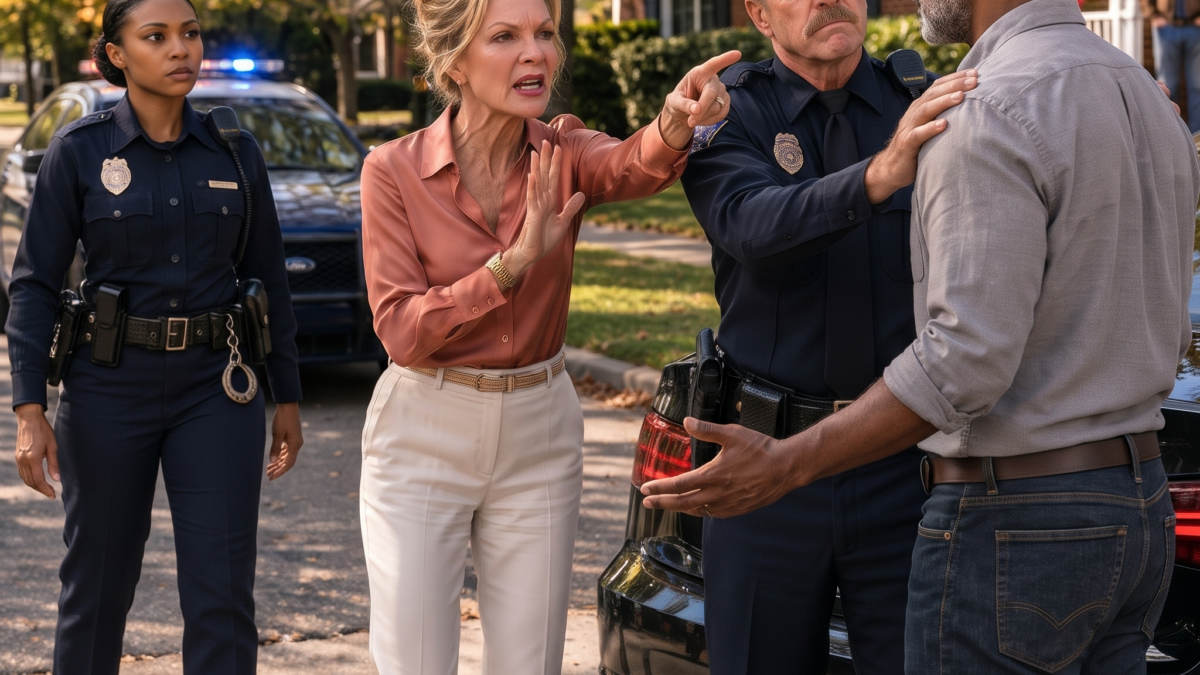
By the time the patrol car turned onto Juniper Court, Brenda was standing near the edge of my driveway, one hand pressed to her chest.
Two officers got out.
One was a tall man with short dark hair. The other was a younger officer who looked barely old enough to have finished his training.
“Sir, keep those hands up. Don’t move.”
I kept them raised.
“I don’t have a weapon, officer. The hedge shears are on the porch rail.”
Brenda stepped forward.
“He has a knife. Arrest him! My heart is about to come out of my chest.”
The older officer turned toward her.
“Ma’am, step back by the mailbox.”
Then he looked at me.
“Sir, turn around. Both hands on the roof of the car.”
I complied.
The metal was warm beneath my palms.
He checked my waistband and pockets while his partner kept Brenda at a distance.
“Phone in the front pocket. Wallet in the back?”
“Yes, officer.”
“Take them out slowly and put them on the roof.”
I did.
He opened the wallet and checked my identification.
“Fourteen Juniper Court?”
“Yes.”
He looked at the house.
“You live here?”
“For now, apparently.”
The younger officer glanced toward the porch.
The older one looked at Brenda.
“Tell me what happened.”
“He threatened me with a knife.”
“Where is the knife?”
“On the porch.”
The officer walked over and examined the shears.
He didn’t pick them up immediately. He looked at the closed blades, the clippings caught near the hinge, and the position of the tool on the rail.
Then he glanced back at Brenda.
“Is this what you mean?”
“Yes. That’s what he had.”
“He had it in his hand?”
“Yes.”
I turned my head slightly.
“No, officer. I put them down before she called.”
“Don’t move, sir.”
I faced the car again.
A woman had come outside from the house across the street. She stood near her mailbox in a blue cardigan, watching the scene.
It was Edna Faraday.
She had lived on Juniper Court longer than I had. She was in her seventies, small-framed, and usually quiet. I knew her well enough to wave when I passed, but we had never been close.
“Edna!” Brenda called. “Tell them what you heard.”
Edna looked from Brenda to the officers.
“I heard someone shouting,” she said.
Brenda nodded emphatically.
“See?”
Edna lowered her eyes.
The older officer returned with the shears.
“These are closed. They’re on the porch rail, about thirty feet from the complainant. There are hedge clippings on the blades.”
Brenda’s expression hardened.
“People like him don’t live on Juniper Court.”
The officer didn’t respond to that.
He looked at me again.
“Sir, do you have identification?”
“It’s on the roof.”
He checked it, then glanced at the screen of my phone.
I noticed his expression change for a fraction of a second.
The phone had lit up with a reminder from my chambers.
I said nothing.
He put it down.
“What happened here, sir?”
“She asked for my car keys.”
“And?”
“I told her no.”
“Then?”
“She called you.”
Brenda stepped forward.
“He threatened me!”
The older officer raised a hand.
“Ma’am, stay where you are.”
She looked at him with disbelief.
“Do you know who I am?”
He gave no answer.
“I have been the block watch captain on this street for twenty-six years. When I pick up the phone, you people show up every single time.”
She pulled out her phone again.
“Gary, it’s Brenda. They’re just standing there chatting with him.”
I watched the officer write something in his notebook.
“Who’s the officer?” she continued. “Stokes? Write it down.”
I almost smiled.
She had apparently decided that learning his name was the same as gaining control over him.
Then the officer looked at me.
“Sir, a knife call has already been logged. To close it out, I need a written statement. Can you ride down to the station and put it in writing? It’s voluntary.”
“Am I under arrest?”
“No, sir.”
“And if I don’t come?”
He hesitated.
“Then the report stays open. Your name will remain next to the knife allegation until the matter is documented.”
I looked at Brenda.
She was watching me with a small, satisfied smile.
“Then I’ll come,” I said. “I want everything written down.”
The officer nodded.
“All right.”
He returned my wallet and phone.
“Anyone we transport from a call rides in the back, sir. Department policy.”
I looked at the patrol car.
Then I thought of the woman across the street, still standing beside her mailbox.
“Of course,” I said.
I climbed into the back seat.
As we pulled away, I watched my house disappear behind the trees.
Brenda remained in her driveway.
She had one hand on her hip and her phone pressed to her ear.
The other neighbors were still watching.
I had lived on Juniper Court for eleven months.
By the time I reached the police station, half the street probably believed I was a man who carried knives and threatened women over car keys.
At the station, the younger officer opened the door and led me toward an interview room.
The older officer introduced himself properly.
“Sergeant Stokes.”
“Calvin Rowe.”
“I have your statement form here.”
I sat down.
He placed a sheet of paper and a pen in front of me.
Before I wrote anything, he asked whether I wanted to make a complaint.
“About what?”
“The false allegation. The misuse of 911. Harassment, potentially.”
I looked at him.
“Sergeant, I want the facts documented. That’s all.”
He nodded.
“Understood.”
I began writing.
I described the time Brenda arrived, what she asked for, my refusal, and the sequence of events that followed. I included where the shears had been placed, how far away they were from her, and that I had not moved toward her.
I wrote that she had called 911 while standing in my driveway and that I had remained beside my car with my hands visible.
When I finished, I read the statement twice.
Sergeant Stokes waited.
“Anything else?”
I put down the pen.
“Yes. I need three things.”
He pulled his chair closer.
“Go ahead.”
“First, tonight, put a preservation hold on the 911 call. Your dispatch center overwrites recordings after thirty days, doesn’t it?”
“Some are retained longer, depending on the incident.”
“Then I want this one protected immediately.”
“I can request that.”
“Second, when this goes to the prosecutor, attach every call that has ever come from her address.”
Stokes looked at me.
“Every call?”
“Every call. Not just the knife allegation.”
He wrote something.
“And third?”
“Don’t tell her who I am.”
He paused.
“Who you are?”
I met his eyes.
“Don’t tell her.”
He looked at my identification again, then back at me.
“Why not?”
“If she hears it from you, she’ll say I leaned on you. She’ll say you treated me differently because of my position.”
“Are you saying your position is—”
“I’m asking you to handle this exactly as you would for any man on that street who doesn’t own a robe.”
For a moment, he said nothing.
Then he nodded.
“Understood.”
I leaned back.
“Do you want to press charges?” he asked.
“That’s not my call. It belongs to the prosecutor. Give the county prosecutor everything you have and let them decide.”
Stokes studied me.
“You’re not interested in making this go away?”
“No.”
“You’re not angry?”
“I am.”
He looked surprised.
I continued.
“But anger isn’t a reason to bend the rules.”
He gave a slow nod.
“You live on Juniper Court and nobody there knows.”
“Judges keep their home addresses private. I’d like it to stay that way.”
“Then why didn’t you tell us back in the driveway?”
I looked at the statement between us.
“If the only reason I get believed is that I’m a judge, then the next man standing in that driveway doesn’t get believed.”
I stood.
“Will you preserve the recording?”
“Yes.”
“Good.”
Stokes walked me toward the front desk.
The younger officer approached with my phone and wallet.
“Everything’s here, sir.”
“Thank you.”
As he handed them over, I saw the reminder still displayed on the phone.
Chambers — 2:00 p.m.
I turned the screen off.
Sergeant Stokes offered to drive me home.
I declined.
The walk from the station to my house wasn’t short, but I needed the air. I called a cab, rode back to Juniper Court, and entered my home without looking toward Brenda’s property.
I made myself a sandwich.
I watered the plants on the front porch.
Then I sat down at my desk and waited for the phone to ring.
It didn’t.
Not that day.
But the 911 recording had been preserved.
And that meant the truth had a chance to survive the story Brenda had told.
My wife, Marian, used to say I had an unfortunate talent for noticing things nobody else wanted to discuss.
She was right.
I had been a judge for twenty-three years. Before that, I spent several years working as a prosecutor. I had seen frightened people, frightened liars, frightened witnesses, and frightened defendants.
I knew that fear could make a person remember things incorrectly.
I also knew that some people used fear as a tool.
Marian understood that part of my work better than anyone.
She had a way of recognizing the difference between my being thoughtful and my being stubborn. She could usually tell when I was carrying a case home in my head.
After she died, I became more aware of how quiet a house could be.
Every Saturday at one o’clock, I visited her grave.
It was a habit I had kept for three years. I brought flowers when the weather allowed, and sometimes I spoke to her as though she were sitting beside me.
I told her about the cases that had bothered me.
I told her when I had made a difficult ruling.
I told her about the neighbors, the garden, and the slow decline of the old maple in our front yard.
I rarely told anyone else what I said there.
That Saturday routine was one reason the Tuesday incident had bothered me so much.
Not because Brenda had accused me of threatening her.
Because she had seemed certain the accusation would work.
And because, when she looked at the officers, she hadn’t merely expected them to believe her.
She expected them to choose her.
I knew the difference.
I had seen it in courtrooms.
A few days after the incident, Sergeant Stokes called.
“Judge Rowe?”
I was in chambers, reviewing a motion.
“Yes.”
“This is Stokes. The preservation hold is in place. We retrieved the recording, and I went through the prior calls from Mrs. Tisdale’s address.”
“And?”
“There are seven in five years.”
I put down my pen.
“Seven?”
“Yes, sir. Suspicious male. Suspicious person. Possible break-in. A delivery dispute. A meter reader. A roofer. Another one involving a home health aide.”
“All from the same address?”
“Yes.”
“Disposition?”
“All unfounded.”
I leaned back.
“Who was the home health aide?”
“Andre Wells. He was working for the woman across the street. Mrs. Faraday.”
I remembered Edna standing beside her mailbox.
“Did she verify him?”
“She said he was supposed to be there. But by the time the officers finished the call, the aide had left.”
I was quiet.
“Did Mrs. Faraday make a statement?”
“Not much. She said she heard shouting.”
“From whom?”
“She wouldn’t say.”
I looked down at the file on my desk.
“Thank you, Sergeant.”
“There’s something else.”
“What?”
“The prosecutor’s office called. Lisa Young wants to review the recording.”
“Send it.”
“She asked whether you’d be willing to speak with her.”
I considered that.
“Tell her I’ll answer questions about what I personally witnessed. I won’t discuss the case beyond that.”
“Understood.”
I hung up.
Then I sat quietly for a while.
Seven calls.
Seven people who had been doing ordinary things on an ordinary street.
A man delivering packages.
A roofer.
A meter reader.
A home health aide.
People whose only apparent offense was that Brenda Tisdale had decided they didn’t belong.
I thought of the way she had said it in my driveway.
People like him don’t live on Juniper Court.
It wasn’t an isolated remark.
It was a rule she had been applying for years.
And the people who paid for it had not been judges.
The prosecutor called me the following week.
“Judge Rowe, this is Lisa Young.”
“I understand you’ve reviewed the recording.”
“I have. The entire call.”
“And?”
“I’m charging her.”
I closed the file I was reading.
“Three counts?”
“False report to police, misuse of 911, and making a false statement to an officer.”
I let the silence sit.
“For what it’s worth,” she continued, “there’s a lot more on that tape than she thinks.”
“I’m not going to ask you what’s on it, Ms. Young.”
“I didn’t think you would.”
“I’m a witness now.”
“Yes, sir. And there’s one procedural complication. Juniper Court falls in the Fourth District. Her arraignment is going to land on your calendar.”
“I know.”
“Will you recuse yourself?”
“Immediately. I have already prepared the appropriate notice.”
“Good.”
She paused.
“I want to be clear. I have enough evidence to proceed.”
“Then proceed.”
“Thank you, Judge.”
I hung up.
I looked toward the window.
The trees outside chambers had begun turning yellow. The year was moving toward autumn, and Laurel Vale was preparing for its annual association luncheon.
I wondered whether Brenda would still receive her Neighbor of the Year award.
I wondered whether she would tell the people at the clubhouse what had happened.
And I wondered how many of them would believe her without asking a single question.
Brenda didn’t wait for the court to contact her before beginning another campaign.
Two days after the charges were announced, I heard from a neighbor that she had circulated a petition.
I learned about it because Edna Faraday called my house.
“Calvin?”
“Hello, Edna.”
“I’m sorry to bother you.”
“You aren’t bothering me.”
She hesitated.
“Brenda’s asking people to sign something.”
“What’s she asking for?”
“She says your house isn’t owner-occupied. She’s asking the association to review the property.”
I looked at the window.
“Why?”
“She says the car is a lease and the house probably is, too. She thinks you’re not really a resident.”
I almost laughed.
“That’s an unusual conclusion.”
“She wants signatures.”
“Did you sign?”
“No.”
I appreciated the firmness in her answer.
“Thank you.”
Edna sighed.
“I should have said more when the police came.”
“You weren’t required to do anything.”
“I know. But I heard what happened.”
I paused.
“Then perhaps you can tell the prosecutor what you heard.”
She went quiet.
“I’m not sure I can.”
“That’s your decision.”
“She’s been on this street a long time.”
“Yes.”
“People listen to her.”
“I know.”
Edna breathed out.
“I’ll think about it.”
We said goodbye.
I put the phone down and returned to my papers.
For years, I had believed that the rules were enough to protect people.
The evidence had to be presented. The law had to be applied. A person had the right to challenge an accusation and defend themselves.
But I was beginning to understand that none of those protections worked automatically.
They required people to speak.
And too often, the people who had been frightened into silence were the ones who knew the most.
Brenda was served on a Thursday afternoon.
I didn’t see it happen, but I heard the story from Sergeant Stokes.
The officer had approached her near the mailbox.
“Brenda Tisdale?”
“Yes.”
“You’ve been served, ma’am.”
She looked at the papers.
Then she looked toward my house.
The complaint listed three charges.
False report to police.
Misuse of 911.
False statement to an officer.
It was a formal accusation, not a conviction. She would have the opportunity to defend herself in court.
But the case had become public.
The same people who had watched the police take me away now knew that Brenda was facing charges herself.
She responded in the way I expected.
She said it was my word against hers.
She said she was being targeted.
She said the police had taken sides.
And she insisted the entire matter was a misunderstanding that would disappear once she explained it.
Her friends told her not to worry.
“It’s an arraignment,” one of them reportedly said. “It’s like traffic court. You stand up for five minutes and go home.”
Brenda decided not to hire a lawyer.
She planned to represent herself.
I learned this from the court clerk, who was careful not to discuss the evidence with me.
“She’s bringing the girls,” the clerk said.
“What girls?”
“Her association friends. Apparently, she wants a show of support.”
I nodded.
Then I signed the notice of recusal.
The law was clear. I was the complaining witness. I could not preside over the case.
I could have made the transfer quietly. I could have requested a reassignment before the public calendar was called.
But I didn’t want anyone to suggest that the matter had been handled privately or that I had used my position to influence the process.
So I decided to recuse myself in open court.
I notified the chief judge in writing and arranged for Judge Agnes Merritt of the Fifth District to take the case.
She had never met Brenda.
She had never met me.
That was exactly what the situation required.
The morning of the arraignment, I entered the courtroom through the side door.
The public benches were already filling.
Brenda sat near the front, wearing a pale blue jacket and pearl earrings. Two women from the association sat beside her. They whispered to one another whenever someone entered.
Edna Faraday sat several rows behind them.
She had come alone.
Brenda saw me first.
Her face changed.
“That’s him.”
One of her friends turned.
“What?”
“He’s the man from the driveway.”
Brenda stood.
“This is a setup. He can’t judge me.”
The courtroom quieted.
I took my seat.
“You’re right, Mrs. Tisdale. I can’t, and I won’t.”
She looked confused.
I addressed the courtroom.
“I am the complaining witness in this case. No judge may preside over a case in which he is the alleged victim. I therefore recuse myself.”
Brenda looked toward her friends.
I continued.
“Before today’s session, I reported this conflict in writing to the chief judge. That report is in the court file. The chief judge has assigned this matter to Judge Agnes Merritt of the Fifth District, effective upon my signing of this order.”
I signed.
The clerk took the document.
“Judge Merritt has never met either one of us.”
Brenda’s expression hardened.
I looked directly at her.
“I chose to do this in open court so that no one can ever say it was handled somewhere else.”
She opened her mouth.
I spoke before she could interrupt.
“You will want to hire a lawyer, Mrs. Tisdale.”
She scoffed.
“He’s scared.”
I gathered my papers.
I had no interest in answering.
She turned toward her friends.
“See? He knows he’d lose.”
I walked away.
Behind me, I heard one of the women whisper, “Brenda, you walked into his courtroom and called it a setup to his face.”
“It’s a setup,” Brenda replied.
I didn’t turn around.
I had done what the law required.
Now it was up to someone else to hear the case.
Brenda hired a lawyer three days later.
His name was Martin Pike. He was a local defense attorney with a reputation for aggressive cross-examination and a habit of speaking to juries as though he were telling them a personal secret.
He called my office to discuss discovery.
I did not speak with him directly.
My clerk directed him to the prosecutor.
Later, I heard that his first strategy had been to challenge the fairness of the proceedings on the basis that I was the alleged victim and had originally been assigned to the case.
That argument had no foundation after the recusal order.
Judge Merritt had been appointed before the arraignment ended.
Still, Pike intended to use the circumstances to suggest that Brenda had been singled out.
He also intended to challenge the 911 recording.
But the recording was clean.
It had been preserved immediately.
The call log had been certified.
The officers’ body-camera footage had been retained.
The written report described the location of the shears, the distance between Brenda and the tool, and my position beside the car.
The prosecution had also obtained the seven earlier calls.
At the center of those records was one name.
Andre Wells.
I asked Lisa Young whether she had located him.
“We have,” she said.
“Will he testify?”
“He may. But we need Mrs. Faraday.”
I looked at her across the conference table.
“She was reluctant.”
“She is still reluctant.”
“Why?”
“Because she’s afraid.”
Lisa closed the file.
“That is what makes her important.”
I thought about the woman standing beside her mailbox while two police officers searched my driveway.
She had heard Brenda shout.
She had seen the shears.
She had been asked to support a statement that wasn’t true.
And she had said only that she heard someone shouting.
It was an answer that sounded neutral.
But it wasn’t the whole truth.
“Don’t pressure her,” I said.
“I won’t.”
“If she testifies, it has to be because she chooses to.”
Lisa nodded.
“Agreed.”
I saw Edna again on a Saturday afternoon.
She was sitting on her porch with a blanket over her knees.
I was carrying a bag of groceries.
“Afternoon, Edna.”
She looked up.
“Hello, Calvin.”
I stopped at the foot of her steps.
“How are you?”
“Fine.”
She didn’t sound fine.
I set the grocery bag on my porch and returned.
“Would you like some company?”
She looked toward Brenda’s house.
“Maybe.”
I sat in the chair beside her.
For several minutes, neither of us spoke.
Then she said, “I should have told them.”
I didn’t ask what she meant.
“I heard her shouting. I saw you standing beside the car.”
I nodded.
“That’s what the report says.”
“But I didn’t tell them that.”
“You weren’t required to.”
“That’s what I keep telling myself.”
She folded her hands.
“When the officers arrived, Brenda looked at me. She expected me to say what she wanted.”
I remained quiet.
“She’d been calling the police on people for years. I saw what happened to them. I saw Andre on my porch.”
I looked at her.
“Tell me about him.”
Edna’s eyes lowered.
“He was my home health aide. I had just come out of the hospital. My daughter lives in Tulsa, and I needed help with meals and medication. Andre was assigned to me through an agency.”
“What happened?”
“He was twenty-eight, I think. A nice young man. Polite. He arrived on time. He helped me with the stairs and carried my groceries.”
She looked at the street.
“Brenda called the police and said someone was breaking into my house.”
I felt my jaw tighten.
“They came to your porch?”
“Yes. They made him get on the ground. He was face down, and I was standing in my doorway wearing my bathrobe, shouting that he was with me.”
She swallowed.
“He quit the next week.”
I didn’t speak.
“I never complained to Brenda. I never said a word. I was afraid she would call the police on the next person who came to help me.”
Edna looked at me.
“Three years, Calvin. Three years of being afraid of my own neighbor.”
I understood then why she had stood beside the mailbox without saying anything.
She hadn’t been indifferent.
She had been frightened.
“What happened to Andre?” I asked.
“I don’t know. The agency sent someone else.”
She glanced toward the street again.
“I’ve been waiting for the next call.”
I looked at her.
“You don’t have to tell me anything you don’t want to. But you should know that Lisa Young is trying to understand what happened. If you decide to speak, she’ll listen.”
Edna nodded.
“I think I can do that.”
“All right.”
She placed a hand on my arm.
“I’m sorry about your driveway.”
I smiled faintly.
“Thank you.”
Then I stood and carried my groceries inside.
I didn’t ask her to do more.
For the first time, I understood that asking someone to speak could be its own kind of pressure.
The trial was scheduled for October fifth.
Brenda rejected the prosecutor’s offer.
Lisa had offered a plea to the false-report charge in exchange for a fine and probation. No jail time. The other counts would have been dismissed as part of the agreement.
Brenda refused.
She also waived a jury trial.
Her attorney tried to persuade her to reconsider.
She insisted that twelve strangers would never understand what it meant to be Neighbor of the Year.
I was not surprised.
She believed the courtroom would recognize her reputation and reward her for it.
She believed that because she had organized block watches, collected donations, and served on committees, no one would question her account.
I had seen defendants make the same mistake in other cases.
They confused their public image with evidence.
On the morning of trial, I sat in the back of the courtroom.
I had been instructed not to discuss the evidence with anyone and not to take part in the proceedings. I was there because I might be called as a witness.
Judge Merritt entered.
“All rise.”
Everyone stood.
The clerk announced the case.
“State versus Brenda Tisdale.”
Brenda looked toward the bench.
For a moment, she seemed relieved to see someone other than me.
Then Judge Merritt explained that Brenda had waived her right to a jury and that the court would hear the evidence.
The prosecutor, Lisa Young, stood.
“The state calls Officer Albright.”
The younger officer from my driveway walked to the witness stand.
He looked more confident than he had that afternoon.
Lisa approached.
“Officer Albright, when you arrived at fourteen Juniper Court, where was the knife?”
“There wasn’t a knife, ma’am.”
“Was there a weapon in the defendant’s possession?”
“No.”
“What did you observe when you arrived?”
“The subject—Judge Rowe—had his hands raised before we were out of the patrol car. He was standing beside his vehicle.”
“Where were the hedge shears?”
“On the porch rail.”
“Were they open?”
“No. They were closed.”
“How far were they from Mrs. Tisdale?”
“Approximately thirty feet.”
“Did Judge Rowe move toward her?”
“No.”
“Did he pick up the shears?”
“No.”
“Thank you.”
The defense attorney stood.
“Officer, you weren’t there when the argument began, were you?”
“No, sir.”
“So you cannot tell this court whether the defendant threatened Mrs. Tisdale before you arrived.”
“I can tell the court what I observed when I arrived.”
“That’s not what I asked.”
“No, sir. I wasn’t there before the call.”
“Then you don’t know what happened.”
“I know what was reported, sir. I also know what I observed.”
Pike walked toward the witness stand.
“Mrs. Tisdale was frightened, wasn’t she?”
“I can’t speak to what she felt.”
“She sounded frightened on the phone.”
“I don’t know what she felt.”
“You’re suggesting she invented the whole thing?”
“No, sir. I’m stating that we found no knife, that the shears were closed and on the porch rail, and that Judge Rowe remained beside his vehicle.”
Pike paused.
Then he returned to his table.
“Nothing further.”
I looked at Officer Albright.
He had written a careful report.
It was a good report.
It did not contain conclusions.
It contained what he saw.
Lisa called me next.
I walked to the witness stand.
The clerk administered the oath.
I sat down.
“Judge Rowe,” Lisa began, “that Saturday at one o’clock, where were you supposed to be?”
“At my wife’s grave. I visit her every Saturday at one.”
“Did you have any weapons with you that afternoon?”
“No.”
“Why were the hedge shears on the porch rail?”
“I had been trimming the hedge. I put them down when Mrs. Tisdale approached.”
“Did you threaten her?”
“No.”
“Did you move toward her?”
“No.”
“Did you raise your voice?”
“I asked her to leave my driveway.”
Lisa nodded.
“Nothing further.”
Martin Pike stood.
He approached with a polite smile.
“Judge Rowe, you’ve been on the bench for twenty-three years?”
“Yes.”
“You know how the system works.”
“I know how the law works.”
“That’s a distinction?”
“An important one.”
A few people in the courtroom shifted.
Pike smiled.
“You know how to work a system, don’t you?”
I looked at him.
“I know how to follow one.”
He paused.
“Mrs. Tisdale says you intimidated her.”
“She is entitled to say that.”
“She says you had a blade.”
“The hedge shears were on the porch rail.”
“She says you threatened her.”
“I did not.”
“She says she was afraid.”
“I cannot tell you what she felt.”
Pike stepped closer.
“Nothing further.”
I returned to my seat.
I had not enjoyed being questioned about something that had happened in my own driveway.
But it was necessary.
If the case was going to be decided fairly, the prosecutor had to prove the charges without relying on my title or reputation.
And the defense had to be allowed to challenge my account.
That was the system I had spent my life serving.
It was still the system I wanted.
Brenda took the stand in the afternoon.
She wore the same pale blue jacket from the arraignment. Her pearl earrings caught the courtroom lights whenever she turned her head.
Lisa began with simple questions.
“Mrs. Tisdale, how long have you lived on Juniper Court?”
“Twenty-six years.”
“Have you been involved in the neighborhood association?”
“Yes. I’ve chaired several committees. I organized the block watch, the holiday drive, the street cleanup. I’ve helped people on this street for decades.”
“Did the association name you Neighbor of the Year on the day of the incident?”
“Yes.”
“At what time?”
“Two o’clock.”
Lisa nodded.
“Tell the court what happened that afternoon.”
Brenda drew a breath.
“I went over to ask Mr. Rowe to borrow his car. My SUV was being repaired. We had a luncheon, and I was receiving an award. I didn’t want to miss it.”
“What did he say?”
“He refused.”
“And then?”
“He became aggressive. He was a large man, and he had those shears. I felt threatened.”
“Did he approach you?”
“He was standing there.”
“Did he move toward you?”
“I don’t remember.”
Lisa paused.
“Were you afraid?”
“Yes.”
“Enough to call 911?”
“Of course.”
Brenda looked at the judge.
“I have never called 911 for no reason. I’ve always tried to protect this street.”
Lisa thanked her.
Martin Pike stood.
“Mrs. Tisdale, you have lived in this neighborhood for twenty-six years?”
“Yes.”
“You know most of the residents?”
“Yes.”
“You know the people who belong here.”
“Yes.”
Pike glanced at the public benches.
“Would you say you have made a positive contribution to the community?”
“Absolutely.”
He nodded.
“Did you ever intend to hurt Judge Rowe?”
“No.”
“Were you simply trying to obtain help because you were frightened?”
“Yes.”
“Nothing further.”
Judge Merritt looked toward Lisa.
“Any questions?”
Lisa stood.
“Mrs. Tisdale, if you were afraid of Mr. Rowe, why did you walk onto his driveway and ask for his car keys?”
Brenda blinked.
“I needed a car.”
“From a man you say was holding a knife?”
“I didn’t know he would react like that.”
“What time was your luncheon scheduled to begin?”
“One-thirty.”
“And what time did you call 911?”
“That’s what the records say.”
“12:52 p.m.?”
“Yes.”
“At 12:52, you were afraid for your life?”
“I was afraid of him.”
“And at two o’clock, you were standing on a stage accepting Neighbor of the Year?”
Brenda’s face tightened.
“I had calmed down.”
“Within an hour?”
“I was trying to put the incident behind me.”
Lisa nodded.
“Let’s listen to your call.”
The court clerk prepared the recording.
The speakers crackled.
Then the operator’s voice filled the courtroom.
“911. What’s the address of your emergency?”
Brenda’s recorded voice followed.
“There’s a man on Juniper Court threatening me. He’s got a blade.”
“What’s the house number, ma’am?”
“Fourteen. I’m in his driveway. Go ahead. Call him, too. Let’s see whose word a cop takes on this street.”
“Ma’am, is he coming toward you?”
“Just send someone.”
“Officers are on the way. Stay on the line with me, ma’am.”
The recording ended.
Brenda stared at the table.
Lisa let the silence sit.
“Mrs. Tisdale, that’s your voice?”
“Yes.”
“Is there anything missing from the recording?”
“It’s taken out of context.”
“It’s the complete call, isn’t it?”
“I suppose.”
“Nobody cut anything.”
“No.”
“Nobody removed a statement.”
“No.”
“Then what is missing?”
Brenda looked toward Pike.
He shifted in his chair.
“Your Honor, the witness has already explained that she was afraid.”
Lisa nodded.
“Understood.”
She returned to her papers.
“Mrs. Tisdale, the state obtained records of seven calls placed from your address over five years. Did you make those calls?”
Brenda’s expression changed.
“What calls?”
“One involving a male delivery carrier. One involving a man walking his dog. One involving a roofer. One involving a woman looking at a house for sale. One involving a delivery driver. One involving a meter reader. And one involving Andre Wells, a home health aide working for your neighbor, Mrs. Faraday.”
Brenda’s jaw tightened.
“I don’t remember all of them.”
“Every call was marked unfounded.”
“I was being careful.”
“Every person was black.”
The courtroom became very still.
Pike stood.
“Objection.”
Judge Merritt looked at Lisa.
“Counsel?”
“The state is presenting a pattern of calls involving people who were engaged in ordinary activities in this neighborhood. The defendant’s explanation that she was simply being careful is relevant to her intent.”
Judge Merritt considered it.
“Overruled. Proceed.”
Lisa looked at Brenda.
“Why did you call the police on those people?”
“I don’t have to explain every concern I’ve ever had.”
“No. But you are expected to answer questions about the evidence before this court.”
Brenda looked down.
“I was being careful.”
Lisa did not argue.
She simply said, “Nothing further.”
I watched Brenda settle back into her chair.
She had spent years telling people that she was protecting the neighborhood.
Now the court had a record of the people she had asked the police to remove from it.
The next witness was Edna Faraday.
She walked slowly to the stand, one hand resting on the rail. She wore a cream-colored cardigan and carried a small handbag.
Brenda watched her.
For a moment, their eyes met.
Then Edna looked away.
Martin Pike approached.
“Mrs. Faraday, Mrs. Tisdale has looked out for your street for twenty-six years, hasn’t she?”
“I suppose.”
“She organizes neighborhood events?”
“Yes.”
“She has helped residents?”
“Sometimes.”
“That call three years ago involving Andre Wells. She made it for your safety, didn’t she?”
Edna looked at him.
“I don’t know.”
“Let’s make it simple. On September nineteenth, you told police you heard someone shouting.”
“Yes.”
“Thank you.”
Pike turned toward his table.
“That’s all.”
He had barely taken two steps when Edna spoke.
“You didn’t ask me who.”
The courtroom fell silent.
Pike turned.
“Excuse me?”
“You didn’t ask me who was shouting.”
Judge Merritt leaned forward.
“Mrs. Faraday, would you like to answer that question?”
Edna swallowed.
“Yes, Your Honor.”
“Please do.”
Edna looked at Brenda.
Then she looked toward the jury box, which was empty.
Finally, she looked at the judge.
“I was behind my screen door. I’d been watching him since he started working on the hedges.”
I felt my hands tighten on my knees.
Edna continued.
“He closed those shears and set them on the rail before she ever crossed the street. He never touched them again. He never took one step toward her.”
Brenda shook her head.
“That’s not true.”
Judge Merritt raised a hand.
“Mrs. Tisdale, you will have an opportunity to speak. Let the witness finish.”
Edna’s voice trembled, but she continued.
“I told the police I heard someone shouting. I didn’t say who because I was scared.”
Pike stood.
“Your Honor, this is not responsive to the question.”
Judge Merritt looked at him.
“Your question was whether she heard shouting. She is explaining what she heard. Sit down, Mr. Pike.”
He sat.
Edna took a breath.
“Three years ago, Brenda called the police and said someone was breaking into my house.”
She glanced toward me.
“It was Andre. He was my home health aide. His first week.”
Her hands were clasped tightly around her handbag.
“The officers put him face down on my porch. I came out in my bathrobe, shouting that he was with me. That he was supposed to be there. I showed them the papers from the agency. They finally let him get up.”
She swallowed.
“He quit the next week.”
Nobody moved.
“I never said one word to Brenda about it. I didn’t complain. I didn’t confront her. I just waited for the next person to come.”
Edna looked toward Brenda.
“For three years, I was afraid I’d be the next name on her list.”
Brenda’s face had gone pale.
Edna continued.
“The one shouting that day was Brenda.”
She turned toward the judge.
“It’s always been Brenda.”
I looked down at my hands.
The testimony was not dramatic in the way courtroom television made people expect. There was no shouting, no sudden confession, no grand gesture.
There was only an old woman, speaking quietly about an incident she had been afraid to discuss for three years.
And every word changed the shape of the case.
Pike stood again.
“Mrs. Faraday, are you saying you witnessed the entire event?”
“Yes.”
“You were inside your house?”
“Behind the screen door.”
“And you could see the driveway?”
“Yes.”
“How far away were you?”
“Across the street.”
“Could you hear every word?”
“No.”
“Then you cannot say what was said before the police arrived.”
“I can say what I saw.”
“You’re not a lawyer, Mrs. Faraday.”
“No.”
“You’re not an expert in criminal behavior.”
“No.”
“You’re simply a neighbor who says she saw something from across the street.”
Edna looked at him.
“Yes.”
Pike paused, apparently expecting her to say more.
She didn’t.
“Nothing further.”
Judge Merritt turned to Lisa.
“Any questions?”
Lisa shook her head.
“No questions, Your Honor.”
Edna stepped down.
As she passed Brenda’s table, Brenda turned away.
I thought of the seven calls.
The people who had been reported.
The officers who had responded.
The neighbors who had watched and stayed quiet.
For the first time, I understood the whole shape of it.
Brenda hadn’t simply used 911 to punish people who refused her requests.
She had created an environment in which people learned that disagreeing with her could bring a police car to their door.
The system had answered her calls.
The people she called about had been left to answer for themselves.
Closing arguments were brief.
Lisa Young stood first.
“The evidence shows that Mrs. Tisdale called 911 and reported that a man had threatened her with a knife. She told the operator she was standing in his driveway. She asked for officers to be sent. She told them he had a blade.”
She turned slightly toward the bench.
“When officers arrived, the man was standing beside his car with his hands raised. The hedge shears were closed and resting on a porch rail thirty feet away. The defendant could not identify any movement toward her. The independent witness confirmed the same facts.”
Lisa paused.
“The defendant says she was afraid. The court must decide whether that explanation is consistent with the evidence.”
She placed the call record on the table.
“Her own words reveal that the dispute began when the man refused to lend her his car. She told the operator, ‘Let’s see whose word a cop takes on this street.’ That statement is important. It shows why she called.”
Lisa looked toward Brenda.
“She was not asking for help because a weapon had been used against her. She was asking the police to use their authority against someone who had refused her.”
She returned to her chair.
Martin Pike stood.
He argued that Brenda had felt intimidated. He reminded the court of her years of community service. He said the previous calls were irrelevant to the incident and that Edna’s account was not enough to establish what had happened before the police arrived.
He spoke about her reputation.
He spoke about her intentions.
He spoke about the difficulty of making a decision when two neighbors disagreed.
He did not address the sentence from the 911 call.
He did not explain why the shears were thirty feet away.
He did not explain why Edna had described seeing Brenda shouting.
And he did not explain why a woman who claimed to be terrified had walked into a man’s driveway to demand his car keys.
When he finished, Judge Merritt looked at Brenda.
“Mrs. Tisdale, is there anything you would like to say before I rule?”
Brenda stood.
She looked at me.
Then at Edna.
Then at the judge.
“I have spent twenty-six years taking care of that street. People know me. I have done more for that neighborhood than anyone else.”
Her voice shook.
“I made one call. One. I was scared, and now you’re treating me like a criminal.”
Judge Merritt listened without interrupting.
Brenda sat.
The judge looked down at her notes.
Then she began.
“Mrs. Tisdale, the issue before this court is not whether you have been a good neighbor in the past. It is not whether you organized a holiday event, served on the association, or helped residents with their lawns.”
Brenda stared at her.
“The issue is whether you knowingly made a false report, misused the emergency system, and made a false statement to responding officers.”
Judge Merritt turned a page.
“The evidence shows that you entered the driveway of a man who had not invited you there. You asked him for his car keys. He refused.”
She paused.
“Instead of accepting that refusal, you called 911 and reported that he had threatened you with a blade.”
Brenda’s lips parted.
“The police arrived and found no knife. They found hedge shears on a porch rail, closed, approximately thirty feet from where you were standing. They found the man beside his car, with his hands raised.”
The judge looked toward me.
“He did not approach you. He did not pick up the shears. He did not threaten you.”
Then she looked at Brenda.
“You called because a man told you no, and you expected the system to answer him for you.”
Brenda lowered her head.
“Your Honor—”
“Please let me finish.”
The judge’s voice was calm.
“You also told the operator, ‘Let’s see whose word a cop takes on this street.’ That statement reveals something important. You were not simply asking for help. You were expressing an expectation that your reputation would influence how the officers treated him.”
Brenda shook her head.
Judge Merritt continued.
“Your testimony today was contradicted by the physical evidence, the officers’ observations, the recording, and the independent testimony of Mrs. Faraday.”
Edna sat very still.
“The court also heard evidence of repeated calls involving people who were engaged in ordinary work or lawful activities in this neighborhood. Each of those calls was investigated and found to be unfounded.”
The judge looked directly at Brenda.
“Mrs. Faraday explained that a previous call resulted in her home health aide being treated as a suspected intruder while he was performing work she had arranged. He left his job shortly afterward.”
Brenda’s eyes filled.
“That pattern is relevant because it demonstrates that this incident was not simply a misunderstanding between neighbors.”
The courtroom remained silent.
“On all three counts, I find you guilty.”
Brenda gripped the edge of the table.
The judge continued.
“You did not call 911 because you were afraid. You called because someone refused to give you something you wanted, and you believed your position in the neighborhood would make the police take your side.”
Brenda opened her mouth.
Judge Merritt raised a hand.
“Two police officers arrived at that driveway with their hands near their weapons, looking for a knife that was never there. They were responding to an emergency report. They had no way of knowing whether the allegation was true. You placed them in that position.”
She paused.
“Emergency services exist to help people in danger. They are not a private enforcement service for someone who dislikes being told no.”
I felt the weight of the words settle over the room.
The judge looked down at the sentencing guidelines.
“Mrs. Tisdale, I sentence you to thirty days in the county jail, beginning today. You will receive two years of probation, a fine of twenty-five hundred dollars, and one hundred and fifty hours of community service.”
Brenda shook her head.
“No.”
The judge continued.
“I am also directing the dispatch center to flag your address for verification. Every call you make will still be answered. No emergency will be ignored. But dispatch may verify the information you provide and document the history of prior unfounded reports.”
Brenda looked toward Pike.
“You’re doing this because of him.”
Judge Merritt looked at her.
“No, Mrs. Tisdale. I am doing this because of the evidence.”
She turned toward the bailiff.
“Take the defendant into custody.”
Brenda stood abruptly.
“Neighbor of the Year! I’m Neighbor of the Year!”
The bailiff approached.
“Mrs. Tisdale, please come with me.”
“You’ve done this!” she shouted, pointing at me.
I remained seated.
I had no intention of answering.
The bailiff escorted her through the side door.
Her two friends sat motionless.
The courtroom gradually emptied.
I looked toward Edna.
She was standing near the back, holding her handbag with both hands.
I walked over.
“Are you all right?”
She nodded, though her eyes were wet.
“I think so.”
I didn’t know what else to say.
So I simply walked beside her toward the exit.
The following afternoon, the neighborhood association removed Brenda’s name from the plaque in the clubhouse.
I heard about it from Rose, who heard about it from her sister, who had attended the meeting.
The association issued a brief statement saying that awards were intended to recognize service to the neighborhood and that the board would review its procedures for future selections.
No one mentioned the seven calls.
No one mentioned Andre Wells.
Those details remained in the court file.
But the street was different.
People who had once crossed to the other sidewalk when Brenda approached began speaking more openly. A few neighbors apologized to Edna for not asking what had happened. Others said they had suspected something but hadn’t wanted to get involved.
Edna accepted some apologies.
She ignored others.
I didn’t blame her.
People often wanted forgiveness before they had done the work required to deserve it.
On a Thursday morning, I found her standing beside her mailbox.
She looked toward my house.
“Calvin?”
I walked over.
“Good morning.”
“Have you got a minute?”
“Certainly.”
She looked down at her shoes.
“Her sister put up a sign. It says Brenda won’t be coming back to this street.”
I nodded.
“She’s serving her sentence.”
“I know.”
Edna took a breath.
“The association took her name off the plaque.”
I waited.
“I thought I’d feel better.”
“Do you?”
“Not really.”
She looked toward the clubhouse.
“I keep thinking about September. About Andre. About standing behind my screen door and saying I heard someone shouting.”
I nodded.
“You said what you were able to say at the time.”
“I should have said more.”
“Perhaps.”
She looked at me.
“That sounds like something a judge would say.”
I smiled.
“Occupational hazard.”
She laughed, then went quiet again.
“I was afraid for three years.”
“I know.”
“And I let that fear make me part of it.”
I didn’t agree or disagree.
I understood that she was trying to make sense of something that had lasted much longer than the case itself.
Finally, she asked, “Do you think Andre would talk to me?”
“I don’t know. But you can try.”
She nodded.
“I’d like to apologize.”
“Then you should.”
We stood in silence.
The morning air was cool, and the trees along Juniper Court had begun losing their leaves.
Then Edna looked at me.
“Calvin, my grandson moved to Tulsa.”
I waited.
“He used to take me to my medical appointments. He’s not here now, and I have a heart doctor on Thursday at ten.”
“All right.”
She looked slightly embarrassed.
“Would you mind giving me a ride?”
I smiled.
“You just asked.”
She lowered her eyes.
“I know.”
“That’s all it ever took.”
Her expression softened.
“Thursday at ten?”
“Thursday at ten.”
She nodded.
Then she looked toward the cemetery beyond the town.
“What are you doing today?”
I glanced at my watch.
“It’s almost one.”
She smiled faintly.
“You have somewhere to be.”
“I do.”
“Your wife?”
I nodded.
“Every Saturday at one.”
She looked at me for a long moment.
“Would you mind if I came along today?”
I considered the question.
Then I held out my arm.
“Not at all.”
Marian’s grave was beneath an old maple tree.
The cemetery sat on a small rise outside Laurel Vale, overlooking the road that led toward the mountains. In autumn, the leaves fell across the grass and gathered around the stone markers.
I always brought flowers.
That Saturday, I had chosen white chrysanthemums because Marian liked them. She used to say they looked cheerful without trying too hard.
Edna walked beside me.
She moved slowly, but she didn’t ask for help.
When we reached the grave, I placed the flowers in the vase and brushed away a few leaves.
“This is Marian,” I said.
Edna looked at the stone.
“Hello, Marian.”
I smiled.
“She would have liked you.”
Edna turned toward me.
“Why do you say that?”
“She liked people who told the truth, even when it was difficult.”
Edna looked down.
“I wish I’d been braver sooner.”
I stood beside her.
“Bravery doesn’t always arrive at the moment we expect it.”
She was quiet for a while.
Then she said, “Do you think the street will be all right?”
I looked toward the town.
“Eventually.”
“People are talking.”
“They’ll talk for a while.”
“And then?”
“Then they’ll remember what happened. Some will learn from it. Others won’t.”
She nodded.
“That’s not a very comforting answer.”
“No,” I said. “But it’s an honest one.”
We stood there until the wind moved through the maple branches.
Before we left, Edna placed one hand against the headstone.
“Thank you for letting me come.”
“You’re welcome.”
We walked back toward the car.
At the gate, she stopped.
“Calvin?”
“Yes?”
“I never asked what kind of judge you are.”
I looked at her.
“I’m not sure what you mean.”
“Do you believe people can change?”
I thought about Brenda. About Andre. About the officers who had arrived in my driveway. About Edna standing behind her screen door, afraid to speak.
“I believe people can choose what they do next.”
She nodded.
“That’s something.”
We continued to the parking lot.
I opened the passenger door for her.
She climbed in carefully, and I closed it.
Then I walked around to the driver’s side.
For the first time in a long while, I was glad I had kept the car.
On Thursday at ten, I drove Edna to her heart appointment.
I arrived five minutes early.
She was waiting on her porch, wearing a gray coat and holding a folder of medical records.
“Good morning,” she said.
“Morning.”
She climbed into the car.
On the way, we talked about ordinary things.
Her grandson’s move to Tulsa.
The price of groceries.
The neighbor who had finally replaced the fence behind his house.
She told me that she had called the agency and asked whether Andre Wells still worked in the area.
He did.
She had sent him a letter.
“I don’t know if he’ll answer,” she said.
“You did what you could.”
“I hope he understands.”
“That may be up to him.”
She nodded.
At the hospital entrance, I helped her out.
“Would you like me to wait?”
She considered it.
“Would you mind?”
“Not at all.”
I sat in the waiting room while she had her appointment.
I read a newspaper, drank bad coffee from a vending machine, and answered two messages from chambers.
When Edna came out, she looked tired but relieved.
“The doctor says I need to keep walking.”
“Then we’ll have to start with the short route.”
She smiled.
“You’ve got yourself a passenger now.”
“So it seems.”
On the drive home, she looked out the window.
“Thank you, Calvin.”
“You’re welcome.”
“No, I mean it.”
“I know.”
She turned toward me.
“I spent a long time thinking that if I stayed quiet, nothing bad would happen to me. But it didn’t stop anything. It just meant I was alone when it did.”
I kept my eyes on the road.
“That’s a hard lesson.”
“It is.”
She looked down at her hands.
“Next time, I’ll speak.”
I nodded.
“I hope there isn’t a next time.”
“So do I.”
When we reached Juniper Court, I pulled into her driveway.
She unfastened her seat belt.
“Same time next week?”
“We’ll see what your doctor says.”
She laughed.
“You’re worse than my daughter.”
I smiled.
“Thursday at ten was a good arrangement.”
She opened the door, then paused.
“Calvin?”
“Yes?”
“Marian really would have liked me?”
I looked at her.
“Yes.”
She smiled.
“Then I wish I had met her.”
“So do I.”
She closed the door and walked up her steps.
I waited until she was inside before pulling away.
That evening, I sat on my porch and watched the street.
Juniper Court was quiet.
The mail carrier walked from house to house. A delivery truck stopped at the corner. Two children rode bicycles along the sidewalk, arguing about whose turn it was to lead.
Ordinary things.
The sort of things that should never require police intervention.
I thought about the first day I had arrived on the street. I had been looking for a place where Marian and I could spend our retirement. She had wanted a garden, a quiet neighborhood, and a porch large enough for two chairs.
She never got to see the house finished.
After she died, I moved in alone.
I kept the garden because she had chosen the plants. I kept the porch chairs because she had liked them. I kept the old maple because she had wanted to see it turn red every autumn.
I hadn’t expected to become part of a neighborhood dispute.
I certainly hadn’t expected to find myself sitting in the back of a police car because a woman wanted to borrow my vehicle.
But the incident had shown me something I should have known already.
A person’s reputation can become a weapon when nobody is willing to question it.
A title can become a shield.
A neighborhood committee can become a small kingdom.
And an emergency number can become a means of intimidation when someone believes they have the right to summon authority against anyone who refuses them.
The answer was not to stop answering calls.
The answer was to make sure every call was taken seriously, investigated properly, and recorded accurately.
I thought about Sergeant Stokes.
He had written down where the shears were.
He had documented that I remained beside my vehicle.
He had resisted Brenda’s insistence that her position on the street should matter.
Officer Albright had done the same.
Neither man had needed to know I was a judge.
That was how it should have been.
I looked at the front door.
The porch rail was still there.
The hedge had grown back, and I had trimmed it properly the previous weekend. The shears were hanging in the garage.
A new season was coming.
I had no idea whether Brenda would ever return to Juniper Court. I had no idea whether she would understand what she had done. I had no idea whether the people who had once followed her would think differently now.
But I knew Edna had an appointment next Thursday.
And I knew I would drive her.
At one o’clock the next Saturday, I would visit Marian again.
I would bring flowers, tell her about the garden, and tell her that the street was beginning to find its voice.
Maybe I would mention Edna.
Maybe I would tell her about the old woman’s courage.
And I would tell Marian that she had been right about one thing all along.
A home wasn’t the car in the driveway, the name on the mailbox, or the plaque on the clubhouse wall.
It was the people who were willing to look out for one another when nobody was watching.
I sat there until the evening light faded.
Then I went inside, set the kettle on, and put two cups on the counter.
Old habits were difficult to break.
Some, I thought, were worth keeping.