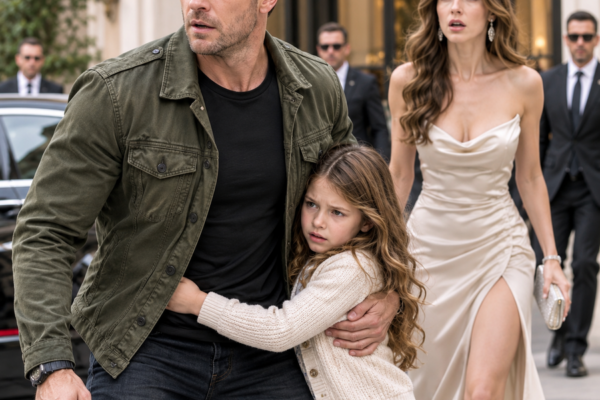
“You Won’t Last Ten Seconds on My Mat” — He Humiliated a Quiet Single Father in Front of His Seven-Year-Old Daughter, Never Guessing the Man in the Gray Jacket Had Spent Twenty-Three Years Learning Exactly Where to Stop
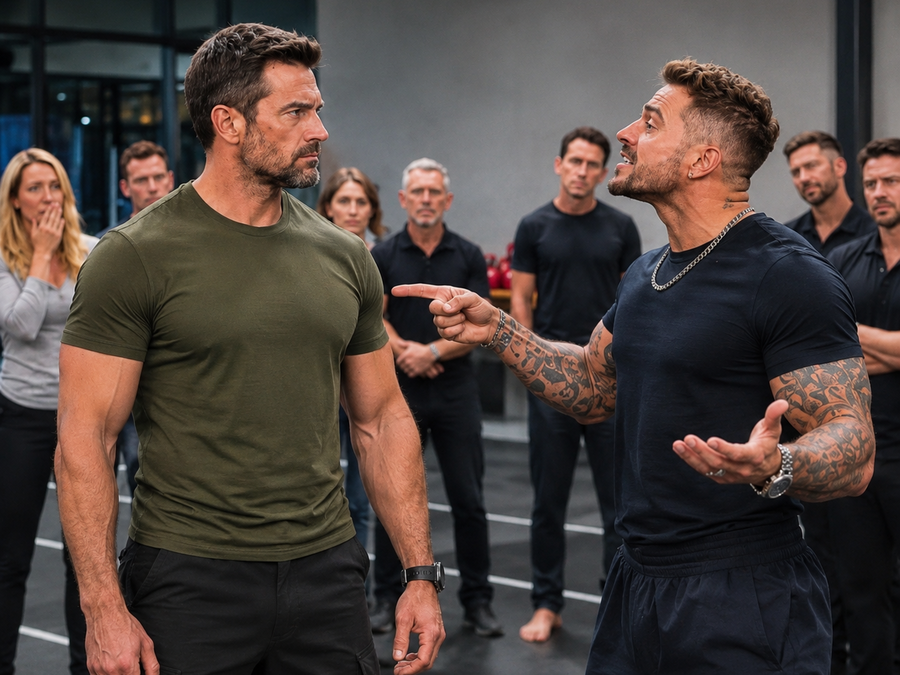
“You Won’t Last Ten Seconds on My Mat” — He Humiliated a Quiet Single Father in Front of His Seven-Year-Old Daughter, Never Guessing the Man in the Gray Jacket Had Spent Twenty-Three Years Learning Exactly Where to Stop
Derek Lawson pointed his finger directly at Adrian Carter’s chest and laughed loud enough for the entire gym to hear.
You old man, you won’t last ten seconds on my mat.
The room exploded with laughter.
Adrian didn’t flinch.
He didn’t step back.
He didn’t say a single word.
He just looked at his seven-year-old daughter standing near the wall and watched her smile slowly disappear. That was the moment everything changed.
Not because a tired mechanic decided to fight a champion, but because a father decided his little girl would never forget what dignity looked like.
The punch came out of nowhere. Not at Adrian, not yet.
It landed two inches from the face of a sixteen-year-old kid named Marcus, a new student who had probably been at the academy for three weeks.
The impact of Derek Lawson’s fist stopping just short of the boy’s nose was so sudden, so precise, that Marcus stumbled backward and nearly knocked over the folding chairs lined up along the gym wall.
The room did not gasp in horror. It erupted in applause.
That’s control, Derek announced to his students, turning away from Marcus like the boy was a prop he’d already finished using.
That’s what ten years of discipline looks like.
You don’t just train your body, you train your mind, and your mind decides exactly where the fist stops.
He was still smiling when he turned and saw Adrian Carter standing just inside the entrance doors.
Most people wouldn’t have noticed Adrian at all.
That was the thing about him.
He had the kind of face that didn’t demand attention.
Steady eyes, weathered skin from years spent under fluorescent lights in a machine shop, hands that were calloused and scarred in ways that had nothing to do with competition.
He was wearing a plain gray jacket, the kind you buy for twelve dollars at a discount store. He had a small girl beside him, holding his hand.
She was seven years old.
Her name was Mia.
She had her mother’s eyes and her father’s quiet way of watching the world like she was taking notes on everything she saw without writing a single thing down.
They had driven forty minutes to get here. Adrian had promised her three months ago, after an incident at school where two older boys had cornered Mia near the playground fence and told her she was too small to do anything about it.
She had come home and cried for an hour.
Not the loud, falling-apart kind of crying. The quiet kind.
The kind that breaks something in a father’s chest that never fully heals back together the same way.
He had held her and promised her, I’m going to find you a good place to learn.
A real place.
Not just kicks and punches.
A place where they teach you to be strong on the inside first. He had researched the Lakewood Martial Arts Academy for six weeks, read the reviews, watched three videos of their open exhibitions.
The head instructor, Master Calvin Hughes, had a reputation for being the real thing.
Someone who believed martial arts was a philosophy before it was a sport.
What Adrian hadn’t fully accounted for was Derek Lawson.
Derek was the kind of man who filled a room before he even opened his mouth. Six foot one, built like someone who had been working toward a specific image for years and had finally arrived there.
He had the posture of a man who had been told he was exceptional so many times that he’d stopped questioning whether it was true.
And in fairness, by most visible measures, it was true.
Twenty-two tournament victories, three regional championships, a sponsorship deal with a sports equipment company that put his face on a banner outside the academy’s entrance.
Online, he had built an audience of nearly ninety thousand followers by posting training clips that were genuinely impressive. Speed, precision, athleticism that was real, not manufactured.
But something had shifted in Derek over the past two years. His old training partner, a guy named Russell, who now ran a small gym in Phoenix, had tried to name it once in a phone call that ended badly.
Man, you stopped competing against other fighters a long time ago.
Now you’re just competing against your own image.
Derek had hung up.
He didn’t like things he couldn’t argue with.
The exhibition that Saturday afternoon was supposed to be a recruitment event.
New families, new students, a chance for the academy to show parents what kind of training their children would receive. Master Hughes had organized it carefully.
Demonstrations, technique breakdowns, a Q&A session at the end.
Derek wasn’t the featured instructor.
He was supposed to assist.
But Derek had a habit of making himself the main event wherever he was. He had already run through two demonstrations before Adrian arrived, and both had gone exactly the way Derek preferred, with the audience watching him like he was performing a kind of magic.
He moved beautifully. That part was true.
When Derek wanted to remind people why he mattered, he had the ability to make every technique look effortless in a way that made everyone watching feel the gap between themselves and him. It was intoxicating to watch.
It was also, Adrian would think later, exactly the kind of performance that had nothing to do with actual martial arts.
Derek noticed Adrian within thirty seconds of him walking in.
He noticed him the way certain people notice anyone who doesn’t immediately recognize them, with a mild reflexive irritation.
Adrian hadn’t reacted to the demonstration.
Hadn’t leaned forward.
Hadn’t whispered to his daughter with wide eyes.
He had simply stood near the entrance and watched with an expression that Derek couldn’t read.
And that unreadable expression bothered him in a way he didn’t examine too closely.
He finished the sequence he was demonstrating, let the applause land, and then turned toward the entrance with an easy smile.
Hey, welcome, Derek called across the gym, but his voice had the specific warmth of someone performing welcoming rather than actually feeling it. You here to sign the little one up?
We’re just looking, Adrian said.
Come in, come in, plenty of room, Derek gestured broadly, like a man inviting someone into his own home. You can sit in the back.
We’ve got chairs.
We’re fine here.
Something about that answer, quiet, complete, not defensive but also not accommodating, landed wrong for Derek. He laughed, but it was the kind of laugh that asked a question.
You train?
Derek called over.
Yeah?
Derek cocked his head.
Where?
Different places, Adrian said.
Mia tugged her father’s hand.
Dad, she whispered, that guy is staring at you.
I know, Adrian said. Not quietly enough.
A few of the nearby parents heard it and looked down to hide their smiles. Derek heard it, too.
The moment that tipped everything over happened twenty minutes later.
Derek was midway through a technique breakdown, explaining the mechanics of how to control a larger opponent using leverage rather than raw strength, when he called for a volunteer from the audience.
Several students raised their hands. He ignored them.
He pointed at Adrian.
You. Gray jacket.
He was already smiling. Come show these kids what used to train looks like.
The room turned.
Adrian didn’t move immediately.
He looked at Mia. She was watching Derek with the particular wariness that children have for adults who are being unkind while pretending not to be.
It’s okay, Mia said softly.
You don’t have to.
That was the thing about his daughter. She always knew when something was wrong before she could name it.
Adrian looked back at Derek.
I’m here with my daughter, he said evenly.
We’re just watching.
Derek tilted his head. Come on.
You said you used to train.
Let’s see it.
Five seconds.
Just a basic stance.
He turned to the audience and widened his smile. Parents usually sit in the back and look at their phones.
They don’t actually know anything.
Maybe this guy’s different.
Light laughter from a few of the students.
Not all of them.
Some of them looked uncomfortable.
A boy in the front row, maybe twelve years old, looked at his own father who was sitting in the chairs, and the father gave a small, almost invisible shake of his head.
Adrian felt the shift in the room. He felt the particular pressure of a crowd being arranged against him.
Not out of malice from most of them, but because they didn’t know what else to do except follow the energy of the person holding the floor.
He’d felt that pressure before, a long time ago, and he knew something Derek didn’t know he knew.
That pressure was a trap.
You either reacted to it emotionally, which was what it wanted, or you found the stillness underneath it and stood on that instead.
I’m not looking for a demonstration, Adrian said.
Nobody is, Derek shot back smoothly, and now the smile had something harder underneath it.
That’s the whole point.
Let’s just see what you actually know.
Unless he paused, letting the pause do its work. You only trained in theory?
The laughter was louder this time.
Mia’s hand tightened around her father’s.
Adrian looked down at her.
Her chin was lifted.
She wasn’t afraid, exactly, but her eyes were asking him something.
Not what are you going to do, but who are you going to be right now in front of all these people? He had asked himself that question before.
The first time was the night of the accident, standing in a hospital hallway, a doctor telling him in careful quiet words that his wife Claire, thirty-one years old, still had half a library book on her nightstand at home, wasn’t going to make it.
And someone needed to make decisions about her care in the next ten minutes. He had asked himself that night, who are you going to be?
And he had found out. He looked back up at Derek.
You want me on the mat, Adrian said.
Derek smiled.
If you think you can handle it.
I’m not worried about what I can handle, Adrian said.
And his voice was so completely calm that several people near him turned to look at him more carefully, as if seeing him for the first time.
I’m just making sure you know what you’re asking for.
The gym went very quiet.
Derek’s smile didn’t waver, but something behind his eyes changed.
A flicker of something he wouldn’t let himself name.
I won’t last ten seconds.
Isn’t that the line?
Adrian said.
Derek laughed.
I mean, look— None taken, Adrian said.
And slowly removed his jacket. He handed it to Mia.
She held it with both hands and watched her father walk toward the mat.
What the audience saw when Adrian Carter stepped forward was, on the surface, unimpressive.
He wasn’t built like Derek.
He wasn’t young like Derek.
He wasn’t performing anything.
He walked to the center of the mat the way a man walks through his own living room. Not because he was relaxed, but because he had decided at some point a long time ago that the space he occupied was his, no matter where he was.
What the audience couldn’t see was the twenty-three years behind that walk.
Adrian had started training at eleven years old in a small gym above a laundromat in Cincinnati, under an instructor named Dale Merritt, who charged fifteen dollars a month and didn’t allow anyone in the gym who wasn’t willing to sweep the floor.
Dale had a saying that he repeated so often it became part of the air in that building.
The belt around your waist doesn’t mean anything.
The one thing it can tell you is that you showed up.
What you did when you showed up, that’s everything.
By the time Adrian was seventeen, he had a strong foundation in judo and had begun serious study in Brazilian jiu-jitsu.
He wasn’t a prodigy.
He was something rarer. A student who never got bored with fundamentals.
He practiced the same sweeps and escapes thousands of times, not because someone made him, but because he had figured out that mastery wasn’t about knowing more techniques.
It was about knowing a small number of things so deeply that they became reflexes, became breathing, became part of the body’s own language.
He competed occasionally, but he was never driven by competition the way some fighters were.
Dale had identified that in him early.
You don’t need the audience, Dale told him once.
Some fighters only come alive when people are watching.
You come alive when you’re solving the problem.
That’s better.
Lasts longer.
When he was twenty-three, Adrian met Claire at a friend’s birthday dinner.
She was a middle school science teacher who had strong opinions about coffee, terrible taste in action movies, and a way of asking questions that made you want to give her honest answers instead of comfortable ones. Six months later, he was more in love than he had known was possible.
Training became less central as life filled in around it. Work, Claire, eventually Mia, the endless and joyful logistics of building something together.
He never stopped entirely. A few nights a week in the garage with a heavy bag, occasional rolling sessions with a friend from the old days.
But it moved to the background. Then Claire was gone.
A delivery truck ran a red light on a Tuesday morning in October.
She was driving to school. The driver walked away without serious injury.
Adrian spent the next year doing what he needed to do to survive. And then, because Mia needed more than survival, doing what he needed to do to rebuild.
He didn’t return to serious training.
He didn’t have time.
But the discipline of it never left him.
It had become structural.
Like bones.
You don’t think about your skeleton.
It’s just what holds you up.
Derek faced him across the mat.
And for just a moment, the performance dropped.
Something in Adrian’s stance made Derek recalibrate unconsciously, the way a veteran poker player adjusts when someone sits down across from them and the table feels different without them being able to say exactly why.
You sure about this?
Derek said.
You started it, Adrian said.
And there was no heat in it. It was just a fact.
Derek exhaled sharply.
And the smile came back. And he moved.
He was fast. Genuinely fast.
The speed that had won him championships was real. And it came at Adrian like a closing door.
Adrian didn’t block.
He moved.
A single step to the left, a slight pivot of the hips.
And Derek’s momentum carried him past the spot where Adrian’s body had been a half second earlier.
Derek recovered quickly.
He was too experienced not to.
But the instant of confusion was visible.
The room was already quieter than it had been. Lucky, someone muttered.
Derek’s jaw tightened and he came again, lower this time, driving forward.
Adrian met the energy differently.
Not with resistance, but with redirection.
One hand guiding the motion like water finding the path around a stone. Derek found himself off balance for the second time in thirty seconds.
And he straightened up and looked at Adrian with an expression that had stopped being performative. Where did you train?
Derek said.
Lot of places, Adrian said.
You already— I’m asking seriously this time.
Dale Merritt. Cincinnati.
And then about four years in São Paulo doing jiu-jitsu.
And then life got full.
Adrian paused.
I’m a little rusty.
A few people in the audience laughed.
Not the mean laughter from before, but something warmer, something that had changed direction.
Derek heard the difference, and something in him didn’t like that the room had changed direction.
Didn’t like that the man he’d brought out here to prove a point had somehow, without raising his voice or throwing a single aggressive move, made Derek feel like the one who was being watched.
Let’s go for real, Derek said.
We don’t have to, Adrian said.
I want to.
I know you do, Adrian said.
That’s what worries me.
The words landed softly, but they landed.
Derek attacked with real intent the third time, and what happened next was the kind of thing that stayed in the memory of everyone who saw it.
Not because it was violent or spectacular, but because it was so utterly controlled that it seemed to operate by different rules than the rest of what they’d witnessed that afternoon.
Derek launched his strongest technique, a combination he had landed in actual competition against trained opponents more times than he could count. Adrian stepped into it.
Not away, not sideways.
Into it.
He moved inside Derek’s reach, where power goes to die, where leverage belongs to the person who understands angles and timing rather than the person who generates force.
In one fluid motion, so quiet it almost looked accidental, he controlled Derek’s arm, shifted his own weight, and brought Derek to the mat.
Not a slam.
Not a throw designed to humiliate.
A clean technical takedown that stopped Derek’s body exactly where Adrian intended to stop it.
Derek was on his back on the mat, looking up at the lights. Adrian was standing over him.
And then Adrian stepped back.
Not forward.
Back. He offered his hand.
The room was completely silent. Derek stared at the offered hand for a long moment.
Why? he finally said.
Why’d you stop?
Adrian’s answer was quiet enough that the people in the back of the room leaned forward without realizing they were doing it.
Because this was never about beating you, Adrian said.
It was about showing my daughter that you don’t have to become the thing that comes at you.
The silence held for another moment. Then, from the back of the room, near the folding chairs, where the parents sat with their phones and their coffee cups and their Saturday afternoon tiredness, a sound began.
One person started clapping. Then another.
Then Mia Carter, seven years old, holding her father’s gray jacket in both hands, put her fingers in her mouth and let out a whistle that could have cracked glass.
And the room came alive. Derek Lawson lay on the mat for three seconds longer than he needed to.
He was not injured. He was thinking.
He had been beaten before. In competition.
Twice. He had handled both losses the way he handled everything uncomfortable, by moving through it faster than it could touch him, filing it away under factors outside my control and moving on.
But this was different.
This was different because the man standing over him, offering a hand, wasn’t gloating, wasn’t performing victory, wasn’t even looking at the crowd.
He was looking at his daughter.
PART 2
And his daughter was looking back at him like he had just answered a question she’d been carrying for months.
Derek had spent ten years training to be looked at that way. He had never once been looked at that way.
He took Adrian’s hand.
And when he stood up, something in the room had permanently shifted. In the crowd, in the academy, and in something quieter and harder to name inside Derek Lawson himself.
Outside, through the tall windows at the front of the gym, the afternoon was doing what Saturday afternoons do.
Slowing down.
Going golden.
Getting ready to become something you’d remember differently than you expected.
Adrian found Mia waiting for him at the edge of the mat.
She didn’t say anything at first.
She just handed him his jacket back.
Then she looked up at him.
Dad, she said, that guy called you old. He did.
You’re not old.
I appreciate that.
You’re just, she considered.
Slow-looking.
Adrian Carter looked at his daughter for a long moment.
And then he laughed.
A real, full laugh, the kind that comes from somewhere deep and hasn’t had an easy time getting out lately.
He put his jacket on and took her hand, and they walked toward the exit of the Lakewood Martial Arts Academy on a Saturday afternoon. And behind them, the room was still buzzing, still processing what it had seen.
And Derek Lawson was standing in the middle of the mat, staring at the door that had just closed behind them, like a man trying to read a sentence he’d already let get too far away.
The door had barely closed behind Adrian and Mia before the gym erupted.
Not in applause this time. In noise.
The specific kind of noise that happens when a room full of people all try to process the same unexpected thing at the same time, and nobody has the right words yet, so they fill the silence with volume instead. Derek was still standing in the middle of the mat.
His chief assistant, a sharp-faced young man named Tyler, who managed Derek’s social media and had been filming the entire exhibition on a mounted camera in the corner, walked up beside him with a look on his face that Derek had learned to interpret as this is going to be complicated.
That was— Don’t, Derek said.
Derek, I— I said don’t.
Tyler pressed his mouth shut. He had worked alongside Derek for two years, and he had learned in those two years that there was a specific quiet that came over Derek when something had gotten underneath the armor.
And the worst thing you could do in that quiet was say something that required an answer.
The students were still buzzing. Parents were pulling out phones, asking each other if anyone had caught the whole thing on video.
Master Calvin Hughes, the academy’s head instructor, was standing near the back wall with his arms folded and an expression on his face that was difficult to read.
Not quite a smile, not quite concern, but something that lived in the exact middle between the two.
Derek walked off the mat. He walked past Tyler.
He walked into the back hallway where the training equipment was stored and the lockers ran along both walls. And he sat down on the wooden bench between two rows of metal doors, and he put his hands on his knees, and he stared at the floor.
His hands weren’t shaking.
He told himself his hands weren’t shaking.
They were. Just barely.
Not from physical exertion.
He hadn’t been seriously tested, and that was the thing that sat in his chest like a stone he couldn’t move.
He hadn’t been seriously tested, and he had still lost.
Not just lost the match.
Lost the room. Lost the narrative.
Lost the thing he relied on without ever fully admitting he relied on it.
The certainty that when he walked into a space, the space rearranged itself around him.
He could still hear the sound of the room when it had shifted. When the laughter stopped being aimed at the gray-jacketed mechanic and started being something else entirely.
When he heard Mia Carter’s whistle cut through the air and the applause begin.
He replayed that moment in his head and felt something he hadn’t felt in a long time.
Something that tasted like shame. He was twenty-nine years old.
He had been training since he was eight. He had given more hours to this discipline than most people give to anything.
And he was good at it.
Genuinely good at it.
Not just the performed version of good, but the real, technical, painfully earned version.
And somehow a tired-looking thirty-four-year-old with calloused hands and a twelve-dollar jacket had walked onto his mat, in his gym, in front of his students, and made Derek feel like a student himself.
Not because he’d been outfought.
Because he’d been outclassed.
And Derek understood the difference.
And he understood it the way you understand something that changes everything once you see it, and that you can’t unsee, no matter how much a part of you wants to.
The back door of the locker room opened and Master Hughes walked in.
He didn’t say anything right away.
He pulled a folding chair from beside the storage shelf and set it directly across from the bench where Derek was sitting, and sat down in it. And the two of them sat there in the low light of the hallway with the sound of the gym filtering through the door behind Hughes.
Hughes was sixty-three years old. He had been training in martial arts since before Derek was born.
And there was something in the way he occupied a room, even a back hallway with bad fluorescent lighting and the smell of old sweat, that made the room feel intentional. Like he had decided to be there fully.
And that decision was enough. He waited.
Derek finally looked up.
Go ahead, Derek said.
I’m not going to say anything you don’t already know, Hughes said.
Then why are you back here?
Because knowing something and sitting with it are different things, Hughes said.
And you’ve spent a long time not sitting with things.
Derek exhaled through his nose. He got lucky with the setup.
If I hadn’t been holding back because of the audience— Derek.
I’m serious.
If I had gone full— Derek.
Hughes’s voice didn’t rise.
It never rose.
That was one of the things about him that had always unnerved Derek slightly.
You couldn’t provoke him.
You couldn’t make him perform anger or perform patience.
He simply was whatever he was. And you could take it or leave it.
Stop.
Derek stopped. What did you feel when he stepped into you?
Hughes said.
Derek was quiet for a moment.
Surprised, he said finally. Why?
Because I expected him to pull back.
That’s what people do.
When I commit to that attack, people pull back and try to create distance.
He moved the wrong direction. He came inside.
The wrong direction, Hughes repeated.
And let it sit. Derek heard it.
He heard the weight inside those three words.
He ran his hand back through his hair and made a sound that wasn’t quite a laugh.
He knew what he was doing, Derek said. Yes.
He’s trained seriously.
Not just some guy who took a few classes.
No. Not just some guy.
Hughes leaned forward with his elbows on his knees. I know who he is.
Not personally, but I know his old instructor.
Dale Merritt.
Old school.
Cincinnati.
Merritt used to send his best students down to a jiu-jitsu program in Brazil.
Adrian Carter trained with one of the sharpest ground fighters in South America for four years.
He doesn’t have a tournament record because he never chased one.
But his foundation is— Hughes paused and seemed to choose the word carefully. Exceptional.
Derek stared at him.
You knew.
I recognized him when he walked in.
And you didn’t.
You had already started.
Hughes said it simply.
And honestly. I was curious.
Derek looked at him for a long moment.
Curious about what? Hughes met his eyes.
About whether you were going to learn something today or just walk away from it. The hallway was quiet.
From the gym, the sound of voices had settled into the lower hum of conversation winding down. People gathering jackets.
Parents calling to kids. The ordinary sounds of an afternoon event finishing up.
Derek said, what do I do with this? And Hughes said, that depends on how you decide to be about it.
He stood up.
He put the folding chair back where he’d found it.
He left his number with the front desk, Hughes said, for Mia’s enrollment consultation.
He walked back toward the gym door and then paused with his hand on the door frame and didn’t turn around.
You made it personal, Hughes said.
He didn’t.
That’s the whole story right there.
Derek, if you’re honest with yourself, then he was gone.
And Derek was alone with something he hadn’t asked for and didn’t know what to do with yet.
The clock on the locker room wall read 4:47 in the afternoon.
He sat there until it read 5:12.
Then he stood up, put on his jacket, and walked back out into a gym that suddenly felt different than the one he’d walked into that morning.
He wasn’t sure if it was the gym that had changed.
That was the problem.
That was the thing he couldn’t argue with.
A week passed. The video Tyler had taken at the exhibition was pulled before Derek had had a chance to post it, but someone in the audience had been filming on a personal phone, and that clip found its way onto a local community Facebook page within forty-eight hours.
It was only three minutes long and the angle was bad, but it was enough.
By the following Wednesday, it had been viewed nine thousand times and shared into three different martial arts forums, where the responses ranged from admiring to skeptical to the kind of keyboard debate that generates more heat than light. Derek watched the video once alone at one in the morning.
Then he closed the tab and didn’t open it again.
But he couldn’t close the thing the video had reopened inside him.
He started noticing things in his teaching that he had stopped noticing.
On Tuesday morning, he ran a class for the intermediate students, twelve kids between the ages of ten and fifteen, a group he usually enjoyed because they were past the raw beginner stage and starting to develop real technique.
He had them drilling the same defensive combinations for forty minutes. And halfway through, he realized he was bored.
Not with the students.
With himself.
With the version of himself standing in front of them.
He was going through it mechanically. Counting repetitions, correcting form, saying the right instructional words in the right order.
But he was somewhere else entirely in his head, and the kids could feel it. They always feel it.
The way kids always feel it when the adult in front of them is performing presence instead of actually being there. A girl named Priya, thirteen years old, one of the sharpest students he had, put her hands down between repetitions and said, Are you okay?
I’m fine, he said automatically.
She looked at him with the particular patience that people develop when they’re used to adults not telling them the truth.
You seem distracted, she said. Focus on your footwork, Priya.
I have been, she said.
That’s why I noticed.
He stared at her. And then something moved in his chest, and he said, Take five.
Everyone.
The students scattered toward the water fountain and their bags. Derek walked to the edge of the mat and stood there looking at the wall where his tournament banners hung.
Seven of them.
Framed.
The colors still bright. He thought about what Adrian Carter had said.
Because this was never about beating you.
It was about showing my daughter that you don’t have to become the thing that comes at you.
He had replayed that sentence approximately three hundred times in the past week.
He had turned it over from every angle.
He had tried to find the flaw in it. The showmanship.
The manipulative construction of it.
Because if it was just a well-timed line, he could dismiss it.
He was good at dismissing well-timed lines.
But it wasn’t a line.
That was what he kept arriving back at.
Adrian Carter had not said it to the room. He had said it despite the room.
His voice had been quiet enough that half the audience had barely heard it.
He hadn’t been performing a lesson.
He had been answering a question Derek asked because Derek actually wanted to know.
And the honesty of that was the thing Derek couldn’t defend against.
Priya had appeared at his elbow. Derek, she said.
Can I ask you something? What?
That video.
The one from Saturday.
She hesitated. Were you trying to embarrass him?
The guy with the little girl? Priya— Because when I watched it, it looked like you were.
And you always tell us not to do that. You tell us martial arts is about respect.
He turned and looked at her fully. She was thirteen years old, ninety pounds, and she was holding his gaze with more steadiness than most adults managed.
You’re right, he said.
Priya blinked. She had clearly prepared for more resistance.
Oh, she said. I know, he said.
Don’t get used to it.
One side of her mouth curved up.
Okay, she said, and walked back to the mat.
He watched her go and thought, she learned that from somewhere.
That quality of saying an uncomfortable thing without cruelty and then letting the other person handle it on their own.
She was too young to have arrived at that naturally.
Someone taught her that or modeled it.
He thought about Mia Carter.
Seven years old, putting her fingers in her mouth and whistling.
He thought about what it must mean to be someone’s daughter and watch your father decide in real time who he was going to be.
He picked up his phone. He looked at the number the front desk had given him.
He put the phone back down. He picked it up again.
He stood there for a long enough time that his intermediate students came back from their break and stood on the mat looking at him.
Waiting. And he said, All right, come in.
Today we’re going to talk about something different.
We’re going to talk about why we train.
He paused. And I mean the real reason.
Not the one that sounds good. The actual one.
They sat down in a loose circle. Who wants to go first?
The kids looked at each other.
Then Priya raised her hand.
I want to feel like I’m not afraid, she said.
The room was quiet. Okay, Derek said.
Okay.
That’s the most honest thing anybody’s said in this gym in a long time.
He looked around at the rest of them. What about you?
The class went forty minutes overtime. Nobody noticed until afterward.
That evening, Derek drove to a hardware store and then to the gym after hours, and he rearranged the front space slightly.
Moved a few things around.
Took down one of the tournament banners that had been hanging at eye level and replaced it with a printed card that said, in plain block letters, what Dale Merritt had once told his students in Cincinnati. The belt tells you that you showed up.
What you did when you showed up, that’s everything.
He had looked it up after Hughes mentioned Merritt’s name.
He stood back and looked at the card on the wall for a long moment.
Then he took out his phone and typed a text message. Mr.Carter, my name is Derek Lawson.
I believe you were in my— in the Lakewood Academy on Saturday.
I’d like to talk.
Not about what happened on the mat.
About Mia’s enrollment.
I’d also like to apologize in person if you’re willing to hear it.
You don’t owe me that.
I just think it matters. He read it twice.
He sent it. He sat in the dark gym for twenty minutes waiting for a response, which he knew was unreasonable given that it was past nine at night and the man had a seven-year-old daughter and probably went to bed at a sensible hour.
His phone buzzed. Tomorrow works.
6:00 p.m.My daughter goes to bed at 8:00, so don’t be late.
Derek actually smiled. Not the performance smile.
The real one.
The one he hadn’t fully used in long enough that it felt slightly unfamiliar, like a coat you’d forgotten you owned.
He typed back.
I won’t be.
Then, after a moment, he added, Thank you.
The response took only a few seconds.
Don’t thank me yet.
I make bad coffee.
This time the smile stayed. He set his phone face down on the mat beside him.
And in the quiet of the empty gym, with his tournament banners on the walls and the new card sitting underneath them, Derek Lawson sat still and let the day settle over him.
The discomfort and the embarrassment and the strange, fragile beginning of something he didn’t have a name for yet.
Outside the gym windows the street was ordinary. Passing headlights.
A dog barking somewhere.
The sound of someone’s radio two buildings over playing something too faint to identify.
He was still there at 10:30 when his phone buzzed again. Tyler this time.
That clip’s at 22K views.
Dude, what do you want me to do?
Derek stared at the message for a long time. Then he typed nothing.
Leave it, Tyler.
Are you serious? This could be a whole brand moment if we handle it right.
Derek. Leave it, Tyler.
A pause. Tyler: Okay, man.
You good? Derek looked at the card on the wall.
The plain block letters. The belt tells you that you showed up.
He typed, Yeah.
I think I’m getting there.
The next evening at exactly six o’clock, Derek knocked on the door of a small house on Date Street with a cracked front step and a child’s bicycle leaning against the porch railing.
The basket decorated with plastic flowers that had faded but not been removed.
The door opened. Adrian Carter was wearing a faded blue t-shirt and holding a dish towel.
He looked exactly like what he was.
A working man who had just finished making dinner for his daughter.
Hey, Adrian said, standing in his own doorway, giving nothing away. They looked at each other.
You’re on time, Adrian said.
I said I would be. Adrian nodded slightly and stepped back to let him in.
The house smelled like pasta sauce and something lemon-scented from the kitchen.
There were drawings on the refrigerator, held up with magnet clips. Crayon work.
PART 3
Abstract shapes and what might have been a horse or possibly a very ambitious dog. Derek stepped inside and noticed immediately that there were no trophies visible.
No framed medals.
No certificates.
On the wall near the door was a single framed photograph of a woman with dark hair and a wide laugh, caught mid-sentence, the way the best photographs always catch people. Unposed.
Alive.
Real.
Beside the photograph was a small drawing, clearly a child’s, of a man and a girl holding hands under a yellow sun.
Derek looked at it for only a moment, but Adrian saw him looking. My wife, Adrian said without weight or performance.
Just a fact.
Just Claire.
She’s beautiful, Derek said.
He meant it. Yeah, Adrian said.
She was.
A small voice came from somewhere down the hall. Dad, is that the karate man?
Adrian’s entire face changed.
Something warm moved through it that Derek had not seen in the gym.
A loosening.
A softening that turned the controlled stillness into something openly human. Jiu-jitsu, Adrian called back.
And yes.
Rapid footsteps. Mia Carter appeared in the hallway doorway with pasta sauce on her left sleeve and the absolute certainty of a child who has decided she is not afraid of anything.
She looked at Derek directly. Derek looked back.
You said my dad wouldn’t last ten seconds, she said.
Derek opened his mouth. He lasted way longer than ten seconds, Mia continued.
I counted.
I don’t know exactly how many seconds, but it was a lot more than ten.
You’re right, Derek said.
I was wrong.
Mia considered this. The pasta sauce on her sleeve caught the kitchen light.
Okay, she said, with the gravity of a judge rendering a verdict.
You can come in.
Adrian looked at Derek with an expression that somehow managed to say I’m sorry and you earned this at exactly the same time.
Derek walked into the kitchen of a house that didn’t belong to him and sat down at a table covered in second-grade math worksheets.
And Adrian Carter poured him a cup of coffee that was in fact genuinely bad. And two men who had stood across from each other on a mat twenty-four hours ago sat down and began, carefully and honestly, to talk.
Mia sat in the chair between them.
She hadn’t been invited to.
She simply decided she would.
Neither of them asked her to leave. Adrian wrapped both hands around his own coffee mug and said, My instructor used to say something.
He said the mat doesn’t lie.
Whatever’s inside you, sooner or later the mat shows it.
Derek was quiet. Then what did the mat show about me?
Adrian looked at him steadily. You already know.
I want to hear you say it. Okay.
Adrian set down his mug.
You’re scared.
Not of being beaten.
You can handle losing a match.
You’re scared of being irrelevant.
You’ve built an identity on being the most impressive person in every room.
And somewhere along the way that stopped being about the training and started being about the audience.
And you know it. Which is why it hit you the way it did on Saturday.
The kitchen was very quiet.
Mia was eating a piece of bread, watching Derek with large, serious eyes.
That’s accurate, Derek said.
And the two words cost him something.
I’m not saying it to hurt you, Adrian said.
I know.
I’m saying it because— Adrian paused.
And for a moment something crossed his face that was older and harder and more private than anything he’d shown in the gym.
I know what it’s like to be afraid of the wrong thing.
I spent a year after my wife died afraid of the wrong things.
Afraid of people seeing that I wasn’t coping.
Afraid of Mia seeing that I wasn’t strong.
He glanced at his daughter, who was still watching with her bread halfway to her mouth. And I was so focused on not looking broken that I almost forgot to actually heal.
The bread made it the rest of the way to Mia’s mouth.
You’re better now though, she said factually.
I’m better now, he agreed.
Derek sat with that for a moment.
The straightforward weight of it.
The way Adrian Carter told the truth about himself without needing it to be admired or approved or carefully framed.
How do you do that?
Derek said. Do what?
Say those things.
Out loud.
Like they don’t cost you anything.
Adrian almost smiled.
They cost plenty.
I just stopped pretending they didn’t.
Derek looked down at the terrible coffee.
He thought about Priya.
I want to feel like I’m not afraid.
He thought about Tyler. This could be a whole brand moment.
He thought about twenty-two thousand people watching a three-minute clip and all of them missing the thing that actually mattered in it.
Which was the twelve seconds after the throw.
The moment Adrian stepped back.
The moment he offered his hand.
The moment the room held its breath waiting to find out who these two people were going to be. I want to learn from you, Derek said.
It came out before he’d fully decided to say it.
He didn’t take it back.
Adrian looked at him, not with surprise, but with the particular stillness of someone who is deciding how seriously to take what they’re hearing.
That’s a bigger ask than you think it is, Adrian said.
I know.
You have ninety thousand followers.
You have sponsors.
You have students who think you hung the moon.
Coming to me means admitting in front of all of that that you have something left to learn. I do have something left to learn.
The question isn’t whether you believe that right now, Adrian said.
The question is whether you’ll still believe it in six weeks when it’s inconvenient.
The kitchen clock made its quiet second-by-second sound.
Mia had finished her bread and was looking back and forth between them like this was the most interesting thing she’d seen since the exhibition.
Okay, she said.
Both men looked at her.
He should do it, she told her father.
With complete certainty. He said sorry.
That means he means it.
Adrian looked at his daughter. Something moved behind his eyes.
Then he looked back at Derek.
She’s got pretty good instincts, he said.
I’ve gathered, Derek said.
Adrian picked up his coffee mug.
Tuesday nights, he said.
After Mia’s in bed.
We roll. I correct.
You don’t argue with corrections.
You have questions, you ask them honestly.
You bring the ego to my mat, I send you home.
That’s the deal.
Derek extended his hand across the math worksheets and the pasta-stained table.
Deal, he said. Adrian took it.
Not the formal handshake of two professionals agreeing to terms. Something quieter and more real than that.
The handshake of two people who have each, for their own reasons, decided to trust the other with something important.
Mia watched them shake hands and then picked up her bread again and said, He makes really bad coffee, by the way.
I know, Derek said.
I’ve had it.
You drank it anyway.
I did.
She seemed to find this satisfactory. She climbed down from her chair and walked toward the hallway.
Then stopped and turned back around.
Derek, she said. He looked at her.
Next time you say somebody won’t last ten seconds, she said, with the absolute moral certainty of a seven-year-old who has thought about this carefully, maybe don’t say it in front of their kid.
She disappeared down the hallway.
Derek sat there. Adrian was looking at the space where his daughter had been.
And the expression on his face was the one that belongs only to parents in moments when their children exceed them.
A complicated, beautiful, slightly undone look that has no single word for it in any language.
She’s going to be something, Derek said.
She already is, Adrian said quietly.
The kitchen settled back into its ordinary sounds.
The clock. The refrigerator hum.
The last of the daylight going gray through the window above the sink. Derek thought about what it must feel like to have built something that good.
That real.
Not from championships or recognition or ninety thousand followers, but just from showing up every day and deciding over and over again who you were going to be.
He thought that might be the hardest thing he’d ever tried to learn.
And sitting in that kitchen with its crayon drawings and its bad coffee and its second-grade math homework and the photograph of a woman who was no longer here but was somehow still very present, Derek Lawson felt, for the first time in longer than he could clearly remember, like a student. Not a champion.
Not a brand. A student with everything still ahead.
The first Tuesday night arrived faster than Derek expected.
He pulled up to Adrian’s house at 6:58 p.m., two minutes early, and sat in his car for those two minutes because Adrian had said seven o’clock and Adrian seemed like the kind of man who meant exactly what he said.
The street was ordinary.
A neighbor’s porch light was on.
Somewhere down the block, a lawn mower had just cut off, leaving the evening with that particular after-silence that feels louder than the noise that preceded it.
At exactly seven o’clock, Derek got out of the car.
He knocked.
Adrian answered immediately, like he’d been standing on the other side of the door.
He was wearing training clothes.
Plain black shorts, a gray compression shirt. Nothing branded.
Nothing performing anything.
He looked at Derek and gave one nod.
Mia asleep? Derek asked.
She fought it until 6:45, Adrian said.
Told me she wanted to watch the training.
I told her it wasn’t a show.
What did she say to that?
She said everything is a show if you pay attention. Derek absorbed that.
She’s seven, he said.
I know, Adrian said, and something in his voice carried both pride and the specific exhaustion of a father who has been routinely out-thought by someone who still needs help tying her shoes.
The garage had been cleared enough to make a workable training space.
Not fancy.
Not equipped with the kind of gear Derek had at the academy.
No wall-to-wall mats with logos. No mirrored walls.
No equipment racks with brand labels facing out. There was a section of interlocking foam mat, maybe twelve by fourteen feet.
A heavy bag in the corner that had seen serious use.
The leather cracked along the bottom third.
A wooden shelf with a few books on it.
Dale Merritt had apparently written one.
A thin volume with a plain cover that Derek found himself wanting to read.
And on the concrete floor beside the mat, two bottles of water. No labels.
That was it. Derek thought about his gym with its sponsored lighting and its video camera positions and its tournament banners and felt the contrast like a physical thing.
Ready?
Adrian said. Yeah.
We’ll start with fundamentals.
Derek was a regional champion with two decades of training. He had been told in many ways and many settings how good he was.
The word fundamentals landed differently than it was probably intended. And something involuntary moved through his chest.
Something that wanted to say, I’m past fundamentals.
Find me something challenging. He recognized the feeling immediately.
He let it pass without giving it words.
Okay, he said.
Adrian looked at him.
Not suspiciously. More like a man reading an instrument.
You almost said something, Adrian said.
I stopped myself.
Good.
That’s the first thing.
They started. What followed in the next twenty minutes was the most quietly humbling experience Derek Lawson had had on a mat in fifteen years.
Not because Adrian attacked him or outmaneuvered him spectacularly. Because Adrian asked him to do simple things and watched how he did them.
And the watching itself was the correction. Adrian had a stillness in his observation that made Derek hyperaware of every inefficiency.
The half-second of telegraphing before a technique. The slight tension in the shoulders that gave away intention before the body moved.
The way Derek’s weight shifted a fraction of a second too early in transitions.
Nobody had corrected Derek in detail in a long time. People either deferred to him or competed with him.
Nobody had just watched him with clear, patient eyes and said, quietly, Again.
Slower this time.
Feel where your weight is. Again.
Again. What did you feel that time?
My left hip was— Don’t tell me what was wrong.
Tell me what you felt.
Derek paused.
There’s a difference.
One is a report, Adrian said.
The other is awareness.
You can fix a report and still not understand what you’re fixing.
Awareness changes your body by itself if you let it.
Derek tried again.
Slower. Paying attention differently.
Not to the end point of the technique, but to the interior of it.
The joints and the weight distribution and the exact moment when commitment became irreversible.
Better, Adrian said.
One word.
It meant more to Derek than any applause he’d received in the last two years.
Forty minutes in, they paused.
Derek sat on the edge of the mat and picked up his water bottle and realized his hands were tired in a specific way.
They hadn’t been tired in a long time.
Not from exertion exactly, but from precision.
From doing ordinary things with the quality of attention they actually deserved. Adrian sat cross-legged on the mat and was completely still in the way that had unnerved Derek at the exhibition.
Not meditative-performance still. Actually still.
Like a man who had learned to be comfortable inside his own silence. Can I ask you something personal?
Derek said.
Depends on how personal.
The accident. Your wife.
He stopped, uncertain whether to continue.
You can ask, Adrian said.
I don’t guarantee I’ll answer everything.
Derek looked at the floor.
Did you stop training after?
Completely? For about eight months.
Yes.
Why?
Adrian was quiet for a moment.
Because every time I got on a mat I felt things I wasn’t ready to feel.
Training strips things down.
You can’t hide in it.
And for eight months I needed to be able to hide a little just to keep moving. And then?
And then Mia had a bad dream.
Woke up at two in the morning screaming for her mother.
Adrian’s voice didn’t change in pitch or pace.
He delivered it the way a man delivers facts he’s made his peace with, even if that peace was costly.
And I went in and I held her. And after she fell back asleep, I sat on the edge of her bed and I realized something.
She was going to watch me for the rest of her childhood and learn from what she saw.
And what I was showing her was a man who had stopped.
Who had folded.
He paused.
I didn’t want that to be what she learned.
Derek said nothing. So I went back to the garage the next morning, Adrian said.
First day back I was terrible. Slow, stiff, out of breath in ten minutes.
I didn’t care.
I wasn’t doing it to be good.
I was doing it to be moving. To be choosing, every day, to get up and do the hard thing even when nothing in me wanted to.
Derek looked at him.
That’s why the mat doesn’t scare you, Derek said slowly.
It’s not that you’re not afraid.
You just already survived something worse than losing.
Adrian met his eyes.
That’s the most accurate thing you’ve said since you got here, he said.
Something shifted in the garage.
The air felt different.
Not heavier, but more honest.
Like two men had stopped standing slightly sideways from each other and turned to actually face the same direction.
I’ve been afraid of being found out, Derek said.
It came out rough, like something that had been lodged and finally released. For years.
Every tournament. Every student.
Every video.
Underneath all of it, I’ve been waiting for somebody to see through it.
To say, okay, actually you’re not that great.
Actually, you’ve just been the biggest fish in a small enough pond.
Adrian said nothing.
He didn’t rush to reassure and he didn’t perform compassion.
He just let the words land and exist in the air between them.
And then a tired mechanic walks into your gym, he said finally.
And a tired mechanic walks into my gym, Derek agreed. Adrian nodded slowly.
The mat doesn’t lie, he said.
Not unkindly. But neither does it condemn.
It just shows you where you are.
What you do from there is yours. The garage clock read 8:14 p.m.Adrian said, Again.
They trained until 9:33 before Adrian called it.
Not because they ran out of energy, but because Adrian seemed to operate on the principle that you stopped while there was still something left. While the body was still listening rather than just surviving.
At the door, Derek pulled on his jacket and said, Same time next week?
If you’re still interested, Adrian said.
I will be.
You’ll think about what we did tonight and you’ll see the gaps, Adrian said.
Your ego will reframe them.
It’ll tell you the fundamentals are fine, actually, and maybe what you really need is more advanced work.
It’ll be convincing.
He looked at Derek steadily. Notice when it starts doing that.
Derek stood in the doorway.
How do you know it’ll do that?
Because it’s what mine did, Adrian said.
For years.
Three weeks passed with the rhythm of Tuesday nights and the ordinary weight of everything else.
Derek taught his classes differently. Not dramatically.
Not with a big announcement or a visible transformation his students would have recognized as a conversion.
But differently.
He slowed down the corrections.
He asked more questions than he gave commands.
He stopped staging moments for the camera that Tyler occasionally brought in.
And when Tyler asked why, Derek said, Because I’m tired of performing and starting to prefer actually doing things.
And Tyler had stared at him like he’d said it in a foreign language.
The clip from the exhibition had climbed to sixty thousand views and then plateaued.
The comments were a mixed terrain.
Admiration for Adrian. A few defenses of Derek.
The usual internet noise. Derek had read the first twenty or so and then stopped.
Not out of defensiveness. Because he realized that the version of events in those comments had almost nothing to do with what had actually happened.
And the distance between those two things told him something important about why he’d built his whole life around what people watching thought of him.
The fourth Tuesday night, something changed. They had been rolling for forty-five minutes.
Grappling. Controlled exchanges where the goal was not to win but to learn.
To find the moments where technique broke down and understand why.
PART 4
When Derek attempted a transition he’d drilled thousands of times, Adrian, without apparent urgency, reversed it so completely and so cleanly that Derek found himself in a position he didn’t recognize.
Genuinely neutralized in a way he hadn’t been on a mat since he was twenty-two years old.
He tapped out. Adrian released him, stepped back the same way he had at the exhibition.
Always that same step back. Derek sat up and looked at him.
Do that again, Derek said.
Which part?
The reversal.
The moment you changed the angle.
Adrian walked him through it slowly.
Three times. The mechanics, the timing, the specific redistribution of weight that created an opening where there appeared to be none.
It was beautiful in the way that genuinely advanced technique is beautiful. Not flashy.
The exact opposite of flashy. So integrated into the body that it looked like it cost nothing when it actually cost years.
Where did you learn that? Derek said.
São Paulo, Adrian said. Man named Guilherme Souza.
He was sixty years old and looked like he should have been gardening somewhere instead of training.
He could put me on the mat without breathing harder. And he taught you this?
He taught me to stop making the motion I planned and start making the motion the situation required. Those are different things.
Adrian paused.
I spent my first year with him planning. Second year I started listening.
Third year— he made a gesture with one hand that communicated something that wasn’t reducible to words.
Third year you stopped thinking, Derek said.
Third year the thinking moved into the body, Adrian said.
So it wasn’t thinking anymore.
It was knowing. Derek turned this over.
How much have you got left, he said, of what he taught you?
Enough for a while, Adrian said.
He picked up his water bottle.
Why?
Because I want to know if what I’m building here has a ceiling.
Adrian looked at him with the expression Derek was starting to recognize. The one that meant he was deciding how honest to be and then deciding to be fully honest.
The technical ceiling is high, Adrian said.
What I’ve seen in four weeks, you’ve got the physical foundation.
You’ve got the instincts.
You’ve got the speed.
What you need isn’t more technique.
You need to stop needing the technique to mean something about who you are.
Right now, you learn something new and immediately think about what it makes you. If you can learn something and just let it be.
Just be a tool you’ve added.
Not a trophy.
The ceiling goes away. Derek stared at him.
That’s harder than the physical part, Derek said.
Yes, Adrian said. By a lot.
Derek was quiet for a moment.
Then is that what your instructor told you?
The one in Cincinnati? Dale?
Adrian smiled.
And it was a real smile, full of something old and fond.
Dale told me once that most fighters who plateau do it because they’re training their weaknesses to be acceptable and their strengths to be impressive.
He said the ones who keep growing are training their weaknesses to become strengths and letting their strength become invisible. Invisible, Derek repeated.
When something’s so integrated, you stop thinking about it.
You stop showing it off too, Adrian said.
It’s just there, doing its work.
Then the twist came. Not dramatically.
Not with a crash or a revelation. It came the way the biggest truths usually arrive.
Quietly.
In the middle of an ordinary moment in a garage on a Tuesday night with two water bottles on the floor and the clock ticking past 8:30.
Adrian’s phone buzzed on the shelf.
He glanced at it and something changed in his face. Not dramatic, but real.
A shift.
A tightening around the eyes. A stillness that was different from his usual stillness.
Not peaceful, but braced.
Everything okay? Derek said.
Adrian set the phone face down.
My shift supervisor called an emergency meeting tomorrow morning. Six a.m.Is that bad?
Adrian was quiet for a moment longer than was casual.
The plant’s been having trouble for six months.
Contracts fell through.
We’ve been hearing rumors.
He picked up his water bottle. Twenty-three people on my team.
Derek heard the weight in that number. Not twenty-three jobs.
Twenty-three people.
Twenty-three families.
Probably twenty-three situations not entirely unlike Adrian’s own.
What happens if— Derek started.
I don’t know yet, Adrian said.
I’ll know tomorrow at six a.m.The training was over for the night.
Not because Adrian said so, but because the shape of the evening had changed, and they both knew it.
At the door, Derek stopped. Adrian.
He turned.
If it goes bad tomorrow.
The meeting.
I want you to know that I’ve talked to Master Hughes about a position.
Part-time instruction.
It wouldn’t replace your salary, but it would— Derek.
I’m serious.
I know you are. Adrian looked at him.
Don’t make promises tonight you don’t know you can keep.
I can keep this one.
Something moved across Adrian’s face.
Resistance. Consideration.
Something that might have been the beginning of trust, pushed against the habit of not needing anyone’s help.
Let me hear what they say tomorrow, he said finally. Derek nodded.
I’ll be up at six if you want to call.
Adrian looked at him for a moment.
You’d answer at six a.m.?
I’m always up at 5:30, Derek said.
Old habit.
Adrian studied him the way he studied everything. With that unhurried attention that made you feel fully seen without feeling exposed.
Okay, he said. Derek walked to his car.
He sat in it for a moment before starting the engine.
And through the closed garage door, he could hear, faintly, the sound of the heavy bag starting to move. Adrian working something out.
Not in anger.
He never seemed to move from anger.
More like a man bringing himself back into his own gravity after something had pulled at it.
Derek started the car and sat there for another moment listening to that sound.
It was, he thought, one of the most human sounds he’d ever heard.
He drove home with the windows down despite the cold.
And he thought about twenty-three people and about a seven-year-old girl who would wake up tomorrow morning and need breakfast and a packed bag and her father standing solid in the kitchen.
Same as every morning. Regardless of what had happened at a six a.m.meeting.
He thought about what that cost.
Invisibly.
Continuously. Without recognition or applause.
He thought about how he had spent a decade trying to be seen and how Adrian Carter had spent seven years trying, with equal and private determination, to simply be enough.
At 6:17 the next morning, Derek’s phone rang.
He answered before the second ring.
Adrian’s voice was measured.
Not devastated, not relieved.
Measured. The way a man sounds when he has processed something difficult in real time and arrived somewhere usable.
Six people are being let go, Adrian said.
I’m not one of them.
Derek exhaled. I volunteered to absorb two of their task sets, Adrian continued.
Which means my hours go from forty-eight to sixty, roughly, for the next quarter.
Adrian— Six people I’ve worked alongside for three, four years.
Two of them have kids the same age as Mia. He paused.
I told my supervisor I wanted to help them with references.
He said that wasn’t his department.
Another pause.
So I’m going to do it anyway.
Derek was quiet.
What do you need?
Derek said.
Nothing right now, Adrian said.
I just— you said you’d be up.
I’m here.
A beat of silence.
Okay, Adrian said.
That’s okay.
He hung up.
Derek sat with his phone in his hand in his kitchen with the early light doing what early light does. And he thought about the fact that Adrian Carter had called him at 6:17 a.m.Not for advice.
Not for help. Not for anything practical.
Just because Derek had said he’d be there, and Adrian had needed to test whether that was true.
It wasn’t a small thing.
It was, in fact, a very large thing wearing a plain gray coat.
Two weeks later, on a Thursday evening, Derek was finishing up a class when a woman appeared at the academy’s entrance doors.
Late thirties.
Professional but tired.
A set to her jaw that indicated she had done significant research and arrived at a decision. She had a boy with her, maybe ten years old.
Lanky.
With the body language of someone who has been told he’s not tough enough enough times that he started believing it.
She asked to speak with the head instructor about enrollment. Master Hughes was on the phone.
Tyler pointed her toward Derek.
She approached the mat with the particular wariness of a parent who has already been in one environment that made things worse, not better.
Mrs.Holloway, Derek said. Yes.
My son Marcus wants to— she stopped.
He was here a month ago, actually.
At the exhibition. He was the boy you— the demonstration near the beginning.
Derek’s stomach moved.
Marcus. The sixteen-year-old.
The stop-short punch that had made the room applaud. He looked at the boy beside her.
That was you, Derek said.
The boy looked at the floor. Yeah.
Marcus.
Derek crouched slightly so they were closer to eye level. I owe you an apology.
What I did. Using you for a demonstration like that.
Without warning. In front of people.
That was wrong.
It wasn’t about you, but it landed on you, and I’m sorry.
The boy looked up. He had the expression of someone who had fully prepared for a different conversation.
Oh, Marcus said.
His mother had her arms crossed, but something in her posture had shifted. He talks about this place constantly, she said, and her voice carried the conflict of a parent trying to be protective and honest at the same time.
Despite what happened.
He keeps saying he wants to come back. Why?
Derek asked Marcus directly.
Marcus shrugged with the careful non-commitment of a twelve-year-old who doesn’t want to sound earnest.
That guy, Marcus said. The one who beat you.
Derek waited. The quiet one with the little girl.
Marcus looked up again. How he moved.
It wasn’t like showing off.
It was like he was just solving something. And I want to learn how to do that.
Derek stood up.
He looked at Marcus’s mother, then back at Marcus.
His name is Adrian Carter, Derek said.
He’s not an instructor here.
But I think you should meet him.
He pulled out his phone and typed a text. Adrian replied in forty seconds.
He sounds like the real thing.
Bring him by sometime. Derek showed the text to Marcus.
The boy read it, then read it again.
Something opened in his face.
He said that? Marcus asked.
He said that.
Marcus looked at his mother.
Something passed between them silently, the specific frequency of mother-and-child communication that doesn’t require words.
She uncrossed her arms.
All right, she said.
Derek enrolled them that evening. And when he walked them out, he caught his own reflection in the glass of the front door.
Not the curated image he usually managed. Not Derek Lawson, the brand, or the champion.
But just a man who had made some mistakes and was working, Tuesday by Tuesday, day by day, to become someone who made fewer of them.
He didn’t stop and study the reflection.
He just noted it.
The way Adrian had taught him to note things. Without judgment.
Without story.
Just there it is.
That’s where you are.
And then he opened the door and walked through it.
The following Tuesday, he arrived at Adrian’s garage at 6:58 again.
Adrian opened the door before Derek knocked. Mia asked if you were coming, Adrian said.
She’s not asleep yet?
She’s supposed to be.
He tilted his head toward the hallway.
She asked me this afternoon whether you were going to be her friend or just her dad’s training partner.
Derek raised an eyebrow. What did you tell her?
I told her that was up to you. Derek stood in the doorway.
He thought about it for a genuine three seconds.
I’ll be her friend, he said.
Adrian nodded. I figured.
He stepped back to let him in.
She wants to know if you can come to her school’s show and tell in two weeks.
She wants to talk about martial arts, and she wants a real demonstration.
Derek stopped walking.
He turned slowly. She wants me to come to her elementary school show and tell, he said.
Yes.
And demonstrate safe techniques.
Nothing that would scare a second grader. Derek looked at the ceiling for a moment.
Then he said, Does she know I have ninety thousand followers?
I mentioned it, Adrian said.
She said, and I’m quoting, that’s a lot of people who could be learning something better.
Derek dropped his head forward.
The sound he made was halfway between a laugh and something that had been waiting a long time to get out.
Tell her I’ll be there, he said.
Adrian’s expression did the thing it did when Mia had exceeded his expectations.
Again. That particular helpless, luminous parental undoneness that Derek was starting to understand was one of the most genuine emotions a human face could produce.
I already did, Adrian said.
She said, and I’m quoting again, obviously.
They trained for two hours.
Derek left.
He sat in his car in the dark for a moment before starting the engine.
And he did something he hadn’t done in years.
He thought about the future.
Not in terms of what he would accomplish or how he would be perceived, but in terms of what he might actually become.
The difference was small.
The difference was everything. He started the car.
Down the block, a light was still on in a second-floor window.
Probably not Mia’s room, but he found himself glancing at it anyway.
This house with its cracked front step and its faded bicycle basket and its refrigerator covered in crayon drawings and its photograph of a woman who’d been taken too soon and its seven-year-old girl who apparently had the moral clarity of someone four times her age.
He pulled away from the curb. The street behind him went ordinary and quiet.
And Adrian Carter, inside the house, stood at Mia’s door and watched his sleeping daughter in the way that parents watch sleeping children.
With something so complete and wordless that it would have been embarrassing to name it in daylight. But which, in the dark, is simply everything.
The whole point. The reason for the sixty hours a week and the bad coffee and the garage mat and the Tuesday nights and the six a.m.calls and the standing up, over and over, on every morning, regardless of what the morning asked for.
He pulled her door almost closed the way she liked it. Walked back to the kitchen.
Poured out the rest of the bad coffee.
Made a grocery list for tomorrow on the back of a math worksheet.
Went to bed at 10:48. The alarm was set for 4:55.
He was asleep by eleven.
The show and tell was on a Friday morning at 9:15.
Derek showed up at nine o’clock wearing a plain navy shirt and carrying nothing except a small rolled-up resistance band he used for warm-up demonstrations.
He had resisted every instinct to bring more.
To show up with branded gear.
To make it an event.
To turn twenty-two second graders into an audience the way he had spent a decade turning every room into one.
He stood outside the classroom door and breathed.
A teacher named Mrs.Okafor opened the door and looked at him with the cheerful efficiency of a person who manages chaos professionally. You must be Derek.
Mia’s been talking about this since Monday.
She leaned slightly closer and dropped her voice. She told the class her father trained with the best martial artist in Ohio.
I didn’t want to complicate things.
Derek blinked.
The best in Ohio, he repeated.
Her words. He walked into a room of twenty-two seven-year-olds who looked at him with the particular intensity that children reserve for things that have been built up significantly in advance.
Mia was in the third row, sitting with her hands folded on her desk with the composed expression of someone who had organized this event and was prepared to evaluate its execution. She gave Derek one small nod.
Assessment in progress.
He introduced himself simply.
First name only.
He demonstrated three things. How to fall safely.
How to stand in a way that used balance instead of tension.
And how patience, physically, in the body, creates opportunity that force cannot.
He let the kids try the falling technique on a small mat he borrowed from the gym teacher.
They collapsed into it with the absolute fearlessness of people who have not yet learned to be afraid of the ground. At the end, Mrs.Okafor asked if anyone had questions.
Every hand went up.
Forty minutes later, Derek was still answering questions and Mrs.Okafor was watching her morning schedule dissolve with the good-natured acceptance of an experienced teacher who knows when something real is happening and chooses to let it.
When the class finally ended and the kids scattered toward the playground, Mia appeared at Derek’s elbow and said, You did okay.
High praise, Derek said.
You were nervous at the beginning.
A little. My dad gets nervous too sometimes, she said.
He doesn’t show it, but his jaw does this.
She demonstrated a very subtle jaw clench with her own face.
Does your jaw do that? Probably, Derek admitted.
She seemed satisfied.
You should come to the science fair in March.
I’m doing a project on levers, and I’m going to explain martial arts with it.
Levers, Derek said. Leverage, she corrected herself.
Mechanical advantage. My dad explained it with jiu-jitsu.
It made more sense than the textbook.
Derek looked at her for a moment.
He thought about Adrian Carter explaining leverage to his seven-year-old daughter as a physics problem. At a kitchen table covered in math worksheets.
After a sixty-hour work week. Before a 4:55 a.m.alarm.
I’ll be there, Derek said.
She picked up her backpack.
You’re getting better, by the way, she said.
At training.
Dad doesn’t say it, but I can tell when he comes inside after your sessions.
He looks like when a hard thing went well.
And then she walked toward the playground like she hadn’t just said something that landed in Derek’s chest and stayed there.
He stood in the empty classroom for a moment. Mrs.Okafor was erasing the whiteboard.
She’s something, Derek said.
She’s extraordinary, Mrs.Okafor said without looking up from the board.
Loses her lunch box about twice a week, but otherwise extraordinary.
He was still half smiling when he got back to his car. Tyler called before he started the engine.
Hey.
Channel 8 wants to do a profile piece. Local sports, human interest.
They saw the exhibition clip. And— No, Derek said.
PART 5
Silence on the line. Derek, this is a good story.
Redemption arc.
Regional champion.
Community outreach. Tyler.
No.
Can you at least tell me why? Derek sat with the question for a genuine moment.
Because the story isn’t finished, he said.
And because the parts that matter aren’t mine to put on camera.
Another silence. Longer.
Who are you?
Tyler said, and it was not entirely a joke. Working on it, Derek said, and hung up.
That evening, he drove to the plant where Adrian worked.
Not to visit.
Adrian was on shift until eight. But he had driven past it three times in the past month and never stopped.
And tonight he stopped. He sat in the parking lot and looked at the building.
The loading docks.
The fluorescent lights through the high windows. The workers in hard hats moving between vehicles with the unhurried precision of people who do physical work that requires absolute attention to detail.
Somewhere in there, Adrian Carter was rebuilding something industrial.
Diagnosing machine failures with patient expertise. Doing invisible, essential work that kept larger systems running.
He had done it for seven years since Claire died.
He had done it on four hours of sleep after long nights helping with homework.
He had done it through grief and through ordinary Tuesday exhaustion and through the specific weight of being the only person in a house who cannot afford to fall apart. And he had done all of it without anyone knowing his name.
Derek thought about ninety thousand followers watching him throw a kick in good lighting.
He thought about the gap between visibility and worth and how long he’d confused the two.
He drove home.
The next twist came on a Tuesday night, three weeks later, in a way nobody in that garage could have anticipated.
They were twenty minutes into training when Adrian’s phone buzzed and he ignored it.
Then it buzzed again. Then a third time in quick succession.
Adrian picked it up with the controlled urgency of a parent who knows that three rapid contacts in a row are never social.
He looked at the screen.
Something changed in his face. It was subtle, the way significant things always are in people who have practiced controlling their expressions from necessity.
But Derek saw it.
What happened?
Derek said.
Mia’s school.
Adrian was already moving.
They need me to come in.
She’s not hurt.
They said she’s not hurt, but something happened.
Go, Derek said.
Go now.
I’ll lock up.
Adrian was already pulling off his training gloves.
I’ll drive, Derek said.
Adrian stopped.
Looked at him. Made the calculation that takes most people ten seconds but took Adrian about one and a half.
Okay.
They were in the car in ninety seconds.
Adrian stared at his phone during the drive, rereading the message, which said only that Mia had been involved in an incident on the afternoon playground and that a parent meeting was requested.
He called the school’s main line and was told, in the maddeningly careful language of institutions protecting themselves, that his daughter was safe and that the principal would explain everything in person.
She’s okay, Derek said.
You don’t know that, Adrian said, but not harshly.
Like a man applying precise language because imprecision is a form of vulnerability he can’t afford right now.
No, Derek agreed.
You’re right.
But she was okay the last time we saw her.
Adrian exhaled once. Looked out the window.
She told me yesterday that a boy in her class has been calling her karate kid as an insult, Adrian said.
I told her to tell her teacher. She told me she handled it herself.
A pause. I should have asked what that meant.
They pulled into the school parking lot at 7:44 p.m.The principal was a tall, measured woman named Dr.Anne Reyes, who had clearly dealt with enough parent meetings to have perfected the specific calm that sits precisely at the intersection of reassurance and seriousness. She gestured them into her office and waited until both men were seated.
First, Mia is completely physically fine, Dr.Reyes said.
Adrian’s shoulders descended approximately one centimeter.
There was an incident this afternoon during free period, Dr.Reyes continued.
A boy named Connor.
He’s been in a pattern of exclusionary behavior this semester that we’ve been addressing.
He told Mia that her father wasn’t a real fighter.
Just a mechanic who got lucky. And that the video was fake.
A pause.
Mia responded by offering to demonstrate that the techniques were real. Silence in the office.
She didn’t hurt him, Dr.Reyes added quickly.
She executed what appears to be a very clean, very controlled takedown that put Connor safely on the grass. And then she immediately stepped back and offered her hand.
Another pause.
Which he didn’t take.
But the offer was made. Adrian said nothing for a long moment.
Derek said nothing. Then Adrian put his hand over his mouth and looked at the ceiling.
Dr.Reyes watched this with the patience of a woman who had learned that sometimes you had to let the moment breathe. She stepped back, Adrian said from behind his hand.
And offered her hand.
Yes, Dr.Reyes said. Adrian looked at the ceiling for another three seconds.
Then he lowered his hand and his face had an expression on it that Dr.Reyes would describe to her wife that evening as one of the strangest mixtures of pride and devastation and love and helplessness she had ever witnessed in a professional context.
I’m not going to pretend I’m not proud of her, Adrian said, because I would be lying, and I don’t do that.
But I know she shouldn’t have done it.
No, Dr.Reyes agreed.
She shouldn’t have.
She knows that.
She told me very clearly that she was wrong and she understood why. She also said, and I want to be accurate here— Dr.Reyes glanced at her notes— that the technique itself was correct even if the context was wrong.
Derek made a sound.
He turned it into a cough with limited success. Dr.Reyes pressed her mouth together briefly.
She’s been asked to write Connor a letter of apology.
We’ve also spoken with Connor’s parents about the behavior that preceded the incident.
Where is she now?
Adrian asked.
In the library.
Reading.
She took a book off the shelf the moment we put her there, and she’s been fine since.
Dr.Reyes looked at him.
Mr.Carter, your daughter is one of the most self-possessed children I’ve worked with in twenty years.
That is both wonderful and occasionally very complicated.
Yes, Adrian said quietly.
I know. He stood.
In the library, Mia was sitting exactly where Dr.Reyes had described. Reading a book about structural engineering with the focus of someone who has made peace with the current situation and decided to use the time productively.
She looked up when her father walked in.
Adrian sat down across from her.
Derek stood near the door and did not follow, because some things belong only to certain people, and he understood his position clearly enough now to know where its edges were. He watched through the glass.
He couldn’t hear what Adrian said.
He watched Adrian lean forward on his forearms across the library table and watched Mia close her book and watched them talk. Really talk.
The way it looked when two people were saying honest things to each other without hedging.
At one point, Mia said something that made Adrian stop. He sat back.
He looked at her. She said something else.
And then slowly Adrian nodded. Not the parental nod of resignation.
The specific nod of a person who has just received information they needed and are integrating it honestly. When they came out, Mia walked directly to Derek.
I used the technique wrong, she said. Your dad told you that?
Derek said. No.
I already knew that. She looked at him.
But the technique worked. Is it— is it wrong to notice that?
Derek crouched down to her level.
No, he said.
Noticing is part of training.
What you do with what you notice, that’s the discipline part.
She considered this with her full, serious attention.
Okay, she said. That makes sense.
She took her father’s hand.
They walked to the car.
On the way back to Adrian’s house, Mia sat in the backseat and was quiet for the first time Derek could remember.
And Adrian drove with one hand and looked straight ahead. And Derek sat in the passenger seat watching the street go by.
And the three of them existed together in that silence in a way that felt entirely different from awkwardness.
More like the specific quiet of people who have been through something small but real together and don’t need to perform recovery from it.
Derek, Mia said from the backseat.
Yeah.
Connor’s going to be at the science fair.
Okay.
I’m going to be polite.
Good.
Even though he was wrong about my dad. Definitely good.
Another pause.
He wasn’t, though, Adrian said quietly.
A mechanic who got lucky.
He wasn’t entirely wrong about the mechanic part.
Derek turned to look at him.
Adrian, I’m not being self-deprecating, Adrian said.
I’m being accurate.
I am a mechanic. I get up before five a.m.and I fix machines that other people depend on.
And I come home and I raise my daughter and I train in my garage on Tuesday nights.
That’s my life.
And it’s— he paused.
Something moved through his face.
It’s a good life.
It’s the life I want.
I just— another pause, shorter— I want Mia to be proud of it. Not because of what happened at the exhibition.
Because of what it actually is.
Mia’s voice from the backseat, immediate and certain: I am proud of it.
Silence. I know, sweetheart, Adrian said.
I told Connor that too, she said.
Before the— before.
I told him my dad fixed things that mattered.
He said that was boring.
That’s when I said we could see whose techniques were real.
A pause.
I know that was wrong.
But that’s what happened.
Adrian’s hand tightened briefly on the wheel.
Then released. Okay, he said.
I’ve got the full picture now.
Are you mad?
Mia said.
I’m something, Adrian said.
I’ll tell you what it is when I figure it out.
They pulled into the driveway.
Mia climbed out of the car and went inside.
Adrian sat in the car for a moment. Derek sat with him.
She defended you, Derek said. I know.
That’s— I mean, Derek.
You’re kidding.
No, Adrian said again.
And his voice had the particular roughness of a man who is doing serious work to keep his composure over something enormous that is insisting on being felt. She put Connor on the ground because he called you a mechanic, Derek said.
She put Connor on the ground because he said I wasn’t real, Adrian said quietly.
And she couldn’t let that stand, because to her— he stopped, restarted— to her, I’m the whole thing.
Her whole frame of reference for what strength looks like.
And when someone said I wasn’t, she didn’t have a way to let that go.
Derek sat with that.
That’s a tremendous amount of weight for one person to carry, he said finally.
Yes, Adrian said.
It is.
They got out of the car. Inside, Mia was at the kitchen table starting her apology letter to Connor.
Pencil in hand. Tongue slightly between her teeth in the way she had when she was concentrating.
She had already written two lines and crossed them out.
Adrian made dinner.
Derek stayed. Not because anyone asked him to.
Because it felt wrong to leave, and both the adults in the room knew it, and neither said anything about it one way or the other.
While Adrian cooked and Mia wrote and rewrote her letter, Derek sat at the kitchen table and read three pages of Dale Merritt’s book, which Adrian had lent him two weeks ago and which was the most plainly written and quietly devastating thing Derek had read in years.
Merritt wrote the way he apparently trained.
With no performance, no ornamentation.
Just the exact words needed to say the exact true thing. One passage had stopped Derek cold the first time he read it and stopped him again now.
The student who trains to be impressive is always afraid, because impressive is a judgment that belongs to someone else. The student who trains to be real is never afraid, because real belongs to no one but themselves.
He read it twice.
Then he looked up at Adrian standing at the stove. Your instructor, Derek said.
Merritt. This book.
Adrian glanced back. He gave me a copy when I was nineteen, Adrian said.
I didn’t understand half of it.
I reread it every couple of years and something new opens up.
This line, Derek said, and read it aloud. Adrian stirred whatever was on the stove.
Yeah, he said. Is that what happened at the exhibition?
Derek said.
That’s why you weren’t afraid.
Because you weren’t trying to be impressive.
I wasn’t trying to be anything, Adrian said.
I was trying to show my daughter something real.
He paused.
Turned out that was enough.
Mia looked up from her letter. Dad, she said.
Spell demonstration.
D-e-m-o-n-s-t-r-a-t-i-o-n.
Without missing a beat, she went back to writing. Derek looked at the two of them.
He looked at the drawing on the refrigerator. The man and the girl under the yellow sun.
He looked at the photograph of Claire on the wall.
Mid-laugh.
Fully alive. He looked at the kitchen table with its scratched surface and its second-grade homework and its bad pencil marks where Mia had been practicing letters.
He thought about his apartment, which was well decorated and completely silent and had trophies in a case in the hallway and no drawings on any surface anywhere.
He thought about ninety thousand people who watched his videos and didn’t know his name the way Mia knew Derek.
And the largest twist of the evening arrived.
It came in the form of an email.
Adrian’s phone was on the counter and he had left the notifications on because of the school situation.
And a new email arrived with a subject line that Adrian read from across the kitchen and went very still. He dried his hands on a dish towel, picked up the phone, read the email.
Derek watched the stillness deepen.
What is it? Derek said.
Adrian set the phone face down on the counter.
Turned off the burner.
Then turned around and leaned back against the counter and looked at the ceiling with his hands braced behind him on the countertop edge.
The plant, he said. They sent the restructuring notice.
Official this time. The whole maintenance division is being outsourced.
He paused.
Contract ends in ninety days.
Derek stopped breathing for a moment. Mia had looked up from her letter.
She was reading her father’s face with the practiced attention of a child who has learned to read her only parent’s face the way other people read weather.
For information that matters.
That determines what happens next. Dad, she said quietly.
It’s okay, Adrian said, and the automatic quality of it was the only thing that betrayed how much it cost him.
He pushed off from the counter and turned back to the stove and adjusted the heat on something that didn’t need adjusting.
Dad, Mia said again, differently this time. He turned.
She was looking at him with her pencil still in her hand and her unfinished apology letter in front of her.
And her face had the expression of someone who is very young and has learned, through no fault of anyone, to be older than they should have to be.
It’s not okay right now, she said.
But it’s going to be okay, right?
Adrian looked at his daughter and the controlled stillness that had held through the meeting with Dr.Reyes and through the car ride home and through the dinner preparation cracked.
Not completely. Not the way it would have alone.
But just enough that Mia and Derek both saw the human underneath it.
The man who was tired and scared and had twenty-three colleagues and a seven-year-old daughter and a 4:55 alarm and a garage mat and exactly ninety days to figure out the next chapter of a life that had already asked more of him than most people are asked to give. Yeah, baby, he said.
It’s going to be okay.
It wasn’t a lie.
It wasn’t a performance.
It was the most honest thing he could say at 8:17 p.m.on a Thursday in his own kitchen, which was that he didn’t know the shape of okay yet.
But he knew they were going to get there.
Because they always had.
Mia went back to her letter. Adrian served dinner.
Derek did not leave. After Mia was in bed, the two men sat at the kitchen table and Adrian spread out what he knew.
Savings. Timeline.
Options.
The specific architecture of a crisis being approached with the methodical steadiness of someone who has rebuilt before and knows what the tools look like.
He was not panicking.
He was not performing calm.
He was working the problem the way he worked everything. With full attention.
No wasted motion.
Derek said, The academy. The position I mentioned months ago.
Full time now. Lead instructor for the intermediate program.
Hughes has been asking me for three weeks whether I’d found someone.
Adrian looked at him. Derek— Before you say no, Derek said, I want you to know that Hughes knows who you are.
Knew at the exhibition.
He’s been waiting for the right moment.
He leaned forward. This was always going to be the moment.
I just didn’t know it then.
Adrian was quiet for a long time. The kitchen clock counted its seconds.
Outside, the street was dark and ordinary.
I’m not a performer, Adrian said finally.
I know.
I don’t want to be a brand or a demonstration or a story for somebody’s social media.
Hughes doesn’t work that way, Derek said.
I didn’t use to believe that.
I believe it now. Another silence.
Let me talk to Hughes, Adrian said.
Directly. Before I decide anything.
That’s all I’m asking.
Adrian nodded once. Derek picked up his coffee cup and found it empty, which seemed correct, and set it back down.
You know what Mia told me at the school? Adrian said.
When you were talking in the library.
She said— he paused— she said that she wasn’t afraid when she did it.
Not because she knew she could put Connor on the ground.
Because she knew even if it went wrong, she’d learned how to fall.
He looked at the table.
She said you taught her that at the show and tell. Derek sat completely still.
She said the most important thing you showed them was how to fall without getting hurt, Adrian continued.
Not how to fight.
How to fall.
His voice had gone very quiet.
PART 6
I’ve been teaching her how to be strong.
You taught her the other half of it.
Derek had no response to that.
He sat in a kitchen on Date Street at 10:30 p.m.with bad, empty coffee and the sound of a sleeping child’s breathing through the hallway and the photograph of a woman who deserved more time on the wall and a man who carried more than anyone saw without ever asking anyone to help him carry it.
And Derek Lawson, regional champion, ninety thousand followers, sponsored athlete, a man who had spent a decade afraid of being found out as ordinary, felt something in his chest open up that he recognized, finally, as the actual reason people train.
Not to be impressive.
Not to be safe from being beaten.
To be capable of standing next to someone in a hard moment and being genuinely, practically, specifically useful. He looked at Adrian.
Tomorrow morning, he said, I’m calling Hughes.
I’ll set up the meeting for whenever works for you.
Adrian met his eyes.
Okay, he said. Not gratitude.
Not relief. Just two men who had started as opponents and become something neither of them had a clean word for yet, sitting in an ordinary kitchen at the end of a hard day, agreeing on the next step.
Derek drove home with the windows down again.
He thought about Mia’s letter to Connor, still unfinished on the table.
He thought about how she’d written it seriously, carefully, crossing out the lines that didn’t say the right thing.
Trying again.
He thought that there might not be a better model for how to do this work than a seven-year-old with a pencil, erasing what wasn’t true and writing it again until it was.
He pulled into his parking spot.
Sat in the car.
For the first time in years, he didn’t check his phone before going inside.
The meeting with Master Hughes happened on a Wednesday morning at eight o’clock, before the first class of the day, in the small office behind the front desk where Hughes kept his tea and his reading glasses and a single framed photograph of his own instructor, a man who had died in 1987 and whose name Hughes mentioned maybe twice a year and always with the particular reverence that people reserve for the people who fundamentally changed the direction of their lives.
Adrian arrived at 7:58. Derek was already there, standing near the door with his arms crossed, not from defensiveness, but from the posture of a man who has done what he could do and now has to step back and let it be whatever it is.
Hughes stood when Adrian walked in. Not a formal gesture.
Something more genuine than that.
The specific standing up of a person who recognizes they are in the presence of someone worth the acknowledgment.
Mr.Carter, Hughes said. He extended his hand.
I’ve wanted to properly meet you since the exhibition.
Adrian shook it.
You knew who I was then? I did.
And you let Derek— Derek made his own choices, Hughes said, without apology or softness.
And then he made better ones.
That’s a better story than me intervening.
He gestured to the chair across from his desk.
Sit down.
I’ll tell you what I’m offering and why, and you can ask me whatever you need to ask.
Adrian sat. Derek remained near the door.
Hughes sat behind the desk and folded his hands and spoke plainly for eleven minutes. Not a pitch.
Not a performance.
The way a man who has run a serious institution for thirty years talks when he wants someone to understand exactly what he’s built and exactly what he’s asking them to join.
He described the intermediate program.
Forty-three students between the ages of nine and sixteen.
He described what it was currently missing, which was not technical instruction, but the quality of presence that made technical instruction mean something beyond itself. He described what he was offering.
A full-time lead instructor position.
A salary that Adrian would find respectable.
A schedule built around Mia’s school day.
Complete instructional autonomy within the program’s values framework.
He stopped talking. He let Adrian sit with it.
Adrian was quiet for thirty seconds. Derek counted.
I need to ask you something directly, Adrian said. Please.
The exhibition. What Derek did.
What he said to me in front of those students, in front of my daughter.
Adrian looked at him steadily.
That kind of culture doesn’t come from nowhere.
Is that something you built, or something you let happen?
The question landed cleanly.
Derek felt it from across the room.
Hughes met Adrian’s eyes and didn’t look away.
I let it happen, Hughes said. For too long.
I told myself Derek’s results justified the methods.
That his students were winning, which meant something was working. He paused.
What I didn’t account for was what they were learning that wasn’t on any curriculum.
About who deserves respect.
About what strength is for.
He placed both hands flat on the desk. You walking onto that mat was the clearest diagnostic this program has had in years.
And I’m not too old to learn from a diagnostic.
Adrian studied him. The clock on the wall moved its second hand.
When would I start? Adrian said.
Something in Derek’s chest unknotted so completely and so fast that he had to breathe through it quietly so neither of them heard it.
Ninety days is your notice period at the plant, Hughes said.
Start the day after.
You know my situation, Adrian said.
Derek told me the outline.
I didn’t ask for details that weren’t mine to have.
Adrian nodded once. He stood.
He offered his hand to Hughes again.
This time the handshake meant something different than it did three minutes ago. I have one condition, Adrian said.
Name it.
The intermediate students.
The ones who’ve been here longest.
Who’ve absorbed what came before me.
I want three weeks to understand what they’ve actually learned before I change anything.
I don’t come in and tear things down.
I come in and find out what’s real and build from that.
Hughes looked at him for a moment. Then he said, That is exactly the right approach.
And it’s the approach Derek should have taken with you.
Derek said from the doorway, I’m aware of that, thanks.
Hughes almost smiled.
Adrian picked up his jacket. Mr.Hughes, he said.
The photograph behind you. Your instructor?
Hughes turned slightly, looking at it.
James Whitfield.
Died in ’87.
What was the most important thing he taught you?
Hughes considered it for a moment.
Not performing the consideration.
Actually going back through decades of memory to find the precise thing. He told me once, Hughes said, that a school reflects its leader.
Not what the leader says. What the leader tolerates.
He looked back at Adrian.
I forgot that for a while. Adrian held his gaze for one more second.
Then he nodded.
He walked out.
Derek followed. In the parking lot, Adrian stopped walking and stood in the morning air, which was cool and carried the particular quality of autumn in Ohio.
Not cold yet, but warning of it.
He didn’t say anything for a moment.
Derek waited.
It’s the right thing, Adrian said finally.
Not asking.
Processing.
I think so, Derek said. Mia is going to ask a hundred questions.
She’s going to be thrilled.
I know that. Adrian looked at the building.
The banner outside with Derek’s face on it, which was scheduled to come down at the end of the month.
Derek had asked for it himself. This is not the life I planned, Adrian said.
No, Derek said.
It’s better than planned.
Adrian looked at him.
That’s very motivational poster of you, he said.
I’m a work in progress, Derek said.
Adrian almost smiled. He got in his car.
Derek stood in the parking lot and watched him drive away and thought that some moments don’t announce themselves as important when they’re happening.
They just settle into a person quietly and stay there. And this was one of those.
The next sixty days moved the way significant periods always move.
Faster in retrospect than in the living of them.
Full of ordinary things that turned out to matter more than they seemed to at the time. Adrian worked out his notice at the plant.
His last day fell on a Friday.
Six of his former colleagues, including two whose jobs had been eliminated months earlier and who were still in the process of rebuilding, showed up in the parking lot after his shift to shake his hand.
One of them, a man named Roy who had worked the same line as Adrian for five years, said, You were the best one of us, Carter.
Whatever you’re going to next, they’re lucky.
Adrian said, You don’t know that yet.
And Roy said, I know it.
And that was the whole conversation, and it was enough. Derek was at the academy when Adrian walked in for his first official day.
It was a Monday.
7:30 a.m.The intermediate class didn’t start until four in the afternoon, which gave Adrian the morning to walk the space, review the curriculum notes Hughes had left for him, and sit on the edge of the mat and simply be present in the room before anyone else was.
Derek showed up because he was running an early advanced class. But he left Adrian alone in the intermediate space completely.
He understood by now that Adrian’s process of preparation was interior and not something that needed company.
He understood a lot of things now that he hadn’t understood three months ago.
The first class Adrian taught at Lakewood Martial Arts Academy had twenty-one students.
Ranging from a nine-year-old girl who had been training for two months to a fifteen-year-old boy named Seth who had been there for four years and had strong opinions about technique and a slight habit of sharing those opinions in the middle of other people’s instruction.
Three minutes in, Seth interrupted to suggest a different approach to the combination Adrian had just demonstrated.
The class held its breath. Adrian looked at Seth.
Show me, Adrian said.
Seth blinked. He had been expecting redirection, not invitation.
He demonstrated his approach, which was genuinely not bad. Unpolished, but instinctively sound.
Okay, Adrian said.
Now do mine.
Seth did. There was a visible moment where he felt the difference.
Which one was harder? Adrian said.
Seth was quiet for a moment. Yours, he said.
Why?
Because it requires more. I had to commit earlier.
Less room to change my mind at the end.
That’s exactly right, Adrian said.
And that commitment is what makes it work. Your version keeps an exit.
Exits feel safe.
But in the moment that counts, the exit is what gets you caught. He paused.
Your instinct was good. Your instinct found something real.
Now we build on it properly. Seth said nothing, but he stood differently for the rest of the class.
After the students left, Priya, who had moved to the intermediate class two weeks earlier at Derek’s recommendation, lingered near the mat.
Mr.Carter, she said.
Adrian looked at her. Derek told us about you, she said.
Before you started.
He said you were the best instructor this program was going to have and that we should trust the process even when it felt slow. Adrian was quiet for a moment.
He said that? He said— word for word.
I wrote it down.
She looked at him with the same steady gaze she’d leveled at Derek months ago.
He’s different now from when I started.
Is that because of you?
Adrian considered how to answer honestly without making it about himself.
We’re different because of each other, he said.
That’s how it works when it works right.
She nodded as if filing this away. Okay, she said.
See you Thursday.
She walked out. Adrian stood alone in the quiet intermediate space with the afternoon light doing what it did.
And he thought about Dale Merritt’s gym above the laundromat in Cincinnati.
And about Guilherme Souza in São Paulo who could put a twenty-two-year-old on the mat without changing his breathing.
And about Claire, who had believed without reservation that the best version of Adrian was the one that existed when he was teaching something that mattered.
And about Mia, who would be here on Thursday watching from the chairs along the wall because Adrian had agreed to let her observe one class per week as long as she didn’t interrupt and did her homework first.
He thought about how long it takes to become the person you were supposed to be. How many mornings of 4:55 alarms.
How many Tuesday nights.
How many bad cups of coffee.
How many moments of choosing, when every instinct said close down, to open instead. Then the big twist arrived.
It came without warning, the way the most important ones do.
Derek’s phone rang at six p.m.that evening while they were both still at the academy.
Adrian finishing notes from his first day, Derek reviewing footage from the advanced class.
Derek looked at the screen and his face did something Adrian had learned to read by now. The particular tension that meant something significant was happening and Derek was deciding how to receive it.
He answered. He listened for forty-five seconds without speaking.
Then he said, When? And then, How many people?
And then, I need to call you back.
He hung up.
He sat with the phone in his hand and stared at the floor. Derek, Adrian said.
That was a journalist, Derek said.
National publication.
Sports and human interest. He looked up.
That original video.
It’s been picked up again.
Something shared it last week to a larger account and it’s been building.
It’s at four hundred thousand views.
Adrian was still.
They want to do a piece, Derek continued, on both of us.
The whole story.
The exhibition.
The training.
You taking the position here.
He stopped. They want to come here.
Film the academy.
Film your classes.
He set the phone down on the mat beside him. Talk to Mia.
If you’re willing.
The room was very quiet.
No, Adrian said.
Immediately. Without conflict.
Derek nodded.
Okay.
Not Mia, Adrian said.
Not her school, not her face, not her name in a national publication.
She doesn’t get to consent to that yet, and I’m not consenting for her.
I already felt that way, Derek said.
I wanted you to be the one to say it. And the academy, Adrian said.
That’s Hughes’s call.
And yours, now that you’re here.
Adrian stood up. He walked to the window.
Not to look out.
Just to move.
Because he was someone who processed difficult things better when his body was in motion.
He turned back.
What do they want to say about it?
Adrian said.
What’s their angle?
They framed it as— Derek picked up his phone, found the email, read from it. A story about what viral moments miss.
What actually happened after the cameras stopped. A mechanic, a champion, and what happens when two people choose accountability over ego.
He set the phone down. Their words.
Adrian was quiet.
It’s not wrong, he said.
No, Derek said.
It’s not.
But it’s ours, Adrian said.
And once it’s theirs, it’s not ours anymore.
Derek looked at him.
I know, he said.
That’s why I’m asking you.
Adrian moved back to where he’d been sitting.
He picked up his notepad with the first-day class notes.
The real reason he was still here at six in the evening.
Because he wanted to capture everything while it was fresh.
Every student’s specific tendencies.
The things that were working.
The things that needed time. He looked at those notes.
He thought about twenty-one students.
About Seth and his exits. About Priya and her steady gaze.
About Marcus, who had enrolled three weeks ago and showed up to every class ten minutes early and left ten minutes late and hadn’t said much yet, but watched everything with the focused attention of someone who was starving for exactly what was being offered.
He thought about what a national article would do to this space.
To the people who came here because it was honest.
Because it wasn’t a performance.
Tell them no, Adrian said.
Derek picked up his phone.
Thank you, Derek said.
Don’t thank me, Adrian said.
I’m protecting something I just started building.
That’s self-interest.
No, it isn’t, Derek said.
I know what self-interest looks like.
I’ve had a lot of practice.
He made the call. He was polite.
He was brief. He thanked the journalist, declined.
And when the journalist pushed back with a revised pitch, Derek said, The answer is no, and ended the call with a steadiness that would have been unrecognizable to the version of him who had spent a decade arranging himself for cameras. He set the phone down.
Neither of them said anything for a moment. Then Adrian said, The four hundred thousand people who watched that video.
Yeah.
They watched something real happen. In three minutes.
He paused.
The lesson is already out there.
We don’t have to explain it.
Derek sat with that.
That’s the most Merritt thing you’ve ever said, he told Adrian.
I’ll take that, Adrian said.
Three weeks later, on a Saturday afternoon, the Lakewood Academy held its quarterly exhibition. The same format as the one where everything had started.
Demonstrations, technique breakdowns, prospective students and their parents, folding chairs along the walls.
But different. Adrian ran the intermediate demonstration.
He stood in front of forty-three students and their families, and he spoke plainly about what the program was for and what it wasn’t for.
And when he demonstrated, he demonstrated with Seth and Priya and three others who each showed something different and real and honest about where they were in their training. Not polished performance, but actual skill at actual stages with actual gaps visible and unashamed.
Derek assisted.
He stood to the side when it was Adrian’s moment and stepped forward when he was needed and said nothing about himself except in the context of the students he was introducing.
Master Hughes sat in the chairs with the parents and watched.
At one point, a father sitting beside Hughes, whose son was in the beginner program, a soft-spoken eight-year-old who had come because he was being bullied at school, leaned over and said quietly, Who’s the guy teaching?
Not the younger one.
The other one.
Adrian Carter, Hughes said.
He’s incredible, the father said.
He makes it look simple, Hughes said.
I know. Is he famous?
Hughes considered.
He’s becoming known, he said, which was a careful and true answer.
For the right reasons.
Mia was in the chairs. She had her notebook.
She was taking notes on her own father’s class with the professional dedication of a correspondent covering something important.
Which, from her perspective, she was.
At the break, she appeared at Adrian’s elbow.
Seth did the commitment thing, she reported.
PART 7
The one where he doesn’t keep the exit.
He almost had it. Almost, Adrian agreed.
By next month he’ll have it, she said.
He’s a fast learner.
He just has to stop second-guessing.
Adrian looked at his daughter. When did you become a talent evaluator?
he said.
I’ve been watching you train Derek for months, she said, as if this were self-evident.
I know what fast learning looks like.
She went back to her chair. Adrian turned to find Derek standing behind him with an expression that was caught precisely between disbelief and delight.
She’s going to run something someday, Derek said.
A gym.
A company. A small country.
Something. I know, Adrian said.
I’m just trying to keep up until then.
The exhibition ended at 4:30.
While the students and parents filed out, Derek found himself standing near the entrance in almost exactly the same spot where he’d first seen Adrian Carter four months ago.
A tired-looking man in a plain gray jacket, standing near the door with his small daughter, watching without demanding to be watched in return.
He stood there and looked at the empty mat and thought about what he’d said to Adrian that first night in the kitchen.
About being afraid of being found out. About the pond and its size.
He thought about Priya asking if he was okay on a Tuesday morning in this room four months ago, and how he hadn’t been, and how that question had been the first honest thing that had passed between him and another person in longer than he could accurately remember.
He thought about Dale Merritt’s book.
Impressive is a judgment that belongs to someone else. Real belongs to no one but themselves.
He thought about a three-minute video and four hundred thousand people and saying no to a national publication because the real story lived in Tuesday nights and bad coffee and second-grade math worksheets and a notebook in a seven-year-old’s hands.
Hughes appeared beside him. Good exhibition, Hughes said.
It was, Derek said.
You stood to the side, Hughes said.
Not as criticism.
As observation. It was his room, Derek said.
You stand to the side when it’s someone else’s room.
Hughes was quiet for a moment.
Then: That took you a while to learn.
Yes, Derek said. It did.
Hughes looked at the mat. That first exhibition, Hughes said.
When you pointed at him.
When the room was laughing.
He paused.
I almost intervened.
Why didn’t you?
Because sometimes people need to see the whole thing play out, Hughes said. The mistake and what follows it.
If I’d stopped it, you would have gone home feeling redirected.
Instead, you went home feeling something you needed to feel. He looked at Derek.
And you came back changed.
Derek said nothing. He would have walked out and found another program for his daughter, Hughes continued.
We would have lost him, and you would have kept being exactly what you were. A pause.
Which was genuinely impressive and genuinely not enough.
Derek thought about that for a long moment.
Thank you, he said.
For the thirty years you built this place.
For what you let it become when it needed to become something different.
Hughes made a sound that wasn’t quite dismissive but wasn’t accepting either.
Thank Carter, he said.
I just unlocked the door. He walked back toward his office.
Derek stood alone on the mat.
He looked at the chair near the wall where Mia had been sitting with her notebook.
Now empty.
He looked at the tournament banners, which were still there.
He’d left them because they were true.
They represented real things that had happened. But they were at the back of the room now, instead of the entrance.
The card with Merritt’s words was at the entrance.
That distinction mattered. Then the final twist of the story arrived.
It arrived in the simplest possible form.
Adrian walked back in from the parking lot, holding Mia’s hand.
She had left her notebook on her chair and come back for it. Adrian picked it up and handed it to her, and she tucked it under her arm and started for the door again.
And then she stopped. She turned and looked at Derek, standing alone on the mat, and she walked back.
She walked across the training space and stopped in front of him and looked up.
Derek, she said. Yeah, Mia.
I know you said sorry to my dad, she said.
For what happened the first day.
I did. But you never said it to me.
The room was very still.
Derek crouched down so he was at her level.
You’re right, he said.
I didn’t.
You called him a name in front of me, she said.
You said he wouldn’t last, and I was scared he was going to get hurt.
I know, Derek said.
And I’m sorry.
I was wrong and I was unkind, and you shouldn’t have had to see that.
And it never should have happened in front of you. Mia looked at him with those large, serious eyes.
She thought about it for what felt like a genuinely long time. Long enough that Adrian, standing near the door, held completely still.
Okay, she said finally.
Yeah.
Yeah.
You’re different now.
She shifted the notebook under her arm.
I’ve been watching.
Derek said, I know.
I can tell.
Don’t go back to how you were, she said.
Not as a threat. As a simple, direct instruction.
The way children say the things adults have learned to hedge.
I won’t, Derek said.
She studied him for one more second.
Then she reached out and shook his hand.
Not the limp, distracted handshake most seven-year-olds give adults they barely know. A firm, deliberate grip, held for two full seconds, the exact way she had watched her father shake hands across the kitchen table months ago.
Then she let go, turned around, and walked back across the mat to where Adrian was waiting near the door.
Adrian looked down at his daughter, then looked back up at Derek.
Neither man said anything for a moment.
They didn’t need to.
Tuesday? Derek asked, rising to his feet.
Tuesday, Adrian said.
Bring your own coffee this time. I was planning on it.
Adrian nodded once, pushed open the heavy glass door, and stepped out into the late afternoon light with Mia walking beside him, her notebook tucked securely under her arm. The door swung shut behind them with a soft, hydraulic hiss.
Derek stood alone in the quiet gym for a long time. The sun had dropped low enough that long, golden rectangles of light stretched across the blue mats, catching the dust motes hanging in the air.
He looked at the card near the entrance. The belt tells you that you showed up.
What you did when you showed up, that’s everything.
He walked over to the wall, flipped off the overhead banks of fluorescent lights one by one until only the natural light from the front windows remained, and locked up.
Three weeks later, on a damp Thursday evening in March, Derek stood in the middle of the Jefferson Elementary School gymnasium, surrounded by folding tables, tri-fold poster boards, and the low, chaotic hum of a hundred parents and children. He was wearing a plain gray sweater.
No logos. No cameras.
At table fourteen, Mia Carter stood beside a neatly lettered poster titled LEVERAGE: WHY BIGGER ISN’T ALWAYS STRONGER.
On the table in front of her sat a small wooden seesaw she and Adrian had built in the garage, three mismatched brass weights from the machine shop, and a hand-drawn diagram of a hip throw that was surprisingly accurate for a second grader. Standing across the table from her was a boy with sandy hair and slightly nervous shoulders.
Connor.
See, Mia was saying, pointing with a sharpened pencil to the fulcrum of the wooden seesaw. If you push here, near the middle, you have to use a lot of force.
That’s just being loud.
But if you move out here—she tapped the far end—it barely takes anything.
You don’t have to be bigger.
You just have to know where to stand. Connor stared at the seesaw, then reached out and pressed the far end with one finger.
The heavy brass weight on the opposite side lifted cleanly off the table. Huh, Connor said, genuinely impressed.
That’s actually pretty cool.
I know, Mia said, without a trace of gloating. Want to try moving the block?
Derek stood a few feet back, hands in his pockets, watching.
A moment later, Adrian stepped up beside him, holding two paper cups of lukewarm gymnasium punch. He handed one to Derek.
She’s got a crowd, Adrian said quietly.
She’s got a gift, Derek replied.
They stood shoulder to shoulder, two men who had once met on opposite sides of a mat—one trying to prove he was untouchable, the other just trying to show his daughter how to stand her ground.
Neither of them was famous in this room.
Nobody was filming them.
Nobody was counting views or waiting for a highlight reel.
Mia looked up from her poster, caught sight of them both standing there, and gave them a single, approving nod before turning back to explain mechanical advantage to Connor’s mother.
Adrian took a sip of the punch, grimaced slightly, and looked at Derek.
Still better than your coffee, Derek said. Barely, Adrian replied, and smiled.
Outside, the March evening was turning dark and cool, the kind of ordinary Ohio night that doesn’t ask for applause and doesn’t need an audience.
Inside, under the bright lights of an elementary school gym, a seven-year-old girl was teaching a room full of people how to move heavy things without ever losing their balance—and two men who had finally learned where to stop stood quietly behind her, watching her do it.