“You’re Not Tired, Sir, You’re Drugged,” the Maid’s Little Girl Said Calmly – Part 8
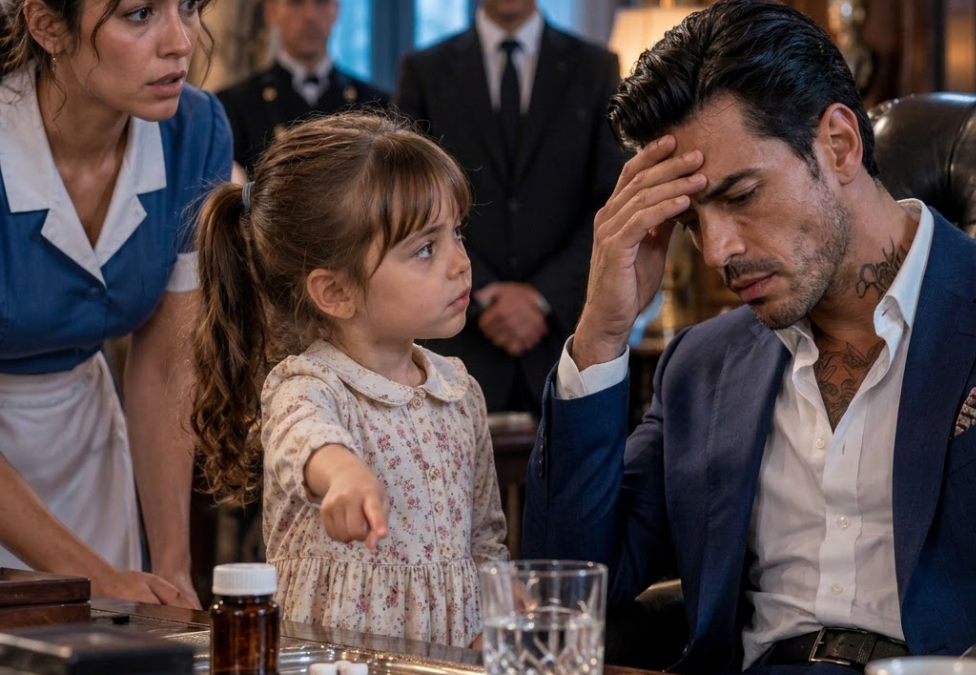
I formalized observations that had already occurred. Russo leaned forward, at whose request Raldi rubbed both hands over his knees.
Victoria asked me whether the records were complete enough to protect everyone if your condition worsened. Protect everyone from what? From you making irreversible decisions while impaired.
From people later claiming we ignored obvious signs. Alessandro felt anger rise but kept it contained.
Did she ask you to falsify reports? Not in those words. In what words?
She said there were things everyone had seen that weren’t being captured in the medical file, and you decided to manufacture visits.
I decided the record should reflect what I believed was happening. The independent physician finally spoke.
Did you prescribe anything that could produce the episodes Mr.Moretti described? Rinaldi looked offended. No.
Compounded sleep aids, low dose, intermittent sedatives, nothing outside normal therapeutic use. Any medication delivered through Northbridge?
At that name, Raldi’s expression shifted.
Not fear, exactly. Recognition.
They coordinate specialty orders. Who introduced them?
Russo asked.
Victoria’s office, I think, or household administration.
Did you know the ownership structure? No. Aleandro watched him.
Did you know someone was altering delivery records? No. Did you know my old access logs were being manipulated?
No.
Did you place Victoria’s business phone inside the second floor sitting room?
Rinaldi stared at him. What? The confusion looked genuine, which made it useless.
Aleandro moved to the question that mattered. Did you ever put something in my afternoon drink?
Absolutely not. Did you ever instruct anyone to? No.
Did Victoria? Not that I know of.
Raldi’s voice cracked for the first time.
Alessandro, I falsified documentation. I will answer for that. But I did not poison you.
It was not exoneration. It was a boundary.
Alessandro believed only that Raldi wanted him to believe it. After the doctor left under supervision, Russo spread the confession across the larger pattern.
We can prove he falsified records. Yes, we can prove Victoria discussed incapacity planning. Yes, we can connect her office financially to the vendor network.
Yes, but we still cannot prove she ordered any substance administered to you.
stole Elena’s old card, moved her own phone, or removed Sophia’s page.
Aleandro knew the case had finally become stronger and less satisfying at the same time. The deeper they dug, the more likely it seemed that several people had crossed separate lines for different reasons.
Rinaldi had falsified records because he convinced himself the conclusion justified the paperwork.
Pro had violated a restricted office because he believed a doctor outranked Aleandro<unk’s privacy.
An administrator might have processed vendor payments without understanding them. Someone else could have exploited all of those weaknesses.
A conspiracy did not require every participant to understand the conspiracy.
Sometimes it required only one person who knew how to use other people’s ordinary compromises.
That afternoon, Sophia provided the smallest clue in the entire case. And for once, Aleandro nearly missed its importance.
She was in the laundry room with Elena when Russo brought printed stills from the damaged corridor footage downstairs. He wanted Elena to identify uniforms and household objects visible in the background.
Sophia was told not to participate.
She sat several feet away coloring a worksheet until one photograph slid from Russo’s hand and landed near her shoe.
It showed the blurred reflection from the glass cabinet. Sophia picked it up to return it, then stopped.
“That scratches towels,” she said.
Elena looked over.
“What?”
Sophia pointed to the metallic blur on the reflected hand.
“That ring?”
Russo crouched beside her.
You can tell that’s a ring.
I think so.
Aleandro, who had entered moments earlier, said, “You were told not to investigate.”
I wasn’t.
It fell by me. He could not argue with that.
Why do you think it scratches towels? Sophia looked at Elena. The square one.
Mom complained because the corner catches the linen when misses. Romano takes clean napkins.
Elena’s expression changed.
“Sophia, is that true?”
Aleandro asked. Elena hesitated.
Victoria wears a ring with a raised square setting. It has caught fabric before.
Russo immediately took the photograph away from Sophia. This is not identification. I know, Allesandro said.
Sophia looked annoyed. Then why did you ask?
Because knowing where to look is different from knowing what happened.
He sent Marco to collect public photographs, event images, and internal security stills showing Victoria’s jewelry over the previous 6 months.
The ring appeared repeatedly, platinum, square dark stone. One corner slightly elevated from a repair to the setting.
A jeweler’s receipt from the household expense files confirmed the repair date.
The enhanced corridor reflection remained too poor to establish ownership conclusively, but its proportions were consistent. More importantly, the day of the missing seven minutes, Victoria had been photographed wearing that ring at breakfast and again at dinner. The clue did not prove she had carried the glass.
It removed another layer of distance between her and the event.
Russo’s financial team found the stronger connection that evening.
One Northbridge management entity had received funds through an account Victoria could authorize without secondary approval. The description on the transfer referred to private continuity services.
Russo compared the dates.
The payments began 11 days before Raldi’s first questionable medical report.
They increased shortly before the incapacity agreement was circulated for final signatures. Then they stopped the week Sophia interrupted Allesandre with the glass.
That timing is difficult to call coincidence, Russo said. Difficult is not impossible. No.
Can Victoria explain the payments? Probably.
Whether the explanation survives documents is another matter. Allesandre looked toward the doorway. Bring her tomorrow.
Russo remained still.
There’s one more thing.
He opened a laptop and displayed an archived email recovered from a deleted drafts folder associated with Victoria’s administrative account.
The message had never been sent. No recipient was entered.
It appeared to be notes for a later communication. Most of the text concerned scheduling, trustees, medical review, and temporary signatures.
Then Allesandre reached the final paragraph. The wording was clinical, almost boring. That made it worse.
When the transfer is triggered, access must change immediately. He cannot be permitted to reverse decisions during a lucid interval.
Everyone must understand that resistance will be presented as another symptom. Allesandro read the sentence again.
Russo said nothing. Beneath it was one final line. The day control transfers, there can be no hesitation.
Aleandro leaned back slowly. For the first time since Sophia touched his sleeve, the evidence did not merely describe what had already happened. It described the logic of what someone expected to happen next.
By 10 the next morning, the long conference room on the second floor looked less like a place for family business and more like a room prepared to decide whether Aleandro Moretti still belonged at the head of his own life. The blinds were half closed against the morning glare. Two independent physicians sat at one end of the table beside Daniel Russo.
Carlo Ventresca had arrived early and spent most of the time pretending to read financial statements. Marco stood near the door with two security officers positioned outside, not inside. Victoria Romano entered last.
She wore a charcoal suit instead of the softer colors she usually chose for private meetings, and she carried a leather folder under one arm. When she saw the doctors, she did not stop.
When she saw Raldi’s empty chair, she did only for a moment.
“Where is Alio?”
she asked. Russo answered before Alisandro could.
“He will not be attending.”
Victoria placed her folder on the table. Why?
Professional conflict. She looked at Aleandro. What happened?
Aleandro was seated at the head of the table, but he had deliberately left several documents misaligned in front of him. He had not shaved as closely as usual. His tie was slightly loose.
Nothing theatrical, just enough to preserve the story everyone had been hearing for weeks.
“Sit,” he said.
Victoria remained standing.
“Is this a medical review?”
among other things, then Raldi should be here. No.
The single word made her study him more carefully. Finally, she sat.
Russo began by explaining that the meeting would document Alessandre<unk’s present capacity, review the continuity agreement, and resolve questions about whether temporary authority should be activated.
Carlo looked uncomfortable. Victoria did not.
She folded her hands on the table and listened with the posture of someone who had expected this conversation eventually. When Russo finished, she turned toward Allesandro.
Did you ask for this? Does that matter? Very much.
Why?
Because if you requested it, then you understand why we’re here.
If someone else forced it on you, that is a different problem. Alisandro allowed a small pause.
And if I don’t remember, Carlo shifted in his chair.
One physician looked toward the other.
Victoria’s face softened.
Then that is exactly why we need to be careful. It was an excellent answer.
Aleandro almost admired it. She did not grab authority. She did not rush toward the document.
She spoke about caution, process, protection. If he had entered the room believing she loved him and feared for his health, every word would have confirmed it.
“Tell them what you’ve seen,” Russo said.
Victoria looked at him.
“Are you representing Alessandro or conducting an examination?”
“Neither.
I’m asking you to describe your concerns.”
Victoria turned toward the physicians. He has been forgetting meetings, repeating questions, misplacing documents, becoming angry when corrected.
He accused staff of moving things he later found where he had left them. He has had moments when familiar information seemed unfamiliar. His doctor documented the same pattern.
She paused. And recently he has become suspicious that people close to him are manipulating him.
Alessandro kept his expression still. Suspicion is a symptom now. It can be depending on the context.
Convenient. That response is part of the problem.
Victoria’s voice remained controlled.
You hear concern as an attack, and you hear disagreement as impairment. No, I hear a man I care about becoming frightened because he cannot rely on his own memory.
She looked toward the physicians. A child in the house noticed some of these episodes and began writing them down.
Alessandro took that notebook as evidence someone was drugging him. A glass was tested. Nothing was found.
An employes access card appeared in a log and it turned out she wasn’t there.