I Woke Up to Her Making Coffee in My Kitchen… “Can We Do This Again?”
I Woke Up to Her Making Coffee in My Kitchen… “Can We Do This Again?”
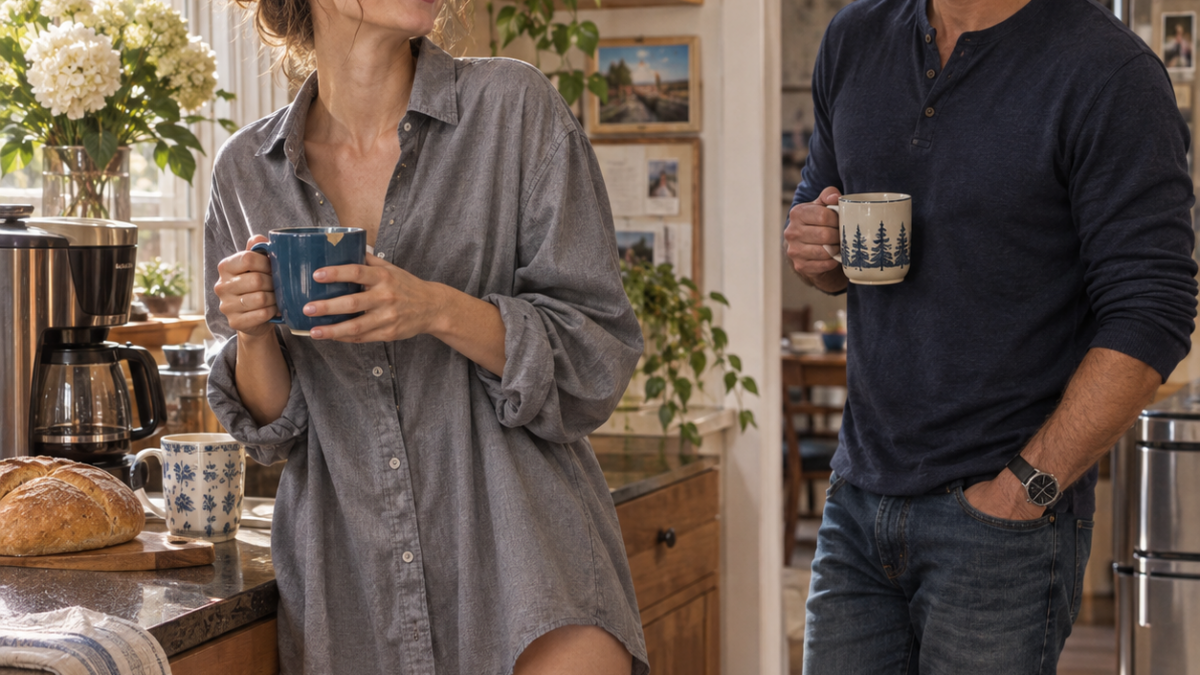
The smell of coffee reached my bedroom before I realized Elena wasn’t beside me. I found her in my kitchen, barefoot, wearing the soft gray shirt I’d left on the chair the night before.
She had one hand around my chipped blue mug and the other on the coffee maker, studying its buttons like a puzzle she was enjoying. When she noticed me, her mouth curved into the smile that had made the last five weeks unusually distracting.
– “Can we do this again?” she asked.
I glanced toward the bedroom and told her I had enjoyed last night, too. She laughed, looked down at the coffee, and said she had actually meant this part. She meant the quiet morning and being here when neither of us had anywhere impressive to go.
She pushed the second mug toward me, and I stood there longer than a grown man should stand in his own kitchen, trying to understand why that sounded more intimate than anything we’d done the night before. My name was on the envelope beside the toaster, and Elena picked it up before I could answer.
– “Miles Donnelly,” she read, as though we hadn’t known each other’s names for five weeks. “Are you going to make me submit a formal request?”
That gave me enough time to reach the counter and take the coffee she’d poured. Elena Ruiz had come into my life by arguing with me over the last open table at a crowded neighborhood bookstore event. She’d offered to share it, provided I admitted that the folding chair was the least comfortable invention in human history.
I had disagreed about the chair and agreed about dinner. Since then, we’d had five good weeks of late meals, long walks, increasingly unconvincing goodbyes, and a deliberate agreement not to load a new attraction with promises neither of us had considered. We were both adults with lives we liked.
Last night had been our first night together—chosen without pressure—and neither of us had suggested it was a contract for anything afterward. I was thirty-three, worked as a building maintenance supervisor, and generally trusted things that did what their labels promised. Elena, thirty, illustrated for publishers and small brands, and seemed to consider labels an invitation to ask whether the thing inside might be more interesting.
She had asked before using the kitchen, but I told her last night to help herself if she woke first. Seeing her follow that invitation so casually was unexpectedly appealing. She hadn’t rearranged my cupboards or performed some theatrical version of being a perfect girlfriend.
She’d just found the beans, worked out the machine, and left enough for me. I told her she was welcome to coffee without filing paperwork. Elena leaned against the counter, watched me drink, and waited in a way that made it clear she wasn’t asking for permission to borrow the machine again.
She was asking whether the welcome extended beyond this particular morning. I crossed to her close enough to see the faint crease my pillow had left on her cheek. Last night, she’d been wearing a dark green dress that made it difficult to concentrate on the restaurant menu.
The woman in my kitchen looked different and just as dangerous to my peace of mind. I set my mug down and asked whether she meant another morning, even without the evening before it. She nodded, then admitted she liked that evening quite a lot, too.
I kissed her because I wanted to, and she met me halfway, warm hands settling at my waist. When I pulled back, she made a quiet complaint about my negotiating methods. I told her I had heard worse reviews.
Her smile stayed, but she didn’t rush to fill the silence. I finally said that yes, I’d like to do it again. I added that I wasn’t sure what kind of plan that made us.
She said it didn’t have to make us anything by breakfast, and I believed her. The trouble with my kitchen was that it exposed my habits without asking. I owned two decent pans, a set of mismatched plates, and more measuring cups than a person who rarely baked deserved.
Elena found the good bread I’d forgotten in the freezer while I tried to explain why all the mugs had handles in different directions on the shelf. She informed me that nobody had been inspecting my mugs—which was only technically true, because she’d inspected everything else. I had always liked mornings alone.
I woke early, checked the weather, made coffee, and left room for whatever needed doing around my apartment. That Sunday, I found myself standing beside a woman buttering toast, quietly enjoying how my routine refused to stay in its usual shape. We weren’t performing a couple for anyone.
She made a face at the burned corner of a slice and handed it to me as fair payment for using my shirt. It was an ordinary, ridiculous exchange, and I wanted another one. We ate at the small table beside my window instead of carrying breakfast back to bed.
Elena told me she had a few errands later and wanted to spend an hour finishing illustrations for a magazine. I had laundry to do and a loose cabinet hinge I’d intended to fix for three weekends. Neither task sounded romantic, which made it easier to talk without dressing our words up.
We discovered that she liked the first hour of a day unplanned, while I felt vaguely irresponsible unless I knew where my keys were. She asked whether I had ever simply gone outside without deciding what I’d do. I said that was generally how people got locked out.
She laughed so hard she nearly spilled her coffee, and I caught the mug before it tipped. The room settled after that, with both of us eating and listening to traffic below. It surprised me how comfortable I felt with a silence I hadn’t prepared for.
At the door, she glanced toward the clock, checked the time against the appointment she’d mentioned, and put on her jacket. I almost asked her to cancel her plans. The words rose because I wanted to keep hearing her voice in my apartment—not because anything important would happen if she stayed.
I kept them to myself. Elena had made it clear she liked her own life, and that was one of the reasons I liked her. Instead, I asked whether she wanted to see me the following Saturday morning.
She considered it with exaggerated seriousness and asked whether I expected her to sleep over on Friday as an admission ticket. I told her breakfast was a separate event, and she was welcome to come over directly. That earned me a look more tender than teasing.
She agreed, but said she had plans Friday night and would be arriving on Saturday—awake and fully dressed, like a responsible member of society. I promised not to demand proof of responsibility. She kissed me in the doorway slowly enough that neither of us could mistake it for a courteous goodbye.
I rested my hand against her back, felt her smile against my mouth, and let her step away when she was ready. After she walked down the hall, I shut the door and immediately noticed how quiet the apartment had become. There was no dramatic emptiness, no sudden belief that I’d finally found the missing half of myself.
I liked my home and had liked it before she arrived. What changed was that now I knew how she looked standing beside the coffee maker, arguing that toast could be saved if you scraped it properly. I washed the second mug and put it away with the others, still smiling at the fact that I had an actual plan to see her at nine the following Saturday.
My phone stayed on the counter while I fixed the cabinet hinge. I didn’t need to send an extra message just to keep the morning going. She’d asked for another one, and I’d said yes.
By Tuesday, I realized the date on my calendar wasn’t functioning like any of our previous dates. Dinner reservations had always been pleasant possibilities—if something came up, we could move them, choose somewhere else, and still have a good evening. Saturday morning felt different, because I’d invited Elena into the part of my week I’d previously protected from everybody at work.
While signing off the last ordinary maintenance request before leaving, I caught myself wondering whether she liked cinnamon in her coffee. I resisted texting to ask. This was not an engineering project requiring specifications, and I knew she would make fun of me if I turned breakfast into one.
Instead, I bought the bread she had enjoyed and replaced the beans she’d nearly finished. I wasn’t trying to impress her with my pantry. I wanted her to walk into a room where I’d thought of her while she wasn’t there—and to notice it without either of us making a speech.
That was a new feeling, and it had very little to do with the night we’d spent together. Saturday arrived without a soundtrack or a special occasion. I woke before my alarm and found myself rearranging the chairs—which was absurd, because there were only two, and I’d already placed them where I liked them.
I made myself sit down and read for half an hour instead. At nine, Elena knocked, carrying a paper bag from the bakery near her apartment. She wore loose black pants, a striped shirt, and an expression that suggested she already suspected I’d been preparing for a presidential visit.
I opened the door and told her she was on time. She looked at my watch and replied that my welcome speech could use work. When she walked in, she paused beside the table, noticed the bread, and took the grocery bag from me to make room for the pastries.
Her quick kiss tasted like the cold air outside. It wasn’t the lingering kiss we might have shared after a late night, but it made me want to draw her back anyway. Elena set a croissant on a plate and examined the elaborate arrangement I’d made with fruit, coffee, and a jar of jam.
She didn’t mock the effort, though she did ask whether breakfast had a seating plan. I admitted I’d bought three kinds of fruit because I couldn’t remember which she’d mentioned liking. That amused her more than it embarrassed me.
She moved the bowl so we could both reach it, opened the jam, and told me she liked pears but wasn’t going to lodge a complaint about strawberries. I’d planned everything through the moment she arrived. I hadn’t planned for the pleasure of adjusting it with her.
She noticed that I checked the clock twice, trying to calculate how long she might stay. Without discussing it as a problem, she asked whether I had somewhere to be later. I said not until the afternoon, when I was meeting a friend to help move a bookshelf.
She said she had a drawing session in a few hours. The answer relaxed us both, because neither had to pretend this breakfast would last forever. We took our coffee to the window and watched a man across the street spend an unreasonable amount of effort trying to parallel park.
Elena gave him a supportive running commentary in a voice he couldn’t hear. I was aware that if I’d been alone, I would have watched for thirty seconds and returned to my book. With her, the little spectacle became a ridiculous contest about whether he would abandon the attempt.
She predicted he’d make it if he stopped listening to the person on the sidewalk offering instructions. When he finally parked, she raised her cup in victory. I called it luck, and she leaned close enough to tell me I was a sore loser.
She brushed a drop of jam from my thumb with her napkin before I realized it was there. I liked that she could be that familiar without pretending she’d lived in my apartment for years. We hadn’t spent a night together this time, and the attraction hadn’t weakened in the least.
After breakfast, I offered to walk with her to a nearby park. She suggested we stay a little longer, because the sun had finally reached the table—and the request caught me off guard. There was no romantic plan she was postponing.
She just liked where she was sitting. I moved the empty plates, found another chair cushion, and put my book aside. Elena asked about a photograph on the shelf, and I told her it was from a camping trip with my brother years ago.
The story wasn’t particularly entertaining, but it gave her a chance to see that I used to take terrible pictures and still hadn’t learned. She talked about a childhood obsession with drawing the same lighthouse from every angle, including one that made it look like it had fallen over. Those details didn’t transform us into soulmates.
They made the person beside me less like somebody I knew only under restaurant lights, and I wanted to know more. At some point, she took out a small sketchbook to show me a rough drawing of the coffee machine. I had accused it of making an alarming noise, and she’d turned that into a creature with tiny, worried eyebrows.
She didn’t offer me a tour of her entire creative process. She showed me the page because she knew I’d appreciate the joke, and I did. I asked whether she was going to publish the portrait of my malfunctioning appliance.
She said she’d need a release form signed by its legal guardian. We laughed, and when she closed the book, I caught her hand and kissed the side of her wrist. She looked at me carefully, giving me room to move closer.
So I did. The kiss we shared was quiet at first and grew warmer when she curled her fingers against my neck. She drew back before I did, glanced toward the bright window, and smiled.
I couldn’t tell whether she was thinking the same thing I was, but she stayed beside me, shoulder against shoulder, without making either of us explain it. Elena left a little before noon. She checked the time, gathered her things, and offered to wash the last plates—even though I told her she was a guest.
She raised an eyebrow at that word, and I realized it sounded formal in the room where she’d been teasing my kitchen equipment. I said she was a guest I was very happy to have. That seemed to satisfy her.
At the door, she hesitated—though not in the hopeful way she had after our first morning. She looked thoughtful, as if measuring something she could say without making it larger than she intended. Finally, she told me she wanted to invite me for breakfast at her place next weekend.
I’d been there once, briefly, to pick her up for dinner, but I had never seen how she actually spent a morning. She warned me that her apartment didn’t have matched dishes, orderly shelves, or any guarantee of a chair that stayed put. I told her I’d survived much worse.
She smiled and said I probably hadn’t, then kissed me goodbye. I watched her walk away from the building and went back upstairs to an apartment that looked almost exactly as it had before she’d arrived. The fruit bowl was half empty.
My book sat where I’d left it. A pencil she’d borrowed was still on the table, although the sketchbook was gone. Nothing dramatic had happened.
For nearly three hours, we’d eaten, talked, kissed, and looked out a window. I had enjoyed the whole thing without waiting for it to turn into something else. That afternoon, I helped move the bookshelf and answered my friend’s questions about the best way to get it through a narrow doorway.
I was good at that kind of problem. But I kept thinking about Elena saying she wanted me at her place. Not because she needed anything fixed, and not because another night together had earned me an invitation.
She wanted me to see the unpolished version of her morning. I decided I was looking forward to it as much as I had looked forward to her standing in my kitchen. Elena’s apartment was on the second floor of an older building with a narrow stairwell and a front door painted the color of ripe plums.
When I arrived the following Saturday, the door was unlocked only after I knocked. She greeted me with a smile, a quick kiss, and a warning that I should not assume she’d cleaned for company. Inside, one wall held a tall shelf of books and drawing supplies, and the kitchen table doubled as a place for her to work.
A half-finished illustration rested beneath a clean sheet of paper. The windows were open just enough for the late morning air to move the curtain. I had been expecting the same feeling I’d had when she stood in my kitchen, only reversed.
Instead, I felt like someone being shown a place that existed fully before I arrived. Elena didn’t apologize for a single thing in the room. She asked whether I wanted coffee and handed me the choice of two unmatched mugs.
Her mornings were less organized than mine, though they weren’t chaotic in the way I’d secretly imagined. She moved between breakfast and her drawing table, stopped to water a plant, and remembered something she’d meant to write down while I was still cutting a pear. She had already told me she’d need to work for an hour before lunch.
I knew the arrangement before walking through the door, but watching her sit at the table with a pencil made it more real. At my apartment, I’d assumed that inviting somebody for breakfast meant giving them my attention until they left. Elena seemed perfectly comfortable letting us share a room without directing every minute toward each other.
She didn’t ignore me. She pointed out a place where I could sit, showed me which book she thought I’d like, and asked if I minded the music she put on softly. I said I didn’t.
I spent the next twenty minutes reading, listening to the scratch of her pencil, and learning that being together didn’t always require a conversation. The chair by her window wobbled whenever I shifted my weight. I noticed it because noticing that sort of thing was part of my job, but I didn’t immediately ask for a screwdriver.
Elena caught me testing one leg against the floor and asked if I planned to write a formal report. I said the chair appeared determined to perform a small dance and ought to be encouraged to retire. She explained that she liked the view from that spot and had learned which direction to lean.
I understood the argument wasn’t about furniture. Her apartment was not a project I was there to improve, and I liked that she’d invited me without expecting a repairman. I settled into the other chair instead.
She glanced up from her work, smiled when she saw I’d moved, and returned to drawing. A little later, she brought me a refill of coffee without interrupting what I was reading. She didn’t try to entertain me, and I didn’t demand it.
The ease of that exchange stayed with me. When she finished the illustration, Elena stretched her shoulders and came over to see the book I’d chosen. It was about old coastal towns, and she turned a few pages until we found a picture of a lighthouse that looked suspiciously like the one she’d once drawn wrong.
She pressed her finger to the page and claimed the photographer had stolen her angle. I was about to answer when she leaned against me, and the conversation turned into a kiss neither of us had planned. Her hands were warm from the mug she’d been holding, and she stepped closer until we were laughing about the difficult angle of the chair.
I asked whether she wanted to move somewhere steadier. She nodded toward the couch, took my hand, and led me there. We kissed with the familiar desire that had brought us together in the first place, but when she pulled back to check the time, I didn’t ask her to stay tangled up with me for the rest of the afternoon.
I liked knowing she could be close and still have a day to get on with. Elena showed me a small stack of work she’d finished during the week, mostly because I had asked what the loose sheets were for. I couldn’t evaluate illustrations like a client, but I recognized the care she’d put into deciding where a line belonged.
She laughed when I compared one complicated sketch to a stubborn cabinet door I’d been trying to align at work. The comparison wasn’t elegant, yet she understood I meant that a thing could look easy only because someone had worked hard on it. She told me she liked that I took her work seriously without insisting she describe it in technical terms.
I was glad she said it. We had talked a lot about food, films, and the embarrassing parts of our teenage years. Watching her get back to a page after an interruption showed me another part of who she was.
It made me wonder what parts of my own routine I still hadn’t shown her. Over the following days, we made plans with a little less ceremony. Elena stopped by for a short dinner one evening and left before it got late because she had an early appointment.
I took a walk near her neighborhood another afternoon, and we met for a drink outside rather than turning every visit into an overnight stay. There was still flirting, and I still caught myself staring when she pushed her hair back or looked up from a sketchbook. Nothing about seeing her in daylight made me less interested in kissing her—but the pattern of our time together was changing in ways I hadn’t imagined when we agreed not to make promises.
We began seeing the things we normally did between the polished parts of our week. She learned I sometimes ate a terrible sandwich standing in my kitchen because I’d forgotten lunch. I learned that her workday could begin late and stretch into the evening, which didn’t mean she had spent the morning doing nothing.
One Wednesday, I suggested we meet on Saturday after she’d finished a morning drawing session. Elena answered that she had already committed to spending the day with her sister, who lived outside the city, and she wouldn’t be back until Sunday. She offered dinner on Monday instead.
Her message was warm and clear, but I caught myself feeling disappointed before I could find a good reason to be. I had no claim on every open day in her calendar. She wasn’t canceling anything we’d planned.
She was telling me honestly what she could do, which was exactly what I wanted from someone I was dating. I accepted Monday and went about my week, though the quick prick of disappointment lingered. Until then, I’d liked having mornings with Elena because each one was something we chose.
Now I had to be careful not to start treating them as appointments she had agreed to keep forever. That weekend, I slept late on Saturday and spent part of the morning alone, doing everything in the order I preferred. I made coffee, caught up on laundry, and took a walk with no need to be back for anyone.
I didn’t feel abandoned or secretly miserable. The pleasure of being on my own was still there, and I was relieved to find it. But at one point, I looked at the empty chair across the kitchen table and remembered Elena laughing about the parallel parker outside my window.
I realized I’d begun to expect her in places where I had never expected anybody. There was no reason to tell her she should have been there—the invitation hadn’t existed. The useful question was what I wanted to do with that feeling now that I’d noticed it.
On Monday, when she arrived for dinner with a folded drawing tucked into her bag, I was ready to see her again without pretending the weekend had meant nothing to me. Elena arrived with her hair pinned back loosely and a faint smudge of ink on her wrist. She’d spent Saturday with her sister and Sunday finishing a commission, and she looked pleased to be at my door without apologizing for either choice.
I took her jacket, kissed her, and noticed how quickly I settled into the familiar feeling of having her there. We ate pasta I’d made from a recipe that required more patience than I naturally possessed. She praised the sauce and suggested that the noodles had been subjected to unnecessary discipline.
It was the kind of remark that usually started an argument neither of us meant seriously. That evening, I laughed, but I was slower than usual to answer. Elena noticed.
She didn’t demand an explanation while we ate, and I didn’t manufacture an excuse. After dinner, she carried the plates to the sink, looked at the coffee machine, and asked whether the supervisor on duty was accepting complaints. I put the dish towel down, because I knew her joke was an invitation to tell her what was on my mind.
I explained that I’d caught myself expecting her on Saturday, even though we’d made no plan. I said it had felt strange to be disappointed about something she hadn’t promised, and I didn’t want that feeling to turn into a rule she hadn’t agreed to. Elena leaned against the counter, listening without the amused defense she sometimes used when something mattered to her.
She told me she’d wondered whether I’d be bothered when she said she couldn’t come, then decided I deserved the ordinary truth instead of a carefully softened version. I admitted I had been bothered for a minute. The honesty sounded more awkward out loud than it had inside my head.
She took a moment before saying she liked seeing me in the mornings, too—enough that she’d started looking at her calendar differently. She hadn’t expected to do that after five weeks with someone who had originally agreed to keep things casual. I reached for her hand.
She gave it to me, and neither of us pretended we’d found an easy word for the change. Her drawing was still tucked into the bag on the chair. When I asked about it, she showed me a rough study for a neighborhood poster full of crooked windows and cheerful awnings.
She’d been working on it at her sister’s kitchen table, where nobody expected her to stop drawing whenever a conversation happened. She seemed relaxed describing that afternoon, and I realized it was a side of her independence I hadn’t pictured when I first started inviting her over. I said I’d be annoyed if someone made me account for every weekend I spent helping my family or working on my own projects.
Elena said she didn’t want to become the person waiting to see whether I was free either. We agreed on that much without trying to turn it into a list of rules. The part that still mattered was whether we could tell each other when we wanted time together, rather than treating every wish as an obligation or pretending it wasn’t there.
The conversation didn’t drain the attraction out of the room. If anything, I wanted to be nearer to her because we hadn’t disguised the awkward part. I drew her toward me slowly enough that she could decide whether she wanted the same thing, and her hand rose to the back of my neck.
She kissed me with an ease that made my earlier defensiveness seem unnecessary. We were still learning each other’s moods, but we knew how to laugh when one of us misjudged a moment. I brushed a loose strand of hair away from her face, and she said I’d managed to do something romantic without making a schedule.
I told her I was preparing an incident report on the achievement. She rolled her eyes, kissed my cheek, and stayed close. When we moved to the couch, she chose to sit beside me with her legs tucked under her, and I wrapped an arm around her shoulders.
We talked about a movie we both wanted to see, then watched half of it before she needed to head home. The evening ended with a real goodbye, not a plea for her to stay longer. During the following week, I noticed the temptation to turn our new closeness into a system.
I almost sent Elena a list of mornings I was free, complete with alternatives, before stopping myself. She wasn’t a contractor I needed to schedule into a maintenance window. I could ask when I wanted to see her and listen to her answer.
I invited her to a short walk on Thursday evening, and she said she would love that as long as we didn’t mind starting later. We walked beside the river while the daylight faded, and she told me about an illustration she’d struggled to finish because the client’s idea kept changing. I didn’t offer to solve it.
Instead, I listened, gave her a place to laugh about the absurdity, and enjoyed the fact that she had chosen to spend part of her busy day with me. At the end of the walk, she asked whether I was free for a late breakfast on Sunday. I told her I was meeting my brother that morning but could do the afternoon.
She said Sunday afternoon sounded good, and we made that plan without either of us trying to hide disappointment. That Sunday afternoon, Elena came to my place with a loaf of bread she’d picked up on the way. She had been drawing all morning, and I had spent time with my brother, who needed advice about a leak at his apartment.
We didn’t give each other a full account of where we’d been or ask for proof that our separate plans had been worthwhile. We made sandwiches, listened to an old album she liked, and ended up standing in the kitchen long after we’d finished eating. She asked if I was still enjoying this arrangement.
I said yes, though I wasn’t sure “arrangement” was the right word anymore. Elena smiled, but didn’t immediately claim a better one. She stepped close and rested her forehead against mine, and I let the question sit between us for a moment.
I could feel how much I wanted to tell her she had become important. I could also feel the pull of our original promise not to rush. For the first time, that promise seemed less like freedom and more like a sentence we’d been repeating because it was familiar.
I told her I was beginning to want to plan things with her further ahead than the next available meal. She looked up and asked what kind of things. I didn’t give her a speech about the future.
I said I’d seen a small photography exhibit opening the following month and thought she’d enjoy it, and that I’d like to buy two tickets. She listened, then asked whether I was worried a date on a calendar would make us official. I said a date on a calendar would make us organized, which was probably more alarming in my case.
She laughed, but her expression softened when I admitted I’d been holding back from making plans because of something we’d said during our first week. She told me she had been doing the same. We bought the tickets together on my phone, with the understanding that neither of us had just signed away every future Saturday.
It was a modest action, but it was the first plan we’d made because we expected to still be choosing each other in a month. On Tuesday, I looked at my schedule and found a morning the following week when I could start a little later without leaving anyone else short-handed. I didn’t need to make a dramatic sacrifice.
I needed to choose to use the time differently. Before asking Elena, I checked that the arrangement actually worked. She’d shown me her life in pieces, and I didn’t want a romantic gesture that demanded she rearrange her whole day because I’d decided to be spontaneous.
I called her after dinner and asked how her week was going. We talked for a few minutes about ordinary things, including the chair she still refused to replace. I told her I had been thinking about a weekday breakfast and wanted to know whether she would enjoy one.
She sounded surprised, then interested. She asked what time I had in mind, and I said we could work that out together. She promised to check her calendar in the morning.
It was a small conversation, but I hung up knowing I’d asked for something I hadn’t dared to name a few weeks earlier. Elena called the next morning while I was finishing breakfast. She’d checked her appointments and said Wednesday would work if we started at 7:30 and kept the morning reasonably short.
She had a deadline later that day and wasn’t interested in pretending otherwise. I told her I’d arranged to begin work at ten so I could come to her place and stay until nine. She laughed and accused me of sounding like a train timetable.
I reminded her that reliable trains were a public good. Beneath the joke, I was pleased by how carefully she’d considered the invitation. She hadn’t surrendered an entire day to make me happy, and I hadn’t canceled an obligation to impress her.
We were simply making room. She asked whether I wanted to bring anything, and I said I could pick up breakfast on the way. She said she’d handle the coffee.
We ended the call with a plan that was modest enough to keep and important enough that I looked forward to it all week. The following Tuesday evening, I went to bed earlier than usual—not because I expected some extraordinary event. I had a normal morning ahead, followed by a normal workday, and I’d chosen to place Elena in the part that usually belonged only to me.
At seven the next morning, I stopped at the bakery, bought two pastries and a small bag of fruit, and walked toward her apartment. The city was awake in the unglamorous way I liked. A delivery truck unloading.
A cyclist arguing with a stubborn lock. A woman pulling up the shutters on a shop. I climbed Elena’s stairs without the anticipation that usually came before a first kiss or a late-night date.
I was excited, certainly, but the excitement had a quieter shape. I wanted to hear her voice before the day got loud. When she opened the plum-colored door, wearing soft pants and a faded blue sweater, I felt an immediate, uncomplicated relief at being where I’d chosen to be.
Her apartment looked the way it had on my first visit. Only the drawing table held a fresh stack of pages. She’d cleared one end of the kitchen table and left her pencils on the other—a compromise that made me smile.
I set the bakery bag down and held up the fruit as proof that I’d remembered what she liked. Elena said she was relieved I hadn’t arrived with measuring cups. She leaned into my arms, kissed me once, then stayed there long enough that I could feel her breathe against my shoulder.
I asked whether she still wanted breakfast before work. She nodded, stepped away, and took the pastries to the table. The small movement affected me more than I’d expected.
We’d spent our first night together without pretending it guaranteed anything. Now she was choosing to kiss me before a day that came with responsibilities—and I was choosing not to turn that kiss into a reason to postpone them. Nothing about it felt less romantic.
We ate while she described a new illustration idea she’d been trying to get right. I told her about a section of my apartment building’s roof that had finally stopped leaking after weeks of intermittent trouble. Neither of us needed the other to understand every detail.
She understood the relief of finishing something stubborn, and I understood why she looked pleased when she found the right shape on a page. At one point, she reached for her notebook to draw a quick line she’d just thought of. Her hand stopped halfway, and she looked at me as though she might be breaking some unspoken rule about entertaining a guest.
I told her to get it down before she forgot. She drew for a minute while I finished my coffee, then returned with a grin and showed me what she’d changed. I hadn’t been left out of her morning.
I’d been included in the kind of morning she genuinely had—where ideas appeared at inconvenient times, and she caught them before they vanished. When she sat beside me again, she rested her hand on my knee and asked whether the weekday experiment was going as expected. I said it was better, because nothing about it required an experiment to work.
That answer earned me an expression of mild suspicion. Elena pointed out that for a man who claimed to value clarity, I had become very good at inventing vague answers whenever something mattered. She wasn’t wrong.
I could tell her exactly when I’d be back, how long a repair might take, or whether I had time for dinner—but I still caught myself saying we were “keeping things casual,” even as I made plans to see her next month. I put my cup down and turned toward her. I told her I liked the time we spent together at night, but I’d started arranging my mornings because I wanted the ordinary pieces, too.
I said I didn’t want to keep pretending that was simply an extension of our first few dates. Elena listened without interrupting. I hadn’t planned to deliver a declaration between breakfast and work, but I knew what I wanted and was tired of disguising it with convenient language.
– “I want to date you for real,” I said. “Not just when we’re both free and everything’s easy.”
I didn’t ask her to move in, promise forever, or clear her calendar. I told her I wanted to call her my girlfriend, if that was something she wanted too—and to keep making plans we both meant to keep. Her eyes searched my face for a moment.
She said the reason she’d asked for another morning was that the first one had felt like a glimpse of what she might miss if we treated everything between us as temporary. She liked her apartment, her work, and the freedom to disappear into a drawing for hours. But she liked me in the room with her, even when neither of us was doing anything impressive.
She wanted to be my girlfriend, she said—and she wanted us to keep asking rather than assuming. I smiled at how little ceremony the answer required. Elena reached for my hand, then shifted her chair closer until our knees touched.
I told her I could respect that condition, provided she didn’t expect me to become spontaneous about where I kept my keys. She laughed, pulled me toward her, and kissed me with a confidence that made me forget the clock for a few seconds. We stayed there until she drew back and reminded me that work was still waiting for both of us.
The reminder didn’t feel like a rejection. I kissed her forehead, gathered the plates, and carried them to the sink while she packed the sketchbook she’d need later. She didn’t ask me to do the dishes, and I didn’t offer to repair the chair by the window.
Before leaving, I checked our plan for the photography exhibit. Elena had already saved the date, and she reminded me that she’d need to leave early afterward because she’d agreed to an appointment the following morning. I said that was fine and suggested we have lunch the Sunday after if she felt like it.
She thought about her week and said she’d rather keep Sunday open for herself, but could come to my place for dinner on Monday. I agreed without a second thought. There had been a time when I might have heard that choice as a limit on how important I was.
Now I heard what she was actually offering: a time she’d chosen, a visit she wanted, and an answer she trusted me to accept. I put the Monday dinner on my calendar—not because I was trying to capture every free hour, but because I didn’t want to forget a plan that mattered to both of us. At the door, Elena slipped her arms around my waist and looked up at me with the same mischievous smile she’d worn that first Sunday in my kitchen.
She asked whether I would be offended if she returned my borrowed shirt the next time she came over. I said I was beginning to suspect I’d never get it back. She offered to negotiate shared visitation, and I told her the matter would need careful review.
She kissed me before I could make the joke any worse. When I stepped into the stairwell, I looked back and saw her already turning toward the drawing table, ready for the rest of her morning. I loved that she didn’t have to stand at the door and watch me leave to prove she’d meant what we’d said.
I walked to work carrying the pleasant certainty that I’d see her again on Monday—and that she’d be doing a hundred things of her own before then. The first time she’d asked for another morning, I hadn’t understood the request. Now we were making room for each other, one ordinary choice at a time.