My Strict Landlady Knocked During the Blizzard Blackout: “Please Don’t Leave Me Alone”
My Strict Landlady Knocked During the Blizzard Blackout: “Please Don’t Leave Me Alone”
I was on my knees in front of the wood stove, working a split log of oak onto the coals, when a flashlight beam slid under my front door and stopped on my socks. The power had gone out forty minutes earlier, along with every street light on Orchard Street, and the wind had been throwing snow against the windows hard enough to rattle the storm glass.
Nobody used the downstairs door of that duplex except the mail carrier—and about once a month, my landlady with a reminder about the recycling bins.
I opened it and found her on the landing in a long wool coat over flannel pajamas. The flashlight pointed politely at the floor between us. Her hair was down, which I had never seen before, and her other hand was holding the stair rail like it might leave.
— “I’m sorry. I know it’s late,” she said before I could ask anything. “Please don’t make me stay up there alone.”
My name is Russell Pike, and for seven months, I had rented the downstairs apartment from Diana Lel, who lived above me and ran that house with the care of someone defending a thesis. My lease came with a two-page addendum about snow shovels, quiet hours, and which hooks in the shared entry belonged to whom. Her notes were typed, dated, and signed with her full name.
And in seven months, she had never once stepped past my doorway.
I had noticed her anyway, of course. I had noticed the way she laughed on the phone in the driveway when she thought nobody was listening. And I had decided that what I noticed was my business and nobody else’s.
So hearing her voice shake on my landing did something strange to the room, and I made sure the first thing out of my mouth was useful. I told her the stove had been going since six, the bedroom was hers, and I would take the couch. Then I added that the sheets had been clean as of Sunday, which I admitted she had no way to verify.
She almost smiled, and she came inside. I did not ask her why, and I think that was the only reason she stayed past the doormat.
Instead, I asked whether she needed anything from upstairs, and she answered with a list—because Diana answered most things with a list. She wanted her toothbrush, her own pillow, her reading glasses, and the wool socks drying on her radiator, and she said she would go get them herself. Then she stood in my kitchen without moving toward the door.
I picked up my headlamp and said I would hold the light while she packed, and she said that would be acceptable in a voice that tried hard to sound like her usual one. Her apartment was already colder than mine by a good fifteen degrees. Every few seconds, something in the ceiling ticked or groaned under the wind, and each time it did, she paused with her hand inside a drawer. I kept the beam steady on whatever she was reaching for and said nothing about how close she stayed to me on the stairs going back down.
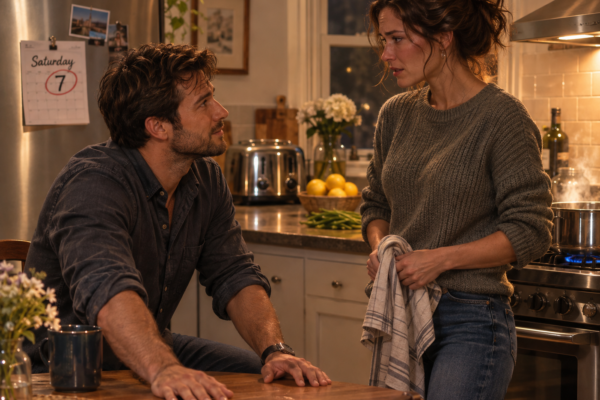
By ten, she was sitting on the rug in front of the stove with my spare comforter around her shoulders, holding a mug of tea I had made in a saucepan on the stove top. She talked in pieces, the way people do when they have been rehearsing a sentence and keep losing their place in it.
This was her first real storm alone in that house since the divorce. She said a year almost to the week. Her ex-husband Philip had always handled storms. He filled the bathtub, checked the pipes, knew where the water shut-off was, and walked through every room with a flashlight like a night watchman. She had never learned any of it because she had never needed to. Tonight, she had heard something heavy in the attic and stood in the dark upstairs hallway for ten minutes trying to decide whether it was ice or a branch or the roof itself.
— “I’m the person who sends you notices about salting the steps,” she said, staring at the stove window instead of at me. “I didn’t want you to see me like this.”
I told her the sound was almost certainly ice letting go of the vent cap, because it did the same thing over my bathroom every January. She said “almost certainly” the way a registrar repeats an unofficial transcript, and I admitted that was fair.
Then she straightened a little under the comforter and did the thing I should have expected. She said she would go back upstairs as soon as the power returned, or by noon tomorrow, whichever came first. And she wanted me to know she understood this was an imposition.
I told her I scheduled grocery trucks for a living, and if there was one thing my job had taught me, it was that weather does not sign off on anybody’s timeline. She could stay until going up there stopped being a bad idea.
She said that wasn’t an answer. I said it was the only honest one I had. And she looked at me for a long moment like I had handed her a form with a box nobody had ever filled in.
Something loosened after that, though I could not have told you exactly what. She got up to look at my bookshelf by the light of the stove, running her finger along the spines, and announced that I alphabetized by author—which she said she would have bet good money against. I asked what she had expected. She said she had assumed I sorted by color, like a man who owned exactly one decorative pillow. And then she looked pointedly at my one decorative pillow.
It was the first joke Diana Lel had ever made at my expense, and it was a decent one. I laughed harder than it deserved, mostly from surprise.
She sat back down a little closer to the stove and a little closer to me, though I tried not to read anything into either.
Around midnight, she took the bedroom, and I made up the couch with a sleeping bag I had not used since college. I fed the stove twice before two, moving quietly so the iron door would not clang. On the second trip, I saw that she had left the bedroom door open about a hand’s width, with her flashlight standing upright on my nightstand like a small lighthouse.
I did not go near that door—and I would not have—but I lay there awake longer than I meant to. The Kellers next door had a generator, a guest room, and a standing offer to anyone on the street. Diana knew that because she was the one who had told me about it in my move-in packet. She could have walked twenty yards through the snow to warm, familiar neighbors with electricity. She had come down one flight of stairs to me instead.
Sometime before dawn, the wind dropped and the house went quiet enough that I could hear the stove ticking as it cooled. I knew that in a few hours there would be gray daylight, a pot of coffee, and the two of us standing in my small kitchen with no darkness to explain why she was there. Nothing in her two-page addendum covered that. I had a feeling neither of us knew which rules still applied once the sun came up.
Diana was up before me, which I should have expected from a woman who dated her recycling notices. When I came into the kitchen, she was standing at the stove with her hair pulled back, the comforter folded into a neat square on the arm of the couch, and my saucepan of water already starting to steam. Outside, the snow had drifted halfway up the kitchen window, and the light coming through it was flat and gray—the color of an old dish rag.
She had her phone in one hand and read the utility company’s update aloud in the tone of someone announcing a policy change. Restoration in our area was “under assessment,” which she pointed out was not a time, a date, or even a verb anybody could hold accountable. I told her that in my business, we called that a soft estimate. She asked what we called it when the estimate was this soft, and I said we called it Tuesday.
After coffee, she went upstairs alone to check her apartment, and I let her. I heard her moving around above me, her footsteps crossing from the kitchen to the bathroom and back, and I kept myself busy hauling a load of split wood in from the back porch. She came down twenty minutes later and reported with clinical precision that the thermostat read fifty-one degrees. The kitchen faucet was dripping the way I had suggested, and nothing had fallen through the roof. The attic noise had been ice—she admitted “almost certainly.”
She said the place looked perfectly normal in daylight. Then she said it felt like a waiting room where nobody was going to call her name, and she went to rinse out her mug before I could decide what to say to that.
We dug out around noon, because the lease said tenants cleared the driveway and the owner cleared the front steps, and Diana was not about to let a blizzard rewrite her addendum. She worked the steps with a short-handled shovel in excellent form while I did my best with the driveway and the half-buried hump of my Subaru. Every so often, she stopped to inspect my progress.
At one point, she told me my edging along the walkway was “an incomplete pending revision.” And when I asked whether I could appeal, she said appeals went through the registrar’s office and the registrar was currently unavailable.
Then she reached into the drift beside the porch, packed something with both mittens, and set a small lopsided snowman on the top step with a recycling bin lid for a hat. She told me he was there to supervise. I had lived under that woman for seven months and never once suspected she owned a sense of mischief—let alone when she would aim it at me.
Back inside, with our gloves steaming on the stove rail, she found my junk drawer while looking for a lighter and gave it a full audit. She held up each item for my review, including three dead batteries, a menu from a Thai place that had closed in the spring, and a bottle opener shaped like a lighthouse. She wanted to know why I had kept the menu, and I said I was optimistic about their return. She said that explained a great deal about me, and she put it back in the drawer with surprising care.
We ate canned tomato soup heated in the saucepan and grilled cheese I made in a cast-iron pan on the stove top, which she watched with an attention that suggested she was learning the procedure.
Somewhere in there, she told me she had written that two-page addendum the month after Philip moved out. She had not known who was supposed to shovel anything anymore, so she had decided the answer should be written down.
By late afternoon, the daylight was already going thin, and I watched her notice it. She checked her phone twice in ten minutes, though nothing new had arrived from the utility company. Then she stood by the wood pile next to the stove, arms folded, and asked me how much firewood I had left.
It was a perfectly reasonable question, phrased the way she phrased everything. But I had spent a full day by then learning how her precise questions were built, and this one had a second floor to it. She was not asking about oak. She was asking whether she had used up her welcome along with my kindling.
So I answered both parts in order, because I suspected she would respect that. I told her there was enough wood for three more nights, maybe four, and that it was plenty for two people. She looked at me the way she had the night before—as if I had filled in a box she had not printed on the form.
Then she busied herself folding the dish towel, first in half and then into thirds.
I could have let the evening simply happen to us. I could have put another log in the stove, started dinner, and let her end up on the rug again without either of us admitting it was a decision. That seemed like the easy way—and also the wrong one.
Last night she had come downstairs because she was scared, and I had not wanted her fear to do any of my talking for me. Tonight she was not scared in the same way, and the difference mattered.
— “I’m not going to assume,” I said, and she stopped folding.
I told her the Kellers had their generator running—because I could hear it from the driveway—and their guest room was twenty yards away. Her own apartment was cold but safe, and I would help her get it as comfortable as it could be. Those were both real options, and neither one would offend me.
— “But I’d like you to stay another night,” I said. “Here. Not because of the stove.”
Then I stopped talking, which is harder than it sounds for a man who usually fills silence with a joke.
She set the towel down on the counter and lined its edge up with the counter’s edge. The stove ticked. I waited, and I did not help her.
— “I’d like to stay,” she said finally, and her voice was steady in a way it had not been on my landing.
Before I could answer, she held up one hand the way she probably did at a counter when a student started arguing too early. She asked me not to treat it as a promise about what would happen when the lights came back on. She said it carefully, and then she seemed to hear how it sounded, because a little color came up in her face. You do not ask someone not to read into something unless there is something there to read.
I told her I would not hold her to anything she had not said. She said that was not exactly what she had asked. I said it was close, and that I would try for exact. She almost smiled—and this time she did not look at the stove instead of me—so she stayed.
And it was different from the first night in every way that counted. Nobody had come to my door in the dark. Nobody had been holding a stair rail like it might leave. She had stood in my kitchen in daylight, with a warm house next door and a cold but perfectly sound apartment upstairs, and she had chosen the rug in front of my stove.
I fed the fire while she went upstairs alone and unhurried to get a book and a sweater. I listened to her footsteps overhead and realized I was waiting for them to come back down.
When they did, she set the book on the couch arm and her flashlight on the nightstand again, standing upright like before. It was the same small lighthouse, but it no longer meant she was afraid of the dark. I just did not know yet what it would mean when there was no dark left to explain it.
Dinner that second night was spaghetti boiled in my biggest pot on the stove top, and Diana insisted on setting the coffee table like a real table. She folded paper towels into triangles and laid the forks on the left. And then she stopped with the second fork in her hand and looked at it longer than a fork deserves.
I asked if she had found a flaw in my silverware. She said no. And then she told me about the eggs.
For a year after Philip left, she had kept buying the eighteen-count carton, because that was the size they had always bought. Every other week, she threw out the ones that had gone past the date. And every other week, she bought another eighteen. She said it was stupid, and that she knew it was stupid, and that she had once stood in the dairy aisle for five full minutes holding a dozen in one hand and eighteen in the other like a woman diffusing something.
I told her, as a professional, that the eighteen-count was a trap the egg people had set for all of us. She laughed, but she did not let me move her off it.
She said the eggs were not really the problem, and neither was Philip, and she wanted to be clear about that, because people assumed she did not want him back. They had been polite and tired with each other for a long time before he moved out, and the divorce had been the most efficient thing they ever did together.
What she missed was smaller and more embarrassing than a husband. “It was the sound of someone else’s keys in the door,” she said. “Someone else knowing what time I got home. I’ve been living up there like I’m waiting for it to feel like mine. It keeps not happening.”
I did not know what to do with that, so I put more spaghetti on her plate, which she accepted as a reasonable response.
After dinner, we ended up on the rug again, the stove door cracked open so we could see the fire. She had her book in her lap but had not opened it, and I had a beer I was not really drinking.
She said, in her registrar voice, that she owed me an apology for seven months of typed notices. I told her the notices were fine, and the one about the hooks in the entry was frankly a model of clarity. She said that was exactly what she meant. I had always been so easy about every rule, so cheerful about the snow schedule and the quiet hours, that she had assumed I liked the arrangement just as it was. She said it was clear I was a man who preferred things uncomplicated.
Then she looked at me, waiting, as though she had asked a question and wanted to see which floor I would answer from.
I had a joke ready—something about how uncomplicated men do not alphabetize their bookshelves. I could feel it sitting right there, and I knew that if I used it, she would laugh and the moment would close politely behind us.
I put the beer down instead.
I told her I had not been easy about the rules because I wanted distance from her. I had been easy because they were her rules and it was her house. And I figured a woman who wrote a two-page addendum after her husband moved out had earned the right to decide who got close.
— “I noticed you,” I said. “I’ve been noticing you since about the second week. I just didn’t think it was mine to do anything about.”
Then I made myself stop there, without softening it and without explaining it to death.
She did not say anything for long enough that I started counting the ticks of the stove. Her face had gone very still—the way it had on my landing the night before—except this time it was not fear. She looked down at the closed book in her lap and then back up at me.
When she finally spoke, she sounded almost annoyed, which I would learn later was how Diana sounded when something got past her guard. She told me she knew the sound of my Subaru’s engine from upstairs. She knew it from the Kellers’ truck and from the mail van, and she could tell when I got home from work without looking out the window.
— “I told myself that was a landlord thing,” she said. “Knowing when the tenant comes and goes.”
I asked whether that was in the addendum. She said it was not, and that was rather the point.
The fire had burned down to a low orange bed, and I reached past her to open the damper. She leaned to move her book out of my way at the same moment, and that was how we ended up closer than either of us had planned. My arm was across her, my hand on the stove’s cool side rail, and her shoulder was against my chest. I could feel her breathing, and I could smell wood smoke in her hair.
She did not move away. Neither did I.
At first, I had wanted to kiss her for months in the vague, safe way you want things you have decided not to have. And now it was not vague and not safe, and her face was right there, tilted up toward mine. All I would have had to do was lean in a couple of inches.
What stopped me was not nobility exactly. It was the memory of her voice shaking on my landing, and the clear knowledge that she had nowhere warm to go tonight but here or the Kellers. I did not want to find out later that she had kissed me partly because the dark upstairs was still waiting for her.
So I stayed where I was and told her the truth quietly, because it was the only thing I could think of that was not a joke. I said I would very much like to kiss her, and I did not want it to be the stove’s idea—or the blackout’s.
She held my eyes for a long moment.
— “It wouldn’t be the stove’s idea,” she said.
Then she breathed out and sat back slowly, and added that she was not going to pretend she wouldn’t have let me. She said she thought one of us ought to be honest about that, and it might as well be her.
We did not say much after that, and it was not an awkward kind of quiet. She opened her book and read about four pages, though I suspect she could not have told you what was on them. I fed the stove and washed the pot and tried to remember how my hands usually went about things.
Around eleven, she stood, folded the comforter over her arm, and told me good night from the hallway with her hand on the bedroom door frame. She left the door open the same hand’s width as the night before. This time, she switched off the flashlight on the nightstand.
I lay on the couch in my old sleeping bag and listened to the fire and thought about two in for a very long time.
The power came back a little after five in the morning. The refrigerator shuddered and began to hum, and the lamp I had forgotten to switch off flooded the living room with yellow light. Somewhere above us, I heard Diana’s furnace kick on and the old radiators start to knock as the heat climbed into them.
I sat up blinking. A moment later, the bedroom door opened all the way, and Diana stood in the hallway in her flannel pajamas and my spare wool socks, squinting at the lamp like it had said something rude.
Neither of us spoke right away. We both looked up at the ceiling—at her apartment slowly warming over our heads, with its lights on and its rooms ready for her. There was no storm anymore, no dark, and no reason she had to stay. Whatever she did next, she would have to do on purpose.
She went upstairs around seven, after the coffee, with her pillow under one arm and her book under the other. She thanked me at my door in a full sentence—the kind with a subject and a verb and no loose ends—and I told her she was welcome in roughly the same format.
Then I listened to her cross the ceiling to her kitchen, and I heard the water run in her pipes for the first time in two days. The house went back to its normal sounds almost immediately, which bothered me more than I expected.
By nine, I had the stove banked low and the lamp switched off, and the living room looked exactly like it had before the blizzard—except for the comforter folded on the couch arm. I left it there. I told myself I had not gotten around to putting it away.
The next evening, I came home from work to find my wool socks hanging on my hook in the shared entry, washed and folded over the peg so the heels lined up. Diana was in the entry too, unzipping her boots, and we did a short, ridiculous dance between the two doors.
She thanked me again for the socks—which were mine—and I said she was welcome to them, which made no sense. She asked whether the stove had needed cleaning after so much use, and I said I would get to it this weekend. Then we stood there with our coats half off, two adults who had nearly kissed in front of a fire, discussing ash.
She said she supposed the addendum still applied, and she said it lightly, the way you test ice with one boot. I said it was a very good addendum. Neither of us went inside for a while, and then we both did at the same moment, through our separate doors.
Philip Sutter showed up on Saturday morning while I was out front scraping the last crust of ice off my windshield. He drove a clean gray pickup with a contractor’s rack and parked it at the curb rather than in the driveway, which I noticed because Diana had a whole paragraph about guest parking.
He was about forty, with a short beard going silver at the chin and the kind of face that looked like it apologized for things in advance. He came up the walk, saw me, and held out his hand.
— “You must be the tenant,” he said. “Russell, right? Diana said you were good about the driveway.”
I said that depended on who was grading the edging, and he laughed like he knew exactly who did the grading. Then he looked up at the eaves and asked whether the vent cap over the bathroom had been dropping ice again, because it always did that in January. I liked him a little, which I had not planned on.
He told me he had come to drop something off for Diana and did not want to just leave it in the mailbox. He was holding a manila envelope, and he tapped it once against his palm. I asked, mostly to be polite, whether it was storm-related.
He hesitated, then said no—it was the offer. He seemed to realize from my face that I had no idea what he meant, and his own face did the apologizing thing in earnest.
Their divorce agreement gave him first refusal if she ever sold, he explained. And she had sent him a letter in early December saying she was considering listing in the spring. He wanted her to have a serious number in writing before a real estate agent got involved.
— “I figured she’d told you,” he said, “since you’d be affected.”
I said I was sure she had meant to, and I even believed it while I was saying it.
Diana opened the upstairs door at the top of the outside stairs and saw us standing together on the walk. I watched her take it in—Philip and the envelope and me with an ice scraper hanging from one hand—and I watched her understand exactly which conversation had already happened. To her credit, she did not pretend otherwise.
She came down, accepted the envelope, and thanked Philip in the same full sentences she had used with me. He told her to take her time and that there was no pressure from his end. He wished me a good winter, shook my hand again, and drove off with his turn signal on at an empty corner. The whole visit took maybe eight minutes.
The envelope stayed in her hand, unopened, and the two of us ended up back in the shared entry, standing between our doors.
— “I sent it the first week of December,” she said before I could ask. “I should have told you.”
She said it plainly, without dressing it up, and I appreciated that even while it landed. She explained that she had not wanted to unsettle my lease over something that was only a possibility. She also admitted, after a pause, that she had not told anyone at all—not her sister, not anyone at work—because saying it out loud would have made it a plan.
I told her I understood, and I mostly did. My lease had five months left, and I could find another apartment in a town full of old houses cut into halves. That was not the part that had gone cold in my chest.
The part that hurt was smaller and more foolish, and I tried to find a way to say it without sounding like a man asking for something he had no right to. Over three days I had built a picture without meaning to. It was nothing grand—just spring on Orchard Street, the steps clear of snow, and Diana coming down them some Saturday on purpose, with no storm and no excuse. I had pictured her lopsided snowman’s replacement and her asking me what I kept in the junk drawer. Now all of it took place in this house, under her floor and above my ceiling. Meanwhile, she had already written a letter—typed and dated—about leaving it.
I told her a careful version of that without the snowman.
— “I guess I thought the last few days were happening somewhere permanent,” I said. “And you’d already been thinking it might not be.”
She looked at the envelope instead of at me—the way she had looked at the stove that first night. Then I made the mistake I should have seen coming, because it felt so much like kindness. I said I understood why she would want out after a blizzard like that, alone in a house that kept reminding her of someone else.
She raised her eyes, and her face went still—but not the soft kind of still.
— “Don’t do that,” she said.
She told me she had written the letter on a sunny Saturday in early December, after a perfectly good week with nothing broken and nothing frightening her. She had been standing in her kitchen holding a cup of coffee, and she had thought clearly and calmly that she did not know whether she was keeping the house or the house was keeping her. The storm had not given her the idea. If anything, it had made the question harder to think about straight.
— “Everyone’s going to decide it’s about being scared,” she said. “Philip probably thinks so. I’d rather you didn’t.”
I opened my mouth to defend myself and found I had nothing much to defend with. I had taken one bad night and two good ones and built them into a whole explanation of her life, with myself standing in the middle as the warm alternative. That was flattering to me and not especially respectful of her.
So I said I was sorry, and that I did not know what her reasons were. I said I suspected she was still working them out herself, and that I would not pretend I knew them better than she did.
She nodded slowly, and some of the stiffness went out of her shoulders. She tucked the envelope under her arm and told me she was going to read it upstairs alone and think.
I went back into my apartment and stood in the living room for a while, looking at the folded comforter on the couch arm. Her footsteps crossed to the kitchen table above me and stopped there, and I imagined her sitting down to open the envelope.
It struck me that I had a choice of my own to make, and it had nothing to do with my lease. I wanted her, and by now she knew that much. But if I told her so again plainly while Philip’s number sat on her kitchen table, it could sound like a counter-offer. It could sound like I was asking her to keep the house so she could keep me.
I did not know yet how to say the true thing without turning her decision into a vote about me. And I knew I had to figure it out before she made it.
I spent most of Sunday doing what I do for a living, which is staring at a problem until it separates into the parts that belong to me and the parts that don’t. I dug my lease out of the kitchen drawer under the Thai menu and confirmed what I already knew: I had five months left, and after that it went month-to-month unless one of us said otherwise.
I looked at rentals online for about an hour and found three that would do, including a second floor over a hardware store on Main Street that smelled, according to one review, permanently of bird seed. None of it was exciting, but all of it was manageable. Whether Diana sold the house or kept it, I could put a roof over my own head without anybody’s help.
Once I saw that clearly, the rest got simpler and also much harder. My housing was my business, and her house was hers. And the only thing left on the table between us was what I actually wanted from her.
I thought about writing it down, which tells you how long I had lived under that woman. I even got as far as imagining the header with the date typed in the corner before I laughed at myself and gave up on it. A note would have let me choose every word and skip watching her face while she read it. That seemed like cheating, and a little like hiding.
So on Monday, I came home from the distribution center, changed out of my work boots, and found reasons to be in the shared entry around twenty to six. I knew when she usually got home—the same way she apparently knew the sound of my Subaru. I sorted the mail twice and hung my coat on my hook with great attention.
When her headlights swept across the frosted glass of the front door, I felt my pulse pick up like I was nineteen.
She came in stamping snow off her boots, saw me standing between our two doors, and stopped with her keys halfway out of her bag.
— “Are you waiting for me?” she asked. “Or is this a coincidence?”
I had a joke ready—something about how I was just very interested in the electric bill. I let it go by.
I told her I was waiting for her, and that I had something to say, and that I would try to keep it short. She set her bag down on the bench, which I took as permission, and she did not take off her coat, which I took as a warning.
I told her first what I was not asking. I was not asking her to keep the house, and I was not asking her to factor me into the decision at all. My lease was my problem, and I had already looked, and I would be fine wherever I ended up.
— “But when you’ve decided,” I said, “whatever you decide, I’d like to take you to dinner. A real one. Out somewhere. Not here.”
She looked at me for a long moment, her keys still hanging from her fingers. Then she asked why—after—because of course she asked the precise question, and I was glad she did.
I told her the truth, which was that I did not trust how it would sound now. Philip’s envelope was sitting on her kitchen table with a number in it. And if I asked her out tonight, it could sound like a second offer stapled to the first. I said I did not want to be a line item she had to weigh against the roof. I wanted to be a separate question, one she could answer on its own.
I said that was the most direct thing I had ever told anybody in an entryway, and that I was going to stop talking now before I ruined it. Then I actually stopped, and the radiator ticked behind her, and she did not rescue me.
— “I want to say yes,” she said finally. “That’s the problem.”
She said it almost crossly—the way she had told me about my Subaru engine—and she looked at the hooks on the wall instead of at me. She tried to explain and lost the sentence twice before she got it out.
If she said yes now and then kept the house, she would never be sure what she had chosen. She would wake up some morning in that kitchen and wonder whether she had stayed for the house or for the man downstairs with the wood stove. She said she had spent a year not knowing whether she was keeping the house or it was keeping her. She was not going to fix that by handing the question to somebody else.
— “Philip used to handle the storms,” she said. “I don’t want you to handle this one, even if you’d be good at it.”
I told her that was fair, and I meant it, though it did not feel especially good to hear.
Then she did something I did not expect, which was to give me a date. Philip had asked for an answer by the end of the month, and she said she would give him one by the thirty-first—two weeks from that night. She asked me not to bring up dinner again until then, and not to bring up the house at all. She said she needed to think about it the way she would think about anyone else’s file, without me standing in the margins.
I agreed. Then I added that the invitation stood, and I was not going to make it smaller just so the next two weeks would feel easier.
She said that was not what she had asked. I said no, she had asked me to wait, and I was only telling her that I meant it.
Her mouth twitched, and she picked up her bag and went up to her door, and I heard her lock it behind her without any particular force.
The two weeks were stranger than the blizzard, mostly because nothing happened in them.
I shoveled the driveway after a light snow on Wednesday and found the front steps already cleared, with fresh salt laid down in neat, even arcs. We said good morning in the entry and talked about the weather and the recycling schedule, and neither of us pretended the other was just a tenant or just a landlady.
She left my saucepan on my hook one evening, washed, with a sticky note on the handle that said only “Returned with thanks” in her small, precise handwriting. I kept the comforter folded on the couch arm and stopped telling myself it was an accident.
Once on a Saturday, a real estate agent’s car sat in the driveway for forty minutes, and I went to the grocery store so I would not be listening through the ceiling. Another night, I heard her on the phone, pacing from her kitchen to the front window and back, and I turned up the radio. I did not ask about any of it, though there were evenings when not asking took real effort.
She broke her own rule exactly once. On the following Thursday, she caught me in the entry and asked, very formally, what date my lease ended. I told her the last day of June and nothing else, because that was the question she had asked, and I had promised to stay on its first floor. She nodded, wrote nothing down, and went upstairs.
I stood there a while with my keys in my hand, trying not to build an entire life out of one question about a calendar, and mostly failing.
The thirty-first fell on a Friday. I got home from work a little after six and saw her light on upstairs. And a little later, I heard her kitchen chair scrape back from the table. Her footsteps crossed to the top of the inside stairs—the ones that came down to the shared entry—and stopped there. They stayed stopped long enough for me to put down the dish towel I was holding. Then they went back to the kitchen, and the chair scraped again, and the house went quiet.
By tomorrow, she would have given Philip an answer, and whatever she said, the arrangement that had kept the two of us under one roof might already be ending. I knew she could find her way to my door when there was a storm. I did not know whether she would want to once there was no house left to share.
Saturday came in clear and bright—the first real sun since the blizzard—and it turned the snowbanks along Orchard Street so white they hurt to look at. I was standing at my counter a little after nine, waiting on the coffee, when someone knocked on my apartment door from the shared entry. It was not a frightened knock. It was two even wraps, spaced like a signature.
I opened the door and found Diana in jeans, boots, and her long wool coat, with her car keys already in her hand and no flashlight anywhere. Her hair was pulled back, and she looked like she had been awake for a while and had used the time well.
— “I called Philip at eight,” she said. “I told him yes. I wanted you to hear it from me before I said anything else, so you’d know the order things happened in.”
She stayed in the doorway while she explained, and I let her keep that distance because I understood why she wanted it.
She had spent two weeks treating the house like someone else’s file, she said—reading Philip’s number, the agent’s estimate, and the inspection report from when they bought it. Somewhere in the middle of all that paper, she had noticed that every room upstairs was still arranged around a life that had ended. They had bought the place because Philip liked the porch, and she had liked that he liked it.
— “I’m not selling because it’s lonely up there,” she said. “I’m selling because I never actually picked it. I’d like to know what I pick.”
The closing would be in May, and Philip had already said in writing that he would honor my lease. She delivered that last part quickly, like a footnote she did not want me mistaking for the point.
I did not tell her she had made the right decision, because she had not asked me to grade it. I told her it sounded like hers, which was the only thing I knew for certain.
She tilted her head and said I had answered only the first floor of that, and I admitted I was trying to stay down there on purpose. That seemed to satisfy her.
Then she took a breath and said there was one other thing, and her voice shifted into something less official. She had a table for two at seven at a small Italian place in Northampton—the one on Masonic Street with the green awning.
— “You offered me dinner,” she said. “I made you wait two weeks, so I’m doing the asking. I’d like you to meet me there. Not drive me, and not walk me down any stairs—just meet me.”
I said yes before she had quite finished, and I did not attach a single condition to it. I nearly asked what came after May, and then I let the question go, because it was not the one she had asked.
She left in the late afternoon, and I heard her car back out of the driveway while I was still deciding which of my two decent shirts looked less like a scheduling meeting.
At six, I locked my door, walked past our two hooks in the entry, and drove fifteen minutes into town with the radio off. It felt strange to leave that house to see her. For seven months, and then for two snowed-in nights, everything between us had happened within a few feet of the same staircase.
The restaurant was warm and noisy, with every light working and a couple at the next table arguing cheerfully about a movie. Diana was already at a corner table with a glass of red wine, and she had ordered a second one for me without asking—which she said was an efficiency and not a presumption. I told her it was both, and she agreed.
What surprised me was how many questions she had saved up. She wanted to know where I grew up, and why a man ended up scheduling grocery trucks, and whether I had ever actually eaten at the Thai place whose menu I kept. I told her Worcester, and that I liked making a hundred moving pieces arrive at the right door on time, and that yes—their pad see ew had been worth the optimism.
She asked each question precisely and listened to the whole answer, the part underneath included. At one point, she told me with a perfectly straight face that she had bought a dozen eggs on Wednesday. It was the first time in a year, she said, and she had not stood in the aisle at all.
I raised my glass to the dozen. She clinked hers against it and laughed, and it was the laugh I used to hear from the driveway when she thought nobody was listening.
We stayed until the server started stacking chairs in the back corner. And then we walked out into a cold, clear night, with the parking lot plowed into tall gray banks. Her car was two spaces down from mine, under a working street light.
She stopped beside her door and looked up at the light, then at me, and said there did not seem to be a stove out here. I said I had noticed that. She said there was no blackout either, and no cold apartment upstairs, and she had driven herself and could drive herself home.
— “So this is nobody’s idea but mine,” she said.
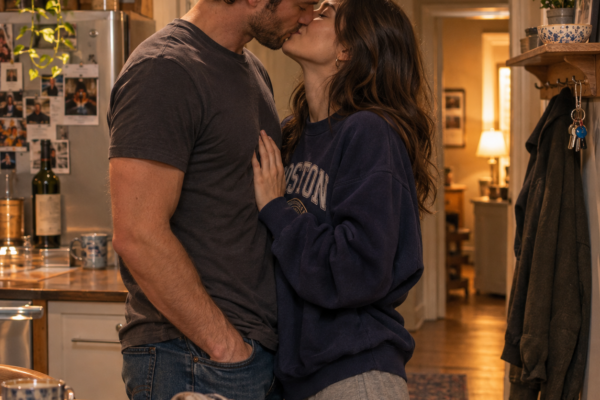
I closed the two inches I had spent that night on my couch thinking about, and I kissed her under the street light, with my hands cold and her coat buttons pressing into my jacket. She kissed me back like a woman who had made a decision and saw no reason to be shy about it.
When we finally stepped apart, she told me it was considerably better than the stove’s idea would have been.
We drove home in separate cars, her headlights steady in my mirror the whole way, and we came into the shared entry together. She did not go up to her door right away. She hung her coat on my hook instead of her own, looked at it there, and left it.
Then she asked whether I would be up early tomorrow, because she planned to come down around nine and make breakfast with her dozen eggs, and she wanted to be clear that nothing was wrong upstairs.
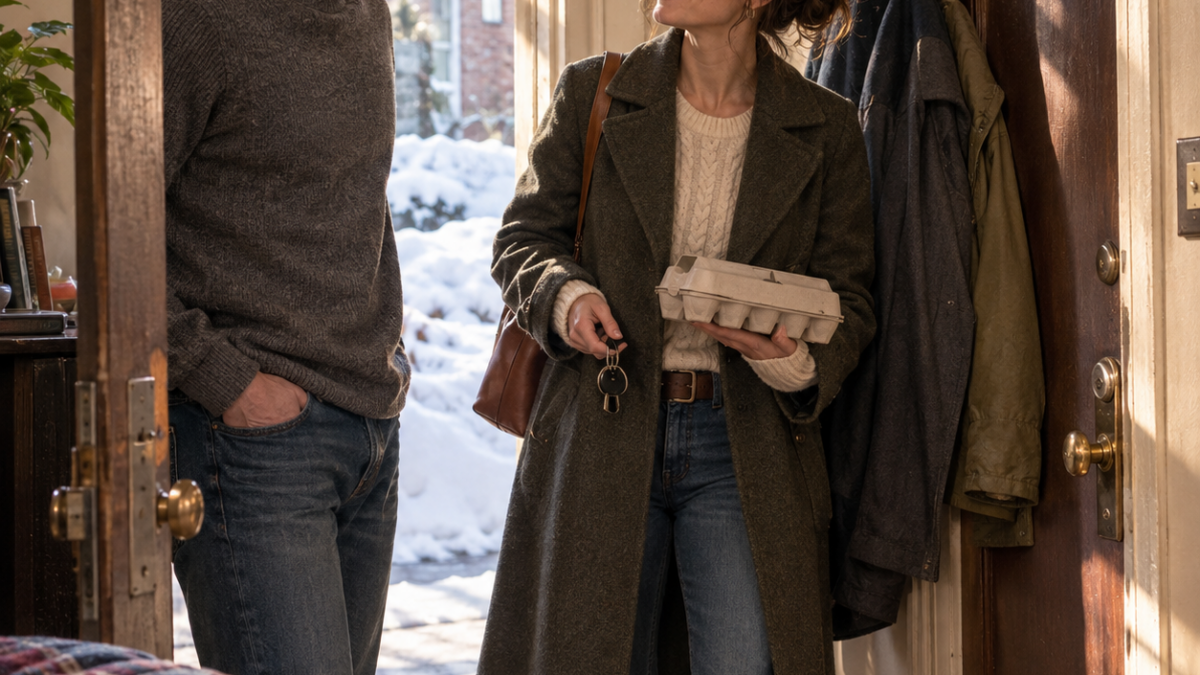
I told her my door would be open. In the morning, she knocked anyway—two even wraps, with the egg carton under her arm.
I put the folded comforter back in my closet that afternoon, because neither of us needed it to explain anything anymore.
We still have not decided where either of us will live once June comes. And for the first time, that question does not feel like weather.
I think about her on my landing that first night, asking not to be left alone, and how badly I wanted to give her anything she needed. What I am glad of now is that she never needed me to stand between her and her own life. She walked down a flight of stairs because she was scared, and later she drove across town because she wanted to. Those turned out to be very different trips, and I am lucky she made both of them.
Could you say yes to someone you were falling for, if you were not yet sure whether saying yes would also mean deciding where you would live? Tell me how you would handle it in the comments. And if you would like more stories like this one, a like and a subscribe lets me know to keep them coming.