“Do You Have Any Expired Cake For My Daughter?”—The Mafia Boss Overheard Everything
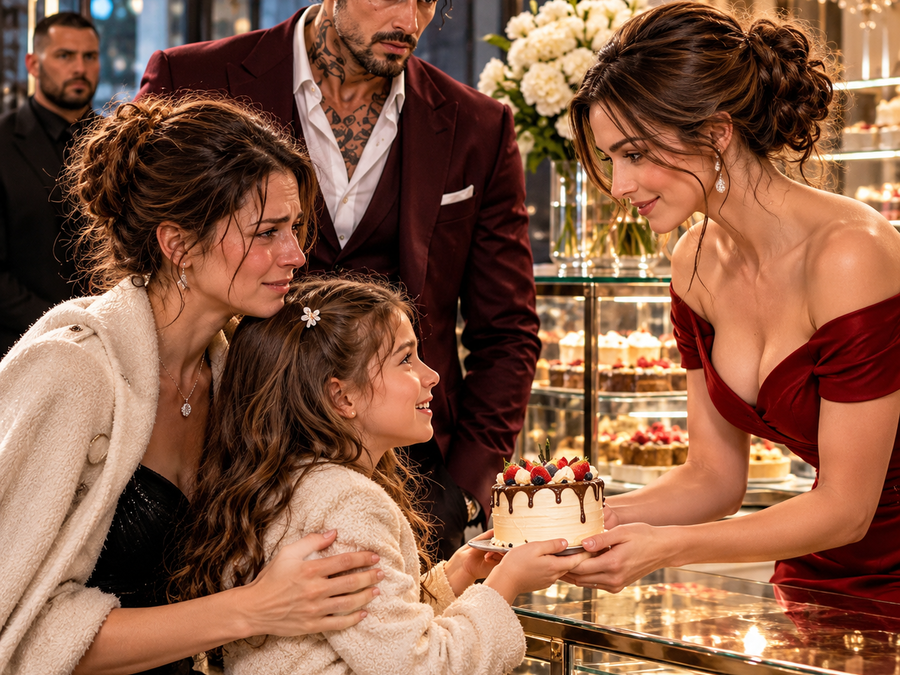
“Do You Have Any Expired Cake For My Daughter?”—The Mafia Boss Overheard Everything
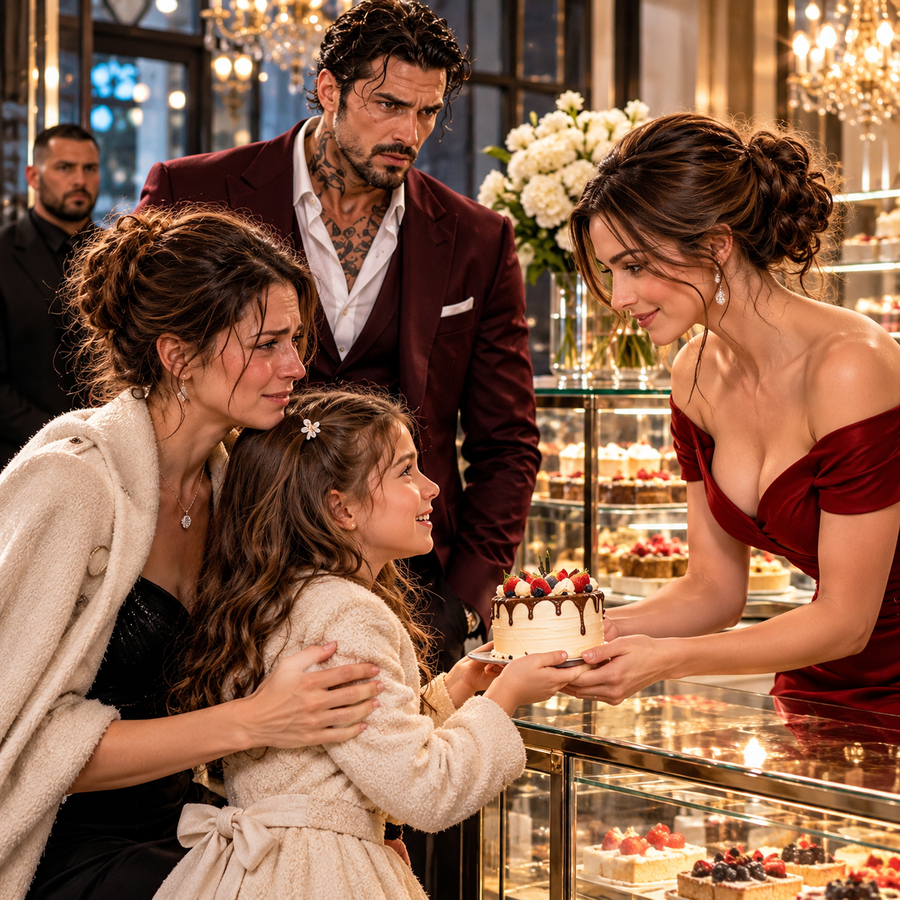
Here’s the truth about monsters.
They don’t always wait in the dark.
Sometimes they sit in the corner of a quiet bakery, drinking black espresso, watching the world rot.
When a desperate mother walks in, clutching three crumpled dollars, asking a simple, humiliating question just to give her little girl a birthday, the monster doesn’t look away.
He listens.
And in that one fragile moment, the city’s most ruthless man decides to rewrite the rules.
Welcome to the story.
The copper bell above the bakery door didn’t chime.
It choked out a dull metallic clack. Maeve hated that sound.
It announced her arrival to a room full of people who didn’t want her there.
It was 8:55 p.m.on a Tuesday.
The neon open sign in the window of Russo’s Patisserie flickered with a dying hum.
Inside, it smelled of spun sugar, warm butter, and money.
It was the kind of smell that stuck to your clothes and reminded you of everything you couldn’t afford.
Maeve stood on the threshold.
Her hands were shoved deep into the pockets of a standard-issue gray wool coat that was two sizes too big.
Underneath, she wore the pale blue scrubs of a third-shift ward cleaner at St.Jude’s.
She hadn’t slept in 32 hours.
Her joints ached with a persistent hollow throb.
But that wasn’t what was twisting her stomach into knots.
It was the date.
November 12th. Mia was seven today.
In her right pocket, Maeve’s fingers traced the edges of her total net worth for the next four days.
Two crumpled dollar bills, a quarter, and three dimes.
$2.
55.
Behind the glass display counter, a teenager in crisp white apron was aggressively wiping down the stainless steel espresso machine.
He looked up, his expression immediately hardening into the practiced annoyance of retail workers counting down the seconds to closing time.
We’re closing in five minutes, he said, not pausing his frantic wiping.
I know, Maeve said.
Her voice felt thin. She cleared her throat, stepping onto the pristine black and white checkered floor.
Her work shoes, cheap rubber and scuffed at the toes, squeaked loud enough to make her wince.
I won’t take long.
She walked to the display case. It was mostly empty.
The grand cakes and delicate tarts long sold to the evening theater crowd. But on the bottom shelf, pushed to the back, sat a few lonely boxes.
Yesterday’s leftovers.
Maeve swallowed the knot in her throat.
She looked at the teenager.
He had stopped wiping and was staring at her with dull, impatient eyes.
Excuse me, she started. The words felt like broken glass in her mouth.
She had rehearsed this in the hospital locker room, in the subway, on the long walk in the freezing rain.
It hadn’t gotten any easier.
The um the items from yesterday, do you throw them out?
The kid blinked.
Store policy.
Anything not sold by closing on the second day goes in the dumpster. Health code.
Maeve nodded slowly.
She looked at the floor.
The tiles were so clean she could almost see her reflection.
A tired, pale woman with dark circles under her eyes. My daughter, Maeve said, her voice dropping to a whisper.
She couldn’t look him in the eye.
It’s her birthday.
I get paid on Friday, but today today is her birthday. And I just She squeezed her eyes shut for a second, forcing the humiliation down.
Is there any expired cake?
Something you’re about to throw away anyway?
I have $2. 50.
I can pay you.
The silence in the bakery stretched. It was heavy, suffocating.
Lady, the kid sighed, sounding genuinely exhausted by the interaction.
I can’t sell you expired food.
I could lose my job.
And I’m not giving it away either.
The cameras are right there.
He pointed vaguely at the ceiling.
I’m sorry.
We’re closed.
Maeve didn’t argue.
You don’t argue when you’re begging.
You just take the hit.
Okay, she breathed out. I understand.
Thank you.
She turned around.
She didn’t cry.
She was too tired to cry.
She just felt hollow, calculating how quickly she could get to the corner bodega to buy a box of generic pancake mix and a single candle before her shift started.
As she walked toward the door, she didn’t notice the man in the corner booth.
He was sitting in the shadows, partially obscured by a large potted fern.
He wore a dark charcoal suit that cost more than Maeve would make in 3 years. A half-empty glass of espresso sat on the table in front of him.
Victor didn’t usually come to Russo’s.
It was his territory, yes. The bakery paid its weekly dues on time every time in a neat manila envelope.
But tonight, a meeting with a troublesome union boss had ended early, and the rain had driven him inside.
He had been watching the street, thinking about shipments, percentages, and the persistent ache in his bad shoulder.
Then the woman walked in.
Victor knew desperation when he saw it.
It wasn’t loud.
It wasn’t frantic.
Real desperation was quiet.
It was the way she stood, shoulders hunched, trying to take up as little space as possible. It was the squeak of her cheap shoes on the expensive floor.
He heard every word.
Is there any expired cake?
Victor’s hand resting on the table stopped tapping.
He looked at her, really looked at her.
The frayed cuffs of her oversized coat, the rigid tension in her jaw, the absolute crushing defeat in the way she accepted the kid’s refusal.
He remembered a basement apartment in South Boston.
He remembered his mother boiling water for soup that was mostly salt and tap water, telling him that the hunger pains were just his body getting stronger. He remembered the smell of cold, damp walls and the sound of rats in the ceiling.
Maeve reached the door.
The copper bell clacked again as she pushed it open, stepping out into the freezing November rain.
Victor sat there for 3 seconds.
Then he stood up.
Victor didn’t rush.
Rushing was for men who lacked control. He walked slowly to the counter, his leather shoes making no sound at all on the tiles.
The teenager who had gone back to wiping the espresso machine looked up.
The impatience on his face vanished, replaced instantly by a pale, twitchy fear. Everyone in the neighborhood knew Victor.
You didn’t have to know exactly what he did to know what he was.
It radiated off him like heat from a furnace.
Mr.Rossi, the kid stammered, dropping the rag.
I didn’t see you there.
Can I get you something?
Another espresso?
Victor didn’t look at the kid.
He looked at the display case, at the bottom shelf.
The chocolate one with the raspberries, Victor said. His voice gravel and smoke, low and entirely devoid of warmth.
Top shelf, the fresh one.
Yes, sir. Right away, sir.
The kid scrambled to open the back of the case, his hands shaking as he carefully boxed the massive, elaborate cake. It was a $50 pastry.
Victor pulled a crisp $100 bill from his pocket and dropped it on the glass counter. Keep the change, Victor said.
And the next time someone asks you for a piece of trash to feed their kid, you give them the best thing in the goddamn store. Do you understand me?
The kid stared at the hundred, then up at Victor’s dead, dark eyes.
He nodded frantically.
Yes, sir. Absolutely.
Victor took the box. He walked out the door.
The rain was coming down harder now, washing the grime of the city into the gutters.
Two men were standing under the awning of the closed dry cleaner across the street. They were massive, wearing heavy dark coats.
When Victor stepped out, they immediately crossed the street, falling in half a step behind him. Boss, the taller one, Paulie grunted.
The woman who just left, Victor said, his eyes scanning the dimly lit street.
Grey coat, blue scrubs.
Where did she go? Paulie pointed a thick finger down the block.
Turned the corner at fourth, heading toward the subway.
Follow her, Victor commanded. Paulie blinked.
Follow her?
Why? Did she see something?
Victor stopped. He turned slightly, just enough to look Paulie in the eye.
The street lights caught the sharp angles of Victor’s face, making him look like something carved from stone.
Because I told you to, Victor said quietly. Paulie swallowed hard.
Right.
Sorry, boss.
Don’t let her see you.
Get an address. Find out who she is.
Victor handed the heavy cake box to the second man, a quiet enforcer named Leo.
Hold this.
Don’t drop it.
If you drop it, I’ll break your hands.
Leo took the box like it was an unexploded bomb.
They walked. They kept a block behind her.
Victor watched her navigate the broken pavement. She walked with a limp, a slight drag of her left leg that spoke of old injuries or bone-deep exhaustion.
She didn’t look back.
She didn’t look at the storefronts.
She just moved with the grim determination of a machine running on fumes.
She lived in a brick tenement building on the edge of the district, the kind of place where the buzzer panel is mostly broken buttons and the front door doesn’t lock.
Victor stood across the street in the shadow of an old brick factory, watching as she climbed the concrete steps and disappeared inside.
Third floor, Paulie said quietly, pointing to a window that flickered to life with a weak, yellowish light. Name on the buzzer says M Gallagher.
Victor stared at the window.
The rain soaked into his wool suit, but he didn’t feel the cold.
He was calculating, assessing.
It was what kept him alive in a world of violent men.
But right now, the ledger in his head wasn’t tracking money or territory.
It was tracking a debt he didn’t know he owed.
Get a car, Victor said, turning away from the building. We heading back to the club?
Paulie asked, already reaching for his phone.
No, Victor said.
He looked at the cake box in Leo’s hands.
We’re making a delivery.
Maeve unlocked her apartment door, throwing her shoulder against the wood to get it past the warped frame. The apartment was exactly three rooms.
It smelled like damp plaster and cheap lavender cleaner. Mom?
The voice was tiny, floating from the sofa in the living room.
Mae forced a smile onto her face before she stepped around the corner.
Hey bug, why are you still awake? Mrs.Higgins is going to charge me overtime.
Mia was sitting on the worn floral couch, wrapped in a faded yellow blanket. She was small for a seven year old, her pale skin making her dark eyes look massive.
Beside her sat Mrs.Higgins, the elderly neighbor who watched Mia for $3 an hour when Mae worked the night shift.
Mrs.Higgins was asleep, her chin resting on her chest, snoring softly. I was waiting for you, Mia said, rubbing her eyes.
Mae’s heart cracked a little further.
She walked over, pressing a kiss to the top of Mia’s head.
Happy birthday, baby.
Mia smiled, missing one of her front teeth. Did you bring the cake?
The question hung in the air.
Mae felt the physical weight of it pressing down on her chest. She looked at the small plastic bag in her hand, containing a box of store brand pancake mix and a single, slightly bent pink candle.
I Mae started.
The lie caught in her throat.
She couldn’t do it.
I tried, baby. The bakery was closed, but I got pancakes.
We can make a giant pancake and we can put the candle right in the middle.
It’ll be a pancake cake.
Mia’s face fell just for a second.
The disappointment was there, sharp and clear, before the little girl bravely shoved it away.
She nodded, pulling the blanket tighter around herself. Pancakes are good.
It was the bravery that broke Mia.
If Mia had thrown a tantrum, if she had cried, it would have been easier.
But this quiet acceptance of having nothing. It was unnatural.
Maeve turned away, walking to the small kitchenette to hide the tears welling in her eyes. Okay.
Let me just get the pan. Then a knock on the door.
It wasn’t a tentative tap.
It was a heavy, deliberate knuckles on wood thud that vibrated through the thin walls.
Mrs.Higgins snorted awake, looking around wildly.
What?
Who’s that?
Maeve froze. Nobody knocked on her door at 9:30 p.m.The landlord just yelled through the mail slot.
The bill collectors called.
She walked slowly to the door, peering through the scratched peephole.
The hallway was dim, the bulb flickering constantly. All she could see was a broad chest covered in dark, expensive wool.
Who is it? she called out, keeping the deadbolt locked.
Her hand instinctively reached for the heavy iron doorstop on the floor.
Delivery.
A deep voice answered.
I didn’t order anything, she said, her voice shaking slightly.
Open the door, Maeve.
He knew her name. The cold dread washed over her.
She gripped the iron wedge. She slid the deadbolt back, keeping the chain lock engaged, and opened the door 2 in.
Victor stood there.
He looked massive in the narrow hallway.
The harsh overhead light threw dark shadows over his eyes.
He wasn’t smiling.
Behind him, she could see the silhouette of a much larger man standing by the stairwell. What do you want?
Maeve demanded, trying to sound tougher than she felt.
Victor didn’t speak.
He simply lifted his hands into the narrow gap between the door and the frame.
He was holding a large, pristine white box tied with a gold ribbon.
Maeve stared at it.
She recognized the logo stamped in silver on the lid.
Russo’s Patisserie.
You were at the bakery, Victor said quietly.
It wasn’t a question.
Maeve looked from the box to his face. Who are you?
Just a man who hates seeing a good cake go in the dumpster, Victor lied smoothly.
His voice was a low rumble. Take it.
I I can’t pay for that, Maeve stammered, pulling back slightly.
I told the boy I only have $2. That cake is paid for, Victor interrupted.
Take the box, Maeve.
The chain is scratching the cardboard.
She hesitated.
Every instinct screamed at her to slam the door.
Men in suits didn’t track women down to give them $50 cakes out of the goodness of their hearts.
There was always a cost, always a trap.
But then she heard Mia’s voice from the living room.
Mom, is it the cake?
Victor heard it, too. Something flickered in his eyes.
A slight softening of the hard lines around his mouth. Take it, he repeated, softer this time.
Tell her happy birthday.
Slowly, with trembling fingers, Maeve unhooked the chain.
She opened the door just enough to reach out and take the heavy box. The cardboard was smooth and cool.
Why? She whispered, looking up at him.
Victor looked at her.
He saw the exhaustion, the fear, the fierce protective grip she had on the box.
Because a kid should have a cake on her birthday, Victor said.
He didn’t wait for a thank you.
He turned around and walked down the hall, his dark coat vanishing into the shadows of the stairwell. The larger man followed him, silent as a ghost.
Maeve stood in the doorway for a long time, the heavy box in her hands, listening to the sound of a heavy car engine starting in the street below. She closed the door.
She locked the deadbolt.
She slid the chain into place. She walked into the living room, setting the box on the cheap laminate coffee table.
She pulled the gold ribbon. She opened the lid.
It was perfect.
A dark chocolate mousse cake, bordered with fresh raspberries dusted with gold leaf. It looked like a crown jewel sitting in the middle of their run-down apartment.
Mia gasped, throwing the blanket off and running to the table.
Mom, it’s beautiful.
Mrs.Higgins put her hand to her chest.
Lord almighty, Maeve. Where did you get that?
I Maeve stared at the cake.
She touched the single pink candle in her pocket. A man brought it.
She placed the cheap candle in the center of the gold leaf.
She lit it.
The small flame illuminated Mia’s face, washing away the shadows of the room, replacing the disappointment with pure, unadulterated joy.
As they sang, Maeve looked at the window. The rain was still falling.
The street below was empty.
But for the first time in years, the city didn’t feel entirely cold.
The high from the chocolate cake lasted exactly 42 minutes.
Then Maeve had to leave for work.
She kissed Mia’s forehead, the little girl already drifting into a sugar-heavy sleep on the worn sofa, and walked back out into the freezing rain.
The subway was mostly empty, populated by the city’s ghosts, exhausted night-shift workers, drunks sleeping off cheap liquor, and kids with nowhere to go.
Maeve sat staring at her reflection in the dark glass of the train window. She looked hollowed out.
St.Jude’s Hospital didn’t care that it was her daughter’s birthday.
only cared about efficiency.
Maeve’s job was invisible until it wasn’t done.
She was the one who scrubbed the biohazard spills in trauma room three.
She was the one who emptied the sharps containers filled with bloody needles. She was the one who mopped the long fluorescent-lit corridors while the rest of the city slept.
Tonight, the emergency department smelled like industrial bleach, stale coffee, and copper. It was a busy night.
At 2:15 a.m., the double doors of the ambulance bay banged open. Paramedics rushed in, shouting a rapid-fire string of medical jargon that Maeve had learned to tune out over the years.
BP crashing, tachycardic, GSW to the upper abdomen.
Maeve stood flush against the wall, clutching her yellow mop handle, making herself small as the gurney flew past. The man on it was young, maybe 22.
His white t-shirt was soaked in a spreading dark red stain.
He was gasping, his eyes rolling back. Move!
Clear the hall!
A resident barked, pushing past her.
Maeve didn’t flinch.
She just watched the blood drip from the side of the gurney, leaving a trail of perfect dark crimson circles on her freshly mopped linoleum. She sighed quietly.
She’d have to get the heavy-duty enzyme cleaner from the supply closet.
10 minutes later, as she was on her hands and knees scrubbing the blood off the floorboards near trauma one, she heard the nurses talking at the central station.
Who is it? An older triage nurse asked, typing furiously on her keyboard.
No ID, but look at the tattoos.
That’s Rossi’s crew.
A younger nurse whispered back.
She sounded terrified and thrilled at the same time. Paramedics said they picked him up outside a warehouse by the docks.
Apparently, there’s a turf war starting with the West Side Boys.
Great, more bodies, the older nurse grumbled. Keep the cops in the waiting room.
If Rossi’s people find out he’s here, they might send someone to finish the job.
Mave’s hand stopped moving.
The heavy, coarse sponge in her grip was soaked in pink foam. She stared at it.
Rossi, Mr.Rossi, I didn’t see you there.
Can I get you something? The teenager behind the counter at the bakery, the absolute paralyzing fear on his face when the man in the charcoal suit had walked up to the register.
Mave felt the blood drain from her face, leaving her lightheaded.
It wasn’t just a rich man in a suit.
It wasn’t a local businessman feeling generous.
Victor Rossi. Even Mave, who lived her life entirely off the grid of city politics and organized crime, knew the name.
Everyone in this zip code knew the name.
Victor Rossi ran the docks.
He ran the unions.
He ran the loan sharks.
He was the reason the local bodegas paid a security fee every Thursday in cash.
He was the reason St.Jude’s saw a spike in blunt force trauma every time a local construction site tried to hire non-union labor.
He was a monster, and he had just been in her living room.
Mave dropped the sponge. Her heart began to hammer against her ribs like a trapped bird.
She remembered the sheer size of the man in the hallway, the cold, dead look in his eyes, the enforcer standing in the shadows behind him.
They had followed her. He knew where she lived.
He knew her name. He had seen Mia.
Panic, cold and sharp, seized chest. She stood up too fast, her head spinning.
She grabbed her supply cart and practically ran to the janitorial closet, slamming the heavy wooden door behind her. She leaned against the sink, gripping the porcelain edges until her knuckles turned white, trying to drag oxygen into her lungs.
Why? Why would a man who orders murders on the docks follow a broke hospital cleaner home to give her a $50 cake?
It didn’t make sense.
Men like Rossi didn’t do random acts of kindness.
Everything was a transaction. Everything had a price.
What the hell did she just owe him?
She pulled her cheap, cracked phone from her pocket and looked at the picture of Mia on the lock screen. The cake was sitting in their fridge right now.
Mia had eaten a slice.
It felt like they had ingested poison.
It felt like she had invited the devil over the threshold. Maeve closed her eyes.
She couldn’t afford to panic.
Panic led to mistakes, and mistakes cost money she didn’t have.
Just a cake. She whispered to the empty closet, the smell of ammonia burning her nose.
He felt bad.
It’s over.
He won’t come back.
You’re nothing to him.
She repeated it until she believed it.
She had to believe it, because if she didn’t, the terror would paralyze her, and she still had 5 hours left on her shift.
She grabbed the heavy mop bucket. She pushed the door open.
She went back to cleaning up his mess.
The sun was barely up when Maeve dragged herself up the concrete steps of her apartment building at 7:30 a.m.The city was gray, washed out by the freezing November morning.
Her back ached in a deep, structural way, and her hands were raw from the industrial soap.
She just wanted to sleep.
Three hours.
That was all she needed before she had to get up, walk Mia to school, and then head to her second job sorting mail at the shipping facility.
She pushed the heavy front door open and froze.
Standing in the narrow, peeling foyer was Gregson. He was the building manager, a sweaty, balding man in his late 50s who smelled persistently of stale beer and cheap cigars.
He was leaning against the mailboxes blocking the stairs. Morning, Maeve, Gregson said.
He smiled, and it was an ugly thing, full of yellow teeth and bad intentions. Maeve tightened her grip on her canvas tote bag.
Gregson, I’m tired.
I need to get upstairs. I bet you do, he said, not moving.
Long night of scrubbing floors, making that minimum wage.
Move, she said, keeping her voice flat.
She had dealt with Gregson for three years.
Showing fear only encouraged him.
I checked the ledger this morning, Gregson continued, casually picking at his fingernails.
You’re two months behind, Maeve.
Two months. The owner is riding my ass.
He says to evict you.
I told you on Friday, she said, exhaustion making her voice tremble slightly.
Mia’s asthma medication doubled in price.
I had to buy the inhalers. I get paid from the sorting facility next Tuesday.
I will have one month’s rent for you then.
The rest by the first of the month.
Gregson clicked his tongue.
Tuesday’s too far away.
Owner wants cash today, or he wants you out.
I don’t have it.
Gregson took a step closer.
The smell of cheap alcohol hit her face.
He looked her up and down, his eyes lingering on her neck.
You know, Maeve, it’s a shame.
A pretty girl like you struggling so hard, working your fingers to the bone. There are other ways to pay rent.
Arrangements we could make, just between you and me.
I could mark you down as paid in full. Maeve felt bile rise in her throat.
She stepped back, her heel hitting the heavy front door.
Don’t touch me!
She hissed as he reached out her hand.
I’ll have the money on Tuesday.
If you try to evict me before then, I’ll call the housing authority.
You haven’t fixed the heat in three weeks.
Gregson’s face hardened.
The sleazy smile vanished, replaced by a vicious scowl. You call the city?
I’ll have your bags on the curb by noon.
You and your brat can sleep in the shelter.
He lunged forward, grabbing her upper arm with a bruising grip.
Let go of me!
Maeve yelled, struggling against him, panic finally breaking through her exhaustion. Before Gregson could say another word, the glass of the front door behind Maeve shattered.
It wasn’t a rock.
It was a massive gloved hand that punched straight through the reinforced glass, reached inside, and grabbed Gregson by the collar of his cheap coat. Gregson yelped as he was violently yanked forward.
Maeve stumbled back, hitting the wall. The door was kicked open, the deadbolt snapping like a twig.
Standing in the doorway was the giant man from the hallway the night before.
Paulie.
He didn’t look angry.
He looked like he was doing a chore.
He dragged Gregson out onto the concrete stoop, threw him against the brick wall of the building, and pinned him there by the throat with one hand.
Gregson was choking, his feet dangling an inch off the ground, his face turning a dark mottled purple.
Maeve stood frozen in the foyer, glass crunching under her cheap shoes.
A sleek black Lincoln Town Car was idling at the curb. The rear window hummed down with a quiet electric whir.
Victor Rossi was sitting in the back seat. He was reading a newspaper.
He didn’t look at Gregson, who was currently fighting for oxygen against the brick wall.
He looked at Maeve. Put him down, Victor said.
His voice wasn’t loud, but it cut through the cold morning air like a blade.
Paulie immediately dropped Gregson.
The building manager collapsed onto the wet pavement, coughing violently, clutching his throat, tears streaming down his face.
Victor folded his newspaper and set it on the seat beside him. He looked at Gregson on the ground.
You managed this building, Victor asked.
Gregson nodded frantically, unable to speak, terrified out of his mind.
He knew exactly who was sitting in the car.
You’re fired, Victor said.
If I see you in this zip code again, my friend here is going to remove your hands.
Do we have an understanding?
Gregson didn’t hesitate.
He scrambled to his feet, slipping on the wet concrete and bolted down the street without looking back.
He didn’t even grab his keys.
The street was silent again, save for the low purr of the Lincoln’s engine.
Maeve walked slowly out onto the stoop.
The freezing air bit into her face. She looked at the shattered door, then at Paulie, who was casually picking a piece of broken glass off his sleeve, and finally at Victor in the back of the car.
She should have been grateful. She should have thanked him.
Instead, a cold, furious fire ignited in her chest. She marched down the concrete steps and walked straight up to the open window of the Lincoln.
Paulie tensed, stepping forward, but Victor held up a single finger. Paulie stopped.
Maeve looked down into the luxurious leather interior. Victor looked back at her.
Up close in the daylight, he looked older. There were silver at his temples and deep dark lines etched around his eyes.
Eyes that were completely devoid of empathy. What do you want?
Maeve demanded, her voice shaking with rage, not fear. Who the hell do you think you are?
Victor looked mildly amused.
I think I’m the man who just saved you from a very unpleasant eviction.
I didn’t ask for your help, she snapped.
I didn’t ask for the cake.
I don’t want anything from you.
He put his hands on you, Victor pointed out, his tone reasonable, like they were discussing the weather. I handle my own problems, Maeve said, leaning down slightly.
I know who you are, Mr.Rossi.
I clean up the blood your people leave on the floor at St.Jude’s.
I know exactly what kind of man you are.
The amusement vanished from Victor’s eyes.
The temperature in the car seemed to drop 10 degrees.
Then you should know better than to raise your voice at me. I have nothing for you to take, Maeve said, her voice dropping to a harsh whisper.
I have no money.
I have no property.
I have a daughter, and if you ever come near her again, I swear to God I will kill you myself.
Stay away from me. She stood up, turned her back on him, and walked back up the stairs, crunching over the broken glass.
Victor sat in the car, watching her disappear into the dark hallway of the tenement.
He didn’t order Paulie to drag her back.
He didn’t order her killed for the disrespect.
He just watched the empty doorway for a time. Boss?
Paulie asked nervously from the sidewalk. Are we going to do something about that?
Victor slowly rolled the window up.
Drive, he said.
As the car pulled away from the curb, Victor felt something he hadn’t felt in a decade.
Intrigue. Maeve locked her apartment door, the three deadbolts she had installed herself and leaned her back against the cheap wood.
She was shaking so hard her teeth rattled.
She had just threatened Victor Rossi.
She had yelled at a man who routinely had people sunk into the harbor in oil drums. Stupid, stupid, stupid.
But the adrenaline felt good.
For three minutes she wasn’t a victim.
She wasn’t a tired broke cleaner begging for scraps.
She had looked a monster in the eye and told him to go to hell. She walked into the living room.
Mrs.Higgins was snoring softly in the chair. Mia was asleep on the couch, clutching a stuffed rabbit with one missing ear.
On the coffee table sat the white box from Russo’s patisserie.
Maeve grabbed the box, marched into the tiny kitchenette and shoved the entire remaining half of the $50 cake into the trash can. She pushed it down deep under the coffee grounds and eggshells.
She didn’t want it in her house.
She didn’t want anything that tied her to him.
She paid Mrs.Higgins the $9 she owed her for the night, locked the door behind the old woman and collapsed onto her bed.
She needed to sleep.
She had to survive, but sleep didn’t come.
Every time she closed her eyes, she saw the shattered glass of the front door and Victor ‘s cold, dead stare.
Two days passed.
The glass door downstairs was boarded up with plywood.
A new building manager, a nervous kid in a cheap suit, slid a note under her door, saying her rent was forgiven for the month due to the inconvenience of the break-in.
Maeve knew what that meant. Rossi had paid it.
Or he had simply terrified the owner into erasing the debt.
Either way, it made her skin crawl.
She owed him now. The ledger was open.
On Thursday afternoon, the phone rang. Maeve was at the kitchen counter, trying to stretch a box of macaroni and cheese with extra milk.
She picked up the receiver. Gallagher?
A woman’s voice asked.
It was Brenda, the shift supervisor at St.Jude’s.
Yes, Brenda.
I’m scheduled for tonight at 11:00, right?
Actually, Maeve, that’s why I’m calling, Brenda said, her voice tight, uncomfortable.
Listen, HR just came down hard. The hospital is doing third quarter budget cuts.
They’re slashing overtime and terminating the bottom 20% of the per diem cleaning staff.
Maeve stopped stirring the macaroni.
The kitchen suddenly felt very cold.
What are you saying?
I’m sorry, Maeve.
You’re let go, effective immediately.
Your final check will be mailed on Friday.
Brenda, no. Please.
Maeve begged. The pride she had shown Victor Rossi evaporating instantly.
I need this job. I have a daughter.
You know I take every shift.
I never call in sick.
Please.
It’s not my call, honey.
It came from corporate.
I’m sorry.
The line went dead. Maeve stood in the kitchen, the dial tone buzzing in her ear.
She had $34 in her checking account. Her job at the shipping facility barely covered groceries.
The hospital job was what kept the lights on.
It was what paid for Mia’s inhalers.
Without it, they were dead in water. She dropped the phone.
She gripped the edge of the counter, trying to breathe, but her chest felt incredibly tight. The walls of the tiny apartment were closing in.
The reality of poverty isn’t a slow decline, it’s a cliff.
And she had just been pushed off it.
She looked at the trash can. Three days ago, after the encounter on the street, she had found a small, heavy piece of card stock sitting on the ledge of her mailbox downstairs.
It was stark white, embossed with a single phone number. No name, no business logo.
She knew who left it. She had torn it in half and thrown it in the garbage bin by the street.
Now she stood in the kitchen, listening to Mia cough in the other room.
A deep, wet, asthmatic cough that meant the cheap over-the-counter medicine wasn’t working.
She needed the prescription, the one that cost $120.
Maeve closed her eyes. She felt the tears hot and angry against her cheeks.
She was out of options.
She was out of pride.
She turned and ran out of the apartment. She sprinted down the three flights of stairs, pushing past the plywood front door and out onto the freezing street.
The garbage truck hadn’t come yet.
She fell to her knees on the wet concrete next to the large green municipal bin.
She threw the lid back. The smell of rotting food and stale beer hit her like a wall.
She didn’t care.
She plunged her hands into the filth, digging through wet newspapers, coffee cups, and slimy plastic bags. She dug for 10 minutes, her hands freezing, her fingernails caked in grime.
She was sobbing now, a quiet, broken sound of absolute defeat. Near at bottom, stuck to the side of a crushed soda can, she found it.
Two halves of a pristine white card.
She pulled them out. She wiped the sludge off the embossed numbers with the sleeve of her coat.
She held the pieces together, her hands shaking violently in the cold wind. She looked at the numbers.
She committed them to memory.
She was going to make a deal with the devil.
Because when you’re freezing to death, you don’t care if the fire is burning down the house.
You just want to get warm.
She walked back upstairs, washed her hands until they bled, picked up her phone and dialed the number.
It rang once. Yes?
It was Victor’s voice, low, gravel.
Maeve closed her eyes.
It’s Maeve.
I need a job.
Silence on the other end, a long, heavy silence. And then a sound that made the blood freeze in her veins.
Victor Rossi laughed.
I’ll send a car, he said, and hung up.
The ledger was open, and Maeve had just mortgaged her soul.
The black Lincoln Town Car was waiting at the curb before Maeve even reached the bottom of the stairs.
It idled in the freezing rain, a massive, predatory thing, completely out of place on her broken street.
Pauly was standing by the rear passenger door.
He didn’t wear a coat, despite the bitter wind whipping off the harbor.
He just looked at her, his massive frame blocking the street light, and opened the door.
Maeve didn’t hesitate.
She couldn’t afford to.
She slid onto the cold leather. It smelled of expensive cologne and ozone.
The door slammed shut behind her, sealing her inside a soundproof vault, severing her from the world she knew. Victor was not in the car.
Pauly got into the driver’s seat.
He didn’t speak.
He put the car in drive and pulled away from the curb. They drove for 20 minutes, leaving the cramped tenement blocks and heading toward the industrial docks.
The city shifted from broken neon signs to towering rust-streaked cranes and corrugated steel warehouses. The rain lashed against the tinted windows, blurring the yellow sodium lights into long, sickly streaks.
The car pulled up to a sprawling facility surrounded by 12-ft chain-link fencing topped with razor wire.
A sign on the gate read Rossi Atlantic Logistics. Pauly flashed his brights.
The heavy iron gates rolled open.
They parked in front of a massive loading dock.
Pauly cut the engine.
Top floor, end of the hall, he grunted, not looking back at her. Maeve got out.
The wind off the water was sharp enough to slice skin.
She pulled her thin coat tighter around herself and walked to the steel side door. It was unlocked.
The inside of the warehouse was cavernous.
Crates stacked four stories high. Forklifts sat idle.
It smelled of diesel, salt water, and wet cardboard. She found a metal staircase and began to climb.
Her cheap rubber shoes squeaked on the grating. Every step felt like walking to the gallows.
The top floor was different.
It was quiet. The floors were polished concrete.
At the end of the hall, a heavy oak door stood slightly ajar. Maeve pushed it open.
The office was vast and minimalist. Floor-to-ceiling windows overlooked the black, churning water of the harbor.
There was no desk, just a massive leather sofa, a glass coffee table, and a steel rolling cart loaded with architectural blueprints.
Victor was standing by the window, watching the rain hit the glass.
He had taken his jacket off.
His white shirt was rolled up to the elbows, revealing forearms corded with muscle and faded black ink.
He didn’t turn around when she walked in.
I bought that cake because it was going to rot in a dumpster, Victor said, his voice carrying easily across the large room.
I hate waste.
I didn’t buy it because I wanted a stray dog following me home.
Maeve stopped in the center of the room.
She forced her hands out of her pockets. She kept her chin up.
I’m not a stray dog.
I’m a worker, and you just got me fired.
Victor finally turned. He leaned his hip against the glass, crossing his arms.
The amusement she had seen in his eyes a few days ago was gone.
He just looked tired and entirely dangerous. I made one phone call to the hospital administrator, Victor said flatly.
I told him you were an excellent employee.
If he decided to interpret that as a threat and terminate you to avoid dealing with me, that’s corporate cowardice, not my problem.
It’s my problem, Maeve said, her voice rising slightly.
My daughter has asthma.
Her inhalers are $120 a month.
My rent is 600.
I have $34 to my name.
I don’t care about your games, Mr.Rossi.
You owe me.
Victor’s jaw tightened.
He walked slowly across the room, stopping two feet in front of her.
He towered over her. The sheer physical presence of the man was suffocating.
I owe you nothing, he said quietly.
You came to my turf. You threw my charity in my face.
You threatened my life in front of my men.
I should have Paulie throw you in the harbor just for the disrespect.
Why should I give you a job?
Because I know how to clean, Maeve said.
Victor stared at her, waiting.
Not just floors, she continued, holding his gaze, refusing to blink.
I’ve cleaned trauma one at St.Jude’s for three years.
I know what a gunshot wound looks like. I know how much bleach it takes to pull arterial blood out of unsealed concrete.
I know how to bag biological waste so the city sanitation workers don’t ask questions.
And I know how to keep my mouth shut. The cops come in, they ask the nurses, they ask the doctors.
They never ask the janitor.
Victor didn’t move.
His dark eyes searched her face, looking for the lie, looking for the weakness.
You’re a civilian, he said.
You have a kid.
People with kids break when the pressure gets high.
People with kids don’t have the luxury of breaking, Maeve fired back.
I just dug your business card out of a municipal trash can in the freezing rain to come here and beg a criminal for money. I am already broken.
I just need to get paid. The silence stretched.
The rain battered the large windows.
Victor reached into his pocket.
He pulled out a thick, folded wad of cash, $100 bills. He tossed it onto the glass coffee table.
It landed with a heavy thud.
2,000, Victor said. That gets your kid her medicine.
That fills your fridge. You start tonight.
Maeve looked at the money.
It was more than she made in two months.
Her stomach twisted.
It felt like looking at a loaded gun.
Where?
she asked. Under the defunct auto shop on 9th and Elm.
We run an off-the-books clinic for guys who can’t walk into an ER.
The doctor is a drunk, but his hands are steady. The place is a slaughterhouse.
It needs to be spotless. It needs to be sterile.
If a guy survives a bullet but dies of sepsis because the floor was dirty, I hold you responsible. Mave swallowed hard.
Okay.
And Mave, Victor added, his voice dropping an octave, turning into a raw, gravelly warning.
You take this money, you step over the line.
There is no union. There is no HR.
There is no quitting. You belong to the house now.
You understand? Mave looked at the cash.
She thought of Mia’s coughing.
She thought of Gregson’s hands on her arm.
She walked to the table.
She picked up the money. I understand, she said.
Three months later, the apartment smelled like roasting chicken and clean laundry. The heat was working.
The pantry was full. Mia had a new winter coat, thick and lined with fleece, and her cheeks had lost that pale, hollowed-out look.
The dark circles under Mia’s eyes were gone.
Mave’s dark circles, however, had only deepened.
The clinic under the auto shop was exactly what Victor had described. A slaughterhouse.
It was a subterranean concrete bunker lit by harsh fluorescent tubes.
Dr.Arthur was a brilliant surgeon who had lost his medical license a decade ago to a vicious oxycodone habit.
He fixed the broken bones, dug out the hollow-point bullets, and stitched up the knife wounds. Mave did everything else.
She scrubbed the steel surgical tables with industrial-grade chlorhexidine. She incinerated the bloody gauze in a heavy iron furnace in the back room.
She mopped the floors until they smelled of iodine and bleach, masking the heavy metallic stench of human blood. She worked six nights a week.
She was making more money than she ever thought possible. She hid it in an old coffee can under the floorboards, paranoid that the rug would be pulled out from under her at any moment.
She was changing. The exhaustion of poverty had been replaced by the hypervigilance of the underworld.
She learned the names of the men. She learned who carried a grudge, who was reckless, and who was trusted.
She stopped flinching when heavily armed men walked into the room. And she learned about Victor.
He didn’t visit the clinic often.
When he did, the temperature in the room changed. The wounded men sat up straighter.
Arthur stopped shaking.
It was a Tuesday night in late February. The clinic was empty save for Mave and Arthur, who was passed out in his small cot in the corner, snoring loudly.
Mave was inventorying the surgical staples. The heavy steel door at the top of the concrete stairs groaned open.
Heavy footsteps descended.
Mave’s hand instinctively dropped to the heavy iron wrench she kept under the supply counter.
She waited. Victor stepped into the harsh light.
He was wearing his usual tailored suit, but he looked wrecked.
His tie was gone. The collar of his shirt ripped open.
There was a dark, wet stain spreading across the left side of his ribs.
His face was the color of ash.
Arthur? Victor grunted, leaning heavily against the concrete wall.
Mave dropped her clipboard. She ran to him, hooking her arm under his right shoulder to take some of his weight.
He was incredibly heavy, muscle and bone feeling like lead.
Arthur’s out, Mave said, her voice sharp, authoritative.
He took a pill an hour ago.
He won’t wake up for six.
She guided Victor to the nearest steel table. He hissed as he sat on the edge.
Wake him up, Victor ordered, his eyes squeezing shut.
I can’t.
He’s dead to the world.
Maeve grabbed a pair of trauma shears from a tray. Take the jacket off.
Victor looked at her.
His eyes were glazed with pain, but the cold, calculating intelligence was still there.
You aren’t a doctor, Maeve, and you’re bleeding all over my clean floor.
Jacket off.
He didn’t argue.
He shrugged off the ruined suit jacket. Maeve used the shears to cut his blood-soaked shirt open from the hem to the collar.
It wasn’t a bullet.
It was a long, jagged slash right along the rib cage.
Deep, but not deep enough to hit organs.
The muscle was exposed, weeping blood steadily.
Knife?
she asked, grabbing a sterile towel and pressing it hard against the wound.
Victor flinched, his jaw locking.
Broken bottle.
Kid tried to get ambitious at a sit-down. Did he succeed?
He’s currently in the trunk of Paulie’s car.
What do you think?
Maeve didn’t blink.
Three months ago, that sentence would have made her vomit. Now, she just focused on the pressure in her hands.
She grabbed a bottle of sterile saline and a tray of sutures.
I’ve watched Arthur do this 50 times, Maeve said, opening a packet of lidocaine.
But I don’t know how to mix the numbing agent properly.
I can just stitch it raw.
It’s going to hurt like hell.
Do it, Victor said.
He gripped the edge of the steel table until his knuckles turned white.
Maeve worked fast.
Her hands, rough from years of manual labor, were surprisingly steady.
She cleaned the wound, ignoring the harsh hiss of breath escaping Victor’s teeth.
She threaded the curved needle. Why did you buy the cake?
she asked suddenly, her voice quiet.
Victor looked down at her. She was entirely focused on the wound, her face inches from his chest.
He could smell cheap lavender soap and the sharp tang of iodine on her skin. I told you, I hate waste, he lied.
I don’t believe you, she said, pulling the first stitch tight.
Victor grunted.
You don’t do anything by accident.
You didn’t know me.
I was a ghost.
Men like you don’t see women like me.
Victor watched the top of her head. He watched the way she meticulously tied off the heavy black thread.
My mother cleaned houses, Victor said softly. The sound of his voice in the quiet, sterile room felt incredibly intimate.
Back Bay, rich families.
She worked 14 hours a day, came home with bleach burns on her hands, and half the time they forgot to pay her.
May have paused for a fraction of a second, then went back to stitching. I was 10, Victor continued, staring at the concrete ceiling.
I asked her for a pair of decent boots for winter.
The ones I had were falling apart. She told me we had to wait.
The next day I caught her stealing a loaf of bread from a bakery in the North End. The owner caught her.
He didn’t call the cops.
He just made her get on her knees and scrub his entire kitchen floor with a toothbrush while he watched to pay for the bread.
May tied off the final stitch. She snipped the thread.
I watched her do it, Victor said, his voice devoid of emotion, totally flat.
I watched her strip her dignity down to nothing just so we could eat a stale piece of bread.
When I saw you in that bakery asking for garbage, I didn’t see you.
I saw her.
I bought the cake because I couldn’t shoot the kid behind the counter.
Maeve looked up. Their faces were very close.
For the first time, she didn’t see the mafia boss who owned the docks.
She saw the 10-year-old boy in the freezing cold, watching his mother break.
She picked up a damp, clean cloth.
Gently, she wiped the smeared blood off Victor’s chest, tracing the heavy lines of his scars.
Victor reached up.
His large, heavy hand wrapped around her wrist.
His grip wasn’t bruising, but it was absolute.
He stopped her hand.
He looked at her, and the air between them shifted.
The cold, transactional nature of their arrangement evaporated, leaving something heavy, dangerous, and incredibly raw in its wake.
I’m not a good man, Maeve, he whispered, his thumb brushing against her pulse point.
Don’t look at me like I am.
I know exactly what you are, Maeve whispered back, not pulling her hand away.
I clean up your messes.
Victor’s eyes darkened.
He pulled her slightly closer, the heat of his skin radiating into the cold room.
Before either of them could move, the heavy steel door at the top of the stairs blew off its hinges.
The explosion deafened Maeve.
A wall of dust and smoke blasted down the stairwell, carrying the smell of cordite and pulverized concrete.
The clinic’s harsh overhead lights flickered, popped, and died, plunging the room into emergency red lighting.
Victor was off the table in a millisecond.
Pain forgotten, he moved with terrifying speed.
He grabbed Maeve by the shoulders, throwing her hard behind a thick concrete support pillar.
STAY DOWN, He roared over the ringing in her ears. He pulled a heavy black handgun from the holster clipped to his ruined trousers.
Gunfire erupted from the top of the stairs. Automatic fire.
Sparks flew as bullets chewed through the steel tables and shattered the glass cabinets containing Arthur’s medical supplies.
Arthur bolted upright on his cot, screaming in a drug-induced panic. A stray round caught him in the shoulder.
He went down hard, dragging a tray of scalpels with him. West side!
Victor hissed, peering around the concrete pillar. They must have followed me from the sit-down.
Maeve was on her hands and knees. Her heart was hammering a frantic, violent rhythm against her ribs.
She tasted dust and copper. She looked at Victor.
He was trapped.
There were at least three heavy guns firing down the narrow choke point of the stairwell, suppressing him.
He couldn’t get an angle.
They were going to die here.
The West Side crew wouldn’t leave witnesses.
They’d shoot her, they’d shoot Arthur, and they’d leave Victor bleeding on the floor.
Mia’s face flashed in Maeve’s mind.
The little girl sleeping under the yellow blanket.
People with kids don’t have the luxury of breaking.
Maeve didn’t panic.
The cold mechanical survival instinct she had honed scrubbing blood off hospital floors took over completely.
She crawled on her belly, staying low beneath the hail of bullets, moving away from Victor toward the supply closet at the back of the room.
Maeve, where are you going? Victor yelled, firing two rapid shots up the stairs to keep their heads down.
She ignored him.
She reached the closet.
She grabbed a five-gallon plastic mop bucket on wheels. She threw in two gallons of industrial bleach.
Her hands were moving on autopilot.
She grabbed the heavy jugs of ammonia she used to strip the floor wax.
She poured them both into the bucket. The chemical reaction was instantaneous.
A thick, violently toxic cloud of chloramine gas erupted from the bucket. It was heavy, noxious, and burned the eyes and throat immediately.
Maeve held her breath.
Her eyes were streaming tears, burning like fire. She pushed the heavy bucket out of the closet and sent it rolling hard across the slick floor directly toward the bottom of the stairwell.
Victor, cover your face! She screamed, dropping to the floor and shoving her face into the crook of her elbow, breathing through the thick fabric of her scrubs.
The rolling bucket hit the bottom of the stairs directly beneath the ventilation draft, pulling air up into the shop above. The thick white cloud of toxic gas billowed rapidly up the stairwell.
Immediately the gunfire stopped.
The sound of coughing replaced it. Violent, wet, choking sounds.
I can’t see!
MY EYES! A voice screamed from the top of the stairs.
Heavy boots scrambled on the concrete, trying to retreat, trying to escape the blinding, suffocating cloud.
Victor didn’t hesitate.
He pulled his shirt up over his nose and mouth, stepped out from behind the pillar and moved into the gas.
He didn’t fire blindly.
He walked halfway up the stairs, finding the silhouettes choking in the smoke.
Three precise, silenced shots rang out. Thwip.
Thwip.
Thwip.
Three bodies tumbled down the concrete steps, landing in a tangle of limbs at the bottom. Silence fell over the clinic, save for the hiss of the chemical reaction and Arthur moaning in the corner.
Victor walked slowly back down the stairs.
The red emergency lights cast long, demonic shadows across his face.
He looked at the bodies. He looked at the smoking bucket.
Then he looked at Maeve.
She was sitting against the wall, coughing violently. Her eyes red and streaming, clutching her chest.
She looked terrified, exhausted, and utterly unbroken. Victor holstered his gun.
He walked over to her.
He didn’t offer a hand.
He just crouched down in front of her, ignoring the burning in his own lungs, ignoring the fresh blood seeping through his stitches. He stared at her for a long time, the realization settling into his bones.
She wasn’t a stray dog.
She wasn’t just a cleaner.
She was a survivor, forged in a fire just as hot as the one that had made him.
She had saved his life, not with a gun, but with the very dirt she was hired to scrub.
You didn’t run, Victor said, his voice rough.
Maeve looked up at him, wiping the tears from her burning eyes.
She didn’t look away.
I told you, I have a daughter.
I don’t have the luxury of dying.
Victor reached out.
This time, he didn’t grab her wrist.
He gently brushed the damp hair out of her eyes, his thumb tracing the line of her cheekbone.
It was a tender gesture from a man covered in blood, standing in a room full of corpses.
The debt is paid, Maeve, he said quietly.
You don’t owe me anything anymore.
Maeve looked at the bodies.
She looked at the blood on Victor’s hands.
She knew what leaving meant. It meant going back to the cold, back to the fear of the eviction notice, back to the humiliation of begging for expired cake.
She looked back at Victor. She saw the absolute terrifying safety he represented.
A monster, yes. But he was her monster now.
I’m not leaving, Maeve whispered, leaning slightly into his touch.
Who else is going to clean up this mess?
Victor smiled.
It was a dark, cynical thing, but it was real.
He pulled her to her feet, pulling her tight against his chest, right over the heart she had just stitched back together. In the dim red light of the slaughterhouse, surrounded by the smell of bleach and blood, they finally understood each other.
The city above them was cold and merciless, but down here, in the dark, they had found their own twisted version of warmth.
Sometimes the most unbreakable bonds aren’t forged in romance, but in survival.
Maeve and Victor’s story proves that when you stop running from the dark, you might just find someone willing to rule it by your side.
If you loved this gritty slow-burn mafia drama, hit that like button right now.