Part 2: All Grandpa Left Her Was a $1 Sheep Ranch, Until the Old Dog Led Her to the Well…
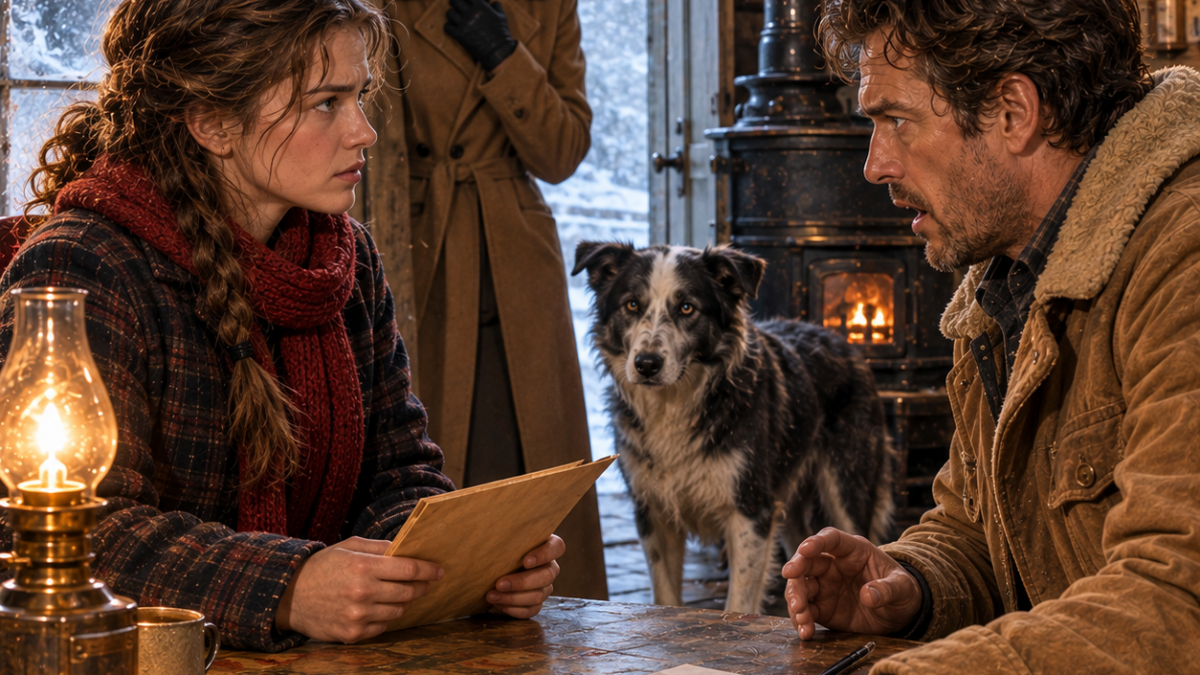
She said Abel left her some instructions she couldnt read out loud with certain people in the room.
She didnt say who.
He took a small black radio out of his chest pocket and held it out.
Channel four reaches my shop from the rise behind your house.
You call me at six every night, trouble or no trouble.
Now put your boots on properly. If Ruths got something to say, its time she said it to you.
They drove to town in the early afternoon, Ossies tow truck first to break the drifts, Maisie behind him in her grandfathers flatbed with the heater blowing, and Tuck sitting upright on the seat beside her. Where the ranch track met the county road, there was a black car.
It was pulled onto the shoulder with its engine running, and a man in a long city coat was standing in the snow beside it, with a camera held up to his face.
He was not pointing it at the house, he was not pointing it at the windmill or the sheds. He was pointing it down into the coulee, the line of drifted snow where the creek ran, and at the three black willows over the spring.
When he heard the trucks, he lowered the camera, got back into the car, and pulled away toward town without looking at them.
Maisie saw the plates as it went out of state.
Ozzies brake lights flashed once ahead of her, and then he drove on, and so did she. She kept both hands on the wheel the rest of the way and thought about it.
A man who had come 70 miles from somewhere else to take pictures of a creek nobody wanted, on a ranch nobody thought was worth a dollar.
She did not know what it meant, but she knew Curtis Rourke did not drive anybody to the edge of nowhere for nothing, and she knew she had not seen the bottom of it yet. And she thought about her mother.
She thought about Joanne Rourke sitting in that pickup with her face to the windshield, and she tried to make it into something else. Maybe her mother had not understood, maybe she had thought it was only a visit, but Maisie had seen her mothers hands at the reading, folded too tightly in her lap, and she knew better.
Her mother had understood all of it and had sat there anyway and had not rolled down the window.
That was the part Maisie could not set down, not the cold, not the money, the window that never came down.
Garnet Flats was a single, wide street of brick and false-fronted buildings under a grain elevator that stood over it like a steeple. The black car was parked in front of the cafe.
Ozzie pulled up in front of the feed store and Maisie parked behind him and pointed at the second floor.
Shell be up there.
Shes always up there.
Ozzie walked back to her window before she could get out.
He He not look at the cafe.
He did not have to. You saw him, he said.
I saw him. Feller wasnt taking pictures of your house.
No, Maisie said.
He was taking pictures of the creek.
Aussie nodded slowly as if she had answered a question he had not asked out loud.
Abel used to say, a man who looks at water like that out here is already counting it.
He tapped the door of the truck twice with his knuckles.
Go on up. Ill sit with the dog.
Maisie left Tuck in the cab with the window cracked and climbed the narrow outside stairs.
At the top was a door with frosted glass and gold letters painted on it. And before she could knock, it opened.
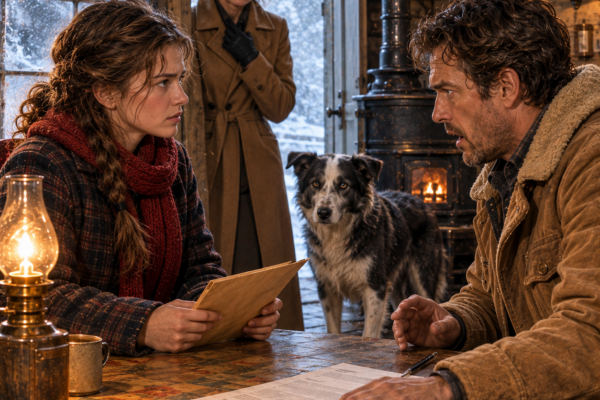
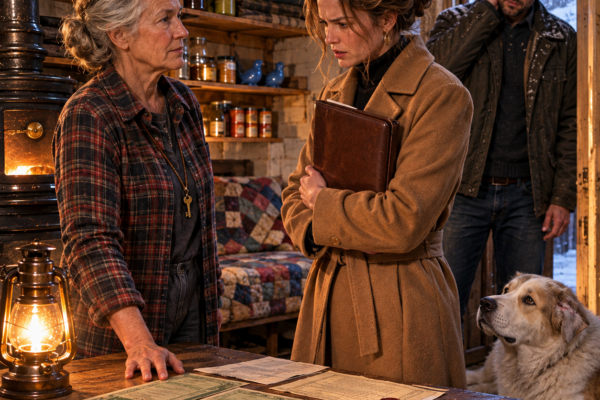
Ruth Ellery stood there with her glasses pushed up on her silver hair and a Manila folder in her hand.
Miss Tolliver, she said, I wondered how long it would take you. She stepped back to let her in and then stopped and looked at Maisie very seriously over the top of the folder.
Before I show you whats in here, I need to ask you one question and I need you to answer it honestly.
Has your stepfather asked you to sign anything? He left a paper on the table, Maisie said.
I havent opened it. He said hed be back Saturday at noon and if I signed it, Id be home by supper.
Ruth Ellery closed her eyes for a moment, then pulled out a chair for her beside the radiator and laid it out slowly and plainly.
The Wolf Cooley place belonged to Maisie, she said. Abel had left it to her by name with nothing tied to it.
And nobody in the world could sell one acre of it without Maisies own signature. You dont need anyones permission to live there, she said.
You dont need anyones permission to say no.
Not his, not mine, not anybodys. Then she opened the folder.
On top was a letter on heavy cream paper from a company called Highline Data Partners, dated last April and addressed to Abel Tolliver.
It said the company meant to build a large computer facility on the high plains, that such places needed great quantities of water for cooling, and that it would pay $1,100,000 for the Wolf Cooley place with its appurtenant water rights.
In the margin, in that hard slanting pencil, Abel had written one word, number.
He brought it in last spring, Ruth said.
He said theyd come back after he was gone to whoever they thought could sign. She slid out a second letter, much newer.
This came to my office Wednesday morning from High Lines attorney.
Maisie read it twice.
It said that the company had received a signed letter of intent from Mr.Curtis Rook, acting on behalf of the Tolliver family and had paid Mr.Rook an option deposit of $20,000 and expected a deed to the property to be delivered by Monday, the 12th of January.
He doesnt own it, Maisie said slowly. No.
He never owned it, so he cant sell it, so he has to get me to sign it to him first. She set the letter down very carefully, the way you set down something that might break.
She could feel the pieces sliding into place, cold and exact.
The trucks, hes lost three trucks since fall. My mother buying day-old bread, all those phone calls out in the garage.
Hes in trouble, isnt he?
And he already took their money, $20,000.
Hes spent it.
Id bet anything he spent it, and now he has to give them a deed by Monday or give the money back, and he cant give the money back.
She looked up. So he took my phone, so I couldnt call anybody.
He took the car, so I couldnt leave. He took my money, so Id have nothing, and he left me out there at 14 below and told me Id be home by supper if I signed.
He wasnt giving me time to think, Mrs.Ellery.
He was giving me time to get cold enough.
Ruth Ellery did not anything for a long moment.
Then she took the yellow pencil from behind her ear and set it down on the desk.
Your grandfather, she said quietly, told me you were smarter than anybody in that family ever gave you credit for.
Im sorry it took this to show it.
There was one more thing, she said as Maisie stood to go.
Abel had asked her to tell his granddaughter something if she ever came up those stairs on her own.
He said, tell her the well was always meant for her. I asked him what that meant.
He said shed know. I know, Maisie said.
When she came down the outside stairs into the cold, Curtis Rook was standing on the sidewalk beside her grandfathers truck. He had come out of the cafe across the street with a man in a city coat who was now getting into a black car.
Curtiss own pickup sat at the curb with the engine running, and through its windshield Maisie could see her mother in the passenger seat. Curtis smiled, warm and a little proud, the smile he used on customers.
Well, look at you, he said.
Made it all the way to town, got the old mans junker running and everything. He glanced up at the gold letters on Ruth Ellerys door, and the smile did not move, but something behind it did.
Honey, theres no need for all this running around.
Come on home with us tonight.
Hot supper, your own bed. Well sign that paper at the kitchen table like a family, and itll all be done.
Inside the cab, Tuck stood up on the seat and stared at Curtis, and a low sound came out of him that Maisie had not heard before.
No, she said. Curtis tilted his head, patient, as if he had not quite heard.
No, she said again. Her voice was steady.
She was surprised how steady. Im not signing anything, and you dont need to come Saturday.
For one moment, his face did something she had never seen it do.
It went blank, completely, like a window with the shade pulled down. Then the warmth came back over it.
Youve had a hard week, he said gently.
I understand. Saturday, noon.
Youll have had another night to think it over.
He walked back to his pickup.
As he opened the door, Maisie looked past him at her mother.
Joanne Rook was looking at her through the glass.
Her hand had come up to the silver locket at her throat and was holding it tight.
Her lips were pressed together.
The window did not come down. The pickup pulled away.
She reached the ranch at nearly dark. She did not go into the house.
She walked straight to the well with Tuck beside her, and she sat down on the stone collar in the cold and put her arm around him.
She thought about her father setting the compass open on the kitchen table.
She thought about that compass in Curtis Rooks pocket. She thought about an old man in a gray felt hat driving 70 miles with a small brown box on the seat beside him and 70 miles home with nothing.
She thought about her mothers hand on the locket, and she found that she was not afraid of tomorrow at noon anymore.
She was only tired and cold and very sure.
After a while, she lowered Tuck down in his sling and climbed down after him and lit the stove and the lamp.
Then she took down the last of the black ledgers from the shelf, the one with last years date on the spine.
The final entry was dated the 14th of November, 5 days before he died, and it was not about sheep or weather. It was four words long, written in a hand gone shaky, and it was addressed to her.
Seventh tie from the ladder, Maisie. Bring the key.
Has anyone ever quietly kept something back for you the way Abel did when the rest of the family was laughing?
Tell me about them in the comments, and stay right here because the seventh railroad tie was about to give up the one paper Curtis Rook never knew existed. She stood up with the lamp in one hand and the brass key in the other.
Behind her, the iron ladder ran up the shaft into the dark, and its bottom rung was set into the stone right beside the doorway.
She went to the wall nearest it and laid her palm on the first railroad tie, waist high, and counted along the row out loud, the way a child counts. One, two, three, four, five, six, seven.
The seventh tie looked like all the others, black and creosoted and rough, but when she pressed on it, it moved, just a little, just the width of a fingernail.
She set the lamp on the table.
She worked her fingers into the gap at the end of the tie and pulled, and it was heavier than she expected, and it would not come.
And then all at once it slid out toward her with a long, dry scrape, and she staggered back with the weight of it and let it drop to the dirt floor.
Behind it, set deep into the packed earth and lined with fieldstone, was an iron box.
It was the size of a loaf of bread with age, with a heavy hasp and a brass padlock, and stamped into the brass of the padlock, small and clear in the lamplight, was a single number. Seven.
Tuck had come to stand beside her.
He did not make a sound. Her hands were shaking now, and not from the cold.
It took her two tries to get the key into the lock.
It turned stiffly with a click she felt in her wrist, and the shackles sprang loose, and she lifted the lid. Inside, wrapped in oilcloth and tied with kitchen twine, was a flat packet of papers.
She carried it to the table and untied the twine and folded back the oilcloth.
There were three things inside, and she laid them out side by side under the lamp.
The first was old and yellow and stiff, with a red seal at the bottom and type so faded she had to tilt it to read. Decree, it said at the top.
District court, concerning the waters of Wolf Cooley Creek. A date in 1903.
The second was newer, though not new.
It was crisp and typed with a stamp from the county clerk in the corner and a recording number written in ink. Water rights deed, it said.
And below that, the words that made her sit down hard in the chair. Grantor, Abel Tolliver.
Grantee, Maisie Ann Tolliver, a minor.
And the date on it was the 14th of April, 19 years ago, the day she was born.
Went to the courthouse in the afternoon.
It is done. The third thing was a letter.
The same hard slanting pencil. Only one page.
She read the deed again before she read the letter. Read it all the way through, every line, and she did not understand half of it.
Severed from the land. All rights to the use of the waters conveyed absolutely.
She understood only that her grandfather had gone to a courthouse on the day she was born and put her name on something and had wrapped it in oil cloth and buried it behind a railroad tie 30 ft underground and had written a key into his last words so that she, and only she, would come looking.
She picked up the letter.
It began without any greeting at all. If you have found this, then you have read the ledgers and you have the key and you have most likely met Curtis Rook in his true colors by now.
Here is the thing they do not know.
The water on this place was never part of the land, Maisie. Not since the day you were born.
That afternoon, I went to the courthouse in Garnet Flats and had old Jasper Ellery draw up a deed and I gave every drop of water this ranch has ever had a right to. All of it, to you.
It was recorded that same day. Jasper is 10 years gone now, and I never told his daughter Ruth because I did not want it in any file a clever man could ask to see.
here a ranch without its water is only grass waiting to blow away. The men from High Line do not want the sagebrush.
They want the creek.
They will tell you different, but that is what they want.
Rook came out here in August. He sat at my table and told me I was a stubborn old fool sitting on a fortune and that Joannes family deserved to see some of it before I was in the ground.
I told him the place would go to you, every acre, and he would never see a nickel of it.
He went white as that windmill. I expect he has been making his plans ever since.
Take this to Ruth. Do not be afraid of what it is worth.
Be careful what you do with it.
Water is the one thing out here nobody can make more of. I kept a little back all my life, and now it is your turn to decide who comes thirsty.
She read the letter through slowly, the stove ticking behind her and the dog warm across her feet.
When she got to the last line, she read it four times.
Rook thinks the land is the prize.
Let him go on thinking it.
It was after 9:00 when she climbed up out of the well with the radio in her pocket and walked through the snow to the rise behind the house and pressed the button the way Aussie had shown her.
Aussie, its Maisie.
The radio hissed. Then his voice came back gruff and wide awake.
You were supposed to call at 6:00.
Im sorry.
I found something.
She looked back at the dark shape of the windmill against the stars. Can you bring Mrs.Ellery out here in the morning?
Early, before noon. There was a pause.
What kind of something? Paper, she said.
The kind he didnt want in any file.
Another pause, longer.
Well be there at 8:00. They were there at a quarter to.
Aussies tow truck came up the ranch track in the grey first light, with Ruth Ellery sitting very upright in the passenger seat in a dark green wool coat, holding a leather briefcase on her knees. Maisie had the house stove going hot and coffee on from the blue tin and the oilcloth packet laid out on the kitchen table.
Ruth did not take off her coat. She sat down, put on her glasses and read.
She read the decree first, all of it, her lips moving slightly. Then she read the deed.
Then she read it again.
Then she opened her briefcase and took out a thick folder and paged through it until she found a single sheet and laid it beside the deed and ran the yellow pencil down both line by line. I pulled the full title history for the estate last night after you left my office, she said without looking up.
Its routine. There was an entry I couldnt account for, an instrument recorded in the Water Rights Index 19 years ago this April under a name I didnt expect to see there.
She tapped the sheet.
Yours.
I was going to drive out this morning and ask you about it.
She took off her glasses. My father drew this up.
Thats his signature as the notary. He never said one word to me.
Grandpa asked him not to, Maisie said.
So I see.
Ruth folded her hands on the table. All right, let me tell you what this is as plainly as I can.
In this state, she said, water rights were property all on their own. They could be separated from the land they ran across and given away or sold by themselves, the same as a car or a house.
Abel had done exactly that.
On the day she was born, he had separated every water right belonging to the Wolf Cooley place and deeded them to her, and the deed had been recorded with the county that same afternoon. A baby can own property, Ruth said.
She just cant sell it until shes 18. Youre 19.
These rights have been yours legally for your whole life. And nobody on this earth needs to give you permission to do anything with them.
What are they worth?
Aussie asked. He had been standing by the stove with his cap in his hands.
Ruth looked at the yellow decree.
This is a 1903 priority on Wolf Cooley Creek, 4.
1 cubic feet per second.
That doesnt mean much, said that way.
So let me put it plainly.
Its about 2 and 1/2 million gallons of water a day, enough for a small town. And out here, water goes by seniority.
Oldest right drinks first. In a dry year when the creek runs low, a right this old takes its full share before almost anybody else on the creek gets a drop.
She opened her briefcase again and took out a sheet of note paper covered in her own small handwriting.
I called a man in the capital at 7 this morning who brokers water rights for a living.
I read him the decree over the phone.
I didnt tell him whose it was. She looked up.
He asked me if it was for sale before Id finished the sentence.
He said senior water on a creek like this one goes for a great deal of money right now, and that a company building one of those computer facilities cant build anything at all without it.
He said 3 and 1/2 million dollars, at least.
Perhaps 3.
6, perhaps more if two buyers wanted it at once.
Nobody said anything. The stove ticked.
Or, Ruth said, you dont sell a drop.
You lease part of it in the dry years to the ranches along this creek that need it. He thought something like $140,000 a year, every year for as long as you live.
And the water stays yours.
It goes to your children after you, the way your grandfather meant it to.
Aussie let out a long breath through his nose and sat down heavily on the bench by the door. Tuck, lying at Maisies feet, lifted his head and looked from one face to the next.
Maisie found that she was holding the edge of the table with both hands. She was thinking about the man in the city coat at the bottom of the ranch track, pointing his camera down into the coulee.
He had not been photographing the land at all. He had been photographing her creek.
And the land, she said.
The land is yours too. 640 acres.
Ruth picked up the high-line letter from the day before. But read what they offered him.
1,100,000 for the place with its appurtenant water rights. That means the water that goes with the land.
Your stepfather read that line and assumed the water came with the ranch.
Most people would. She set the letter down.
It doesnt. If you had signed that paper on the table, Mr.Rook would have handed high-line 640 acres of dry sagebrush and nothing else.
Theyd never have closed. Hed have owed them their 20,000 back and youd have lost your ranch for nothing.
He knew Grandpa was leaving it to me, Maisie said, since August.
She pushed Abels second letter across the table and Ruth read it and her mouth went thin. That will interest high-lines attorney a great deal, she said.
A man who signs a letter of intent to sell land he knows he will never own. I dont think theyll be pleased.
She was quiet a moment. Then she said more gently, theres one more thing I ought to tell you.
Your mother telephoned my office on Thursday afternoon.
Maisie looked up. She didnt give a reason.
She asked if I knew whether you were all right.
I said I didnt know.
She was quiet for so long I thought the line had dropped. Then she asked me not to tell your stepfather she had called and she hung up.
Ruth put her glasses back on. I thought you should know.
I dont know what it means. Maisie did not know either.
She sat with it, turning it over, and could not make it fit with a face turned toward a windshield.
It was Ozzie who brought up the weather. I dont want to scare anybody, he said, but I had the weather radio on driving out.
Theres a ground blizzard coming down out of Canada.
Theyre saying Sunday afternoon, wind 50, gusting higher, and a wind chill around 35 below. When it hits, theyll close the county road from here to the highway.
He looked at Maisie.
That means nobodys coming out here and nobodys going back, not for a day, maybe two. Ive got the room, Maisie said.
Youve got the room, he agreed.
Then he nodded at the black stove pipe running up from the cook stove to the ceiling. But mind that pipe in the meantime.
Abel told me last winter the elbow up top was rusting thin, and he never got around to replacing it.
He said dont run that stove hard.
A cracked stove pipe in a wind like that will fill a house with smoke in 5 min.
Maisie looked up at the elbow.
It was dark and scaly where it bent into the wall.
She had been running the stove hot all morning. Ill mind it, she said.
At a quarter past 11, Ruth closed her briefcase.
She left Maisie certified copies of everything, the deed and the decree and the high line letters in a fresh Manila folder, and took the originals with her to put in her own safe. Nobody walks off with these, she said, not while Im alive.
Ozzie stopped on the porch with his hand on the rail. I dont like leaving you, he said.
Not with him coming at noon. He cant do anything to me, Ozzie, not anymore.
Mrs.Ellery said so. I know what she said.
He looked at her a long moment and then at the dog, and then he put his cap on.
You call me on that radio the minute hes gone.
And if that sky starts turning before Sunday, you get yourself and that dog down that well, and you stay there.
You hear me? I hear you.
She watched the tow truck go down the ranch track until it was a speck, and then nothing.
Then she walked out alone to the rise behind the house, the one where the radio reached, and stood there in the wind with Tuck pressed against her leg and looked at it. She had looked at this land for four days and seen sagebrush and snow and nothing else.
Now she looked again.
Down in the coulee, the three willows stood black against the white, and under them, under the ice, the spring she had broken with the bar was running. Beyond them, the creek bed wound away east, a long, crooked line of drifted snow with something moving underneath it all winter long, patient and cold and older than anyone living.
Her great-grandfather had watched that water through the dry year. Her grandfather had kept it for her through 19 years of Christmases when a man named Rook answered the phone.
It had been hers the whole time she was 16 and standing at the top of the stairs.
It had been hers the whole time she was refilling coffee for long-haul drivers and counting dollar bills on Sunday nights.
She did not feel rich. She felt something else, something she did not have a word for.
It was closer to being found.
All right, she said to the dog. All right.
She spent the next 40 minutes getting ready, though she could not have said for what. She banked the house stove low, the way Ozzie said.
She carried an armload of split wood to the well and lowered it down in the sling, and then another. She took two cans of soup from the pantry and a jug of spring water down to the room under the ground.
She laid the Manila folder squarely in the middle of the kitchen table beside the white envelope Curtis had there on Tuesday.
She still had not opened the envelope.
She did not open it now.
Then she sat down at the table with Tuck at her feet and waited. At 3 minutes past 12 she heard the engine.
Curtiss pickup came up the last rise with snow pluming off its tires and stopped in the yard.
Both doors opened. Curtis climbed down first in his tan ranch coat with the sheepskin collar, a leather portfolio under his arm.
Her mother came around the hood after him slowly in her long camel coat and stopped at the bottom of the porch steps as if she were not certain she was allowed to climb them. Curtis came up the steps and in without knocking.
He looked around the warm kitchen, at the coffee pot and the swept floor and the old dog by the stove and at her grandfathers truck parked by the shearing shed.
And Maisie saw him take all of it in and adjust quickly the way he adjusted prices. Well, he said warmly, somebodys made herself at home.
Tuck stood up. He did not growl this time.
He simply stood between Curtis and the table and did not move.
Curtis laughed and sat down across from her and set the portfolio on the table.
Im not going to pretend with you, kiddo, he said.
I think youre old enough for the truth. Theres a company that wants to buy this place.
Good people.
Theyll pay real money, more than this dirt has ever been worth.
Sign it over to me and Ill handle the wholesale and Ill put your share straight into a college fund. Youll never have to wait another table in your life.
He unzipped the portfolio and laid out a fresh quit claim deed and a pen. Thats all this has ever been about, your future.
Maisie looked at the pen. She looked at the quit claim.
Then she opened the manila folder and took out the copy of the water rights deed with its county stamp and its recording number and her own name typed under her grandfathers and she laid it on the table beside his paper and turned it so it faced him.
Read that first, she said.
Curtis smiled and picked it up.
He began to read. Maisie watched his face.
She watched the smile stay where it was for one line and two and three, as if nobody had told it to leave. Then she watched it go.
It did not fall. It drained slowly, the way color drains out of the sky.
Her mother had come up onto the porch.
She was standing in the open doorway now, with her hand at her throat, holding the locket.
Behind her, out past the shearing shed and the windmill and the long white swell of the land, the northwest edge of the sky had gone a hard, flat white, a full day early, and the first gust of wind came across the yard and rattled every window in the house.
Curtis read the deed twice.
Then he set it down on the table very carefully, as if it were hot. This is some kind of mistake, he said.
Its recorded, Maisie said.
19 years ago, the day I was born, Mrs.Ellery found it in the county books herself. Her own father drew it up.
Then it can be contested. You were a baby, Maisie.
A baby cant accept a gift like that.
An old man, not in his right mind, signing things behind the familys back. Any judge in this state would Mrs.Ellery says theres nothing to contest.
Maisie did not raise her voice. He was 65 and sharp as a tack, and the deeds been sitting in the county books in plain sight for 19 years.
You cant sell water you dont own, Curtis. Off land you dont own either.
Thats all this is. She laid the second high line letter on top of the deed, and you took their $20,000, knowing since August that he was leaving everything to me.
Theyre going to want it back.
For a long moment, Curtis Rook did not say anything at all.
Then he leaned back in her grandfathers chair and looked at the ceiling. And when he spoke again, his voice was one she had never heard.
It was not gentle, and it was not warm.
It was just tired.
When I was 12 years old, he said, I stood in our front yard and watched the bank sell my fathers farm at auction.
Everything, the tractor, the cows, the house. They carried my mothers kitchen table out onto the lawn, and our neighbors bid on it.
People wed had to Sunday dinner, and she stood there and watched them do it. I swore that day nobody would ever carry my table out of my house.
And this fall, the trucks started going back to the bank one at a time, and the notes kept coming, and I spent their 20,000 making payroll so my drivers could feed their kids at Christmas. Then the old man died, and here was this place, sitting out here doing nothing.
I told myself it was only dirt. I told myself youd never miss what you didnt know you had.
He stopped. He did not say he was sorry.
He did not ask her for anything.
That explains it, Maisie said quietly.
It doesnt make it all right. No, Curtis said.
I dont suppose it does. The wind hit the house.
It came all at once, a long, roaring blow out of the northwest that shook the windows in their frames and sent snow hissing across the porch boards like sand. The kitchen went dim.
Through the window, Maisie could no longer see the shearing shed, only a churning gray-white wall where the yard had been.
Thats not supposed to be till tomorrow, Curtis said, standing.
Its here now. He pulled the door open, and the wind tore it out of his hand.
We can make the county road.
Joanne, get in the truck.
Curtis, you cant see the truck, Maisie said.
He went anyway, head down into the white, and her mother went after him because she always went after him. Ten minutes later, two shapes came stumbling back, holding on to each other.
Snow caked to Curtiss eyebrows.
Buried to the axles at the gate, he said, I couldnt see my own hood. Maisie got them inside and shoved the door shut and turned to the stove, and that was when she smelled it.
Smoke, sharp and gray and rolling down from the ceiling.
With the wind howling across the chimney top, the stove pipe was shuddering in its brackets, and right where it bent into the wall, at the elbow Aussie had warned her about, a crack had opened as long as her finger. Smoke was pouring out of it in a flat gray sheet.
There was no fixing it in that wind. There was no staying in that house either.
Get your coats on, Maisie said, all the way on.
Were going down the well. Her mother stared at her.
The well?
Theres a room at the bottom. Its warm.
Grandpa built it for exactly this. Ive been sleeping in it for three nights.
She was already shutting the stove damper and pulling on her gloves.
Dont argue with me, please.
Just come.
They went across the yard roped together, Maisie in front with Abels coil of rope around her waist, then her mother, then Curtis, the wind shoving at them, the snow so thick she found the well collar by walking into it. She hauled the lid up and dropped Tucks sling over the pulley, and the old dog stepped into it as calmly as ever, and she lowered him into the dark.
Her mother froze at the edge. I cant, Joanne said.
Her voice was very small.
Maisie, I cant do heights. I never could.
You dont have to look down.
Maisie took her mothers gloved hands and put them on the first rung. Look at the stone in front of your face.
Ill be right below you the whole way.
I wont let you fall. She went first, three rungs, and waited.
Her mother came down one rung, then another.
Maisie talked to her the whole way down, low and steady, the way you talk to a frightened animal, counting the rungs out loud. At 30, her mothers boots touched the plank ledge, and she stood there shaking.
And Maisie opened the low black door, and the warm air came out over both of them. Curtis came last.
He pulled the heavy lid shut over his head, and the roar of the storm dropped away to a distant hollow moaning, like wind across the mouth of a bottle. Maisie lit the hanging lamp and fed the stove, and the little room came up gold around the four of them.
 [Tap here for the Next Part ]