All Grandpa Left Her Was a $1 Sheep Ranch, Until the Old Dog Led Her to the Well…
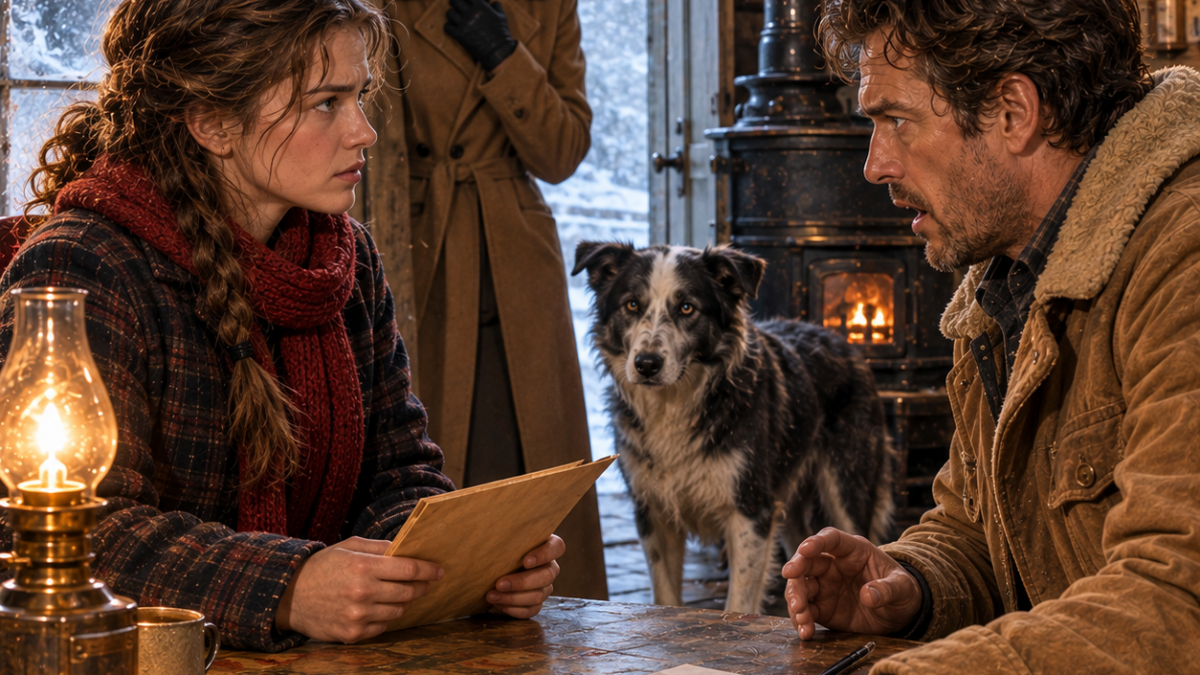
All Grandpa Left Her Was a $1 Sheep Ranch, Until the Old Dog Led Her to the Well…
At 19, Mazie Tolliver had learned to keep her face still while people laughed at her.
She kept it still when her stepfather laughed at her grandfathers will, and again that afternoon, when he took her phone, her car keys, the envelope of tips she had saved from two years of waiting tables, and her dead fathers brass compass, and left her on a sheep ranch nobody thought was worth a dollar, 26 miles from the nearest town.
On the second night, at 14 below, she noticed that frost would not settle on the old well lid.
30 feet down that well, she found a door, and behind it a room built by the grandfather her stepfather had spent six years making sure she would never meet.
To understand what was waiting down there, you have to start with the morning the whole room laughed.
The lawyers office was on the second floor above the feed store in Garnet Flats, and it smelled of radiator heat. Curtis Rook took the middle chair, the way he took the middle of everything, and set his hat on his knee like a man settling in at a ball game.
Mazies mother sat beside him in her long camel coat with her hands folded in her lap. Curtiss brother Wes had come along for the drive and the free coffee.
At the end of the row sat an old woman in a black church hat, Abel Tollivers second cousin Hazel, up from the river country hoping for the piano. Mazie sat in the last chair.
Nobody had told her to. It was just where she had learned to sit.
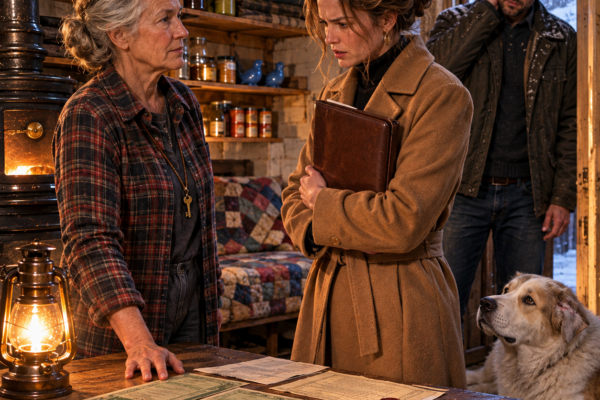
The lawyer, a tall woman named Ruth Ellery, with a yellow pencil behind one ear, read the will slowly.
Abel Tolliver of Wolf Coulee died the 19th of November at the age of 84.
His savings, $31,000, went to the Garnet Flats Volunteer Fire Department.
His mothers upright piano went to his cousin Hazel.
Then Ruth Ellery turned the page and looked over her glasses straight the road to the last chair.
To my granddaughter, Maisie Ann Tolliver, she read, I leave the Wolf Cooley place, all 640 acres of it, the house and the sheds and the windmill and the well, which I am told by men who know about such things is not worth a dollar.
For a moment, there was nothing. Then West snorted into his coffee and Curtis tipped his head back and laughed out loud, a big, easy laugh, the kind he used at church suppers, and Hazel laughed too behind her handkerchief because everyone else was laughing.
Maisies mother did not laugh. She looked at her hands.
Maisie kept her face still. She had been doing it since she was 13, since the week her father died and Curtis began coming around with groceries and a careful voice.
Inside, though, something turned over slowly like a stone in a creek.
She had not seen her grandfather since her fathers funeral.
She had been told for years in that same careful voice that the old man wanted nothing to do with any of them.
And now he had left her the one thing he had. Well, kiddo, Curtis said, wiping his eyes, congratulations.
Youre a landowner. It was a quarter to 11 on Tuesday, the 6th of January.
They did not drive home to Hartsel afterward, 70 miles south.
Curtis turned the pickup north instead, and when Maisie asked where they were going, he said, To see your inheritance, and smiled at her in the rearview mirror.
He had told her that morning to pack two bags in case the lawyer needed her a day or two.
And because she had learned that nothing she hid in that house stayed hidden, she had packed her envelope of tips at the bottom of the second bag under her good sweater, $2,300.
Two years of refilling coffee at the Truck Stop Cafe, folded flat and counted on Sunday nights.
The county road ran 17 miles between snow fences, and the last nine were an unplowed ranch track.
There were no trees.
There was sagebrush to the edge of the world, humped and silver under the snow, and a sky so wide and pale it seemed to have no top. The ranch appeared at a quarter past two.
A tall gray house with its paint gone the color of old bone, a sagging porch, a rusted tin roof, a gray shearing shed with a round stone well beside it, and a steel windmill standing over everything with its wheels stopped dead as if it had been waiting a long time for a wind it trusted. On the top porch step lay a dog.
He was a border collie, black and white, with a white blaze down his face and one white sock on his front left paw. His muzzle had gone gray.
His ribs showed in long thin shadows under his coat. He lifted his head when the truck stopped and watched them and did not bark.
Thats the old mans mutt, Curtis said, climbing down. Dont feed it.
You feed it, itll never leave.
He carried her two bags up onto the porch, stepping wide around the dog and pushed the door open.
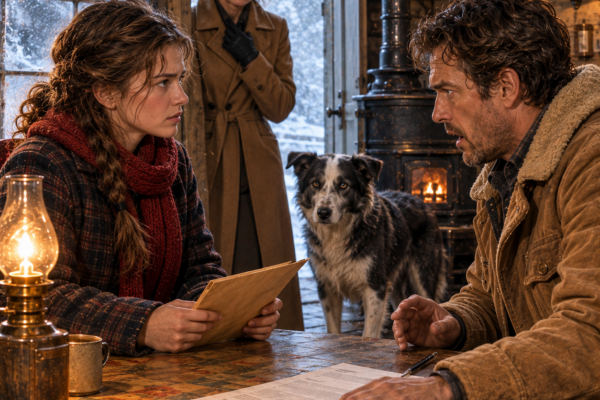
The cold inside was older and deeper than the cold outside, the still cold of rooms nobody had breathed in for seven weeks. A black iron cookstove, a pine table under faded oilcloth, frost grown in feathers across every window.
Curtis set a white envelope on the table and tapped it twice with one finger. Heres how I see it, he said.
He said it gently.
He always said things gently.
It was the voice of a man explaining the weather, as if none of what came next was his doing, only the way the world happened to be arranged. Youre a grown woman with 640 acres.
Id say its time you stood on your own land and saw what its like.
Youre leaving me here, Maisie said.
Im giving you a few days to think. Sign this place over to me and Ill get it off your hands before the taxes eat you alive.
Ill be back Saturday noon.
You sign it, youre home by supper.
He held out his hand. Phone, honey.
Its on my plan. Plans in my name.
She gave it to him. Car keys.
Cars in my name too. You know that.
She gave him the keys.
He was already looking at her second bag. Your mother tells me youve been squirreling money away.
He crouched, unzipped the bag and slid his hand under the good sweater as if he had known exactly where to look. He came up with the envelope.
Two years under my roof and not a dime of rent.
Ill put this toward whats owed and hold the rest for you.
Thats only fair. She did not answer.
Her right hand had gone into her jacket pocket on its own and closed around the compass. It was a small brass thing.
Its case worn smooth at the edges.
Her father had carried it every day of his life. Inside the lid, in letters so fine you had to tilt it to the light, someone had engraved the words True North.
When she was small, her father used to set it open on the kitchen table and say, wherever you end up, kiddo, the needle still knows the way home. It was the last thing of his she owned.
Curtis saw the shape of her hand in the pocket and held out his own. Thatll get lost out here, he said.
Let me keep it safe for you.
No, Maisie.
The same gentle voice. Dont make this harder than it is.
She looked past him out the open door to the truck. Her mother sat in the passenger seat with her face turned toward the windshield, very still.
Maisie waited for her to get out. She waited for the window to roll down.
She waited for one word. Her mother did not move.
Maisie put the compass in Rooks hand, and something inside her went quiet and flat, like a field after the wind stops. Saturday, he said, noon.
He went down the steps.
The truck doors thumped.
The pickup swung around in a wide half circle, and its tail lights slid away down the ranch track, small and red and steady.
It did not stop. Neither of them looked back.
Then there was only the wind moving low across the sage and the ticking of the tin roof and the old dog on the step looking up at her. She had one turkey sandwich in wax paper, left over from the cafe the night before.
She sat down on the step and tore it in half and held one half out on her flat palm.
The dog looked at the sandwich, then at her. He stood on stiff legs and came close and took it so gently she barely felt his teeth.
He ate it in three bites.
Then he lay down a careful foot away from her, chin on his white paw, and sighed.
Me too, Maisie said.
His collar was worn brown leather with a brass ring. There was no tag.
The stove came next, because the stove was the only thing that mattered. There was split wood against the north wall under a crust of snow, kindling in a box, and on the shelf a tin of kitchen matches.
She counted them. Eleven.
Her hands were already clumsy with cold. The first match broke against the striker.
The second flared and died in the draft. She knelt with the third held in her fingers and made herself breathe slowly, the way her father had taught her to light a campfire in the wind, cupping her body around it, and she struck it and fed it one curl of paper, then a sliver of pine, then another, and the flame stood up and held.
She did not breathe again until the first split of wood caught. The stove ticked and groaned, and a thin warmth began to move across the floor one plank at a time.
Eight matches left.
In the pantry she found a few dented cans of beans, a tin of oatmeal and a sack of salt.
In a drawer a can opener and a hatchet. On a hook by the door hung a red wool scarf faded at the fringe.
She wound it twice around her neck and it smelled faintly of wood smoke and pipe tobacco and she stood very still with her face in it for a long moment. When it got dark she opened the door and called the dog.
He would not come in.
He walked through the snow to the round stone well beside the shearing shed, climbed up onto its heavy plank lid, turned once and lay down curled tight with his tail over his nose. Suit yourself, Maisie said, but she left the door open a crack for an hour anyway.
That night it went to nine below zero.
She slept in her coat on the floor by the stove and woke every hour to feed the fire. In the morning the water barrel by the back door had frozen solid on top.
She broke the ice with the back of the hatchet, three hard blows that rang through the empty house like a bell.
She dug the wood pile out with her hands and split kindling until her palms burned. She cooked oatmeal with snow water, ate half and set the other half on the porch in a pie tin.
The dog came and ate it and this time he did not walk away.
He sat down against her knee and leaned his weight there and stayed.
Tuck, she said, without knowing why, except that it felt like his name.
He thumped his tail once on the boards.
It was in the afternoon, carrying wood, that she noticed the well. Frost had furred every fence post and sage stem and nail head on the shearing shed and grown in thick needles along the windmills legs.
But the plank lid on the well was bare. It sat dark and dry in the middle of all that white like a hand print left on a frosted window.
She walked over and laid her bare palm flat on the boards.
They were not warm, exactly, but they were not cold the way everything else was cold. Tuck came and stood beside her and looked at the lid, and then at her, and then at the lid again.
The second night the cold came down in earnest, fourteen below. The stove could not keep up.
The wind found every gap in the old clapboards, and by midnight Maisie sat with her knees pulled to her chest and the red scarf over her mouth, watching her breath hang in the lamplight. She thought about the white envelope on the table she had not opened, and the warm truck, and her own bed, and how easy it would be.
One signature.
Then she thought about her mothers face, turned toward the windshield.
She got up, put on every layer she had, took the lamp, and went out into a cold so hard it squeaked under her boots. Tuck was on the well lid.
He lifted his head when the light reached him.
He looked at her the way he had on the first afternoon, as if he were waiting to see whether she would understand.
She set the lamp in the snow and took hold of the iron hasp.
There was no lock on it. The lid was three planks thick, bound with strap iron, and she had to brace her boot against the stone collar and lift with her whole back.
Tuck slid off and stood aside, and the lid came up with a long, dry groan and fell back on its hinges.
Air came up out of the well. It was not cold.
It touched her face soft and damp and almost warm, like breath.
And it smelled of earth and stone and, very faintly, of lamp oil and cedar.
She held the lamp out over the opening. The shaft went down and fitted fieldstone, round and true, farther than the light could reach.
And set into the stone, one below the other, descending into the dark were iron rungs.
She held the light right against the nearest one. There was no rust on it, not a speck.
The iron was dark and smooth and faintly shining, as if someone had wiped it down with an oily rag. And not long ago, somebody had been keeping that ladder ready.
And the only person who could have done it had been in the ground for seven weeks. She did not let herself think about it for long.
She hung the lamp from her wrist by its wire handle, swung one leg over the stone collar, and found the first rung with her boot.
Tuck stood at the edge and watched her go down.
The rungs were set a foot apart, cold through her gloves, but solid.
10:15.
The circle of night sky above her shrank to the size of a dinner plate, and the air grew softer and damper with every step until her breath stopped smoking in the lamplight. At 30 rungs, her boot found a ledge of thick planks bolted across the shaft.
The well went on below it into darkness, dry and silent. But here, set into the field stone wall at the level of her knees, was a door.
It was low and heavy, made of timber gone black with age, hung on strap iron hinges with a plain iron latch.
Above it, someone had set a long, flat stone like a lintel over a doorway, and cut into the face of that stone in deep square capitals were words.
She held the lamp up to them. Keep a little back in the dry years.
Somebody will come thirsty.
She read it twice, then she lifted the latch. The door swung inward without a sound, and the room beyond it breathed out warm, still air into her face.
She ducked through.
It was a room, a real room, dug out of the earth 30 ft underground, 12 ft across and perhaps 14 deep.
Its walls cribbed solid with dark railroad ties laid one on another.
The floor was packed swept clean.
A small iron stove stood against the far wall with its pipe running up into the rock.
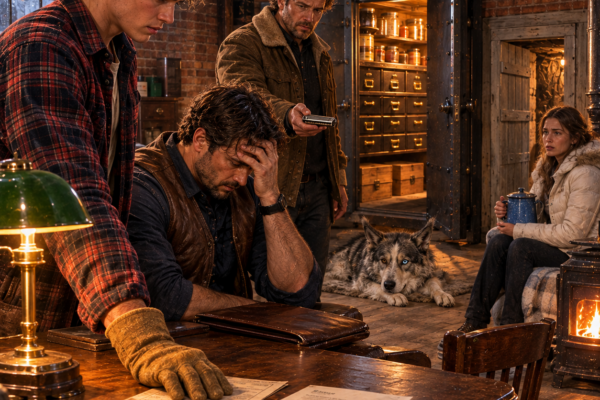
There was an army cot made up with gray wool blankets. There was a table built of planks and a chair and a lamp hanging from a nail in the ceiling beam with oil still in its glass.
And along both side walls ran shelves floor to ceiling crowded with things.
Jars of canned beef and peaches, sacks of beans and flour hung from hooks against the mice.
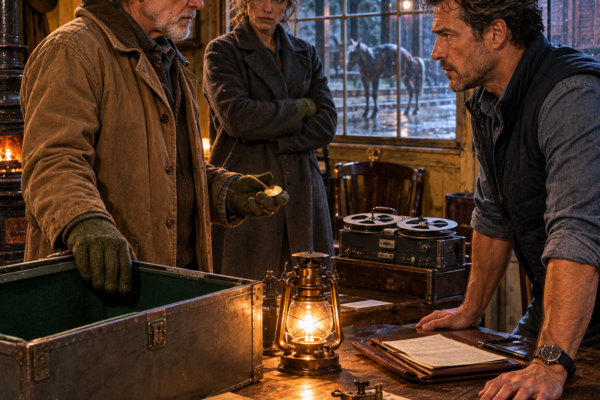
Tins of coffee, cans of lamp oil, and a dozen boxes of matches stacked like bricks. On the table sat a square tin box, the kind crackers used to come in.
And on its lid, held down by a smooth white stone, lay an envelope.
Maisie stood in the middle of the room with the lamp in her hand and could not move. The thermometer nailed to the nearest tie read 48 degrees.
Up above her it was 14 below.
She had been rationing matches two nights running while all of this sat under her feet waiting.
She lit the hanging lamp with the first of the dozen boxes of matches and the room came up gold.
Then she remembered the dog.
She did not have to wonder how. In the corner by the door, folded neatly on a peg, hung a canvas sling with four leather straps and an iron ring.
And someone had stitched a name along its edge in red thread. Tuck.
A rope ran from the ring up through a pulley bolted into the shaft above the door. She climbed back up.
When she lowered the sling down to him on its rope, he looked at it and then at her.
And then he walked forward and stepped into it, front feet and back feet, as calmly as an old man stepping into his boots. She lowered him hand over hand down the dark shaft, the rope creaking through the pulley.
And when she climbed down after him, he was already inside, lying on a folded blanket beside the cold stove, as if it were the most ordinary night of his life. Youve done this before, she said.
He thumped his tail. The stove was laid with paper and kindling and split pine, ready for a match.
She did not light it yet. She sat down at the plank table and moved the white stone and picked up the envelope.
On the front, in a hard slanting pencil hand, it said, for Maisie, when Tuck brings her. Her hands were not steady.
She opened it anyway.
Maisie, if you are reading this, then they did what I figured they would and brought you out here with nothing and left you. I am sorry for that.
I would have stopped it if I could. My name is Abel Tolliver.
I am your daddys father. You were 13 the last time I saw you at his funeral and you held my hand at the graveside and did not let go until your mother came for you.
I have thought about that hand every day since. I expect you have been told I did not want you.
I wont spend this letter calling anybody a liar.
Ill only tell you what is true and you can sort the rest.
You were never a burden to me, Maisie.
You were the reason I kept the windmill turning.
This room was dug by my father in the dry year of 1934, when the well gave out and the whole country blew away. He kept it stocked so that anybody who came up this road in trouble would find something here.
I have kept it the same way all my life. Now it is yours and so is everything on this place and some things that are not on it but belong to it all the same.
You will understand that last part later. I did not want to put it in a letter that might be read by the wrong eyes.
Do not sign anything Curtis Rook brings you.
Go see Ruth Ellery in Garnett Flats and nobody else. The stove draws better if you open the damper two turns before you light it.
The coffee in the blue tin is good. The red tin is old.
My truck is in the shearing shed under the tarp and its battery is on the bottom shelf in here where it will not freeze.
The spring in the runs all winter under the ice below the three willows.
Break it with the bar, not the axe. Tuck knows everything else.
Your grandfather, Abel, she read it twice and then a third time and the third time she had to stop halfway through and set it face down on the table and sit with both hands pressed flat on top of it because her eyes had blurred and she could not see the words.
The reason I kept the windmill turning in six years nobody had said anything like that to her, not one person.
After a while she got up and found the damper on the stove pipe and opened it two turns just as he had said.
She struck one match.
The paper caught and the kindling caught and the stove began to tick and warm and Tuck sighed and stretched out full length in front of it with his gray chin on his white paw.
Some old men cant say what they feel, so they leave a warm room and a letter instead.
She found it on the shelf above the cot, not one book but a long row of them, cheap black ledgers of the kind ranchers use for tally books, each with a year written on its spine in white paint.
Sheep counts and weather and prices were in them line after line, but between the counts, in that same slanting hand were other things. She took down the one with the year she was born.
In the middle of April she found it. Dannys girl born this morning in Hartsel, seven pounds four ounces.
They are calling her Maisie Ann.
Went to the courthouse in the afternoon.
It is done. She did not know what that last line meant.
She read it again. It is done.
Then she turned the pages forward year by year and watched her own life go by in another persons handwriting.
Maisie lost her first tooth, Danny says.
Maisie can ride the pony. Took Maisie to see the lambs.
She named every one of them and cried when we sold the weathers. And then in the year she turned 13, one short line pressed so hard the pencil had nearly gone through the page.
Buried my boy today. After that the entries about her grew thinner.
Called Hartsell at Christmas.
A man named Rook answered. Said Joanne was resting.
Called on her birthday.
Same man, same answer. Sent a card, sent a card, sent a card.
Then she came to the year she turned 16 and the page that made her set the book down.
April 14th.
Drove the 70 miles to Hartsell for Maisies 16th.
Took her the dollar. Rook came to the door.
Said she had been told plenty about me and none of it good and she did not care to see me. Said it would be kindest to let her be.
I left the box on the step, drove home. Maisie sat very still.
She remembered that day. She remembered being upstairs in her room on her 16th birthday and hearing a knock and going to the top of the stairs and seeing Curtis standing in the open front door with his back to her and past his shoulder out on the walk a tall old man in a gray felt hat holding a small box wrapped in brown paper.
She remembered Curtis shutting the door. She remembered asking who it was.
Salesman, Curtis had said.
Selling knives. Dont worry about it, kiddo.
She had not worried about it. She had gone back to her room.
She had been 16 years old and her grandfather had been standing on the front walk and she had gone back to her room. She never saw the box.
She did not know what a dollar meant, either.
She wiped her face with the end of the red scarf and found that it was his scarf.
Of course it was his, and that was nearly the end of her. was close to 4:00 in the morning when she finally lay down on the cot with Tuck pressed against her legs.
The stove ticked. The lamp burned low.
For the first time in two nights she was warm all the way through, and she slept the way she had not slept since she was a child. She spent all of Thursday down there and up top, back and forth on the rungs.
She carried the battery up to the shearing shed and found the truck under its tarp, a green flatbed older than she was, and she did not try it yet because she did not know how.
She found the three willows in the coulee and the bar leaning against one of them, and she broke the ice where the spring ran black and clear underneath and carried two buckets back. Tuck walked beside her the whole way, out and back, and twice he stopped on the rise above the coulee and looked off toward the county road for a long time, the way a dog looks for someone who is late.
She knew who he was waiting for. She did not have the heart to tell him.
She knelt in the snow instead and put her arm around his thin shoulders, and the two of them stayed there in the wind until he was ready to go on. She kept the house stove going only enough to keep the pipes from bursting, and in the afternoon she noticed that the smoke from the room under the well did not come out of the ground at all.
It came out of the old forge chimney at the end of the shearing shed, 30 yd away. The pipe must have run through the rock the whole distance.
Her great-grandfather had thought of that, too. That evening, at the table in the warm room, she went back through the tin box properly.
There were photographs at the bottom, her father as a boy on a pony, her father and mother on their wedding day on the porch above her head, a baby in in white blanket in an old mans arms, and on the back in pencil, Maisie, three days.
And beneath the photographs, loose in the bottom of the tin, It was brass, short and heavy, and stamped into its bow was a single number, seven. She walked the whole room with it, and then the whole house, and then the shearing shed.
She tried it in the stove door and the tin box and the truck. She tried it in every lock she could find.
It did not fit anything. She slept with it in her fist.
On Friday morning she climbed up into a hard blue sunrise with Tuck in the sling behind her and two buckets for the spring.
She had just set the lid back on the well when Tuck stiffened at her side and turned his head toward the south. An engine, low and grinding, coming up the ranch track.
Maisie stood in the snow with the empty buckets and felt her heart go cold and small. It was Friday.
Curtis had said Saturday.
But something was coming up that road, and it was coming fast. It was not Curtis.
It was a tow truck, old and square and dented.
Its paint faded to the color of a dried tomato, chains rattling against the bed. It ground up the last rise and stopped in the yard with a hiss of brakes, and a short, barrel-chested old man climbed down into the snow.
He wore grease-stained canvas coveralls and a black knit cap pulled to his eyebrows, and a pair of reading glasses swung on a cord against his chest. He looked at Maisie, he looked at the buckets, then he looked at the dog, and his thick white eyebrows went up.
Well, Ill be, he said. There you are, you old fool.
Tuck went to him at once, not running, but walking straight across the yard with his tail swinging low and pushed his gray head against the mans knee. Im Aussie Barnhardt, the man said, rubbing the dogs ears with a hand like catchers mitt.
I run the garage in Garnet Flats.
I was hauling a stalled stock trailer off the county road this morning, and I looked up here and saw smoke coming out of that shearing shed. He nodded at the forge chimney.
Only one man ever lit a fire in that shed, and we buried him in November.
So I came to see who.
He straightened and looked at her properly from the red scarf down to her thin jacket.
Youd be Dannys girl.
Maisie.
I know who you are.
I was at the back of the room Tuesday. Im the fire department.
He said it as if that explained everything, and she supposed it did. $31,000.
I saw them drive you north.
I figured they were taking you home the long way.
His jaw worked.
I should have figured better.
He did not ask what had happened. He looked at the single plume of smoke from the house and the wood pile she had dug out with her hands, and he seemed to read the whole of it there, the way some men read weather.
Then he went back to the tow truck and returned with a steel thermos and a paper sack. Inside the sack were six biscuits wrapped in a dish towel and a slab of ham.
I cant pay you for this, Maisie said.
Nobody asked you to.
He poured coffee into the thermos cap and held it out. Im not giving you a thing, young lady.
Im running a tab your grandfather opened 20 years ago. The winter my shop roof came down and he showed up with three men and a load of lumber and wouldnt take a dime.
Ive been trying to settle it ever since. He never let me.
So youll let me. Thats how it is.
She took the coffee.
It was hot and black and very strong, and she stood in the snow and drank it and could not say anything at all. Tuck had gone back to sit at Aussies boots.
Bud Hadley took him after the funeral, Aussie said. Buds got the place 12 miles east.
Good kennel, good food. That dog walked back here twice in the first week, 12 miles in December on that hip.
The second time, Bud found him lying on the well lid and said he couldnt do it to him again.
Said a dog that wants something that bad ought to be let to have it. Buds been leaving food on the porch every few days ever since.
He looked at Maisie for a long moment.
Youve been down there. She did not answer, and that was answer enough.
Abel taught that dog one job, Ozzie said quietly. Anybody came up this road in trouble, a stuck truck, a lost hand, somebody caught out in a blizzard, Tuck was to take them to the warm.
Thats what Abel called it, the warm. I always thought it was just a saying.
He shook his head.
My father used to tell it.
In the dry year 1934, when every well in the county went to dust, old man Tolliver dug a room down that shaft and kept water in barrels and food on the shelves, and anybody who came by with an empty canteen got a drink and a bed and no questions. And in the winter of 49, a cattle buyer and two ranch hands and a school teacher walked in here half dead out of a three-day blizzard.
Abels father put them all down that well.
They all walked out. He looked at the stone collar.
I never knew if I believed it.
There are words cut over the door, Maisie said, at the bottom.
What do they say?
Keep a little back in the dry years. Somebody will come thirsty.
Ozzie took off his cap and held it in both hands, and for a while he did not say anything. Thats both of them, he said finally.
Thats the whole family in one line. She took the brass key out of her pocket then and held it out on her palm.
This was in his tin box.
It doesnt fit anything. Ive tried every lock on the place.
Ozzie fitted his glasses onto his nose and turned it over in his thick fingers and looked a long time at the number stamped into the bow.
Seven, he said. Able numbered everything, gates, fence corners, lambing pens.
Had a system in his head nobody else ever learned. He handed it back.
Whatever it opens, he meant you to find it.
Able never once hid a thing he didnt want somebody to find.
He just liked them to work for it a little.
She closed her hand over the key.
Now, Aussie said, that truck in the shed, youre 12 miles from your nearest neighbor with no way out.
Lets fix that.
He did not fix it for her.
He stood in the shearing shed with his hands in his pockets and told her what to do, and she did it.
She carried the battery up from the well and scraped the frost off the terminals and set the cables, red first, then black. She shoveled a coffee can of live coals out of the forge and slid it under the oil pan because the oil, he said, was as thick as cold molasses and no engine on earth would turn over through molasses.
They waited half an hour by the forge, drinking the last of the thermos. Then she climbed into the cab and pumped the gas three times and turned the key.
The engine coughed, caught, died. Count to 10, Aussie said.
Dont flood it.
She counted.
She turned the key. The engine coughed and caught and shook itself and roared, and blue smoke rolled out across the shed floor, and Tuck barked once from the doorway, one sharp note, and Maisie sat with both hands on the wheel and laughed out loud for the first time in four days.
There, Aussie said.
Now youve got legs.
Taped to the cracked dashboard, faded almost white, was a photograph of a small girl on a spotted pony, grinning with a missing tooth.
Maisie knew that pony.
She knew that girl. While the engine warmed, he leaned on the fender and wiped his glasses on his coveralls and said without looking at her, Your stepdads been in town.
She went still twice before the reading. First time at the county office, asking who owned the right of way out here and whether a man could pave a road to this place if he wanted.
Second time, he ate lunch at the cafe with a fella in a city coat. They drove off in a black car with out-of-state plates.
He put his glasses back on.
Im not saying it means anything.
Im telling you what I saw. Maisie did not answer.
She was remembering. She was remembering five long-haul rigs painted blue with Curtiss name on the doors, lined up in the yard on the edge of Hartsel, and how by October there were three, and by Christmas there were two.
She was remembering her mother at the grocery store, quietly putting the good coffee back and taking the store brand and buying bread from the day-old rack. She was remembering Curtis out in the unheated garage after supper, night after night, his phone pressed to his ear and his breath smoking, and how he always hung up the moment the kitchen door opened.
Nobody had told her anything.
She had told herself it was nothing.
One more thing, Ossie said. Ruth Ellery stopped me on the courthouse steps after the funeral.
 [Tap here for the Next Part ]