Nobody Wanted the Old Lodge, So They Gave It to Her — Then the Fireplace Wall Sounded Hollow
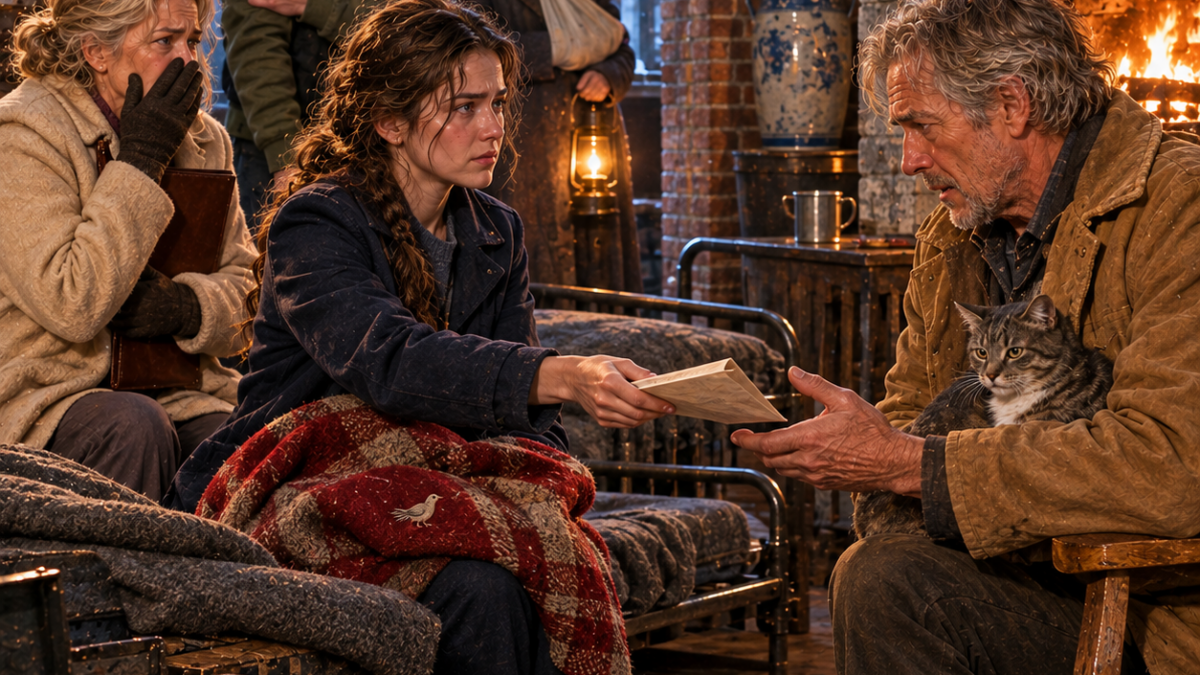
Nobody Wanted the Old Lodge, So They Gave It to Her — Then the Fireplace Wall Sounded Hollow
At 20, Rowan Callaway had learned to say thank you for things that were taken from her.
So when her uncle drove her up a snowedin forest road and called the old family lodge a gift, she thanked him and let him take her phone, her car keys, her savings from 2 years of cleaning rental cabins, and the box of her mothers things.
The lodge had been shut for 14 years.
The nearest town was 17 mi away.
On the second night, the cat sleeping in the cold fireplace never shivered, and when Rowan wrapped her knuckles on the stone beside the firebox, the wall answered with a hollow sound.
Behind it was a warm brick room, a room her uncle had spent 10 years making sure she would never go looking for.
To understand what she found, you have to start with the afternoon they left her. It was the 16th of January, a Saturday, and the sky over Slate Lake was the color of an old nickel.
Her uncles gray truck took the last mile of the forest road in low gear, the plow blade on its front, scraping gravel under the snow.
Gordon had cut the road himself that morning, 9 miles of it, and he had mentioned this twice, the way a man mentions a favor.
His wife Lindsay sat beside him in her cream wool coat, turning a car key fob over and over. Their son Dustin sat in the back.
Beside Rowan, 6 feet and 2 in of him folded against the door, studying his boots. Between Rowans feet, sat a cardboard box that held everything her mother had left behind.
The lodge came out of the trees all at once.
Two stories of dark spruce logs gone silver with age, a metal roof sagging under a foot of snow, a long porch drifted up to its rail.
Over the door hung a carved wooden sign, and on the sign beneath the words Tarmagan Lodge, was a small plump bird with feathered feet, painted white and gone to gray. Rowan looked at it until she understood why her chest had gone tight.
The same bird was stitched in white thread into the corner of the red wool blanket folded inside the box at her feet. She had always thought it was a dove.
Gordon turned off the engine.
The quiet that came in had weight. You told me this place was sold.
Rowan said it was the first thing she had said since the county road. I did.
Gordon turned in his seat.
He had a broad, ruddy, pleasant face, and he wore it now the way he wore it at church and at the bank because it was easier than the truth.
Nobody would buy it, row, the roof is half gone, and the county has a lean on it for back taxes, and a sold lodge is a nicer thing to tell a 9-year-old than a rotting one.
That was Gordon. He said unfair things in the voice of a man reading from a form, and in 10 years he had never once raised it.
You cannot fight someone who sounds as though he is only being sensible. Nobody wanted the lodge.
That had been the whole of the discussion the Sunday before at Lindsays dining table.
Gordon would take their grandmothers house in town and her savings and her truck because he would handle the paperwork.
Rowan would take the lodge. Rowan had signed.
Signing in that house was what a person did. Its yours free and clear, he said.
Now, coming around to open her door, except for the taxes, $22,400.
Well take care of that together.
Ill bring the paper out Friday.
Lindsay got out next and held out one gloved hand.
Your phone, honey, theres no signal up here, and the cold will kill a battery in an hour.
Let us carry it for you.
It was the voice she used with waiters and with Rowan.
warm a half second early and never unsure it would be obeyed.
Rowan put the phone into the gloved hand and the keys to the hatchback, Gordon said, still pleasant.
I dont want you getting ideas about walking out of here. Rowans thumb found the little plastic fish on the keyring that Dustin had given her when she was 12.
She held on to it one second longer than she needed to before she let go. The envelope, too.
Theres better than $2,000 in that bag and nothing out here to spend it on. $2,140 in tens and 20s.
Every bill of it earned on her knees scrubbing other peoples bathtubs.
She gave him that, too. Then he reached in and lifted the cardboard box from between her feet, gently with both hands, like a man handling something fragile that belonged to him.
Inside were her mothers photographs, a wooden hairbrush, a recipe card in her mothers handwriting, and folded on top the red and cream blanket with the white bird in its corner. Thats my mothers, Rowan said.
I know whose it is, he said it kindly. Let us carry this for you, Rowan.
Thats what family is for.
The roof leaks in there, and Id hate for it to get ruined.
four things, her phone, her car keys, $2,140, the last of her mother. He had taken all of it in four minutes, in the soft voice of a man helping a friend carrying groceries, and the part she would turn over in the dark that night was that she had handed it over herself, one thing at a time, saying nothing.
Dustin carried a grocery bag up the porch steps and set it by the door.
He stood there a moment longer than he needed to, tugging at his sleeve, and Rowan waited for him to say something.
He was 23. He had once pulled her out of a snowdrift by the hood of her coat and laughed until they were both crying.
He looked at the toes of his boots.
Then his father said his name, and he went back down the steps without a word.
Gordon stood on the bottom stair. Stay put and keep warm.
Friday, 10:00. The sentence was kind.
What it meant was a lock. The truck turned in the clearing and rolled back toward the trees.
It did not slow at the bend.
Nobody turned around. Rowan stood on the porch of a lodge she had never known she owned and watched the red tail lights go small and then go out.
A thermometer was nailed to the porch post.
It read 9°. The grocery bag held a loaf of bread, a jar of peanut butter, four cans of soup, one can of tuna, a box of crackers, and six apples.
Gordon had counted out a week.
A man who leaves a week of food expects to find her exactly where he put her.
She pushed open the door with her shoulder.
The great room was cold in the way only a closed building can be cold.
a stale, patient cold that had been settling since before she was in middle school.
Pale light fell through frosted windows onto furniture shrouded in dust sheets. In the west wall stood a fireplace of gray riverstones taller than a man with a firebox black as the inside of a bell.
She had been five the last time she stood in this room.
She remembered woodsm smoke and a lap and a pair of rough, warm hands and nothing else.
In her pocket was a half-used book of matches left over from her summer job lighting campground grills.
Nine matches. She counted them twice.
In the kitchen, a pantry door stood a hands width open.
She had her fingers on the latch, hunting for candles, when something on the other side scraped softly against wood.
She pulled the door wide.
On the top shelf, between a rusted flower tin and a cracked croc sat a cat.
She was gray with darker stripes, a white patch on her chest, and a crooked tip to her tail, and so thin that her shoulder blades stood up under her fur like folded wings.
Her left ear had a small, neat notch cut out of it. Her amber eyes rested on Rowan without fear and without hope, as though she had been waiting for someone a very long time, and was no longer sure it would be this one.
Hello, Rowan said.
Where did you come from? The cat blinked once.
There was one can of tuna in the grocery bag. It was dinner for 2 days stretched with crackers.
She stood in the freezing kitchen with her thumb on the pull ring and did the arithmetic.
And then she did something the arithmetic did not recommend. She opened the can, forked half of it onto a lid, and set it on the shelf.
It was the smallest kindness she would do that week, and it would turn out to be tied to every other kindness in this story, tighter than she knew at the time.
The cat ate with a fierce sort of politeness. When the lid was clean, she jumped down, trotted into the great room, and walked straight into the cold stone fireplace.
She turned around twice in the old gray ashes, and lay down against the left side of the firebox with her chin on her paws.
Rowan laughed, a cracked little laugh.
That is the coldest bed in the building, she said.
You are a very strange cat.
She decided to call her Cinder because she was the color of one and because she plainly lived in the ashes, now the fire. On the porch, somebody had stacked a full cord of split spruce under a tarp tied down with careful square knots, and beside the hearth sat a box of birch bark and dry cedar splinters, as if the last person to leave this room had meant to come back and light it.
She pulled the damper handle, and it came down with a groan, but no breath of air came with it.
She pushed the poker up into the throat of the chimney and met something soft and pushed harder, and a whole nest of sticks and moss and old feathers came down in a gray avalanche. She stood coughing, while Cinder watched with mild reproach.
The first match flared and died in the draft.
The second caught the bark and went out. She laid the cedar splinters crossways, a little log house the way her old boss at the campground had taught her, and cupped the third match inside its walls, and held her breath until the bark took, and the splinters took, and a thin yellow flame stood up.
Six matches left. The flame leaned.
She noticed it without quite noticing it.
It leaned toward the left wall of the firebox, the way a candle flame leans toward a cracked window. Then the first split of spruce caught, and the room around her began very slowly to be a room.
By dark she had dragged the leather sofa to the hearth and built a nest of dust sheets. Sometime after midnight, she woke to find the fire burned down to coals.
Cinder lay pressed against the left wall of the firebox, the way a cat lies against a warm radiator.
The coals were dying, and she did not leave. Rowan pulled her hat down over her eyes, thought about her mothers blanket in the back of a gray truck, and cried quietly for a few minutes.
10 years in her uncles house had made her very good at it. Sunday came up clear and savagely bright, 3° above zero.
She went out onto the porch to look for Gordons road, and it was gone, filled to the top of the ruts, so smooth and white that no truck might ever have driven there. A road that disappears overnight does a particular kind of work.
It keeps a person exactly where she has been put.
She spent the day learning the lodge. 12 rooms upstairs with numbered brass doors.
A guest register in the hall.
Its last page dated September of 2012.
Everything covered, everything waiting, nothing stolen, nothing ruined.
By evening, her hands were black and her back achd. and she noticed that she was in some small and surprising way not unhappy.
The lodge was cold and strange and hers and it had not yet lied to her.
That evening she lit the fire with two matches and let it settle. Cinder came in at dusk and made straight for the left wall again.
But tonight she did not lie down. She rose on her hind legs, set both front paws against the stone just above the hearth, and scratched once, twice, with great patience, the way she might have scratched at a door.
Then she looked over her shoulder at Rowan.
What? Rowan said.
The cat scratched again.
Rowan knelt on the hearthstones. The fire burned on the right, so the left wall should have been the colder one.
She laid her palm flat against the stones where the cats paws had been and snatched it back.
The stone was warm, not the scorching warmth of a wall beside flame, but a deep, even living warmth, as if something on the other side were breathing out. She had cleaned 140 rental cabins over two summers, and the cabins had taught her what a wall sounds like.
She made a loose fist. She knocked on the right wall of the firebox, and it gave back a solid, deadened thud.
She knocked on the left wall at the place where the cat had scratched. It gave back a hollow sound, like a knock upon a door.
Rowan did not breathe. She knocked again, lower, then higher.
Solid, solid, hollow, hollow.
At the bottom of the hollow place, the soot of 70 odd years lay thick as felt. She brushed it away with her sleeve and found a hairline seam much too straight to be a crack.
It was not stone at all. It was a plate of iron painted the exact dull black of the firebox and set so close to flush that the soot had bridged the gap and hidden it perhaps for decades.
At its lower edge she found a lip no wider than a coin.
She took the poker from its hook. She fitted the tip into the lip, and she leaned.
For a moment, nothing happened, and she thought of her four matches, and of Gordon, saying, There was nothing out here but wind.
Then the plate shifted by the width of a fingernail, and a breath of air came out of the dark, and touched her face.
It was warm. It smelled of cedar and lamp oil and old wool, and it was a smell she had never known in her life.
And yet it went through her like her own name spoken softly in a crowded room, so that she felt recognized before she knew by whom. The plate swung inward on a pin she could not see slowly with a long dry sigh of iron, and the warm air kept coming as if the lodge had been holding that breath for 14 years.
Behind it lay a dark opening no taller than her shoulders. Cinder walked past Rowans ankles and through it without a backward look, tail crooked like a woman going into her own kitchen.
Well, Rowan whispered, I suppose that settles who lives here. She lit a cedar splinter at the fire, ducked her head, and stepped through.
The splinter showed her bricks first, red and close, and curved overhead in a low arch like the inside of a loaf of bread. The room was 12 ft long and 9 ft wide.
It was dry.
It was warm. Truly warm.
The warmth a great chimney gives up to the brick behind it.
A little at a time all winter long.
Brass lamps hung from hooks.
12 iron cs hung folded on pegs like coats, each with a gray wool blanket rolled at its foot. Shelves held glass jars with cloth tops and a stack of tin plates.
In the corner by the chimney stood a blue croc as tall as her knee.
And beside it, drawn up to the brick as though someone had only just got up from it, was a chair. It was an ugly old thing, a kitchen chair with one leg mended with wire, and it did not match anything in the room.
Rowan held her splinter up and turned slowly, and her throat closed, because only one of the 12 Cs had been taken down. It stood open and level, third from the door, and it was made up.
A sheet tucked square, a pillow, a blanket folded back at the corner, the way a person folds it for a guest who is expected tonight.
Somebody had made that bed, and not 70 years ago. The sheet smelled of cedar, and the floor around it had been swept in a wide, clean ark.
Under the cot sat a steel box the size of a bread loaf painted green and bolted to a slab of slate.
Its lock plate was a small bird in brass with a keyhole where its eye should have been. Rowan knelt and tried the lid it did not give.
She had not really expected it to.
On the shelf above the pillow stood a flat tin that had once held tea and propped against it in an envelope gone soft with handling was a letter with her name on the front.
She knew the handwriting. She had not seen it since she was 9 years old on a birthday card with a $5 bill in it.
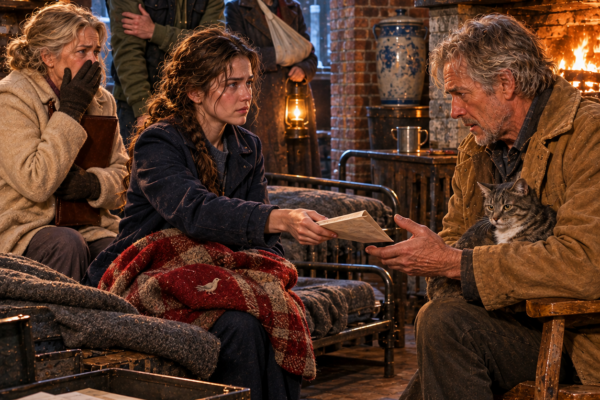
She sat down on the madeup cot and Cinder jumped up beside her and curled against her hip and Rowan broke the seal.
My dear Rowan, if you are reading this, then Gordon has done what I feared he would, and you have found this room anyway. I expect the cat showed you.
She has been keeping watch for me. I am not a woman who writes letters, so I will be plain.
I called your uncle house on your birthdays, and I was told you were busy. Every Thanksgiving, I set your place at my table, and every year I was told you were busy.
I stopped believing it a long time ago.
I did not have the strength to fight your uncle for you and I have been ashamed of that for years.
Eat something warm, sleep, then read the practical part because the practical part will keep you.
This room was built by Aldens uncle Silas and it has been kept ready every winter since.
I aired the blankets and filled the lamps this October as I have every October for 40 years. If I am living when you read this, I will tell you why.
If I am not, Vera will.
Cinder eats at the pantry door.
There is a sack of her food behind the flower tin.
She is nine and stubborn and has outlived two of my opinions. The lamp oil is in the blue croc.
Matches are in the tea tin, and there are plenty.
This room once kept 11 people alive through three days of white out, and it can keep one.
Under the third cot, you will find a steel box.
It is locked and the key is not in this room because I have known for a long time that Gordon would go through this lodge and my house and my desk looking for anything with a lock on it.
The key is with Vera Lindon, the sheriffs widow on Spruce Road in the yellow house.
Go to her.
Go before anyone comes to you with papers to sign. Do not sign anything more.
Gordon will call this lodge worthless.
Let him.
A man who believes a thing is worthless stops looking at it.
And that is the only reason it is still standing. You were never a burden to this family, Rowan.
You were the best part of it, and some of us were too small to say so.
Your grandmother, Ruth Callaway.
P. S.
Read what Silas cut over the door.
Rowan read it twice. Then she folded it along its old creases, laid her hand flat on top of it, and sat very still.
and the only sound in the room was the cat breathing and the fire ticking on the other side of the brick.
She did what the letter said first because it was something to do with her hands. The tea tin was packed with kitchen matches, more than a hundred wrapped in wax paper against the damp.
In the pantry behind the flower tin stood a paper sack of cat food clipped shut with a wooden clothes pin. Cinder was at her heels before she could pour.
She ate as if she had never stopped being hungry. And Rowan sat on the pantry floor and watched her and found that she was crying again, and that it did not feel like the crying she had learned in her uncles house.
It felt like something loosening.
What we leave behind for the people we love tells the truest story of all.
She carried a lamp back into the keeping room, trimmed the wick the way her campground boss had taught her to trim a grill torch, and lit it with a kitchen match, and the room came up golden and round and entirely real.
Then she remembered the last line. Read what Silas cut over the door.
She turned and looked up.
The iron plate, standing open on its hinge, had hidden a beam of dark timber set into the brick above the opening. The beam had been carved.
Years of soot and lamps smoke had filled the cuts, so that the letters were nothing but a long shadow.
She fetched a tin plate of water and a rag from the kitchen and washed the beam an inch at a time, standing on the ugly chair, until the grooves came up pale and sharp as if they had been cut that morning.
Silas had worked slowly and well, the letters were deep and square, with a small bird at each end. Keep one chair by the fire for whoever comes in last.
She stood on the chair for a long time with the wet rag in her hand. Then she stepped down and looked at the chair she had been standing on with its wired leg and its worn seat and understood that it had never been meant to match anything.
It was the chair that waited. There were photographs on the shelf by the lamp, and she had not looked at them until now.
Three in plain wooden frames. A man with a white mustache and a laughing mouth holding up a fish nearly as long as his arm.
A woman in a canvas apron with her hair coming down, squinting into sunlight. Rowans grandmother, much younger than she remembered her, and a girl of 16 on the lodge porch in the snow with her chin up and a red and cream blanket pulled round her shoulders like a cape and a white bird stitched in its corner.
Rowans mother had been 16 once.
She had never imagined it.
She picked up the frame with both hands, and Colleen looked out of it, mischievous and unafraid and entirely alive, in the same blanket that Gordon had folded into a cardboard box and driven away. Rowan found that she was holding her breath the way you do when you are afraid a face in a photograph might speak and you might not be able to bear what it says or might bear it and be changed.
She thought of the stitched white bird and of a lap and a pair of rough warm hands.
They had been Ruths.
She had been 5 years old in this house and loved. And then she had been taken out of it and told it was gone.
Tucked into the back of the frame was a newspaper clipping cut with scissors folded in four. It was from the Hallane crossing paper from the June after she turned 18 a list of the graduating class of the county high school.
Her name had been circled in pencil once neatly by someone who had no other way of being there. She slept that night on the third cot in the room that had been made up for her, with the lamp turned low and the cat on her feet.
On Monday the wind rose, and the lodge groaned in it.
She opened the kitchen flew first, as the letter said, and the black iron cook stove drew at once with a deep, contented roar.
She melted snow in a copper pot until it ran clear and made tea from a tin she found behind the jars and drank it standing at the window with both hands round the cup.
Then she sat down by the fire with the letter in her pocket and remembered the lie.
She had been nine. Her mother had died in October and her grandfather Alden had died the following March.
And in the week after the second funeral, Gordon had knelt in front of her in his good black suit, one hand on each of her shoulders, and told her what was going to happen. She would live with him and Lindsay.
The lodge was gone, sold to a stranger, and the money had gone to pay for the funerals.
Her grandmother was very tired and very sad, and the sight of a child would only make the sadness worse. So it would be kinder to Grandma Ruth not to ask to see her.
It was the kindest voice in the world. She had believed every word because 9-year-old girls believe the grown man who is holding them while they cry.
She had stopped asking about the lodge by summer.
She had stopped asking about her grandmother by the next Thanksgiving, and the birthday cards had stopped arriving at about the same time, and she had thought it was because she had been forgotten.
It had not once occurred to her that a card could be stopped. Years later, the winter she turned 18, she had come in from school and seen her uncle at the kitchen counter with a rustcoled envelope in his hand addressed to her in typed letters.
He had looked up with that same pleasant face, tore it across without opening it, dropped it in the trash, and said it was an advertisement for hearing aids. She had laughed.
She had been 18 years old, and the man had never lied to her in her life, so far as she knew.
She took out the letter and read the first line again, there by the fire, in the howl of the wind. Every year I was told you were busy.
The food Gordon had counted out for a week, would last 4 days more. The box under the third cot would not open without a key.
Vera Lyndons yellow house was somewhere past 17 miles of drifted road, and Gordon would be back on Friday at 10:00 with a paper for her to sign, while her grandmother had written in a hand gone shaky at the edges, Go before anyone comes to you with papers. Rowan put on her jacket and went looking for something that could carry a person over snow.
And on the porch under the eaves hung from a single peg, as though they had been waiting a long time for somebody to need them, she found a pair of old wooden snowshoes with new rawhide lacing that somebody had put in only this fall. She left at first light on Tuesday, with the thermometer on the porch post reading 7 below zero and the sky the pale clean color of a washed plate.
She had spent Monday afternoon getting ready the way her old campground boss had drilled into every seasonal girl who ever walked a trail alone. Two apples and the heel of the bread in one pocket.
A fistful of kitchen matches wrapped in wax paper in the other.
Ruths letter inside her shirt where it could not get wet.
She banked the great room fire with three split logs and set a full bowl of food and a bowl of water in the keeping room where the brick would hold its warmth for a day and a night. Two nights maybe, she told the cat.
Stay in the warm.
Cinder sat in the arched doorway beside the ugly chair and watched her go with the crooked tail curled around her feet and an expression of such calm that Rowan almost believed it.
The snowshoes were older than her mother, ash frames strung with rawhide, and they felt wrong on her feet for the first quarter mile, and then quite suddenly, right?
The trick of them was not to fight the snow.
You let the webbing take your weight, and you did not look at the whole of the road, because the whole of the road was 9 mi of white.
You looked at the next 10 yards. Gordons track had drifted level, but the road itself was still there, a long straight avenue between the spruces, and she read it by the lean of the trunks.
At the first mile, she took a mitten off and made a fist inside her sleeve until the feeling came back. At the second mile, she broke through the crust to her thigh and crawled out the way the campground boss had taught her, rolling and not lifting, spreading her weight like a spilled thing.
At the third mile, the wind came up the valley and threw the loose snow across the road in long white veils.
She pulled her hat to her eyebrows and heard her own breath, and under it a low thought she had not expected, steady as a drum beat. They are not going to find me where they put me.
She was perhaps 4 mi from the lodge when she heard the engine.
It was a deep, grinding, patient sound, a diesel working in low gear, and it came from the wrong direction for Gordon. Rowan stood still.
For one dreadful second she thought of the gray truck, of the broad, pleasant face and the plow blade, and of how very far she was from any tree that was not on a road.
Then the truck came around the bend, and it was not gray.
It was a battered hunter green pickup with a scraped orange plow blade on its nose and a rack of amber lights on the cab throwing a curl of snow off to one side like a ships bow wave.
The truck stopped 10 ft from her.
The window came down. A small round-faced woman in a red wool cap and round steel glasses leaned out of it with one arm in a sling made from a dish towel and looked her over from the hat to the snowshoes.
Well, she said, youre Colleens chin. Rowan could not think of a single thing to say.
Get in, said the woman. before you freeze to the road.
Ive got coffee and a heater and a very bad temper, and Ive been meaning to come up this hill since Sunday.
The heater in that truck was a kind of religion.
Rowan sat with her mittens in her lap, and watched the color come back into her fingers, and the woman drove with one hand, steering with the heel of it, the dish towel sling riding up and down against her chest.
Vera Lyndon, she said.
Id shake, but she nodded at the sling.
I broke it on the church steps in December. Cast came off yesterday noon, and I was in this truck by 1:00, and the sheriffs widow will tell the whole county she was not about to sit in her kitchen one more day listening to that cat.
Cinder, Rowan said. Your grandmother called her that.
God help her. I called her a few other things.
Vera glanced over and her warm brown eyes behind the round lenses were very bright.
I fed her every Thursday after Ruth passed till I fell. Then I could not get up that road for 6 weeks and I lay awake nights thinking that cat was up there in the ash waiting for a door to open.
And then on Saturday, I saw Gordon Callaways truck go through town with a plow on it in the middle of the afternoon and him and his wife and that long boy in the back going out the lake road.
Gordon Callaway has never in his life plowed a road for free. She put the truck back into gear and I thought, Theres the door.
They drove for 20 minutes before either of them said another word.
Veras house was the yellow one on Spruce Road at the edge of Haldane Crossing with icicles along the eaves as long as her arm. The kitchen was small and bright and smelled of coffee and onions.
A black cast iron range ticked in the corner with a kettle on it, and there were gingham curtains, a radio on the wall, enamel mugs on pegs, and a pot on the back burner that Vera ladled into a bowl without once asking whether she was hungry.
Eat, she said. Rowan ate with her head down until the bowl was empty.
Vera put another in front of her.
She asked no questions.
She put a wool sweater around Rowans shoulders and sat across from her with her own cup and waited. I dont have any way to pay you, Rowan said at last.
It came out thin. My uncle has my money and my phone.
I only have whats on my back. Its not a gift, said Vera.
Its an old debt coming due, and youre only the one who happens to be standing on the porch when I get to pay it.
She turned her cup in her hands.
The winter my Barrett died, I was 52 years old, and I had a house I couldnt heat and a pension that hadnt started.
Your grandmother drove down in her husbands truck on the 1st of November, put me in the cab with two suitcases, and took me up to that lodge for the whole winter. She never asked me one question.
Not one.
She just set a plate in front of me and a chair by the fire and kept the stove going until the thaw.
Vera took off her glasses and rubbed the bridge of her nose. I owe that woman a winter.
Id have owed it to you whether you were hers or not, but you are hers. Rowan looked at the table.
I didnt come to her funeral. No.
Gordon said it was only going to be a graveside. He said it was quiet.
No flowers.
only the immediate family and that I should not take the day from work.
She heard her own voice go flat the way it did when she was reciting.
I believed him. There were 41 people at that graveside, said Vera.
I counted half the county.
Ruth sold eggs and mended coats for 60 years.
And at the end, when we were all standing in the snow with our hats in our hands, I noticed the front row had an empty place in it.
She put her glasses back on. I thought at the time that somebody had forgotten to tell somebody.
It has taken me 3 months to learn that nobody forgot.
Tell me about the room, Vera said. Rowan told her.
The warm air, the iron plate, the cat, the madeup bed, the ugly chair, the photographs, the letter. She did not say the words from the lintil aloud because they felt too big for a kitchen.
But when she said the third cot, Vera closed her eyes and a smile moved across her face that was not entirely happy.
Silass room. She said she did it again.
Again? Every October.
40 years aired every blanket, filled every lamp, made one bed up fresh with the good sheet. Nobody knew who it was for.
Vera shook her head slowly. I asked her once.
She said, Somebody always comes in last, Vera.
It might as well be somebody we expected.
 [Tap here for the Next Part ]