They Threatened a Wheelchair Woman’s Dog for Land – Until A Navy SEAL’s K9 Revealed Their Mistake
They Threatened a Wheelchair Woman’s Dog for Land – Until A Navy SEAL’s K9 Revealed Their Mistake
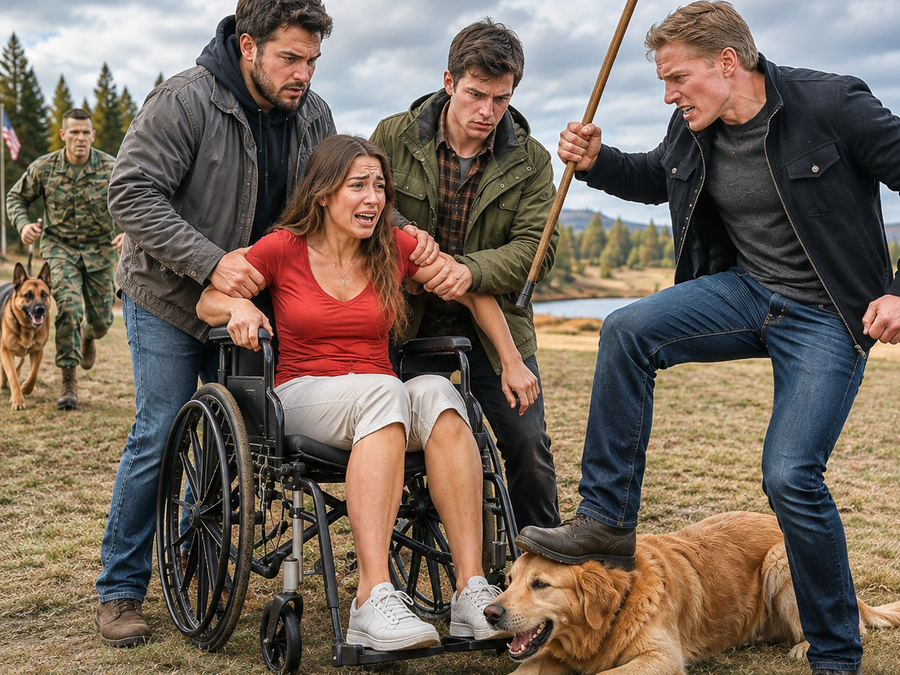
They picked the wrong target. Three men in expensive jackets cornered a young woman in a wheelchair on a frozen Colorado shoreline, surrounded her, demanded she sign away the land her dead father left her, and when she refused, one of them kicked her small dog across the ice like it was nothing.
They laughed. They had no idea that a man 200 yd away had already heard the dog cry out.
No idea what he’d done for 12 years in places that don’t appear on any map.
No idea that the animal running toward them at full speed was not a pet.
This is Claire Bennett’s story.
And it does not end the way those men expected.
The Memorial Garden didn’t look like much from the road.
Most people drove past it without slowing down. A modest rectangle of stonework and winter dead grass tucked between the two-lane highway and the eastern bank of Silver Ridge Lake.
A low iron fence, a gravel path wide enough for a wheelchair, 12 granite monuments, each one engraved with the name of a local man or woman who had served, and in some cases, not come home.
A bronze eagle mounted on the center stone, wings spread, head tilted slightly as if it were watching something in the distance that nobody else could see. Claire Bennett had planted the flowers herself, rebuilt the path herself, or rather, directed the work from her chair while a rotating crew of volunteers did the lifting, because her hands were good and her instructions were precise, and she had learned a long time ago that there were approximately 100 ways to get things done without the use of your legs.
Her father had built the original
garden 12 years ago, the summer before the accident.
After he died, it became hers.
After her accident, it became the one place she went when the walls of the house started closing in. She arrived that Tuesday afternoon around 2:00, same as always.
The sky was the kind of flat February gray that made the mountains look painted on.
Temperature sitting at 23°, wind cutting off the lake in short mean gusts that smelled like iron and old snow.
Milo was tucked inside her jacket with just his head poking out. His ridiculous tan and white face turned into the wind with his ears flattened, doing his best impression of a dog who was not cold.
He was absolutely cold.
“You could stay home,” Claire told him.
Milo blinked at her with his enormous brown eyes.
“That’s what I thought.”
She pushed through the garden gate and began her slow circuit of the monuments, the way she did every time. Reading the names even though she had long since memorized them because the reading was the point.
Harold Vance, Korea. Thomas Wills, Vietnam.
Elena Garza, Afghanistan. The gravel crunched under her wheels and the wind knocked a loose chain against the iron fence with a sound like a distant bell.
She stopped at her father’s contribution, a low bench beside the center stone engraved with a single line he’d chosen himself.
“Those who served deserve to be remembered by name.”
The paint on the bench was chipping at the edges.
She made a mental note to bring touch-up supplies on Thursday.
She was still looking at the bench when she heard the vehicles.
Two of them.
Big.
She didn’t turn around right away.
She’d learned that turning around too fast telegraphed anxiety, and she refused to give people that.
So, she finished her thought about the paint, exhaled slowly through her nose, and then looked over her shoulder.
Three men were climbing out of a black Escalade and a pearl white Range Rover parked on the gravel pull-off outside the garden fence.
They were young, mid-20s maybe.
The kind of young that came packaged with money and the specific confidence that money gives people who’ve never had to work for it.
Expensive coats, clean boots. One of them was already on his phone.
Another one was looking at the lake like he was measuring it. The third one, tall, broad-shouldered, with the kind of jaw that got him taken seriously in rooms, opened the gate.
Claire turned back to the bench.
“We’re closed,” she said.
“It’s a public garden.”
He had a voice like someone who was used to being listened to.
She heard his footsteps on the gravel and did not move.
“You’re Claire Bennett?”
“Who’s asking?”
The man came around to face her, close enough that she had to tilt her head to look at him.
He smiled the way people smile when they’ve decided the outcome of a conversation before it started.
“Landon Pierce.
Pierce Capital Group.”
He produced a business card and held it out.
When she didn’t reach for it, he set it on the arm of her wheelchair.
“I think you’ve received some correspondence from my office.
“I’ve received three letters and two voicemails,” Claire said.
“I didn’t respond to any of them.
” “Right.”
The smile stayed, but something behind it shifted.
“That’s actually why I’m here.
I wanted to have a conversation in person.
Sometimes things get lost in writing.”
The other two men drifted into the garden now.
The one with the phone slid it into his pocket and started walking the fence line, looking at the property from different angles.
The third one crouched down and picked up a stone from the path, turned it over in his fingers.
Claire watched them.
Then she looked back at Landon Pierce.
“This is private property,” she said.
“The garden and the 40 acres behind it.
My name is on the deed.”
“It is.”
He put his hands in his coat pockets.
“Which is why I wanted to talk to you directly.
My group is prepared to offer you $3. 2 million for the parcel.
That’s 20% above current market value.”
He let that number sit in the air for a moment.
“For a piece of land you’re not developing, not farming, not doing anything with except” He gestured at the monuments.
“This.”
“My father left me this land.”
“Your father also left you with significant estate taxes from what I understand and maintenance costs and a house that’s going to need a new roof inside of 2 years.
He said it gently, the way a doctor delivers bad news they’ve delivered many times before.
I’m not here to be difficult, Ms.Bennett.
I’m here because this is a genuinely good offer and I’d like you to seriously consider it.
Milo had gone very still inside her jacket. No.
Claire said.
Landon Pierce blinked.
No, she said again in case there was any ambiguity.
I’m not selling.
I’m not going to sell.
I’ve been clear about this in writing three times now and I’m being clear about it in person.
This garden and this land are not for sale, not for 3.
2 million, not for 5 million, not for anything.
The smile faded. Not dramatically.
It just sort of withdrew like a tide going out. He studied her face for a moment with an expression she recognized.
She’d seen it on people who’d looked at her wheelchair and constructed a theory of who she was based entirely on what they thought her wheelchair meant.
Ms.Bennett, you should go.
He exhaled through his nose, looked over at his associates.
The one who’d been picking up stones dropped it back on the path.
The one who’d been walking the fence came back toward them.
You’re going to want to think about this more carefully.
Landon said. The gentleness was gone now.
Because this offer has an expiration date and what comes after it is considerably less pleasant for everyone involved. Is that a threat?
He didn’t answer that directly.
Instead, he looked at Milo, at the tiny dog tucked inside Claire’s jacket with his chin resting on her collarbone, and something crossed his face that she would think about later.
A kind of calculation, like he was identifying something to use.
Cute dog, he said.
He turned and nodded to his associates and the three of them walked back toward the gate.
Claire watched them go.
She was very careful not to let her hand shake and they almost didn’t.
Mason Ryder had been on his feet since 4:30 that morning, not because of insomnia.
He was a decent sleeper for someone with his history, which was to say he got 5 or 6 hours most nights, and woke up once or twice, but usually went back under.
He’d been up early because Shadow had woken him, which Shadow only did when there was a reason.
The reason, it turned out, was a coyote that had gotten through the back fence and was helping itself to the chickens.
Mason had dealt with that efficiently and without ceremony, repaired the fence section, and then found himself standing in the dark at 4:45 with no desire to go back to bed.
So, he’d made coffee and sat at the kitchen table with Shadow lying across his feet and worked through the after action in his head.
Not the coyote.
That wasn’t worth cataloging.
He meant the fence.
Third time that section had failed. He needed to replace the whole run, not just patch it.
Shadow was a Belgian Malinois, 5 years old, retired from operational service after taking shrapnel through his left shoulder on a deployment Mason wasn’t at liberty to discuss in detail.
The dog had healed well physically. He still carried the weight of the work in ways that were harder to measure.
A certain stillness he got in crowds, a preference for high ground, a tendency to station himself at doorways and windows with his ears cocked and his attention on the middle distance. Mason understood all of that.
He had the same habits himself.
They’d been Ridge for 8 months.
Mason had bought the small ranch property because it was inexpensive, because it was quiet, and because no one who knew him was likely to come looking for him here.
He told himself it was temporary. He was still telling himself that.
He drove into town that afternoon for fence wire and ended up parking near the lake because Shadow needed to run, and the memorial garden path was the flattest open stretch near the water. He let the dog off leash and watched him move, low and fast, ears pinned, burning through the space between the fence line and the shoreline with the focused intensity of an animal that had been trained to believe every open field was a potential problem to be solved.
Mason stood with his hands in his jacket pockets and watched the lake. The ice along the bank was starting to show cracks where the afternoon sun caught it.
Give it two more weeks and the edge would be mush. He was thinking about that, about the ice, about nothing in particular when he heard the vehicles arrive.
He didn’t look immediately.
He had a habit, trained and refined over 12 years, of observing without appearing to observe. He registered the sound of two large engines, doors opening, multiple sets of footsteps on gravel.
He registered the tone of the conversation that followed, controlled at first, then slowly acquiring an edge.
He heard the word sell, and then offer, and then something he couldn’t quite make out, and then a woman’s voice saying clearly, “This is private property.
” Shadow had already stopped running.
The dog stood about 40 yards out, oriented toward the garden, ears up, completely motionless.
Mason looked at him, then looked at the garden. He watched the conversation play out.
Could see enough, three men, the woman in the wheelchair, the body language of the interaction, to understand the basic shape of what was happening.
He didn’t intervene.
It wasn’t his business.
People had difficult conversations, and that was life.
And he had learned through hard experience that inserting himself into situations he didn’t fully understand created more problems than it solved.
He called Shadow back with a low whistle. The dog came, but kept looking at the garden, kept his attention split.
“Leave it.”
Mason said quietly.
Shadow looked at him. Looked at the garden.
Looked at him again. Mason watched the three men walk toward the gate.
Watched the woman in the wheelchair hold herself very still, very straight, watching them leave.
Good posture, deliberate. The posture of someone who had decided that how she held herself when other people were watching was something she could control, and she was going to control it.
One of the men, the tall one, stopped at the gate and said something.
Mason couldn’t hear it.
He saw the woman’s chin come up slightly.
Then the three men climbed into their vehicles and drove away. He almost left.
He had fence wire to pick up.
Instead, he watched the woman sit for a long moment in the empty garden and then reach into her jacket and pull out the small dog and set it in her lap.
And he saw her hands moving through its fur with the kind of repetitive motion that wasn’t affection so much as it was steadying herself, grounding herself, using the animal as a fixed point.
He done the same thing with Shadow in the back of a helicopter once, waiting for a medical evacuation over a desert that wasn’t on any American map.
He picked up the fence wire.
He drove home.
He thought about her hands, the way they’d been steady until the men left, and then weren’t quite.
Then, the second visit happened four days later. He was at the lake again.
Different reason. Early morning, the kind of February dawn that arrives gray and leaves gray and offers nothing in between.
His breath visible in short plumes as he walked the shoreline with Shadow working ahead of him.
He had a camera with him, an old Canon he’d bought at a pawn shop in Denver, because someone had told him once that finding something to photograph forced you to look at your surroundings differently.
And he was trying to look at things differently. He heard the Escalade before he saw it.
Same vehicle, or an identical one, pulling into the garden lot. Same three men.
But this time they didn’t stop to talk.
They went directly to the garden gate, and it was early enough that Claire wasn’t there yet.
And two of them went inside while one stayed by the vehicles.
Mason lowered the camera.
He couldn’t see exactly what they were doing inside the garden.
Enough to tell they weren’t being respectful of the monuments.
He started toward the lot without particularly hurrying with Shadow at his left heel, and he was about 30 yards out when the far gate opened and Claire rolled through. She stopped when she saw the men.
Mason saw her shoulders tighten.
“Get out of my garden.”
she said.
Landon Pierce turned from wherever he’d been standing.
“Good morning, Ms.Bennett.
We were just having a look.”
“I told you to leave.”
“4 days ago I told you to leave and not come back.”
“I came back to tell you the offer dropped.
” “2.
8” He spread his hands like he was delivering unfortunate news.
“Market adjusted.”
“Get out.”
He moved toward her, not running, not threatening exactly, but with the slow deliberate walk of someone who had decided to close the physical distance between them regardless of whether she wanted that.
The other man came around behind her on the left side. Mason kept walking, steady pace, not running yet.
“You are going to sell this property.”
Landon said low and flat, the charm entirely gone now.
“It’s just a question of how much you’re going to make me work for it and how much that’s going to cost you.”
“Back up.”
Claire said.
He didn’t.
She had her phone in her hand now and he reached out, casually almost, and knocked it from her grip. It skittered across the gravel.
The man behind her put a hand on the back of her wheelchair.
Milo burst out of her jacket barking, a sound completely out of proportion to the animal producing it, all compressed fury, and lunged at Landon’s hand and Landon pulled back and then with one sharp kick sent the dog skidding across the frozen stone path toward the icy shoreline and Milo hit the rocks at the bank and lay there crying.
And in the perfect silence that followed that cry, Mason Ryder was already at the gate. Shadow went through first.
He didn’t make a sound.
He didn’t need to.
The two men inside the garden froze the moment they saw him.
A Malinois at full focus is a completely different creature from any dog most people have encountered, something ancient and deliberate that bypasses the part of the brain that argues and goes straight to the part that understands threat.
Both men went statue still. Neither of them moved their hands.
Mason came through the gate. He looked at Landon Pierce.
He looked at the man behind Claire’s wheelchair whose hand was still on the handle.
He looked at Claire whose face was absolutely controlled and absolutely white.
“Step away from her.”
he said.
The man behind the wheelchair took one step back, then another.
Mason moved past Claire, moved past the frozen men, went to the shoreline and crouched where Milo was lying on the rocks making a low broken sound. He ran his hands along the dog.
Ribs, spine, limbs with the same systematic efficiency he’d used on injured personnel in the field.
Milo flinched at his ribs but didn’t cry out when Mason pressed gently around them.
He picked the dog up carefully, cradled it against his chest, and walked back to Claire.
“He hit his ribs.”
Mason said keeping his voice even.
“Probably bruised.
He needs a vet to confirm.”
He handed Milo to her.
She took the dog and held it and for exactly 1 second her composure cracked. Just a single exhaled breath, the kind that has too much in it.
And then it was back.
“My body camera.”
Mason said speaking now to no one in particular, loud enough for everyone, “has been recording since I entered the lot.”
He let that settle.
“Assault, intimidation, animal cruelty, all of it.”
He looked at Landon Pierce.
“Silver Ridge County Sheriff is about 7 minutes out on this road.”
It was a bluff. But it landed clean.
PART 2
Landon Pierce looked at Mason the way people sometimes looked at Mason when they figured out what he was or what he used to be. The slight recalibration that happened in their eyes when the math stopped adding up in their favor.
“We’re leaving.”
Landon said.
Mason watched them go. When the last door slammed and the engine started, he turned to Claire.
She was looking at him with an expression he couldn’t fully read.
Gratitude, he thought, but under it something harder.
Something that didn’t want to need help and was angry that it did.
“Thank you,” she said.
Shadow sat down at her feet and regarded Milo with grave professional interest.
“You said no,” Mason said.
“Excuse me?”
“To the sale.”
He nodded in the direction the vehicles had gone.
“You said no to them.”
She looked at him for a moment.
“Yes.”
“Then it’s not going to stop.”
He said it plainly, because pretty words didn’t make things less true.
“You know that.”
Claire looked down at Milo, who was pressing his small battered face into her palm.
“I know,” she said quietly.
The bronze eagle watched from the center stone.
The wind moved across the lake, and the ice at the edge groaned once, slowly, like something that had been holding its breath and finally couldn’t anymore.
The vet clinic was a 20-minute drive on roads that hadn’t been properly plowed since the last storm, and Mason made it in ’17.
He drove.
Claire sat in the passenger seat with Milo pressed against her sternum, one hand curved around the dog’s ribs, the other flat on the door panel.
She didn’t talk for the first 5 minutes, and he didn’t push it.
Shadow rode in the back with the kind of disciplined quiet that big working dogs develop. Not relaxed, never fully relaxed, just waiting.
Dr.Anita Reyes ran the only veterinary practice in Silver Ridge proper. Converted house on Marsh Street with a hand-painted sign and a waiting room that smelled like antiseptic and wet dog, and the particular exhaustion of a one-person operation held together by competence and stubbornness.
She was in her mid-50s, sharp-eyed, and she did not ask unnecessary questions when Mason carried Milo in and Claire rolled in behind him, and the dog was cradling his left side with the careful breathfulness of an animal in pain.
She took Milo to the back.
Claire sat in the waiting room.
Mason stood near the door with his jacket still on because sitting down felt wrong, and he couldn’t explain why.
“You don’t have to stay.”
Claire said.
“I know.”
She looked at him for a moment, then looked at her hands in her lap. The waiting room had a single mounted television cycling through a local weather forecast.
Another system moving in from the northwest. Significant snowfall expected by the end of the week.
A child’s drawing of a horse was taped to the wall beside the reception desk.
A space heater in the corner ticked and hummed.
“How long were you watching?”
Claire asked.
“Long enough.”
“Long enough to see him knock my phone away.”
“Yes.”
She was quiet for a moment.
“Did you actually have a body camera recording?”
Mason looked at her.
“No.”
Something moved across her face.
Not quite a smile.
“Okay.”
Dr.Reyes came back 20 minutes later with Milo tucked in the crook of her arm, moving carefully.
“Two bruised ribs.”
She said, “No fractures, no internal bleeding that I can find.
He’s going to be sore, and I want him resting for a week, which I understand is going to be a negotiation.
” She handed Milo to Claire with the practiced transfer of someone who’d done it 10,000 times.
“Anti-inflammatory for 5 days.
If he stops eating or his breathing changes, you bring him back immediately.”
“Thank you.”
Claire said.
“You want to tell me what happened?”
“A man kicked him.”
Dr.Reyes looked at her, then at Mason, then back at Claire.
“You file a report?”
“Not yet.”
The vet held her gaze for a beat.
“Animal cruelty is a class one misdemeanor in Colorado.
Goes up fast if there’s prior intent.”
She said it the way someone says something they know will be ignored and want on record anyway.
“I know.”
Claire said.
Mason drove her home.
The house was a modest two-story wood frame set back from the lake on the northern edge of the property. Older, well-maintained, the kind of house that had been repainted and re-roofed at least twice by someone who cared about it without having the money to do more than care.
A ramp replaced the front steps. A covered porch ran the length of the facade, and on the porch railing there was a row of clay pots with dead back Rosemary waiting for spring.
“You don’t have to come in.”
Claire said.
“I’m going to come in.”
Mason said, “because I want to make sure your door locks properly and your windows aren’t the kind that open from outside.”
She opened her mouth and he could see the refusal forming and then she looked at the house and seemed to make some internal calculation he wasn’t privy to.
“Fine.”
She said. The inside of the house was tidy and personal in a way that told him things about her.
Books organized by subject, not size. A drafting table with architectural drawings rolled and stacked in a specific order.
Photographs on the wall, her father older in a park somewhere. Claire at maybe 16 on a dock standing both legs under her.
A group photo that looked like a fundraiser of some kind. A small wood stove that was doing real work, not decorative work.
The kitchen had a modified layout, counters at chair height, pull out shelves.
She’d adapted the space methodically and without self-consciousness, the way you do when you’ve been doing it for years and stopped noticing the adaptation.
Mason walked the window line while she settled Milo into a dog bed near the wood stove. He checked the kitchen window latch, flimsy, the kind that failed under pressure.
And the two bedroom windows he could see from the hallway.
The front door deadbolt was solid, but the strike plate was anchored with screws that were too short.
“Your strike plate.”
He said coming back to the living room.
“What about it?”
“3-in screws instead of the ones in there.
Cost $2.
Means the door holds under a kick instead of the frame splitting.”
She looked at him from across the room.
“You’re different from what I expected.”
“What did you expect?”
“I don’t know.
Less um specific.”
He almost said something to that and then didn’t.
He looked at the photographs on the wall instead. Her father was in three of them.
A solid looking man with her same dark eyes, the kind of face that had spent significant time outdoors.
“He built the garden,” Mason said.
It wasn’t a question.
Two summers before he died. She wheeled to the kitchen and filled a bowl of water for Milo.
“He was a veteran, Air Force.
He wanted there to be somewhere in Silver Ridge that remembered the people who served because the county seat was 45 minutes away and nobody was going to drive 45 minutes to read a name on a wall.”
She set the bowl down.
“So he built it here.”
“And Pierce wants to put what on the land?
Condos?”
“Mixed-use development, luxury units facing the lake, commercial on the south end.”
Her voice was even.
“They’ve already broken ground on two similar projects in the county.
They know what the lakefront is worth and they know that my parcel is the last private hold on this stretch of shore.
” “And they know you’re alone.”
She looked at him directly.
“They think that’s relevant.”
“It is relevant,” Mason said.
“That’s not the same as it being their advantage.”
She held his gaze for a moment, assessing him with the same careful attention she’d used earlier at the garden, trying to determine what category of person he was and what his presence here was going to cost her.
“Who are you?”
she said.
“Mason Ryder.”
“That’s your name.”
“Who are you?”
He thought about how to answer that honestly without giving her more than she’d asked for.
“I was in the Navy for 12 years, teams mostly.”
“SEAL?”
“Yes.”
She nodded slowly. That was all she said about it.
He appreciated that more than she probably knew.
“The body camera bluff,” she said.
“Would they believe it?”
“Long enough to leave, which was the only thing that mattered in that moment.”
“But when they figure out you were bluffing, I won’t be bluffing next time,” he said.
He went back to his property and spent two hours replacing the compromised fence section he’d been putting off, working by the light of a clip-on LED in the gathering dark while Shadow patrolled the perimeter with his nose low and his tail straight.
Physical work settled Mason in a way that little else did. The specific satisfaction of a problem that had dimensions you could measure.
A solution that held or didn’t.
No ambiguity about the outcome.
He was thinking about Claire Bennett’s window latches when his phone buzzed.
A number he didn’t recognize.
He let it go to voicemail, then listened to the message while he wound a section of new wire around the post anchor.
A man’s voice.
Smooth, professional. The voice of someone who made calls like this regularly.
Mr.Ryder, my name is Gerald Finch.
I’m legal counsel for Pierce Capital Group.
It’s come to our attention that you were present at an incident this morning involving our client.
We’d like to speak with you about your account of that interaction.
Please call us at your earliest convenience.
Mason played it again.
Then he called the Silver Ridge County Sheriff’s non-emergency line and spent 20 minutes giving a formal statement about what he’d witnessed at the memorial garden, including the assault on the dog, the physical intimidation, the knocked phone.
The deputy who took the statement was named Ortega. Tired, thorough, professional.
He didn’t express any particular urgency.
He said someone would follow up.
Mason drove into town the next morning and bought 3-in screws.
Taught.
He knocked on Claire’s door at 9:00 a.m.She answered it in the time it took most people to get off a couch.
Fast. No hesitation.
Which told him she’d either heard the truck or she kept herself in a permanent state of readiness.
She looked at the screws in his hand. You came back?
Said I would.
She stepped back.
He came in, fixed the strike plate in about 8 minutes, replaced the kitchen window latch with a keyed lock, and checked the back door while he was at it.
Claire worked at her drafting table the whole time he was doing it, head down, pencil moving, as though having a stranger move through her house upgrading her security was something that happened regularly and didn’t require attention.
When he was done, she came over and tested the door.
“Finch called you,” she said.
It wasn’t a question.
Mason looked at her.
“You know him?”
“He’s their cleanup man.
He called me 6 weeks ago after the first letter didn’t get a response.
Very polite.
Very careful with his language.”
She tested the lock again.
“He never says anything that sounds like a threat.
He just describes the situation very precisely until you understand what the threat is.
” “What did he say to you?”
“That the property had title complications my father might not have been aware of.
That there were questions about the original easement on the northern boundary.
That these things had a way of becoming expensive to resolve without professional guidance.”
She turned from the door and looked at him.
“None of it’s true.
I’ve had a title attorney look at every document.
The deed is clean.
They’re manufacturing pressure.
They’re good at it.”
She went back to the drafting table and sat with her hands flat on the surface, looking at whatever she’d been drawing.
They did the same thing to a ranching family outside of Glenwood Springs.
Created a boundary dispute that didn’t exist, tied the property up in litigation for 2 years, and by the time the case was dismissed, the family had burned through their savings on legal fees, and accepted a settlement.
She paused.
“Half of what they’d originally been offered.”
Mason leaned against the kitchen doorframe.
“How do you know all that?”
“Because after the first letter I spent 3 weeks researching every property transaction Pierce Capital Group has been involved in in this state for the past 7 years.”
She finally looked up from the drafting table.
“I had time, and I am very thorough when I’m angry.”
He looked at her, at the careful arrangement of her workspace, the methodical stacking of documents, the research that was clearly ongoing.
He thought about what it took to do all of that alone, to take fear and convert it without any outlet except your own intelligence and your own two hands into something that could be used.
“What are you drawing?”
he asked.
She hesitated for a moment, then turned the drafting table so he could see. It was an expansion plan for the memorial garden.
A modest one, a semi-circular addition to the north end with a covered walkway and space for perhaps 20 more monuments.
Accurate scale, thoughtfully laid out.
The kind of thing that had been planned and replanned and revised.
“My father started a list,” she said.
“Veterans in the county who didn’t have their names anywhere.
” People who served in conflicts that didn’t get monuments because they were too small or too recent or nobody thought to build anything.
“The list has 41 names on it.”
She tapped the drawing.
“There’s enough room on the north parcel if I grade the slope correctly.
I’ve been working with a county grant application for 18 months.
” Mason looked at the drawing, then at her.
“That’s why you won’t sell.”
“That’s one reason.”
“What’s the other?”
She held his gaze.
“Because they want me to.”
Or He found himself at the lake most mornings after that.
Not because he was watching over her.
Or not primarily.
He ran Shadow along the shoreline at dawn the way he always had. And if the route took him past the memorial garden, that was just geography.
And if he sometimes arrived at roughly the same time as Claire and ended up walking the path beside her chair while Shadow and Milo conducted their ongoing negotiation of personal space.
Milo increasingly bold, Shadow increasingly tolerant in the specific way of large animals who’ve decided the small one isn’t worth the energy.
Then that was just coincidence becoming habit.
He learned things about her in the accumulative sideways manner that you learn things about people when you spend time near them without agenda. That she drank black coffee and was judgemental about it being made wrong.
That she had a nearly complete architectural drafting education that she’d finished remotely after the accident and never formally used.
That she argued with the county planning office by email with the precision of someone who’d read every regulation in the relevant code and enjoyed catching bureaucrats in their own language.
That she was funnier than she let most people see.
Dry, quick, with a timing that came from spending a lot of time observing rather than performing.
That she didn’t talk about the accident.
Not once. Not directly.
He didn’t ask.
He understood the thing where you don’t talk about the defining event because talking about it gives it too much of the room, and you need the room for other things.
She asked him questions instead. Not intrusive ones.
She had good instincts about what was a fair question and what wasn’t.
She asked about Shadow’s training and he told her some of it.
The parts that were shareable, the obedience structure and the tracking methodology, and the way military working dogs were paired with handlers. She listened with the focused attention of someone who actually wanted the information rather than the conversation.
“Does he ever just relax?”
she asked one morning watching Shadow work the fence line at the garden’s edge.
“Sometimes.
At home, he sleeps in positions that shouldn’t be physically possible for an animal his size.”
Mason watched the dog.
“Out here, he’s on.
He doesn’t really have an off switch in open ground.
” “Neither do you.”
He looked at her. She shrugged.
“You’ve walked this path six times and you’re looking at the parking lot every time a car passes.”
“Old habit.”
“I know.”
she said without making it into anything.
He shut up.
The letter arrived on a Thursday.
Claire called him.
She had his number by then, traded practically when he’d fixed the window lock with the same casual efficiency she applied to most things.
And her voice was steady, but there was something underneath it that wasn’t.
He drove over. The letter was on Pierce Capital Group letterhead, signed by Finch.
And it was very precisely worded in the way Claire had warned him about.
It referenced the unfortunate incident at the memorial garden, expressed concern for Ms.Bennett’s well-being and safety given her circumstances and noted that the property in question had been flagged for a county environmental review based on potential drainage issues affecting the northern boundary.
“Environmental review,” Mason said, “there’s no drainage issue.”
Claire had the letter on her drafting table and was looking at it with the expression of someone who wanted to tear it in half and was not going to.
“The northern boundary is 30 ft above the lake’s flood plain.
There’s nothing there to review, but a formal environmental hold can freeze a grant application for 12 to 18 months while the county processes it.”
“So, the expansion plan goes on ice.”
“And the grant money?
It’s a fixed cycle, one application window per year, disappears until next year’s cycle.
And by then they can manufacture the next problem.”
She turned from the table.
“This is how they do it.
They don’t break your door down.
They just close every path in front of you until there’s nowhere to go except toward them.”
Mason read the letter again. The language was impeccable.
Nothing actionable.
Nothing that crossed a clear line.
“I filed a statement with Ortega,” he said, “about the garden, the physical intimidation, the dog.”
“I know.
He called me.”
She paused.
“He said Pierce’s lawyer had already been in contact with the department.
They’re claiming the contact was consensual, that it was a business meeting that got emotionally heated, and that the dog ran into the rocks on its own.
” The room was quiet for a moment.
“Their word against ours,” Mason said, “their lawyer’s word against a disabled woman and a stranger.”
She said it flatly, without self-pity, just measurement.
“They’ve done the math.”
PART 3
Shadow, who’d been lying by the wood stove with Milo pressed against his flank in a configuration that had developed gradually over multiple visits, and that neither animal had officially acknowledged, lifted his head and looked at Mason.
Mason folded the letter and set it back on the table.
“Then we change the math,” he said.
She looked at him with that same careful assessing look, like she was checking whether he understood what he was saying, whether he thought it through.
“This isn’t going to be simple,” she said, “and it’s going to get worse before it changes.
” “I know.”
“You don’t owe me anything.”
“I know that, too.”
Another silence.
Milo shifted against Shadow’s ribs and made a small contented sound that was somewhat undignified for an animal with bruised ribs, but nobody commented on it.
“The body camera,” Claire said.
“You said you wouldn’t be bluffing next time.
” “Right.”
“So, next time you’ll actually have one?”
“Already ordered, and four wireless cameras for the garden perimeter.
Good ones. Low light, weather proof, motion activated.
They’ll run to a local server, so there’s no cloud dependency.”
She was looking at him.
“You planned that before I called you today.”
“Yes.
” “Before the letter.”
“Before the letter,” he confirmed.
She was quiet for a long moment, and he couldn’t entirely read what was moving through her expression.
Something complicated.
Something that involved gratitude and resistance to gratitude, and something else underneath both of those.
“Okay,” she said.
He drove to the hardware store.
He started running the camera cable that afternoon in the cold, with Shadow tracking his movements along the garden fence, and Milo watching from Claire’s lap under a wool blanket on the porch, with the regal air of a dog who had suffered greatly and was not letting anyone forget it.
By evening, the first two cameras were mounted and live.
Mason was checking the angle on the third when Claire rolled out to the porch rail and looked down at him.
“Mason.”
He looked up.
“Why does it matter to you?”
she asked.
Not confrontationally, just directly.
“You don’t know me.
You’ve been in Silver Ridge 8 months, and you clearly came here to be left alone.
So, why does this matter to you?”
He thought about it. He could give her a version of the truth that was technically accurate and emotionally dishonest.
He decided not to.
“Because I watched you sit in that garden after they left,” he said, “and not fall apart.
And I’ve seen a lot of people under pressure in a lot of situations, and most of them fall apart.
And the ones who don’t” He stopped, started again.
“The ones who don’t deserve to have someone in their corner who can be useful.”
Claire looked at him for a long time.
“That’s not a complete answer,” she said.
“No,” he agreed.
“But it’s an honest one.”
She went back inside. He finished the third camera.
He was mounting the fourth, the one covering the north lot and the road approach, when the motion sensor on camera two triggered, and he checked his phone and saw the feed. A black Escalade parked half a block down the road with its lights off, engine running, visible as a heat signature against the cold dark.
Just sitting there, watching. Mason lowered the camera mount slowly, looked at his phone screen.
The Escalade didn’t move.
He checked the time.
9:47 p.m.He went inside, told Claire what the camera had picked up, watched her face go through something she controlled quickly and didn’t fully succeed at controlling.
He didn’t comment on that.
He went back outside, locked the front gate on the garden, walked to his truck, and drove it to where the Escalade was parked. By the time he got there, it was gone.
He sat in his truck in the empty street and looked at the tire marks in the thin snow at the road edge and thought about what it meant that they’d shifted from pressure and daylight to surveillance at night.
It meant they were escalating.
It meant the letter and the environmental hold and the legal maneuvering wasn’t moving fast enough for them.
And when that happened, people like Landon Pierce started looking for levers that weren’t on the legal menu.
He drove back to the house.
He didn’t tell Claire that last part.
He told her he’d drive past twice more before midnight, and he did.
On the second pass, at 11:58, there were fresh footprints in the snow along the garden’s east fence that hadn’t been there at 11:00.
He stopped the truck and took photographs.
He sent them to Ortega’s direct line with the and a note.
He sat in the truck for another 20 minutes looking at the dark perimeter of the garden and the lake beyond it, where the ice was groaning and settling in the cold the way it did when the temperature dropped fast. The footprints were a size 11, maybe 12.
Two sets.
They’d walked the full length of the east fence and then doubled back toward the road.
They hadn’t entered the garden.
Not yet.
But they’d measured it.
He sent Ortega the photographs at midnight and didn’t hear back until morning.
The reply was a single line.
We’ll log it.
Keep documenting. Mason stared at that for a moment.
Then set his phone face down on the kitchen table and drank his coffee standing up, looking out the window at the pre-dawn dark.
Shadow was stationed at the back door doing his thing.
Ears rotated forward, attention on something in the field that Mason’s eyes couldn’t resolve.
Probably just wind in the dry grass.
Probably. He drove past the garden at 6:30 on his way into town for supplies.
The east fence was intact. No new prints in the snow.
Or none he could see from the road. The bronze eagle on the center monument caught the early light for a second as he passed.
Just a flash of gold in the gray morning and then it was gone. He bought the 3-in screws.
He bought a case of weatherproof electrical tape and two additional motion sensors and a battery backup unit for the camera server. He stood in the hardware aisle for a while looking at floodlights before deciding they were the right call and adding four to the cart.
When he got back to the garden, Claire was already there.
She was at the center monument with a notebook in her lap writing something.
Milo was on a fleece pad she’d clipped to the arm of her chair.
The dog was supposed to be resting at home, but the negotiation had apparently not gone well.
Shadow went to him immediately in the differential he’d developed for the smaller animal.
Not the alert and assess posture of his work mode, but something lower, more deliberate, a kind of careful gravity.
He stood close without touching and Milo pressed his nose into Shadow’s leg and stayed there.
“They walked the fence line,” Claire said without looking up from her notebook.
“I saw your photos.
Ortega logged it.
” “Logging it?”
She wrote something.
“That’s useful.”
He heard the flatness in it and didn’t argue with it because she wasn’t wrong.
He started on the floodlights instead, running the first bracket into the corner post of the north fence while she worked behind him, and they existed in the same space for an hour without talking in a way that had stopped being awkward sometime in the last 2 weeks and become something else, something that had no particular name but felt like a shared understanding of how to occupy a perimeter.
He was threading cable through the second conduit when she said, “My father knew a man named Vic Castillo, deputy sheriff, retired now.
He’s the one who told my father about the veterans list.
He’d been keeping it informally for years, names he’d collected from families, from service records, from She paused.
“Vic called me last night after your photos went to Ortega.
Mason looked up.
“Ortega’s a good deputy,” she said.
“But the department runs through Sheriff Parr, and Parr and Landon Pierce’s father were in the same hunting club for 15 years.”
She finally looked up from the notebook.
“Vic wanted me to know that.”
Mason set down the cable.
“How sure is he?”
“Sure enough to call me at 10:30 at night.”
She closed the notebook.
“He said Parr won’t obstruct anything obviously.
He’s too careful for that.
But he’ll let things move slowly.
He’ll find reasons to deprioritize.
He’ll accept whatever explanation Pierce’s lawyer offers, and he’ll note the conflicting accounts, and he’ll recommend further review.
Which takes time.
“Which takes time,” she confirmed.
“And meanwhile, the environmental hold moves through the county planning office, and the grant window closes, and they keep walking my fence at night until” She stopped.
Started again.
“Until something happens that can’t be explained as conflicting accounts.
The wind came off the lake and moved through the garden with a sound like paper being slowly torn.
Mason looked at the east fence, then at the center monument, the bronze eagle, the names engraved in the granite.
“Vic,” he said, “does he have any standing, any way to go above par?”
“He’s retired and he’s 71 years old and he’s not in good health.”
She said it without softness, just fact.
“He called because he wanted me to know, not because he could do something about it.”
Mason picked the cable back up. He finished threading it.
He mounted the floodlight.
He was thinking about the tire marks in the road and the footprints in the snow and the black Escalade sitting in the dark with its engine running and he was thinking about the specific progression, letters, legal pressure, physical intimidation, nighttime surveillance, and the logic of that progression, where it was pointing.
They were running out of soft options.
That was what the fence walking meant. They were moving from pressure to preparation.
The snow came on a Wednesday, the way the forecast had promised, steady and serious from mid-morning onward.
The kind of accumulation that didn’t announce itself with drama, but simply built and built until the world looked different.
By 2:00 in the afternoon, there were 6 in on the ground and the lake was invisible under a flat white sky.
Mason spent the morning rerouting the camera server cable and confirming that all four exterior cameras were transmitting cleanly to his phone and to a tablet he’d set up on Claire’s kitchen counter so she could see the feeds without going outside.
He walked her through the interface twice until she could work it without thinking about it.
“If the motion sensor on camera two triggers between midnight and 5:00 a.m.,” he said, “you call me before you do anything else.”
“I know.”
“I mean it.
You don’t go outside.
You don’t call Ortega first.
You call me.”
She looked at him over the tablet.
“You’re not going to be here every night.”
“I’m going to be close.”
She started to say something and then didn’t.
He’d noticed she did that sometimes, started a sentence that was about to push back and then thought it through and withdrew it.
Not because she was a pushover, but because she had a specific kind of intelligence that distinguished between the argument worth having and the one that was just friction.
“The cameras are good.”
she said instead.
“Thank you.”
He drove home at 3:00. He was 40 minutes into replacing a section of water pipe in the basement when his phone buzzed with the camera two alert.
He looked at the timestamp.
3:47 p.m.Still daylight, barely.
He pulled up the feed. A county truck was parked on the road outside the garden.
Two men in high-visibility vests were walking the northern boundary with survey equipment. A total station on a tripod, range poles, a clipboard.
They moved with the specific methodical slowness of official process, which was its own kind of intimidation.
He called Claire.
“I see them.”
she said. She was already at the tablet.
“County surveying crew.
They’d need a work order to be on that boundary.”
“Can you get the work order number?”
“Trying.”
He heard her on another call in the background. The controlled briskness of someone who had navigated bureaucracy enough to know exactly which words got you through to the right person faster.
He waited.
3 minutes.
“Environmental Services.”
she came back.
“Work order filed yesterday.
Drainage assessment request.
Filed by” A pause.
“Filed by a third-party contractor.
The contractor’s address is a registered agent service in Denver.”
Mason watched the surveying crew on the feed.
They were professional.
They weren’t doing anything wrong, technically.
“Can you find who hired the contractor?”
“I can try.
It’ll take time.”
She paused.
“They’re really doing this.”
“Yes.”
Another pause.
When she spoke again, her voice had a quality he hadn’t heard from her before.
Not fear, exactly.
More like the sound of someone who had been braced for something for a long time finally feeling the weight of it arrive.
“I’m not going to sell.”
She said.
“I know you’re not.
I want to make sure you understand that.
Whatever they do.
I’m not going to sell.”
“Claire.”
He kept his voice level.
“I know.”
He started sleeping light. Not the five or six hours with two interruptions that was his normal.
More like what he’d slept on deployment.
A surface level consciousness that wasn’t quite rest.
The kind where your body recovered but your mind stayed available.
He’d hated it then.
He’d lost the capacity to hate it now because it had been too long and it had just become how he slept when situations warranted it.
The same way he ate irregularly and moved quietly and kept his back to walls in rooms he didn’t know.
He ran shadow in the dark at 5:00 a.m.and drove past the garden and found nothing.
No vehicles, no prints, just the snow sitting clean and undisturbed under the beam of the new floodlights. He looped back by the house and saw one light on in the kitchen which meant Claire was up early too, which meant she was sleeping light as well.
And he thought about that as he drove home, about what it cost her to do that night after night in a house alone with only a small injured dog for company. He started leaving his truck parked on the road outside the garden overnight.
He told himself it was a deterrent.
It was also just a thing he needed to do and he wasn’t going to spend a lot of time analyzing the distinction.
Ortega called on Thursday and told him the report on the memorial garden incident had been formally classified as a civil dispute with no criminal finding.
Mason listened to that without comment.
When Ortega finished, he said, “The footprints logged as inconclusive.
No trespassing occurred. They walked a private property boundary at midnight.
The boundary is unfenced on the roadside.
Legally ambiguous.”
Mason was quiet for a moment.
“Deputy.”
He said.
“What would it take to move this to a criminal investigation?”
A pause on Ortega’s end.
“Something more definitive.”
“Define definitive.”
Another pause, longer.
“Something on camera, clear enough that it can’t be called inconclusive.
” Mason thanked him and ended the call.
Moot.
The first heavy snow of the season came Thursday night. Not the Wednesday system, but a second one behind it, deeper and faster, the kind of mountain snowfall that arrived with wind and buried the Wednesday accumulation under another foot in 6 hours.
Mason was awake for most of it.
By 4:00 a.m.the road was drifted and the lake had disappeared entirely behind a wall of white and the garden was a featureless expanse of snow with only the tops of the iron fence posts visible.
He checked the camera feeds at 4:15, all clear.
At 4:40, camera 3, the one covering the south approach and the main gate, caught movement. Not a person.
A vehicle, lights off, moving slowly past the garden and continuing down the road.
He watched it.
The vehicle stopped 200 yards past the gate, sat for 90 seconds, and then reversed, moving back past the garden, slower this time.
Then it was gone.
He noted the time and saved the clip.
At 6:30 he drove to the garden.
Clare was not there yet.
He walked the path and the path was clean. The snow showed only his own boot prints in the fresh accumulation.
He checked the gate latch, undisturbed.
He looked at the fence line, the monuments, the bronze eagle. He looked at the center monument.
He had checked the camera feeds at 4:40. The vehicle had passed at 4:40.
He was at the garden at 6:30.
In between those two times, the cameras had caught nothing. But standing at the center monument, he saw it, faint but legible in the angle of the early light, where the snow had partially covered it, but not completely.
A mark on the stone base of the eagle. Scrape marks.
Fresh ones.
At the height where someone’s knee would be if they were crouching to look at the base of the monument.
He crouched and looked at the base. Someone had been here.
After the vehicle passed and before the snow came down hard enough to cover it completely. Whoever it was had done something careful and had not gone further into the garden.
Just the center monument in and out fast. He was still looking at the scrape marks when he heard the sound.
A car door. Then footsteps on the fresh snow coming fast.
He stood, turned.
Claire was coming through the gate at a pace he hadn’t seen from her before.
Leaning forward in the chair, pushing hard, jaw set, face the color of old chalk.
She had her phone in one hand and she was looking at the center monument and then at him and then back at the monument and she stopped just inside the gate and stared.
He turned to follow her gaze.
He’d been looking at the base.
He hadn’t looked up.
Painted across the face of the center stone in red commercial spray paint applied fast and heavy bleeding down the granite in long streaks were six words.
Sell the land or you’re next.
The bronze eagle above it looked down with its head tilted slightly.
The same fixed attention as always watching something nobody else could see.
The cold stole every sound from the garden. No wind at that moment.
No birds.
Just the two of them and the red letters and the white expanse of snow and Milo making a single low sound from his fleece pad on the arm of Claire’s chair.
Mason looked at the words.
Then at Claire.
Her face had passed through white and arrived somewhere else. Not fear he realized.
He’d seen fear.
PART 4
He knew what it looked like. This was something that had been compressed and compressed until it arrived at a particular kind of stillness.
The stillness that wasn’t calm but was what happened after calm was no longer available.
Camera two he said.
She understood immediately.
She pulled up the feed on her phone.
They both looked.
Camera two covered the center monument from the north corner.
He had checked it at 4:40.
He checked the motion log now, scrolling back.
There.
4:53 a.m.A figure hooded, moving fast from the south entrance, which was the blind spot, the one gap in the camera arrangement, the approach angle he hadn’t fully closed because the fourth camera had been aimed at the road.
The figure had sprinted the path, hit the center monument, worked for less than two minutes, and gone back out the same way.
13 minutes after the vehicle had passed with its lights off.
Mason looked at Claire.
She was still looking at the painted words.
“I need you to listen to me,” he said.
She didn’t look at him.
“Claire.”
She looked at him.
“Do not touch anything.
Leave it exactly as it is.”
He was already pulling out his phone.
“I’m calling Ortega right now, and I need you to call whoever you trust at the county planning office, and tell them to put a hold on any further action on the environmental assessment until this is documented.
Can you do that?”
“Yes.”
Flat, controlled.
“And I need the camera footage from the last eight hours preserved on a separate drive.
Do you know how to export it from the server?”
“Yes.”
“Good.”
He looked at the words again.
“Or you’re next.”
He thought about what next meant in the operational vocabulary of men like Landon Pierce, men who had moved through letters and lawyers and nighttime surveillance, and were now painting threats on veterans memorials in the hours before dawn.
What came after this?
“They’re not going to stop at paint.”
“No,” Claire said.
“They’re not.”
“I want you to stay with someone tonight, not here.”
She looked at him with an expression that said exactly what she thought of that.
“I’m not leaving my house.”
“Claire.”
“I am not leaving my house.”
Each word its own complete thing.
“They want me afraid enough to run.
I’m not going to run.
He looked at her, at the fixed set of her jaw, and the way her hands were steady on the wheel rims, and the fact that she was right strategically, and that he hated that she was right.
“Then I’m staying,” he said.
She held his gaze for a moment. Then she looked back at the monument.
“Make your call,” she said.
He called Ortega.
He gave the deputy the timestamp, the camera footage reference, the scrape marks on the stone base, the vehicle pass at 4:40, the figure at 4:53. He used precise language, the kind you used in incident reports, the kind that left no room for reclassification as inconclusive.
Ortega was quiet for a moment after.
Then, “I’ll be there in 20 minutes.”
It was the first time Mason had heard anything close to urgency in the deputy’s voice.
He ended the call and stood in the cold garden with Claire, and looked at the red letters bleeding down the granite, and thought about the vehicle with its lights off, and the hooded figure that had moved fast and known exactly where the camera blind spot was. That last part stayed with him.
The blind spot.
He’d installed the cameras himself.
He’d walked the perimeter with Claire.
He’d positioned each unit based on the coverage gaps.
Nobody had observed that installation except him and Claire.
He hadn’t broadcast the positions.
He hadn’t documented them anywhere public.
The figure had gone straight to the one approach angle the cameras didn’t fully cover.
He looked at Claire. She was still looking at the monument, at the words, with the same compressed stillness.
He didn’t say the thing he was thinking, not yet.
Not until he thought it through completely and confirmed it wasn’t paranoia, wasn’t the old pattern of his mind finding threat architecture where there was only coincidence.
But he looked at the blind spot on the camera feed. Feed again.
The precise angle of approach.
The 2 minutes of work and the clean exit.
Someone had known what the cameras covered, which meant someone had seen the camera layout, which meant and he was still pulling on this thread, still following it to wherever it went. Someone had either observed the installation from a distance with good optics, or someone had accessed the footage and reverse-engineered the coverage map from what the cameras showed, or someone had been close enough to see.
He looked at the perimeter, the road, the fence line, the lake.
From the lake, if you had the right equipment and the ice held your weight along the shore, you could see the garden from an angle that the road cameras didn’t cover.
You’d see the mounting positions.
You’d understand the coverage geometry in about 5 minutes if you knew what you were looking for.
He looked at the ice at the lake’s edge.
February ice in this part of Colorado after 2 weeks of sub-freezing nights, thick enough.
He looked at the shore.
There were no footprints on the shore that he could see from here. The snowfall would have covered anything from earlier in the week, but there was a section of the bank ice, maybe 30 m out, where the surface texture was irregular, broken slightly, refrozen.
A pressure ridge that didn’t match the natural settling patterns of the rest of the sheet.
It could be thermal expansion. It usually was.
He stared at it for a long time. Ortega arrived at 6:58 with another deputy named Huang, and they photographed the monument and took the camera footage reference numbers, and walked the perimeter with clipboards, and spoke to Claire with the careful professionalism of law enforcement that had been pushed into actually doing something by evidence that was finally too clear to reclassify.
Mason watched them work. He answered their questions.
He showed them the scrape marks at the monument base.
Then he walked to the garden’s east fence, the section closest to the lake, and stood there looking at the shore while Ortega and Huang moved behind him.
The irregular ice was still there, 30 m out.
The refrozen pressure ridge.
He looked at the angle from that position to the camera mount on the north fence post, the one he’d installed on the Tuesday of the second week, the one he’d adjusted three times before getting the coverage angle right.
Adjustments that would have been visible from the lake in daylight if someone had been watching.
He stood there until Ortega called his name.
Then he turned back to the garden, to the red words on the granite, to Claire sitting straight-backed in her chair in the snow, to the bronze eagle watching the distance with its fixed attention.
He thought, “They’ve been watching longer than I understood.
” He thought, “Which means they’re further along in their planning than the paint suggests.”
He thought, “The paint isn’t the threat.
The paint is the announcement.
The wind came back off the lake, sharp and purposeful, and moved through the iron fence with a sound like a note held just past the point of resolution.
Not music, not quite, just the edge of something that hadn’t resolved yet and was still deciding which way it would land.
” Deputy Huang photographed the monument from three angles.
Ortega was on his radio, voice low and clipped. Claire watched them work.
Mason looked at the lake.
And somewhere room with a clean desk and a phone that never rang with numbers he didn’t recognize, Landon Pierce was looking at his watch and thinking about timelines, about how long the paint would take to drive someone from no to whatever you want, and what he would need to do if the paint wasn’t enough.
Mason knew that calculation.
He’d watched it play out in other contexts, in other languages, with higher stakes and faster consequences.
He knew exactly where that calculation ended. He just needed to make sure he was ready when it did.
Ortega left at 8:15 with Huang and a full documentation package.
Photographs, camera footage, exports, the scrape marks measured and recorded. The spray paint sampled with a kit Huang had in his kit bag.
He told Claire he’d be in touch.
He told Mason the same thing.
He said it with the weight of someone who meant it, which was different from the last time. Mason watched the county vehicle pull away.
Then he stood in the garden for another minute looking at the lake. The ice, he said.
Claire had been waiting for him to say something. She looked at the shore.
Someone was out there, he said, earlier in the week watching the camera installation from the ice.
That’s how they knew the blind spot.
She was quiet for a moment.
That’s a long way to go.
They’ve been long gaming this from the start.
He turned from the lake.
I want to close the blind spot today, and I want to run a secondary cable to a fifth camera back of the house covering the approach from the south access road.
I’ll get the ladder.
You’ll stay inside while I do it.
She looked at him with the particular expression she used when she was deciding whether an argument was worth the energy. This time it went the other way.
Fine, she said, which meant she was more shaken than she was showing, and they both knew it, and neither of them commented on it. He worked through the morning.
Claire sat at her drafting table and made calls. Her title attorney, who said the environmental hold was procedurally aggressive but legally thin and could be challenged.
Vic Castillo, the retired deputy, who listened to the account of the spray paint with a silence that had a specific texture to it, the texture of a man hearing a thing he’d expected and been hoping he was wrong about.
And a woman named Petra Salinas at the Colorado Attorney General’s regional office, who turned out to be an old contact of her father’s, and who asked Claire to email her the full documentation package that afternoon.
Mason came in at noon for coffee.
He heard the tail end of the Petra Salinas call.
Everything Claire was saying, every letter, the survey work order, and the contractor registration, the incident reports, the camera footage.
Yes.
The spray paint photo specifically. A pause.
I understand.
I’ll have it to you by 3:00.
She ended the call, looked at Mason.
AG’s office?
he said. Petra was a property rights attorney before she went into public service.
She said what they’re doing with the environmental hold is a documented pattern in three other counties.
Same contractor registration structure, same filing timeline.
Claire pulled up her email.
She’s opening a preliminary inquiry.
That’s a long road.
Longer than tonight, she agreed, which is why I need you to tell me what you think they’re going to do next.
He drank his coffee, set the mug down.
The paint was a message.
But it was also a test.
They wanted to see how you’d respond.
What whether you’d run, whether you’d call the sheriff, whether someone would show up that they’d have to account for.
And now they know I didn’t run, and the sheriff showed up.
Which means the soft pressure options are exhausted. He looked at the window.
They’ve manufactured enough legal delay to keep you off the grant cycle.
The incident documentation gives them problems, but not immediate problems.
Complaints and inquiries take months.
They’re working a timeline.
They need the property, and they need it before whatever project schedule they’re running expires.
The lakefront development permits have a 3-year approval window, Claire said.
They filed 18 months ago. So they have 18 months left.
Less.
Construction season in the mountains is May through October. If they break ground this May, they need clear title by March.
She looked at the calendar on the wall.
February 14th.
They have 6 weeks.
6 weeks. Mason ran that through what he knew about operational timelines and the specific psychology of men like Landin Pierce.
Men who had money and momentum and the particular blind spot of people who had never been denied anything they wanted badly enough.
When the soft options ran out and the clock was visible, they didn’t stop.
They accelerated.
They’re going to try to destroy the garden, he said.
The room was very quiet. Before the grant documentation is complete, he said.
Before the AG inquiry gets any traction. If the garden is gone, the primary argument for historic preservation disappears.
The grant dies.
The case for the land-specific community value disappears, and you’re left with a vacant lot and a legal fight that could take years.
Claire was looking at him steadily.
When?
Soon. Within the week.
He thought about the vehicle with the lights off.
The hooded figure who’d moved in and out in under 2 minutes, testing timing.
They’re not going to do it themselves.
They’ll hire it out.
Two or three people, accelerant, in and out before the cameras register anything useful.
He paused.
Except they don’t know the camera coverage anymore.
They think they do. Claire looked at him.
Because you closed the blind spot. And because I know their approach window.
He picked up his mug, found it empty, set it back down.
I spent 12 years figuring out how people were going to hit a target before they hit it.
I’m not always right, but I’m right about the shape of this.
She was quiet for a moment. Looking at her drafting table, at the expansion plans and the grant documents and the veterans list with 41 names.
What do you need? Two things.
First, I need to call someone. Who?
A man named Webb. We served together.
He does private security consulting now, works with law enforcement on evidence collection. He said it carefully because the full description of what Webb did was more complicated than that, and not all of it was something he wanted to get into right now.
He has equipment I don’t have, and he knows how to set up a documentation package that holds up in federal court.
Federal.
If Pierce Capital is running this land acquisition pattern across multiple counties, that’s a federal racketeering question.
Webb knows people at the FBI’s financial crimes unit.
He met her eyes.
This can be bigger than Silver Ridge. She absorbed that.
And the second thing?
I need you to trust me for the next 72 hours and do exactly what I tell you when I tell you. A long pause.
I trust you, she said.
I’m not always going to do exactly what you tell me.”
“That’s what I expected,” he said.
“I needed to ask anyway.
On.
” Webb arrived the next day in a black pickup with a canopy and Colorado plates that Mason suspected were not Webb’s primary plates.
He was 44, medium height, the build of someone who had once been extremely capable and was still mostly there.
Heavier in the shoulders than Mason remembered, a beard that was new, eyes that processed everything in a room within about 4 seconds of entering it and never fully stopped.
They stood in Mason’s kitchen and Mason laid out the situation in the same clean sequential way he’d have briefed an operation.
Timeline, principles, documented incidents, current threat assessment, available assets, known gaps.
Webb listened without interrupting. When Mason was done, he was quiet for a moment, looking at the kitchen table.
“Okay,” Webb said.
“The camera blind spot.
You’ve closed it?”
“Fifth unit installed yesterday.
Covers the south approach completely.”
“Motion sensitivity?”
“Set to ignore animals under 25 kilos.
Shadow triggered it twice before I adjusted.”
Webb looked at Shadow, who was watching him from across the kitchen with professional neutrality.
“Smart dog?”
“Smarter than most people I’ve worked with.”
“That’s true of most dogs.”
Webb looked back at the table.
“The lake approach?”
“Ice is enough for a man’s weight.”
“Checked it this morning.
8 inches at the shore, thicker further out.
It’ll hold.”
“So if they come from the water again, they’ll avoid the east fence cameras by hugging the shoreline south of the garden.
” He pulled out a small notebook, paper, no electronics, old habit, and made a mark.
“I can run two thermal sensors along the bank.
Low profile, they won’t see them.”
“Anything with a heat signature above ambient that moves along the shore between midnight and 5:00 a.m.Go straight to my phone and yours.”
“How fast can you have them in place?
Tonight.
Mason nodded. The documentation package, Webb said.
I’ve got a body cam array that’ll give you four angle coverage with audio.
Legal in Colorado for private use on private property. Everything goes to an encrypted remote server simultaneously.
Not local. Not something they can destroy by taking a hard drive.
He paused.
I also want to reach out to Danny Reyes at the Denver field office.
He’s been building a file on Pierce Capital for 2 years.
Mason looked at him. How long have you known that?
Since you texted me last night. Webb closed the notebook.
I did some reading.
Pierce Capital’s operating structure, the third-party contractors, the environmental hold mechanism, the title complication playbook.
It matches the pattern Danny’s been tracking in four western states.
He’s been waiting for a case where the evidence chain is clean enough to move on.
He looked at Mason.
Your camera footage from the spray paint incident, is it clean?
Clean enough that Ortega changed his tone. Then I want Danny to see it.
He paused.
With your permission and Claire’s.
Mason thought about that.
About what it meant to bring a federal inquiry to Claire’s door.
The time it would take, the exposure, the way a woman who had been fighting alone for months would suddenly have a case that was larger than her property and her father’s garden and 41 names on a list.
I’ll talk to her, he said.
You’ll do more than talk to her, Webb said.
She’s the center of this.
She needs to understand what she’s consenting to and make that call herself.
I know that. Just making sure.
Webb picked up his coffee.
She sounds like someone who’s been making her own calls for a long time.
She has. Then stop protecting her from information, Webb said, not unkindly.
Give her what she needs to decide.
Claire said yes before Mason finished explaining. 2 years, she said.
He’s He’s had a file for 2 years.
A pattern file.
Not a case. He needs a case.
A clean evidence chain and a willing complainant.
I’m a willing complainant.
PART 5
She said it without pause, without drama.
Claire, a federal inquiry means I know what it means. She had her hands flat on the drafting table.
It means lawyers and depositions and timelines that don’t match mine and people in suits who don’t know anything about this county telling me what my father’s garden is worth in terms of community interest.
She paused.
It also means that what’s happening here becomes part of a larger record.
That other properties, other people who were pressured into selling, other families who got the Finch letter and ran the math and gave up, that becomes part of the case.
He looked at her. Yes.
She said. Tell your friend to call Danny Reyes.
Web had the thermal sensors in place along the lake bank by 10:00 p.m.He walked Mason through the positioning while Shadow quartered the shore behind them, moving in the low purposeful way he moved when he was working ground he hadn’t worked before.
The night was clear and very cold.
The temperature dropping fast after sunset. The kind of dry Colorado cold that felt like the air had been emptied of everything soft.
The lake surface was a flat dark mirror with a rhyme of snow along its edges. No wind, no sound except their footsteps and the occasional complaint of the ice adjusting under its own weight.
Sensor one covers the south bank from the tree line to the first dock, Web said, crouching at the base of a willow with a sensor unit smaller than a paperback book. Sensor two covers the shoreline north of the garden to the road bend.
If anyone comes in from the water, one of these catches them.
What’s the range on the alert?
Immediate.
Cell connected, same as your cameras.
You press the unit into the ground and covered it with snow. The alert is silent on the phone, vibrate only.
Don’t want anything audible if we’re positioned in the garden.
Mason looked at the garden from the bank.
From this angle, in the dark, the iron fence was a black line against white snow, and the center monument was a shadow with the bronze eagle barely visible at its peak.
“If they come tonight,” Mason said, “They won’t,” Webb said.
“Tonight they’re watching, checking whether anything’s changed since they did the recon.”
He stood and brushed snow from his jacket.
“They’ll come the night after, or the one after that.
They’ll wait until they think the pattern is established.”
“Then we establish a pattern?”
Mason looked at the house where a light was on in Claire’s kitchen.
Same truck parked on the road, same floodlight schedule, same camera indicator lights visible from the road.
“Make it look like nothing changed.”
“Exactly.”
Webb looked at the sensor location satisfied.
“Danny’s driving up tomorrow.
He wants to walk the property and talk to Claire directly before anything goes on record.
” “How is he?”
“Good.
Different.
He’s been pushing this Pierce thing for 2 years, and nobody at the field office wanted to move on it without a stronger anchor case.”
He started back toward the road.
“He’ll want to talk to you, too.”
“About the surveillance setup?”
Webb looked at him sideways.
“About you.
About why you’re in Silver Ridge, and what you’ve been doing for 8 months, and whether any of the operational methods you’ve used here are going to complicate a federal case.
” Mason was quiet for a moment.
“That’s a reasonable question,” he said.
“Danny’s a reasonable man.”
A pause.
“He also did two tours as a JAG officer before he went FBI, so he’s going to have opinions about evidence collection methodology.”
“I didn’t do anything illegal.”
“I know you didn’t.
Say it like that when he asks, not like you’re deciding whether it’s true.
” Mason Danny Ray has arrived at 11:00 the next morning in a personal vehicle, no markings, jeans, and a canvas jacket.
A face that looked like it had spent a lot of time not reacting to things while still registering them completely.
He was 41, quick-eyed, with the specific stillness of a man who had learned early that people talked more when you said less.
He sat at Claire’s kitchen table and drank her coffee and listened to her tell the whole sequence from the beginning.
The first letter, the garden visits, the dog, the phone footage, the environmental hold, the footprints, the spray paint.
While he made occasional notes in a small notebook.
He didn’t interrupt.
He didn’t express sympathy or outrage or any of the social responses that usually punctuated those conversations.
He just listened and noted and once in a while asked a short precise question.
The contractor who filed the environmental assessment, he said, you said you traced it to a registered agent service in Denver. Yes.
Sterling Registered Agents LLC. The contact name on file is a Thomas Wren.
There is no Thomas Wren registered as an attorney or business principal in the state of Colorado. How did you find that?
Colorado Secretary of State online database.
It’s public.
Danny wrote something.
And the work order for the survey crew, filed through the same entity? Same contractor registration number.
He nodded.
I’m going to need copies of everything you have on that chain.
The letters, the work order, the contractor filing, the correspondence with the county planning office.
He looked at her.
All of it.
I’ve had it organized for 2 weeks.
She pulled a folder from beside the drafting table and set it on the table between them.
Thick, tabbed, dated in chronological order on the outside.
Danny looked at the folder, then at Claire, then he picked it up and opened it and spent 5 minutes going through it with the expression of someone who was checking work they’d been told was good and finding out it was actually better than that.
He set it down.
Ms.Bennett, he said, I want to be direct with you about what this inquiry means and what it doesn’t mean, so you can make an informed decision about participating.
Please. If this becomes a case, uh and I believe it has the elements to become a case, it will not move quickly.
Federal racketeering investigations take years. Pierce Capital will have very good lawyers who will challenge every piece of evidence and every procedural decision.
There will be depositions. There will be press.
At some point this property and your father’s garden will be discussed in court documents and potentially in news coverage.
He paused.
During that time the pressure on you will not decrease.
It may increase. The people who are already targeting you will know that cooperating with a federal inquiry carries legal protection, but protection and safety are not the same thing.
Claire looked at him.
Are you trying to talk me out of it? No.
I’m telling you what you’re saying yes to.
A silence.
My father spent four years of his life building that garden, Claire said.
He died before he got to expand it.
I’ve spent the last three years trying to finish what he started while people who’ve never lost anything tried to take it from me because they decided I was an easy target.
She held Danny’s gaze.
I know what I’m saying yes to.
Danny nodded once. He picked up his pen.
Okay, he said.
Mhm. The setup took the rest of the day.
Webb ran the body cam system and explained the encrypted server architecture to Danny, who had questions about chain of custody documentation that Webb answered with the patience of someone who had answered them before.
Mason walked the perimeter with both of them confirming sight lines, timing the approach windows, establishing the communication protocol, who called whom and in what order if the sensors triggered. At 4:00 p.m.Mason drove to the gas station on the highway 2 miles south of the garden and pulled the security footage from the manager himself, a compact man named Eddie, who remembered the date because his register had gone down that night and the repair call had taken 3 hours.
The footage showed Landon Pierce’s Range Rover entering the memorial road at 11:47 p.m.on the night of the footprints.
Clear plates. Clear view of the driver.
Mason emailed the footage to Danny and Webb and saved a copy to three separate drives. He was in the truck outside the gas station doing that when his phone buzzed.
A number he didn’t recognize.
He answered. Mr.Ryder?
Gerald Finch, smooth, careful, the same voice from the voicemail 3 weeks ago.
I hope I’m not catching you at a bad time.
What do you need, Mr.Finch?
I wanted to reach out directly, professional to professional.
I understand you’ve become involved in Miss Bennett’s situation, and I want to be clear that Pierce Capital Group has no interest in conflict with you personally.
You’re a private citizen who’s been helpful to a neighbor.
That’s admirable.
A beat. But the situation has progressed to a point where continued involvement on your part could create legal exposure for you.
Obstruction of a legitimate business process, interference with property assessment.
Mr.Finch, Mason said.
A pause. Yes.
I need you to understand something clearly. He kept his voice the same temperature it always was because that was the voice that worked.
The voice that communicated something below the level of the words.
Everything that has happened at that property, every visit, every letter, the survey crew, the spray paint at 4:53 on February 14th, the vehicle on the Memorial Road at 11:47 on February 11th, all of it is documented, time stamped, and in the hands of people who are not Silver Ridge County Sheriff’s Department.
He let that settle.
Call me again, and I’ll add this call to the package.
Silence on the line. Then the call ended.
Mason sat in the truck for a moment.
Then he drove back to the garden. The sensors triggered at 2:19 a.m.on Saturday.
Both of them in sequence, sensor one first, then sensor two 40 seconds later.
Something moving along the south bank heading north following the shoreline toward the garden.
Mason’s phone vibrated on the floor beside him where he’d been lying on the back seat of his truck with Shadow across his feet.
He was upright in 4 seconds, looking at the thermal feed.
Two heat signatures moving low and fast along the ice margin at the bank.
A third staying back near the road at the south end, stationary.
He sent one text.
Sensors, south bank.
Two moving, one static. Web replied in 8 seconds, on it.
Mason was already out of the truck.
He moved to the garden gate, unlocked the way they’d agreed, considered choice, and went through and positioned himself at the north fence in the shadow of the fence post where the floodlight didn’t fully reach.
Shadow beside him, pressed against the fence rail, completely still.
No command needed.
The dog had read the situation from Mason’s body language and gone quiet the way he went quiet when it was real.
The temperature was 18°, no wind. The lake ice made a slow settling sound, deep and irregular.
He heard them before he saw them. Not footsteps.
They’d crossed onto the snow at the bank edge and were moving carefully.
What he heard was breathing.
Two people working hard to keep their breath quiet and not quite managing it in the cold. He saw the first figure come over the east fence, over, not through the gate, hauling themselves up and over in one practiced movement.
The second figure followed, both hooded, both carrying something.
He could see the shape of it in the dark, a container, plastic, the kind that fuel came in.
They were moving toward toward the bronze eagle and the granite base and 41 names waiting in a folder in Claire’s kitchen.
He stepped out of the shadow.
Walk away.
He said. His voice came out flat and even and not loud at all, and in the cold silence of the garden it carried exactly as far as it needed to.
Both figures stopped. Shadow moved forward from the fence, not running, not barking, just moving, low, deliberate, forward.
In the way he moved when he was working, the way he’d moved in places Mason wasn’t allowed to describe, the way that bypassed argument, both figures went very still.
From the road, blue and red lights came on.
Danny had two vehicles positioned on the north and south road approaches, coordinated with Ortega’s two deputies.
The whole arrangement timed from the sensor alert and running with the particular precision of people who had planned it out in daylight and then waited in the cold for it to become real. The lights flooded the garden from both ends.
A spotlight from Ortega’s vehicle swept across the fence line and caught both figures in full, standing 15 ft from the center monument with fuel containers in their hands.
One of them dropped the container. It hit the frozen ground and cracked at the base and the smell of accelerant opened in the cold air sharp and immediate.
The third figure, the one who’d been static near the road, was already in zip ties when Mason looked over.
Webb was walking him toward Ortega’s vehicle with the unhurried efficiency of a man who’d done that particular movement many times in his life.
Ortega came through the gate. Huang was behind him.
The two figures by the monument didn’t run.
There was nowhere to run and whatever courage had brought them to a closed garden at 2:00 a.m.with fuel cans didn’t extend to Shadow standing 5 ft away in the dark looking at them like he was solving a problem.
“Hands.”
Ortega said.
They put their hands up.
In the back of the second deputy’s vehicle, not yet in cuffs, visible through the rear window in the sweep of the spotlight, sat Landon Pierce.
He was looking at the garden, looking at Mason, looking at the bronze eagle on the monument that was still standing in the cold air, exactly where it had been, exactly where Claire’s father had placed it.
He looked, Mason thought, like a man doing math that wasn’t adding up.
Like a man who had spent a long time calculating who could fight back and had made an error he was only now beginning to understand.
Mason stood in the garden and said nothing. Shadow sat down beside him in the snow.
The spotlight stayed on.
Or take a process the arrests in the cold while his radio traffic cut back and forth across the quiet night.
And Mason stood at the garden gate and watched it happen with the particular blankness that followed the end of something he’d been braced for.
Three men in zip ties, two fuel cans logged and bagged. One broken at the base, the accelerant already soaked into the snow around the center monument, and the smell of it hanging in the air like something that had almost happened and was still deciding whether it had.
Danny Reyes moved through it all with a clipboard and a body cam of his own, speaking quietly into a recorder, documenting the scene with the methodical thoroughness of a man who had waited two years for exactly this and was not going to let a single procedural
gap give anyone an exit.
He photographed the cans.
He photographed the figures before their hoods came down. He photographed the tire tracks on the south access road and the thermal sensor positions and the camera angles and the precise location where Shadow had positioned himself between the figures and the monument.
Landon Pierce sat in the back of Huang’s vehicle and said nothing.
His two associates, men Mason didn’t recognize, hired work, the kind of faces that appeared in situations like this and disappeared after, were walked to separate vehicles.
The third man, the one Webb had zip tied near the road, turned out to be 19 years old and crying before anyone asked him a question, which told Mason everything he needed to know about how far down the chain Landon had reached when he was looking for people willing to do this.
Mason went back inside the garden and stood at the center monument. The red spray paint from two nights ago was still there.
They hadn’t cleaned it yet.
It was evidence. The words bleeding down the granite in the floodlight.
Sell the land or you’re next.
He looked at it for a moment.
Then he looked at the bronze eagle above it. His phone buzzed.
Claire.
“Are you okay?”
she said.
“Yes.”
“They’re in custody?”
“Three of them.”
“Pierce is in Huang’s vehicle.”
A silence on the line that had texture to it, not relief exactly, more like the sound of pressure equalizing.
“The garden.”
She said, “standing.
They didn’t reach the monument.”
Another silence.
“Okay.”
She said, “Okay.”
Her voice was steady, but he could hear what was underneath it.
The thing that came after you’d been holding a line for long enough in the line held, when the body finally started the delayed accounting of what that cost.
He didn’t point it out.
He just stayed on the line with her until she said she’d see him in the morning and hung up.
He stayed in the garden until Ortega’s last vehicle left at 4:15 a.m.Then he sat on the bench beside the center stone, his father’s bench, the one with the chipping paint that Claire had been meaning to touch up, and let Shadow climb halfway onto his lap, which was undignified for a military working dog, and which Shadow did anyway whenever he decided the situation warranted it, and Mason put a hand on the dog’s back and sat in the quiet for a while.
The cold was deep and clean. The ice on the lake groaned once, settling.
He thought about 12 years in places without names and what it felt like to come home from them, and about what home meant for someone who’d spent long enough in the work that the normal coordinates of that word had stopped functioning, and about a woman who had spent 3 years alone defending something her father built because she’d decided it mattered more than her own safety, and about 41 names on a list that didn’t have a monument yet.
He sat there until the sky started going gray in the east.
Then he went home and slept for 6 hours, deeply, without interruption, for the first time in 2 weeks.
The arraignment was Tuesday. Landon Pierce, his two associates, and the 19-year-old whose name was Kyle Britton, who had been hired through a landscaping company Pierce Capital used as a front for miscellaneous labor, appeared before county judge at 9:00 a.m.on charges that Ortega had built carefully and Danny Reyes had helped structure.
Criminal mischief, criminal threatening, animal cruelty, attempted arson, conspiracy to commit property destruction.
PART 6
The conspiracy charge was the one that mattered most because it required demonstrating coordination and the documentation package made that demonstration with the kind of clarity that left Finch’s two-person legal team very quiet in the courtroom.
Claire was there. She sat in the gallery with Milo on her lap.
The bailiff had tried to object and she had explained the emotional support animal documentation with a brevity and precision that ended the discussion.
And she watched the proceedings with her notebook open and her pen moving, noting things with the same focused attention she brought to everything.
Mason sat beside her.
He’d worn the cleanest jacket he owned, which was not particularly clean, and Claire had looked at it when he picked her up and said nothing, which he interpreted as acceptance.
Bail was set and posted by Pierce Capital’s financial arm within the hour.
Landon Pierce walked out of the courthouse in a coat that cost more than most people’s monthly rent, and he walked past Claire and Mason in the lobby without looking at them, with Finch beside him speaking in a low urgent voice.
And for a moment the lobby
was very quiet and the distance between them was about 8 ft.
Then Pierce and Finch went through the glass doors and the lobby resumed its normal volume.
“Bail.”
Claire said.
“Expected.”
Mason said.
“I know.”
She looked at the door.
“Danny thinks the federal charges will come within 60 days.”
“He said 90.”
“He said 60 when Parr’s name came up in the financial records.
” She closed her notebook.
“Apparently Parr’s brother-in-law is listed as a consultant on two of Pierce Capital’s Colorado acquisitions.”
Mason looked at her.
“Vic found it.”
She said.
“He’s been going through public contract records for 3 weeks.
His eyesight’s not good and it took him a long time, but he found it.”
She said it with a quietness that was about more than just the information.
“He called me at 7:00 this morning.
They went outside.
The February sky was the same flat gray it had been for 2 weeks.
The mountains behind it patient and enormous, waiting for something to shift.
The thing about a situation resolving was that it didn’t resolve cleanly.
It resolved the way ice broke up in spring, in sections unevenly, the main mass fragmenting while smaller pieces persisted longer than expected.
The criminal case was moving and the federal inquiry was building and Parr was quietly placed on administrative review pending an investigation into undisclosed financial relationships and all of that was real and measurable and good. But it was also slow.
And the slowness was its own kind of weight.
The environmental hold on the grant application was lifted in the third week of February after Danny’s office sent a letter to the county planning department that was brief and very specific about the fraudulent origins of the assessment
request.
The county moved faster on that than Mason expected, which suggested the planning office had its own anxiety about being associated with the Pierce Capital methodology now that it was under federal scrutiny. The grant application went back into review.
The county cycle closed in March. Approval would take 4 to 6 months.
Claire went back to the garden every morning. She brought the touch-up paint for the bench on the last Thursday of February and worked on it in the cold, the small brush moving carefully along the chipped edges.
And Mason showed up with coffee and a fresh screwdriver because two of the monument base bolts had loosened over the winter and needed tightening.
They worked beside each other and didn’t talk much.
Milo supervised from his fleece pad, fully recovered now, back to the specific arrogance of a small dog who had been through something and emerged from it with an inflated sense of his own legend.
“Webb’s going back to Denver,” Mason said at one point.
“When?”
“End of the week.”
He torqued the last bolt.
“He did good work.”
“He’s good at what he does,” Claire said.
She was examining her brushwork with a critical squint. So are you.
He didn’t say anything to that.
I’ve been wondering, she said, whether you’re going to leave.
He looked at her.
When it’s settled, she said, when the case is moving and the grant comes through and there’s nothing left that needs your specific skill set.
She kept her eyes on the bench.
You said you came here to be left alone.
I’ve made that difficult.
You didn’t make anything difficult, he said.
The three men in the expensive coats made things difficult. You know what I mean.
He did know. He sat back on his heels and looked at the lake, at the ice that was starting to show stress fractures along the shore now that the temperature had crept up 2° in the afternoons.
Give it 3 more weeks and the edge would be mush.
I don’t know, he said.
It was the honest answer.
She looked at him.
That’s okay, she said.
That’s an honest answer.
I’ve been in Silver Ridge 8 months.
I know.
Before this, I wasn’t He stopped, started again.
I wasn’t doing anything.
I was fixing things on the property and running shadow and telling myself I was decompressing.
He looked at the bench she’d been painting.
This is the first time in 8 months I felt like I was doing something that mattered. She was quiet for a while.
Then, that’s two honest answers in a row.
You should be careful or I’ll start expecting it.
He almost smiled, not quite. The fence wire I bought the day I first saw you, he said.
I still haven’t finished that project.
Is that a reason to stay?
It’s a data point.
She looked at him for a moment and something moved through her expression that he didn’t fully catch.
Too quick, too complex. And then she went back to the bench with her brush.
The bolt on monument seven is also loose, she said.
I noticed it last week. He looked at monument seven.
I’ll get to it, he said.
Indeed.
March came in with a warm spell that lasted 4 days and then retreated as it always did in the mountains.
The warmth a tease rather than a commitment. The lake ice pulled back from the shore in ragged sections and the dry grass along the bank showed its first uncertain green at the roots.
Birds returned that hadn’t been around since October.
The news story broke on a Thursday.
A journalist named Cora Hutchins at the Denver Post had been following the Pierce Capital federal inquiry and had found her way to Silver Ridge through Danny Reyes’ office, not through Danny himself, who was careful about what he said and to whom, but through the public court records from the arraignment and a conversation with Vic Castillo, who had opinions about what the public deserved to know and was not inclined to keep
them to himself.
Hutchins drove up on a Wednesday and spent 6 hours in Silver Ridge.
She talked to Ortega, who was professionally measured but accurate.
She talked to Dr.Reyes, who talked about Milo with the compressed frankness of a vet who’d seen animal cruelty cases go nowhere too many times.
She talked to Eddie at the gas station. She talked to Webb by phone briefly in terms that revealed almost nothing.
She talked to Claire for 2 hours in the kitchen while Mason was outside replacing a fence post and actively not listening, which was why he was startled when Claire rolled to the back door and said his name.
He came in.
Hutchins was at the kitchen table, late 30s, sharp, the kind of journalist who asked questions that were slightly different from the questions they sounded like. She looked at him with the evaluating attention of her profession.
Ms.Bennett says you’d rather not be quoted, Hutchins said.
Correct.
Is there anything you want to say off the record about why you got involved in this?
Mason looked at Claire. Claire looked at him with an expression of mild interest, like she too was curious about the answer.
No, he said. Can I describe you as a neighbor who provided assistance?
That’s accurate.
Hutchins wrote something.
The body camera footage, the sensors, the encrypted server, that’s not typical neighbor assistance.
“I have particular skills,” he said.
“I use them.”
She looked at him for a moment, deciding whether to push. She decided not to.
“That’s fair,” she said.
The piece ran on Sunday.
It was long and carefully sourced, and it told Claire’s story from the first letter through the arraignment with the kind of structural clarity that made the pattern of what Pierce Capital had been doing legible to a general audience.
It named the other properties, four of them, in three counties, where the same methodology had been used. It included a photograph of the spray-painted monument and one of the veterans list, and one of Claire in the garden beside the center stone with Milo in her lap.
It did not include Mason’s name.
It described him only as a neighbor with military background who assisted in evidence documentation.
He read it at his kitchen table on Sunday morning with Shadow across his feet and a mug of coffee going cold because he kept forgetting to drink it.
His phone rang 40 minutes after the piece went live online, a number he didn’t recognize.
He let it go to voicemail. Then it rang again, and again.
By noon, he’d received 11 calls and three text messages from numbers he didn’t know, and two emails to an address he’d given almost no one.
And he sat looking at all of this for a long time before he called Webb.
“It’s moving,” Webb said.
“Hutchins is good.
She connected the right dots.”
“I’ve got 11 calls.”
“So does Claire.”
“How is she handling it?”
“She’s been returning calls since 8:00 a.m.” A pause.
“She’s different from what you might think about how she’s handling it.
” He drove over.
The kitchen was organized chaos, Claire at the drafting table with her phone on speaker and her laptop open, and three separate notebooks going, managing the incoming volume with the brisk efficiency of someone who’d been mentally preparing for this for weeks.
Milo was on his fleece pad watching the activity with round eyed attention.
The tablet showing the camera feeds was pushed to the side but still live. She held up a finger when he came in, one minute, and finished the call with a woman at a veterans advocacy organization in Colorado Springs who wanted to talk about the memorial garden project and what kind of support they could provide.
Claire gave her the grant application timeline and the expansion plan dimensions and her email address in that order and ended the call and looked at Mason.
“The piece is good.”
She said.
“Yes.”
“Petra Salinas called.
The AG’s office is formally requesting cooperation from four additional property owners who may have been subject to the same pattern.
” She looked at her notes.
“Two of them already agreed this morning.”
“How many calls have you gotten?”
She looked at the notebook.
“40 something.
I stopped counting.”
She didn’t say it like it was overwhelming.
She said it like it was a list to be worked through.
“Most of them are supportive.
Some are other property owners or their families. Three are journalists.
One was a man named Harold Vance Jr.
who wanted to know if his father’s name was in the garden.”
Mason looked at her.
“Harold Vance, Korea.”
“Yes.”
“His son lives in Pueblo now.
He didn’t know the garden existed.”
She was quiet for a moment.
“He’s driving up next Saturday.”
He looked at the veterans list on the drafting table.
“41 names.
” “Harold Vance was on it.
Not for a new monument because his name was already on the original.
But the son hadn’t known.”
Three years of Claire tending this place and the things she’d built had just become visible to the people it was built for.
The weeks after the story ran had a different texture from the weeks before.
Before, the pressure had been inward, everything compressing toward the garden, toward Claire, toward the question of how long she could hold before something gave. After, something opened.
Not dramatically, not all at once, but in the specific incremental way of things that had been compressed for a long time beginning to expand. A veterans group from Colorado Springs drove up and spent a Saturday cleaning the garden and repairing the winter damage to the path surface.
A hardware store in town donated materials. A masonry crew from the county offered two weekends of labor for the expansion project at no charge.
Harold Vance Jr.
arrived on the Saturday.
Mason had marked in his head driving a 12-year-old pickup from Pueblo, a man in his 60s with his father’s eyes, which Mason knew from the photograph on the monument.
He stood at the granite for a long time without saying anything. Claire gave him that time.
She’d positioned herself a respectful distance back, close enough to answer questions, far enough to leave him with the moment.
When Vance finally turned around, he looked at the garden, at the whole of it, the perimeter, and the monuments, and the eagle, and the snow-patched grass, and the lake beyond.
And his face did something complicated that he didn’t try to explain, and Claire didn’t ask him to.
“He’d have liked knowing it was here,” Vance said.
“I think so,” Claire said.
“I’m glad you know it’s here now.”
He shook her hand.
He shook Mason’s hand.
He looked at Shadow for a long moment and then reached down and put his hand very carefully on the dog’s head, and Shadow permitted it with the grave stillness he reserved for people he’d decided were all right.
Vance drove back to Pueblo. He sent a check the following week for the expansion project that was more than Claire had expected.
She sat looking at it for a while before she deposited it.
The grant approval came in April. Not April 1st, 4 days later.
A letter from the county with the state seal and the project reference number and the approved amount, which was 92% of what Claire had requested, with the remaining 8% subject to a phase two review after construction began.
She called Mason and he heard the news in the specific quality of the silence before she said the words. It came through, she said.
How much?
She told him.
That’s enough to start.
That’s enough to do the covered walkway and the first 10 monuments in phase one.
Her voice was careful.
The rest comes after phase two approval, which Dr.Anita I’m sorry.
Petra said the precedent from the federal inquiry will help considerably because the fraudulent environmental hold is now a documented interference on the record.
When can you break ground? May, if the grade work starts this week.
She paused. I want to be there when they pour the first foundation section.
You’ll be there.
She was quiet. Then Mason Yeah.
I know this is not your project.
I know this isn’t what you came to Silver Ridge for.
Another pause, more deliberate.
But I want you to know that it would have ended differently without you.
The garden would be ash.
The grant would be dead and I would be She stopped.
I don’t know exactly what I would be.
Smaller, maybe.
I don’t know.
He thought about how to answer that. You were already handling it, he said.
I was surviving it.
That’s not nothing.
No, she said, but there’s a difference between surviving something and actually winning.
He didn’t have an answer for that, so he didn’t give one.
He sat with it instead.
The way you sit with something true that doesn’t need a response.
Just acknowledgement.
I’ll be there when they pour the foundation, he said.
She let out a breath.
Okay, she said. Good, said.
The federal charges came down in late April. Not 60 days from the arraignment, not 90, 81, which was Danny Reyes working at the pace the evidence allowed him to work, not faster.
Landen Pierce and two senior Pierce Capital executives were charged with wire fraud, racketeering, and conspiracy to deprive property owners of their rights under federal law.
Finch was named as an unindicted co-conspirator pending further investigation. The four other property owners whose cases had been folded into the inquiry became co-complainants, which meant their cases moved on the federal timeline rather than the county timeline, which meant things moved considerably faster.
Pierce’s bail was revoked at the federal arraignment.
He walked out of a Denver courtroom into custody, and the photograph that ran with Hutchins’ follow-up piece showed him in the specific arrested posture of a man who had spent his whole life believing the accounting would never catch up and had been wrong about that.
Mason saw the photograph on his phone.
He looked at it for a moment, then set the phone down and went back to finishing the fence run he’d been working on for 9 months.
He finished it that afternoon.
The groundbreaking for the expansion was on a Saturday in early May, when the snow had pulled back to the high peaks and the lake was fully open and the light had that particular quality of a Colorado mountain spring morning, clear and cool and angled in a way that made everything look like it was being seen for the first time. Claire had not sent formal invitations.
She’d made calls and sent emails and mentioned it to people, and the result was what happened when you mention something to the right people.
The parking area along the road was full an hour before the start time, and cars were parked along the shoulder for 200 yards in either direction.
63 people, Mason counted, which was not a number he’d expected, and which Claire handled with the same organized competence she handled everything, moving through the crowd with Milo on her lap and a clear idea of who needed to talk to whom and what needed to happen in what order.
Vic Castillo came.
He was thinner than his voice had suggested on the phone, a tall man bent by age and some specific difficulty in his lungs that showed in how carefully he managed his breathing.
And he stood at the fence rail with a paper coffee cup and watched the gathering with the expression of a man who had been keeping a list for 20 years and was finally seeing someone do something with it. Claire found him early and stayed near him longer than she stayed near anyone else.
Mason watched them talk from across the garden, couldn’t hear it, didn’t try to, and saw Vic nod several times and then put a hand briefly on her shoulder.
Harold Vance Jr.
PART 7
was there.
He’d brought his own two sons, men in their 30s who had driven from Pueblo and Grand Junction respectively, and who stood at the original monument for a while and then helped carry the first load of materials for the expansion foundation.
Dr.Reyes was there with Milo’s records in a folder.
She’d offered to provide documentation for the animal cruelty charge component of the criminal case and had prepared the formal report with the thoroughness of someone who was angry about what had happened and channeling that anger into paperwork.
Webb was not there.
He’d sent a text the night before.
Not really a ceremony guy. Good work.
Call if you need anything. Mason had replied with a thumbs-up, which was all that was needed.
Ortega came in uniform off duty and stood at the back of the crowd with the quiet presence of someone who had decided which side of a thing he was on and was letting that be visible without making a speech about it.
At 10:00, Claire positioned herself at the expanded north perimeter.
The graded earth already leveled, the stakes marking the foundation line, the covered walkway sketched in white string against the dirt.
And people gathered around her.
She didn’t have notes.
She’d told Mason she wasn’t going to speak long and she didn’t.
“My father built this garden because he believed the people who served this country deserve to be remembered by name,” she said.
“Specifically, not as a category, not as a collective, by name.”
She looked at the original monuments, at the names in the granite.
“He started a list of people who didn’t have their names anywhere yet.
41 names.
That’s what we’re building toward today, not a bigger garden, but a more complete record.”
She paused.
“A lot of people tried to stop this from being completed.
They didn’t.
” She looked at the crowd briefly and then at the graded earth.
“So, let’s build.”
That was it. That was the speech.
Someone started clapping and then everyone was and Milo made his compressed bark in the general direction of all this noise and the first shovel went into the graded earth at 10:03.
Mason worked all day.
He wasn’t the only one.
12 people with skills showed up and contributed from the masonry crew that had offered their weekends to Vance’s two sons who turned out to be contractors and had opinions about the foundation pour that were worth hearing.
By 4:00 in the afternoon, the foundation for the first section of the north wall was poured and curing, the covered walkway posts were in the ground, and the first new monument base was staked and squared.
It didn’t look like much at 4:00 in the afternoon.
It looked like the beginning of something, which was accurate.
Mason drove home with Shadow in the back and mud on his jacket and a particular kind of tiredness that was the good kind. The kind with actual accomplishment in it.
And he sat at his kitchen table and thought about what Webb had said.
Stop protecting her from information.
Give her what she needs to decide.
And thought about what he’d said to Claire about the fence wire and the data points.
He had not left Silver Ridge.
He told himself every week for the past 2 months that he was staying because the situation wasn’t settled and then the situation had settled and he was still there.
He had in fact driven into town last week and spoken to the owner of the property next to his about the possibility of a longer-term lease arrangement, a conversation that had lasted 20 minutes and involved the word boundary markers appearing several times, which was not a conversation a person on his way out of town typically needed to have.
He was not entirely sure when he’d made this decision.
He suspected he’d made it sitting on Claire’s father’s bench in the garden at 4:00 a.m.in February with Shadow on his lap, which was not how he’d expected it to happen, but was probably appropriate.
He saw Claire a week after the groundbreaking. She was at the garden in the early morning doing her circuit of the original monuments before the construction crew arrived.
The light was that specific low gold of early May in the mountains, hitting the granite at an angle that warmed the stone and made the names there look carved deeper than they were.
He came through the gate.
She heard him and looked up.
Webb texted, he said, “Danny’s moving the case to trial in October.
Finch took a cooperation deal.”
I know, Petra told me. She turned back to the circuit.
He walked beside her.
“It’s going to be a long fall.”
“Depositions start in June.”
“I know that, too.”
She stopped at the center monument. The red spray paint was gone, cleaned professionally in March.
The granite treated so no residue remained. The bronze eagle looked down with its unchanged attention.
“They offered a settlement last week.
No criminal admission, no civil judgment, a financial arrangement.”
He looked at her.
“What did you say?”
“I said no.
” She said it the way she said all the things she’d decided, flatly, without emphasis, the word carrying its own weight.
“Petra said it was a substantial offer.”
“I know it was.”
“If I take the settlement, four families in three other counties have a harder case to make.”
She looked at the eagle.
“The pattern doesn’t get into the record the way Danny needs it in the record.
The methodology stays available for the next time they want to use it on someone who doesn’t have camera equipment and a neighbor with specific skills.”
He was quiet.
“I know it’s harder this way,” she said.
“I know it takes longer.”
She turned to look at him.
“But I’ve been doing this for 3 years.
I can do it for another 6 months.”
He nodded.
“Also,” she said, “Finch’s cooperation deal includes his testimony about the other properties, which means the families in those cases have standing again, regardless of what I do.”
She almost smiled.
“Petra told me that specifically before she told me the settlement number.
I think she knew what I was going to say.
” “Smart woman.”
“Very.”
She started moving again.
He walked with her.
They finished the circuit in the quiet of the early morning, with the construction stakes casting long shadows in the gold light and the lake lying flat and open to the east and the covered walkway posts standing in their new concrete with the squared promise of something not yet built but already committed to. At the bench she stopped.
“Are you staying?”
she asked.
He’d known the question was coming.
He’d been thinking about the honest answer for 2 months.
“Yes.”
he said.
She nodded. Looked at the bench, at the chipping paint she touched up in February which was already starting to chip again at one corner because that was the nature of things that were exposed to the elements.
They required continuous attention, not one-time repair.
“You’ll need something to do.”
she said.
“Beyond the fence wire.”
“I have thoughts on that.”
“Such as?”
“The east boundary needs a retaining wall before winter.
The access road needs grading. The security camera system for the expansion needs to be extended before the new section is complete.
” He paused.
“And monument seven still has a loose bolt.”
She looked at him with the expression she used for things that landed closer than she’d expected.
“That’ll take a while.”
she said.
“That’s the idea.”
he said.
Shadow had moved ahead on the path and was sitting at the garden gate looking back at them with the implacable patience of a dog who had places to be and was prepared to wait an entirely unreasonable amount of time for the humans to catch up.
Milo was on his fleece pad on Claire’s chair arm watching Shadow with round brown eyes apparently engaged in a calculation about whether to make a break for the gate or maintain his dignity.
The morning light moved across the granite.
The names were there, all of them, exactly where they’d always been.
Claire looked at the new foundation curing in the north section, 12 ft of concrete that would eventually hold 10 more names, phase one of 41.
“My father would have liked you.”
she said.
“He had no patience for people who stood by when something wrong was happening.”
“Sounds like where you get it from.”
“Among other things.”
She looked at the bench, then at Mason.
He also had a terrible time asking for help, thought it meant he couldn’t handle things himself.
Did he get over that?
Eventually. She pushed forward toward the gate where Shadow was waiting.
It took him a while.
Mason watched her go, then he followed.
The spring morning opened around the garden, the lake, and the mountains, and the particular silence of a place that had been fought for and held, that carried in its stones and its graded earth, and its bronze and granite the accumulated weight of the people who had refused to let it become something smaller than what it was. Shadow led the way out.
Well, 6 months later in the first week of November, a Colorado jury returned a verdict in United States versus Pierce Capital Group et al. after 11 days of deliberation.
Landen Pierce and both co-defendants were found guilty on the primary counts of wire fraud and racketeering. The sentencing hearing was set for January.
Claire sat in the gallery that day with Petra Salinas on one side and Vic Castillo on the other.
Vic had driven himself, which his doctor had advised against and which he’d done anyway.
And when the verdict was read, she did not cry and did not make a sound.
She sat very still with Milo pressed against her chest and let the words settle into the room and stay there.
Outside the courthouse in the November cold, Petra shook her hand and said things that were professionally appropriate and also genuine, and Vic said nothing at all, but held her hand in both of his for a long moment, and then he went to find his car and the slow drive back. Mason was outside with the truck.
He’d been in the gallery, too, at the back, but he’d come out early because courtrooms were not his preferred environment, and he’d known the verdict before it was read from the way the jury filed in and where they looked when they sat down.
She came out and looked at him.
“Well,” she said.
“Yes,” he said.
They drove home.
The Memorial Garden expansion was completed in its entirety the following May. 14 months after the groundbreaking, two phases, 41 new monuments set in the extended north section under a covered walkway that was wider than the original plans because someone had pointed out that the original width was not sufficient for two wheelchairs to pass each other, and Claire had revised the plans immediately.
On the dedication day, the parking situation was worse than the groundbreaking and nobody complained about it. The 41 names were there, in granite, each specific.
Harold Vance wasn’t in the expansion.
He was already in the original section, but his son was there for the dedication and stood for a long time in the covered walkway looking at names he’d helped carry the materials for, and at one point he put his hand flat against a stone, the way people put their hands against things that matter, and looked at nothing in particular.
Vic Castillo was there, too.
He’d made it through the winter and the spring, thinner still, and more careful with his lungs.
And he stood with his paper coffee cup and looked at the completed garden with an expression that Mason thought was probably what 20 years of keeping a list looked like when the list was finally finished.
After the dedication ceremony, which was simple, which Claire had insisted on being simple, people moved through the garden in small groups, reading names, having conversations, eating from the food that a dozen local people had brought without being asked.
Mason stood at the east fence and watched it.
Claire found him there an hour later.
“Harold Jr.
wants to bring his father’s unit association next spring,” she said.
“A reunion.
There are seven surviving members and they want to come to the garden.
We’ll have room.”
“We will.”
She was quiet for a moment, looking at the gathered people, the completed work, the bronze eagle watching the distance with its fixed attention.
“I keep waiting for it to feel done.”
“Does it?”
She thought about that.
“Parts of it.
The list is done.
The garden is done.
The case is done.”
She paused.
But Harold Jr.’
s visit isn’t done yet.
And the family in Glenwood Springs who took the settlement, their case is separate from the federal one, and they’re in mediation.
And I’ve been corresponding with the daughter for 6 months.
She turned slightly to look at him.
I don’t think it’s the kind of thing that gets done.
I think it’s the kind of thing that keeps going.
“Yes,” he said.
“That’s how it works.”
She looked at the garden again, at Milo making his way along the path in his sweater, dignified and slow, accepting the attention of the gathered people with the grace of an animal who had survived something and was not shy about having survived it. At Shadow Station near the gate, watching the perimeter the way he always watched perimeters, patient and permanent.
“My father used to say that a community was just people deciding together what they refused to let go of,” Claire said.
“I thought that was simple when he said it.
I understand it differently now.”
Mason looked at the 41 new names in the granite, at the covered walkway wide enough for two chairs to pass each other, at the people moving through the garden, unhurried, reading, stopping, placing their hands on stones.
“He was right,” Mason said.
“He was right about most things,” she said.
“Took me a while to admit that.”
They stood at the east fence and watched the garden hold all of it.
The grief and the stubbornness and the people who had driven hours to be here, and the names that had been nowhere and were now somewhere, and the ordinary difficult specific work of refusing to let something good be taken from the world without a fight. The bronze eagle watched the lake.
The lake moved in the spring light, open and easy, the way it moved when nothing was pressing against it.
And if you look closely at the bench beside the center stone, at the corner that was already starting to chip again at the paint, just slightly, the way things that are exposed to the elements always do, you would see that someone had brought a small brush and a tin of paint and left them on the ground beside it, ready for the next time. The work was never finished.
That was the point. That was why it mattered.
Courage is not the absence of fear. It is the decision made again each day that some things are worth more than your own safety.
And a community is not a place.
It is people who have looked at each other and said, “Not on my watch.”