Homeless at 71, an Old Couple Rode Out the Flood in an Abandoned Mill — What the Attic Hid…
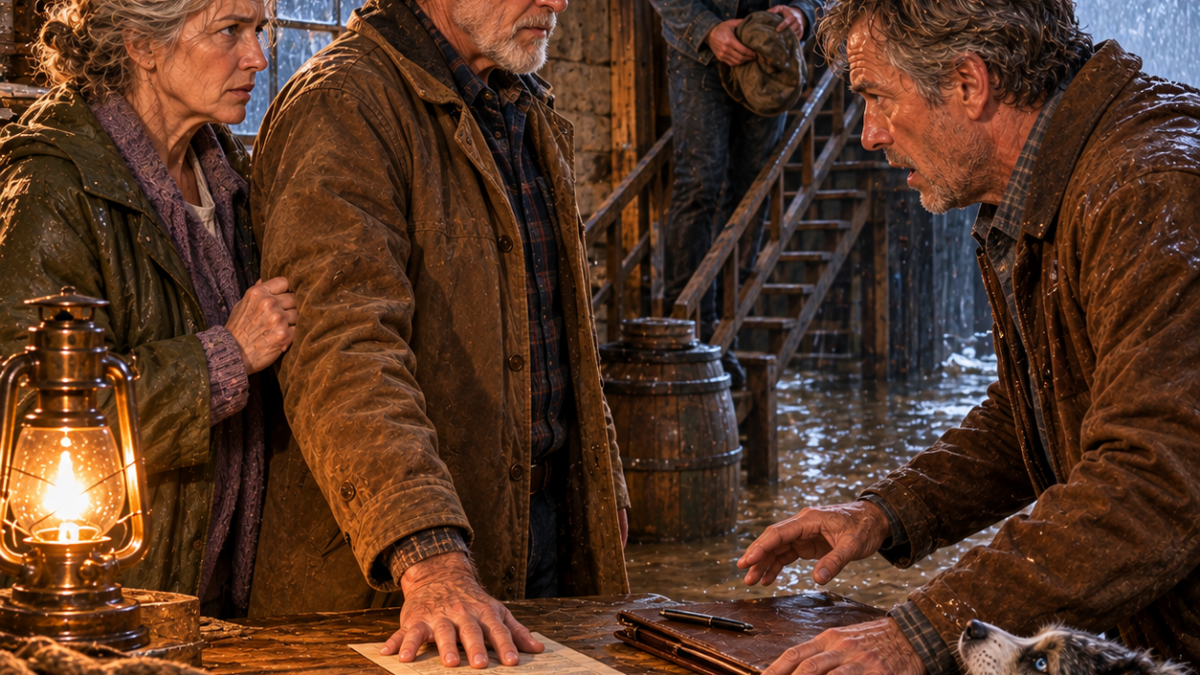
At 71, Walter Kesler had just watched his own brother carry his wifes mothers milk pitcher out the door in a cardboard box.
That same April morning, Merl sold the farm out from under the cottage Walter and Ada had lived in for 31 years, kept the truck, the furniture, and the $14,000 Walter had loaned him, and left them at the old family mill on the Tallow River bottom, 9 mi from town, with the river rising.
On the second day, the pigeons in the gear loft began vanishing into a wall that had no hole in it. Behind it was a room their grandfather had built, a room Merl had spent a year hoping his brother would never think to look for.
To understand what was up there, you have to start with the morning they lost the house. It had rained for 4 days.
At 10:00 on Monday, the 6th of April, Merls pickup came up the lane with the wipers going, and behind it, a flatbed truck with two young men from town that Walter did not know.
Merl got out in his clean boots and stood in the rain by the porch, looking at the porch roof instead of at his brother.
Buyers want the place empty by the 15th, he said. Im sorry to rush it.
I know its hard. He said it kindly.
Merl always said hard things kindly. He had a way of lowering his voice, as if the world had arranged itself this way, and he was only the man who had to tell you.
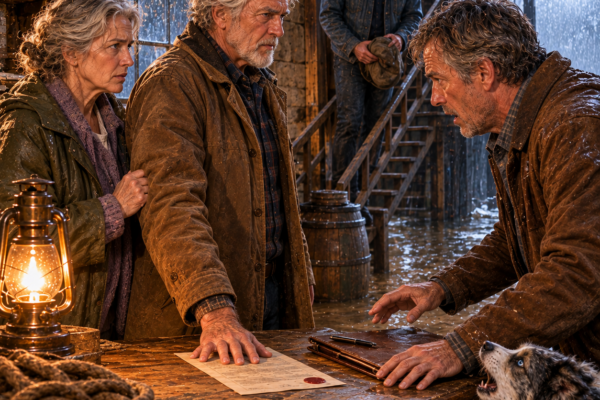
Walter stood on the porch with his hands in the pockets of his chore coat. Behind him in the doorway, Ada had her arms folded across her lavender cardigan.
You said wed have till summer, Walter said. I said I hoped you would.
The buyers changed it.
Heres the thing.
Youve still got the mill lot. Dad left it to you, fair and square.
Ill have Dwayne run you down there this afternoon and you can get settled.
Theres one little paper about the mill lot I need you to sign before the sale closes.
A boundary line thing. Nothing to it.
Ill bring it out Saturday at noon.
The mill? Ada said from the doorway.
Merl.
The mill floods every spring. Its stone on the bottom.
Itll stand.
Merl smiled at her. Were only doing what dad would have wanted.
Ada, keeping it simple. The two young men began carrying out the table, the bed, the rocking chair Walter had rebuilt twice.
They had come with the cottage and he supposeded they belonged to the farm.
The truck, he said, titled to the farm. Walt, you know that Ill need the keys.
Walter handed them over and the 14,000.
Walter said, The money I loaned you for the planter two springs ago. Merl sighed a long, patient sigh.
Its in the farm, Walt. Its in the ground.
Soon as the sale closes, well sit down and square it.
You have my word.
Then one of the young men came out of the kitchen carrying a cardboard box, and on top of the box, wrapped in a dish towel, Walter saw the blue rim of the pitcher.
It was a plain blue and white porcelain thing with a chip on the lip.
Adahs mother had poured milk from it at every supper of Adas girlhood, and when Adahs mother died, it was the only thing Ada had asked for. For 46 years, it had sat on their kitchen windows sill, and every morning the son touched it before it touched anything else in the house.
Thats Adahs, he said. That was her mothers.
Merl glanced at it.
Everything in the kitchen went on the inventory Walt.
The buyers people already listed it.
I cant be pulling things off an inventory.
He lowered his voice.
Ill see what I can do later. Ada turned and went back into the empty kitchen, and Walter heard her open and close a cupboard door, though there was nothing left in the cupboards.
At the bottom of the porch steps by the flatbed, their younger brother Dwayne stood in the rain with his cap rolled up in his hands.
He had come with Merl. He had not carried anything.
He had not said one word. He stood there with water running off the brim of his collar and looked at the ground.
And when Walter looked straight at him, Dwayne looked away. That was the thing Walter would turn over in his mind for days afterward.
Not Merl.
He had known what Merl was for 60 years, but Dwayne, who had followed Walter around the barn as a little boy, and called him Walty, standing in the rain with his cap in his hands, saying nothing at all.
At 3:00, Dwayne drove them to the mill. They had two suitcases, a box of kitchen things, Adahs sewing basket, and a sack of groceries.
The last two mi of gravel ran along the bottom with the tallow on their left, wide and brown and fast, carrying whole branches past them like matchsticks.
The mill stood where it had always stood, at the end of the road on a low stone bench above the river. Three stories, field stone below, weathered board and batten timber above, a steep tin roof gone rust red, and on the riverside the broken wooden waterhe not turned since before Walter was born.
Their grandfather, August Kesler, had ground flour there for half the county. Since he died, it had stood empty for 47 years.
Dwayne stopped at the edge of the yard. He did not turn off the engine.
Waters high, he said. It was the first thing he had said all day.
Its been high before, Walter said. For a moment, Walter thought Dwayne was going to say something more.
Then he looked at the dashboard.
Ive got to get back before the low spot goes under, he said. He set the suitcases by the mill door, got back in his pickup, and drove away up the river road, and his tail lights went red at the curve and then were gone.
He did not stop.
He did not look back.
Walter stood in the rain with his wife and two suitcases and listened to the river.
Well, Adah said finally. She pulled her olive green raincoat tighter.
Ive always wanted to live in a mill. He laughed in spite of himself, and she took his arm, and they went in.
The ground floor was cold and damp and smelled of river mud and old flour. Two great millstones lay on the floor.
There was a small iron stove in the corner that had heated the millers office and a wood box beside it with a few split boards in it, gray with age.
Walters matches were damp. He had six of them in a tin in his coat pocket.
The first two would not strike at all.
He dried the third against the warm skin of his neck for a full minute, the way his grandfather had taught him to do on a duck blind 60 years ago, and then struck it on the stove door, and it caught.
He fed it a strip of cardboard from the kitchen box, then splinters of the gray boards, and blew on it gently, and the fire took. Three matches left.
They ate bread and cold ham beside the stove and lay down in their coats on the plank floor, and under the rain was the river. A deep, steady roar that never paused.
Walter did not sleep for a long time.
In the gray of the morning, he walked to the door and opened it, and the river was in the yard.
Not much.
A sheet of brown water ankled deep moving across the gravel where Dwaynes truck had stood.
But the river road was gone. Where it had curved along the bottom, there was only the tallow spread out flat and brown between the cottonwoods as far as he could see, and the water was still coming up.
Ada, he said, get the suitcases. Were going upstairs.
By 10, it was over the doorsill.
By noon, it was a foot deep across the ground floor, swirling around the millstones, carrying the wood box slowly across the room like a boat.
They had moved everything to the second floor by then.
Adahs knees were worse than his.
She went up those stairs one at a time with one hand on the rail and one on his shoulder, and she did not complain once. It was from the high loading door on the second floor early that afternoon that Walter saw the dog.
The loading door was a square hole in the gable wall with a hoist beam above it where sacks had once been lowered to wagons. 40 yards out where the old pasture fence ran down toward the river.
Only the tops of the fence posts still showed above the flood. And on top of one of them, crouched on a square of wood no bigger than a dinner plate, with brown water rushing past on every side, was a dog.
It was young, lean, a blue merl with copper on its legs and face.
It was soaked to the skin and shaking so hard Walter could see it from the mill. It had a frayed red collar.
It was holding on.
Oh, the poor thing, Adah said at his shoulder.
The current carried debris past the mill in a steady line, sweeping close against the fence before it bent back toward the mill wall. Walter looked at it for a long moment, the way he used to look at a field before he plowed it.
Then he went to the hoist beam.
There was still an old rope there, gray and stiff, run through an iron pulley with a rusted hay hook on the end of it.
He could not reach the dog, but the current could. He waited until a long cottonwood branch came down the line.
And he swung the hook out and caught it on the third try, and he played it out on the rope, letting the current carry it down against the fence post. And the branch bumped against the post and swung.
And the dog looked at the branch and at the mill and at Walter in the loading door.
Come on, Walter said.
Come on now.
Come on. The dog jumped.
It landed on the branch and slipped and went in the water up to its shoulders and scrambled and got its front legs over the wood and held on.
And Walter pulled. He pulled hand over hand with his shoulders burning.
Ada behind him with her arms around his waist, and the branch came across the current toward the mill wall. And he leaned out of the loading door as far as he dared, and got one hand in the red collar, and hauled the dog up and over the sill, and they all three went down in a heap on the second floor boards.
The dog lay there gasping.
Then it got up, shook itself from nose to stubby tail, and walked straight to Ada and put its wet head in her lap. He had one blue eye and one brown.
There was no tag on the collar.
Post, Adah said, rubbing him with the hem of her raincoat.
Well call you Post because thats where we found you.
They gave him half the remaining ham. Walter did not say anything about it.
Neither did she.
It was later that afternoon, with the water still rising on the floor below, and the light going, that Walter climbed the last steep stairs to the gear loft. The gear loft was the top of the mill, under the slope of the roof, where the great wooden crown wheel had once turned the stones below.
Pigeons roosted on the beams in dozens, and as Walter stood at the top of the stairs, getting his breath, he watched one of them do something strange. It flew from the crown wheel to the far end of the loft where the gable wall was plain solid planks and it landed on a ledge at the top of the wall and it walked into the wall and was gone.
He watched another do it.
Then a third.
He went to the wall.
It was bored and batten, tight and gray with age with no window and no hole that he could see.
He put his hand flat on the boards near the top of the wall, and he felt it at once. Air was moving.
A thin, steady draft coming out between the boards, and it was dry. Everything in that mill was damp to the touch.
The walls, the beams, their own clothes, but the air coming out of that wall was dry and still, and smelled very faintly of cedar. Post had come up the stairs behind him.
The dog walked straight to the wall and sniffed along the bottom board and then stood up on his hind legs and scratched at it with both front paws and whed. Walter ran his fingers down the batten nearest the dog, and at the height of his own chest, his thumb found a board that moved just a little, just the width of a fingernail.
It was not nailed. He pressed on it and it slid smooth and silent a few inches sideways in a groove and behind it was darkness and the dry air came out into his face like a breath.
Ada, he called down the stairs. His voice did not sound like his own.
Bring the lantern. She came up slowly, one step at a time, with the kerosene lantern from the cottage in one hand.
He took it from her and lit it with the second to last match and slid the board the rest of the way open. And it was not a board at all.
It was a door, a narrow plank door set so cleverly into the battens that from two steps away it was only part of the wall. He ducked his head and went through and held the lantern up.
It was a room. It had been built inside the roof itself, in the great triangle of space between the rafters and the tie beams, where nobody looking up from the mill floor would ever think to look.
The walls sloped in overhead, sheathed in tight cedar planks.
At the far end, a small round window of thick glass let in the last gray light of the afternoon, which was how the pigeons had been getting in through a gap where one pane had cracked out of its lead.
There were two narrow wooden bunks against one wall, one above the other. A small iron stove stood on a square of flat stones with its pipe running up through the roof.
There was a rain barrel in the corner fed by a pipe from the gutter outside, and it was full. There were shelves, and on the shelves were gray tins with tight lids, and stone crocs sealed with wax, and cans of lamp oil, and a box of candles, and a coil of rope, and a lantern with a glass chimney, clean.
and across the room at the height of a tall mans head ran the great central tie beam that held the two halves of the roof together. Cut deep into its face in square capital letters a hands width high were words, Build high and leave room for the neighbors, AK197.
Ada came in behind him and read the words aloud softly, and then she put her hand over her mouth. Walter, she said, Your grandfather.
He could not answer her. He was looking at the rafters.
On the rafters, all along the slope of the roof, someone had painted names.
White paint faded to the color of old bone in a careful old-fashioned hand, family names, and under each one a number.
Briggs five, Halverson four, Akerly six, Lindren 3. Seven families, and one rafter low on the side above the stove was black with old soot, and whatever had been painted there, he could not read.
The flood of 37, Walter said, Grandpa used to talk about it when I was a boy. Water to the second floor, half the bottom washed away.
He touched the nearest name.
I never knew where the people went.
They came here, Ada said. They came up here.
Post had come in last.
He walked once around the little room with his nose down, and then he lay on the bottom bunk and put his chin on his paws as if he had been sleeping there his whole life.
At the foot of the bunks, there was a cedar chest with brass corners.
Walter knelt in front of it, and his knees cracked, and he lifted the lid. Inside were quilts folded tight, smelling of cedar and nothing else.
Not mildew, not mice. And on top of the quilts lay a black clothbound notebook with a strip of faded blue ribbon tied around it.
On the cover, in a small upright hand that Walter knew at once, though he had not seen it in 35 years, someone had written for Walter when the water comes. It was his grandmothers hand.
Lisel Kesler had died the year Walter turned 36. He sat down on the edge of the bottom bunk beside the dog.
He untied the ribbon. Adah held the lantern.
Walter, if you are reading this, then the river has come up and you have come to the mill, and I expect you have come because you had nowhere else to go.
I dont know what brought you here.
Your grandfather always said the river would bring you here in the end, one way or another, and he was seldom wrong about water.
He built this room the summer after the flood of 1937. That spring, seven families sat on this roof for two days and two nights in the rain, holding on to the ridge with their children tied to the chimney, and he pulled them in through the loading door one at a time.
Afterward, he said, A mill that only grinds flour is half a mill. The other half is a high, dry place for whoever the river leaves behind.
So he built this and he never told the town where it was because he said people in trouble are proud and pride drowns more folks than water does.
Anybody who needed it, he simply brought up the stairs.
Now I want to tell you something your father never told you because he never believed it himself. Your grandfather never once thought you were the dreamer in this family.
He thought you were the one who would stay.
When he left you the mill, it was not because it was worthless. It was because you were the only one he trusted with it.
There are some other things he left you.
I will tell you about them at the back of this book when the time is right.
The stove draws well if you open the damper all the way. The barrel fills from the roof.
The beans in the gray tins will keep forever, and the honey in the crocs will keep longer than that.
The matches are in the glass jar with the screw lid. Dont try the river in the dark.
Your loving grandmother, Leisel Walter, read it twice. Then he closed the book and held it against his chest with both hands and looked at the floor, and for a long time he did not say anything at all.
Ada set the lantern down on the shelf. She did not ask him anything.
She found the glass jar with the screw lid behind the gray tins, and inside it were a hundred dry wooden matches, and she opened the stove door and found it already laid, paper, and kindling and split oak, as if someone had laid it yesterday. She opened the damper all the way, the way the book said.
She struck one match and the fire caught at once and the little stove began to tick and in 10 minutes the room under the roof was warmer than any place they had been in three days. Some people love you out loud.
Some love you with a hammer and a 100 nails.
Ada opened one of the gray tins with the blade of Walters pocketk knife.
navy beans, dry as gravel and perfect.
She put a handful to soak in a pot of rainwater and opened a croc and it was honey gone thick and pale. And she dipped two fingers in and tasted it and laughed out loud.
Its good, she said, Walter.
Its good.
They ate bread and honey on the bunk with the dog between them, and the rain drumed on the tin roof a few feet over their heads, and down below them the river roared through the ground floor of the mill.
Walter sat with the notebook in his lap, and listened to it, and thought about his father.
He had been 24 the spring his grandfather died. He remembered the kitchen table at the farmhouse after the funeral and his father reading the will out loud in his flat, tired voice, with Merl across the table, 17 years old and already as big as a man, and Dwayne, 13, sitting on the stairs where nobody would notice him.
The savings to Leisel, the house in town to Leisel, and to Walter the mill.
His father had set the paper down and looked at him.
Pa left you the mill, he said.
Figures.
Its worth about as much as your notions. Merl had laughed.
Walter remembered the laugh better than he remembered anything else about that day. He had wanted at 24 to put the mill back to work.
He had drawn plans for a new water wheel on the backs of feed receipts.
He had talked about it at supper how people in town would pay for real stone ground flour again. His father had called it his notions.
And after that laugh at the kitchen table, Walter had folded the plans and put them in a drawer and gone out to work the farm for his father and then for his brother for 47 years, and the mill had sat empty at the end of the river road, and he had driven past it a thousand times and not once gone inside.
It was not because it was worthless.
It was because you were the only one he trusted with it. He did not know what to do with that.
It was too big and too late to fit anywhere.
So he opened the notebook again and turned the pages.
The middle of the book was lists. Supplies and dates they were laid in.
Notes on the stove, on the gutter, on a leak in the round window fixed in 1958. The names of people his grandfather had brought up the stairs in floods after the big one.
A few in every decade. A widow, a hired man, a family of five.
in 1965. And then the back of the book, blank pages, page after page of them, and on the very last page, in the same small upright hand, gone a little shaky, just two lines.
Third rafter from the window, when they come for the trees. Walter read it out loud.
Ada looked at him. What trees?
She said, I dont know. He took the lantern and went to the round window at the end of the room and counted the rafters back from it.
1 2 3.
He held the light to the third rafter and ran his hands along it, top and bottom and sides as far as he could reach. He knocked on it with his knuckles.
It was solid oak, as hard and sound as the day it was cut.
He tried the third rafter on the other side of the roof and then the third from the other end for good measure. Solid all of them.
When they come for the trees, Ada said slowly. Walter, what trees would anybody come for?
He stood under the slope of the roof with the lantern and did not answer because he was thinking about the long rows of black walnut that ran down the creek bottom on the farm, the ones his grandfather had planted as a young man, the ones that had been old when Walter was a boy. Merl had been talking about them all winter.
Walter had heard him on the phone in the machine shed.
He had never paid it any mind. Before they slept, Ada took the cardboard box of kitchen things and set them out on the shelf one by one.
A pot, two cups, two plates, a spoon. She looked a long time at the empty space at the end of the shelf, about the size of a milk pitcher, and then she turned away from it and did not mention it, and Walter did not either.
They slept that night in the bunks, Ada below with the dog and Walter above under his grandmothers quilts, with the stove ticking and the rain on the roof.
And for the first night since the 6th of April, they both slept through.
In the morning, the rain had stopped. Walter climbed down to the loading door with post at his heels and looked out.
The sky was pale and washed. The river was still everywhere, brown and wide across the bottom, but it had fallen in the night.
He could see a line of wet mud on the fence posts a foot above the water, and the top rail of the pasture fence was showing again, and the current had slowed.
The water was going down. He stood there in the loading door in the thin Wednesdaylight, breathing it in, with his grandmothers book inside his coat against his chest.
And that was when Posts ears came up and the dog stiffened and turned his head toward the cottonwoods downstream.
An engine, small and high and buzzing, coming up the flooded river bottom from the direction of town.
Somebody was coming, and there was no road left for anybody to come on. It was a johnboat, flatbottomed and dented, with a small outboard motor on the back, nosing its way up through the flooded cottonwoods with a man standing in the stern.
He was short and wiry and wore rubber hip waiters and a red and black buffalo check wool jacket.
And he had a white goatee and bushy white eyebrows.
And when he saw Walter in the loading door, he cut the motor and let the boat drift the last 20 yards on the current until it bumped gently against the mill wall below. Walter Kesler, the man called up.
Ill be switched.
I saw smoke coming out of August Keslers roof this morning, and I thought Id lost my mind.
Leland.
Walter said he knew him the way everybody in that end of the county knew everybody.
Leland Briggs ran the feed and seed store in Cobbs Ferry and had for 50 years, and Walter had bought seed from him for half his life.
He had never once seen him outside the store. Then Post pushed past Walters knees and put his front feet on the sill of the loading door and looked down at the boat, and his stubby tail began to wag so hard his whole back end wagged with it.
Leland stared up at the dog.
Then he took off his cap and slapped it against his leg.
Well, theres my fool dog, he said. Ive been looking for you since Sunday, you worthless runaway.
He shook his head. Hes mine, Walter.
or he was till he decided he wasnt.
Got him off a man in the next county as a pup. Twice this winter he slipped his collar and I found him 9 miles out here sleeping on the stone step of this very mill.
Sunday night when the river came up he was gone again.
I figured that was the last of him.
He was on a fence post.
Walter said in the middle of the river. Ada named him Post.
Leland looked at the dog a long time. Post, he said.
Well, thats a better name than I gave him.
He put his cap back on.
Seems hes made up his mind who he belongs to.
I wont argue with a dog thats walked 9 miles twice.
He tied the boat to the old hoist chain hanging from the beam and climbed up through the loading door, slow and careful in his waiters, and stood dripping on the second floor. Ada came down the stairs to meet him one step at a time.
He took her hand and held it. I heard, he said simply, heard Monday afternoon at the store.
The whole valleys heard by now. Im sorry, Ada.
He had brought a paper sack. In it were a loaf of bread, a pound of coffee, a jar of peanut butter, six eggs packed in a coffee can full of sawdust, and a bag of dog food.
Leland, we cant take this. Ada said, We cant pay you back.
It isnt help, Leland said. And it isnt charity either, so dont you start.
Your granddaddy floated my daddys whole family out of this bottom. In 1937, my daddy was 4 years old.
He told me about it every spring of his life.
Every time that river came up, Im just running about 90 years late paying it back. Walter looked at him.
Briggs, five, he said quietly.
Lelands face changed.
What did you say? Walter did not answer him.
He went to the stairs and after a moment Leland followed him, and Ada after them both, and they climbed the last steep flight to the gear loft.
Walter slid the plank door open, and Leland ducked through it behind him and straightened up under the slope of the roof and stopped. He stood there a long time in the gray light from the round window, looking at the bunks and the stove and the shelves.
Then he looked up at the rafters and found the name. He reached up and touched it with two fingers.
My daddy said they were somewhere high and dry, he said.
His voice had gone rough. Up top, he said, where it was warm.
Seven families, two days, he said.
Old August brought them all up the stairs in the dark one at a time and wouldnt let a single one of them tell where theyd been.
Said it was nobodys business whod needed it. He shook his head slowly.
I always figured he meant the attic.
I never thought it was a real room. Theres something cut in the beam, Ada said.
Leland turned and read it.
He read it out loud the way Ada had. Build high and leave room for the neighbors.
He stood there under it a while. Thats him, he said finally.
Thats the whole man in one line. They went down to the loading door again in the bright Wednesday noon, and Leland looked out at the river and squinted at the line of mud on the fence posts.
Shes dropping a foot every few hours, he said.
Road wont be clear till Thursday.
You two cant stay up here on beans and honey till then. Youll come to town.
Ive got a room over the store and a cot and a hot stove and a bathtub.
We dont have any money, Leland.
Then its a good thing I didnt ask you for any.
They went down the hoist chain into the boat.
Leland first, then Ada with Walter holding her arm and Leland steadying her from below.
Then the two suitcases and the notebook wrapped in oil cloth.
and last of all Post, who jumped from the loading door straight into the middle of the johnboat, and nearly turned it over, and then sat down in the bow with his ears up, as if he had been riding in boats his whole life.
Halfway down the river bottom among the drowned cottonwoods, the outboard hit something under the water, and whined and died. Leland pulled the starter cord.
The motor turned over and caught and roared, and the boat did not move. The propeller was spinning free.
Sheared the pin, Leland said, disgusted. And the spares are sitting in a coffee can on my workbench.
Walter had already leaned back over the stern.
He tilted the motor up out of the water, and there was the propeller, loose on its shaft, the little brass pin that held it, sheared clean in two. He felt in the pocket of his chore coat where he had carried odds and ends for 60 years.
Wire and washers and a bent nail and a stub of pencil.
He came out with a cotter pin from a hay rake. It was a little too long.
He bent it double with his fingers and fed it through the hole in the shaft and spread the ends with the blade of his pocketk knife and tipped the motor back down.
Try her, he said. Leland pulled the cord.
The motor caught and the boat surged forward and Post barked once at the bow and Ada laughed. Your granddaddy could do that, Leland said, shaking his head.
Fix anything with what he had in his pockets.
Cobbs ferry sat on high ground where the county road crossed the river, one long street of old brick buildings. The river had stopped at the bottom of Front Street.
Leland tied up at the boat ramp and walked them two blocks to the store with post trotting ahead as if he owned the town. The room over the store was small and plain and warm.
There was a bed with a white chenille spread and a radiator that knocked and a window that looked down on Main Street. Ada sat down on the edge of the bed and put both hands flat on the spread and closed her eyes.
And Walter knew she was going to cry and she did not.
She only sat there for a while breathing. That evening, Leland cooked eggs and fried potatoes on the hot plate in the back of the store, and they ate at his workbench by the wood stove among the seed bins and feed sacks, and Leland talked.
He did not ask them anything. He told them things.
He told them that Merl had sold his big four-wheel drive tractor at the February auction, the one hed only bought 2 years before, and had not bought another. He told them a man from the bank in the county seat had been seen at the farm three times since Christmas in a gray car.
He told them that Merl came into the cafe most mornings and took his coffee to the corner booth and talked on his phone with his back to the room. And theres been trucks out at your place, Leland said.
Not farm trucks, big flatbeds with a company name on the door. Hollowell Hardwoods out of the city.
A man from the cafe said he saw two fellas in orange vests walking the creek bottom on your farm in March painting numbers on trees.
Walter set down his fork.
Numbers, he said.
On the walnut, Leland said every one of those big old walnuts down along the creek, white paint about chest high. He looked at Walter over the top of his coffee cup.
Merl tell you anything about that?
No, Walter said slowly. Merl never told me anything, but he was remembering.
He was remembering all winter long Merl in the machine shed with the door pulled to talking on his phone and how he always stopped talking when Walter came in for a wrench. He was remembering a big flatbed truck hed seen turning around in the lane in March and thinking nothing of it.
He was remembering a year ago last fall, Merl carrying three cardboard boxes of their fathers papers out of the farmhouse attic and down to the machine shed and spending the better part of a week out there with a lamp on late into the night.
Walter had thought he was finally going through dads things. He had thought it was grief.
Third rafter from the window when they come for the trees.
 [Tap here for the Next Part ]