“Get on Your Knees!” He Mocked—Until the Silent Single Dad Veteran Taught Him a Brutal Lesson
“Get on Your Knees!” He Mocked—Until the Silent Single Dad Veteran Taught Him a Brutal Lesson
You walked onto my mat, janitor. Big mistake.
His shoulders hurt.
He’s done for tonight.
He’s done when I say get up, Mason.
No.
Everyone’s watching.
Bow down. Apologize.
Then take your kid and leave. Not happening.
Big mistake.
Then I’ll teach you where you belong.
Derek Vance believed he was putting a nosy janitor in his place. A man who should lower his eyes, apologize, and take his son home.
Gavin Mercer did none of it.
He did not argue or raise his voice. He simply stood between a hurt boy and the man who had hurt him.
Weight shifted carefully off one hip, and that silence only pushed Derek deeper.
Few people noticed how fast he had checked the boy’s fingers and eyes like someone who had done it somewhere far worse.
Now with Gavin’s 12-year-old son watching, Derek was ready to throw the punch he believed would end it.
But what happens to a black belt who swings first in a room full of witnesses who are finally done staying silent?
Before we find out if you believe the quietest person in the room is sometimes the strongest, take a second to subscribe so you don’t miss stories like this one.
And tell us in the comments where you’re listening from tonight.
Now, let’s go back to where it all began.
6 weeks before that night, nobody at Pine Brook Recreation Center would have looked twice at Gavin Mercer.
He was the man in the gray work jacket who kept the old boiler alive through the winter, replaced the flickering lights above the basketball court, and knew exactly which radiator would start banging if someone turned the thermostat too high.
Most people knew his face.
Very few knew his last name.
Pinebrook sat at the quiet edge of Madison Creek, Pennsylvania.
a modest community center with a leaking roof, a small gym, and a multi-purpose room that Northridge Martial Arts rented three evenings a week.
Gavin had rearranged his shifts so he could finish work just as class began, then take his usual seat on a plastic chair at the far end of the hallway.
From there, through the wide glass window of the training room, he could watch his son without making the boy feel w. At 44, Gavin had learned that most of life came down to showing up on time and staying until the job was finished.
He had learned at first in uniform and later in a small rented house where he suddenly found himself raising a little boy alone.
Owen’s mother had left when Owen was barely old enough to remember her face.
And after that, there had been no one else to pack lunches, sign permission slips, or sit up with a feverish child at 3:00 in the morning.
So Gavin had done all of it imperfectly.
He burned the toast every Sunday morning without fail, so reliably that Owen had started calling the smoke alarm their breakfast bell. He checked the front door twice every night before bed, turning the knob, stepping away, then coming back to turn it again.
More evenings than not, he fell asleep on the couch after a long shift and woke near midnight to find that Owen had quietly thrown a blanket over him before the maintenance keys and the lunchboxes.
There had been years in the military that Gavin kept locked away as carefully as he locked that front door.
Those years had left him with an old injury in his hip that achd whenever the weather turned cold. On bad days, he walked with a slight limp he tried to hide, and he could not stand in one place too long without shifting his weight to the other leg.
They had also left him with a cold, private honesty about his own limits. If he were ever forced into a real fight again, he would have seconds to end it, not minutes.
The hip would never let him last longer than that. It was a fact he carried quietly the way he carried everything else from that part of his life.
And he had never said it out loud to anyone.
He never talked about any of it. When Owen asked about the scar near his hip, Gavin told him it came from an old accident.
When Owen found a folded flag at the back of the hall closet, Gavin said it had belonged to a friend. He did not want his boy growing up in the shadow of a soldier.
He wanted Owen to know him simply as a father and nothing more.
Owen was 12, thin for his age, and quiet in a way that worried Gavin more than he admitted.
He was smart and kind, the kind of kid who saved half his lunch for a stray cat behind the school. But he had a habit of shrinking whenever someone raised their voice.
That habit had made him an easy target for Tyler Brooks, a boy in his grade who had discovered that Owen would not push back.
It started with a shove against the lockers, a backpack knocked to the floor, a nickname repeated loudly enough for the whole hallway to hear.
Owen never told his father directly.
Gavin found out when he noticed a bruise on his son’s arm, and heard a story about tripping on the stairs that did not quite fit.
He called the school, sat through a meeting with a tired vice principal, and came home knowing that meetings alone would not fix the look in Owen’s eyes.
That was why he had signed Owen up for martial arts. He did not want his son to learn how to hurt anyone.
He wanted him to learn how to stand up straight, how to take a fall and get back up, how to walk into a room without apologizing for being there.
When a flyer for Northridge appeared on the bulletin board by the front desk, promising confidence and discipline for young students, Gavin had taken it as a sign.
The instructor was Derek Vance, 31 years old, broad-shouldered and sure of himself in a way that filled any room he entered.
On the first evening, he shook Gavin’s hand firmly, looked Owen up and down, and grinned.
“Give me three months,” Derek told him, “and you won’t recognize this kid.
” The other parents laughed and nodded.
Several of them clearly adored him. And at first, Gavin could understand why.
Derek was skilled, and there was no question about that.
His black belt was real. His movements were fast and clean.
And when he demonstrated a technique, the children watched him with wide eyes.
He often brought along a friend named Travis Cole, a heavy set man who had trained with him for years and helped hold pads or act as a partner during demonstrations.
Together, they made the class look impressive from the hallway.
Richard Hail, the director of Pinebrook, was one of Derek’s biggest fans.
Since Northridge had started renting the room, enrollment in the cent’s youth programs had doubled, and Hail mentioned it at every staff meeting, as though he had personally trained each student.
Whenever Derek walked through the lobby, Hail would stop whatever he was doing to shake his hand and ask whether the room was working out.
For the first couple of weeks, Gavin believed he had made the right decision.
Owen came home tired and sore, but he talked about stances and blocks at the dinner table, and once or twice, he even demonstrated a move in the kitchen.
Gavin would sit on the plastic chair in the hallway, rubbing the ache out of his hip, and feel something close to relief.
Maybe this was exactly what his son needed.
But the longer Gavin watched, the more small things bothered him. The children bowed to Derek too quickly, eyes down, bodies stiff.
They went silent whenever he walked past, and some of them flinched when he raised his hand, even if he was only pointing at the mat. Gavin had spent years around men who commanded respect, and he knew what respect looked like.
What he saw through that glass was fear. Derek was not teaching those kids to be strong.
He was teaching them to be afraid of him and he seemed to enjoy it. He made jokes at the expense of students who stumbled and the rest of the class laughed because laughing was safer than being the next joke.
Every week the same few children seemed to shrink a little more and Derek seemed to stand a little taller.
The one he picked on the most was Mason Reed. Mason was 13, a year older than Owen, but so small and awkward that most people assumed he was younger.
His uniform hung loose on his narrow shoulders, his glasses slid down his nose during every drill, and he never seemed to know what to do with his hands. Derek had given him a nickname in the first week, Noodle, and now the whole class used it.
Mason’s mother, Carla, worked night shifts as a nursing assistant at a care home across town.
Gavin saw her only in passing, a tired woman in blue scrubs who pulled up to the curb, kissed her son on the top of his head, and drove off before class began. She never had time to sit in the hallway and watch.
As far as Gavin could tell, she had no idea what went on inside that room. Over the weeks, Gavin and Mason had fallen into a quiet sort of friendship.
Gavin would buy the boy a bottle of water from the vending machine after class. And on evenings when Carla got stuck at work, he drove Mason home along with Owen.
Mason talked more in the backseat of that old car than he ever did on the mat. He liked comic books, hated math, and wanted to be a veterinarian someday.
He also had a look that Gavin recognized the look of someone always calculating how to stand where nobody would notice him and how to keep his voice low enough that no one would turn around.
Gavin had seen it on young men far from home who had learned that the easiest way to survive was to disappear.
He had never expected to see it on a 13-year-old at a community center.
It happened on a Wednesday evening in late October. Derek had the class practicing a simple defensive turn, the same movement Owen had been proudly showing off in the kitchen all week.
When Mason’s turn came, he hesitated, stepped the wrong way, and brought his arms up too late.
It was the kind of mistake every beginner makes a dozen times before getting it right.
Derek did not correct him. He stepped forward and shoved Mason hard in the shoulder with the heel of his hand.
The boy’s feet went out from under him and he landed on his back with a thud Gavin heard even through the glass.
Derek stood over him and smiled.
“If you fall that easily in here, Noodle,” he said loudly.
“Imagine how easy you’ll fall out there.”
A few students laughed, the nervous kind of laughter that comes from relief at not being the one on the floor. Several parents in the hallway shifted in their chairs.
A mother near the door pressed her lips together, and a father looked down at his phone as though he had suddenly received an important message. The discomfort spread through the hallway, but nobody stood up, and nobody spoke.
Inside the room, Owen turned his head and looked through the glass directly at his father. Gavin felt that look land on him like a hand on his chest.
His fingers tightened around the edge of the plastic chair, and for a moment, every muscle in his body was ready to move.
Then Mason climbed back to his feet, pushed his glasses up his nose, and returned to the line, and the moment slipped away.
Gavin stayed in his seat. He told himself it was not his place, that Derek was the instructor, and he was only a parent in a hallway, that a shove was not the same thing as an injury.
But beneath those reasons was another one he did not want to examine. He was afraid that if he walked into that room, he would not know where to stop.
He had spent years keeping that part of himself locked away.
The drive home was quiet. A light rain streaked across the windshield, and the old wipers squeaked with every pass.
Owen sat in the passenger seat with his bag on his lap, staring out at the wet streets. Gavin kept waiting for him to talk about class the way he usually did, but Owen said nothing for almost the entire ride.
Then, as they turned onto their street, he finally spoke.
“Dad,” he asked quietly without looking at him.
“What if he did that to me?”
The question was so simple, and yet it made Gavin’s hands tighten on the steering wheel.
He pulled into the driveway and turned off the engine, but neither of them moved to get out.
The rain tapped softly on the roof while Gavin searched for the right answer.
“A good teacher can make you tired,” he finally said.
“He can make you frustrated and push you until you want to quit, but a good teacher never needs to make you afraid to prove he’s strong.
” Owen picked at the strap of his bag while he thought about it.
Mason didn’t even do anything wrong,” he said at last.
Gavin had no reply because his son was right.
That night, after Owen had gone to bed, Gavin checked the front door twice and then sat at the kitchen table in the dark.
He kept seeing Mason’s face as he got up off the mat, and he kept seeing Owen’s eyes through the glass.
His son had looked to him for an answer, and Gavin had given him silence.
He did not sleep much, and when he did, the old dreams came back.
The next morning, Gavin went to see Richard Hail.
The radiator in the director’s office had been rattling for a week, so he brought his toolbox.
While he worked on the valve, he described what he had seen calmly and without exaggeration.
the shove the nickname, the way the children flinched whenever Derek came near.
Hail listened with the polite impatience of a man who had already made up his mind. When Gavin finished, the director leaned back and waved a hand.
Parents love him, Hail said.
Enrollment has doubled since he started. Nobody has complained.
He said that last part a little too quickly, then smiled.
You just focus on fixing the heater, Gavin.
Let Derek worry about his class.
Gavin tightened the last bolt, packed up his tools, and left. He had tried the right way through the right person, and the right person had brushed him off.
From that day on, Gavin stopped looking at his phone in the hallway during class.
He simply watched, and the more he watched, the less he liked what he saw. Mason had started favoring the shoulder Dererick had shoved, and he winced whenever he raised his arm to tie his belt.
On Friday, while driving the boys home, Gavin glanced into the rear view mirror and asked Mason how the shoulder was feeling.
Mason admitted that it still hurt, especially when he tried to sleep on that side. When Gavin asked whether his mother knew, the boy shook his head and looked out the window.
His mom was working double shifts that month, he explained, and she was already worried about bills.
He did not want to give her one more thing to worry about.
“It’ll get better,” he said with a small shrug, the way a much older person might.
The following Friday, exactly a week after that conversation, Derek announced that the class would be watching a sparring demonstration.
Travis stood beside him on the mat with his arms crossed and the children sat in a nervous row along the wall.
Several parents had come inside to watch and a few more gathered by the open door. Gavin stayed at the glass.
Derek and Travis started with a few throws between themselves, fast and loud, and the children clapped when Travis hit the mat and rolled back to his feet.
Then Derek turned toward the row of students with a slow smile, and Gavin already knew whose name he would call.
“Noodle,” Derek said.
“You’re up.
Let’s show them what a real fall looks like.”
Mason walked to the center of the mat with his left arm held stiffly against his side.
When he reached Derek, he said something too quietly for Gavin to hear through the glass.
But Owen, sitting closest to them, heard every word and would repeat it to his father later. Mason had said that his shoulder still hurt from last week, and he had asked if he could sit this one out.
Derek laughed and clapped the boy on his sore shoulder hard enough to make him flinch.
“Pain is just weakness leaving the body,” he announced, and Travis grinned.
Then Derek grabbed Mason by the collar and sleeve, turned his hip in, and threw him. It was no teaching throw.
It was fast and hard, meant for an adult who knew how to land. And Mason hit the mat with a sharp cry.
The boy curled onto his side and began to cry, pressing his face against the mat to hide it.
Derek stood over him with his hands on his hips and shook his head in disgust.
“Crying doesn’t count as a rep,” he said.
“Get up.
We’re doing it again.
And this time you’re going to land like you mean it.
A mother near the door took a half step forward and then stopped.
Mason pushed himself up with his good arm, tears running behind his crooked glasses, and faced Derek again.
Gavin’s hand pressed flat against the cold glass.
He could see the boy’s left arm hanging wrong now, not quite natural, and something old and alert woke up inside him.
Derek threw him again, and this time Mason had no strength left to fight it.
He landed badly, all of his weight crashing down on the injured shoulder. The sound he made was a thin, choked gasp, and then he curled into a ball, clutching his arm against his chest, his whole body trembling.
For a second, the room went completely still.
Then Travis laughed.
the careless laugh a man gives when he sees someone slip on ice.
And a couple of students laughed with him because the grown-ups were laughing.
Owen did not laugh.
He turned on the bench and found his father’s eyes through the glass.
It was the same look he had given him a week and a half earlier, but now it was no longer a question.
It was a quiet plea, and underneath it was something that frightened Gavin more than any fight ever had.
the fear that his father would do nothing again.
This time, Gavin stood up and he did not sit back down.
He walked through the doorway and onto the mat without asking permission. The parents by the door stepped aside and a murmur ran along the row of students.
Derek turned, frowning as though a stranger had wandered into his house.
Gavin did not look at him. He went straight to Mason and knelt beside the boy on the mat.
His hands moved before he had to think about them.
He supported Mason’s injured arm against the boy’s body so it could not shift, then asked him to wiggle the fingers of his left hand one at a time.
He checked the color of the fingertips, then tilted Mason’s chin up and watched his pupils to make sure he had not hit his head.
It was quick and precise, and a couple of the parents noticed how practiced it looked.
Derek’s voice came from above him, cold and sharp.
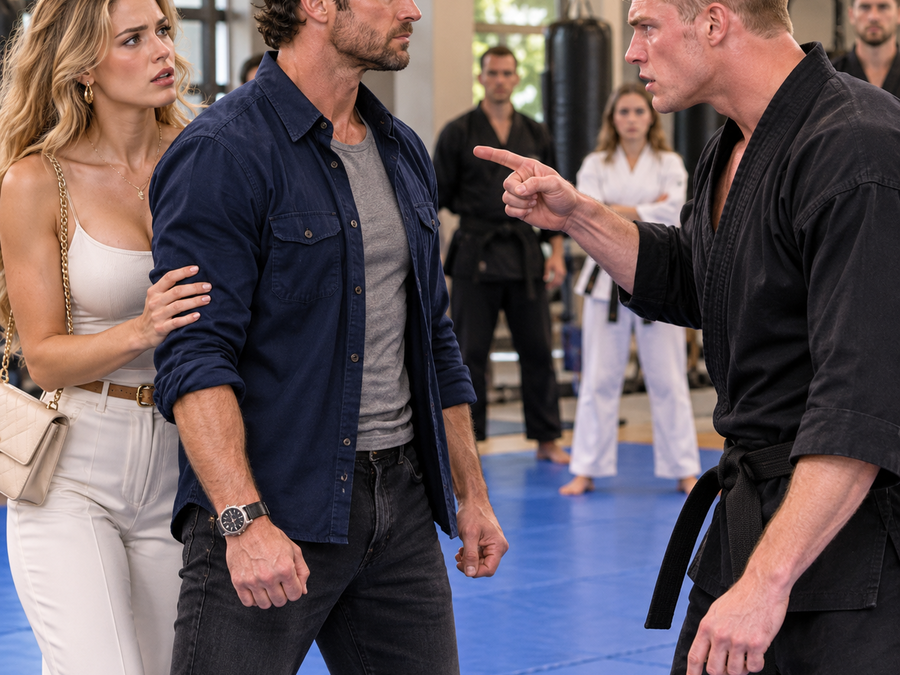
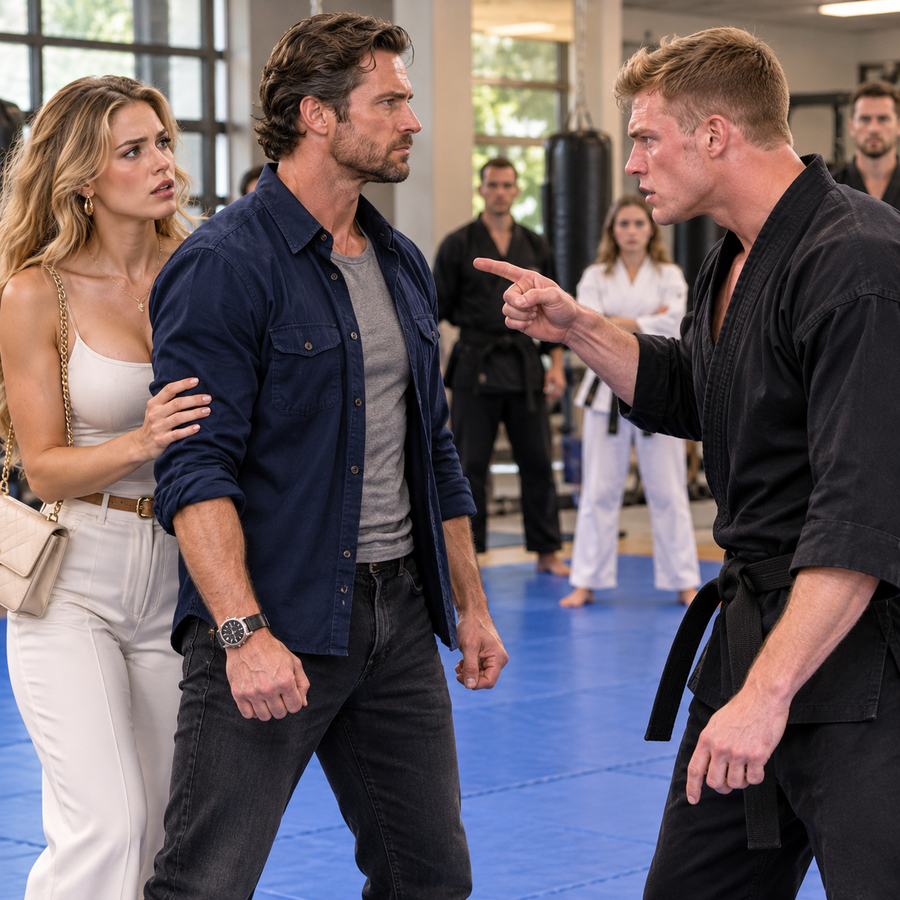
You walked onto my mat, janitor. Big mistake.
Gavin kept one hand steady on Mason’s arm and answered without raising his voice.
His shoulders hurt, he said.
“He’s done for tonight.”
Behind him, he could feel every eye in the room on his back, and he knew one pair of those eyes belonged to his son.
Dererick stepped closer, his shadow falling across both of them.
You’re a parent.
I’m the instructor, he said loud enough for the whole room to hear.
And around here, you’re the guy who fixes the pipes.
Don’t you tell me how to run my class.
Travis snorted behind him. Near the door, a father muttered that maybe they should all just go home and let the instructor handle it.
Gavin understood that he had a choice. He could take Owen by the shoulder and walk out.
Nobody would blame him.
Derek would get his class back. Hail would keep his enrollment numbers.
And Gavin would keep his job and his quiet life.
By Monday, everyone would pretend it had never happened, just as they had the week before.
Then he looked down at Mason, still trembling against his hand, and up at Owen, frozen on the bench with his fists clenched on his knees. For 12 years, Gavin had told his son that strong people protect those who cannot protect themselves.
If he walked away now, every one of those words would become hollow. And Owen would remember that far longer than any lesson on a mat.
Derek seemed to sense his hesitation and mistake it for weakness. He looked past Gavin at the boy on the floor and spoke in a flat, bored voice.
He’s done what I say.
Get up, Mason. Mason flinched and tried to push himself up, his face twisting with pain.
Gavin’s hand pressed gently against his back and held him where he was.
Then Gavin rose, slowly shifting his weight off his bad hip, and stepped between Derek and the boy.
He was not taller than Derek, and he was certainly not younger.
His jacket was old and faded, and his hands were still rough from a day of fixing other people’s broken things.
But he stood there without moving, calm and silent.
And Gavin Mercer did not step aside. Derek stared at him and a slow, disbelieving smile spread across his face.
He glanced at Travis, then at the row of students along the wall, as if inviting them all to share the joke. When he looked back, he repeated the order more loudly, pointing past Gavin at Mason.
Gavin answered with a single word.
“No.”
He did not raise his voice, and he did not move his feet.
Dererick’s smile tightened.
He began the circle, looking Gavin up and down, the way he looked at students who stumbled.
He mocked the faded jacket, the stiffness in the way Gavin stood, and the idea of a middle-aged father with nothing better to do than stick his nose into other people’s business.
When that failed to get a reaction, he shoved Gavin hard in the chest. The same open-handed push he had used on Mason.
It moved Gavin back half a step. A mother near the door gasped.
“Gavin simply settled his weight again and looked Derek in the eye.”
“The boy is hurt,” he said evenly.
“This ends here.”
Derek glanced around the room. Every parent, every student, and even Travis was watching him now, and backing down in front of this audience was not something his pride would allow.
He stepped close enough that Gavin could smell the coffee on his breath and lowered his voice so it sounded almost reasonable.
“Everyone’s watching,” Derek said.
“Bow down.
Apologize.
Then take your kid and leave.”
He pointed down at the mat between them the same way he pointed when a student forgot to bow at the start of class. Gavin looked at the finger, then glanced once at Owen, who sat frozen on the bench with his hands clenched in his lap.
When he turned back to Derek, his face had not changed at all.
“Not happening,” he said.
Derek grabbed the front of his jacket with both fists and pulled him closer.
“It was meant to frighten him, and it would have frightened most men.”
But with his knuckles pressed against Gavin’s collar, Derek noticed something strange.
The man in front of him was not tense. His breathing was slow and even.
His hands hung loose at his sides, and his eyes held no anger at all.
For a heartbeat, something flickered across Dererick’s face, an instinct warning him that he had misjudged the situation badly.
Then he shoved the feeling aside, let go of the jacket, and stepped back. He rolled his shoulders and cracked his knuckles, a lazy smile returning to his lips.
“Then I’ll teach you where you belong,” he said, as if the matter were already settled, and he threw the first punch.
“It never landed.”
Gavin slipped to the side, caught Dererick’s wrist and elbow as the arm passed him, and turned with it.
Dererick’s own momentum carried him forward, and in one smooth motion, Gavin brought him down onto the mat and pinned the arm behind him.
It took less than two seconds, and Gavin had not thrown a single strike. He had simply ended the fight before his hip could make it longer.
Travis charged from the side with a roar.
Gavin released Derek, pivoted, and met him with the same economy of movement, twisting the bigger man’s arm into a joint lock that folded him to his knees and then flat against the mat.
A bolt of pain shot through Gavin’s hip so sharp that his vision flashed white.
He clenched his jaw and did not let it reach his face. When both men stopped struggling, Gavin let go and stepped back.
He did not kick, did not strike, did not stand over them the way Derek had stood over Mason. He simply returned to the boy on the floor.
The room was completely silent.
By the door, the same mother who had gasped earlier slowly lowered her phone, realizing she had recorded all of it.
On the bench, Owen had not moved. His mouth was slightly open and he was staring at his father as though he had never seen him before.
In a sense, he never had. For 12 years, Owen had known a man who burned toast and fell asleep on the couch.
The man who had just put two grown men on the floor in seconds was someone else entirely, and Owen did not know what to do with him. Derek got to his feet first, red-faced and clutching his shoulder.
He dialed 911 right there in the middle of the mat, telling the dispatcher loudly that he had been assaulted by a parent. Gavin did not argue.
He knelt beside Mason, kept the boy’s arms steady, and asked one of the fathers to call Mason’s mother and tell the dispatcher they needed an ambulance as well.
The officers arrived about 15 minutes later with an ambulance pulling in right behind them.
Officer Lena Torres was a compact woman with a steady voice who separated everyone before anyone could start shouting.
Her partner, Officer Grant Ellis, was older, gray at the temples, with the unhurrieded patience of someone who had seen every kind of trouble. Derek went straight to them, describing a vicious, unprovoked attack.
This time, the parents did not stay silent.
The mother with the phone stepped forward first and played her video for Officer Torres.
A father who had looked away the week before said the instructor had thrown an injured boy twice and then thrown the first punch. Another mother confirmed it and then another.
One by one, the people who had said nothing for weeks found their voices as if Gavin standing up had given them permission.
The center also had a security camera mounted high in the corner of the room, and the evening desk clerk pulled the footage in the front office. Meanwhile, Officer Torres took Travis aside and explained very calmly that charging at a man who was defending himself could get him written up as well.
The swagger drained from Travis’s face, and he began glancing nervously at Derek.
Officer Ellis watched the footage twice.
The takedown did not impress him much, quick and clean as it was.
What held his attention was what came after it. When he walked back into the hallway, he found Gavin on the plastic chair, one hand pressed discreetly against his hip.
“You didn’t throw a single extra strike after they went down,” Ellis said quietly.
“Only somebody trained hard can stop like that,” Gavin did not answer.
Ellis sat down beside him and mentioned almost casually that he had served two tours before joining the police department.
Then he asked directly, “What unit were you with?”
Gavin studied the floor before he spoke.
Then very briefly, he told him, “16 years, a few places.
A few things he did not talk about anymore.”
Ellis nodded slowly, the way only another soldier would, and held out his hand.
Gavin shook it, and neither man said anything more. But the door beside them had been left open a few inches, and just behind it stood Owen.
He had come looking for his father and had stopped when he heard the officer’s question.
He heard every word of the answer.
Before leaving, Ellis handed Gavin a business card that belonged to an old friend of his, Harold Brennan, who taught a small judo class for kids in the gym of a church across town.
“In case those kids need somewhere else to go,” Ellis said.
Gavin slipped the card into his jacket pocket without thinking much about it. He had no idea yet how much that small piece of paper would matter.
Carla Reed arrived just as the paramedics were settling Mason onto a stretcher, still in her blue scrubs, her face pale with fear.
She had left in the middle of her shift.
She held her son’s good hand as they wheeled him out, and before she climbed into the ambulance, she turned and took Gavin’s hand in both of hers.
She was trembling, too tired to hold back her tears, and all she could manage was a whispered, “Thank you.
repeated twice.
Later that night, she texted Gavin that Mason’s shoulder had been partially dislocated and that the doctor had asked her how on earth it happened.
By then, Gavin and Owen were already home.
The drive had felt longer than usual. Owen had sat with his backpack on his knees, just as he had the night Mason was first shoved.
But this silence was heavier.
Halfway home at a red light, Owen had finally spoken.
Why didn’t you ever tell me?
He asked, and there was hurt in his voice.
Gavin kept his eyes on the light. Because I wanted you to learn how to be a good man, he said.
Before you learned how to be a strong one.
The light turned green. Owen turned his face toward the window and stayed that way until they pulled into the driveway.
For Gavin, the question was no longer about Derek. He had handled Derek in two seconds.
What he could not handle so easily was the look on his son’s face and what Owen had learned tonight.
That his father protected people or that his father could hurt them. Gavin realized the answer depended on what he did next and he was not sure he knew.
Owen spent most of Saturday in his room with the door closed, coming out only for meals. On Sunday morning, Gavin burned the toast the way he always did, and the smoke alarm went off the way it always did.
Usually, Owen would come running into the kitchen, laughing and waving a dish towel at the ceiling.
This time, he simply sat down and buttered the blackened toast in silence.
That hurt Gavin more than anything Dererick had said. He sat across from his son, turning his coffee mug slowly in his hands, and waited.
At last, Owen looked up from his plate.
“Have you ever really hurt someone?”
he asked.
“Not like Friday.
I mean, really hurt them.”
Gavin could have lied.
Part of him wanted to just to make his son look at him the way he used to, but he had spent 12 years teaching Owen that the truth mattered, even when it was hard.
Yes, he said quietly.
And I’m not proud of it.
Owen stared at him and said the words Gavin had been dreading.
I’ve never seen you like that before.
That was the consequence Gavin had feared most than the police or his job.
It was his own son looking at him as though he were dangerous.
Gavin set down his mug and leaned forward. Knowing how to hurt people was not the most dangerous thing in the world, he told Owen.
The most dangerous thing was liking it.
And he had seen men who did.
Then for the first time, he told his son the truth about the scar on his hip.
“This is what those years cost me,” he said, touching his side.
“I never wanted you to pay anything like that.”
Owen looked at the spot for a while.
He did not come around the table to hug his father the way he might have when he was younger, but the hardness in his face softened a little.
“I think I just need some time,” he said, and he picked up the burnt toast and took a bite.
It was not forgiveness, not yet. But it was a door left open, and Gavin was willing to wait on the other side of it.
On Monday morning, Richard Hail called Gavin into his office and did not invite him to sit. Derek had filed a formal complaint over the weekend, Hail explained, claiming that an employee of the center had assaulted a contracted instructor on the premises.
Derek’s lawyer had already mentioned suing Pinebrook.
Hail said it all without once meeting Gavin’s eyes.
Until the matter was reviewed, Gavin was being placed on unpaid leave. He read the form carefully, signed it, and handed back his keys.
On the drive home, he did the math the way he always did when money got tight. Rent was due in 2 weeks.
The car needed new tires. He had some savings, but not enough to last long, he did not tell Owen.
But on Tuesday, Owen came home from school and found his father at the kitchen table in the middle of the afternoon, surrounded by bills and bank statements.
Gavin quickly gathered the papers into a pile and asked about homework. Owen answered, but his eyes stayed on the pile.
That night, he heard his father moving around the kitchen long after midnight. Over the next two weeks, the truth about Derek began to surface.
Officer Torres called Gavin to follow up and mentioned carefully that the investigation had uncovered complaints from two other families the previous year.
Both had pulled their children out of Northridge after injuries and both had written to Pinebrook.
Neither complaint had been acted on because Richard Hail had filed them away and told no one. Then Travis Cole, facing possible charges for joining the fight, walked into the police station and gave a full statement.
He also handed over his phone, which held videos from earlier sessions.
They showed the same pattern again and again. An injured child, an instructor who laughed, a student forced to repeat a throw until he could barely stand.
Travis had filmed them because he thought they were funny.
Pinebrook suspended Derek’s contract, pending a full review, and the North Ridge class was shut down.
The multi-purpose room sat dark on Monday, Wednesday, and Friday evenings. It should have felt like justice.
Instead, Gavin found himself thinking about Owen, who had loved those first few weeks of class and now had no place to train because of what his father had done.
The story spread through Owen’s school faster than any of the adults expected.
Some of the kids from the class had idolized Derek, and they told a very different version of events.
By the end of the week, half the seventh grade had heard that Owen’s father was a psycho who attacked their instructor and got the whole class shut down.
Tyler Brooks heard it, too, and he recognized an opportunity.
The shves against the lockers started again harder than before, and the nickname came back along with new ones. One afternoon, Owen came home with the strap of his backpack torn nearly off and a scrape along his elbow.
He said he had caught it on a fence.
Gavin knew better, and Owen knew that he knew, but neither of them mentioned it at dinner.
Later that night, Gavin passed Owen’s halfopen bedroom door and heard him on the phone with a friend, his voice flat and tired.
I’m never going back, Owen was saying.
Not to karate, not to any of it.
It’s not worth it.
Gavin stood in the hallway with one hand on the wall, then walked back to the kitchen before his son could see him. He sat at the table in the dark and finally asked himself the question he had been avoiding.
Had he really protected his son or had he dragged the violence of his old life into Owen’s world?
The very thing he had spent 12 years keeping out. Mason was safe now, but Owen had lost his class, was being bullied again, and looked at his father like a stranger.
A few days later, Pinebrook’s board completed its review.
They had watched the camera footage, the parents video, and the recordings Travis had turned over to the police. Gavin was cleared of any wrongdoing and reinstated with backay.
Richard Hail, now facing hard questions about the complaints he had buried, delivered the news over the phone in a stiff, careful voice and did not apologize.
Gavin’s first shift back was an evening shift, covering for a co-orker who was out sick.
With no one to watch Owen, he brought his son along and set him up in the staff break room with his math homework and a bag of chips from the vending machine.
Owen did not complain.
He opened his textbook and started working, and Gavin went to check the boiler. By 9:00, the building was nearly empty.
Gavin was changing a burnt-out light in the multi-purpose room, standing on a ladder above the bare mats when the door opened behind him.
He knew who it was before he turned.
Derek had never returned his key to the room.
He had come to collect the last of his equipment, and he clearly had not expected anyone to be there.
Gavin climbed down the ladder.
Derek stood in the doorway with an empty duffel bag in his hand, and neither of them moved.
There were no students now, no parents, no phones, no audience to perform for, only the hum of the lights.
Derek dropped the bag onto the mat, stepped forward with his face hard and hollow, and said, “You took everything from me.
” Gavin looked at him at the anger in his eyes and the exhaustion beneath it and understood something very clearly.
Whatever happened in this room tonight could not be settled the way it had been settled a few weeks ago.
Another fight would not end this. It would only prove that Derek had been right about what strength meant.
And that was the one thing Gavin could not allow. Once Derek started talking, the words poured out of him like water through a broken pipe.
Bitter and fast. Gavin had humiliated him on purpose, he said, in front of his students and their parents in the one place he had ever been respected.
His contract was gone.
His name was being passed around every parent group in Madison Creek, and nobody would ever trust him with a class again. Six years of work destroyed in two seconds.
Gavin listened without interrupting. When Derek finally ran out of breath, Gavin shook his head.
I didn’t humiliate you, he said.
You did that yourself long before I ever stood up from that chair.
Derek’s jaw tightened, but Gavin went on in the same even voice.
Derek’s skill was real, he told him.
And so was the black belt.
Nobody had ever doubted that. But you took something that was supposed to make weak kids stronger, Gavin said.
And you used it to make them feel small. He looked at the bare mat at the exact spot where Mason had curled up, clutching his shoulder.
You wanted them to bow because you thought that meant they respected you.
But people can be afraid of you their whole lives and never respect you for a single day. The words hit there a harder than any takedown.
His face went red then pale and his hands curled into fists. He stepped close enough that Gavin could see the vein pulsing in his temple and raised his right fist to shoulder height.
It trembled slightly in the air between them.
For a moment, the room felt exactly the way it had a few weeks earlier, just before the first punch. Gavin felt the old instincts wake inside him.
His body knew exactly the angle to step the arm to catch, the quickest way to put this man back on the floor. but he also felt his hip.
He had been on his feet for hours climbing ladders and crouching beside the boiler, and the joint was aching deep and hot. He was not sure he could end another fight in 2 seconds.
He was not sure he could end it at all.
That was not what stopped him, though.
Over Derek’s shoulder in the doorway stood a small figure.
Owen had heard the raised voices from the breakroom and had come to see what was happening.
He stood with one hand on the doorframe and his math pencil still in the other, staring at the two men with wide, frightened eyes.
Gavin lowered his hands.
“He did not step back, and he did not raise his guard.”
“If you need to hit me to feel strong again,” he said quietly.
“Then go ahead.
I won’t hit back.”
He said it without challenge and without fear, the way a man might tell someone the time.
Then he waited, standing completely open in front of the raised fist.
The fist stayed in the air, shaking harder now, and Gavin watched the anger in Dererick’s face slowly turn into something confused and almost lost.
Derek had been ready for a fight. He had wanted one, but there is no way to win a fight against a man who refuses to have it, and some part of him understood that.
His arm dropped to his side and he took a step back, then another. He ran a hand over his face and when he spoke again, only a raw, tired confusion was left in his voice.
A few weeks ago, he said, you had me on the floor. You had both of us.
You could have broken my arm and nobody would have blamed you.
Why didn’t you?
Why did you just let go? Gavin looked past him toward the doorway and Dererick slowly turned his head to follow his gaze.
For the first time, he noticed the boy standing there with the pencil in his hand.
He looked at Owen, then back at Gavin.
Because my son was watching, Gavin said, “And because he’s watching now.”
Derek had nothing to say to that.
It was the one thing he had never understood.
Gavin had never needed to beat another man to prove anything. He had needed to be the kind of man his son could learn from, and that was much harder.
It was not measured in takedowns or belts, but in the moments when a man chose not to use what he had.
Then Gavin asked the question Derek clearly did not expect. Who taught you that students are supposed to be afraid of their teacher?
Derek frowned, started to answer, and stopped.
He looked down at the mat and the quiet stretched out until Gavin began to think he would not answer at all. When he finally did, his voice was low and flat.
When Derek was 12 years old, he said he had been the smallest kid in his grade, skinny and clumsy and scared of everything.
The other boys had knocked him around every day on the walk home. His father had finally signed him up at a martial arts school in the basement of an old building downtown run by a man who believed fear was the only real teacher.
Derek did not say the man’s name.
Every class there began and ended with bowing, but not the kind Derek later taught.
The students knelt on bare concrete with their foreheads pressed to the floor and stayed there until the teacher told them to rise. Sometimes it was a minute, sometimes it was much longer.
Derek remembered kneeling until he could no longer feel his knees, until his legs shook so badly he could barely stand. He had hated that man.
But he kept going back year after year and he got stronger.
And one day the boys who used to knock him down stopped touching him.
So he decided the teacher had been right, that fear was the price of strength, and anyone who wanted to be strong had to pay it.
He had never once questioned it.
Not until tonight.
As he spoke, his eyes drifted back to the spot where Mason had fallen, and Gavin watched a slow, uncomfortable understanding spread across his face.
Derek had not picked on Mason by accident.
The small, clumsy boy with the crooked glasses had reminded him of someone he had spent nearly 20 years trying to forget. Every time he looked at Mason, he saw himself on that concrete floor.
“I became him,” Derek said quietly as if to the empty room.
“I hated him for years, and I turned into him.”
His voice cracked on the last words. He sat down heavily on the edge of the mat, elbows on his knees.
And for the first time since Gavin had known him, Derek Vance looked exactly as small as he had once been.
Gavin had seen men regret losing a job or a reputation. And that kind of regret usually lasted only until they found someone else to blame.
What he saw now ran deeper.
Derek finally understood what he had done to a 13-year-old boy and why he had done it. And that kind of understanding does not go away.
Gavin did not ask Derek to apologize to him.
He did not ask him to bow or to admit he had been wrong.
He had no interest in making Derrick feel the way Dererick had made those children feel. After a while, Dererick stood, picked up the empty duffel bag, and walked toward the door, leaving behind everything he had come for.
Gavin simply stepped aside to let him pass. At the doorway, Dererick stopped in front of Owen.
The boy did not move out of the way, but he did not shrink back either.
Derek looked down at him as if he wanted to say something and could not find the words. Then he took the key to the room from his pocket, set it gently on the edge of the mat, and walked out without looking back.
When his footsteps faded down the hallway, Owen crossed the room and stood in front of his father.
He studied Gavin’s face.
the way he had been studying it for weeks, as if searching for the stranger he had seen on the mat that Friday night. Whatever he was looking for, he did not find it.
What he found instead was just his dad.
You weren’t going to hit him, Owen said.
Gavin shook his head.
Even if he hit you first, Owen asked. Even then, Gavin told him.
Owen turned the pencil over in his fingers, thinking about that.
Then he stepped forward and leaned his forehead against his father’s chest the way he used to when he was small, and Gavin wrapped his arms around him.
In the weeks that followed, the consequences came quickly for Derek Vance.
Pinebrook’s board terminated his contract permanently and banned Northridge Martial Arts from renting any space in the building.
The organization that had certified him as an instructor received the security footage, the parents video, and the recordings Travis had given the police. It opened a formal review and suspended his instructor status.
The board also adopted a new child safety policy for every program at the center with regular observations and a clear way for parents to report concerns. Richard Hail received a formal reprimand for burying the earlier complaints.
He kept his job, but he no longer stopped to shake hands in the lobby, and when he passed Gavin in the hallway, he only nodded stiffly and kept walking.
About a month after that night in the empty room, Carla Reed received an envelope addressed to her son.
Inside was a handwritten letter from Derek.
He did not explain himself or offer excuses.
He did not mention his old teacher or the concrete floor. He simply told Mason that what he had done was wrong and that Mason had never deserved any of it.
Carla told Gavin about it on the phone one evening.
She had not been sure whether to give the letter to Mason, but in the end she decided it was his to read.
Mason read it once at the kitchen table, folded it carefully, and took it to his room. As far as Carla knew, it had been in the drawer of his nightstand ever since.
During that same call, Carla asked the question she had clearly been working up to.
Mason’s shoulder was healing well, and his doctor had said he could return to light activity soon.
He missed training more than he would admit.
Did Gavin know of anywhere safe?
Gavin reached into the pocket of his work jacket where a small business card had been sitting since that Friday night.
Harold Brennan answered on the second ring. He was in his 60s with a warm grally voice, and he laughed when Gavin mentioned Officer Ellis.
He taught a judo class for kids three afternoons a week in a church gym on the other side of Madison Creek, and there was always room for a couple more. He had only one rule.
Nobody in his class was ever made to feel small.
Mason joined right away.
Owen was a different story. The trouble at school had eased since word got around that Derek had been banned, but Tyler Brooks still made comments in the hallway, and Owen had not forgotten the torn backpack.
He told his father he was done with martial arts in the same flat voice Gavin had heard through his bedroom door.
Gavin did not push. He had learned long ago that you cannot force someone to be brave.
But one evening while they were washing dishes together, he mentioned the class once.
“A bad teacher doesn’t get to take away something you used to love,” he said, handing Owen a wet plate.
“Owen dried it slowly and put it away without answering.”
The next afternoon, he asked what time the class started.
The church gym was small and a little shabby with a scuffed wooden floor and old mats rolled out in the center.
On the first day, Harold Brennan did not teach a single throw.
He spent the whole hour teaching the children how to fall, how to tuck the chin, how to slap the mat, how to roll so the ground could not hurt you. Before you ever learn to put someone else down, he told them, you learn to go down yourself and get back up.
Gavin stood by the back wall with the other parents. Mason was careful at first, protecting his shoulder, and Brennan worked with him patiently, showing him how to land on the side that did not hurt.
When Mason lost his balance and tumbled awkwardly onto the mat, nobody laughed. Brennan walked over, held out his hand, and pulled the boy back to his feet.
Mason pushed his glasses up his nose and grinned. And beside him, Owen grinned, too.
It was the first real easy smile Gavin had seen on his son’s face in weeks.
Leaning against the wall, he felt something in his chest loosen. Owen was finally seeing the difference between a teacher who demanded discipline and one who used cruelty, between power and responsibility.
The rest of the change happened somewhere Gavin never saw. A few weeks after the new class began, Owen climbed into the car after practice and told his father about something from earlier that week.
Tyler Brooks had cornered a sixth grader by the lockers, a small kid clutching his books to his chest and trying not to cry. Owen had walked over and stepped between them.
He did not shove Tyler or raise his fists.
He just stood there calm and steady and said, “That’s enough.”
A few other kids stopped to watch.
Tyler laughed and called him the old nickname, waiting for Owen to shrink the way he always had, but Owen did not look away, and after a moment, it was Tyler who did.
Tyler muttered something and walked off, and the sixth grader scured away in the other direction.
Owen told the whole story, looking out the windshield instead of at his father.
Then he added one more thing. I wanted to push him, he admitted.
I really wanted to, but I didn’t.
Gavin reached over and squeezed the back of his son’s neck, and neither of them needed to say anything else.
The following week brought a cold evening that winter, and the sun had already set by the time class let out. The parking lot behind the church was nearly empty, lit by a few tall lamps that cast pools of yellow light across the frozen pavement.
Owen walked beside his father toward their old car, his judo uniform stuffed into his backpack, his breath clouding in the air.
The cold had settled into Gavin’s hip, and he walked with a slight limp.
Halfway across the lot, Owen asked the question Gavin had half expected for weeks.
Dad, could you teach me the things you know, the stuff you did that night? Gavin walked a few steps before answering.
He looked at his son at the earnest face and the thin shoulders that were starting to broaden just a little. Someday, he said at last, Owen frowned.
Why not now?
Gavin smiled, then the easy crooked smile Owen had known his whole life. Because first, he said, you have to learn when not to use them.
Owen walked on, hands shoved deep in his pockets, thinking it over. Then he looked up.
I think I’m learning, he said.
I think you are, Gavin agreed.
They kept walking beneath the parking lot lights, and without either of them mentioning it, Owen slowed his steps to match his father’s limp.
He no longer looked at Gavin as a stranger with a dangerous past. He looked at him the way he always had before any of this began.
To Owen, he was once again the man who checked the front door twice every night, who burned the toast every Sunday morning, who fell asleep on the couch and woke up under a blanket his son had thrown over him. He was the man who sat on a plastic chair at the end of a hallway three evenings a week, tired and aching, just to watch his boy learn.
Only one thing had changed. Owen finally understood why his father was always so calm.
Gavin had never stayed quiet because he was weak.
He stayed quiet because a man who truly understands how dangerous strength can be will never need to use it just to prove that he is strong. Sometimes the strongest person in the room is not the one giving orders or demanding that others bow.
It is the one who stands between the hurt and the harm, keeps his voice low, and still chooses restraint when he could choose revenge.
Our children are always watching. And what they learn from us is not how hard we can hit, but when we decide not to.
If Gavin’s story reminded you of someone in your life, a quiet parent, a patient teacher, or a person who once stood up for you when no one else would, share it with them today.