6 Thugs Surrounded a Single Dad at 2 A.M.—He Was a Navy SEAL Combat Instructor in Plain Clothes
6 Thugs Surrounded a Single Dad at 2 A.M.—He Was a Navy SEAL Combat Instructor in Plain Clothes
You actually called the cops right in front of us.
I did. Night shift waiter, single dad.
And you think that phone call means something out here?
That little girl is right up there, isn’t she?
Kneel down. Buy her breakfast.
Last warning.
Travis Keane had six men a crowbar through Nolan’s windshield and a 10-year-old girl sleeping on the floor above.
He had every reason to feel untouchable.
What he didn’t have was any red on the man in front of him.
Nolan didn’t raise his voice or step back.
He took the cash against his chest without flinching. Gave Travis every opportunity to walk away.
And only when none of those opportunities were taken did he set down his jacket slowly, deliberately, and say his last word on the matter. Travis was still smiling when he gave the order to move in.
He had no idea how badly he’d just miscalculated.
How long before Travis Keen understood exactly what he’d walked into.
If you’re new here, this channel tells stories about the people you’d never expect to be the most dangerous ones in the room.
Subscribe so you don’t miss what comes next.
The last school bell of the day had barely faded when Nolan Mercer pulled up to the curb outside Jefferson Elementary.
He was driving the same dark green SUV he’d owned for 6 years, dented along the rear quarter panel passenger mirror, held in place with electrical tape.
and he was exactly on time the way he always was.
Tessa came through the double doors at a run backpack bouncing and climbed in before he even had the engine in park.
She dropped something in his lap without a word.
A keychain she’d made in art class, a small painted star with her name scratched into the back.
He turned it over once in his fingers, then clipped it to his belt loop and pulled out of the lot. That was how most of their afternoons went.
Not dramatic, not complicated.
Dinner at home, homework at the kitchen table, Tessa in bed by 9. Nolan had built their life around routines because routines were the thing that held after everything else fell apart.
Four years earlier, his wife Clare had been killed in a collision on I64 on a Tuesday morning in November.
And in the months that followed, the only thing that kept him from going completely under was the fact that a 9-year-old girl needed breakfast made and lunches packed and someone sitting in the second row at the winter recital.
He stopped counting the things he’d lost and started counting the things he still had to show up for.
He never talked much about his work, not with the neighbors, not at school pickups, not even with Tessa’s teachers when they asked what he did for a living.
He told people he taught fitness classes for Navy personnel, which was technically true in the way that saying a surgeon works in a hospital is technically true. What Nolan actually did was run a combat instruction program at Naval Special Warfare Group 2 training SEAL candidates in close quarters fighting weapons disarmament and threat deescalation.
His commanding officer, Rebecca Sloan, had recruited him for the instructor role herself after his last overseas deployment.
She’d said she needed someone who could teach the difference between controlled force and reckless force, and that there weren’t many people left in the program who actually understood where that line was.
Nolan submitted a written report to Sloan after every training cycle documenting outcomes and flagging anything that needed adjustment.
It was a habit she’d built into the program and one he’d kept without complaint, the kind of discipline that looks unremarkable until it suddenly matters.
He had taken the position partly because it kept him stateside and partly because he knew she was right about him.
He didn’t bring any of that home.
At home, he was just Tessa’s dad.
The arrangement with Carter’s Harbor Diner had started 3 weeks earlier after his mother-in-law, Evelyn Carter, had her left knee replaced at Norfolk Centaur.
She’d owned the diner for 22 years, a corner spot two blocks from the waterfront that stayed open around the clock and smelled permanently of coffee and frier oil.
Her regulars were truck drivers, dock workers, nurses coming off long shifts, and the occasional insomniac who just needed somewhere lit up and warm. Evelyn had told Nolan she could manage fine on her own, which was exactly the kind of thing she always said, right up until she tried to stand on the knee 3 days post surgery and nearly went down in the kitchen.
After that, Nolan started covering the night shifts while she recovered upstairs in the apartment above the diner.
It wasn’t glamorous work, and it wasn’t what he was trained for, but Evelyn had taken Tessa in every time he’d been deployed overseas, and never once complained about it.
Showing up four nights a week to pour coffee and run the register was the least he could do. The night everything changed.
Tessa’s babysitter had canled at the last minute.
a text at 8:30 some excuse about a fever. Nolan drove Tessa to the diner, got her settled upstairs with Evelyn, and was behind the counter by 9:00.
The dinner crowd had thinned out by 11, and by 1:00 in the morning, the place was quiet. A retired nurse named Dorothy was finishing her decaf at the end of the counter.
Two dock workers he recognized from previous nights sat near the window. Nolan was wiping down the espresso machine when the front door opened and the night shifted.
Six of them came in together.
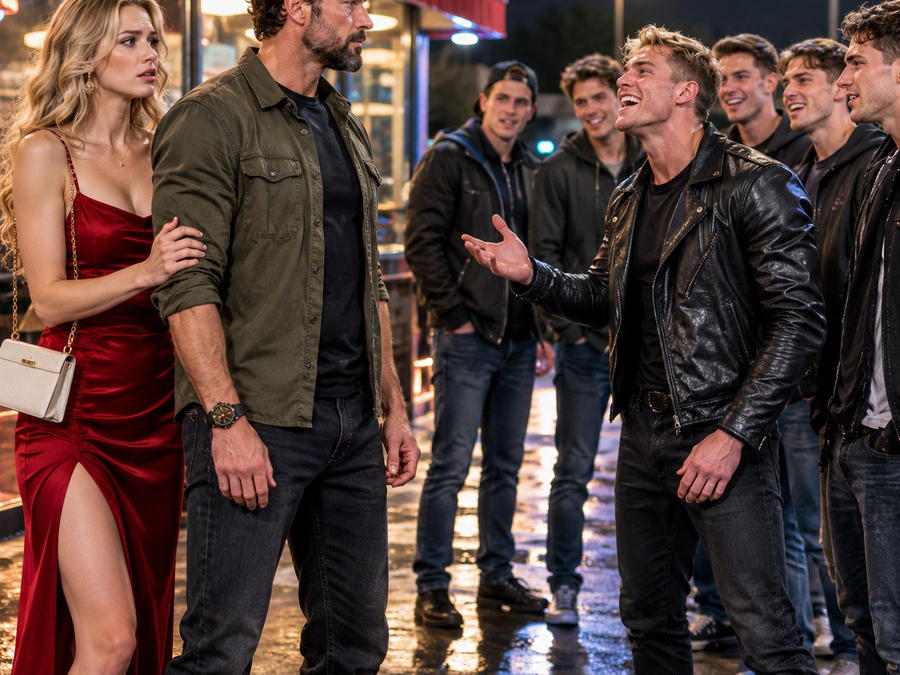
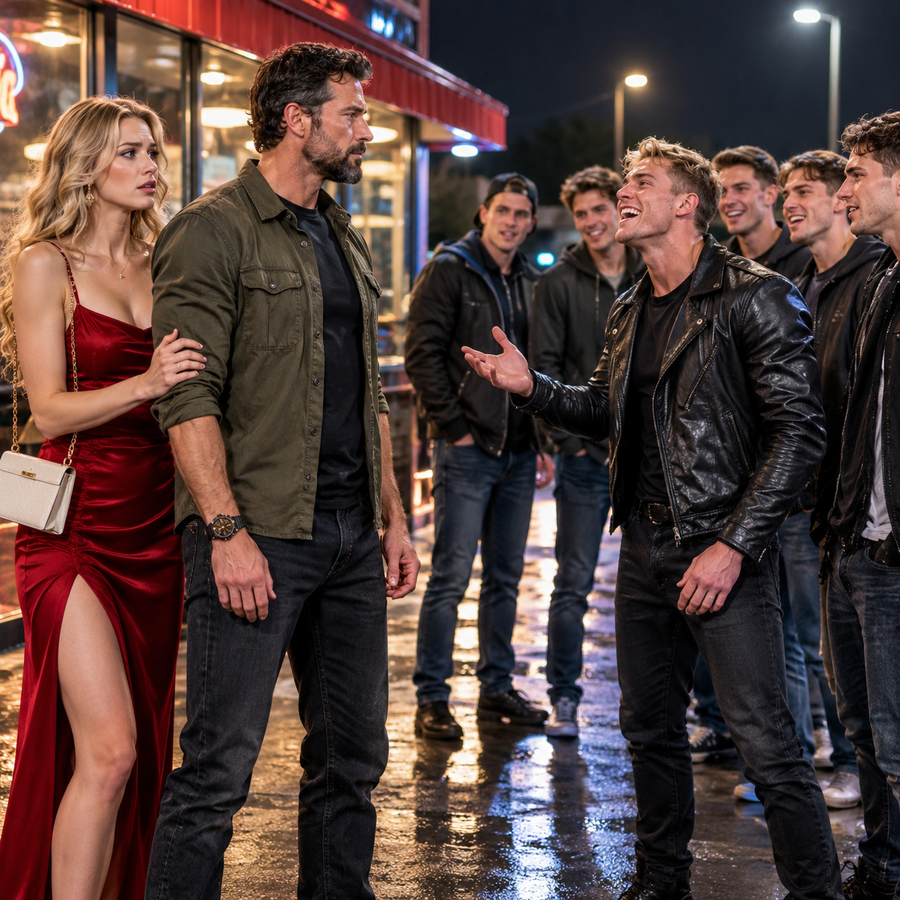
They were young, mid20s at the oldest, and they moved through the door with the particular ease of people who had never once had to consider what anyone else in the room might think of them. They took over where two full rows of booths put their boots up on the seats and lit cigarettes in open defiance of the no smoking sign posted directly above their table.
One of them knocked a sugar dispenser off the counter and didn’t look down at it.
Nolan recognized the group.
He’d seen them in the neighborhood before, usually at night, usually right before something got broken or someone got scared.
The locals called them Riptide Crew, though nobody who used that name said it loud or where the wrong people might hear.
They’d been working their way through the businesses along the waterfront district for months, pressuring owners to pay protection money, vandalizing storefronts that refused, making sure every shop on the strip understood that the easiest path forward was to sell out to Graham Keane’s development company and move on.
Nobody had managed to get it on record yet.
The connection between the crew and Keen’s real estate operation was the kind of thing everyone in the neighborhood suspected, and nobody could prove which was exactly how Graham Keane preferred it.
The one who seemed to be in charge was Travis Keen Graham’s son.
He was younger than Nolan had expected the first time he saw him, maybe 26, with an easy practiced smirk, and the kind of confidence that comes from spending a lifetime being insulated from consequences.
Travis sat in the center booth and looked at Nolan the way people look at furniture. Nolan set a menu on the counter and asked if they wanted to order something.
Travis glanced at his crew, then back at Nolan, and didn’t answer.
One of the others, a wide shoulder man with a shaved head.
The others called Brock, deliberately tipped his coffee mug off the edge of the table.
It shattered on the tile floor.
He looked at Nolan and said the mess wasn’t going to clean itself up.
Nolan didn’t move to pick anything up.
He set a bar towel on the counter, looked at the table, and said they were welcome to order, or they were welcome to leave.
Those were the two options.
Travis stood up from the booth and walked toward the counter, and that was when he noticed the drawing.
It was taped to the wall behind the register, a kid’s crayon drawing, two stick figures holding hands beneath a yellow sun, and in careful crooked letters at the bottom.
Daddy is my hero.
Travis studied it for a moment with an expression of mild amusement, then looked at Nolan. He said something about how touching it was.
a man spending his nights mopping up spills for minimum wage.
And his little girl still thought he was worth admiring.
He asked if Nolan thought she’d feel the same way in a few years once she was old enough to understand what her father actually amounted to.
Then he reached up and pulled the drawing off the wall from the far end of the counter. Dorothy made a quiet sound of protest.
One of the crew members turned toward her and knocked her coffee cup into her lap. When Nolan moved to help her, Travis dropped a folded wad of bills on the floor between them, crumpled 20s, the kind of money you throw rather than hand over, and told Nolan to get on his knees and pick it up.
He said there might be enough there to cover Tessa’s breakfast.
Nolan looked at the money on the floor.
He looked at Dorothy, who was pressing paper napkins to her blouse and trying not to show that her hands were trembling. Then he reached under the counter and picked up the phone.
He dialed 911 with Travis standing 3 ft away.
He told the dispatcher his name, the address of the diner, and that he had six individuals refusing to vacate private property and actively threatening customers.
He gave a physical description of the group.
He did all of this in a calm, level voice, as though Travis were not in the room at all.
The expression on Travis’s face shifted in a way Nolan noted carefully.
It wasn’t anger exactly.
It was something more specific than that.
The look of a person who has decided that an insult requires a response. Travis leaned across the counter and told Nolan his shift was almost over.
He said the crew would be outside waiting when it ended. He wanted to see how long Nolan could hold on to the hero act when there was no one around to watch.
They left and the diner went quiet. Nolan helped Dorothy to her car first, then the dock workers standing at the door and watching until each of them had driven out of the lot.
Then he locked the front entrance and stood at the window for a moment with the lights still on.
Upstairs, he heard Tessa’s voice through the ceiling.
She called down to ask if everything was okay, said she’d heard yelling.
Nolan told her everything was fine.
He told her nobody could get up to where she was.
When he looked through the glass toward the street, he could see Travis’s pickup truck parked under a broken street lamp across from the diner.
As he watched figures emerged from the shadows, one at a time, moving into the lot from different angles, carrying bags and what looked like tools. Some of them had long objects tucked under their coats.
Nolan called 911 a second time.
The dispatcher told him units were tied up at a serious accident near the port and that someone would respond, but she could not give him a time estimate. He understood what that meant.
If he stayed inside, Travis had every incentive to escalate, break windows, start a fire, do whatever was necessary to force the situation.
If that happened with Tessa and Evelyn on the second floor, the only way out for them ran through whatever was waiting in that parking lot. Nolan went upstairs long enough to tell Evelyn to lock the apartment door, pull the curtains, and stay back from the windows, no matter what she heard.
He didn’t explain why.
Evelyn had known him long enough to understand that when he used that particular tone, explanations came later. I went back down, picked up the bank deposit bag from behind the counter, and stood at the back door for a moment.
There was a version of this where he waited, kept the doors locked, lights on, and hoped the police arrived before anyone put a torch to the place. But that version required six dangerous people to make patient, reasonable decisions for the next unknown period of time.
with his daughter sleeping 30 feet above the room.
They were threatening to enter. Nolan unlatched the deadbolt and stepped out into the parking lot.
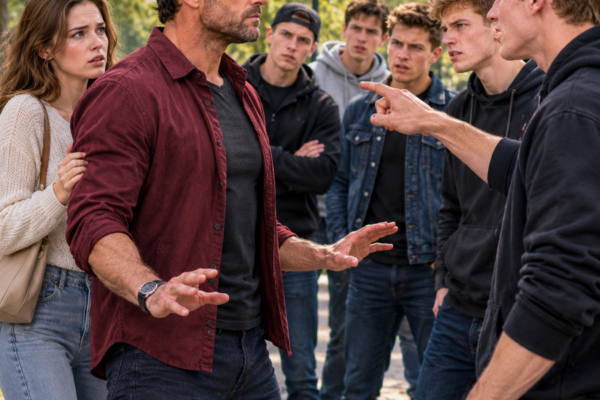
They came out of the dark the moment the door clicked shut behind him. Six of them moving from from three different directions at once, spreading into a loose arc that closed off the alley to his left, the gap between the fence and the dumpsters at the back and the direct path to the street.
The execution was practiced enough that Nolan understood immediately this was not the first time they’d done something like this.
They weren’t drunk kids picking a fight.
They’d positioned themselves before he stepped outside, which meant they’d been watching the back of the building long enough to know exactly where the exits were.
Nolan still had the bank deposit bag in his left hand.
He didn’t set it down yet.
He stood with his back to the door and took stock of what was in front of him mixed men. At least three visible weapons.
The SUV parked 20 ft to his right with its driver’s side window already caved in from the crowbar.
Brock was now resting against his shoulder.
Tessa’s blue backpack had been pulled from the back seat and was sitting in a puddle near the rear tire.
Travis walked over to it and stepped on it slowly, looking up at the lit window on the second floor of the building.
“She’s up there, right?”
Travis said.
“Your little girl.”
Something changed in Nolan’s face.
It wasn’t the expression of a man trying to hold himself together.
It was the opposite, a kind of settling, like a temperature drop.
Travis noticed it, and for just a moment, the smirk flickered.
Then one of his crew laughed about something and the moment passed.
Nolan set the deposit bag down on the hood of the nearest car, keeping both hands visible and told them to leave the property. He said it the way someone reads coordinates off a map.
No inflection, no heat.
He told Travis that was his first warning. The crew found this genuinely funny.
Travis walked toward Nolan and threw a folded stack of bills against his chest. the same kind of crumpled money he dropped on the diner floor earlier and told him to get on his knees and apologize for making that phone call.
He said a man who spent his nights serving coffee to truckers didn’t get to act like he had authority over anything.
Nolan told him that was his second warning.
What happened next?
Nobody in the crew registered as significant.
Toward the back of the group, the youngest one, a 22-year-old named Kyle, who was always trying to keep up with the others, slipped his phone out of his jacket and started recording.
He’d had the idea in the diner had been turning it over ever since footage of some middle-aged diner worker getting broken down in a parking lot would get thousands of views before sunrise.
Travis had told him to put it away when he’d caught a glimpse of it earlier.
So Kyle did the obvious thing, which was to pretend to comply.
He slid the phone into his breast pocket with the lens facing out and left it running. Nobody in the group noticed.
Nolan certainly didn’t.
Travis moved closer and told Nolan exactly what was going to happen next. After they were done with him out here, two of the crew were going upstairs.
He wanted to make sure the people in that apartment understood how things worked in this neighborhood. He said it with the casual certainty of someone who had never in his life been told no by anyone who could back it up.
Nolan reached up and took off his jacket. He folded it once and laid it across the hood of the SUV.
Then he unclipped the small star-shaped keychain from his belt loop, Tessa’s keychain, the one she’d handed him that afternoon and pressed it into his front pocket.
When he looked back at Travis, he said it was his last warning.
Brock didn’t wait for any signal from Travis.
He raised the crowbar with both hands and swung it directly at Nolan’s head.
He didn’t connect.
Nolan stepped into the swing instead of away from it, closing the distance so fast that the arc of the bar ran out of momentum before it reached him.
He caught Brock’s forearm on the way through, redirected the weight of the swing into a lock, and drove the bigger man’s wrist down and back in one motion.
The crowbar hit the asphalt.
Brock went down on one knee with a sound that wasn’t quite a shout, and Nolan guided him the rest of the way to the ground.
then stood back up. The whole thing had taken less than 3 seconds.
The man behind Nolan, the one who’d been circling wide with a length of steel pipe, came in fast from the left.
Nolan turned into it, let the pipe swing wide past his shoulder, and used the man’s own forward motion to put him face first into the dented hood of the SUV.
The metal crumpled a little more. The man did not get back up.
5 seconds and the two physically largest members of Riptide crew were on the ground. The rest of the group stood still for the space of a breath, not long, but long enough for something to change in the atmosphere of the parking lot.
Travis had come into this situation with a set of assumptions about who Nolan Mercer was, and all of those assumptions were now in the process of being proved completely wrong. Three of them came at once.
One had a folding knife. One had a short length of rebar.
And the third, a wiry man in a gray hoodie, broke left and started running toward the back door of the diner, toward the stairs that led up to the second floor.
Nolan read all three lines of movement at the same time. He grabbed the man with the knife by the collar and yanked him into the path of the rebar, sending both of them stumbling into each other, then cut toward the third man before either of them could recover.
He reached the hoodie man four steps from the door, caught him by the back of the jacket, and brought him down onto the asphalt with enough controlled force to end the run without permanent damage.
The man tried to swing upward with a hammer he’d pulled from his waistband.
Nolan took it away from him, tossed it into the shadows under the dumpster, and stepped back. I was breathing harder now, but not much.
What he was focused on was the window above the back door, because when he’d turned to cut off the run toward the stairs, he’d caught a glimpse of the curtain moving, a small hand pulling it back from the inside, a child’s face at the glass.
Tessa was watching.
He’d known on some level that this was possible.
She was a curious, perceptive kid, and she was 10 years old, which meant she was old enough to understand that whatever was happening in the parking lot below her window was not something normal people could stop with a phone call.
Nolan held on to that thought in the way you hold on to something that keeps you from going somewhere you shouldn’t.
She was watching him, which meant the way he handled the next 60 seconds would be the version of him she carried forward.
He didn’t have long to hold the thought.
From behind him, the fifth crew member, one of the two men, who hadn’t yet committed to an attack, threw a glass bottle at the second floor window.
Nolan turned and moved at the same time, getting his left arm up and forward. The bottle caught him on the shoulder and exploded against the brick above the sill instead of the glass.
In the moment his attention shifted, the sixth man hit him from behind with a stun device, jamming it into the space between his shoulder blades.
The charge was off center, and Nolan had moved enough that it wasn’t a full connection, but his left arm went numb from the shoulder down for several seconds, and that was enough.
In the brief struggle, the stun device clattered loose, and Kyle’s phone jostled from his breast pocket during the scuffle, skidded across the asphalt, and came to rest near the base of the dumpster, face down, still recording.
Travis picked up the crowbar Brock had dropped.
For the first time all night, Nolan was at a real disadvantage. one arm not fully responding, two crew members still mobile, and Travis moving in with what looked like genuine intent rather than theater.
Nolan used the narrow channel between the SUV and the vehicle parked beside it to keep Travis from getting around his left side, put the sixth man down with a single controlled strike to the back of the knee, then turned to face Travis directly. Travis swung the crowbar
twice.
Nolan deflected both swings off his forearm and elbow rode the third swing past him and when Travis overextended stepped inside his guard and took him to the ground.
Travis hit the asphalt and immediately went still.
Then the performance started. He said it had been a joke that none of this was serious, that Nolan had clearly misunderstood the situation and there was money available to make the whole thing go away right now if that was what he wanted.
When Nolan didn’t respond to any of that, Travis’s voice changed.
He said his father owned the property on both sides of this block and three more beyond it.
He said that by morning Nolan would be the one in handcuffs and that after the attorneys got done, no one in this city would let a man with Nolan’s record anywhere near a child.
Nolan understood exactly what Travis was doing, and he understood exactly why the words still landed.
He could take a physical beating and stay functional.
That part of his training had been tested enough times that he knew his own limits.
What he couldn’t absorb without flinching was the idea of Tessa being removed from his care because someone with enough money had decided to reframe what had happened in this parking lot.
He stayed with Travis in the control hold pulled out his phone and called 911 for the third time that night.
He told the dispatcher that six individuals were incapacitated in the rear lot of Carter’s Harbor Diner, that there were multiple weapons on the ground, that a child was in the building, and that he was requesting immediate assistance.
Then he released Travis, moved back three steps, and raised both hands in the air.
The first patrol car arrived 90 seconds later.
What the officers found when they pulled into the lot did not tell a simple story. Six men on the ground in various states of injury.
A parking lot full of broken glass and scattered tools.
A deposit bag sitting on a car hood.
And one man standing in the middle of it all with his hands up.
Travis was already on his feet by the time the second car pulled in, and he was already talking.
He told the officers that Nolan had lured the group into the back lot by pretending to negotiate and that once they were away from the street, he’d attacked without provocation.
He described the group as acquaintances who’d stopped by to discuss a business matter and had no idea they were walking into anything dangerous.
The camera mounted above the diner’s back door had been painted over a spray can job done quickly and recently before Nolan had stepped outside.
Graham Keane arrived before Nolan had finished giving his preliminary statement to the officers.
He came with two attorneys and a certainty about how the evening was going to resolve that made Nolan’s stomach tighten.
Graham spoke quietly to the senior officer on the scene and the conversation lasted longer than it should have. Within the hour, Nolan was told he needed to come to the station for a formal statement.
The Navy’s duty officer was notified of the incident, and by 2 in the morning, Nolan received word that his instructional duties at the base were being suspended pending review.
Because Tessa had been present in the building during the altercation, a child welfare officer was being contacted for a mandatory assessment.
Evelyn brought Tessa downstairs after the lot was secured. Tessa walked past the broken glass and the scuff marks on the pavement and the officers in their vests without looking at any of it and went straight to Nolan.
She put her arms around him and pressed her face against his jacket and he held on to her with the one arm that was working properly and the other still half numb from the stun device.
After a while, she looked up at him and asked a question he had no answer for.
She asked if they were going to take her away from him.
Nolan had been through things that required him to keep moving when every instinct said to stop.
He had lost a person he loved and found a way to keep functioning.
He had stood in a parking lot against six armed men and not once lost track of what he was protecting.
But standing there with Tessa’s face turned up toward his, waiting for a reassurance he couldn’t honestly give was the most exposed he had felt in four years.
He pulled her closer and didn’t say anything, which was its own kind of answer and the worst moment of the entire night.
The formal interview began at 9 the following morning in a conference room at the Norfolk police precinct, and the attorneys Graham Keane had brought made their strategy clear within the first 20 minutes.
They weren’t going to argue that the incident hadn’t happened.
They were going to argue about what kind of man Nolan Mercer was and what a man like that did when he got angry.
The lead attorney laid it out with the measured confidence of someone who had done this before.
He said that Nolan’s military background, the years of specialized training, the specific skills he’d been paid to develop and refine represented not a mitigating factor but an aggravating one.
He said that a civilian who reacted violently to a threat could claim fear as a defense.
But a man who had spent the better part of two decades learning exactly how to disable people in the most efficient one possible could not credibly claim he had no alternative. He said the evidence showed six young men who had come to the property for a conversation and left in ambulances and that the person responsible for that outcome was sitting across the table from him.
He said it calmly the way a person presents something that has already been decided.
Travis sat beside his father and said nothing, which was the most disciplined Nolan had ever seen him.
Nolan’s own attorney, a woman named Carol Briggs, who had worked with Navy personnel cases for 11 years, objected to the characterization and asked for the investigation to account for the prior incidents at the diner, the threats made inside the building, and the documented calls to 911 that Nolan had placed before stepping outside.
The keen attorneys acknowledged the calls and suggested that Nolan had made them as preparation, establishing a narrative before carrying out a premeditated attack.
It was a precise and cynical argument, and Nolan could see from Carol’s expression that she understood it was designed to drag the process out long enough for the pressure to become unsustainable.
I was thinking about Tessa sitting with Evelyn upstairs in the diner apartment waiting.
What changed the room came from outside it.
Sergeant Lena Ortiz knocked and entered just before 10:00.
And the way she was carrying herself told Nolan something had shifted before she said a word.
She’d been processing evidence from the parking lot since early morning.
One of the items collected from the scene was a phone found face down near the base of the dumpster cracked screen, still showing a recording in progress when the officers bagged it.
The phone belonged to Kyle, the youngest member of the crew. The footage had been reviewed.
What the video contained was not complicated.
It ran for just under 8 minutes, and it started before Nolan had stepped outside.
It showed the crew positioning themselves in the lot. Showed Brock using the crowbar on the SUV window.
Showed Travis picking up Tessa’s backpack from the back seat and dropping it in the puddle.
It showed Nolan coming through the back door with the deposit bag in his hand and his hands kept deliberately visible.
It showed Travis stepping on the backpack and looking up at the second floor window.
It captured Nolan’s three warnings, each one clear enough that the audio left no interpretive room.
It showed Brock initiating the attack, and it showed in detail the distinction between what Nolan did and what someone who had lost control would have done every time a crew member stopped being a threat, Nolan stopped.
He didn’t follow anyone down.
He didn’t take a weapon and keep it.
He put Brock on the ground and stepped away. When he took the hammer from the man near the stairs, he threw it into the shadows rather than holding on to it.
The video ended with Travis on the ground making threats about his father’s property holdings and Nolan on the phone with the dispatcher hands already coming up before the first patrol car appeared at the lot entrance.
Kyle had wanted footage that would humiliate a man.
What he’d created instead was a complete record of the night assembled by the crew’s own arrogance, preserved on a phone that had slipped from his pocket during the chaos and been found 12 in from a dumpster by a patrol officer doing a routine sweep of the scene.
The keen attorneys asked for time to confer privately.
The request was granted.
They came back and said very little. Commander Rebecca Sloan arrived at the precinct that afternoon.
Nolan had not called her.
She’d been notified through the Navy’s duty officer when the suspension was filed, and she had driven down from the base herself once she’d reviewed the situation.
She was 51 years old, wore her uniform without any visible effort toward impressiveness, and had the manner of someone who had spent three decades making decisions that other people found difficult. She met with the investigating detectives for 40 minutes.
Nolan was not in the room for that conversation, but Carol Briggs was, and when she came out, she told him to sit tight. The press statement Sloan gave late that afternoon was short.
She confirmed Nolan’s position in Naval Special Warfare Group 2 and the nature of his instructional work.
She said that the footage recovered from the scene showed an individual applying under extreme duress and with his child directly at risk the exact principles that his program was designed to teach warning before acting, protecting bystanders first removing weapons from the situation and disengaging the moment a threat was neutralized.
She said that in her professional assessment, having supervised Nolan’s work for several years and reviewed his training reports firsthand, there was nothing in the parking lot footage that surprised her.
Then she said one more thing before stepping away from the microphones.
She said that Nolan Mercer had not acted like a man who wanted a fight. He had acted like a father who knew exactly what he was protecting.
The Navy lifted the suspension the same evening.
The child welfare assessment, which had been opened as a mandatory procedure, was closed within 48 hours.
The case worker’s report noted that the adult in question had not placed the child in danger.
He had identified the danger, removed himself from the building to draw it away from where the child was sleeping, and neutralized it in a manner consistent with his professional training. The report further noted that the child appeared securely attached, well cared for, and showed no signs of distress beyond what was appropriate given the events of the previous night.
The criminal process moved more slowly, the way it always does, but it moved. Travis and five members of Riptide crew were charged on multiple counts.
conspiracy to commit assault, possession of weapons, criminal destruction of property, and making threats against a minor.
Kyle negotiated a lesser arrangement through cooperation.
He gave investigators a detailed account of the crew’s operations over the preceding 8 months, including specific incidents and specific instructions Travis had relayed from his father.
That cooperation combined with financial records subpoenaed from Keen Development opened a separate inquiry into Graham Keen’s company.
Business owners along the waterfront who had stayed quiet for months began coming forward one at a time.
The pressure that had made the neighborhood feel like a closed system started releasing. The diner was repaired through a collection that organized itself without anyone asking.
Doc workers and restaurant staff and a few of the nurses who were regulars passed the word around and within two weeks the backlot was resurfaced, the broken window replaced and the interior repainted where the walls had been damaged.
The SUV needed more than cosmetic work.
A group of mechanics from a shop four blocks away towed it in, spent a week on it, and returned it without a bill.
When Nolan picked it up, he found the star-shaped keychain Tessa had made hanging from the rear view mirror where someone had put it while the car was in the shop. He stood beside the truck for a moment before getting in.
The idea for Guardian Shift started with a question Nolan couldn’t stop turning over.
He’d been back at the base for two weeks running the same curriculum he always ran.
And one afternoon between sessions, he found himself thinking about Dorothy, the nurse who’d been sitting at the end of the counter when Riptide crew came through the door.
She’d been frightened in a way that the evening had cost her, even though nothing physical had happened to her.
She had no training that would have changed that.
Most people didn’t.
Nolan had spent years teaching specialized skills to people who were already physically capable and psychologically selected for high stress environments.
And he’d never once aimed any of that at the people who actually needed it most.
The woman coming off a double shift at 2:00 in the morning.
The delivery driver parking his truck in an unlit lot.
The parent walking alone to their car in a parking garage.
He talked to the precinct’s community liaison officer, a 15-year veteran named Dale Hutchkins, and to two former SEAL colleagues living in the Norfolk area.
He talked to Evelyn, who offered the diner’s back dining room for evening sessions once she was back on her feet.
He put together a framework and called it guardian shift free self-defense and situational awareness instruction open to anyone who worked nights, lived alone, or had reason to think practically about personal safety.
The first session ran on a Tuesday evening, 6 weeks after the parking lot incident. 53 people showed up.
Dorothy was there in a chair near the back.
A woman who drove overnight delivery routes sat beside her.
Three restaurant workers, a convenience store clerk, a man who said he walked home from the bus stop at midnight most nights and had been nervous about it for years. Nolan stood in front of them with no particular ceremony and started talking.
He told them the first lesson wasn’t about how to hurt someone.
The first lesson was about recognition. How dangerous itself before it arrives.
How most situations offer a window to leave before they require you to stay.
And how knowing what you’re willing to stand for changes every calculation that comes after.
He said that understanding your own line was more important than any technique because technique without judgment was just more chaos introduced into an already chaotic situation.
Dorothy raised her hand from the back of the room.
She asked how he’d managed to stay calm with six people threatening his daughter and whether that kind of calm was something that could actually be learned or whether some people were just built differently.
Nolan looked at her for a moment before answering.
He glanced toward the corner where Tessa was sitting cross-legged on the floor, working through a stack of homework with a highlighter and a water bottle the way she did at the diner counter most evenings.
Then he looked back at Dorothy.
He said the calm wasn’t a personality trait.
It was a consequence of knowing exactly what he was protecting.
He said that when Tessa was at that window watching him, he wasn’t just trying to get through the situation.
He was aware at every point that she would carry what she saw into the rest of her life.
He told Dorothy that he wasn’t only keeping her safe from six men in a parking lot.
He was keeping her safe from the memory of her father becoming something she didn’t recognize.
The room stayed quiet in a way that meant people were actually absorbing what he’d said rather than waiting for the next thing.
Months later, Carter’s Harbor Diner looked mostly like it always had.
The coffee still came out a little strong. The booths near the back window were always the last to fill up, and Nolan was behind the counter on Thursday nights, while Evelyn rested her knee the same as before.
Tessa did homework at the table nearest the register, the same spot she’d claimed for herself on the first night he’d brought her along.
The drawing she’d made was back on the wall behind the counter, retaped in the same place it had always been, slightly wrinkled, but intact.
Nolan had added a line beneath her text in his own handwriting, small enough that you had to be close to read it.
Tessa’s line said, “Daddy is my hero.”
His line said, “A hero isn’t the strongest person in the room.
It’s the person who knows what their strength is for.
The strongest people you’ll ever meet aren’t the ones who look the part.
They’re the ones who’ve already decided long before the moment arrives.
Exactly what they’re willing to protect and exactly how far they’re willing to go to protect it.
That’s what keeps them from crossing the line when it would be so easy to.
And that’s the kind of strength that stays with a child for the rest of her life.