Part 2: Town Laughed at the Widow’s Rusted Gas Station — Until She Lifted the Hatch Under the Pumps
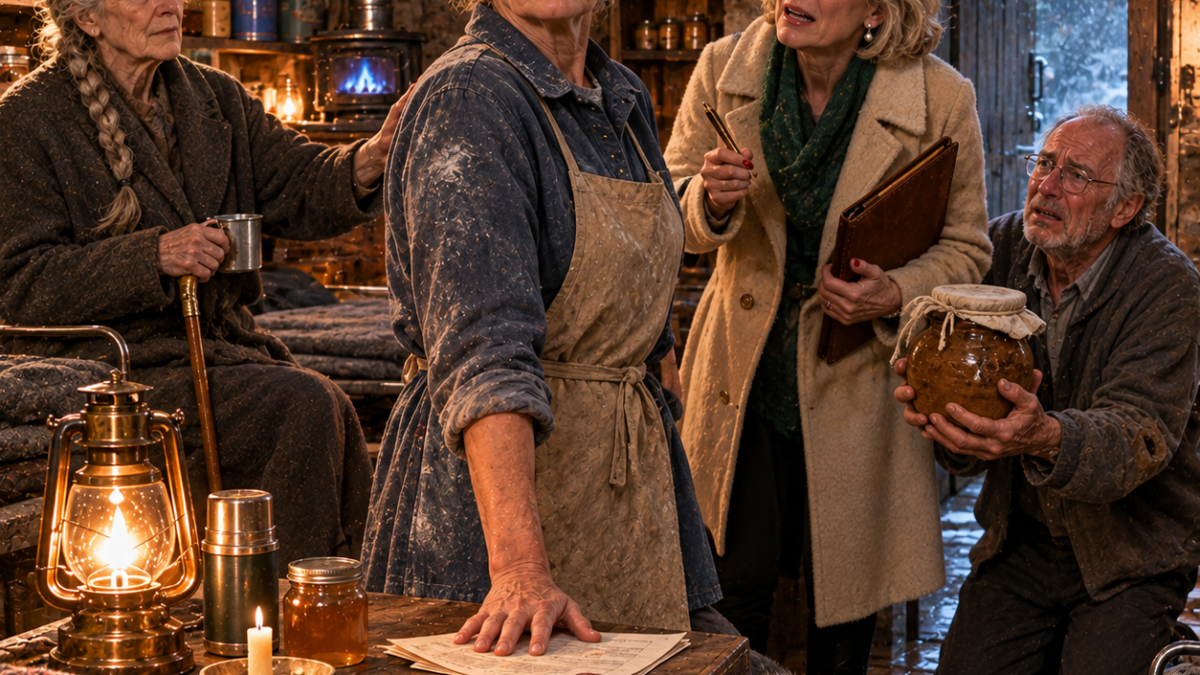
Two men sat on stools by the cracker barrel.
Connie knew them both. One was Gil Ansley, who had bought 400 pies from her over the years and complained about every crust.
He looked up from his coffee and she watched him decide to be amused.
Heard Warren gave the widow the eyesore, he said to the room.
Gave her a gas station with no gas.
He chuckled.
Thats what youd call a fair trade, Del.
A farm for a ghost. The other man laughed.
Thatll do, Gil, said Marvella without raising her voice. Im only saying what the whole towns saying.
I know it is, Marvella said.
Thats what I find so interesting about it. Connie stood very straight with the cold air of the cooler on her neck.
A 66-year-old woman in a store while people she had fed for 40 years decided what she was worth.
She opened her mouth and for the first time in a long while, she He not apologize.
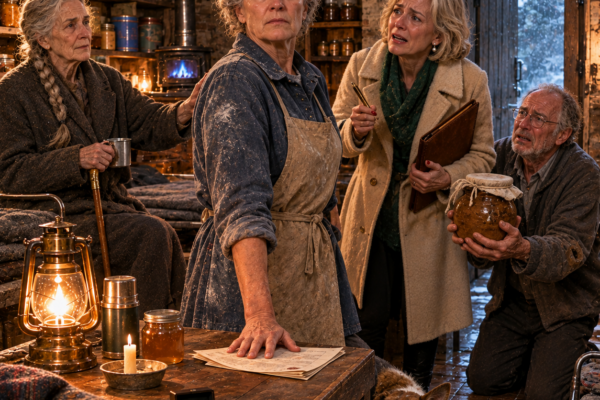
I have been sleeping in that station for two nights, Gil.
She said, Its very quiet. You should come out and see it.
Delmar made a sound in his mustache like a kettle.
Marvella Teague put a paper sack on the counter and began filling it without asking with bread and cheese and canned peaches and a pound of coffee and a can of lamp oil. I have $10.
Connie said, Keep it.
Marvella, I cant. You can.
Marvella did not look up.
Every pie that crossed that counter for 30 years has been sitting on this shelf in the back of my mind like a debt. Ive been waiting for somebody to let me pay it.
It isnt charity. Delmar said quietly at her shoulder.
40 odd years ago, a kid ran out of fuel on that road and was handed 40 gallons and a sandwich.
Im only paying the tab.
He set a $20 bill on the counter and walked out to the truck so that nobody would have to thank him. That evening, she ate at Delmars table in a small white house at the end of a lane of oaks with a pot of beans and a pan of cornbread.
He had been a widower since 2019, he said, and the house had gone very still.
When she told him the painted line, Everybody runs low sometime.
He put down his fork. That is why I drove past that station every week for 11 years with a sign down and the doors locked.
He said. It was like passing a church.
She slept in his spare room.
On Sunday, he brought her back at dusk because she could not have borne to leave the hatch uncovered and they found the crow on the west island keeping watch on that square of concrete as though it were a nest.
She hauled the slab down over the opening and carried the lantern and the groceries down the ladder and sat in the long light with the green ledger and the black bird came to the lip of the hatch and looked down at her and did not ring.
Monday morning at 8:00, Delmars blue truck pulled up under the oaks and she climbed in with her good cardigan buttoned wrong and the steel box wrapped in a bath towel on her knees.
They drove the 20 minutes into Brannick and on the far side of the tracks they passed a long low yard with a banner across the fence.
Dray Farm and Implement. The lot was half bare.
A flatbed was backing up to a combine at the rear and a man in a gray suit stood beside Warrens white crew cab with a clipboard under his arm.
She did not look at it.
She looked straight ahead with the steel box in her lap and said, Drive on, Delmar. Gail Whitlocks office was above a hardware store on Court Street up a flight of linoleum stairs behind a door with her name painted on the glass in gold.
She was 58, short and quick with cropped auburn hair, red reading glasses, a charcoal blazer and white sneakers, and a canvas tote of files that she set down on the desk as though it weighed nothing. She looked at Connie for a long moment.
Mrs.Dray, she said, sit down. Hal told me youd come.
She took off her glasses. And Im afraid his will does not say what Warren told you it says.
Gail Whitlock put on her red glasses again and opened the top file. Plain English, Mrs.Dray, or the other kind?
Plain, said Connie.
Hals will was signed in 2019.
To you, outright, he leaves Drays service station and the land it stands on, and I am reading now, all that is in or under it.
To you, for your lifetime, he leaves the right to live in the farmhouse. After you, the farm goes to Warren and Annette.
Warren is executor.
She looked up.
I asked Hal why he wrote under.
He said his father had written it that way in the deed in 1999, and he was not a man to improve on his father.
Now, Warren told you the farm was carrying a loan of $310,000. It isnt.
I pulled the recorders index this morning at 7:00.
That farm has been free and clear since 1991.
She turned the page.
And the station? When Hal brought me this will, he brought me a folder and said, In case anyone ever tells Connie that place owes something, here it is.
The state environmental office, 2004.
Tanks removed, soil tested, file closed, no further action.
There is no letter, Mrs.Dray. There has never been a letter.
Something went very quiet in Connie.
It was not anger yet.
It was the stillness of a woman who has been carrying a heavy pot across a kitchen and has just been told that it was empty.
I signed a paper, she said. In April.
You signed a release of your right to live in that house because a man you trusted told you something false about money.
Gail took off the glasses.
A signature you give because someone lied to you about a fact is not a signature a judge will hold you to.
We file to set it aside for misrepresentation, and I would like to see Roy Fenner explain to a court why he handed you a pen. She slid a single sheet across the desk stamped with the county seal.
This was recorded on the 30th of August. A contract.
The seller is the Dre estate by Warren executor.
The buyer is Iron Road Travel Plazas. The property is the farm, 38 acres, price $1,900,000, closing the 30th of this month.
She tapped a line near the bottom.
And this clause sale is conditioned on access across the adjoining parcel known as Dres service station or a recorded easement acceptable to buyer.
Connie read it twice. Then she began to speak slowly in the flat careful voice she used for counting a till and understood only afterward that she had been working it out for 2 days without knowing.
The new interchange is on the far side of the station. The farm doesnt touch it.
The only way a truck plaza can get from the farm to the road is across my corner. She pressed her fingers to her temple.
So he needs the farm, which he got when I signed. And he needs the road, which is mine, and which he cant sell, so he gave it to me with a letter that wasnt real and told me to keep clear of the pumps.
He put me in a shut-up gas station with no telephone and $10 so that when he came back with an offer, I would take anything.
That is the size of it, said Gail.
First Brannock Bank filed on his dealership last week. The floor plan loan is $410,000 due the 1st of October.
He needs Iron Roads money on the 30th and your signature before it. She closed the file.
Sign nothing, whatever he says, whoever he brings, Ill file the petition and a notice on the farm by tomorrow noon, and the sale will stop where it stands.
And Connie, she had dropped the Mrs., is there anything at that station I ought to know about? She had meant to be careful.
She told her instead about the hatch and the tape and the green ledger and the box in its towel and Gail Whitlock did not say a word until the end. Under it, she said at last, very softly, he wrote under it.
She rubbed her eyes. Dont open that box without a witness.
Photograph everything.
And find the key. It was Delmar in the end who found it.
He sat behind the wheel of the blue pickup in the shade of the oaks and listened to her tell it.
And when she came to the line about every driver who ever stopped there, he took off his cap. Pump one, he said.
The boot on the nozzle, Ellis told every trucker the same thing a hundred times, if youre stuck here in the night and Im not around, the spare keys in the boot of pump one.
He said it so often we stopped hearing it.
Not one man in 50 years ever took it. They left him notes instead.
He started the truck.
A man stuck at night doesnt look for a key.
He looks for a light. They stood in front of the first pump in the long afternoon light with its dead glass face and its rubber hose coiled stiff on its hook.
The old nozzle rested in a boot gone hard as bark.
Connie put two fingers inside it.
At the bottom, wrapped in a twist of waxed paper, was something small and cold and heavy. It was a brass key on a loop of black leather lace.
Delmar photographed it where it lay on a flip phone older than his granddaughter and then again in her palm. A man had hidden it in the plainest place on the property in the sight of every hand that ever pumped a gallon and counted on the whole world to be too busy to look.
She felt a quiet ache of gratitude toward the dead, such as one feels after an unexpected kindness from a stranger.
She lifted the hatch with Delmar and went down the nine rungs with the key closed in her fist.
Pause with me a moment and tell me in the comments who in your family kept a small kindness going for years without anyone ever thanking them.
Then stay with Connie because the key in her hand was about to open a lock nobody had touched in 28 years. She knelt by the third cot in the lantern light and Delmar knelt beside her with his cap in his hands and his phone held out and she slipped the steel box out of its towel.
The key slid in as if it had been oiled the day before. It turned with a short, dry click.
The lid rose.
A smell came up out of the steel, of cedar and old paper and something faintly sweet like pressed flowers.
On a bed of folded flannel lay a thick bundle wrapped in oilcloth and tied with string and on top of it a single envelope with one word in a square hand, Connie.
She opened the envelope first.
There was one page in pencil. Connie, if the key found you then somebody has come for the corner.
Look at these and then put them where no one will see. The state paid me for the back 40 in 1977 when they cut the new road and I did not trust a bank to hold what a flood would not.
I bought the governments own paper.
It pays whoever holds it. I never clipped a coupon because a man who clipped coupons starts to count and I wished to be the other sort.
The Treasury has never yet lost a war.
It will take a lawyer and a long time. Do not hand this to anyone who says it is safer in his name.
When you have paid what you owe to the world, put the rest where it is needed.
There is always somebody low.
ED. She set it down.
She untied the string with fingers that had gone strangely clumsy.
The oilcloth fell open on the flannel, and under the lantern, one on top of another in green and black ink, so rich it seemed wet, lay a stack of engraved certificates.
United States of America. Treasury Bond.
Payable to the bearer. Delmar made a small sound, like a man stepped on.
She counted them aloud, because it was something to do with her mouth.
20.
Six of them were printed $100,000. 14 were 10,000.
She added it twice.
$740,000. In her lap, on a cot where a baby had once been born.
And along the bottom edge of every bond hung a long strip of tiny printed squares, folded accordion fashion, uncut, in ranks of 60, each one a promise to pay.
She lifted a strip. It went on and on, like a ribbon off a spool.
Mrs.Dray, said Delmar in a hoarse whisper.
He never clipped one.
No, she said.
He said he wouldnt.
Neither of them could speak.
The lantern ticked. Above them, small and clear, a bell rang twice, and then a third time, and then again, fast and urgent, and not at all like the bell of a happy bird.
Delmar lifted his head.
Thats not Dime laughing, he said.
Thats Dime telling. Tires crunched on the gravel overhead.
A door slammed, and then another, and a voice came down through the hatch that she would have known at the bottom of the sea, warm and easy, and a half second early.
Connie, now. There she is.
We saw the light from the road.
We thought you might like some company. They had perhaps half a minute.
Connie did the one thing she could think of, which was exactly what Ellis Drax would have done. She laid the certificates back on the flannel, folded the oilcloth over them, tied the string, slid the box under the third cot, and drew the blanket down over it.
She slipped Elliss letter into her cardigan, and the brass key on its leather lace over her head, and inside her collar.
Delmar held out his hand to her without a word, and together, they climbed the nine rungs into a violet dusk.
Two men stood on the pump island.
One was Warren, big and easy in his tan vest, with his hands in his pockets, and his head on one side.
The other was perhaps 40, trim and tanned, in a clean jacket the color of oatmeal, with a tablet under one arm, and the smooth, pleasant, empty face of a man who has been taught that politeness is the cheapest tool in the box.
A silver sport utility vehicle idled behind them with its lights on, and on the crown of the west pump, the crow stood with every feather lifted, ringing the bell again and again, like a fire alarm.
Connie, said Warren. Honey, youve been living in a hole in the ground.
Its a cellar, said Delmar mildly. He had drawn the iron hatch down behind them with a clang, and now he stood on it with his thumbs in his suspenders, and both boots planted, as if he had grown there.
Ellis Drax, a man needs somewhere to wait out a flood. Warrens gaze went from the hatch to Delmars face and back to Connies.
It lingered half a second too long. Id heard he filled it with sand.
So had I. Said Connie.
Well, Warren put on his smile and spread his hands. Im just glad to find you in one piece.
I hated the way I left it Thursday and I said to myself, Warren, you go out there and make it right. This is Doug Marchetti from Iron Road.
Hes been helping me think about what to do with this old place.
Doug, my stepmother. Mrs.Dray.
The man inclined his head. A pleasure.
I hope youll forgive the intrusion. Youve been tying ribbons to my fence.
Said Connie.
Since June.
I have a professional interest in the corner. He smiled.
And we are prepared to be generous.
Generous?
Warren agreed as if the word were his own.
Thats it exactly.
$45,000, Connie, cash, and a furnished apartment over the hardware store in Brannick with a window. All you have to do is sign the easement for the road, one page, and let me carry the rest for you.
Its more than this place has ever been worth to anybody.
Dad would want you comfortable.
It was the sentence about dad that did it.
She had been listening for it. It came, as it always came, soft and warm and a half second early.
And she felt in her chest, quite distinctly, something that had been bent for six months begin to straighten. I spent the morning with Gail Whitlock.
She said.
Nobody moved. A cricket started up in the weeds and thought better of it.
Warrens smile stayed exactly where it was. But Doug Marchettis eyes went to Warren and the evening air between the three of them seemed to thicken like gravy.
She read me the recorders index. The farm has been paid off since 1991.
She said it slowly, so there should be no mistake. And I would like to see the letter, Warren, the one from the state, the one that said $180,000.
The silence went on long enough for the bell on the pump to stop ringing. Mr.Dray, said Marchetti, very evenly, you did tell me the owner was cooperating.
Doug, I will wait in the car.
He was already moving with his tablet shut against his chest like a man leaving a table where the bill has not yet been looked at.
Iron Road does not close under a dispute. You may reach my office on Monday.
The car door clicked.
The silver vehicle sat there with its lights on, not leaving. Warren stood quite still.
The warmth went out of his face slowly, the way a stove goes cold. And what lay underneath was neither anger nor shame, but something older and more tired, the look of a man who has been quietly afraid for a very long time.
Then his eyes dropped to the iron hatch under Delmars boots and stayed there. Dads cellar, he said softly.
He told me hed filled it with sand. When he looked up, something moved behind his eyes that she had never in 46 years seen there.
It was quick and bright and careful, like a man counting twice.
It must be in the estate file, Warren said at last. His voice had come back, easy and pleasant, as if nothing had passed.
The letter, Ill look for it. He patted the pump twice with the flat of his hand and found he was patting a rusted thing in a gas station and let the hand fall.
Youve had a long day, Connie. I wont keep you.
Annette and I will come by Thursday afternoon with the papers and well sit down properly as a family.
Sleep on it. Ill be here, said Connie.
Im sure you will. He smiled at Delmar.
Mr.Sloan, youre a good neighbor. He turned and she watched him walk toward the silver car, a big man in a good vest in the purple light, and saw that he walked a little slower than he had on Thursday.
At the door he stopped without turning around.
An executor has a good many powers, Connie. Youd be surprised.
It would be a shame to find out the hard way.
The lights of the silver car swung across the canopy and away. It was a long time before the sound of it faded off the county road.
Delmar let out a breath that seemed to come from his boots. I believe that was a threat.
I believe it was a very polite one, said Connie. Her knees had begun to shake now that it was over and she sat down on the edge of the island next to the crow.
Delmar, he looked at the hatch.
He looked at it like he was doing sums.
Then Ill sleep in my truck.
He did.
He spent the night in the front seat of the blue pickup with a blanket and a thermos and the crow slept on the rearview mirror and Connie lay on the first cot with the steel box under her hand and did not sleep until it began to get light.
On Tuesday they drove the bones to Brannick. They went in the plain steel box wrapped in the bath towel on Connies knees.
Gail Whitlock met them at the side door of the Farmers and Merchants Bank at 9:00 in the white sneakers with the tote on her shoulder and a woman at her elbow named Nadine Voss who was the vice president and who wore a gray suit and a face that had seen every kind of paper there was.
They sat in a small room with no window.
Gail laid a clean sheet on the table and Connie lifted the first bond out of the oilcloth with two fingers as one lifts a sleeping child and put it down.
Nadine Voss put on white cotton gloves. She looked at it for a long time.
She turned it over and held a corner to the light and examined the engraving with a glass and then she looked at the next one and the next.
When she had been through all 20, she took off the gloves and said in a very quiet voice, I have worked in this bank for 31 years and I have seen perhaps four of these.
Are they real?
said Connie. They are as real as the dollar bill in your wallet.
She pointed. Treasury bonds, 30-year, payable to bearer, issued between 1979 and 1982.
They matured between 2009 and 2012.
A matured bond stops earning but the Treasury still owes the face and it has a department that does nothing else but redeem old paper. They take months and a great many forms and they have never once said no to their own signature.
She touched the long folded strips at the bottom. And these are the coupons.
One for every six months of the bonds life.
Each one is a separate promise to pay.
Nobody has cut a single one.
30 years of interest, Gail said slowly, sitting in the paper.
Nadine Voss took a pencil and a sheet and worked it in silence for several minutes.
Those years, the long bonds paid between 9 and 13% call it 10 and 1/2 on average.
That is $77,700 a year on 740,000 for 30 years.
She wrote the figure and turned it around.
2,331,000 dollars.
Add the face and you are a little over 3 million dollars, Mrs.Dray.
Perhaps 3,070,000 once the Treasury has been through it. I would not tell you so if I had any doubt.
Connie looked at the number. It would not stay still.
She said it once, aloud, in a voice like a childs, and then Gail Whitlock was gripping her hand hard across the table.
Now the part you must listen to, said Gail.
A bearer bond belongs to whoever holds it, and the law asks only that they hold it honestly. Ellis put them in a room under a pump island that Hals will left you in or under.
The deed says it.
The tape says it.
A judge will see it in 5 minutes.
She tapped the table. And as of this minute, no one needs Warrens permission for anything.
It is yours. The only question is how we keep it safe until the Treasury pays.
They put the bonds in a bank box in Connies name in a steel drawer with two keys, and she kept one on the black leather lace around her neck. When the drawer shut, she found that she was crying, the quiet kind with no sound.
It was after 11:00 when Gail drew her aside in the corridor by the water fountain with a folded paper in her hand. Theres something else.
Last night I read the estate file, the inventory Warren himself filed with the court in April.
Item 14.
She unfolded the page.
State environmental closure certificate, station parcel, 2004.
He listed it.
He had it in his own hands. Connie, with his own signature on the inventory, on the very week he told you there was a letter.
He knew there was no liability.
He knew there never had been. And the loan?
He swore on the same inventory that the farm was unencumbered. She folded the paper.
He told you what he told you because he knew you wouldnt check. Roy Fenner telephoned me this morning in the voice of a man with a stomach complaint to ask whether I would accept his withdrawal as Warrens counsel.
I said I would accept almost anything from him.
She looked at Connie.
I filed the petition at 8:00 this morning and the notice on the farm at half past.
The sale is stopped.
Judge Pennington has set a hearing for Monday.
Until then, you do not let him talk you out of one word. He doesnt know about the bonds.
No, said Gail.
He does not, and I would very much like to keep it that way.
Wednesday, the weather changed.
It began at breakfast when Delmar turned up with a barometer from his kitchen wall, a round brass thing with a cracked face, and tapped it and frowned.
The pointer had gone down.
By noon, the sky over the oaks had turned the color of old dishwater. At 2:00, the little radio in the garage, which Connie had coaxed to life with two cells from the flashlight, began to talk about a storm that had come ashore on the Gulf on Sunday and was now traveling north, a long, wet, gray thing with the wind and the rain going before it.
Remnants, said Delmar, with the air of a man hearing the name of an old enemy. They get to us once in 10 years.
Wind 55, maybe 60.
4 to 6 inches in a night.
Theyll close the Larkin Creek bridge before its over and the low crossing on County 9. When?
The man says Thursday evening.
They always come early. They spent the day getting ready because it was something to do with their hands.
Delmar brought down pillows and a case of bottled water from the back of his truck.
Connie carried the lanterns and the oil.
On the shelves they found tinned peaches and sardines and soup and a can of coffee sealed since 1996 that smelled when Delmar cracked it, astonishingly good. Then she looked up for the first time in her life at the long steel canopy over the pumps.
A panel at the east end had a bolt hanging out of it. Another sagged.
Hal always meant to see to that, she said. Ellis would have had it done by now.
Delmar tugged at the post, but hed have said the same thing. If it blows down, it blows down.
The hole stays. That night, she sat at the plank table with the crow on the back of the opposite stool, and she read the ledger by lantern light, page after page of no charge.
Somewhere in 1983, she found a line that said, Weather bad. Four in the vault.
Left the coffee on.
She laid her hand on the page.
She thought of Warren at the kitchen table saying its only responsible and of Annettes hand lifting half an inch and falling. She did not hate him.
She was too busy wondering what had been done to him long ago to make him count everything twice.
Thursday began warm and still in a yellow light that made every blade of grass look lit from underneath.
By noon, it was 76°.
By 2:00, the first wind stirred in the oaks, a long breath like a man turning over in bed. The sky went from yellow to green.
A line of clouds the color of slate rolled up out of the southwest with a bright hard edge to it, and the swallows went down into the weeds.
Delmar had gone back to his house at noon to lay in his own supplies and to telephone Gail, who said the Brannick courthouse was shutting early and the bridge at Larkin Creek was running over.
At 4:00, he came back through the first spits of rain with a sack of groceries and a lantern and the radio.
Gail says to stay put, he said. Shell come at first light if the roads open.
If its not, shell send the sheriff.
At half past 4:00, a white crew cab came up the county road out of the murk with its wipers going and turned in under the dripping canopy. Warren got out in a tan rain jacket with a leather folder under his arm and his shoulders hunched against the wind.
Annette came out the other side slowly in a gray cardigan with her glasses pushed up in her hair and a cardboard box held to her chest with both arms.
She did not look at anyone. She set the box down on the hood of the truck and stood beside it with her hands folded like a person at a funeral.
Connie, Warrens voice was kind.
He looked tired.
I know its a poor day for it, but Id rather not wait. Ive brought something I hope youll think is fair.
He opened the folder on the counter of the office where the old cash drawer stood open and the nine mugs sat in their row. He took out a single typed sheet and laid a pen across it.
120,000 dollars.
Its every dollar I can borrow, Connie. Cash on the 30th and the apartment, and I drop every objection Ive made to your lawyers petition, and we put this behind us.
Dad would want us to be a family.
He looked at her across the paper.
Im only trying to do right by everyone.
She looked at the paper. She looked at his big hand with the silver watch trembling very slightly on the pen and at his sister behind him in the doorway with her eyes on the floor and at the rain beginning to come in sideways under the canopy.
She thought of a man who had put 40 gallons of fuel into a boy with $2 and written down nothing but the word free. No, said Connie.
It was a small word and she said it gently. Warren did not seem to hear it.
Im sorry. No, Warren.
Im not selling.
She laid one finger on the corner of the paper and pushed it back toward him across the counter an inch. It isnt spite.
I want you to understand that, but it isnt a gas station youre asking to buy.
Its the only place in 6 miles where a man could run out of everything and be handed more.
I dont think I could take money for that from anybody. For a moment, nobody breathed.
In the doorway, Annette lifted her head and looked at her stepmother for the first time all day straight in the face.
Something moved in her thin plain tired face that might have been fear or might have been something much braver. A sound came from the roof, a long rising note like a bow drawn across a wire.
The steel panels of the canopy boomed once, twice.
Every head turned. Out in the lot, the whole sky had gone the dark green black of a bruise and the first gust struck the building like the flat of a great hand.
The glass in the office window bowed.
Over their heads with a scream of tearing metal, a long panel of the canopy lifted at its east end and folded back on itself like a card and the bolt that had hung out of it for 10 years went spinning away into the dark.
The truck. Said Warren.
My truck is under that canopy. Your truck is going to be in a ditch.
Said Connie. And the creek is coming up.
She was already moving across the office and out into the roaring wet with Delmar at her shoulder holding his cap on with one hand. Delmar, the hatch.
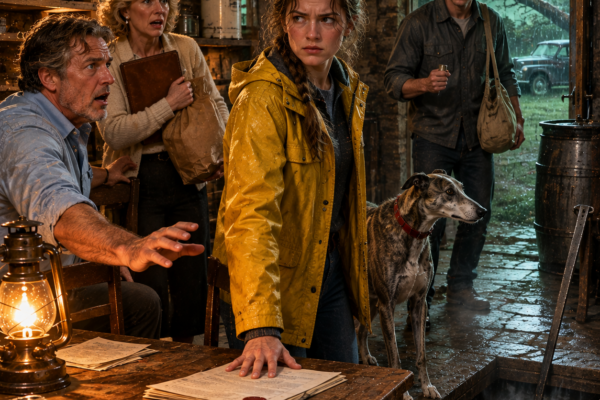
It took the two of them. The wind snatched at the slab and tried to lay it flat and the rain came down on their backs like thrown gravel and the crow with a shriek came off the canopy beam and landed in her collar.
Then the iron gave and the opening yawned below them gold in the dark where the lantern still burned on the plank table. She turned in the howl and held out her hand.
Down. She said.
All of you.
Now. They went down one at a time with the rain driving after them like thrown gravel.
Delmar went first to catch whoever fell. Then Annette clutching her cardboard box and Warren who had to turn sideways on the ladder to fit his shoulders.
Connie came last with the crow inside her collar and let the slab fall home over her head with a long hollow boom.
The roar of the storm went away. It did not stop.
It simply moved overhead a deep endless sound like surf and now and then the whole room shivered gently like a cup on a saucer.
But in here the lantern flame stood perfectly still.
Nobody spoke for a long time.
Delmar lit the second lantern. The crow hopped onto the back of a stool shook himself like a wet dog and surveyed the company with profound disgust.
Warren had sat down on the third cot with his hands between his knees.
He was looking at the iron cots and the shelf of tins and at last, slowly, at the line over the inner door painted in white on the gray.
Everybody runs low sometime.
Fill them anyway.
He read it twice with his lips.
Dad never said that, he said, not once. He lived it, said Connie.
He told me it was a gas station that nobody wanted, said Warren thickly.
He never said there was a thing like this under my feet.
He told nobody, said Delmar.
That was the point of it. It was Annette who moved.
She had been sitting on the end of the first cot with the box on her knees as still as a person in a waiting room and now she stood up quite suddenly with her glasses sliding in her hair. She walked across the gray floor to the table and set the box on it and opened the flaps.
I didnt put it in the church sale, she said.
She lifted out a bundle wrapped in a dish towel and unwrapped it and set it on the plank. It was a green enamel percolator chipped at the lid with a dent in its belly from 46 years of Hals elbow.
Connie put out her hand and did not quite touch it. I took it out of the box the same afternoon, Annette said.
Her voice shook. I kept it in the trunk of my car under a blanket and told Warren I dropped it at the church.
I should have said so on Thursday. I should have said a great deal on Thursday.
I sat in that chair by the window in April, Connie, and I watched you sign that paper and I knew it was wrong. I knew it as I know my own name and I said nothing.
She put her fingers over her mouth. Roy Fenner asked me the next week to sign a statement that you understood what you were signing.
I told him I could not.
I think that is the only reason he quit. Its not very much.
It isnt enough.
I know its not enough.
Warren had lifted his head. Annette.
No, said Annette without looking at him. You can be angry at me later.
Connie stood a long moment.
She thought of the hand lifting half an inch and of what a quiet woman to say anything at all in a room where a loud man has been saying the opposite for 40 years.
I heard you not saying it, she said.
I heard every minute of it. I wont tell you it didnt matter.
 [Tap here for the Next Part ]