Part 2: What Was Behind the Cracked Oven Wall of the Old Bakery?
A man named Corliss has been parking a gray sport vehicle in front of your bakery on the 1st of every month, and he walks around it with a tablet and a tape measure, and tied orange ribbons to the corner post in November. He is from a company called Harbor Line.
They are buying up the whole block for what the newspaper calls a riverfront square, and your sister has been seen having lunch with him at the corner table twice. Sylvia says its a money pit.
She told me Harbor Line sends someone to look.
Does she? Philippa picked up her cane.
Ill tell you what else I know.
A friend of mine at the credit union has not told me, and so I cannot tell you, that the Pratts have a notice posted on that house.
It is not a nice notice. They have been very busy, and Russell has been seen at the lumberyard with his hat in his hand.
Her blue eyes were steady. A woman who does not need your bakery does not send a man from Harbor Line to measure it once a month, and a woman who thinks a thing is a money pit does not take such pains to see you sign something you have not read.
Greta sat very still.
The slat in the oven shifted and fell in on itself with a small sound. You need a lawyer, Philippa said.
Not hers, a real one. Calvin Marsh has an office above the shoe repair on Main Street.
I taught him long division when he was 9 years old, and he is the only boy in my 51 years of teaching who read every assigned page and then asked for more. He will be at the county courthouse until Thursday.
He will be in his office on Friday at 9:00. She was already moving toward the door.
Ill ring him from my kitchen, and you will go, and you will take the book, and you will tell him nothing that you do not wish to tell.
I cant pay him.
Then you will owe me for the soup, and Calvin for the rest, and the town for whatever is left.
She turned in the doorway, a tall gray figure against the white light.
That is how it is done here, Greta.
It was done here for 16 years.
I am only reminding you.
She went out. The bell above the door gave a thin, cracked chime that Greta had not heard in 9 years.
Thursday was gray and bitter.
The bank clock said eight below at noon.
Greta fed the old oven and swept the frozen shop and did the small, exact work of keeping herself alive, and the dog followed her from room to room with his stiff gait as though he were taking a census. She did not touch the flour bin.
She stood in front of it once with her hand on the lid and thought of her mothers slanted hand, Do Do open the box until you have the law behind you. She took her hand away.
At 3:00, she heard the radio in the shop, a battered transistor she had found in the counter drawer and coaxed to life with two cells from a lantern.
A calm voice read the weather.
A front was moving down from Canada, it said.
Clear tonight, clear tomorrow, but by Saturday evening, the temperature would begin to fall like a stone to 18 below with winds out of the northwest at 40 miles an hour. A hard freeze warning for the whole river valley.
Stay indoors. She turned it down.
Crum lifted his head and gave it a look.
At a quarter to 5:00, as the light was draining from the sky, she wiped a clear patch in the frost on the front window to look at the street.
A gray vehicle sat at the curb across the corner with its engine running and its lights off. A man in a long dark coat stood on the sidewalk beside it with a tablet in one hand, tilted up toward the roof of her bakery, toward the chimney.
He photographed it twice. Then, he spoke into the phone at his ear and glanced at the orange ribbon on the corner post and glanced at her window, and Greta stepped back out of the glass.
He did not leave for a long time. She stood in the dark of the shop with her heart beating in her throat and her hand on the dogs head.
Behind her, in the back, the fire murmured. In her pocket, folded in her grandfathers careful hand, was a letter that had said, Do not let her carry one more thing out of a door.
She thought of Sylvias cherry-colored hand coming down on a thin blue folder, lightly, like a lid. Tomorrow, she thought, at 9:00.
Calvin Marsh.
It was the first time in 11 weeks that she had made a plan that was her own. Calvin Marshs office was up a flight of rubber-treaded stairs above the shoe repair, behind a door with his name lettered on the glass in a hand that had given up on straight lines.
He was 54, a big, untidy man with graying hair that stood up where he had run his hands through it, a corduroy jacket gone shiny at the elbows, and reading glasses pushed up on his forehead and forgotten there. Miss Vasek, Miss Aldrich told me about the nines, and I find Im still afraid of her.
He shook her hand.
I spent 40 minutes this morning with the register of wills and the county recorder.
I cant promise you anything, but I can tell you what the paper says, if you want it plain.
Plain?
said Greta.
Your mothers will was signed in 2019.
The house on Linden Hill and the residue go to you and your sister in equal halves. To you she gives, and Im reading, Vaseks Bakery Building on Third Street, together with all that is within its walls.
Sylvia is executor.
He looked up. That is the whole of it.
Half of everything, Greta. On a rough estimate, a little over a million dollars.
Greta sat very still.
She thought of Mr.Daceys long, gray hand lying on a blue folder, and her sister saying, Thats only the old one. And she was not surprised.
She was only tired, as one is when a thing one has known in ones bones for a week is finally said aloud. I signed a paper.
11 pages. She said the will gave me only the bakery.
I have it. Page six.
You release your claim to Linden House and acknowledge that you have been informed of every liability of the estate. Page nine.
You will cooperate in any sale of the bakery to a third party the executor names.
He turned a sheet toward her.
Did she tell you the house was mortgaged?
No. $395,000 in two loans against the house signed with the power of attorney your mother gave her in March.
Due in full on the 31st of January. He drew out a second sheet with the county seal in its corner.
And this was recorded on the 30th of December. The day after your mother died.
A memorandum of an option to purchase. The seller is the estate by Sylvia Pratt.
Executor. The buyer is Harborline Square LLC.
The property is your bakery. The price is $1,400,000.
Closing by the 1st of February.
For a moment Greta did not breathe. Then she began to speak slowly in the flat careful voice she used for counting change.
And only afterward did she understand that she had been working it out for a week without knowing it.
The house is mortgaged for $395,000. She borrowed it for the inn she wants to make of Linden House.
So she needs a million dollars by the 1st of February. And the only million she has is my building.
But she cant sell it because its mine under the will. Unless I sign it over.
She pressed the heel of her hand to her forehead. So she gave it to me.
She took the house and gave me the building and made me sign that Id cooperate.
And she put me in it in January with no heat and no car and $40. So that when she came back with an offer I would take anything.
I would put it a little less kindly. Said Calvin Marsh.
But I would not put it differently.
You keep the bakery. You sign nothing.
She hands you whatever she says, whomever she brings.
Ill file an objection to the option and a petition to set aside the settlement this afternoon. And Greta, is there anything in that building I ought to know about?
She felt the book in her coat pocket, small and heavy as a stone.
My mother left me a note. She said not to open something until I had the law behind me.
Then you have it.
He smiled, a quick, rumpled, boyish smile.
As of this morning. Open it tonight with Miss Aldridge as a witness and photograph everything before you touch it.
Philippa was waiting in the production room with a flashlight and a camera and she looked at Gretas face and said only, Well?
I have the law, said Greta.
Come and see what mother meant. They stood in front of the flour bin, a great oak chest with an iron-banded lid as long as a coffin.
Greta raked out the few inches of dead gray flour and rapped the bottom board with her knuckles.
It rang hollow. She found a notch no wider than a thumbnail and pressed and the board lifted on a pin with a puff of dust and under it, in a bed of gray flannel, lay a small brass key on a loop of red thread.
Philippa took the picture.
The flash made the room go white.
Greta carried the key in her closed hand through the warm brick door and sat down on the cot with Philippa on the stool and Crum at their feet and drew out the steel box.
Before she turns that key, tell me something in the comments. Who in your life ever believed in you when no one else did?
And when did you find out?
Then stay with Greta because the box in her lap held more than paper, and her sister was already on her way.
The key slid in as if it had been oiled the day before. It turned with a short, dry click, and the lid rose, and a smell came up out of the steel of cedar and old paper and a faint ghost of cinnamon.
Inside lay four things on a bed of folded flannel.
Philippa photographed them where they lay, then she nodded, and Greta lifted them out one at a time. The first was a long envelope sealed with a single word on the front in her grandfathers hand.
Greta.
The second was a bundle of thin yellow statements tied with a string.
The third was a small leather folder soft with age, and in it a sheet of heavy cream paper with an engraved border and a seal in red wax, and across the top in black ink were three words, Certificate of participation. The fourth, wrapped in a handkerchief, was a pocket watch with a cracked crystal that had stopped long ago at 20 minutes past 6:00.
She unfolded the certificate.
It was typed and signed and stamped by a notary named Orville Quast on the 9th of March, 1966, and she read it by Philippas flashlight in a whisper as if the paper might crumble if she spoke. In consideration of $9,400 advanced in cash and of flour and credit delivered over the term of 1 year, the Hartley Milling Company of Alder Falls grants to Josef Vasik, baker, a silent partnership interest in the said company equal to 15 parts in every hundred of its stock to be held by him and his heirs and assigns, the same not to be called, sold, or surrendered except by his written consent.
It was signed Edward N.
Hartley, President. Beneath his signature, in a slanting younger hand and blue ink, was one more line.
Yosef, you were the only man in town who didnt ask what it would cost him. I wont forget it.
Ned.
Philippa had stopped taking pictures. Hartley, she said.
Greta, did you say Hartley Milling?
The mill by the river.
It closed in 1981. It did not close.
It moved.
Philippas voice was very quiet. It went to the county seat, and then it grew, and it became a flower company that sells to bakeries in nine states.
Hartley Foods.
It has been on the evening news this entire week because a very large grain company is buying it. I wrote the figure on my kitchen pad because I could not believe it.
Greta waited.
Crum lifted his gray muzzle from her boot.
26 million dollars, said Philippa Aldrich, and, my dear, I believe you are holding 15 parts in every hundred of it. Greta did the arithmetic.
It was not hard. It was only that the number would not stay still in her head.
$3,900,000. She said it once aloud, and then she said it again, and Crum thumped his tail on the tile, and Philippa began, to Gretas astonishment, to laugh.
Oh, Yosef, said the old teacher, wiping her eyes with the back of her glove.
Oh, you stubborn old man.
60 years. Theyll say it isnt mine.
Gretas hands were shaking.
Hartleys people, Sylvia, anyone The certificate is in my grandfathers name.
Hes been dead for 28 years.
Then we read the rest of what he left you, said Philippa, and we ask Calvin in the morning. Open the letter.
She slit the envelope with her thumb.
Inside were two pages in her grandfathers blocky pencil, dated the 4th of March, 1998, the same day as the other. Greta, it began, if you have this, Lucille has kept her promise, and you have the law behind you.
Here is the whole story, so you will not hear it wrong from anyone. In March of 1966, Ned Hartleys father died, and the boy was left with a mill in debt and a bank at his throat.
He came into my shop with his hat in his hands and asked for credit on 1 years flour. I gave it.
He was 22. When the mill was safe again, he wanted to pay me back, and I said to put it in the ground and let it grow, and he gave me a share instead, and we shook on it.
Every spring the statement came in an envelope, and the money was set aside in my name, and I never drew a dollar of it. The statements are in the box.
Hartleys heirs have been told to hold it until a Vasek asks.
Do not be afraid of them. They are decent people.
I told no one because I knew what a number does to a family. Anton would have sold it to buy a bigger shop and lost it.
Your sister would have sold it to buy a bigger house and called it prudence. You were the one who would have given the first loaf away.
That is why it is yours, not because you are good, but because you are practiced.
Whatever you do with it, bake one loaf more than you can sell. Greta lowered the page.
She untied the string around the yellow statements and spread them on the blanket. There were 31 of them, one for every year from 1967 to 1997, each a thin sheet typed by the companys bookkeeper, and each was stamped across the bottom in faded red ink, held for J.
Vasek.
Not $1 of it had ever been drawn. Beside each year, in the last column, was a figure that grew a little every spring, the way a loaf grows, until the last one, which read, in a column of its own, $41,000.
He never spent a cent, whispered Philippa.
31 years. He baked bread, said Greta, and began to cry quietly, without any sound, and found that Philippas gloved hand was on her shoulder.
It was Crum who heard it first.
The old dog rose from the tile with his stiff legs braced and his one ear up, looking toward the front of the shop. A moment later, Greta heard it, too, through the thick brick of the wall, a car door shutting in the street, and then another, and a voice she knew better than her own.
I told you, Brent. Its the chimney.
Shes lit that ridiculous oven.
Quick, said Philippa, and she was on her feet, tall and quite steady. She slid the certificate and the letter back into the leather folder, and buttoned the folder inside her coat.
Greta lifted the empty steel box onto the cot and threw the gray blanket over it. They stepped out through the brick door together, and Greta put her shoulder to the wall until it swung shut with its greased click, and in the dim light of the production room, there was nothing to see but a patch of old brick, a wall of frost, a flower bin with its bottom board put back, and a dog.
Out in the front, a key turned in the lock.
Greta.
Her sisters voice came down the dark of the shop, warm as bread and bright as a tin whistle.
Darling, we saw your smoke. Weve come to take you home.
Sylvia came down the length of the shop in her cream coat with her emerald scarf floating behind her, and she was smiling before she saw anyones face. There you are.
She stopped under the dead light fixture and her eyes went around the room to the counter, the dust sheet, the window with its feathers of frost. They paused on Philippa Aldridge, tall and gray in her long coat, standing by the old oven with her cane across her hands, and something moved behind the smile and was put away.
Miss Aldridge, how nice.
Greta, darling, you cant think how worried weve been. Russell and I were saying only this evening that it is simply too cold for you down here.
Russell had come in behind her. He stood just inside the door with his hat in his hands, looking at nothing, and behind him, in a long dark coat with a tablet under his arm and the pleasant blank face of a man who has learned that politeness is the cheapest of tools, stood the person Greta had seen from the window.
This is Mr.Corliss of Harbor Line Square, said Sylvia. Hes been so helpful.
Brent, my sister.
Miss Vassic.
The man inclined his head.
A pleasure.
I hope youll forgive the intrusion.
Youve been on my sidewalk, said Greta, with a tablet. I have a professional interest in the block.
He smiled. Your sister has been kind enough to share your situation.
Were prepared to be very generous. Generous, said Sylvia, quite as if it were her own idea.
Thats the word, isnt it?
I was telling Brent that I wouldnt hear of your staying here, not in this weather, and he has been so kind as to say that Harbor Line would take this old place off your hands at a fair appraisal, $85,000.
She drew a folded paper from her handbag, cash by the 31st.
Thats more than most people in town see in 10 years.
You could take an apartment. You could take a rest.
Let me carry the paperwork for you, dear. Youve had such a hard month.
It was the word carry that did it. Greta had been listening for it, and it came, as it always had, soft and warm and a half second early.
She did not move from the oven. She was a short woman, and she felt, standing there, very large.
Ive been to see Calvin Marsh, she said.
The silence lasted perhaps 3 seconds.
In it, she heard the oven tick and Crums nails on the tile as he came to stand against her leg. Sylvias smile stayed exactly where it was, but her eyes went to Brent Corliss, and Brent Corliss glanced at his tablet, and Russell, at the door, closed his hands on his hat.
Calvin Marsh, said Sylvia lightly.
Good heavens, hes a country lawyer, dear. He does wills for the Lutherans.
He read Mothers.
It gives me the bakery and half the house.
Greta spoke slowly. It gives me half of the $395,000 you borrowed against it, too, doesnt it?
I never saw that part. I signed 11 pages and read one.
You told me the other 10 were boilerplate, and you recorded an option to sell this building to Mr.Corlisss company for $1,400,000 the day after Mother died. Brent Corliss closed his tablet.
I think, he said, very evenly, that I will wait outside.
Brent, Miss Pratt, you did not mention an option recorded in December.
He was already moving, nor a competing council. My company does not negotiate under dispute.
You may reach my office on Monday. The door clicked behind him, and the bell above it gave its cracked, thin chime.
Sylvia turned to her sister, and Greta watched the warmth go out of her face, slowly, as the color goes out of a cooling iron, and what was underneath it was neither anger nor shame, but something older and more tired. It was the face of a girl of nine who has been told that there is not enough to go around.
You have no idea what youve done, she said in an ordinary voice.
I have a very good idea. I am trying to save this family from losing everything.
You have never once in your life had to think about money. Greta, you have lived on mothers goodness for 62 years.
Youve baked your little loaves and cried over your little crock, and I have been the one who paid the bills. Her voice shook and was steadied.
Tomorrow at 5:00, Ill bring the papers myself. Think very carefully.
A receiver can be appointed for a failing property. A court can order a sale.
It would be so much kinder to do it the gentle way. Where is the crock, Sylvia?
It was the only thing she asked.
Sylvias mouth opened. Behind her, in the doorway, Russell lifted his head, and for the length of one breath, his tired blue eyes met Gretas and held.
Its gone, said Sylvia. Dont be sentimental.
Russell, get the car. They went.
The bell chimed again.
And a long time afterward, in the dark of the shop, Philippa Aldrich said quietly from the shadow of the oven, That young man took a very long time to put his hat on. Which young man?
Your sisters husband. The old teachers pale eyes were thoughtful.
He is 60, and he is a coward, Greta, but a man who is a coward is a man who is frightened of something.
I would find out of what.
Saturday began clear and bitterly bright. The bank clock said four below at 8:00, which Greta recognized with an odd lightning as a mild morning.
She fed the oven and swept the shop and ate three oat crackers with honey. At 9:00, Calvin Marsh knocked at the front glass with the side of his fist, carrying a briefcase and a thermos and the look of a man who has been awake since before the world was made.
He sat with her at the steel table with the oven door open and listened with his head down while she told him about the room.
He did not touch the folder.
He looked at it for some time. Greta, he said at last, may I tell you what I did at 6:00 this morning?
Please. I telephoned the general counsel of Hartley Foods at her home, a woman named Judith OShea.
I read her the number of the certificate.
He rubbed his eyes.
She was silent for perhaps 15 seconds. Then she said, Mr.Marsh, we have been looking for a Vasek for 28 years.
Greta put her hand on her mouth. The companys ledger carries 150 shares in the name of Josef Vasek, held in escrow with every dividend since 1967 set aside.
Ned Hartleys will required it.
His daughter runs the company now, and she keeps a framed copy of that clause in her office.
He opened his briefcase. I will say this, the way the law says it, and then in English, shares pass through each estate with the property they belong to.
Your grandfathers will left the bakery and its contents to Anton. Antons left everything to Lucille, and Lucilles gave you the building and all that is within its walls.
The certificate was within its walls. It is yours, subject only to the courts order reopening your grandfathers estate and confirming the chain.
That is paperwork, not a fight.
In English, its yours, and Hartleys counsel has already said so over the telephone.
How much? 15 parts in a hundred of a company that is being sold for 26 million dollars if the sale closes on the 15th of February.
A little under 4 million.
Plus the dividends in escrow, which are, he consulted a sheet, a good deal more than I expected.
Call it 4,600,000, give or take. I will not insult you with decimals.
Greta sat very still. Behind her, in the oven, a slat shifted and fell, and a shower of sparks rose up the flue and vanished.
Sylvia doesnt know, she said.
No, neither does Harbor Line.
They have been courting a building for a million four, and the owner is sitting on a wall full of paper worth three times that.
It is, if I may say so, the most thoroughly deserved thing I have seen in a courtroom. He closed the briefcase.
I have to drive to the county seat now. I need an emergency order from Judge Tilden to reopen your grandfathers estate and to freeze the option.
I will be there by 11 and back, I hope, by four. And Sylvia comes at five.
Sylvia may come when she pleases. You sign nothing.
You say nothing about the room. He stood and hesitated and glanced out the front window.
Greta, have you seen the sky? She went to look.
In the west, over the roof of the mill, a long thin line of cloud lay along the horizon, white as a scar. And above it, the blue of the morning had begun to look, quite suddenly, thin.
The wind had changed.
It was no longer from the south.
It came flat and hard from the northwest and rattled the plywood on the side windows. The forecast said Saturday evening, said Marsh.
That was yesterdays forecast.
I have a bad feeling about it.
He pulled on his gloves.
If it comes early, you stay in that building. You do not go out.
Do you understand?
Whatever she says, whoever knocks, he was gone.
The gray wool of his coat flickered across the window and then the engine of an old car caught, coughed, and receded down Cooper Street.
The afternoon went white. By 1:00, the sky had closed over the river like a hand.
By 2:00, the first snow came, not falling but driven, flat and dry in long streamers that made the street vanish.
By 3:00, the bank clock read 11°. And then 6:00 and then, as the daylight began to drain from the windows at 3:30, 9° below.
The transistor in the counter drawer talked steadily of an Arctic front, a wind chill warning, a hard freeze to 18° below by midnight. The roads closed north of the river.
Greta stacked the last of the oak against the oven wall.
She filled every pot she owned with melted snow.
She carried a quilt and the lantern into the secret room and set the kerosene stove ready on its brick shelf and stood in the doorway looking at it. A cot, a table, a candle in a saucer, a dog.
At 20 past 4:00, the front door opened with a gust that blew the dust sheet off the counter.
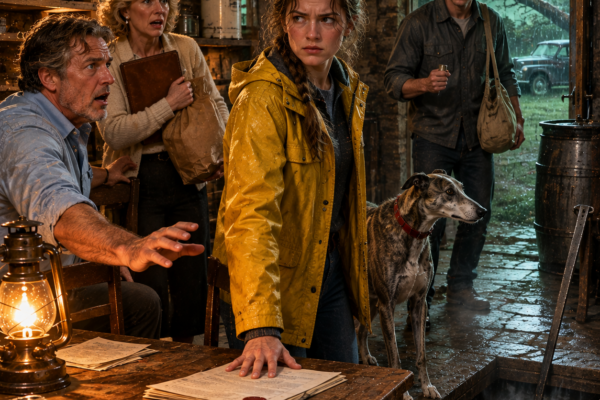
It was Philippa Aldridge with her braid white with snow and her cane in one hand and a thermos in the other. I looked out of my window, she said, and I said to myself, there is a woman who is going to need a witness.
Dont argue, Greta.
I am 79 and I have not been talked out of anything since 1963. She stamped her boots.
Is the oven drawing? Good.
Wheres the dog?
At 10 minutes to 5:00, headlights swept the frosted glass.
Sylvia came in out of the white with a leather folder under her arm and her cream coat buttoned to the chin, snow on her silver hair, and Russell came behind her wearing his hat low with a flat dark shape in his arms wrapped in a plaid blanket. He kept his back to the room.
Sylvia did not look at Philippa.
She did not look at anyone. She crossed to the steel table, laid the folder on it, and uncapped a gold pen.
I want to say before we begin, said Sylvia, that I am doing this out of love. $85,000, said Greta.
90. Sylvias voice was thin.
It is the most that the appraisal will bear.
You will walk out of here with a cashiers check and a ride to my house and a room with a window. I will see that you are warm.
I have always seen that you were warm. She pushed the paper across the steel.
It was a purchase agreement, two pages with a yellow flag on the line at the bottom. Greta looked at it for a long time.
She looked at her sisters cherry red hand trembling very slightly on the gold pen and at her husbands back and at the old oven behind her with its door open on a bed of orange coals.
She thought of a man who had paid a mills debts with flour and written down nothing but the weather. No.
said Greta. It was a small word.
And she said it gently. Sylvia did not seem to hear it.
Im sorry. No, Sylvia.
I wont sign.
Im not selling the bakery.
Not for 90,000 and not for 1 million 4 and I dont think I will be selling it at all. She reached out and with one forefinger turned the agreement face down on the steel.
It isnt spite. I just want it and you were right about one thing.
It is not a money pit. It is a place where people get fed.
A sound came from the roof.
A long rising note like a bow drawn across a wire. The plywood on the east windows boomed once, twice.
Every one of them looked up.
Then the single bulb in the shop which Greta had never been able to make work flickered once, brightened strangely and went out and the wind hit the building like the flat of a great hand. The wind did not blow.
It leaned.
The old brick building took it on its whole west face with a groan that went down through the floor and up through the soles of their boots and the plywood on the side windows tore away in one piece and went sailing off into the dark like a sheet of paper.
Glass burst somewhere upstairs. A rush of air as cold as iron came down the stair into the production room and put out the lantern on the steel table.
Into the wall. said Greta.
All of you. Now.
What wall?
cried Sylvia.
Greta, I have a car outside. You have a car in a drift, and the temperature is going to 18 below.
Greta was already across the room, pulling the iron ring.
In the black dark, she felt the wall give, felt the warm breath of the old room roll out against her wrists, and heard behind her a small stunned sound from her sister, which she would remember all her life.
Philippa, the dog. Russell, mind the step.
They went in one at a time. Philippa first with her cane and her thermos, then Crumb, then Russell with the plaid bundle held against his chest, and last of all Sylvia, who stood at the brick door with the snow melting in her silver hair and her face quite empty, and said in a voice like a girls, Papa Josefs hole.
What did you say?
Mother used to say that he had a hole in the oven. Sylvia put out one hand and touched the whitewashed arch.
I thought she meant it as a joke.
I was 12.
Come in out of the cold, Sylvia, said Greta. Her sister stepped through.
Greta put her shoulder to the wall.
It swung home with its greased click, and the roar of the storm fell away behind the brick, as if a door had closed on a train. The first thing was light.
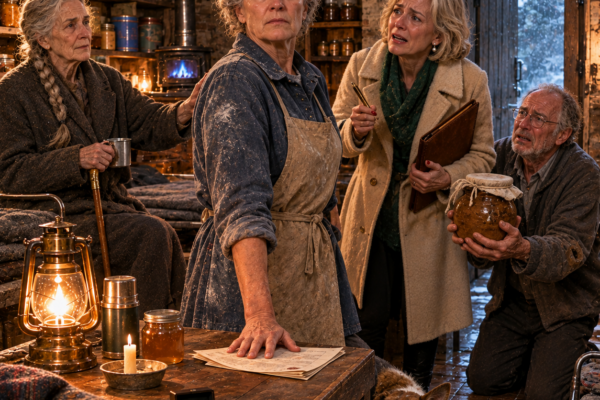
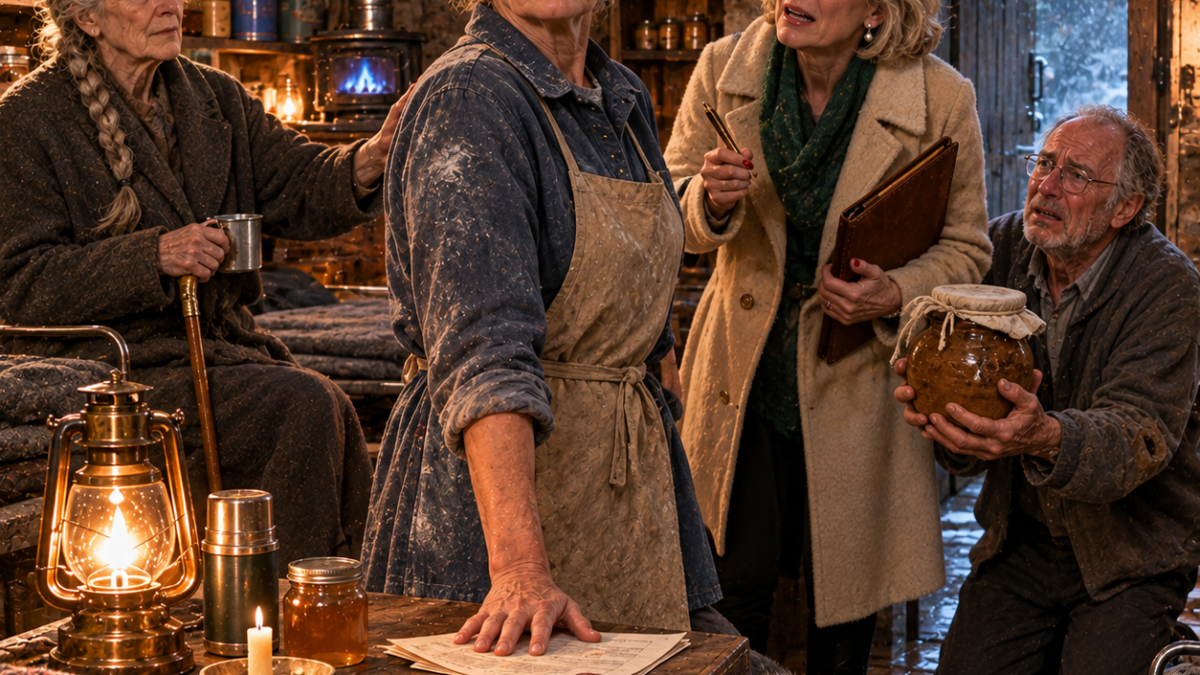
Greta lit the lantern with the last of her matches and set the candle in its saucer, and the room came up gold around them. The low whitewashed vault, the two iron cots, the shelves of tins and jars, the stool and the pine table, the beam above the inner doorway with its six square words.
The second thing was warmth.
The thermometer on the nail read 49. It climbed to 52 within the hour.
As five living bodies and a kerosene stove warmed the brick.
Outside, through the foot of masonry, the storm went on and on, a deep and endless sound like surf, and now and then the whole room shivered gently like a cup on a saucer.
But in here, the flame stood perfectly still. Philippa sat on the left-hand cot with a blanket across her knees and poured tea from her thermos into a tin cup.
Crum lay on her feet. Sylvia sat on the right-hand cot with her cream coat buttoned to the chin and her handbag on her lap, gripping it with both hands.
Nobody spoke for a long time.
It was Russell who crossed the little room at last and knelt down before Greta in the lamplight and unwrapped the plaid blanket.
It was the crock.
The brown stoneware pot with its chipped lip and its linen cloth tied over the top with string. He held it out to her in both arms and his hands were shaking and his face under the smudged glasses was working.
I never poured it out, he said hoarsely. I told her I did.
I kept it in the refrigerator in my workshop behind the paint cans. I fed it every morning at 6:00, a spoon of rye and a spoon of water, the way your father did.
I read your grandfathers note on the side of the crock, the one pasted in the bottom. I didnt know whether I was doing it right.
He swallowed. I should have said something at the table on Monday.
I should have said something at the lawyers.
I kept thinking tomorrow, and then it was a week. Greta took the crock.
She untied the string with fingers that were not steady and lifted the cloth, and the smell came up to meet her, sour and sweet and alive, the smell of every morning of her life, a thick, pale foam, domed and bubbling, rose in the stoneware and breathed.
Its alive, she said.
Its alive, said Russell, and he began to weep like a large child in the lamplight with his hat still in his hand.
And I have this. He felt in the pocket of his cardigan and drew out something small and brought it to her in his closed fist.
It was a cameo ring, chipped in the setting.
She put it in her jewelry box, and I took it out on the 6th of January when she was asleep.
Im sorry it took me so long to bring it.
Im not a brave man, Greta.
Im only a man who couldnt stand to throw out a thing that was alive. Greta slipped the ring onto her finger.
It fit. It had always fit.
Thank you, Russell, she said. She did not say that it was all right because it was not, but she laid her hand over his a moment on the cool stoneware, and he bowed his head.
Well, said Philippa into the silence, if the family is going to cry, it may as well do it on a full stomach.
They ate from the tins.
 [Tap here for the Next Part ]