Part 3: Town Laughed at the Widow’s Rusted Gas Station — Until She Lifted the Hatch Under the Pumps
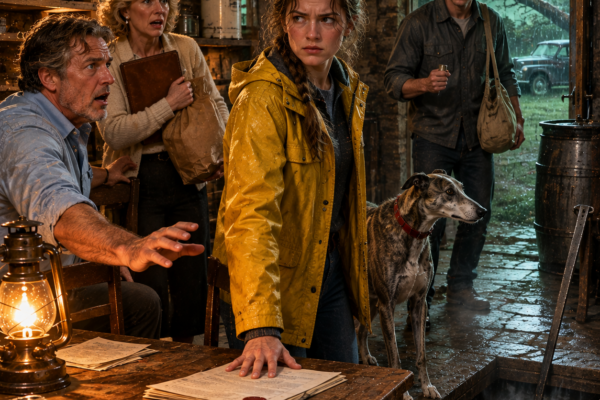
She laid her hand on the cool green enamel and felt the old familiar dent under her palm.
But you brought the pot and you told me, thats a door, Annette.
Ill leave it open.
Annette nodded and sat down on the nearest stool and wept without any noise with her glasses in her hand.
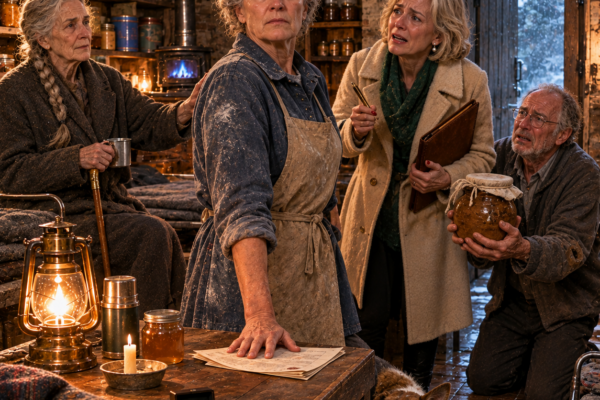
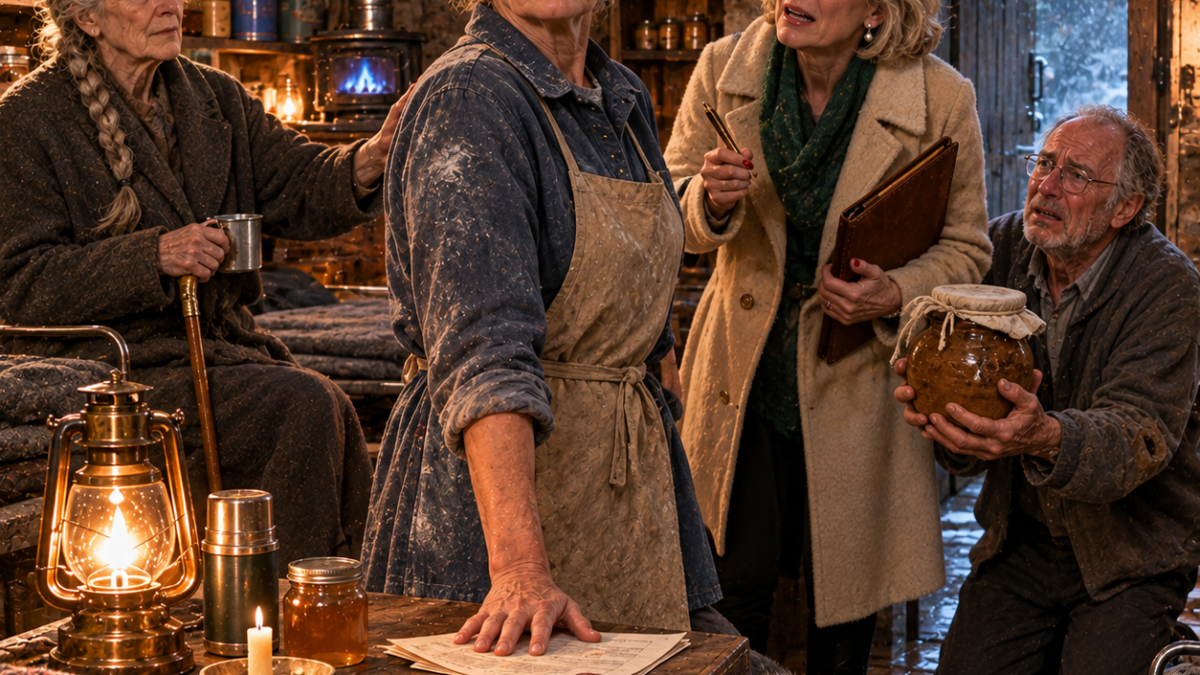
Delmar put a small blue camp stove on the table from the grocery sack.
Connie filled the percolator from a white jug and measured the coffee out of the can that had been sealed since 1996 and set the pot on the flame. In 10 minutes, the room filled with the smell of it, dark and sweet and strong, the smell of every dawn of her married life.
And Warren shut his eyes. She poured four cups and a bottle cap of it cooling for the crow.
She set the last cup before her stepson and kept her hand on it for a moment.
Im not pouring this because youve earned it, Warren, she said. Im pouring it because Ellis would have.
He took it in both hands as a man takes something he is afraid will spill.
It was past midnight when the canopy went.
They heard it, a long shriek of metal that seemed to come right down through the concrete, and a crash that shook dust from the ceiling, and then a rumble that went on and on. The lantern swayed.
The crow said something sharp.
After it, there was only the rain and the hush of a room where four people are not looking at one another. Ellis would want you to hear him, Connie said suddenly.
She did not know why she said it. She went to the coffee can and took out the tape and set the little gray player on the plank and began to turn the crank.
He left me a message, Warren. Its about all of us.
I think you should hear it. She counted 60 turns and pressed the key.
There was the long hiss and the creak of a chair in a year that was gone, and the old mans dry level voice filled the cellar.
They listened to it with their cups in their hands.
When it came to the baby on the third cot, Delmar cleared his throat and looked at the third cot where Warren sat.
And when it came to Warren counts everything twice and trusts nothing once, and I have seen what that does to a mans face, nobody breathed. The big man on the cot did not move at all.
The tape ran out.
It clicked. The rain went on.
He saw it, said Warren. His voice was strange, hoarse and small.
He saw it when I was 21 years old.
He wiped his face with the back of his wrist. When he spoke again, it came slowly as if each word were being drawn out of the ground like a post.
I was 10 and I was pumping gas in January and a boy at school said I smelled like the station.
They all laughed.
I went home and dad was giving a man a free tank of gas, and he laughed, too. He laughed at everything.
The Interstate opened, and the trucks stopped, and he laughed.
I swore that I would never smell like gasoline again, and I would never be a man who gave it away.
Then it was the dealership and the bank, and it was one loan, and then another one to cover the first. I told myself I was protecting you, Connie.
Thats what I told myself. I never wrote a letter from the state.
I just said there was one. He shut his eyes.
I looked at that station every day of my life, and all I saw was what it cost us. I wanted it gone.
I dont know that I can forgive that, said Connie, at last, slowly.
Ill tell you the truth. I dont know yet.
She picked up the percolator and filled his cup again. But you dont have to be sorry for me to pour you another.
The pots on. Thats all it is.
Warren Dray put his face down into his big hands and cried, with his shoulders shaking, the way he had cried at the age of three, in a farmhouse kitchen, with a skinned knee and no one to tell.
After a while, Delmar crossed the floor and put a hand on his shoulder and said nothing and left it there. The storm went on until nearly dawn.
Toward four it dropped rather than ended, as a voice drops in a church. They lay in a row on the six iron cots under the gray blankets, a widow and a trucker and a stepson and a stepdaughter and a crow on the rim of a tin cup, and the lantern burned down to a small gold bead.
Connie lay awake and listened to the roof of the earth settle over them and thought of 1957 and of the child on the third cot who was snoring.
When she opened the hatch at seven, the morning that fell through it was the color of washed glass. The canopy lay across the lot in a heap of twisted steel.
Its long beams folded like the ribs of a ship. The west pump stood untouched in the middle of it, and so did the iron slab at its foot.
Warrens white crew cab was nose down in the ditch with a limb through its windshield.
Down at the foot of the county road, the whole river bottom lay shining like a mirror under a pale pink sky.
Bel-Mart crawled out after her and stood looking at the wreck of the canopy with his cap in his hand. Ellis would say it did its work, he said.
Gail Whitlock arrived at 9:00 in the cab of a county road tractor with a deputy at the wheel and her tote on her knees. She climbed down in white sneakers gone mud to the ankle and surveyed the lot and then the four people and the crow sitting on overturned buckets around a camp stove with a green percolator on it.
I came prepared to defend a widow, she said, and I seem to have arrived at a hospitality suite. She opened the tote.
Judge Pennington signed an order at 11:00 last night by flashlight. The release is suspended pending the hearing.
Iron Roads counsel wrote to me on Wednesday.
The contract is terminated for failure of its access condition.
I believe the estate has no buyer. She looked at Warren who sat on his bucket with his eyes red and his hands open on his knees.
Mr.Dray, I would counsel you very strongly to listen to someone who is not me. Ill sign whatever she wants, said Warren quietly.
It took the rest of the autumn, mostly paper. Warren signed the order setting aside the release in Gails office on a gray Tuesday with his own pen.
The farm stayed in the family as Howls will said, and when Connie declined the house, Annette took it.
Warren sold the last of his dealership to the bank, took a job selling tractors for someone else in Brannick, and paid back every borrowed dollar over years with no help from anyone.
The Treasury sent its first check on the 19th of January, and word of the figure got around Tinker Ford the way weather does, and Warren heard it at the hardware counter, and went home and sat at his kitchen table for a very long time. In April, an envelope to the station in the mail.
It held $2,140 in worn bills, every one of them accounted for, and a $10 bill folded in quarters, and a note in his big square hand.
Ill carry the weight myself.
Gee.
She put the $10 in the cash drawer. By summer, she had built a new canopy of white steel and a new sign on its pole that said Dres with every letter and under it in smaller paint, Everybody runs low sometime.
She had new tanks set deep in the ground far from the island and the pumps made to work.
A driver who could pay paid, and a driver who could not did not, and the green ledger on the counter said no charge a great many times that year in Delmars hand and in hers. She made the old vault the countys storm shelter with a new ladder and a sign.
She put a wood stove and a bed and a window in the back of the office because the farmhouse was too large for one woman and a crow, and the station was exactly the right size.
And on the counter, in the place where Hal had set it every morning of his life, stood a chipped green percolator, which was never once allowed to go cold. Annette came on Saturdays to help with the bread, and she and Connie did not speak much, and each left with a loaf.
On a Friday in the second week of the new year, a white crew cab turned in at the pumps, and Warren got out and filled his own tank, and went into the office, and put a dime in the cup by the register.
Neither of them mentioned it.
A year went by.
It was the 16th of September, a Saturday, mild and golden. Connie stood in the doorway of the office at 10:00 in the morning with a dish towel over her shoulder and the smell of coffee behind her.
Delmar was under the hood of a farm truck by the east pump, whistling through his mustache.
The crow sat on the new beam above the drive, feathers glossy, with one bent foot tucked up and an air of complete ownership. A figure was coming up the county road.
He was a young man, no more than 21, in a thin flannel shirt and boots gone pale with dust, with a canvas duffel over one shoulder and a red plastic gas can in his hand, swinging empty.
He stopped at the edge of the lot and looked up at the sign and the words painted under the name. His face worked.
He looked, she thought, like a boy deciding whether it was a kindness or a trap. Connie wiped her hands on the towel and went out into the sun.
She did not ask his name.
She said, Theres coffee and a chair in the shade and a full tank for whatevers broken down on the road.
Nobody here will ask you what you can pay. I cant, said the boy.
His voice was cracked. Ive got $3, maam.
My car quit 2 miles back.
Then youre exactly who the pumps for.
She took the empty can from his hand. A man I never met wrote a thing over a door.
I used to think it was about gasoline.
She smiled. Everybody runs low sometime.
So, we fill them anyway.
His name, she learned later, was Eli Hargrove, and he drank three cups. When he had eaten, and Delmar had driven out with the can, and the boy was sleeping with his head against the cinder block in the long gold light, the crow came down off the beam and walked across the concrete and settled beside him on the step.
Out past the oaks, the road lay empty and bright.
On the pump rail, a green percolator steamed, and from the steel beam of the new canopy, as it had on the first morning, in the exact voice of a rubber hose over a driveway, an old crow rang the bell for whoever was coming.