Part 2: The Neighbor Whispered, “Don’t Sell It” — What Was on His $2 Old Farm?
He was lean and tanned with slicked black hair and mirrored sunglasses pushed up on his head and a glossy leather folder like a man bringing flowers.
Nate Kadder? Ward Tillman.
Bridgeway Logistics. The smile was very white.
I hope Im not catching you at a bad time.
Sage had gone stiff beside the steps.
She did not growl.
She simply moved without hurry until she stood between the man and the porch. Nice dog, said Ward Tillman without looking at her.
He sat on the porch swing which complained and in the next 10 minutes Nate learned a number of things at the speed of a man being walked through a door.
The state was building an interchange on Route 9 3 miles east.
Bridgeway planned a distribution center on the new frontage road. The Hollow farm had the only parcel in the corridor that reached it.
$1,460,000 Tillman said turning the folder so the figure faced him.
Cash. Closing this Friday.
No inspections. No commission.
Youd walk out with a cashiers check for a farmhouse most buyers would knock down. It did not look real.
It looked like something written on a napkin. How did you find me?
Your father was very helpful. Tillman said it so smoothly that Nate was a moment hearing it.
He said you might need a little guidance. A young man, first property.
He said youd want to be sensible. He didnt mention any offer.
Im sure he was getting to it. Something cold moved in Nates chest.
It was not fear.
It was recognition.
A voice that had learned its manners from the same teacher. Reasonable.
Gentle.
In no hurry at all.
Except that the offer was good only until Friday at noon.
I can run you to Picket Mills right now, Tillman said. And with a front coming through this week, Id hate for you to be stranded.
He glanced at the Ford.
That creek looks like it has opinions. Behind him, a battered green pickup crossed the ford without slowing, throwing brown water in a wing on both sides.
Lenore Tibbs got out in the same apron and boots with the ledger under her arm and looked at the rented SUV as though it were something the cat had left on the step. Mr.Tillman, she said, I thought that was you.
Maam, do we know each other? Everybody knows everybody, and I know that sticker.
She came up the steps and stopped close beside Nate and bent to move the empty pie pan on the rail. And under the sound of it, she said so quietly, he almost thought he imagined it.
Dont sell it, son.
Then her voice came up to ordinary. Im early.
Trucks running.
Weve got that appointment.
There was no appointment. Nate understood that and understood that she knew he did.
Id like to think it over, Mr.Tillman.
For half a second, the other mans face did something quick and still, like a hand closing.
Then it opened again. Absolutely.
Take your time. He laid a card on the arm of the swing.
The offer stands through noon Friday. He looked once more at the sagging porch and the leaning barn with the face of a man who has already priced the lumber.
Land like this is a burden. People always think theyre sitting on something.
Mostly theyre sitting on a mortgage. The SUV backed down the lane and was gone.
That boy wears his shoes like hes never had to run.
Lenore said. Get your jacket.
Ill tell you on the way.
She told him on the way. 13 miles with the windows down and the old truck rattling on every seam.
Land men had been up and down the back road since February offering farmers two and three times what their acres were worth. Bridgeway had bought four parcels.
The Hollow farm was the fifth and the only one that touched the new road. Id like to know.
Lenore said, eyes on the road, Why a man who needs money gives away a million and a half for $2 and then sends a salesman to buy it back.
They came into Pickett a little before 11:00.
Two blocks of brick and a grain elevator.
Lenore parked at the curb under a second floor pane of old glass lettered in gold leaf and across the street between a barber pole and a dentists office stood a long low building with a green awning.
Ketter Farm Supply. He had spent three years behind that counter.
He knew every board of it.
The window held fertilizer sacks stacked too neatly the way you stack them to hide an empty wall.
Past the glass, the shelves stood half bare. A square of white paper was taped inside the door and he could read it from the truck.
Cash only.
No new accounts.
At the side of the building where the alley ran back to the loading dock, a man in an ironed light blue shirt stood with his back to the street and a phone against his ear. He was pacing.
Three steps and turn.
Three steps and turn. One hand pressed flat on the top of his head.
Even from across the street, Nate could see him shaking his head between words. A man who takes a call outside is a man who does not want the staff to hear it.
He felt, for 1 second, something close to pity, and he put it down as quickly as a hot pan.
I dont know the whole of it, Lenore said, but I know a man who does or can find out.
Take the deed and nothing else. Dont sign anything for that boy in the sneakers until hes read every page.
She nodded up at the old glass, and this time Nate read the gold letters. Marcus Telford, Attorney at Law.
She turned off the engine. And Nate, do it before Friday noon.
The stairs smelled of floor wax and old paper.
At the top, behind a frosted glass door, a tall, thin man in a tweed jacket and a navy bow tie rose from a desk heaped with folders.
He was bald but for a white fringe, with rimless glasses, and his chair did not make a sound. Mrs.Tibbs, he said in a slow, careful voice.
Then he looked at Nate and his face softened. And you are Emmetts grandson.
I have been expecting a Ketter in this office for about a year.
I did not expect it to be this one. Marcus Telford read the deed standing, then sat and read it again, and stopped at the recorders stamp.
The 28th of May, $2. He took off his glasses.
Tell me everything.
Leave nothing out. It took 20 minutes.
When it was done, he folded his hands.
A deed that is signed, notarized, and recorded passes title, and it stays passed until a court says otherwise. You own the Hollow Farm, Nate.
Nobody needs your permission to refuse anyone. He paused.
Now, a man who owes money and hurries to give away what he owns is doing something the law has a name for.
I drew Marvins loan papers 6 years ago.
$412,000 against the store building with his own name behind it.
It comes due in full on the 30th of June. Nate heard his own voice, calm and a little distant, like a man reading a column of figures at the end of a long day.
If the farm stayed in his name, the bank could take it on the 30th. In my name, they cant.
And if I sold it to Bridgeway on Friday, the money would come to me and hed be family and hed ask me to help. Telford looked at him for a long moment.
That is how I would read it.
I would have said it more kindly. I dont think kindly is the problem.
No. The lawyer almost smiled.
A transfer made to put property out of a creditors reach can be undone by a court, but that is the banks fight, not yours. Say no and no one in this county can make you say yes.
He tapped the deed.
One more thing. I wrote your grandfathers will in 2018.
It left everything to Marvin and that is what went through probate. But a later will, properly signed and witnessed, controls over an earlier one.
In the spring of 2021, Emmett sat in that chair and asked me exactly what makes a will valid.
I told him I never saw another. Beside the window, Lenore had stopped moving.
Mr.Telford, Nate said slowly.
My grandfather left me instructions in jars.
The last one says not to open it until Ive been to town.
Then you have been to town. Go home, Nate.
Open it.
Whatever it holds, bring it to me before you show it to anyone, and sign nothing for anyone until you do. Lenore drove him home in the long light of late afternoon and did not talk.
At the top of the lane, beside the Ford, a tan sedan stood with its nose to the house, and on the porch steps, in an ironed light blue shirt with the sleeves rolled, sat Marvin Kettler. Lenore looked at him for exactly as long as it took to turn the truck around.
Sage came out from under the porch and stopped halfway, ears flat. In the sedans passenger seat, he could see his mothers profile, perfectly still, her hands in her lap.
There he is.
His father stood and brushed off his khakis.
Ward tells me youve been difficult.
He said it fondly.
Wards people will pay a fair price. Well put it in a trust.
Your mother and I will look after it, and youll never have to think about this place again. I went to see Mr.Telford.
The smile did not go away. It stopped.
It stood on his fathers face like something nailed there.
Marcus has a grudge.
Marvin said lightly.
I took the stores business elsewhere. He read the deed.
Its recorded.
Its mine.
Of course its yours. I gave it to you.
You gave it to me for $2.
Nate was surprised at how level it sounded. Im not signing, and Im not going to argue about it.
Id like to keep what I paid for.
Down in the hollow, the creek ran on.
His fathers gaze went past him, up to the second floor window, and rested there a half second too long, the way a mans eyes rest on a place he has already searched.
You dont understand what youre doing. Marvin said softly.
Your mother and I will come out Saturday.
Well talk like adults. He walked to the sedan.
Through the glass, Beth Ketter turned her head just slightly, and her eyes met Nates and slid away to the ring she was twisting on her finger.
The sedan went down the lane and over the Ford. He stood on the porch until the sound was gone.
Saturday.
His father had said it the way a man names a day he does not mean to keep. Let me ask you something before this goes any further.
Who in your family stood beside you when it would have been easier to look away?
Stay with Nate because the last jar was about to send him somewhere his father had searched twice and never really seen.
Nate went upstairs through the little door and lit the lantern.
He took the 12th jar down from the shelf and set it on his knee.
The padlock was the size of a walnut and the brass key slid into it with a small, willing click.
He held it there, 1/4 turn from open, with the dogs chin on his boot and the lantern ticking and the whole of his life narrowed to the width of a key.
He turned the key.
The lock fell open in his hand with hardly a sound.
He unwound the wire and unscrewed the lid and Sage lifted her head at the smell that came out.
Paper and machine oil and the cold of old iron. On top lay a single folded sheet and under it a small black key, heavier than the brass one with a worn bow.
He opened the paper.
Nate, if you are reading this, you have been to town. Then you have seen how matters stand with your father and I am sorry for it.
I could not make stay my son. I could make certain you were never at his mercy.
The pump in the well house sits on a platform of eight boards. Count from the south wall.
The third board lifts if you press down on the north end and pull up on the south. You pressed the wrong place, I would guess, the first time.
Everyone does.
Under it is a steel box, and this is its key. Do not carry what is in that box to anyone in town but Marcus Telford, who is slow and dull and honest, and the only man in Picket Mills I would trust to read it plain.
One more thing. What is in the box is not the best of what I left you.
The best of it is the room you are sitting in, but you will need the rest, and I have made sure it is yours. Your grandfather.
Nate read the last line twice, and a small sound came out of him that was half a laugh, slow and dull and honest. He could hear the old mans voice saying it, flat and dry, the way he had always said the things he meant most.
He folded the paper along its old creases and put it in his pocket with the coin, and for a long moment he sat with the key in his hand and did not move.
His mothers eyes had gone to her ring. His fathers had gone to the window.
Two people had stood on that porch, and each had looked away from him in a different direction, and he thought, with a clarity that surprised him, that he was done being looked away from. He did not wait for morning.
He took the lantern from its nail.
At the top of the stairs he stopped and listened to the house, to the last bucket ticking in the dark and the old boards settling, and he felt for the first time since Saturday that the place was listening back and not unkindly.
The dog rose with him and they went down together. It was evening.
The clouds had broken in the west and the hollow lay in low gold light and the yard was cold and wet underfoot. A killdeer cried somewhere down by the water.
He thought of Lenore telling him not to say a word to a soul and understood now that she had not been asking for silence.
She had been asking for time.
The creek talked over the ford.
Sage went ahead of him across the grass with her nose low and stopped at the little white shed and waited as she had waited at the wall.
He lifted the loop of wire from its nail.
Inside, the lantern threw his shadow huge against the planks.
He thought of his father standing in this same shed in April with a flashlight, looking at a pump and a platform of boards and seeing only what a man sees who is looking for something else. The pump stood on its platform with the handle up like a raised hand.
He set the lantern on the floor and counted from the south wall. One, two, three.
This time he knelt and laid both palms on the north end of the third board and pressed down.
On Monday he had pressed the middle, he realized, with the flat of his hand and told himself it was solid. He had been eight the first summer he was old enough to want to try it.
His grandfather had lifted him onto an upturned bucket so he could reach the iron handle and stood behind him with both big scarred hands over his and said, Slow, slow, son. A well gives what its asked for, not what its yelled at.
The water had come up cold enough to ache. Nate had laughed out loud.
He had forgotten that he had ever laughed out loud in this place.
Something beneath the boards gave a small oiled sigh.
When he pulled up on the south end, the board came away like the lid of a chest, and a breath rose out of the dark under it that was cool and clean and smelled of stone.
Under it lay a shallow space lined with flat stones, dry as a bone, and in the space lay a bundle wrapped in oilcloth and tied with a loop of gray string.
He lifted it out in both arms. It was heavier than it looked and colder and a good deal bigger than a loaf of bread.
He set it on the planks in the circle of the light, and the dog sat down beside it, and the creek ran on outside.
His hands were not quite steady. He unpicked the string and folded back the oilcloth in four careful turns, the way you would unwrap something sleeping, and there, shining dully, sat a steel box the color of a rain cloud with a hasp and a small round lock.
Somebody had rubbed the corners with oil. Somebody had come out here year after year to rub the corners with oil and put it back and lay the board down and go home to a house with a dry room in it and an empty chair.
The black key fit.
It turned the way a thing turns that has been waiting a long time to be asked. The lid rose.
The lantern light fell in. On top lay a long brown envelope, and across its face, in the square hand, for Marcus Telford, and under that, not before Nathan has seen it.
Beside it lay a thick bundle of heavy paper, engraved along the edges with scrollwork, and tied with string. A great many sheets, each with a number written in the corner in pencil.
Beneath them, packed side by side like loaves, sat a row of small canvas bags with their necks tied.
One of the strings had slipped.
Out of the mouth of the bag, where it sagged open, a bright round rim caught the flame and gave it back.
Nate knelt there in the lantern light with his hands flat on his knees, and for a moment he forgot that he was breathing. The dog put her chin on the edge of the box and looked in as though she had been told about this a long time ago.
There were 20 bags.
He counted them on the plank floor by lantern light because counting was something a person could do while his heart was doing something else. 19 were as heavy as a pound of nails, tied at the neck with the same gray string.
The 20th was a little lighter.
Inside each, wrapped in twists of flannel so that no coin touched another, lay a row of gold the size of the one in his pocket, and he counted them by feel, bag by bag, until his hands understood what his head had not caught up to.
19 bags of 10 and one of nine, 199 coins.
With the one from the first jar, an even 200.
Then the paper. 40 sheets of heavy cream stock, engraved around the borders with wheat and a rising sun, and each with a number penciled small in the corner, 1 through 40.
Across the top of every one ran the same words, Tri-Valley Farmers Cooperative.
Founding Member, 10 Shares, 1958.
At the bottom of the first, in a hand he knew from the calendar, a name had been signed in ink gone brown, Emmett J. Ketter.
He did not know what they were worth, a cooperative he had never heard of.
They might as well have been wallpaper.
Under the stack lay the brown envelope. He broke the flap with his thumbnail.
There were two things inside, a legal paper of four typed pages and a smaller envelope sealed with a single word across its face, Marvin.
A note in pencil was clipped to the pages.
Nathan, this is my will. I wrote it myself from a book at the library and I had it signed properly in front of two witnesses and a notary at the courthouse in Harlan.
I did not ask Marcus to draw it. He would have had to look your father in the eye afterward and I did not want to put him to that.
The sealed letter is for Marvin.
Give it to him or do not as you see fit.
I leave that to you because I have learned the hard way that I cannot leave it to anyone else.
He read the will by the light of the lantern, one slow line at a time.
It was plain, like everything the old man did.
I, Emmett Josiah Ketter, being of sound mind, declare this to be my last will and I revoke every will I have made before it. I leave my farm known as the Hollow Farm with every building on it and everything in or under them and all the rest of what I own of whatever kind and wherever it is kept to my grandson, Nathan Emmett Ketter.
To my son, Marvin Ketter, I leave my love, which he has always had whether he asked for it or not, and the letter that goes with this paper. It was dated the 14th of April, 2021.
Beneath the old mans signature were two more in different hands.
Lenore M.
Tibbs, Walter Gerlach. Below those, a round raised seal pressed into the paper and a name Nate did not know.
He sat there on his heels in the shed with his grandfathers will on his knee, and the dogs chin on his shoe, and for a while he did not think anything at all.
Then he put everything back in the box exactly as it had been, and wrapped the box in its oilcloth, and carried it across the dark yard in both arms, and slid it under the cot by the door, and slept that night with his boot against it.
On Wednesday morning Lenore came at a quarter to eight. She listened to all of it standing in the kitchen, and did not sit.
And when he reached the part about the witnesses, she put one hand flat against the table as though the floor had tilted.
Harlan, she said, the 14th of April. Emmett drove me and Walt Gerlach over in his truck, and bought us both lunch at the diner, and made us sign a paper on the hood.
He said it was farm business.
I never read it. A witness is not required to.
She shook her head slowly.
Five years Ive had that signature in me, and never knew what it was. You told me to see Mr.Telford.
I told you to see a man who would read it plain. Her mouth twitched.
I only had a notion. Marcus Telford read the will standing at his window with the light behind him, and the pages held at arms length, and when he was done, he did not speak for some time.
Then he sat down, and laid the will on the blotter, and put both hands on it. It is valid.
Two witnesses, a notary, a clear statement that it revokes all earlier wills. I could not have drawn it better, and I should have liked to.
He looked up.
It revokes the one I wrote.
The farm is yours under it, as it already is by deed, and so is everything else in that box. Nobody needs Marvins permission to keep it, or to spend it, or to say no to him about any of it.
I will file a petition with the court on Monday.
It is a matter of procedure.
It is not a matter of doubt.
He picked up the sealed envelope marked with a single name and turned it over and held it out.
That is not mine to open, or yours, until you decide. Nate took it.
It weighed almost nothing.
The certificates and the coins will stay in my safe, Telford said, until we know what they are.
I would not leave them in a well house.
And Nate, the slow voice dropped, do not tell anyone, anyone at all, what you found. Not yet.
He slept Wednesday night in Lenores spare room under a quilt that smelled of lavender with sage on the rug. On Thursday, a little before 4:00, Marcus Telford called them both into his office and shut the door.
I have three answers, he said.
He had written them on a legal pad in a small, neat hand, and he read them off like a man reading a verdict. The first is from a coin dealer in Harlan, a man named Raymond Voit, who has looked at photographs of all 200 and has no reason to inflate.
Each is a $10 gold eagle, the Indian head, in sound condition.
He values them at $1,450 a piece, $290,000.
Nate said nothing.
Lenore sat very still. The second is from the transfer agent for a company called Heartland Grain Partners.
Tri-Valley Farmers Cooperative merged into it in 1999, 22 shares for every one. Your 40 certificates held 400 shares.
They became 8,800. In 2007, the stock split two for one, so you hold 17,600 shares.
At todays close, $148.
50 each.
He set down the pencil.
$2,613,600. The shares are carried on the books in your grandfathers name.
They have been quietly for 68 years.
Together, Nate said, and his voice came from a great distance.
Thats $2,903,600. Telford said it gently.
Plus the farm. Nobody spoke.
Out the window, a pigeon landed on the sill, thought better of it, and left. The third answer is the one I would rather not give.
Telford turned the page.
I telephoned the title company this morning and asked, in the manner of a man who wants to know whether any order had been opened on the Hollow farm. It had.
On the 3rd of May, nearly 4 weeks before your birthday dinner, naming Nathan E.
Ketter as seller, Bridgeways insurer will not close on a farm that came through probate when the family whispers of a later will. They require every person who might claim to sign a release.
There was one person who might. He folded his hands.
Your father did not need you to own it, Nate.
He needed you to sign.
He needed me to sign. Nate heard himself say it, quietly, as if he were testing the weight of the words.
He did not feel angry yet. He felt the way a man feels when the last piece of something drops into the place where it has been missing, and he can see the whole shape, and it is plain, and it is smaller than he feared.
The barn. The summer he was 14, his fathers face the color of putty, and the hand on the porch lifted as if to stop something.
My grandfather told him, in the barn, that he was leaving it to me.
I think so.
Telford said. He had to have known something.
He went through that house twice in April, I am told, and the court file holds his sworn statement that he knew of no later will.
A man who truly knows of none does not search.
And the Thanksgiving.
And the letters. He thought of his mother at the sink with her back to him.
If I never went out there, Id never find it. Telford said nothing, which was an answer.
When they went down the stairs into the afternoon, the sky over the grain elevator had gone the color of pewter.
A flag on the courthouse across the square was standing straight out and then collapsing and then standing out again. Lenore stopped on the sidewalk and put her face up to it like a woman reading a page.
I heard the forecast at noon.
She said. A front stalled over the hills to the west.
The grounds already full from Sunday and theres more behind it.
Theyve put a flood watch up from tomorrow evening through Sunday. She looked at the old green ledger under her arm and then at him.
2011 was the same weather. The week the Gerlach roof came off.
It took the Ford out for 4 days.
Jar 6. Nate said.
It said the creek would come up in an hour.
Emmett wasnt a man who wrote things down for fun. She turned her wiry frame toward the truck.
Marcus called your father this morning, said he had matters to put to him and would he and Beth come out to the farm Saturday at 3:00 with Ward Tillman if he liked.
Marvin said yes before Marcus had finished the sentence.
He asked, whether youd be reasonable.
Nate laughed once without any pleasure in it. It startled the dog.
He spent Friday getting ready for people who had not yet asked for help. He split wood and stacked it in the dry room under the bench.
He filled the six water jugs again and hauled a bucket of creek water to the kitchen cistern and moved the stew pot and the buckets under the three worst stains in the ceiling and set out two more.
He walked down to the ford at noon and stood watching the third stone from the near bank and the offer lapsed at that hour without a sound. Nobody came.
He had found he was listening for the rented SUV and when it did not come, what he felt was not relief but something stiller like a held breath.
By evening, the sky to the west had turned a dark and ugly green.
The creek had gone from coffee to chocolate. The third stone was under by two fingers.
Saturday came up gray and heavy and warm. The air thick as wet wool and the only birds he heard were the ones going the wrong way.
By noon, the radio on Lenores dash had changed the watch to a warning.
By 2:00, the third stone was a foot under. At 10:00 past, Marcus Telfords old dark sedan crept across the ford with its bow-tied driver at the wheel and a leather satchel on the seat with Lenores green truck close behind.
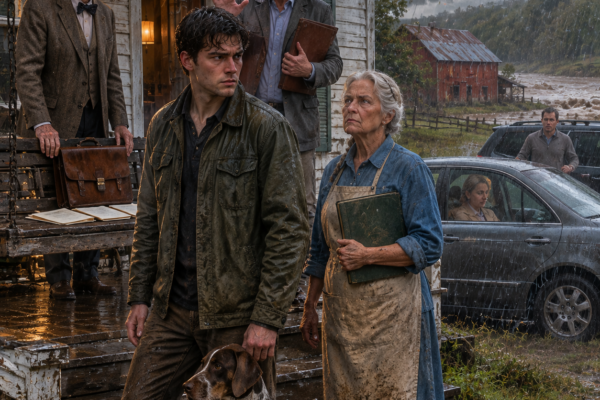
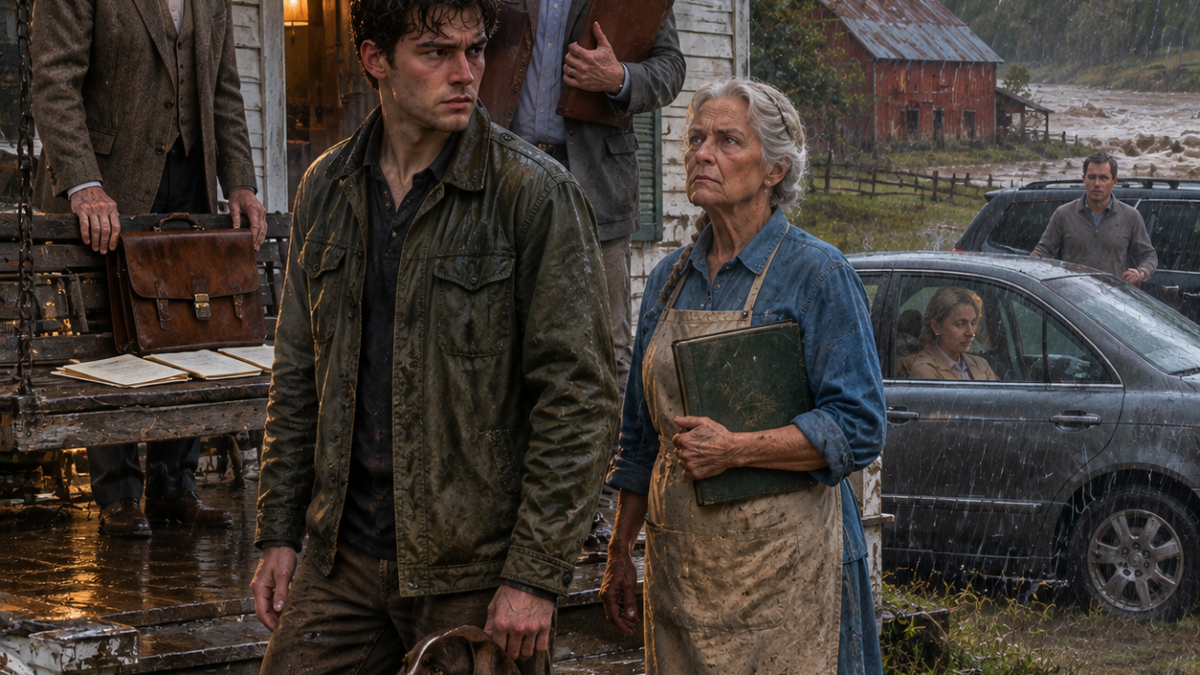
At 3:00, a tan sedan and a rented SUV came up the lane one behind the other and parked in the wet grass at the foot of the porch steps.
Marvin Ketter got out first in a pressed gray jacket over his light blue shirt with a leather folder under his arm.
He looked up at the three of them on the porch, Nate, the old lawyer, the old woman in the apron, and the dog sitting at Nates knee, and the tight pleasant smile slid into place.
Behind him, in the passenger seat, his wife did not open her door. In the SUV, Ward Telford lowered his window, saw the faces, and kept his hands on the wheel.
Marcus, Marvin said. Marvin.
Nate, his father came up two steps and stopped, one hand lifted in a small easy gesture, the hosts gesture, the ribbon-cutting gesture.
I dont want any of this to be hard.
Lets keep this simple and fair. Ive brought a family agreement, and everyones here.
We can have it all settled in half an hour.
Nate looked at the folder.
He looked at the gray sky behind it, and the green ugly light along the western ridge, and he took his hand off the dog. Dad, he said, sit down.
Theres something you need to hear. Marvin opened his mouth, and over their heads, on the old tin roof, the first hard rain began, all at once, like a handful of gravel flung against a drum.
Marvin did not sit.
He stood on the second step with the leather folder against his chest and looked from his son to the old lawyer to the woman in the apron, and the smile held a moment longer, and then simply stopped being used. I think, he said, this is a family matter.
It is, said Marcus Telford.
 [Tap here for the Next Part ]