Judge Mocked Black Teen "Life in Prison" — One Call, FBI Director Walked Into Court
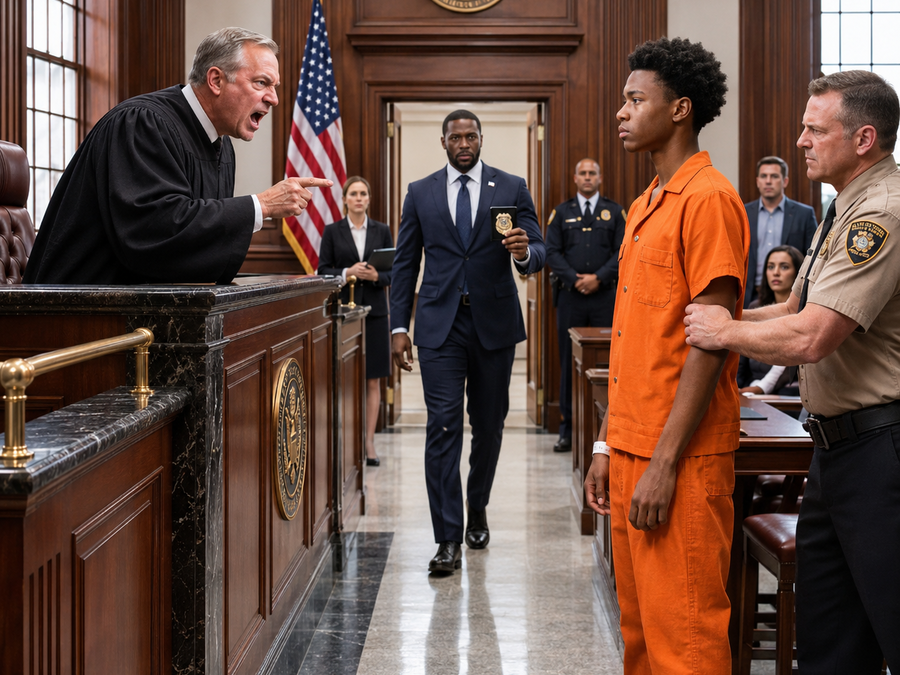
Judge Mocked Black Teen "Life in Prison" — One Call, FBI Director Walked Into Court
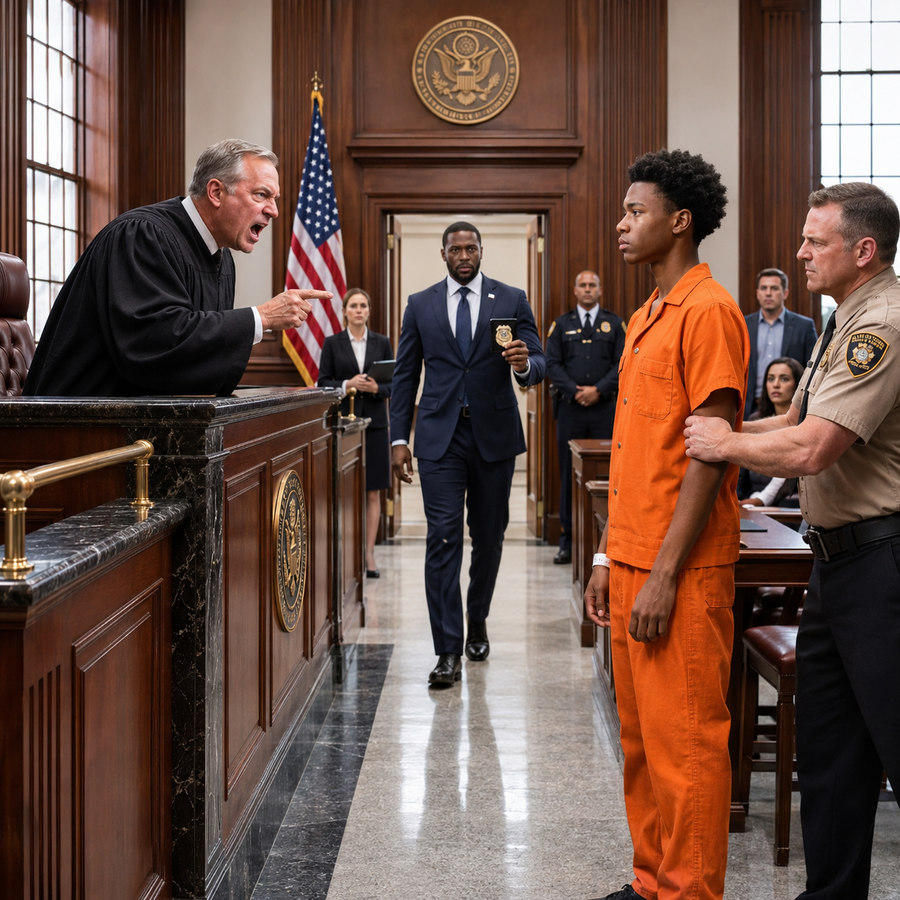
Get this animal out of my sight.
Judge Crawford didn’t look up.
He waved his hand like swatting a fly. Isaiah Owens stood in chains.
16, honor student. Your honor, I was just walking home from I can explain, your honor.
It wasn’t Shut up!
I’m so sick of you.
Same face, same hoodie, same disgusting excuses. You make me physically sick.
The clerk laughed. Deputy Holt grinned.
A woman in the gallery whispered, “Good riddance.”
Life in prison.
That’s where I put animals.
Isaiah’s hands trembled, but his voice stayed quiet.
Sir, I didn’t do anything.
Crawford stared at him, then laughed. The whole courtroom laughed with him.
But one phone call had already been made, and the man on the other end had the power to walk into any courtroom in America. He was already on his way.
Atlanta, Georgia. Summer heat pressing down on the city like a closed fist. Isaiah Owens was 16 years old, junior at Westfield Prep on a full academic scholarship, 3.
9 GPA, ran the 400 meters for the track team. Quiet kid.
Always had a book in his backpack, always said, “Yes, ma’am.”
and “No, sir.”
The kind of boy teachers remembered years later. He wanted to study criminal justice.
He told his mother that once sitting at the kitchen table.
She looked at him over her coffee and said, “Baby, why would you want to do that?”
He said, “Because somebody has to fix it.
” He lived with his mother, Gloria Owens, in a small two-bedroom apartment on the south side.
Nothing fancy. Clean floors, a refrigerator covered in report cards and posted notes. Gloria wrote one every night before her shift.
Stuck it on the fridge where Isaiah would see it in the morning. Proud of you, always.
Eat the leftovers. I mean it.
You are going to be something extraordinary. Gloria worked nights, ER nurse at Grady Memorial Hospital, 12-hour shifts, sometimes back-to-back.
She’d come home at 6:00 in the morning, shoes in her hand so she wouldn’t wake Isaiah.
She’d leave a thermos of coffee on the counter and be asleep before the sun hit the window.
Isaiah’s father died when he was nine.
Car accident on I-285 during a rainstorm. No drama, no villain, just wet roads and bad timing. After that, it was just the two of them.
They had family.
Gloria’s older brother, Nathaniel, lived in Washington, D.
C. Uncle Nate.
He called on birthdays, sent cards with $20 bills inside.
Isaiah hadn’t seen him in person in over two years.
He knew Uncle Nate had some kind of government job, something important. Gloria never talked about it much.
That was the world Isaiah lived in, small, quiet, safe, until Tuesday, 6:15 in the evening. Isaiah was walking home from tutoring at the community center.
Eight blocks, a route he walked three times a week. Earbuds in, dark hoodie, backpack over one shoulder. Three blocks from home, two squad cars screeched to a stop in front of him.
Doors flew open. Four officers, guns drawn. On the ground, now.
Hands where I can see them. Isaiah dropped to his knees.
His earbuds fell out. His backpack hit the sidewalk. He put both hands flat on the hot pavement.
“I didn’t do anything,” he said.
“I was at school.
I have my ID.
It’s in my backpack.”
Nobody checked. They rolled him onto his stomach, cuffed him, pulled him to his feet, pushed him into the back seat of a patrol car.
The crime they were looking for happened 45 minutes earlier, a convenience store robbery eight blocks east.
The suspect was described as a black male, 6’2, mid-20s, neck tattoo, armed with a handgun.
Isaiah was 5’8.
16, no tattoos, no weapon, no criminal record, not even a detention slip. The only match was this, black male in a dark hoodie.
That was enough. His body camera footage, released weeks later, captured his voice from the backseat. Calm, polite, shaking.
“Please call my mom.
She’s working at the hospital.
Her name is Gloria Owens.
Please.”
They didn’t call Gloria for 6 hours.
She found out at midnight, not from the police, from Isaiah’s one allowed phone call.
She drove to the Fulton County Juvenile Detention Center, still wearing her scrubs, badge still clipped to her chest, hands gripping the steering wheel so hard her knuckles turned white. At the front desk, she was told Isaiah had already been processed.
Bail had been denied. A judge had signed the order at an emergency hearing that evening.
A hearing nobody told Gloria about. The charge was armed robbery in the first degree, a felony, the kind that carries life in prison in Georgia. Her 16-year-old son, life in prison for walking home.
Gloria sat in her car in the parking lot for 20 minutes. The engine was off.
The windows were up. The heat was suffocating.
She didn’t turn on the air.
She cried hard.
The kind of crying that doesn’t make noise, because if it made noise, it would never stop.
Then she wiped her face, took a breath, started making calls. Neighbors, the school, every lawyer she could find who would answer at 2:00 in the morning.
She scrolled through her contacts, past one name, Nate. Her thumb hovered over it.
She put the phone down. Not yet. The judge who signed that bail denial was Harlan Crawford, 58 years old, 22 years on the bench in Fulton County.
A career built on one reputation, the toughest judge in Georgia. They called him Iron Gavel Crawford. Defense attorneys dreaded drawing his courtroom.
Not because he was strict. Strict is fair.
Crawford wasn’t fair.
Crawford had a pattern and the numbers told the story.
Over the past decade, black defendants in Crawford’s courtroom received sentences averaging 3.
4 times longer than white defendants convicted of identical crimes. In drug possession cases, black defendants averaged 8.
2 years, white defendants averaged 2. 1.
The Georgia Bar Association flagged this disparity in a report 3 years ago. The report was filed.
Nothing happened. Six formal complaints had been submitted to the Judicial Qualifications Commission. All six were dismissed.
Three of those dismissals were signed by a review panel that included Crawford’s former law partner.
Nobody touched him. Nobody challenged him. Nobody could.
Crawford played golf with the district attorney every other Saturday. He dined with city council members at a private club downtown.
His campaign fund received regular contributions from Redfield Corrections Group, a private prison company that operated three facilities across Georgia. More inmates meant more revenue. Longer sentences meant fuller beds and nobody filled those beds faster than Judge Harlan Crawford.
He’d built a machine and for 22 years it ran without a single interruption.
He had learned something dangerous, that power without accountability becomes permission. Permission to humiliate. Permission to destroy.
Permission to look at a 16-year-old boy in an oversized jumpsuit and see nothing worth saving.
Isaiah Owens was not Crawford’s first victim, but he would be his last.
If you think you know how this story ends, stay.
Because what happened next didn’t just shock that courtroom, it shook the entire state of Georgia.
And it started with one phone call that Gloria Owens hadn’t made yet.
Three days. Isaiah had been locked inside Fulton County Juvenile Detention for three days.
He hadn’t slept more than two hours at a time.
The fluorescent lights in his cell never turned off. The mattress smelled like bleach and sweat.
He’d lost 4 lbs.
On the morning of his preliminary hearing, a guard handed him the same oversized orange jumpsuit. Isaiah pulled it on.
The sleeves hung past his wrists. He folded them up twice, carefully, the way his mother taught him to fold his church sleeves when he was small. He walked into the courtroom in chains.
Gloria was already there, second row, still in her scrubs.
She’d come straight from a 12-hour shift.
Her eyes were red, but her back was straight. She held her purse in her lap with both hands, like she was holding herself together. Denise Calloway was waiting at the defense table.
29 years old, two years out of law school, 85 active cases on her desk. She had met Isaiah for the first time 15 minutes ago in a concrete room with no windows.
15 minutes to learn a boy’s entire life.
But Denise was sharp.
She’d done her homework the night before.
Pulled the convenience store security footage on her own time.
The suspect on camera was 6’2, mid-20s, neck tattoo clearly visible above his collar.
Isaiah was 5’8, 16, smooth skin.
Not even close. She also had three signed statements from tutors at the community center confirming Isaiah was present until 6:00 in the evening. The robbery happened at 5:30, eight blocks away.
The evidence wasn’t ambiguous.
It was obvious. Denise stood up.
Your honor, I’d like to present exculpatory evidence.
Security footage from the convenience store clearly shows the suspect is not my client. Height, age, and distinguishing marks do not match. Additionally, I have three witnesses confirming my client was at the Westfield Community Tutoring Center at the time of the robbery.
She held up the printed stills from the footage side by side, the real suspect then Isaiah. Two completely different people.
Crawford glanced at the screen for less than 2 seconds.
He didn’t ask for a closer look.
He didn’t ask the prosecution to respond.
He just leaned back in his chair and folded his hands.
“Counselor,” he said, “I’ve seen a hundred of these boys come through my courtroom.
Every single one of them has an excuse. Every single one has some blurry footage and a friend willing to lie for them.
” Denise kept her voice steady.
“Your honor, this is not an excuse.
This is timestamped video evidence showing my client was in a completely different location.
The physical description does not match in any Two words.”
He didn’t even let her finish.
“Your honor, with all due respect I said denied, counselor.
Sit down.”
Crawford straightened his papers. The defendant will be held without bail pending trial.
The state’s motion to try the defendant as an adult will be heard next week.
The courtroom went quiet. Tried as an adult?
A 16-year-old boy with a 3. 9 GPA, no record, no evidence.
Facing a mandatory minimum of 25 years to life. Denise gripped the edge of the table, her knuckles whitened. She opened her mouth to object again.
Crawford pointed his gavel at her.
“One more word, counselor, and I’ll hold you in contempt.
We’re done here.
Next case.”
The entire hearing lasted 11 minutes.
11 minutes to decide a boy’s life.
Isaiah turned to look at his mother. Gloria was gripping the bench in front of her so hard the wood creaked. Her lips were pressed together.
Her chin was trembling, but she didn’t cry.
Not here. Not in front of him.
Isaiah mouthed two words to her, “I’m okay.”
He wasn’t okay.
That evening, Assistant DA Garrett Whitfield filed a motion to add two additional charges, conspiracy and assault with a deadly weapon. There was no evidence for either charge. No weapon had been recovered.
No accomplice identified. No stolen merchandise found on Isaiah or anywhere near him.
Whitfield’s written justification was one sentence.
“The severity and nature of the crime warrants the fullest prosecution available under Georgia law.
” Denise read the filing at her kitchen table at 11:00 that night.
She sat there until 3:00 in the morning writing her opposition brief. Her coffee went cold twice.
Isaiah Owens had been in the system for 72 hours. He had not been convicted of anything.
He had not been shown a single piece of evidence against him, was over.
And in Judge Crawford’s courtroom, it very nearly was.
The juvenile detention center smelled like industrial bleach and boiled vegetables. The fluorescent lights buzzed 24 hours a day.
There was no switch.
No window in Isaiah’s cell.
Just a steel door with a slot at the bottom where food tray slid in and out. Isaiah kept to himself.
He was the smallest in his unit. Most of the others were 17, 18.
Some had been there for months. They moved through the halls with the heavy silence of boys who had already stopped expecting anything.
Isaiah didn’t talk much.
He read.
A dog-eared copy of Just Mercy by Bryan Stevenson that he’d found on a shelf in the common room.
He read it twice in four days.
He underlined a sentence with his fingernail because they didn’t allow pens.
The sentence was about how the opposite of poverty isn’t wealth.
The opposite of poverty is justice. A guard walked past his cell one evening, stopped, looked in through the narrow window.
Kid, I’ve seen Judge Crawford’s courtroom.
You ain’t coming home.
He said it the way someone says, it might rain tomorrow. Then he kept walking.
Isaiah sat on the edge of his bunk. He stared at the wall.
Then he picked up a sheet of paper and started writing a letter to his mother. He was allowed one letter per week.
He didn’t waste it complaining.
He asked about her shifts, whether she was eating, whether the neighbor’s cat was still sleeping on their porch.
He told her he was reading a good book.
He told her the food wasn’t bad.
He didn’t tell her about the guard.
He didn’t tell her about the boy in the next cell who screamed in his sleep every night.
He didn’t tell her that he’d started counting the ceiling tiles because it was the only way to make the hours pass.
He signed the letter the way he always did. Love you, Mom.
I’m okay.
He wasn’t okay.
Meanwhile, Denise Calloway couldn’t sleep.
It wasn’t just Isaiah’s case.
It was what she’d found behind it.
On her own time, unpaid, working after midnight at her kitchen table, Denise had started pulling Judge Crawford’s sentencing records.
Not just Isaiah’s case, all of them.
10 years of data, case by case, charge by charge, defendant by defendant.
The pattern wasn’t subtle.
It was staggering.
Black defendants in Crawford’s courtroom received average sentences 3.
4 times longer than white defendants for identical charges. In drug possession cases, the gap was worse. Black defendants averaged 8.
2 years. White defendants averaged 2.
1. Same charge, same statute, same courtroom, different skin. Crawford denied bail for black defendants at a rate of 74%.
For white defendants, the denial rate was 22%. Denise pulled the complaint history. Six formal complaints have been filed against Crawford with the Georgia Judicial Qualifications Commission over the past 15 years.
Racial bias, improper conduct, sentencing irregularities. All six were dismissed. She dug deeper.
Three of those dismissals were signed by a review panel that included a man named retired judge Leland Prescott. She ran the name.
Prescott was Crawford’s former law partner.
They’d shared an office for six years before Crawford took the bench.
The fox wasn’t just guarding the hen house.
The fox had built the hen house. Then Denise found something else. Something that made her put her coffee down and sit very still.
Crawford’s annual financial disclosures listed regular consulting payments from a firm called Ridgemont Advisory Associates.
Four payments per year, $15,000 each, 60,000 annually. Ridgemont Advisory Associates had one client, Redfield Corrections Group.
Redfield operated three private prisons in Georgia. Their business model was simple.
More inmates meant more revenue. Longer sentences meant fuller facilities. Fuller facilities meant higher profits.
And nobody in the state of Georgia delivered longer sentences more reliably than Judge Harlin Crawford. Denise stared at her laptop screen. She understood now.
This wasn’t just bias.
This was a business arrangement.
Crawford wasn’t just racist.
He was profitable. But Denise was one public defender with 85 cases. She had no subpoena power.
She couldn’t compel financial records.
She couldn’t convene a grand jury.
She could file motions that Crawford would deny. She could write briefs that nobody would read. She hit a wall.
And she knew it. She closed her laptop at 2:00 in the morning, sat in the dark, and for the first time in her career, Denise Calloway felt completely powerless. Back at the apartment on the South Side, Gloria Owens was falling apart quietly.
She had visited Isaiah that afternoon, took unpaid leave from the hospital. Her supervisor had already warned her about attendance.
One more absence, and she’d face a formal review.
She sat across from her son in the visitation room, a glass partition between them, a phone receiver that smelled like other people’s tears.
Isaiah looked thinner. His eyes were steady, but the skin beneath them was dark. He smiled at her, that same gentle smile.
“Mom, I’m okay.
Don’t worry about me.
Are you eating?
You look tired.”
He was 16, locked in a cage, and he was asking if she was eating. Gloria held it together for the full 30 minutes.
She smiled. She told him Denise was working hard. She told him this would be over soon.
She told him she loved him.
Then she walked to her car, sat in the driver’s seat, and broke.
She gripped the steering wheel and cried until her ribs ached, until there was nothing left, until the parking lot was empty and the sun was going down, and the only sound was her own breathing. Then she picked up her phone.
She scrolled past every contact, every neighbor, every friend, every lawyer who hadn’t returned her calls.
She stopped on one name. Nate.
Her thumb hovered.
She hadn’t spoken to her brother in months.
There was distance between them. Not anger, just the kind of silence that builds between two people who love each other, but live in different worlds. Gloria in her two-bedroom apartment, Nathaniel in his life in Washington that she never fully understood.
She’d never asked him for anything, not once in her adult life.
She was proud that way, maybe too proud, but her son was locked in a cell.
A judge had called him an animal, and the system she’d spent her whole life trusting was grinding her child into dust.
She pressed call. It rang three times. Gloria?
Nathaniel’s voice was calm, not surprised, not confused.
“Calm.
Nathaniel, it’s about Isaiah.”
Her voice cracked.
“They’re trying to give him life, Nate.
He’s 16.
He didn’t do anything.
The judge won’t look at the evidence.
He won’t even let the lawyer talk.
They’re trying him as an adult, and I can’t” She stopped, pressed her hand against her mouth.
Silence on the other end. One second, two, three.
Then Nathaniel spoke, slowly, each word measured.
“Gloria, I know.”
She blinked.
“What do you mean you know?
I’ve known about Judge Crawford for 18 months.
His name has been on my desk since before any of this happened.
He’s not just unfair, Gloria.
He’s criminal, and we’ve been building a case.”
Gloria’s hand tightened around the phone.
“What does that mean?
What kind of case?
Who is we?”
“It means I need you to trust me.
Don’t say a word to anyone.
Not the lawyers, not the neighbors, nobody.
Can you do that?”
“Nathaniel, my son is in a cell.
I know where he is. I know what Crawford is doing and I promise you he will not get away with it, but I need time and I need you to trust me. Silence again.
Gloria stared through the windshield at the empty parking lot. Just bring my son home, Nate. I will.
The call lasted less than 3 minutes. Gloria sat in the car for another 20.
She didn’t cry this time.
She just breathed. One week later, the transfer hearing. The courtroom was fuller now.
Word had spread. A local reporter sat in the back row with a notebook.
Denise presented everything she had, alibi footage, expert testimony on misidentification, Isaiah’s school records, character statements.
Coach Terrence Wallace took the stand.
Isaiah Owens is the most disciplined, respectful young man I’ve coached in 15 years.
The idea that he committed a violent crime is beyond absurd. Principal Elaine Bradshaw followed.
Isaiah has a 3. 9 GPA. He volunteers at the community library every Saturday.
He has never had a single disciplinary incident, not one in 3 years. Crawford listened with visible impatience. He interrupted Coach Wallace twice.
He checked his watch during Bradshaw’s testimony.
Then he granted the motion. Isaiah would be tried as an adult.
The courtroom gasped. Denise stood frozen. Gloria in the second row made a sound.
Not a word, not a scream, something deeper than both. Crawford looked at Isaiah and almost smiled.
Son, this court doesn’t run on report cards and feelings.
You’re being tried as an adult.
I suggest you prepare accordingly. Isaiah looked directly at the judge.
He didn’t cry.
He didn’t blink.
He held Crawford’s gaze for five long, unbroken seconds.
The bailiff took his arm.
As Isaiah passed his mother, he leaned close and whispered, “It’s going to be okay, Mom.
” She grabbed his hand for 1 second before the bailiff pulled him forward.
That night, two FBI field agents checked into a hotel in downtown Atlanta.
They carried two sealed boxes of documents and a federal warrant with Judge Harlan Crawford’s name printed across the top.
Isaiah Owens had 31 days until trial.
He was 16 years old, locked in an adult facility, facing life in prison for a crime he didn’t commit.
And the only person who could save him hadn’t made a single public move yet.
29 days passed. 29 days of fluorescent lights that never turned off.
29 days of steel doors and cold food and silence.
29 days of Isaiah Owens sitting in an adult holding facility surrounded by grown men twice his size, counting ceiling tiles and writing letters he wasn’t sure his mother ever received.
The trial had been fast, too fast. Crawford fast-tracked it, pushed it through in 3 weeks when similar cases took 3 months. The courtroom felt rigged from the first morning.
Crawford sustained nearly every objection from the prosecution. He overruled nearly every motion from the defense.
When Denise tried to introduce the security footage showing the real suspect, Crawford ruled it insufficiently authenticated and excluded it. Denise fought. She fought hard.
She cross-examined the arresting officers. She presented the physical discrepancies.
She put Isaiah’s tutors on the stand.
She did everything a lawyer with 85 cases and no resources could do.
It wasn’t enough.
The jury convicted Isaiah in 4 hours. They deliberated for 90 minutes.
Two jurors later told reporters they felt pressured by Crawford’s jury instructions, which emphasized the gravity of violent crime in our community and made no mention of reasonable doubt.
4 hours to end a boy’s life.
And now, it was sentencing day. The morning was hot, 92° by 9:00, the kind of Atlanta heat that makes the air shimmer above the pavement.
Inside the Fulton County Courthouse, the air conditioning hummed low and steady, but it couldn’t touch the tension in courtroom 3.
Every seat was taken. Local media filled the first two rows on the left.
A sketch artist sat at the end of the press bench, charcoal pencil already moving. Three journalists had their phones recording. A reporter from the Atlanta Journal-Constitution had her notebook open to a fresh page.
Word had spread. A 16-year-old honor student convicted of armed robbery with no physical evidence. Social media had picked it up 2 weeks ago.
A hashtag was circulating. Legal analysts were calling the trial deeply troubling.
A civil rights organization had issued a statement. None of it mattered to Crawford.
He didn’t read social media.
He didn’t watch cable news.
He’d spent 22 years in his courtroom answering to no one, and today would be no different.
Or so he believed. At 9:15, the side door opened.
Isaiah walked in. Orange jumpsuit, chains on his wrists and ankles.
He was thinner than he’d been a month ago.
His cheekbones were sharper, but his eyes were the same, steady, quiet, looking straight ahead. He sat down next to Denise.
She put her hand on his arm. He looked at her and nodded once.
A small nod, the kind that says, “I know.
I’m ready.”
Gloria sat in the second row.
She was wearing the same scrubs she’d worn the night Isaiah was arrested.
She’d come straight from a 12-hour shift, no time to change, no time to eat.
She’d driven 40 minutes with the windows down because her air conditioning was broken.
Her hands were folded in her lap. Her back was perfectly straight, and her face was calm. Strangely calm.
The kind of calm that comes when you know something nobody else in the room knows. At 9:30, the bailiff called the court to order. Everyone rose.
Judge Harlan Crawford entered through the back door of the bench, black robe, silver hair, reading glasses perched on the end of his nose. He carried a leather folder, unusual for a sentencing.
He’d prepared a statement.
He wanted to make this one memorable. He settled into his chair, took his time, adjusted his glasses, opened the folder, looked out over the courtroom the way a king surveys his kingdom.
“Mr.Owens,” he began.
His voice was slow, deliberate, performative.
“You have been found guilty by a jury of your peers of armed robbery in the first degree.”
He paused, let the words settle.
“The evidence presented to this court” Denisa’s jaw tightened.
She knew what evidence had been presented, almost none.
“leaves no room for doubt.”
Crawford looked at Isaiah over his glasses, that same look, that same curled lip.
“Young men like you are the reason this community lives in fear.
You think the rules don’t apply to you.
You think you can take what isn’t yours and walk away.
You think this court is a joke.”
He leaned forward.
“I am here to tell you that this court is not a joke, and neither is this sentence.”
He straightened the paper in front of him, cleared his throat.
“The court sentences you to” The double doors at the back of the courtroom opened.
Not fast, not dramatic, just opened, the way a door opens when the person behind it has no need to rush. Every head in the The turned.
A man stood in the doorway, tall, dark navy suit, silver at the temples, a badge clipped to his belt, catching the overhead light. His posture was straight, his shoulders square, his expression completely unreadable. Behind him stood four FBI agents in dark tactical vests.
Each one had FBI printed across the chest in yellow block letters.
And behind them, a woman in a charcoal suit, Agent Vivian Stokes, carrying a white banker’s box filled with documents.
The man in the navy suit walked down the center aisle. His shoes clicked against the marble floor.
Each step measured, unhurried.
He didn’t look at the gallery.
He didn’t look at the cameras.
He looked straight ahead at the bench, at Crawford. Crawford stopped mid-sentence.
His mouth stayed open. His hand was still raised, holding the sentencing document.
Who is Bailiff, who authorized these people in my courtroom? Deputy Holt stepped forward, but froze when he saw the tactical vests. His hand went to his belt, then dropped.
The man reached the wooden bar that separated the gallery from the court. He stopped.
Reached into his jacket pocket, pulled out a leather credential case, opened it, held it up. Not to the judge, to the entire courtroom. Deputy Director Nathaniel Owens, Federal Bureau of Investigation.
The name landed like a thunderclap. Owens.
The sketch artist’s pencil stopped.
The court reporter’s fingers froze above the keys.
Every phone in the press row was already recording. The courtroom was so silent, you could hear the air conditioning cycling through the vents.
Crawford’s face shifted.
Not fear. Not yet.
Confusion. The confusion of a man who has never been challenged in his own territory. Deputy Director, Crawford said, recovering slightly.
This is a state proceeding. You have no jurisdiction in my courtroom.
I’m going to ask you to leave immediately.
Nathaniel didn’t move.
His voice was level, almost gentle.
Judge Crawford, I’m not here for the state proceeding.
He nodded to Agent Stokes. She stepped forward, heels clicking, and handed a sealed document to the court clerk.
The clerk looked at it, then looked at Crawford. Her face went white.
Nathaniel turned back to the judge.
I’m here to execute a federal warrant for your arrest.
Crawford stood up. His chair rolled backward and hit the wall behind the bench.
This is You can’t I am a sitting judge in the state of Georgia.
You have no authority to Sit down, Judge Crawford.
Nathaniel didn’t raise his voice.
He didn’t need to.
The four agents behind him had already moved to the sides of the courtroom.
Agent Stokes stood at the clerk’s desk with the warrant in plain view.
Crawford didn’t sit, but he stopped talking.
Nathaniel spoke to the courtroom, not rushed, not angry, just facts. Each one a nail in a coffin.
Judge Harlan Crawford, you are under arrest pursuant to a federal grand jury indictment, 14 counts. He listed them the way a man reads a grocery list. No drama, no performance, just the weight of truth.
Four counts of judicial corruption under Title 18, United States Code, Section 1346. Three counts of wire fraud. Two counts of conspiracy to deprive civil rights under Section 242.
Three counts of accepting bribes from Redfield Corrections Group, totaling $462,000 over 9 years. Two counts of obstruction of justice, specifically the suppression of six formal complaints filed against you with the Judicial Qualifications Commission. He paused, let the numbers breathe.
These charges carry a combined maximum sentence of 185 years in federal prison. The courtroom erupted.
Reporters were on their phones. The sketch artist was drawing furiously.
Voices overlapped.
Someone in the gallery said, “Oh my god.”
loud enough to cut through the noise. Crawford gripped the edge of the bench.
His knuckles were bone white.
“This is a setup.
This is political. I have served this state for 22 years and I will not Mr.Crawford.
” Nathaniel’s voice cut through the noise like a blade through silk.
“You are no longer presiding over this courtroom.
You are no longer presiding over any courtroom.
You are no longer a judge.”
Agent Stokes walked toward the bench. She was holding handcuffs.
The same kind of handcuffs Isaiah had worn for 29 days. Crawford looked at the cuffs.
Then at Stokes. Then at the agents on either side of the courtroom. Then, for the first time since Isaiah had entered his courtroom, he looked at the boy.
Really looked at him. Isaiah was sitting perfectly still. His hands were flat on the defense table.
His face hadn’t changed.
No anger. No satisfaction. Just those same steady eyes watching a man who had called him an animal realize that the cage was closing around himself.
A reporter in the second row called out, “Deputy Director, the defendant, Owens, same last name.
Is he related to you?”
Nathaniel paused. For the first time, something shifted in his composure.
Just slightly. A softening around the eyes.
He looked at Isaiah, then at Gloria. Gloria was crying.
Not sobbing. Just tears. Steady and silent rolling down her face.
Falling onto her scrubs.
“Isaiah Owens is my nephew.
Murmurs rippled through the gallery. Camera shutters clicked. Nathaniel turned back to the courtroom.
His voice was steady again, controlled, clear. But I want to be absolutely clear about something. This investigation began 18 months ago, long before Isaiah was arrested, long before he stood in this courtroom.
Judge Crawford was already under federal surveillance. His pattern of racially discriminatory sentencing, his financial ties to a private prison corporation, his systematic suppression of judicial complaints, all of this was documented, investigated, and presented to a federal grand jury before my nephew ever set foot in this building. He paused.
The courtroom was silent again.
Isaiah’s case did not start this investigation.
Isaiah’s case confirmed it.
He was the latest victim of a system that Judge Crawford built to profit from incarceration and to punish people based on the color of their skin. He turned to Crawford. The judge was still standing behind the bench.
His hands were shaking. His face had lost all its color.
You spent 22 years deciding the fate of people who looked like my nephew, people who stood where he’s standing, people in chains, people in jumpsuits too big for their bodies, people you called animals.
Nathaniel’s voice dropped, quiet now, almost a whisper, but every person in that courtroom heard every word.
Today, a jury of your peers will decide yours. Agent Stokes stepped behind the bench.
Crawford didn’t resist.
He held out his wrists. The cuffs clicked shut with a small metallic sound that echoed off the marble walls.
The same sound Isaiah had heard 29 days ago. Crawford was led down from the bench, down the three steps he had climbed thousands of times, past the defense table, past Isaiah, who watched him pass without a word.
Past Gloria, who didn’t look away.
Past Denise, who was holding Isaiah’s case file against her chest, her hands trembling.
Through the side door, the defendant’s door.
The door Crawford had sent hundreds of people through. This time, he walked through it himself. The courtroom erupted.
Applause, tears, reporters shouting questions into phones. The sketch artist held up her drawing, Crawford in handcuffs being led from his own bench. But in the middle of all that noise, one moment was perfectly quiet.
Nathaniel walked to the defense table. He stood in front of Isaiah.
Neither of them spoke for a long time.
Then Nathaniel reached out and put his hand on Isaiah’s shoulder.
Isaiah looked up at his uncle. His eyes were wet.
For the first time in 29 days, he let them be. Nathaniel gave him one small nod. Gloria crossed the bar.
Nobody stopped her. She wrapped her arms around her son. The chains were still on his wrists.
She held him anyway. She held him like she was holding together every broken thing in the world.
Isaiah pressed his face into his mother’s shoulder.
“I told you it was going to be okay, Mom.”
Gloria couldn’t speak.
She just held him tighter.
They removed Isaiah’s handcuffs at 9:52 in the morning.
An acting judge, assigned within the hour, vacated all charges. The order was three sentences long.
“Case dismissed.
Defendant released.
Record expunged.”
Three sentences.
That’s all it took to undo what Crawford had spent 29 days building.
Isaiah stood at the defense table and rubbed his wrists. The skin underneath was raw.
Pink lines where the metal had pressed against bone for almost a month. He stared at his hands like he was seeing them for the first time.
Denise was standing next to him.
She was holding his case file, the one she’d built alone night after night at her kitchen table.
Every page of sentencing data, every complaint she’d dug up, every number that proved what everyone already knew but nobody could say out loud.
An FBI agent approached her, young, professional.
He spoke quietly, “Miss Calloway, your research on Judge Crawford’s sentencing disparities, we’d like to incorporate it into the federal case file.
It corroborates 18 months of our own findings.”
Denise looked at him, then at the file in her hands. All those nights, all those hours, all that work she thought nobody would ever see.
She handed it over. Her hands were shaking.
“Take it,” she said.
“Use every page.”
Gloria was still holding Isaiah.
She hadn’t let go.
A deputy had to ask her gently to step back so they could process the release paperwork. She stepped back exactly 1 ft, no further.
Isaiah walked out of the Fulton County Courthouse at 10:30 that morning. No jumpsuit.
They’d given him back the clothes he was wearing when he was arrested.
The dark hoodie, the jeans, the backpack with his school ID still inside. He walked down the courthouse steps into the Atlanta sun.
Gloria held his hand. Nathaniel walked three steps behind them, close enough to be there, far enough to let the moment belong to mother and son.
A wall of reporters waited at the bottom of the steps. Cameras, microphones, shouted questions.
Isaiah didn’t stop.
Gloria didn’t stop.
They walked straight to the car, got in. Gloria started the engine. They drove home in silence.
Isaiah leaned his head against the window and watched the city pass. Gloria kept one hand on the wheel and one hand on his arm.
When they pulled into the apartment parking lot, Isaiah looked at the building, the cracked sidewalk, the neighbor’s cat sleeping on the porch railing, the mailbox with Owens written in Gloria’s handwriting.
He said, “I miss this.”
Gloria turned off the engine.
“I know, baby.
” They sat there for a while, just breathing, just being home.
In the weeks that followed, the scope of Crawford’s corruption unfolded like a map of everything wrong with the system that had unchecked for two decades.
The federal grand jury had reviewed 2,300 pages of evidence. Financial records showed Crawford received $462,000 from Redfield Corrections Group through a shell company called Ridgemont Advisory Associates.
$15,000 per quarter, 60,000 per year, nine years running. Every dollar had a corresponding pattern.
In quarters when Crawford increased average sentence lengths, Redfield’s per prisoner revenue rose proportionally.
When Crawford’s sentences dipped slightly during an election year when he was under mild public scrutiny, so did Redfield’s payments.
An internal Redfield memo obtained by FBI forensic accountants described Crawford in writing as our most reliable judicial partner in the southeastern region. Partner.
That was the word they used. Not judge, not public servant. Partner.
Crawford had also suppressed six formal complaints against himself. Three were buried through the review panel that included his former law partner, retired judge Leland Prescott.
The other three simply disappeared from the commission’s records.
FBI data recovery specialist found them in deleted server files. The Georgia Supreme Court ordered a comprehensive review of every case Crawford had presided over in the last 15 years.
The numbers were devastating. 214 cases flagged for review.
83 defendants received sentence reductions or full exonerations. 79 of them were black. Some had served 5 years.
Some had served 10. One man had served 12 years for a drug possession charge that should have carried 18 months.
12 years stolen because one judge decided his skin was worth more time. Redfield Corrections Group faced a separate federal investigation. Two senior executives were indicted on conspiracy and fraud charges.
The company lost its Georgia state contracts within 90 days. Two of its three facilities were scheduled for closure.
Garrett Whitfield, the assistant DA who had filed charges onto Isaiah’s case, was placed under internal investigation for prosecutorial misconduct.
Evidence showed he had coordinated with Crawford on at least 11 cases to inflate charges against black defendants. He resigned before the investigation concluded. His law license was suspended pending review.
Deputy Holt, the bailiff who had grinned when Crawford called Isaiah an animal, was terminated. Not for grinning, for failing to report judicial misconduct he had witnessed repeatedly over 6 years.
One by one, the pillars of Crawford’s machine came down.
And the people who had been crushed by that machine began to stand back up. Isaiah returned to Westfield Prep on a Monday morning in September.
The school didn’t throw a party.
They didn’t hang banners.
Principal Elaine Bradshaw met him at the front entrance. She shook his hand.
Isaiah, your seat was never filled. Welcome home. He walked into his first class, sat down, opened his notebook.
The kid next to him slid a piece of paper across the desk.
It said, “Glad you’re back.”
Isaiah finished his junior year with a 4. 0 GPA. He received a full scholarship offer from Morehouse College, pre-law.
He accepted the same week. Gloria took a week off work, her first in 3 years. She slept late.
She cooked meals that took longer than 30 minutes.
She sat on the porch in the evening and watched the street and didn’t check her phone.
One night, Isaiah came out and sat next to her.
They didn’t talk.
They didn’t need to.
The silence between them was the kind that only exists between two people who have survived the same storm. Denise Calloway was appointed to the newly formed Fulton County Judicial Reform Commission. She was the youngest member by 15 years.
Her first formal recommendation was mandatory bias audits for every sitting judge in the county, reviewed annually by an independent body with subpoena power. The recommendation was adopted unanimously. Nathaniel Owens returned to Washington.
He and Isaiah talked on the phone every Sunday evening now. Long conversations.
Not about the case, about school, about books, about what kind of lawyer Isaiah wanted to be. Their calls were longer than they used to be. Neither of them mentioned that.
Neither of them needed to. Eight months later, Harlan Crawford stood trial in federal court.
He entered through the defendant’s entrance, the same door he had sent thousands of people through, the same door Isaiah had walked through in chains.
Crawford wore a gray suit, no robe, no gavel, no elevated bench. Just a man in a chair sitting where his defendants used to sit. The trial lasted 3 weeks.
The evidence was overwhelming.
2,300 pages of financial records, internal memos from Redfield Corrections Group, deleted complaint files recovered from state servers, testimony from former clerks, former bailiffs, and three former prosecutors who admitted they had cooperated with Crawford’s system because they were afraid of what would happen if they didn’t.
Crawford was convicted on 12 of 14 counts. The sentencing hearing was held on a Tuesday morning.
The courtroom was full.
Some of the people in the gallery were former defendants, men and women who had stood before Crawford’s bench and received sentences they didn’t deserve.
They sat quietly. They watched.
The judge who sentenced him was a black woman, Judge Adrienne Palmer, 30 years on the federal bench. She spoke without notes.
“Mr.Crawford, you took an oath.
You swore to uphold the Constitution and to administer justice equally, without prejudice, without favor, without fear. You violated that oath every single day for 22 years.
” She paused.
“You turned your courtroom into a revenue stream.
You turned human beings into inventory. You looked at young men and women who came before you asking for fairness, and you gave them cruelty.
Not because of what they did, because of who they were.”
She folded her hands.
“This court sentences you to 15 years in federal prison.
No possibility of early release.”
Crawford was 60 years old. He would be 75 before he saw the outside of a prison.
He said nothing.
He was led away through the defendant’s door.
The same door. One last time. One year after his arrest, Isaiah Owens received an invitation.
A congressional subcommittee on juvenile justice reform wanted him to testify. They had read about his case. They wanted to hear from him directly.
Isaiah was 17 now, taller, broader in the shoulders, still quiet, still the kind of person who listened more than he spoke. Gloria tied his tie in the hallway of a Washington hotel.
Her hands were steady. She straightened his collar and looked at him.
“You don’t have to do this, you know.
I know, he said. I want to. He sat before the subcommittee in a dark blue suit.
No notes, no prepared remarks. He spoke for 12 minutes. His voice was calm.
The room was silent. I was 16 years old standing in an American courtroom, and a judge looked at me and saw a criminal before I said a single word.
Not because of what I did, because of what I looked like. He paused, looked at the committee members.
I’m not here for revenge.
Judge Crawford is serving a sentence.
That’s the law working the way it should.
I’m here because right now, today, there are boys sitting in courtrooms who look like me being judged the same way I was judged, and they don’t have an Uncle Nate.
They don’t have an FBI investigation that started 18 months before they got arrested.
They just have themselves, and that’s not enough.
It shouldn’t have to be.
The gallery gave him a standing ovation.
Isaiah didn’t smile.
He just nodded. Once. His testimony contributed to the introduction of the Judicial Accountability and Transparency Act, a bill requiring federal bias audits for all state court judges receiving federal funding.
Legal scholars began calling it Isaiah’s Law.
Denise Calloway’s Reform Commission model was adopted by three other states within 2 years.
Bryan Stevenson’s Equal Justice Initiative cited the Crawford case in their annual report as proof that judicial accountability is not a fantasy.
It is a choice. 2 years later, Morehouse College, Atlanta. Isaiah sat in a lecture hall, Criminal Justice 101, first day of freshman year.
The professor stood at the front of the room and opened the class.
Today, we’re discussing judicial bias and systemic inequality.
Can anyone give me a real-world example? Isaiah raised his hand.
The professor pointed to him. Isaiah looked around the room, took a breath, and smiled, just barely.
I’ve got one.
Justice isn’t revenge.
Justice is making sure the next kid doesn’t have to stand where Isaiah stood.
It’s one phone call, one person who refuses to look away, one courtroom where the truth finally matters more than the gavel.
THE END.