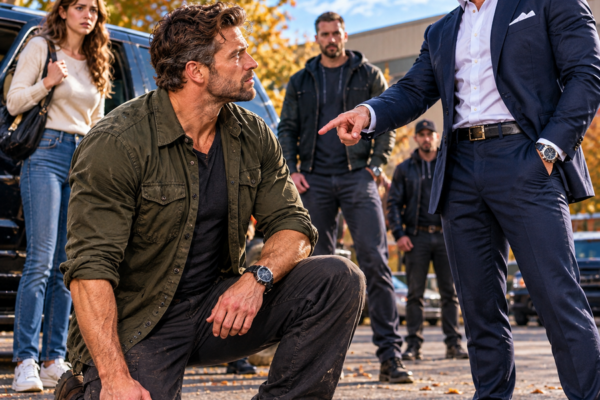
The Billionaire Tried to Leave Quietly—Then Her Little Girl Begged to Eat With an Ex-SEAL Single Dad-Part 3

========== PART 3 ==========
The kind of person who never asked you to do anything he hadn’t done himself.
The death had been ruled an accident.
He had fallen from the terrace of a private residence during a dinner party.
The medical examiner’s report
which Cole found summarized in a local news article
noted blunt force trauma consistent with the fall and no evidence of foul play.
Cole read that sentence carefully.
Then he read the guest list from the dinner party
which the same article had published with a studied casualness that suggested the journalist had known it was significant without knowing quite why.
He didn’t recognize any names.
He cross- referenced them anyway
one by one
in the particular methodical way he’d learned to cross reference information.
Not hunting for confirmation, but hunting for the thing that didn’t belong.
Names told stories when you set them next to each other.
patterns revealed themselves in the gaps.
Two of the guests were listed as executives of a logistics consulting firm called Meridian Pacific Group.
He searched Meridian Pacific Group.
Haritch Defense Consulting had acquired Meridian Pacific Group 11 months ago
4 months before the deal was publicly announced
according to the filing dates of the incorporated documents Cole eventually found in a state business registry.
He sat back.
The chair creaked.
The kitchen was quiet.
The refrigerator hummed.
He was looking at something.
He was fairly certain he was looking at something
but he was also aware that he was a maintenance technician in Seattle who had spoken to this woman for 90 minutes over garlic bread and bad coffee
and that the instinct telling him this was significant could equally be the instinct of a man whose brain had been trained to find threats and patterns and hadn’t fully learned to stand down.
He closed the laptop.
He washed his coffee cup.
He turned off the kitchen light.
He stood in the hallway outside Sadi’s room and listened to her breathe for a moment
the way he did sometimes when the day had left him unsettled
and he needed something real to confirm itself.
She was fine.
She was sleeping.
She was 8 years old and had a permission slip in the front pocket of her backpack
and she had made a friend last night over garlic bread.
He went to bed.
He thought about Vivien Sterling and the way her hand had tightened on the tablecloth.
He thought about a man named Elias Vain who was supposed to be dead and apparently was not.
He thought about the look on Lena’s face when she’d touched her wrist.
Not distress exactly
not pain
more like the reflex of someone who had gotten very good at reminding themselves to stay calm because staying calm was a thing that had become necessary.
He did not sleep well.
He didn’t sleep well the night after that either.
He told himself he was going to let it go.
He had no connection to Vivien Sterling.
He had no obligation to her
to her company
to the acquisition of Haritch Defense Consulting
or to whatever buried thing existed in the space between a dead man’s dinner party guest list and the name of a former military contractor who had reasons to stay off the grid.
He said that to himself with some regularity over the following 10 days.
On the 11th day
his phone rang at 7:43 in the morning while he was driving to a job site.
He didn’t recognize the number.
He almost didn’t answer.
He answered, “Is this Cole Mercer?”
The voice was controlled
professional
and underneath that
far underneath
in the place where people hid the things they couldn’t afford to show.
Frightened, he recognized the voice.
“This is Cole,” he said.
A breath
a pause that lasted long enough to tell him she’d been stealing herself to make this call.
“This is Viven Sterling.
I We met at Polarmos.
I don’t know if you remember.”
I remember, he said.
Lena is missing.
The words came out flat and deliberate
stripped of the panic they’d been shaped around.
She didn’t come home from school.
She wasn’t at afterare.
The car I sent for her.
The driver waited 40 minutes.
The school can’t account for her after 3:00.
Cole pulled to the curb.
“Have you called the police?”
he said.
“I called them 15 minutes ago.
They’ve taken a report.”
A pause.
“I need you to help me find my daughter.”
He sat at the curb.
The traffic moved around him.
A morning in Seattle, ordinary and indifferent, going about its business.
“Why me?”
he said.
“Because it was the right question.”
Vivian was quiet for a moment.
“Because you were the only person at that table who was actually paying attention
” she said.
“And I don’t know who else I can trust right now.”
Cole looked at the traffic.
He thought about a child who touched the inside of her wrist when she was anxious.
He thought about fear
the particular kind that wasn’t about the present
but about something already in motion.
Something that had been in motion for a long time
that had been set in motion
maybe before a man fell from a terrace at a dinner party 22 months ago.
He thought about a name.
Give me 20 minutes, he said.
He put the car in drive.
He drove to Sterling Group’s headquarters first because Viven was there and because he needed to see her face when he asked her certain questions that he could not ask over a phone.
The building was a glass tower on 4th Avenue
42 floors of the kind of architecture that announced its own importance without quite committing to beauty.
The lobby had the particular hushed quality of expensive spaces.
marble floors
a security desk staffed by two men in dark blazers
a wall of elevator doors that opened and closed with the silence of things that had been engineered never to malfunction.
Cole walked in wearing his work jacket.
“The security guard at the desk looked at him the way security guards looked at people who didn’t match the building.
” “I’m here for Vivien Sterling,” Cole said.
“She’s expecting me.”
He was upstairs in 4 minutes
which told him either that Viven had significant pull over her own security staff or that she was frightened enough to have cleared the path herself
probably both.
She met him at the elevator.
She looked like she had not slept.
She had dressed
composed herself
arranged herself in the way that people who had been trained to function under pressure arranged themselves when the pressure was real.
But the arrangement was slightly wrong at the edges.
Her hair was not quite right.
She was holding her phone in both hands without looking at it
which was the opposite of her usual relationship with the device.
“Thank you for coming,” she said.
“Tell me everything from 3:00 yesterday,” he said.
“Don’t summarize.
Just go in order.”
She nodded and took him to a conference room on the 38th floor
and she went in order.
Lena’s school day had been normal by all accounts.
Her teacher had nothing unusual to report.
She had eaten lunch
attended afternoon classes
been present at roll call at 2:45.
At 3:00, school dismissed.
The car
a black SUV driven by a man named Marcus
who had worked for Viven for 3 years
had been parked at the designated pickup lane since 2:50.
Marcus had waited until 3:40 before calling Viven’s assistant.
By then
the school had already checked twice with teachers
the library
the gymnasium
and the bathrooms.
Lena was gone.
Was she upset about anything recently?
Cole asked.
Before yesterday, Vivien hesitated.
Vivien.
She had been asking about her father again
Vivien said more than usual in the last 2 or 3 weeks.
She looked at the table.
She found a photograph she hadn’t seen before.
In my desk.
She wasn’t supposed to be in my desk.
What photograph?
Daniel at a at some kind of event.
There were other people in the photograph.
She didn’t recognize them and she asked me who they were and I told her I didn’t remember.
She paused.
I did remember.
Cole was quiet.
I told her I’d explain later, Vivien said, which is what I always tell her.
He sat back.
He looked at the ceiling for a moment, then at her.
The people in the photograph
were any of them connected to Harwitch Defense Consulting?
The silence that followed was about 3 seconds longer than it should have been.
Why would you ask that?
Vivien said
“Because I looked up your company after we met
” he said
“and I found the Haritch acquisition and I found a name on the executive roster that I recognized.
” He watched her face carefully.
Elias Vain.
Vivien did not react in the way he’d expected.
She didn’t look confused.
She didn’t say the name like she was hearing it for the first time.
She closed her eyes.
That told him enough.
“You know who he is?”
Cole said.
He’s an executive at Harwitch, she said, eyes still closed.
He came highly recommended by the board advisers who proposed the acquisition.
He’s more than that, she opened her eyes.
I know what he is, she said quietly.
I’ve known for 8 months.
I had a private investigator look into the acquisition before I agreed to move forward with it.
The investigator found some things that were
she stopped
started again
complicated.
What did the investigator find?
that Harwitch has been routing money through subsidiaries in a way that doesn’t appear in the consolidated financials
that several of those subsidiaries have government defense contractor numbers attached to
them
that some of the contracts those numbers correspond to don’t exist in any public registry.
She was speaking carefully
choosing the precise weight of each word
and that Elias Vain has been the operational architect of that structure for at least 3 years.
Cole looked at her.
And you still moved forward with the acquisition.
It was not a question.
Viven’s jaw tightened.
I was advised that pulling out of the deal without clear legal grounds would expose the company to a breach claim.
And I was She stopped again.
This stop was different.
Not searching for the right word, but deciding whether to use the right word.
I was told that withdrawing would create problems.
Who told you?
Someone on my board.
Which someone?
She met his eyes.
A man named Graham Ree.
He’s been on the board for 4 years.
He came in after Daniel died as part of a restructuring.
She looked at her hands.
I was at the dinner party the night Daniel died.
Cole went very still.
He had seen Graham Reese’s name in the guest list.
He had cross- refferenced it and found nothing.
a board director
an unremarkable biography
a man who existed in the financial ecosystem in the diffuse
uncontroversial way that people with power sometimes chose to exist.
He had not flagged it.
He flagged it now.
“I need you to find Lena,” Vivian said.
Her voice had dropped.
The composed surface of it had developed a fracture that she was not trying to hide.
“Whatever else is happening
whatever I have to deal with
whatever comes
I need you to find her first.”
She may have run, Cole said.
What?
Kids who run are usually running towards something or away from something.
She’s eight.
She doesn’t have resources or a plan.
She has somewhere specific in mind.
He stood.
Where did she go with her father regularly?
Not the vacations, not the big things, the small regular things.
Vivian thought.
The park.
Maplewood.
The one near our house.
Daniel used to take her Saturday mornings.
She paused.
And the community center on Ellison, he volunteered there.
He took her twice and she loved it.
Which community center?
The Ellison Street community center.
It’s, she thought.
It’s been closed for renovation for about 6 months.
They’re doing the roof.
Cole picked up his jacket.
Stay here, he said.
Answer the police when they call.
Don’t call Ree.
Don’t call anyone on the board.
Vivian stood.
I’m coming with you.
I’ll move faster without she’s my daughter.
There was nothing negotiable in her voice, just the flat undecorated fact.
I’m coming, he looked at her for a moment.
Fine, he said, but you do what I say when I say it.
No questions, no delays.
Then you do that.
She held his gaze.
Yes.
He was not entirely sure he believed her, but he moved.
The Ellison Street Community Center was a two-story brick building in a neighborhood that had been in the process of becoming something different for the last decade without quite deciding what.
Half the storefronts on the block were occupied and half were papered over.
And the community center sat at the near corner with scaffolding along its east side and a padlock chain across the front entrance and a handwritten sign in the window that said
“Renovation in progress.
See you in spring.”
which had been there by the look of it since a spring that had already passed.
Cole walked the perimeter first while Viven stood by the car and tried not to visibly fall apart.
He found a side door with a lock that had been not quite fully engaged.
The mechanism turned
but the bolt didn’t fully seat
which was the kind of thing you noticed if you’d spent 8 months doing building maintenance and had learned the language of doors that had been persuaded rather than forced.
Someone small had come through this door recently.
The ground near the threshold was disturbed in the particular way that suggested a child-sized footprint
though the surface was too rough to be definitive.
He pushed the door open and stepped inside.
The interior was dim
dusty
smelling of construction materials and old gymnasium floor.
The renovation had not progressed far.
The lobby ceiling had been stripped
wires hanging
but the hallway beyond it was intact.
He moved through it without turning on the flashlight on his phone
letting his eyes adjust.
He heard something before he saw anything.
A sound, very small, not movement, breathing.
The specific rhythm of someone who was trying to breathe quietly and was not quite managing it because they’d been crying.
He followed it to a room at the back of the building that had been some kind of meeting room.
stackable chairs against the wall
a folding table
a window with a broken blind.
Lena was sitting on the floor against the far wall with her knees pulled to her chest
wearing her school uniform and a jacket that wasn’t quite warm enough
and she had been crying for a while by the look of it
the kind of crying that had exhausted itself and
left the face behind it red and swollen and utterly spent.
She looked up when Cole appeared in the doorway.
She didn’t look frightened.
She looked relieved, which told him something important.
“Hey,” he said.
He didn’t move into the room.
He kept the doorway between them
close enough to be present
far enough not to crowd her.
“You okay?”
Lena wiped her face with the back of her hand.
“How did you find me?”
“Your mom told me your dad used to bring you here.”
Lena looked at the floor.
“She’s outside,” Cole said.
“She’s worried about you.”
“I know.”
The girl’s voice was thick, stuffed with the aftermath of crying.
I didn’t mean to.
I wasn’t trying to scare her.
I just needed to be somewhere that felt like him.
Cole stepped into the room then and sat on the floor
not beside her
but a few feet away at an angle.
The way he’d learned to sit next to people who were fragile
so they didn’t feel cornered by proximity.
He rested his arms on his knees.
“This was his place,” Cole said.
He used to set up chairs in here, Lena said.
For the Saturday meetings, the AA meetings.
There was a group that met here.
He’d set up chairs and make coffee, and I’d help him put the cups out.
She looked at the stacked chairs against the wall.
He said it was important to do things that weren’t about you.
Cole said nothing.
He let that sit.
I heard them talking, Lena said.
He looked at her.
Who?
Two men at school, not teachers.
They were standing near the fence at the back of the playground at lunch.
I don’t know how they got there.
I heard them saying my dad’s name.
She pressed her lips together.
They were still trembling slightly, unevenly.
They didn’t know I could hear them.
They were talking about files and about something my dad had found.
Cole kept his voice even and quiet.
What did they say he found?
Lena looked at him.
She had her mother’s eyes dark
direct
the kind that didn’t look away when they decided to say something.
They said he was going to tell someone about the money.
They said he’d put things somewhere safe before, she stopped, swallowed.
Before the party, Cole held himself very still.
They said if the files came out, it would ruin everything, Lena continued.
And then one of them said that the little girl doesn’t know anything.
She’s not a problem.
Her voice broke slightly on the last word
not from fear
but from something harder.
the particular humiliation of being discussed as if you’re not consequential.
But the other one said they weren’t sure anymore.
Cole looked at the girl
this 8-year-old who had carried this for however long she’d carried it
who had gotten on a school bus and walked past a fence and heard her dead father’s name
and then walked to the one place she could think of that still smelled like him.
And he felt something that he had no name for that sat behind his sternum and made it hard to breathe cleanly.
Lena, he said, “What you just told me is very important.
Do you understand that?”
She nodded.
“You did the right thing running here instead of going with them if they’d approached you.
” “They didn’t approach me,” she said.
“They didn’t see me.”
“Good.”
He held her eyes.
“But we’re going to leave now
and we’re going to go to your mother
and then you’re going to tell both of us exactly what you heard.
Every word you can remember.
Can you do that?
Is my mom in trouble?”
He considered the precise and honest answer to that question.
“She might be,” he said, “but she’s got people trying to help her now.”
Lena looked at him for a moment with the evaluating directness of a child who had been lied to carefully for 2 years and had developed a very good ear for it.
Then she nodded.
“Okay,” she said.
“Okay.”
She let him help her up
and they walked back through the dim hallway
out the side door into the gray afternoon.