Part 3: “You’re going to spend the rest of your life trying to earn me. Starting now.”
CHAPTER 14: The Press Conference
The U.S. Attorney’s office scheduled the press conference for Friday morning.
Elena stood in the wings of the federal courthouse, watching the cameras assemble, the reporters jostle for position, the microphones cluster on the podium like a swarm of locusts. She’d been to a hundred events like this during her years as a Kessler wife—charity galas, foundation announcements, product launches—but she’d never been on this side of the podium.
Adrian stood beside her, his face pale but composed. He’d spent the last week preparing his statement, working with his lawyers, cooperating with investigators. He looked thinner than he had a month ago, the shadows under his eyes darker, but there was something steadier about him—something that hadn’t been there before.
“Are you ready?” she asked.
“No.” He turned to her. “But I’m going to do it anyway.”
“That’s what courage looks like.”
He almost smiled. “You sound like my sister.”
“I’ll take that as a compliment.”
The U.S. Attorney stepped to the podium, a tall woman with graying hair and a voice that carried without amplification. She spoke about the investigation, the charges, the evidence that had been gathered. Then she introduced Adrian.
He walked to the podium.
The cameras clicked. The reporters leaned forward. Elena held her breath.
“My name is Adrian Kessler,” he said. “Until three weeks ago, I was the CEO of Kessler Pharmaceuticals. I am here today to plead guilty to charges of fraud, obstruction of justice, and negligent homicide.”
A ripple went through the crowd.
“I am also here to tell you the truth about my family and the company my father built. For thirty years, Kessler Pharmaceuticals has been engaged in a pattern of criminal behavior—falsifying trial data, suppressing adverse events, bribing officials, and intimidating witnesses. This behavior was orchestrated by my mother, Vivian Kessler, who served as chair of the board and used her position to enrich herself and her family at the expense of human lives.”
He paused, his voice steady.
“I participated in this behavior. I signed documents I knew were false. I approved trials I knew were dangerous. I told myself I was protecting the company, protecting my family, protecting my future. But the truth is simpler and uglier: I was protecting myself. I was too cowardly to stand up to my mother, too greedy to give up the money and power that came with the Kessler name.”
The room was silent.
“Corvalex is the latest example of this pattern. The drug was known to cause severe cardiac events—at least fifteen deaths can be directly attributed to it—and yet we were preparing to submit it to the FDA for approval. I was going to let it happen. I was going to let more people die.”
Adrian’s voice cracked, but he kept going.
“I am here today to say that I am done. I am done lying. I am done covering up. I am done being my mother’s son. I am pleading guilty to the charges against me, and I am cooperating fully with the investigation. I will testify against my mother and anyone else involved in this conspiracy. I will spend the rest of my life trying to make amends for what I’ve done.”
He stepped back from the podium.
The silence lasted a beat—two—three—and then the questions exploded.
CHAPTER 15: The Matriarch’s Fall
Vivian Kessler was arrested two days later.
Elena watched it happen on the evening news—the flashing lights, the reporters camped outside the Kessler estate, the small, unmarked car pulling away with Vivian in the back seat. She looked out the window of the drawing room, her silver hair perfectly coiffed, her expression unreadable, as if she were on her way to a luncheon rather than to a federal detention center.
Adrian stood beside Elena, his hands shoved in his pockets, his face pale.
“She knew it was coming,” he said quietly.
“Does that make it easier?”
“No.” He turned away from the window. “Nothing makes it easier.”
Elena sat down on the couch. The house was empty except for the two of them—the staff had been dismissed weeks ago, the furniture covered with dust sheets, the rooms growing colder as the heating system was scaled back to save money. It was strange, being in this house that had been her prison for seven years, knowing it would soon belong to someone else. The government had frozen the family assets. Everything would be auctioned off—the estate, the cars, the art, the jewelry.
“What happens now?” she asked.
“The trial starts in three months. I’ll testify. Isabel will testify. Cordelia has already given her deposition.” He paused. “My mother will probably be convicted. She’ll spend the rest of her life in prison.”
“And you?”
“I’ll go to prison too. Not for as long—my cooperation has bought me some leniency—but long enough.”
“How long?”
“Five years, probably. Maybe less with good behavior.”
Elena nodded slowly. Five years. Five years of her life spent waiting for a man who might not come back the same person. Five years of visits and letters and the slow erosion of everything they’d built.
“I’ll be here,” she said. “When you get out. I’ll be here.”
“Elena—”
“Don’t.” She held up a hand. “We’ve had this conversation. I’m not leaving. I’m not running. I’m staying.”
“Why?”
“Because I believe in second chances. Because I’ve seen you change. Because—” She stopped, her voice catching. “Because I love you. I’ve always loved you. Even when I hated you. Even when I wanted to destroy you. I love you, Adrian. And I’m not going to let your mother take that away from us.”
He crossed the room and knelt beside her, taking her hands in his.
“I don’t deserve you.”
“I know.” She almost smiled. “But you’re going to spend the rest of your life trying to earn me.”
“I will. I swear to God, I will.”
She leaned forward and kissed him—soft, gentle, full of everything she couldn’t put into words. It was their first kiss in months. Their first real kiss in years.
Outside, the reporters were still camped on the lawn, their cameras trained on the house. But inside, in the dim light of the abandoned drawing room, two people who had lost everything found something worth keeping.
CHAPTER 16: The Witness
The trial began on a gray morning in March.
Elena sat in the gallery, watching as Isabel Moreau took the witness stand. She was dressed in a plain gray suit, her blonde hair pulled back, her face pale but composed. She looked nothing like the polished woman from the gala—she looked human, vulnerable, real.
“Do you swear to tell the truth, the whole truth, and nothing but the truth?”
“I do.”
The prosecutor stepped forward. “Ms. Moreau, can you tell us your relationship to the defendant, Vivian Kessler?”
“She was my employer. And she was—” Isabel paused, her voice steady. “She was the woman who killed my mother.”
A murmur went through the courtroom.
“Can you explain what you mean by that?”
Isabel took a breath. “My mother, Marie Moreau, was Richard Kessler’s mistress. When she became pregnant with me, he paid her off—gave her a house, a monthly stipend, and the promise that he would never acknowledge me as his child. When I was five years old, my mother was given an experimental drug—the early version of what later became Corvalex. She died three days later. The death certificate said heart attack. But I’ve since learned that the drug caused her death. And Vivian Kessler knew it.”
“How do you know she knew?”
“Because she told me.” Isabel’s voice was hard. “When she hired me three years ago, she told me everything. She said she wanted to ‘keep me close.’ She said she wanted to make sure I never went public with what I knew. She used my mother’s death as leverage—a threat and a promise. If I kept quiet, I would be rewarded. If I spoke out, I would be destroyed.”
“And did you keep quiet?”
“For a while. Then I started sending anonymous tips to the FDA. Then I met Dr. Elena Marchetti and told her everything.”
The prosecutor nodded. “Thank you, Ms. Moreau. No further questions.”
The defense attorney stood. He was a small man with a sharp suit and sharper eyes—one of the best criminal lawyers in the country, hired with the last of Vivian’s frozen assets.
“Ms. Moreau, you’ve testified that Vivian Kessler ‘killed’ your mother. But isn’t it true that you have no direct evidence of this? No documents, no witnesses, no proof?”
“I have my mother’s autopsy report. I have the original trial data from the drug that killed her. I have—”
“You have speculation.” The lawyer’s voice was smooth. “You have a grudge against a woman who gave you a job. You have a convenient story that casts you as the victim rather than the accomplice. Isn’t it true that you worked for Kessler Pharmaceuticals for three years? That you helped cover up the very crimes you’re now testifying about?”
Isabel’s jaw tightened. “I did what I had to do to survive.”
“Survive? Or profit?”
“Objection.” The prosecutor was on his feet. “Harassment.”
“Sustained.”
The defense attorney smiled. “No further questions.”
Isabel stepped down from the witness stand, her eyes meeting Elena’s for just a moment. There was something in her gaze—sadness, maybe, or gratitude—that Elena couldn’t quite name.
CHAPTER 17: The Truth Comes Out
Adrian testified on the third day.
He walked to the witness stand with the same measured stride he’d used as CEO, but there was something different about him now—a humility that hadn’t been there before. He wore a plain blue suit, no tie, no pocket square, no jewelry. He looked like a man who had stripped away everything that wasn’t essential.
“Do you swear to tell the truth, the whole truth, and nothing but the truth?”
“I do.”
The prosecutor spent the next hour walking him through the details of the Corvalex conspiracy—the falsified data, the suppressed adverse events, the bribes paid to FDA officials, the threats made to researchers who tried to speak out. Adrian answered every question without hesitation, his voice steady, his eyes fixed on some point in the middle distance.
Then it was the defense’s turn.
“Mr. Kessler, you’ve testified that your mother orchestrated this conspiracy. But isn’t it true that you were the CEO? Isn’t it true that you had the power to stop it at any time?”
“I had the title,” Adrian said. “But my mother had the control. She controlled the board, the finances, the key relationships. If I had tried to stop her, she would have destroyed me.”
“Destroyed you? Or fired you?”
Adrian was silent for a moment. “Both. She would have fired me from the company and destroyed me personally. She would have leaked information about my personal life, my marriage, my—” He stopped.
“Your what, Mr. Kessler?”
“My sister.” Adrian’s voice was barely audible. “My sister who died when I was twelve. My mother covered it up—told everyone it was a heart condition. But it was a drug. An experimental drug. The same drug that killed Isabel’s mother.”
The courtroom went silent.
“Your sister died from the same drug?” the prosecutor asked, rising to his feet.
“Yes.”
“And your mother covered it up?”
“Yes.”
“Why?”
Adrian looked at his mother—really looked at her, for the first time in years. She sat in the defendant’s chair, her silver hair perfectly coiffed, her expression cold and unreadable. She didn’t flinch. She didn’t look away.
“Because the drug was profitable,” Adrian said. “Because acknowledging the risk would have cost the company millions. Because my mother believed that the Kessler name was worth more than the lives of the people who died for it.”
“And what do you believe?”
Adrian turned back to the prosecutor. “I believe I’ve been complicit in something monstrous. I believe I should have stopped it years ago. I believe I’m guilty of the charges against me, and I’m prepared to accept whatever punishment the court decides.”
“Thank you, Mr. Kessler.”
The defense attorney didn’t have any more questions.
CHAPTER 18: The Sentence
The verdict came in on a Thursday afternoon.
Elena sat in the gallery with Cordelia beside her, their hands clasped tightly together. The jury had deliberated for three days. The courtroom was packed—reporters, spectators, victims’ families. Somewhere in the back, Elena could hear someone crying.
The judge entered. The room rose. Then the verdict was read.
Guilty on all counts.
Vivian Kessler sat motionless as the foreman read the charges—fraud, obstruction, negligent homicide, conspiracy. She didn’t flinch. She didn’t cry. She looked straight ahead with the same icy composure she’d worn her entire life.
Then the judge asked if she had anything to say before sentencing.
Vivian rose slowly, her joints creaking with age. She turned to face the courtroom, and for a moment, her eyes found Elena.
“I have spent my entire life protecting my family,” she said. “Everything I did—every decision I made—was for the Kesslers. To build our name, to secure our future, to ensure that we would never be vulnerable again.”
She paused.
“I don’t regret any of it. Not the trials. Not the drugs. Not the deaths. Because those deaths—every single one of them—were sacrifices. Sacrifices made to preserve something greater than any individual life. The Kessler legacy.”
The room was silent.
“My only regret,” Vivian continued, “is that my son chose to destroy that legacy. That he chose a nobody—a scientist’s daughter from a country nobody cares about—over his own family. That he chose weakness over strength, sentiment over survival.”
She looked at Adrian, her eyes cold.
“You are not my son. You are a traitor. And I will never forgive you.”
Adrian didn’t respond. He just looked at her—really looked at her, for the last time—and then turned away.
The judge sentenced Vivian Kessler to life in prison without the possibility of parole.
Elena watched as the bailiffs led her away. She expected to feel triumph, or relief, or satisfaction. Instead, she felt something emptier—a kind of grief for the woman she might have been, the family she might have had, the life she might have lived.
“She’s not worth your tears,” Cordelia said quietly.
“I’m not crying for her.” Elena wiped her eyes. “I’m crying for the girl I was when I married into this family. The girl who believed that if she just tried hard enough, she could make them love her.”
“And now?”
“Now I know better.”
CHAPTER 19: The Sentence
Adrian was sentenced on a Friday.
The courtroom was smaller than the one where Vivian had been tried—no cameras, no reporters, just the judge, the lawyers, and a handful of spectators. Elena sat in the front row, her hands folded in her lap, her heart pounding against her ribs.
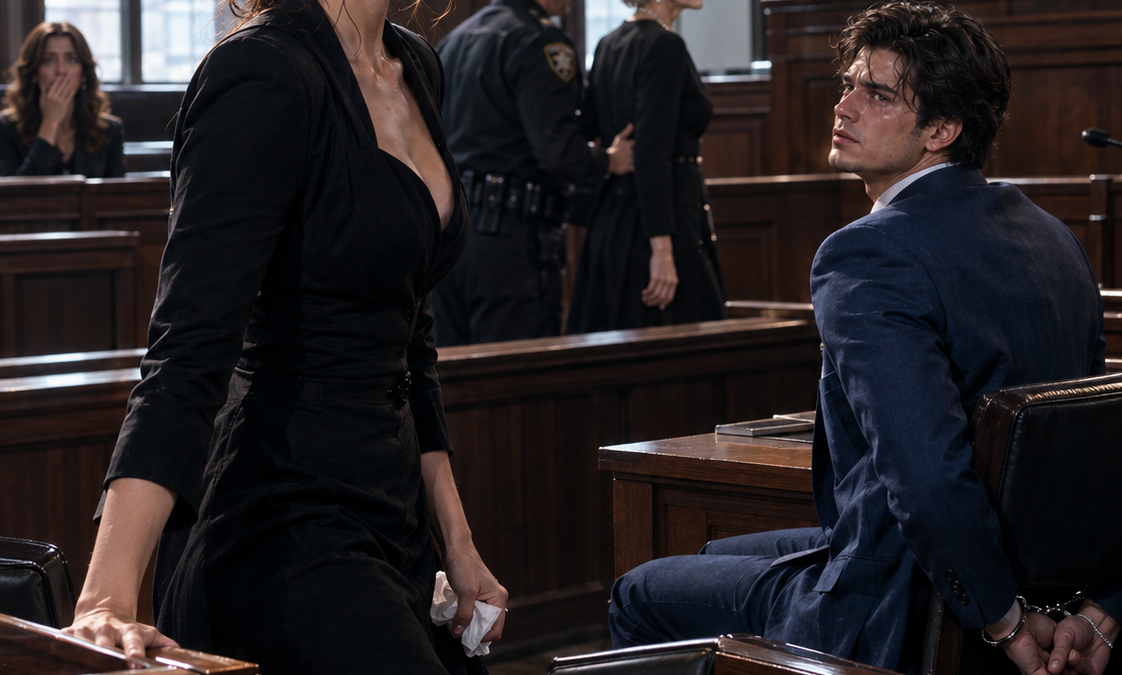
Adrian stood before the judge in a plain gray suit, his hands cuffed in front of him. He looked calm. That was the thing that struck Elena most—how calm he seemed, as if he’d already made peace with whatever was coming.
“Mr. Kessler,” the judge said, “you have pleaded guilty to charges of fraud, obstruction of justice, and negligent homicide. You have cooperated fully with the investigation, and your testimony was instrumental in securing the conviction of your co-conspirator. These are mitigating factors.”
Adrian nodded.
“However,” the judge continued, “the severity of your crimes cannot be overlooked. Fifteen people died as a direct result of the Corvalex trials. Many more were harmed. You were in a position of power, and you used that power to enrich yourself and your family at the expense of human lives.”
Elena’s throat tightened.
“I sentence you to five years in federal prison, with the possibility of parole after three years. You will also be required to pay restitution to the victims’ families—a sum to be determined by the court.”
Five years. Three with good behavior. Elena had known it was coming, but hearing the words aloud made it real in a way that nothing else had.
Adrian turned to look at her. His eyes were wet, but he was smiling—a small, sad smile that broke her heart.
“I love you,” he mouthed.
“I love you too,” she mouthed back.
The bailiffs led him away.
CHAPTER 20: The Letter
Three weeks after Adrian began his sentence, Elena received a letter.
It was addressed in his handwriting—the same sharp, angular script she’d seen on the note to Dr. Chen, the note that had started everything. She opened it with trembling fingers.
Elena,
I don’t know if you’ll read this. I don’t know if you’ll care. But I need to say these things, even if they never reach you.
I’m sorry.
I’m sorry for the lies. I’m sorry for the affair. I’m sorry for every moment I made you feel small, or invisible, or unwanted. I’m sorry for the years I spent being my mother’s son instead of your husband.
I’m sorry for the miscarriage. I know I never said that—not really. I know I let you carry that grief alone, because I didn’t know how to carry it with you. I was afraid. I was always afraid. And fear made me cruel.
I’m not asking for forgiveness. I don’t deserve it. But I want you to know that I see it now—all of it. The way I treated you. The way I let my mother treat you. The way I chose the Kessler name over the woman I loved.
I see it, and I’m ashamed.
The prison counselor says I need to focus on the future. He says I need to think about who I want to be when I get out. I’ve been thinking about that a lot. I want to be the man you thought you were marrying. I want to be someone who deserves you.
I don’t know if that man exists. I don’t know if I can become him. But I’m going to try. Every day. For the rest of my life.
You don’t have to wait for me. You don’t have to write back. You don’t have to do anything. But if you do—if you decide to give me another chance—I’ll spend every moment of the rest of my life trying to earn it.
I love you, Elena. I’ve always loved you. Even when I was too broken to show it.
Yours,
Adrian
Elena read the letter three times. Then she folded it carefully, placed it in the drawer of her nightstand, and sat in the dark for a long time, thinking.
CHAPTER 21: The Reckoning
Six months after Adrian’s sentencing, Elena testified before a Senate subcommittee.
She’d been asked to speak about the Corvalex scandal—about the FDA’s failure to catch the falsified data, about the need for stronger oversight of pharmaceutical companies, about the human cost of corporate greed. She’d spent weeks preparing her testimony, working with lawyers and advocates and the families of victims.
The hearing room was packed.
Elena walked to the witness table with her head held high. She wore a simple black dress, her mother’s pearl earrings, and no other jewelry. She looked nothing like the Kessler wife who had once been paraded around charity galas like a show pony. She looked like what she was: a woman who had survived.
“Dr. Marchetti,” the committee chair said, “thank you for being here today. Can you tell us, in your own words, what happened at Kessler Pharmaceuticals?”
Elena took a breath.
“I was married to the CEO of Kessler Pharmaceuticals for seven years,” she said. “During that time, I was systematically isolated from my career, my friends, and my family. I was made to believe that I was worthless—that my only value was as a wife and a potential mother. When I discovered evidence of criminal wrongdoing, I was threatened and intimidated. My husband’s mother, Vivian Kessler, told me she would destroy me if I spoke out.”
She paused.
“I’m speaking out now. Not because I’m brave—though I hope I am. Not because I want revenge—though I’ve felt that too. I’m speaking out because fifteen people died, and their deaths were covered up by a corporation that valued profit over human life. I’m speaking out because I was complicit in that cover-up, even if I didn’t know it at the time. I’m speaking out because if I don’t, nothing will change.”
The committee was silent.
“I’ve spent the last year trying to make amends,” Elena continued. “I’ve worked with victims’ families. I’ve advocated for stronger regulations. I’ve testified in court. I’ve tried to be part of the solution instead of part of the problem. And I’m here today to ask you to do the same. To hold pharmaceutical companies accountable. To protect the people who trust them. To make sure that what happened with Corvalex never happens again.”
She stepped back from the microphone.
The room erupted in applause.
CHAPTER 22: The Visit
Elena visited Adrian for the first time on a cold November morning.
The prison was in a rural part of Massachusetts, a two-hour drive from Boston. She’d been putting it off for months—not because she didn’t want to see him, but because she was afraid. Afraid of what she’d feel. Afraid of what she’d see. Afraid that the man she’d fallen in love with was gone forever.
The visiting room was sterile and bright, with plastic chairs and vending machines and a clock on the wall that ticked too loudly. Adrian was already seated when she arrived, wearing a prison-issue jumpsuit, his hair shorter than she’d ever seen it, his face thinner.
He looked up when she walked in. And he smiled.
It was the same smile she remembered from their early years together—before the distance, before the lies, before everything fell apart. It was the smile of a man who was genuinely happy to see her.
“You came,” he said.
“I came.”
She sat down across from him, her hands folded on the table. For a long moment, neither of them spoke.
“You look good,” he said finally. “Different. Stronger.”
“I feel stronger.” She paused. “I testified before the Senate last month.”
“I heard. Cordelia wrote to me about it.” His voice was soft. “She said you were incredible. She said you made people cry.”
“I made myself cry.”
“That doesn’t surprise me.” He looked at her—really looked at her, the way he used to, before everything. “I’m proud of you, Elena. I know that doesn’t mean much, coming from me. But I’m proud of you.”
“It means something.” She met his eyes. “I didn’t come here to fight, Adrian. I didn’t come here to yell at you or punish you or make you feel guilty. I came here because I wanted to see you. Because I wanted to know if—” She stopped, her voice catching.
“If what?”
“If I still feel the same way.”
“And do you?”
She looked at him—at the man who had betrayed her, who had lied to her, who had let her carry the weight of his family’s sins. And then she looked deeper, past the betrayal, past the lies, to the man underneath. The man who had lost his sister. The man who had been manipulated and controlled and broken by a mother who saw him as nothing more than a tool. The man who had finally found the courage to stand up and tell the truth.
“Yes,” she said. “I do.”
Adrian’s breath caught. He reached across the table, his fingers brushing against hers.
“I don’t deserve you.”
“No,” she agreed. “But you’re going to spend the rest of your life trying to earn me. Remember?”
“I remember.” He smiled—that same smile, the one that had made her fall in love with him all those years ago. “I’ve been thinking about that. About what I want to do when I get out.”
“What do you want to do?”
“I want to start a foundation. Something that helps victims of pharmaceutical fraud—people who don’t have the resources to fight back. I want to use what I know—what I’ve learned—to make sure that what happened with Corvalex never happens again.”
Elena nodded slowly. “That’s a good idea.”
“You think so?”
“I think it’s the first thing you’ve said in years that sounds like the man I married.”
He squeezed her hand. “I’m trying, Elena. I’m trying so hard.”
“I know.” She squeezed back. “That’s why I’m here.”
CHAPTER 23: The Foundation
Adrian was released after three years.
Elena was there to meet him at the gate—the same gate she’d walked through a hundred times over the past three years, the same gate she’d come to know as well as the front door of her own house. He walked out into the sunlight, blinking, his prison-issue clothes hanging loose on his frame.
He looked older. Tired. But when he saw her, his face lit up.
“Elena.”
She ran to him, and he caught her in his arms, and for a long moment, neither of them said anything. They just held each other, there in the parking lot of the federal correctional facility, while the world went on around them.
“I missed you,” he whispered.
“I missed you too.”
“I’m never going to take you for granted again. I swear to God, Elena, I’m never going to—”
“Shh.” She pulled back, looking at him. “We have time. We have all the time in the world.”
He laughed—a real laugh, the first she’d heard from him in years.
“Where do we go from here?”
“Home,” she said. “I bought a house. A small one, in Cambridge. Nothing fancy. No staff, no marble floors, no portraits of dead ancestors. Just us.”
“Us.”
“Unless you don’t want—”
“I want.” He took her face in his hands. “I want everything with you, Elena. I always have.”
She kissed him.
The foundation opened six months later.
They called it The Marchetti-Kessler Foundation—a deliberate choice, putting her name first. It was a small operation, housed in a converted warehouse in Somerville, staffed by a handful of lawyers and advocates and survivors. Their mission was simple: to help victims of pharmaceutical fraud seek justice, and to advocate for stronger regulations to prevent future tragedies.
Elena ran the foundation. Adrian worked alongside her, using his knowledge of the industry to help identify cases and build legal strategies. He was good at it—better than she’d expected. The years in prison had changed him, softened him, given him something he’d never had before: perspective.
They worked long hours. They fought sometimes—about money, about strategy, about the right way to help people who’d been hurt. But they always found their way back to each other.
At night, they went home to their small house in Cambridge, with its creaky floors and its leaky faucet and its garden that Elena was slowly learning to keep alive. They cooked dinner together. They talked about their days. They watched bad movies on the couch and argued about whether the endings made sense.
It wasn’t the life Elena had imagined when she’d married into the Kessler family. It wasn’t the life Adrian had been groomed for since birth.
It was better.
CHAPTER 24: The Reunion
One year after Adrian’s release, Elena received a letter from Isabel Moreau.
She’d been expecting it, in a way. Isabel had testified at the trial, had provided crucial evidence, had helped bring Vivian Kessler to justice. But after the verdict, she’d disappeared—moved out of Boston, changed her name, started over somewhere far away.
The letter was postmarked from California.
Dr. Marchetti,
I don’t know if you’ll remember me. I know I’m not someone you’d want to remember. But I wanted to write to you. I wanted to say thank you.
Thank you for believing me. Thank you for giving me a chance when I didn’t deserve one. Thank you for helping me find the courage to tell the truth.
I’m doing well. I’m in therapy. I’m learning to live with what happened—with what I did, and what was done to me. It’s not easy. Some days I don’t think I’ll ever be okay. But I’m trying.
I wanted you to know that I’m sorry. For everything. For the affair. For the lies. For the pain I caused you. I know that doesn’t change anything. I know it doesn’t undo what happened. But I wanted you to hear it from me.
I hope you and Adrian are happy. I hope you’ve found peace. I hope—I hope you’ve found what I’m still looking for.
Yours,
Isabel
Elena read the letter twice. Then she wrote back.
Isabel,
I remember you. I forgive you.
I don’t say that lightly. I’ve spent a long time being angry—at you, at Adrian, at Vivian, at myself. But I’ve learned that anger is a weight. It drags you down. It keeps you from moving forward. And I want to move forward.
I hope you find what you’re looking for. I hope you find peace. I hope you find someone who sees you the way you deserve to be seen—not as Vivian’s pawn, not as Adrian’s mistake, but as yourself. As Isabel.
You are not what happened to you. You are not what you did. You are a person, worthy of love and forgiveness and a future.
Take care of yourself.
Elena
CHAPTER 25: The Wedding
They remarried on a rainy afternoon in April.
It wasn’t a big event—nothing like the first wedding, with its four hundred guests and its crystal chandeliers and its photographers from the Globe. Just a small ceremony at Cambridge City Hall, with Cordelia as Adrian’s witness and Wren as Elena’s. The clerk was a middle-aged woman who’d seen too many weddings to be impressed by anything, but she smiled when she pronounced them married.
“You may kiss the bride.”
Adrian kissed her—soft, gentle, full of everything they’d been through and everything they’d become.
“I love you,” he said.
“I love you too.”
“Are you ready to go home?”
“I’m ready.”
They walked out into the rain, hand in hand, and drove back to their little house in Cambridge. The garden was blooming—Elena had finally figured out how to keep the roses alive—and the neighborhood cats had gathered on the porch, waiting for their evening feeding.
“This is it,” Elena said. “This is our life.”
“It’s not what I imagined.”
“No?”
“No.” Adrian turned to her, his eyes soft. “It’s better.”
CHAPTER 26: The Legacy
Two years later, the Marchetti-Kessler Foundation won its first major case.
A pharmaceutical company in Ohio had been falsifying trial data for a diabetes drug—covering up adverse events, bribing researchers, pressuring doctors to prescribe it anyway. The foundation took on the case, working with victims’ families and whistleblowers and journalists to expose the truth.
The company settled for forty million dollars.
The victims’ families received compensation. The CEO resigned. The FDA launched a broader investigation into the company’s practices.
And Elena stood in the foundation’s small office, looking at the faces of the people they’d helped, and felt something she hadn’t felt in years.
Pride.
Not the hollow pride of the Kessler name. Not the brittle pride of a perfect marriage. Real pride—the kind that came from doing something that mattered.
Adrian came up behind her, wrapping his arms around her waist.
“We did it,” he said.
“We did it.”
“What’s next?”
Elena turned to face him. “I don’t know. But whatever it is, we’ll do it together.”
He kissed her forehead. “Together.”
EPILOGUE: The Garden
Ten years later, Elena sat in her garden, watching the sun set over Cambridge.
The roses were blooming—pink and red and yellow, a riot of color against the fading sky. The neighborhood cats had multiplied; there were five of them now, all named after characters from Elena’s favorite novels. Adrian was inside, making dinner. She could hear him humming through the open kitchen window.
She thought about the life she’d lived. The marriage she’d entered as a young woman, full of hope and naivety. The betrayal she’d discovered. The battle she’d fought. The man she’d married, lost, and found again.
She thought about Vivian Kessler, who had died in prison the year before—alone, unrepentant, still convinced of her own righteousness.
She thought about Isabel Moreau, who had sent them a Christmas card from Oregon, where she was running a small clinic for underserved communities. She’d married a woman named Sarah. They had a dog named Rufus and a garden that, according to Isabel’s letters, was even more chaotic than Elena’s.
She thought about Cordelia, who had been reelected twice and was now chairing the Senate subcommittee on pharmaceutical oversight. She’d introduced legislation—the Marchetti-Kessler Act—that had passed with bipartisan support.
And she thought about herself. The girl from a small town in Italy who had married into a dynasty and almost been destroyed by it. The woman who had found the courage to fight back, to speak out, to demand justice.
She had won. Not just the battle against Vivian Kessler, but the battle for her own soul.
Adrian came out onto the porch, holding two glasses of wine.
“What are you thinking about?” he asked.
“Everything.”
“That’s a lot.”
“It is.” She took the glass he offered, their fingers brushing. “But it’s a good everything. A hard everything. A real everything.”
He sat down beside her, and they watched the sun sink below the horizon together.
“Are you happy?” he asked.
Elena thought about it. Really thought about it—not the easy answer, not the expected one, but the truth.
“Yes,” she said. “I am.”
“Even after everything?”
“Because of everything.” She turned to look at him. “We went through hell, Adrian. Both of us. And we came out the other side. Not perfect. Not fixed. But together.”
He took her hand. “Together.”
The stars came out, one by one, and the garden filled with the sound of crickets and the scent of roses. And in that small house in Cambridge, two people who had lost everything found that they had something worth keeping after all.