They Bullied His Wife and Little Girl, Not Knowing He Was a Legendary War Hero
THE DAY MY DAUGHTER WELCOMED ME HOME
The first time I heard someone threaten to destroy my family, I was standing in a room with the President of the United States.
The second time, I was standing in my own driveway, watching a bulldozer crawl toward the house my father had built.
The second threat frightened me more.
Not because I doubted what I could do to the man who made it. I had spent years learning how to deal with men who believed violence made them powerful. I knew how to recognize a threat, how to assess a position, and how to keep my emotions from interfering with a decision.
But I had been away from home for two years.
My daughter had grown from three to five while I was gone. My wife had spent twenty-four months answering questions she couldn’t answer and protecting a little girl who still believed her father might walk through the door.
I had missed birthdays, scraped knees, Christmas mornings, and the ordinary moments that make a family feel like a family.
I had promised Sarah that the last deployment would be my last.
Now I was home.
And a man named Gideon Price had decided that my first day back would be the day he took everything from us.
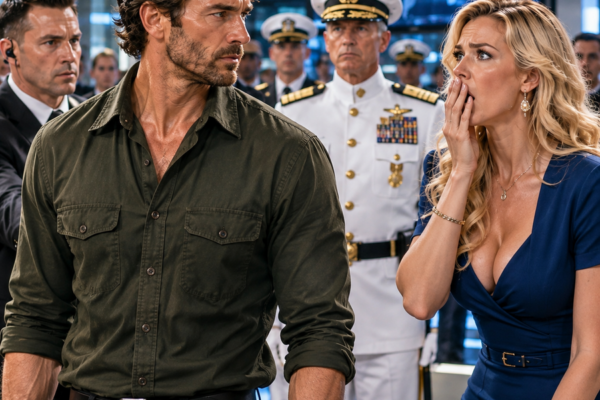
The ceremony took place in a room that didn’t appear on the White House tour.
There were no television cameras, no reporters, and no crowd of invited guests. Only a handful of senior officers, two members of the President’s staff, and the people who had been cleared to know why I was there.
I stood at attention in my dress uniform.
The gold braid on my shoulder felt heavier than it had any right to. I had worn that uniform in too many places, under too many skies, to be impressed by decorations. But the medal in the President’s hands was different.
The Medal of Honor.
For most of my career, the mission that had earned it did not officially exist. The operation had been classified, the records restricted, and the names of the people involved buried under layers of security procedures.
Five men had gone into that operation.
Only four had come home.
Noah Bennett had been twenty-nine. He was married, expecting his first child, and constantly talking about the name he wanted to give the baby. He had carried a photograph of his wife in the pocket of his uniform and shown it to anyone who would listen.
He had died getting the rest of us out.
The President pinned the medal to my chest.
“Master Sergeant Dawson,” he said, “your actions under extraordinary circumstances saved American lives. Your courage and your refusal to leave your people behind represent the highest traditions of our service.”
I kept my eyes forward.
He shook my hand.
“Your citation will remain sealed. The public record will reflect neither the location nor the details of the operation. Officially, this ceremony never happened.”
“Understood, Mr. President.”
The President stepped back.
“Do you understand what this medal means?”
“Yes, sir.”
He studied me for a moment.
“Then tell me why you look as though you’d rather be somewhere else.”
I thought of Sarah.
I thought of Lily.
“Because the people I want to show it to aren’t here.”
The President’s expression softened.
“Your family?”
“Yes, sir.”
He nodded toward the medal.
“That’s one reason we’re honoring you.”
I looked down briefly.
“Mr. President, there’s something I’d like to request.”
“Go ahead.”
“The survivor benefit and the pension increase that come with this recognition. I’d like them directed to Noah Bennett’s wife.”
The President glanced at General Avery, who stood behind him.
“That’s a substantial benefit.”
“Noah didn’t make it home, sir. His wife is having their baby this month. He never got to choose the name.”
I swallowed.
“Let her have something from him that keeps helping after we’re gone.”
The President regarded me for several seconds.
Then he nodded.
“We’ll make the arrangements.”
“Thank you, sir.”
General Avery stepped forward.
“Master Sergeant, the Army would like you to stay. We have instructors, training positions, leadership assignments. Your experience could make a difference to the next generation.”
I looked at him.
“Sir, I appreciate that.”
“You would be valuable.”
“I know.”
“Then?”
“My daughter was three the last time she saw me in uniform. She thought it was a Halloween costume.”
General Avery said nothing.
“I promised my wife this was the last one.”
The President looked toward the general.
“Then go home, Master Sergeant.”
I stood straighter.
“Yes, sir.”
After the ceremony, General Avery walked me through a private corridor. A staff officer carried a small case containing the medal and the paperwork.
At the door, Avery stopped.
“One more thing.”
He reached into his jacket and took out a small black device.
It looked like an ordinary key fob, although a small red indicator was set into its side.
“Family protection beacon,” he said. “One press sends an authenticated emergency signal directly to my office and the response network. It gives us your location and identifies the device.”
I accepted it.
“Anyone comes after your family, you press it. I don’t care who they are. Local officials, military officials, wealthy civilians, somebody with a badge. You understand?”
“Yes, sir.”
“Don’t wait for permission.”
I slipped it into the inner pocket of my jacket.
General Avery held my gaze.
“You’ve spent years protecting people you barely knew. Don’t make the mistake of thinking your family has to handle everything alone.”
“I won’t.”
He nodded.
“Go home, Cole.”
For the first time in two years, I didn’t have an answer involving a mission, a briefing, or a flight schedule.
I just smiled.
“Yes, sir.”
The road into Millbrook looked smaller than I remembered.
The same gas station stood at the intersection. The old feed mill still had its faded red sign, and the high school football field was visible through the trees. There were new houses along the eastern road, but the town itself seemed unchanged.
I had left from this place thousands of days earlier.
I had driven away expecting to be back in a few months.
Then the operation changed. Communications became restricted. Our team was assigned follow-on work, and the restrictions that had been intended to protect us extended to our families. We were told not to make contact through ordinary channels. Even a short message could compromise an operation.
I had understood the reasons.
Understanding didn’t make the silence easier.
Sarah had received no letters for two years. She had no way of knowing where I was, when I might return, or whether I was still alive. The official military record showed that I had been discharged in 2014 as a corporal.
That document had been designed to keep my real identity hidden.
I had spent years accepting that the truth might never be something I could explain to my family.
Now I had the medal.
I had the authorization to return.
And I had a little girl waiting for me.
I turned onto our road.
The farmhouse appeared beyond a row of old oak trees.
My father had built it with his own hands. He had bought the land when he was twenty-six, cleared the first field with a borrowed tractor, and spent the next decade adding rooms, repairing fences, and planting the trees along the driveway.
He used to say a man could build a house in a season, but it took a lifetime to make it a home.
My mother had died before I joined the Army. My father lived long enough to see me get married and hold Lily when she was born.
He had been gone for four years now.
The farmhouse belonged to Sarah and me, but it never stopped feeling like his.
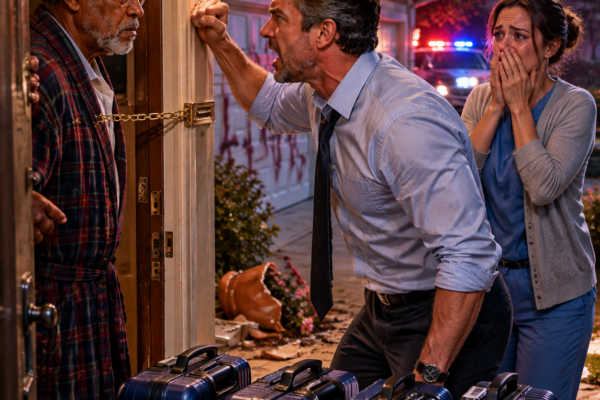
As I approached the driveway, I saw a bulldozer.
It was parked beside the old barn, its blade lowered into the grass.
Two men in work jackets stood near it. Another was measuring the fence line with a surveyor’s pole.
Sarah was on the porch.
She stood in front of Lily, one hand resting on the little girl’s shoulder.
A man in an expensive jacket was speaking to her.
I recognized the face from the local paper.
Gideon Price’s son.
Trent.
He was in his early thirties, with carefully styled hair and the sort of smile that looked friendly until someone refused him.
I parked.
Before I could get out, I heard Sarah’s voice.
“Mr. Price, my answer has not changed. This house is not for sale.”
Trent spread his hands.
“Mrs. Dawson, the county board votes on Phase Two this Thursday. My father needs this land before then. Sign today, or we level it today.”
Sarah stood straighter.
“My father-in-law built this house with his own two hands. My husband grew up here. It is not for sale.”
Trent glanced toward the house.
“Your husband has been gone for two years.”
“He is coming home.”
Trent laughed.
“Lady, the whole town knows he hasn’t sent you one letter. Either he’s dead, or he doesn’t want you anymore.”
Sarah’s hand tightened around Lily’s shoulder.
“Don’t speak about my husband.”
“People have been telling you for two years. Maybe you should listen.”
“He’s coming home. Today.”
Trent smiled.
“Sure he is.”
I opened the truck door.
Sarah hadn’t seen me yet.
I stepped down and shut it behind me.
Trent turned.
For a moment, nobody moved.
Then Sarah saw me.
The expression on her face was something I will never forget. First disbelief. Then recognition. Then a kind of hope so sudden and painful that it looked almost like fear.
“Cole?”
I started walking toward her.
“Hey, sweetheart.”
She made a small sound.
Then Lily looked up.
“Daddy?”
I dropped to one knee.
“Hey, baby.”
She stared at me.
Her eyes moved over my face, then my uniform, then the medal case in my hand.
I opened my arms.
“Come here.”
She ran.
I caught her and held her against my chest. She was bigger than I remembered. Her hair was longer, her arms stronger, and her voice had lost the little softness she had when I left.
She buried her face in my neck.
“Daddy!”
I held her tighter.
“I’m home, baby.”
She started crying.
I closed my eyes.
“I’m sorry I’m late.”
Then I looked over her shoulder.
Trent was watching us.
His smile had disappeared.
“Who the hell are you?”
I stood with Lily in my arms.
“Her father.”
Trent glanced at Sarah.
“Is this some kind of joke?”
Sarah was crying now.
“No,” she whispered. “He came home.”
Trent looked at me again.
“You’ve got no idea who you’re dealing with.”
I set Lily down carefully.
“Get off my property.”
He stepped closer.
“You know whose job this is? My father owns half this town. Cops, judges, the county board. They all answer to the Prices.”
I kept my voice level.
“Then you should have no trouble finding somewhere else to park that bulldozer.”
He laughed.
“You’re going to tell me what to do?”
“No. I’m telling you what happens next.”
I looked at the two workers.
“Shut the machine down. Move it away from the house.”
One of them looked toward Trent.
Trent snapped his fingers.
“Don’t move anything.”
I took one step forward.
Trent shoved Sarah’s shoulder.
She stumbled.
Lily screamed.
I caught Sarah with one hand and turned back toward him.
“Don’t touch my wife.”
He reached for Lily.
She grabbed my trouser leg.
I saw his hand close around her arm.
I didn’t think.
I moved.
I caught his wrist, forced his fingers open, and pulled Lily behind me.
“Let go!”
He jerked against my grip.
“Get your hands off me!”
“You let go of her first.”
I held his wrist until he released her.
Then I let him go.
“Now get on your knees.”
He looked at me, his face reddening.
“Who do you think you are?”
I heard sirens in the distance.
Trent smiled.
“That’s right. My people are coming.”
Chief Mosley arrived with two patrol cars.
He stepped out wearing his uniform and a wide, practiced smile. He looked from Trent to Sarah, then at me.
His eyes stopped on my uniform.
“What’s going on here?”
Trent answered before I could.
“This man assaulted me. He threatened me and grabbed my arm.”
Sarah stepped forward.
“That’s a lie. He grabbed Lily. The bulldozer nearly ran over her.”
Mosley raised a hand.
“Ma’am, calm down.”
“Calm down? Your men were standing here while he threatened our home.”
“Let’s keep things civil.”
I looked at the chief.
“Your man brought heavy equipment onto private property without permission. He threatened to destroy the house and put his hands on my daughter.”
Trent scoffed.
“We came out here to discuss buying the land.”
“That’s a lie,” Sarah said.
Mosley looked at me.
“Mr. Dawson, getting upset isn’t evidence.”
I nodded toward the bulldozer.
“That machine nearly ran over my child. There’s your evidence.”
Mosley sighed.
“Sir, turn around. You’re under arrest for assault and unlawful restraint.”
Sarah stepped forward.
“What?”
“Chief, you can’t arrest him.”
I looked at her.
“Sarah, stay with Lily.”
She shook her head.
“Cole, please.”
I lowered my voice.
“It’s all right.”
It wasn’t, but I didn’t want her to see the anger building in me.
Mosley reached for my arm.
“Hands behind your back.”
I didn’t move immediately.
“Before you cuff me, call that number.”
I gave him General Avery’s card.
He glanced at it.
“The Pentagon?”
“Yes.”
He laughed.
“Sure. Want me to call the President while I’m at it?”
Trent started laughing.
Mosley tossed the card into the mud.
“Dispatch, run a Cole Dawson.”
The radio crackled.
A few seconds later, dispatch replied.
“Cole Dawson. Army. Discharged in 2014 as a corporal. No warrants. That’s all we’ve got, Chief.”
Mosley looked at me.
“A corporal.”
He gave a little laugh.
“This county’s full of war heroes, pal.”
Trent stepped closer.
“His old man’s in the ground, Chief. Nobody’s coming for this guy.”
Sarah grabbed my hand.
“Cole. Not in front of Lily.”
I looked down.
My daughter was standing behind Sarah, crying silently.
I could have ended the confrontation in seconds. I knew how to break a hold, how to disarm a man, and how to deal with someone who mistook my restraint for weakness.
But if I hit a police officer, the next report would not need to be invented.
I turned around.
Mosley cuffed me.
“You’re making a mistake, Chief.”
He leaned closer.
“I think you are.”
As he pushed me toward the patrol car, I looked back at Sarah.
“Every report you’ve ever filed, find them all. Keep them safe.”
She nodded, tears running down her face.
Lily stepped forward.
“Don’t go, Daddy!”
I stopped.
The officer pulled my arm.
“Keep moving.”
I turned enough to see her.
“Hey, baby.”
She reached for me.
“You just came home.”
I wanted to go back.
I wanted to lift her into my arms and tell her that nobody was going to take her house, her mother, or her father.
Instead, I had to let the officer lead me away.
“Make me a new sign,” I called.
She didn’t understand.
“Put it by the front door. I’ll tell you when.”
The patrol car door closed.
And my first hour at home ended in handcuffs.
I activated the beacon on the drive to the station.
The small device was still in my jacket pocket. I pressed it once, holding the button for three seconds.
A faint vibration confirmed transmission.
I couldn’t see the signal, but General Avery would receive it.
The police station was six minutes away.
Mosley drove while Trent rode behind us in another vehicle.
When we arrived, an officer took my belt, wallet, and phone. Mosley kept General Avery’s card in his hand.
He looked at the black device.
“What’s this?”
“Personal equipment.”
He turned it over.
“Looks expensive.”
“Put it with my property.”
He smiled.
“Sure.”
He pressed the button.
The little red light blinked.
Mosley frowned.
Then he placed it on the desk and struck it with the handle of a flashlight.
The casing cracked.
The red light went out.
I looked at him.
“You shouldn’t have done that.”
He laughed.
“Who’s going to know?”
I said nothing.
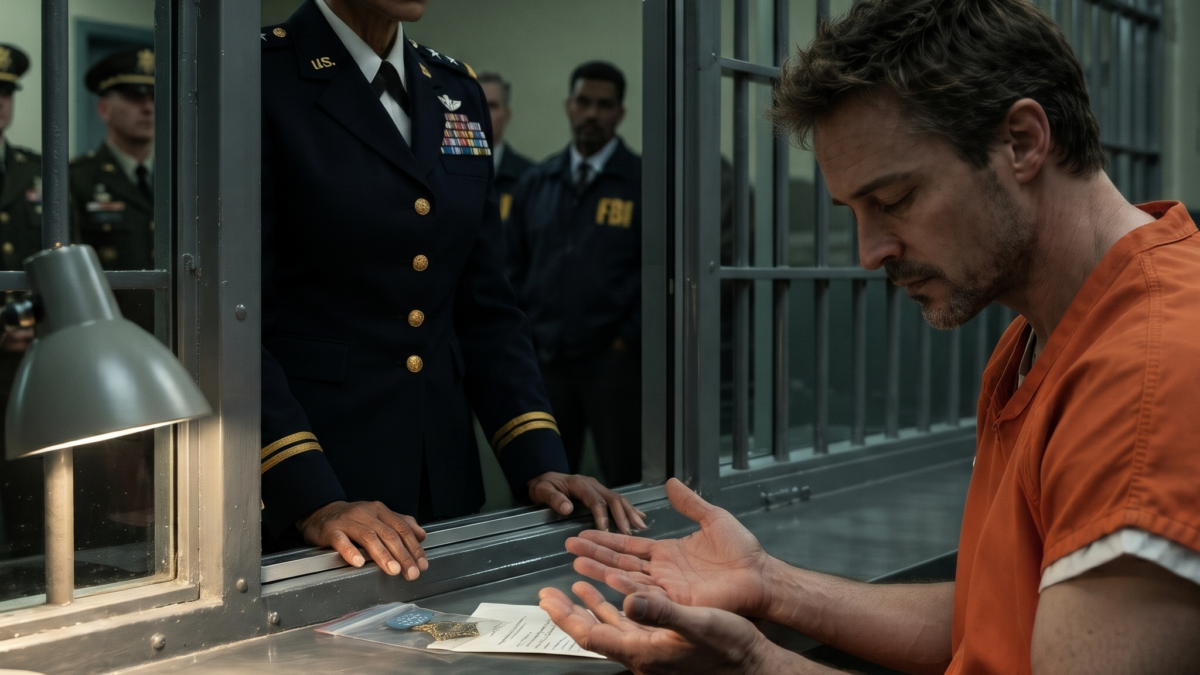
They placed me in an orange jumpsuit and locked me in a holding cell.
Trent stood outside the bars.
“Some homecoming, Cole.”
He tapped the metal.
“You should’ve stayed wherever you came from.”
I sat on the bench.
“Get out of here, Trent.”
He laughed.
“Tomorrow morning, your wife signs the land over on the steps of this station. She brings the kid to watch. Sign or no sign, that farm will be flat by next week.”
He leaned closer.
“Maybe you’ll get to watch it happen.”
I looked at him.
“You just made a mistake.”
He grinned.
“Another imaginary commanding officer?”
He turned to Mosley.
“This one’s losing his mind.”
The door closed.
The station went quiet.
I looked at the broken device on the desk beyond the bars.
Then I waited.
General Avery was in Washington when the alarm sounded.
He had been reviewing an intelligence briefing when his aide entered without knocking.
“General. Dawson’s family beacon just went off.”
Avery stood.
“Where?”
“Millbrook, Virginia. We have a location signal from the device.”
“When was it activated?”
“Approximately ten minutes ago.”
“Who’s with his family?”
“Unknown. The last check-in indicated two local agents were assigned to the property.”
Avery reached for his phone.
“Get me the FBI field office in Richmond. I want agents at the Dawson farm tonight, watching that family.”
His aide was already moving.
“Yes, sir.”
“Get me a car. I’m going myself.”
The aide hesitated.
“General, that’s a four-hour drive.”
“Then get me a helicopter.”
He looked at the screen.
The signal had gone dead.
“General?”
Avery’s expression changed.
“That wasn’t a normal disconnect.”
He turned.
“Protocol says if the beacon is destroyed after activation, we treat the soldier as captured. Last signal?”
“Inside Millbrook police station.”
Avery’s jaw tightened.
“Then this is a red alert.”
“Yes, sir.”
“Forget the car. Get the helicopter in the air. Tell the FBI to send their tactical team now.”
The aide nodded.
Avery was already heading for the door.
Back in Millbrook, Chief Mosley had grown comfortable.
He stood behind his desk, drinking coffee while Trent leaned against the counter.
“Put him in the holding cell until tomorrow,” Trent said. “Your report says he assaulted me. The board gets the land. Everyone goes home happy.”
Mosley laughed.
“You’re not the one who has to explain the paperwork.”
“My father will take care of that.”
Mosley glanced toward the broken beacon.
“What was that thing?”
“Some junk he brought from the Army.”
Trent leaned closer to the cell.
“You collect dead men’s stuff, Dawson?”
I looked up.
“Those belong to men who didn’t come home.”
He smiled.
“Then why are you carrying them around?”
“I’m taking every one of them back to their families. In person.”
He shook his head.
“Here’s what I don’t get. You guys take taxpayer money to go play soldier.”
I stood.
“And who pays those taxes?”
He shrugged.
“People like me.”
“People like you pay them, too.”
He laughed.
I stepped closer to the bars.
“Everything I did over there, I did for people like you.”
Trent’s smile faded.
“Put him down,” Mosley said.
An officer approached.
I remained still.
Then another officer came through the side door.
“Chief, an Army helicopter just landed on the high school football field.”
Mosley looked up.
“So?”
“The FBI is with them.”
“What’s that got to do with me?”
The younger officer glanced toward my cell.
“They’re asking for Cole Dawson.”
Mosley laughed.
“Well, look at this. A corporal walking around with a fake Medal of Honor. That’s stolen valor, pal. Federal crime.”
He turned toward Trent.
“First, he hands me some card from a general at the Pentagon. I tossed it in the mud where it belongs.”
Trent grinned.
“Let’s see who’s faster. Him or a bullet.”
Before Mosley could answer, the station doors opened.
A group of federal agents entered.
“FBI! DROP THE WEAPON NOW!”
One of them had spotted Trent’s hand moving toward his waistband.
Trent raised his arms.
“Get off me! You know who I am? I’m Trent Price!”
The agents took him to the floor.
Mosley stepped back.
“What the hell is this?”
General Avery came through the entrance.
He wore his uniform, his expression controlled, and his eyes fixed on the cell.
He walked directly to me.
Then he stopped.
He saluted.
I returned it as best I could from behind the bars.
The chief stared.
“You’re saluting him?”
Avery turned.
“Do you have a problem with that?”
“General, he’s a corporal. He’s a nobody with a fake medal.”
Avery’s expression hardened.
“That discharge from 2014 was written for one purpose. To make sure the people who served in places nobody could talk about could go home without those places following them.”
He stepped closer.
“This is Master Sergeant Cole Dawson. Medal of Honor recipient.”
Mosley shook his head.
“That’s impossible.”
“At ten o’clock this morning, I watched the President of the United States place that medal in his hand.”
Avery glanced at the broken device on the desk.
“And that card you threw in the mud?”
He looked Mosley directly in the eyes.
“That was my number.”
The FBI agent beside him opened the cell.
“Chief Mosley, you’re under arrest on suspicion of civil rights violations, obstruction, and conspiracy.”
Mosley stepped back.
“You’re making a mistake.”
Avery’s voice was quiet.
“No. You made it.”
The agent turned toward Trent.
“Trent Price, you’re under arrest, too. You threatened a civilian, assaulted a child, and used a local official to facilitate unlawful land seizure.”
Trent struggled against the agents.
“My father is going to make every one of you sorry!”
Avery watched them take him away.
Then he turned toward me.
“Master Sergeant.”
I stood.
“Sir.”
“Are you hurt?”
“No.”
“Your family?”
“At the farm.”
“Two agents are already there.”
I looked at the door.
“My daughter watched them put cuffs on me.”
Avery’s expression softened.
“I’m sorry.”
I looked down at the orange jumpsuit.
“Some homecoming.”
He gave a brief nod.
“Let’s get you home.”
Sarah was waiting outside the farmhouse when I arrived.
Two FBI agents stood near the gate. Another was beside the barn, speaking into a radio.
Lily was on the porch.
She saw the vehicle first.
Then she saw me.
“Daddy!”
I opened the door.
She ran down the steps.
I dropped to my knees and caught her.
She wrapped both arms around my neck.
“You’re home!”
“I’m home, baby.”
She started crying.
I held her until she stopped.
Sarah stood a few feet away.
Her hands were pressed against her mouth.
I looked up.
“Hey, sweetheart.”
She came toward us.
I stood, keeping one arm around Lily, and held Sarah with the other.
For a long time, none of us said anything.
Then she whispered, “You came home.”
“I told you I would.”
She closed her eyes.
I held her carefully.
When she stepped back, she looked at my uniform.
“What’s happening?”
I glanced at General Avery, who had come to the gate.
“There’s a lot to explain.”
He walked toward us.
“Mrs. Dawson.”
Sarah turned.
“General.”
He removed his cap.
“First, I’m sorry. The orders that kept your husband from contacting you were mine. For two years, I allowed the operational restrictions to remain in place because of the work he was doing. It was necessary for the mission, but I know what it cost your family.”
Sarah looked at him.
“You kept him from writing?”
“Yes.”
“Even when we thought he was dead?”
Avery lowered his eyes.
“Yes, ma’am.”
Sarah looked at me.
I wanted to explain everything, but I knew no explanation would make two years disappear.
He continued.
“This morning, the President awarded your husband the Medal of Honor. The citation remains sealed. He also directed that the survivor benefit be transferred to Noah Bennett’s wife.”
Sarah looked stunned.
“The Medal of Honor?”
I nodded.
“I’d trade it to have been here.”
She stared at me.
“Two years. No letters. No calls. I didn’t know whether you were alive.”
“I know.”
“No, Cole. You don’t.”
She was right.
I had been alive, but I had not been there.
I had known she was waiting, but I had not known what it felt like to sit with a little girl who asked every night when her father was coming home.
I reached for her hand.
“I’m sorry.”
Her eyes filled.
“Thank you for saying it.”
General Avery waited until Sarah had settled.
Then he turned to me.
“Until I know this isn’t retaliation tied to the operation, I’m not returning to Washington.”
I frowned.
“Sir?”
“I want the FBI to review the Price connection. You can assist as a consultant, but you’re retired. You do not return to active service.”
I nodded.
“Understood.”
He looked toward the agents.
“We’ll have two people on this property around the clock.”
Sarah glanced toward the barn.
“What about Gideon Price?”
Avery looked at me.
“Without evidence, we can’t touch him. Tonight, we have enough to proceed against the chief and his son. We still need to establish the larger conspiracy.”
I looked toward the house.
“Then we’ll give you the evidence.”
Sarah turned to me.
“Cole?”
I looked at her.
“Remember the calls?”
She nodded.
“Every time something happened, I called the station. The bulldozer, the fences, the poisoned chickens. The men who came at night. I called six times.”
I looked at her.
“Six?”
“Not one report was written down.”
She went inside.
A minute later, she returned carrying a thick folder.
“I kept copies of everything.”
I opened it.
There were photographs, handwritten dates, letters, property documents, and copies of complaints Sarah had submitted to the police.
One photograph showed the north fence torn down.
Another showed dead chickens beside the barn.
There were notes documenting phone calls at two in the morning, men walking the perimeter, and survey markers placed without permission.
I looked at the dates.
Two years.
Every incident.
Every complaint.
Every visit to the station.
Sarah had preserved it all.
I looked at General Avery.
“Ma’am, you just made our case against the chief.”
Sarah shook her head.
“I didn’t do it to make a case. I did it because nobody believed me.”
Avery nodded.
“Now they will.”
The FBI assigned two agents to the farm.
One stayed near the house, the other watched the driveway and barn. They installed cameras at the gates and reviewed the complaints Sarah had collected.
I spent the first day helping them organize the evidence.
The second day, I finally slept.
On the third, General Avery came to the kitchen with a copy of my medal citation.
He placed it on the table.
“Your wife deserves to know what happened.”
I looked at Sarah.
She sat beside me.
Avery explained the operation in broad terms, avoiding the classified details.
He told her that Noah had saved my life. He explained that the mission had required years of restricted communication and that the discharge record had been deliberately altered.
Sarah listened without interrupting.
When he finished, she looked at me.
“You never told me any of this.”
“I couldn’t.”
“You could have told me you were alive.”
“I wasn’t permitted.”
She looked toward the window.
“Do you know what it’s like to explain to a three-year-old that her daddy hasn’t written because he can’t?”
I lowered my eyes.
“Yes.”
“No, Cole.”
I looked at her.
She was crying, but her voice remained steady.
“You don’t. You know what it was like to be away. You don’t know what it was like to stay.”
I took her hand.
“You’re right.”
She looked at me.
“I don’t want another medal. I don’t want another ceremony. I want my husband to come home when he says he will.”
I nodded.
“That’s what I want, too.”
Lily came in carrying a sheet of pink construction paper.
“Daddy?”
I turned.
“What’s that?”
“My sign.”
She held it up.
It showed a crooked house, three stick figures, and a bright yellow sun. The letters were uneven, but she had written them carefully.
WELCOME HOME, DADDY.
I smiled.
“That’s beautiful.”
“It’s not finished.”
“What else does it need?”
She looked at me.
“Your name.”
I took the marker.
She pointed to a space at the bottom.
“Write it here.”
I wrote COLE.
She nodded.
“Good. That’s how you know it’s yours.”
I looked at Sarah.
She smiled through her tears.
I had been given the highest military honor my country could offer.
But a five-year-old girl had just made me a sign.
And I knew which one I would keep closest.
The first unexpected visitor came on Monday.
I was repairing a section of fence near the barn when a woman stepped out of her truck.
She was in her early thirties, with a small child sleeping in a carrier on the passenger seat.
“Mrs. Dawson?”
Sarah came out of the house.
“Yes?”
The woman smiled.
“I’m Caroline Bennett.”
Sarah stopped.
I put down the hammer.
Caroline came toward us.
“Noah’s wife.”
I felt the air leave my chest.
“Caroline.”
She smiled.
“The baby came last night.”
I looked at the carrier.
“A boy?”
She nodded.
“A healthy boy. Nine pounds.”
My throat tightened.
“What did you name him?”
She looked down at the child.
“Noah.”
I turned away for a moment.
Sarah came beside me and took my hand.
Caroline continued.
“The benefit came through. The paperwork was approved yesterday. I wanted to thank you in person.”
I shook my head.
“It belongs to Noah.”
“I know. But you made sure it came to us.”
She looked at the baby.
“He’d have liked that.”
I looked at the little boy.
He had a small patch of dark hair and one hand curled near his cheek.
I remembered Noah showing me that photograph of Caroline. I remembered him talking about baby names, arguing over whether they should choose something traditional or something uncommon.
I remembered the last thing he said before the operation.
“Get home to your wife, Cole. You owe her a decent anniversary.”
He had smiled.
Then he had pushed me toward the exit.
I looked at Caroline.
“Would it be all right if I visited?”
“Of course.”
“Sunday?”
She nodded.
“Sunday would be lovely.”
I looked at the baby.
“Noah would’ve been proud.”
Caroline smiled.
“I think he would.”
After she left, I stood by the fence for a long time.
Sarah came out with two cups of coffee.
“Are you all right?”
I nodded.
“Just thinking about him.”
She handed me a cup.
“Then let’s go see his son on Sunday.”
I looked at her.
“All three of us.”
She smiled.
“All three of us.”
Gideon Price requested lunch on Wednesday.
The invitation arrived at the gate in a sealed envelope.
The pleasure of your company is requested at noon, Millbrook Country Club.
There was no signature.
The FBI agents wanted me to decline.
General Avery wanted me to delay.
I wanted to look Gideon Price in the eye.
“I’m going,” I told Avery.
He stared at me.
“Cole, this man has spent years buying influence. We have evidence against Mosley and Trent, but not enough to tie Gideon directly to the intimidation.”
“Then let him talk.”
“That isn’t a reason to walk into a room with him.”
“It’s the reason I’m going.”
Avery studied me.
“Two agents will be nearby. You won’t be alone.”
“Understood.”
Sarah stood beside the kitchen counter.
“I don’t like this.”
“I know.”
“You’ve been home for three days, Cole.”
“Four.”
“That doesn’t make it better.”
I went to her.
“I’ll be careful.”
She searched my face.
“You said that before.”
I couldn’t argue.
“Then I’ll do more than say it.”
She nodded.
“Come home.”
“I will.”
The Millbrook Country Club stood on a hill overlooking the golf course.
A waiter led me through the dining room.
“Mr. Dawson, your guest has saved you the window.”
I looked toward the table.
Gideon Price was sitting with his back to the wall, facing the entrance.
He was in his late sixties, with silver hair, a tailored suit, and the smooth expression of a man who had spent most of his life getting what he wanted.
I recognized him from the local papers.
He had built the library, funded the police station renovation, and donated money to half the county’s charities.
He stood.
“Mr. Dawson. Welcome.”
I didn’t offer my hand.
“Mr. Price.”
He smiled.
“I saved you the best view in Millbrook.”
“I’ll take the wall.”
He glanced at the seat I chose.
“Old habit?”
“Yes.”
He sat.
A waiter approached.
“Coffee, sir?”
“Black.”
Gideon smiled.
“Straight to business. I appreciate that.”
I looked at him.
“What do you want?”
He spread his hands.
“Small towns, Mr. Dawson. Misunderstandings happen. My boy got carried away. He’s young.”
“He’s thirty-two.”
“Young enough to make mistakes.”
“He threatened my wife and put his hands on my daughter.”
Gideon sighed.
“I understand emotions ran high.”
“He brought a bulldozer onto my property.”
“We were discussing a purchase.”
“She said no.”
“People change their minds.”
“Not when someone threatens their child.”
Gideon looked at the menu.
“Let me make it right.”
I waited.
“Two million dollars for your farm.”
I didn’t move.
“The land out there goes for four or five hundred thousand at most. You’ll be getting a very generous offer.”
“No.”
He nodded as if he expected me to negotiate.
“All right. Two point two.”
“No.”
“Two point five.”
I looked at him.
“My father built that house. My wife raised our daughter there. I grew up on that land. You could offer me ten million, and the answer would be the same.”
He leaned back.
“Then let’s discuss something else. You tell those federal boys you won’t testify against my son. We go our separate ways. The board passes Phase Two, everybody gets what they want.”
I looked at him.
“You sent a bulldozer at my daughter.”
His smile vanished.
“Children should not be involved in business matters.”
“She was standing in our yard.”
Gideon adjusted his cuff.
“I hear she’s making a new sign. Pink, isn’t it? Going right up by the front door.”
I felt my jaw tighten.
He watched me carefully.
“Funny thing about children’s things. They break once, they tend to break again.”
I leaned forward.
“Are you threatening my daughter?”
He picked up his glass.
“I’m saying small towns can be unpredictable.”
I stood.
“Then you should be careful what you do in one.”
He smiled again.
“Enjoy your lunch, Mr. Dawson.”
I left without ordering.
Outside, one of the FBI agents was waiting near the entrance.
He looked at my expression.
“What happened?”
“He’s already making his move.”
“How do you know?”
“Because he just told me someone was watching my daughter.”
The agent took out his phone.
“Where is she now?”
“At the farm.”
He nodded.
“Let’s get back.”
We reviewed the security footage from the previous twenty-four hours.
A gray pickup had parked near the feed mill twice.
The driver had remained inside.
The second time, the truck had been positioned behind a line of trees with a clear view of the country club entrance.
I looked at the map.
“There’s one spot on this street with a clean shot at the club’s front door.”
The agent followed my finger.
“The feed mill roof.”
“And that gray pickup?”
“Parked just behind it.”
The FBI team moved in.
I stayed outside the perimeter.
The agents took positions near the club entrance while another unit approached the feed mill from the service road.
I heard the radio traffic.
“Front team, hold the door.”
“Rear team in position.”
“Suspect vehicle occupied.”
Then a voice came over the channel.
“FBI. Don’t move. Hands where we can see them.”
A few seconds later, someone shouted.
“Weapon!”
Then the radio went quiet.
I watched the feed mill roof.
Two agents emerged from the stairwell escorting a man with his hands cuffed behind his back.
The gray pickup was empty.
A rifle lay inside.
The suspect refused to answer questions.
At the station, he kept his head down.
For two hours, he said nothing.
The FBI agent assigned to the interview room came out.
“We’re getting nowhere.”
“What do you know?”
“Former security contractor. No direct connection to Price on paper. Claims he was just watching the building.”
I looked at the interview footage.
The man sat with his hands on the table.
Every time the interviewer mentioned Gideon Price, his right hand stopped moving.
Every time the agent said the word “family,” he looked toward the door.
“Watch his hand,” I said.
The agent leaned closer.
“Every time your partner says Price, it stops. And he keeps checking his phone.”
The agent watched again.
I looked at him.
“He’s not protecting Price.”
“Then who?”
“Price has his family.”
The agent stood.
“Find out where they are.”
He made a call.
A few minutes later, he returned.
“Nobody’s picking up at the house.”
“Who?”
“His wife and son.”
I walked toward the map.
“Get me every piece of property Gideon Price owns. The estate on Ridge Road, the country club, the warehouse on Mill Street, the old cannery on Route Eleven. Anything with his name on it.”
The agent started making calls.
A property list appeared on the screen.
There were several locations.
The estate.
A commercial warehouse.
The old cannery.
The country club.
A development called Price Crossing.
I studied the map.
Price Crossing lay less than a mile from my farm.
It consisted of a row of unfinished model homes, empty lots, and construction equipment waiting for the county board’s approval.
There was one house at the far end of the development.
A nearly finished model home.
I pointed.
“Who’s registered there?”
The agent checked.
“Nobody. It hasn’t been occupied.”
“How far from my property?”
“About a mile.”
I looked at him.
“That’s where they are.”
He picked up the radio.
“All units, sit tight. We may have a hostage location. Prepare a coordinated approach.”
Gideon Price was in his office when the phone rang.
He listened.
Then his expression changed.
“What?”
He stood.
“Where are they?”
The voice on the other end was distorted.
“The feds are at the feed mill. They have our guy.”
Gideon looked through the window.
“Don’t move them.”
“We’re exposed.”
“If you move them now, you’ll drive straight into the FBI.”
“Then what do we do?”
“Nothing. You keep them there.”
He lowered his voice.
“As long as you have his family, he won’t say one word in that room.”
He ended the call.
Then he reached for another phone.
The FBI team arrived at Price Crossing just before sunset.
I was ordered to stay behind.
I ignored the order long enough to get to the perimeter, then accepted that going farther would make the operation harder.
Sarah and Lily were inside.
I knew the layout of the model home from the property maps. It was a two-story structure with a garage entrance and a rear door that opened onto a narrow service road.
Two agents approached from the front.
Another group moved around the side.
I heard a radio click.
“Visual on one adult female, one child.”
My pulse hammered.
“Status?”
“Both appear safe. One male in the kitchen.”
Then a voice came over the radio.
“Who’s out there?”
I held my breath.
An agent answered.
“Federal agents. Step away from the door.”
There was a crash.
“FBI! Hands where we can see them!”
A few seconds later:
“Clear. Mother and child both safe.”
I let out a breath.
Sarah emerged from the house with Lily in her arms.
I ran toward them.
Sarah saw me.
“Cole!”
She came forward.
I wrapped my arms around both of them.
Lily buried her face in my chest.
“Are you okay?”
Sarah nodded.
“We’re okay.”
“What happened?”
She held my shirt.
“They came to the house. One of them said we were going for a ride. I told him no.”
She looked at Lily.
“He grabbed her bag. I tried to get her inside, but they forced us into the car.”
I closed my eyes.
“How long?”
“About an hour.”
I held her tighter.
The lead agent approached.
“We have the man who was holding them. He says he was following orders.”
“Whose?”
“Price.”
I looked toward the house.
“Did he say why?”
“He said Price told him to kill you in town, but not in front of your little girl. He thought that made it acceptable.”
I looked at Sarah.
Her face had gone pale.
I turned toward the agent.
“He’s going to testify?”
“He wants a deal.”
I nodded.
“Then make sure he gets one that tells the truth.”
The following morning, the FBI interviewed the captured security contractor.
His name was Daniel Rusk.
He had worked for Gideon Price for nearly ten years, handling security at private events and managing several of the Price properties.
He admitted that Gideon had offered him fifty thousand dollars to kill me.
When he refused, Price’s men had taken his wife and son.
They were supposed to remain at the model home until the situation was resolved.
Rusk had agreed to cooperate.
He also agreed to testify.
But he wanted something else.
“I want to speak publicly,” he told the prosecutor.
The prosecutor looked at him.
“Why?”
“Because Price has spent years telling everyone he’s a good man. He built a library. He paid for the police station. He gives money to the town every Christmas. People need to know what he does when nobody is watching.”
The prosecutor considered it.
“We’ll discuss the conditions.”
Rusk looked at the table.
“There’s a groundbreaking tomorrow. The whole town will be there.”
He raised his eyes.
“Put me in front of that microphone.”
The next afternoon, Gideon Price stood on a temporary stage overlooking the new Price Crossing development.
The town had gathered.
There were local officials, business owners, reporters, and representatives from the county board. A large banner announced the next phase of construction.
PRICE CROSSING — BUILDING MILLBROOK’S FUTURE.
Gideon stood beside the mayor and smiled for photographs.
He looked exactly as he had at the country club.
Confident.
Untouchable.
He had no idea what was coming.
The mayor stepped toward the microphone.
“Millbrook has always taken care of its own. And this afternoon, as the county board prepares to vote on Phase Two, we’re going to keep right on doing it.”
The crowd applauded.
Gideon smiled.
Then the microphone was passed to Daniel Rusk.
He walked onto the stage with two federal agents nearby.
Gideon’s smile faded.
Rusk looked toward the crowd.
“My name is Daniel Rusk. I worked for Gideon Price for almost ten years.”
The crowd quieted.
“Mr. Price paid me to carry out certain jobs. Some were security work. Some were intimidation. Some involved people who owned land he wanted.”
Gideon stepped toward the microphone.
“This is ridiculous.”
An agent raised a hand.
“Mr. Price, please remain where you are.”
Rusk continued.
“Last week, Gideon Price offered me fifty thousand dollars to kill Cole Dawson.”
A murmur went through the crowd.
“When I refused, his men took my wife and my little boy. They locked them in a model home right over there.”
He pointed toward the development.
“They were being held so I would do what he wanted.”
The crowd began talking.
Gideon turned toward the mayor.
“Stop this.”
The mayor stepped back.
Rusk looked into the microphone.
“I was afraid. I was afraid for my family. But I’m not going to let him make me another person who stays quiet.”
Federal agents moved toward Gideon.
“Gideon Price, you’re under arrest for murder for hire and kidnapping.”
He pulled away.
“You can’t do this!”
The agent took his arm.
“Sir, turn around.”
“And your police chief started talking last night,” another agent said. “He and your son are already facing federal charges.”
Gideon stared.
“That bastard.”
The county board chairman stepped toward the microphone.
“This afternoon’s vote on Phase Two is canceled. All work on Price Crossing is suspended pending the investigation.”
The crowd went silent.
Gideon looked toward the people who had applauded him minutes earlier.
“Thirty years I’ve run this town.”
Nobody answered.
“You think one soldier can take it from me?”
The agents led him down the steps.
He turned once more toward the crowd.
“Watch. You’ll all be sorry.”
I stood near the back with Sarah and Lily.
I looked at my daughter.
She was holding the pink sign she’d made.
The same sign she had practiced writing every day since I came home.
I knelt beside her.
“You’re all right?”
She nodded.
“Is it over?”
I thought about Gideon being arrested, the county vote canceled, and the evidence finally in the hands of people who could act on it.
“Not everything,” I said. “But we’re getting there.”
She looked up at me.
“Good.”
Then she took my hand.
The charges against Gideon were only the beginning.
The FBI investigation uncovered years of land intimidation, fraudulent complaints, bribery, and misuse of public funds. Chief Mosley had been paid to ignore complaints from landowners who resisted Price’s development plans. Trent had used the police department to intimidate residents and fabricate reports.
The county board’s records showed that several members had received campaign contributions through companies connected to Price.
The police station renovation had been used to create a public image of generosity while the department was quietly serving the interests of one family.
The evidence against Mosley grew quickly.
Several officers came forward.
Others admitted they had been pressured to keep their reports off the record.
One deputy told investigators that he had been ordered to remove a complaint from the system after a Price employee threatened to have him transferred.
The case spread beyond Millbrook.
The local paper began publishing a series of reports.
Residents who had lost land came forward.
Some had been forced to sell after repeated harassment. Others had been charged with code violations that disappeared once they accepted an offer from Price’s company.
Sarah’s folder became one of the most important pieces of evidence.
Six documented incidents.
Six visits to the police station.
No reports.
Her notes had been ignored for two years.
Now federal investigators were reading every page.
One evening, she sat at the kitchen table sorting through the old papers.
I came in with two cups of tea.
“Still going?”
“Almost finished.”
I placed a cup beside her.
She looked up.
“I didn’t think anyone would believe me.”
I sat down.
“I believe you.”
“I know.”
She touched the photograph of the torn fence.
“I used to think I should have done more.”
“You did enough.”
“No. I should have kept pushing.”
I shook my head.
“Sarah, you were raising Lily, protecting the house, dealing with threats, and trying to understand why your husband hadn’t come home. You were doing everything.”
She looked at me.
“I was afraid.”
“Of course you were.”
She took my hand.
“I don’t want Lily to grow up thinking people like Gideon Price can do whatever they want.”
“She won’t.”
“How do you know?”
I glanced toward the living room.
Lily was drawing at the table.
“Because she’ll remember what happened when they tried.”
The first Sunday after Gideon Price’s arrest, we drove to Caroline Bennett’s house.
I had packed the medal case, the documents for the survivor benefit, and a small wooden box that had belonged to Noah.
Inside was his photograph, a folded American flag, and the letter he had written to his wife before the mission.
I had carried it for two years.
I hadn’t been able to give it to her until the restrictions were lifted.
Caroline welcomed us at the door.
The baby was sleeping in a cradle near the window.
“Come in.”
I handed her the box.
“This belongs to you.”
She looked at the photograph.
Her eyes filled.
“Noah.”
I nodded.
“He wanted me to tell you something.”
She looked up.
“What?”
“He said you were the best thing that had ever happened to him.”
She laughed through her tears.
“He used to say that.”
“He also said he was going to teach the baby to play baseball.”
Caroline smiled.
“He did?”
“Every time he talked about the baby, he mentioned baseball.”
She looked at the boy.
“Well, I suppose we’ll have to.”
I sat beside her.
“I’m sorry he didn’t make it home.”
She took my hand.
“You brought him home in the way you could.”
I looked down.
“He saved my life.”
“Then live it.”
I nodded.
We stayed for several hours.
Lily sat beside the cradle and watched the baby sleep.
“He’s very small,” she whispered.
“He’ll grow,” Caroline said.
“What’s his name?”
“Noah.”
Lily smiled.
“That’s Daddy’s friend.”
Caroline nodded.
“Yes.”
Lily looked at the baby.
“Then I’ll tell you about him when you’re bigger.”
I turned toward the window.
The afternoon sun was bright.
For the first time since the operation, I felt that something had been returned to its rightful place.
Not Noah.
Nothing could bring him back.
But his name would be spoken.
His son would know who his father had been.
And his family would not have to face the future alone.
The next few weeks were quiet.
The farm remained under federal protection while the case proceeded. The county board suspended Phase Two indefinitely. The bulldozers were removed from the property, and the survey markers were taken out of our fields.
Sarah began sleeping through the night again.
Lily stopped asking whether someone would come to take the house.
I started helping with the fence repairs.
The first time I carried a tool into the barn, Sarah stood in the doorway watching me.
“What?”
“Nothing.”
“You’re looking at me.”
“I’m allowed.”
I smiled.
“Fair enough.”
She stepped closer.
“I used to wonder whether I’d ever see you working out here again.”
I looked around the barn.
My father had built the shelves along the back wall. He had repaired the roof after a storm in 1998 and painted the doors himself.
I touched one of the wooden beams.
“He’d be glad we kept it.”
Sarah nodded.
“He’d be glad you’re home.”
I put down the hammer.
She came into my arms.
We stood there until Lily called from the house.
“Daddy! Mommy! Come look!”
We walked inside.
She had finished her sign.
It was pink, with a picture of our farmhouse and three people standing in front of it.
The letters were bigger now.
WELCOME HOME, DADDY.
Underneath, she had written her name.
LILY.
She held it up.
“Is it good?”
I looked at the sign.
“It’s perfect.”
“Can we put it by the front door?”
“Absolutely.”
Sarah helped her hang it.
I stepped back.
The sign was crooked.
The letters leaned in different directions.
One corner had a little fold where Lily had pressed too hard.
It was the most beautiful thing I had ever seen.
General Avery visited the farm on a Friday.
He came without an escort, carrying a small envelope.
“I thought you might want to see this.”
I opened it.
Inside was a copy of the order confirming my retirement status and the transfer of the survivor benefit to Caroline Bennett.
There was also a letter asking me to return to service as an instructor.
I read it.
Then I looked up.
“They still want me?”
“They do.”
I handed the papers back.
“What did you tell them?”
Avery smiled.
“That I expected you to refuse.”
I looked toward the porch.
Sarah was helping Lily with a drawing.
“I already made a promise.”
“I know.”
He looked toward the house.
“Then keep it.”
I nodded.
Avery stepped closer.
“Your family is safe. The FBI has enough evidence to pursue the people involved. The local department is under review. There will be more hearings, but the worst of it is behind you.”
“Thank you, sir.”
He glanced at my chest.
“You’ve worn that medal well.”
I looked down.
“Somebody else should have had it.”
“Noah earned his place in that operation.”
“He earned more than that.”
Avery nodded.
“Then make sure his boy knows.”
I looked toward the envelope.
“I will.”
He turned to leave.
“One more thing, Cole.”
“Sir?”
“Don’t make the mistake of thinking you have to earn your place at home.”
I looked at him.
He smiled.
“You’re already there.”
A month later, the divorce from Gideon’s old network of influence had finally begun to reach the town.
The county board appointed an independent review committee. The sheriff’s department opened a public inquiry into Chief Mosley’s conduct. Several officers were placed on leave while their records were examined.
The new chief came to our house one afternoon.
His name was Robert Ellis.
He had spent twenty years in law enforcement, most of them outside Millbrook. He apologized for the department’s failure to act on Sarah’s complaints.
I listened.
Then I asked him one question.
“How many other families were ignored?”
He looked at me.
“We’re finding out.”
“Make sure you do.”
He nodded.
“We will.”
After he left, Sarah sat beside me on the porch.
“Do you think they’ll change?”
“Some will.”
“And the others?”
“We’ll find out.”
She looked toward the road.
“At least Lily won’t have to see that bulldozer again.”
I slipped my arm around her.
“No.”
She leaned against me.
“Do you ever wish you’d stayed in the Army?”
I considered it.
I thought about the men I had served with, the places I had been, and the work I had done.
Then I looked at the house.
“I miss the people. I don’t miss leaving.”
She nodded.
“Good answer.”
I kissed her forehead.
“Best one I’ve got.”
The day Lily finally delivered her welcome-home speech was a Saturday.
She had been practicing for weeks.
She’d asked me to wait on the far side of the driveway, then walk to the front door as if I were coming home for the first time.
I agreed.
Sarah stood on the porch with her phone, ready to record.
Lily stood beside the front door holding a folded piece of paper.
“Ready?” she called.
I walked to the end of the driveway.
She waved.
“Wait! You’re supposed to knock!”
I turned around and walked back to the front door.
I knocked twice.
Sarah opened it.
“May I help you?”
I smiled.
“I’m looking for my family.”
She looked over her shoulder.
“Well, I think someone is waiting for you.”
Lily stepped forward.
She unfolded her paper.
Then she looked at me.
“Welcome home, Daddy.”
I knelt.
She took a breath.
“My name is Lily, and I’m five.”
I smiled.
“I know.”
She continued.
“Grandpa built this house with his own two hands. Mommy kept it safe for you.”
Her voice was clear, though she stumbled slightly over the next sentence.
“And now you’re home, and you don’t ever have to leave again.”
I looked at Sarah.
She was crying.
I looked back at my daughter.
“Not one word wrong.”
Lily grinned.
“Not one?”
“Not one.”
She threw her arms around my neck.
I held her.
“I’m home, baby.”
She leaned back.
“Forever?”
I looked at Sarah.
Then back at Lily.
“Forever.”
That evening, I took the medal out of its case.
I had kept it on the shelf in the bedroom, mostly because I hadn’t known where else to put it.
Lily was in her pajamas, sitting on the floor with her sign.
Sarah was folding laundry.
I held the medal out.
“Do you want to see this?”
Lily looked at it.
“Is that your special medal?”
“Yes.”
“Does it mean you’re a hero?”
I sat beside her.
“It means I did something important with people who were important to me.”
“Did you save somebody?”
“Yes.”
“Like a princess?”
I smiled.
“Something like that.”
She studied the medal.
“Was Noah a hero?”
I felt something catch in my throat.
“Yes. He was.”
“Did he get one?”
I looked at Sarah.
Then back at Lily.
“No. He didn’t come home.”
She looked down at the medal.
“That’s sad.”
“It is.”
She touched the edge of the case.
“Can we put it by his picture?”
I looked at her.
“Which picture?”
“The one Daddy brought from his friend.”
I smiled.
“Yes, baby.”
We placed the medal beside Noah’s photograph.
Then Lily returned to her drawing.
Sarah came over and sat beside me.
“You gave the medal away?”
“No.”
I looked at the photograph.
“I put it where it belongs.”
She took my hand.
For a while, we listened to Lily hum quietly to herself.
Then Sarah spoke.
“You know what I want?”
“What?”
“Nothing dramatic. No more ceremonies. No more secret missions. No more men standing in our driveway telling me what my house is worth.”
I smiled.
“What do you want?”
She leaned her head against my shoulder.
“I want you to help me make breakfast tomorrow.”
I laughed.
“I can do that.”
“And I want Lily to wake up knowing you’re here.”
“I’ll be here.”
“And I want us to have a life that’s ordinary.”
I kissed her forehead.
“We’ve earned one.”
On Sunday morning, I woke before the sun.
For years, my body had been trained to respond to alarms, radio calls, and the sound of boots moving through a hallway. Even in retirement, I still woke early.
I went downstairs and started the coffee.
Sarah came into the kitchen a few minutes later.
“You didn’t have to do that.”
“I know.”
She smiled.
“You’re going to burn the toast.”
“Probably.”
She leaned against the counter.
“Do you remember the first morning after we got married?”
I laughed.
“You told me my eggs were terrible.”
“They were.”
“I was trying.”
“You were trying to turn them into leather.”
I shook my head.
“Some things never change.”
She came closer and kissed me.
“Some things do.”
I looked at her.
She touched the small scar on my jaw.
“You came home.”
I nodded.
“I did.”
From upstairs, Lily called out.
“Daddy! Mommy! I’m hungry!”
I turned toward the staircase.
“Coming!”
Sarah laughed.
“She’s already got you working.”
“Best assignment I’ve ever had.”
I finished the eggs, put the toast on a plate, and carried breakfast to the table.
Lily came running downstairs.
She had the pink sign tucked under one arm.
“Can we put it outside today?”
“Why?”
“So everyone knows.”
I looked at the words.
WELCOME HOME, DADDY.
Then I looked at the house my father had built.
The land he had cleared.
The barn he had repaired.
The front porch where Sarah had stood waiting.
The home that Gideon Price had tried to take, and that Sarah had protected with nothing but courage, paper records, and an unshakable refusal to surrender.
I lifted Lily into her chair.
“Yes, baby. We can put it outside.”
She smiled.
“And you won’t go away?”
I held her little hand.
“No, sweetheart.”
I looked at Sarah.
Then at the medal beside Noah’s photograph.
“I made a promise.”
Lily nodded, satisfied.
She placed the sign on the table and began eating breakfast.
Outside, the morning light moved across the fields.
For the first time in years, I had nowhere else I needed to be.
And that was enough.
I had served my country. I had buried friends. I had carried home things that belonged to men who could not return for them.
But the most important thing I had ever brought home wasn’t a medal.
It was the chance to sit at my own kitchen table, hear my daughter’s voice, and watch my wife smile without wondering when the next goodbye would come.
My father had built the house with his hands.
Sarah had kept it standing.
And my daughter had made sure I knew where I belonged.
I was home.