The K9 Wouldn’t Let Anyone Near the SEAL Captain’s Daughter — But the Nurse Knew His Call Sign – Part 3
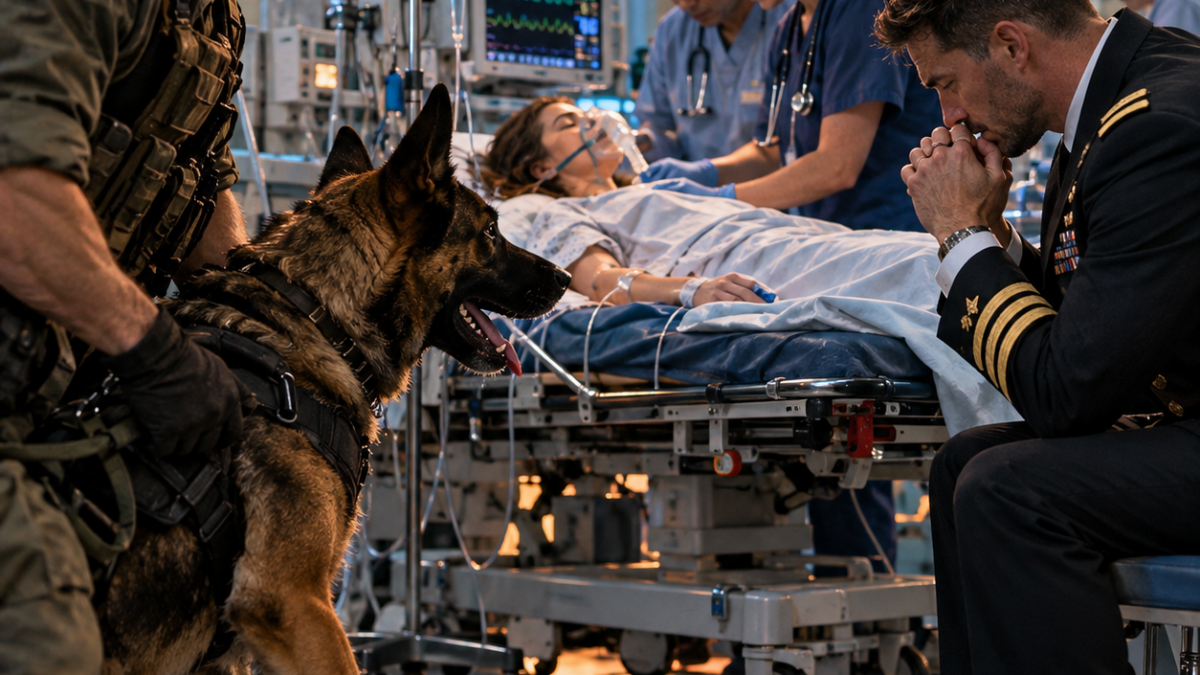
“He’s never done that with anyone outside the unit.”
“He’s a good dog.”
Calloway was quiet for a moment.
“Reyes told me what you said to him.
The exact phrase. He paused.
There are six people alive who know that phrase. I know all six of them.
Claire typed. Her hands were steady. Then you know it works, she said.
Calloway turned and looked at her for the first time since he sat down. Really looked.
The way he had looked at the crew before every mission. The assessment that goes deeper than rank and faster than words.
I knew a pilot, he said quietly. 160th.
Best low-level night flyer I ever worked with. I flew with a lot of good people.
She was different. He stopped.
The word she landed between them and sat there. Claire did not move.
Did not type. Did not breathe differently. We lost contact with her after the last op, Calloway said.
Four years ago.
The official record said medical discharge, but the file was sealed in a way that medical discharges aren’t sealed.
The monitor at the station beeped once. A routine alert.
Torres acknowledged it without looking away from his screen. Calloway kept his voice low.
The dog knew her, he said. From a fire base in Syria. She flew the extract on a night when the instruments failed and she brought six men home anyway.
The burn on Claire’s forearm was cold again.
The specific cold that is not temperature.
That’s quite a pilot, she said.
Yes, Calloway said. She was.
He held her gaze. She held his.
The ER moved around them. Ordinary. Indifferent.
Then the desk phone rang. Claire picked it up before the second ring. Trauma desk.
A pause, then the OR attending’s voice, steady and clean.
Patient is stable. Hemorrhage repaired.
She’s closing now.
Neuro is reviewing imaging. Early read suggests mild TBI, no bleed. Prognosis is good.
Understood, Claire said. Thank you.
She set the phone down, turned to Callaway.
She’s stable, she said.
Hemorrhage repaired. Early neuro read is favorable. Callaway closed his eyes for exactly 3 seconds.
When he opened them, they were clear. He stood, extended his hand. Claire shook it.
His grip was firm and brief and said more than his voice had in the entire conversation. He turned toward Reyes.
The two men moved toward the surgical waiting area. The Malinois stood, looked at Claire once, then followed its handler. Torres exhaled from across the station.
Okay, he said quietly. Who are those people?
Claire pulled up the next chart. Family, she said.
Torres looked at the corridor where they had disappeared, looked back at Claire, looked at the empty space under the desk where the dog had been. Right, he said slowly, and went back to his screen.
But his eyes came back to her one more time before he did.
Everyone’s did eventually.
It was the part she had never quite managed to prevent, no matter how quiet she stayed, no matter how still. The room always noticed.
The OR attending’s update lasted 40 seconds.
Claire documented every word of it before the line disconnected. Then she sat quietly for a moment with her hands on the keyboard and did not type anything.
The ER had settled into its evening rhythm. The hard cases of the afternoon giving way to the steadier pace of early night.
Sprains, fevers, the ordinary human business of bodies failing in manageable ways. Torres had gone on break.
Priya had returned to the station and was updating charts with the mechanical focus of someone who is thinking about something else entirely. She had not asked Claire another question since the hallway, but she had not stopped watching her, either.
The Malinois was gone. The space beneath the desk where it had rested felt different without it. Not empty, exactly, just changed.
The way a room changes after someone who carries a lot of gravity leaves it. Claire finished her documentation and closed the chart.
She was reaching for the next file when the main entrance doors opened. Not the ambulance bay, the front doors.
The ones that families used, the ones that delivered bad news and reunions in equal proportion. A woman walked in, 50s, silver blonde hair cut short and precise, wool coat, dark gray, the kind of coat that costs enough to be invisible about what it costs. She moved through the ER entrance the way certain people move through rooms they have never been in before, but are not intimidated by.
Assessing without appearing to assess, deciding without appearing to decide. Her eyes went to the nursing station immediately, to Claire specifically.
She did not look at anyone else. She walked directly to the desk and stopped. Her ID was already in her hand.
She placed it on the counter without being asked. Claire looked at it.
Federal badge, Defense Intelligence Agency. The name read Sandra Voss, Senior Operations Analyst.
Claire kept her face still. Set the badge down without picking it up.
“Can I help you?”
she said. Voss looked at her with the particular patience of someone who does not need to rush because the conversation is already over, and they are simply waiting for the other person to understand that.
“I think you know why I’m here,” Voss said.
“This is a trauma center,” Claire said.
“People come here for medical reasons.
And sometimes for other reasons, Voss said. Her voice was pleasant. The pleasantness of a very sharp instrument in a very clean case.
Priya looked up from her chart. Claire gave her one small look.
Priya went back to her chart, but her typing slowed. Is there somewhere we can speak privately?
Voss asked. Claire stood, walked to the same staff alcove beside the medication room.
Voss followed. The door closed behind them. Voss did not sit, neither did Claire.
They stood in the small room with the hum of the medication refrigerator between them and looked at each other with the mutual recognition of two people who have spent careers in rooms where the real conversation is not the one being spoken.
You’ve been careful, Voss said.
I’m a nurse, Claire said.
You’ve been a nurse for 3 years, Voss said.
Before that, you were Warrant Officer Claire Renner. 160th Special Operations Aviation Regiment.
Call sign, Ghost Bird. She paused.
That’s quite a name to earn.
The burn on Claire’s forearm went cold.
She said nothing. 209 classified flight hours, Voss continued.
31 direct action support missions. 11 SEAL team insertions and extractions across three theaters. She tilted her head slightly.
And one night in particular that is still classified at a level that requires my specific authorization to access. If you have access, Claire said carefully, then you know why I left. I know the official reason, Voss said.
Medical discharge. Injury sustained during operational activity.
She glanced briefly toward Claire’s right forearm.
I also know that the injuries were real, the discharge was a choice,” she said.
“Yours, not the Army’s.”
Claire held the silence. This was the part she had rehearsed.
Not in words, in breath. The ability to stand inside a moment like this and give nothing away while everything inside reorganizes itself.
“What do you want?”
Claire said. Voss reached into her coat and withdrew a single photograph.
She placed it on the counter between them. Claire looked at it. A man, mid-40s, dark complexion, short hair, standing outside a building Claire did not recognize in a city she did not immediately place.
Ordinary photograph, the kind that surveillance assets produce.
“His name is Damir Kosic,” Voss said.
“He is a procurement specialist for a network that has been acquiring medical-grade chemical compounds through civilian hospital supply chains for the past 22 months.
” Claire kept looking at the photograph.
“He acquires access through personnel,” Voss said.
“Specifically through staff who have military or federal backgrounds.
He finds them. He approaches them.
He uses leverage.”
She let the word sit.
“What kind of leverage?”
Claire said.
“The kind that people with sealed files are vulnerable to,” Voss said.
Claire looked up from the photograph. Voss met her eyes.
“He knows who you are,” Voss said.
“Not Claire Mercer, Warrant Officer Renner.
He has known for approximately 6 weeks. 6 weeks. The exact length of time Claire had been at St.
Augustine. The room temperature did not change, but something inside it did.
“He has been watching this facility,” Voss continued.
“We believe he made initial contact with someone on staff here approximately 3 weeks ago.
We do not yet know who Claire thought about 3 weeks ago. Tried to map it. Every interaction, every small anomaly she had filed and not yet pulled back out.
There had been things. Small things. The kind of things she logged and set aside because she was trying not to be who she used to be.
“Why are you telling me this?”
Claire said.
“Because Callaway’s daughter was not in that vehicle by accident.”
Voss said. The words landed like a step onto ice.
Claire stared at her.
“The collision was staged.”
Voss said.
“The vehicle that struck them was reported stolen 4 days ago.
The driver fled on foot.