Part 2: Homeless at 71, an Old Couple Rode Out the Flood in an Abandoned Mill — What the Attic Hid…
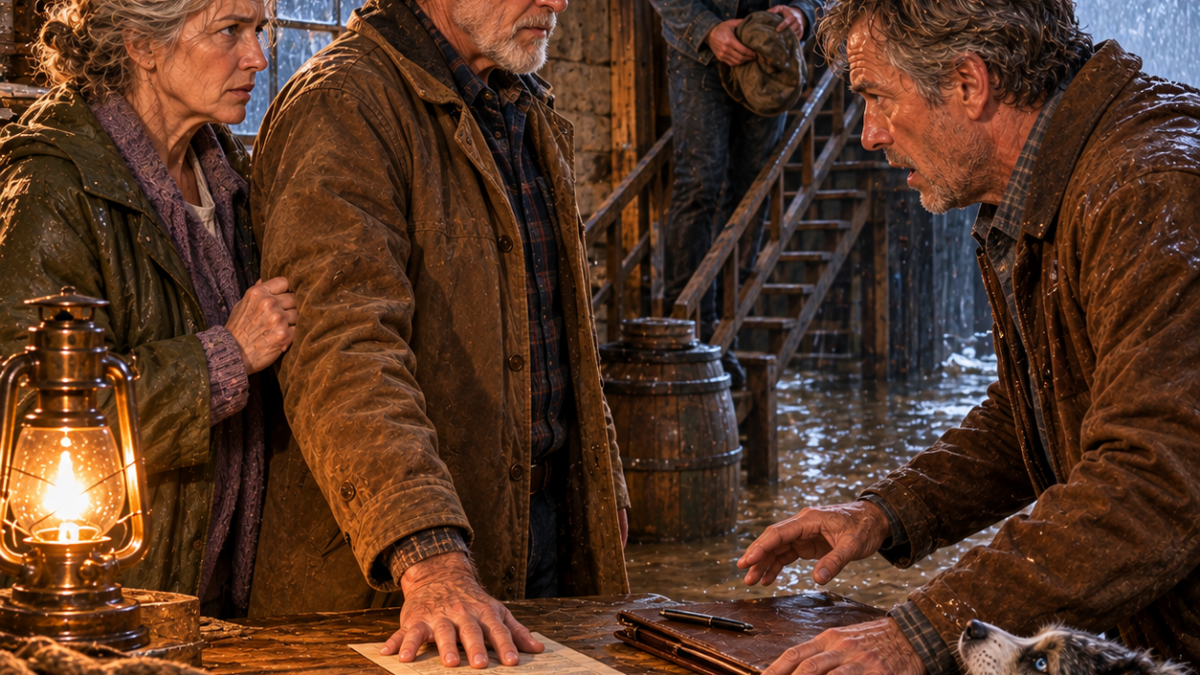
He took the notebook out of its oil cloth and opened it on the workbench to the last page and turned it so Leland could read.
Leland read it twice. Then he took off his glasses and looked at Walter and did not say anything for a long moment.
Walter, he said finally.
Whats this mean? I dont know, Walter said.
I tried every rafter up there.
Theyre solid.
Leland put his glasses back on and looked at the page again. Well, he said, Somebody seems to think it means something.
Your grandma didnt write things down for no reason. Neither did August.
Before they went up, the telephone on the wall behind the counter rang. Leland answered it, listened, and his face went flat.
He put his hand over the mouthpiece.
Its Merl, he said quietly, asking if Ive seen you. Walter held out his hand for it.
Leland shook his head once and took his hand off the mouthpiece.
Havent seen a soul, Merl. Rivers had the bottom shut since Tuesday.
He listened.
Walter could hear his brothers voice coming out of the receiver. Small and warm and quick.
Quicker than Walter had ever heard it.
Ill tell him if I see him, Leland said.
A warm bed.
Yes. And a paper.
He listened again.
Saturday noon.
I heard you.
He hung up for a moment. Nobody said anything.
He called here twice yesterday, too, Leland said.
And this morning he drove down the river road as far as the water would let him and sat there in his truck a good half hour looking at your roof.
He poured out the last of the coffee.
50 years Ive known your brother, Walter.
I have never once seen him in a hurry about anything.
Hes in a hurry now. Walter looked at the notebook open on the workbench at his grandmothers two lines.
And Dwayne, Ada said quietly. Has Dwayne called?
No, Leland said.
Dwayne hasnt called.
Ada looked at Walter, and Walter looked at the floor, and neither of them said what they were both thinking about their youngest brother standing silent in the rain with his cap in his hands. They went up to bed early.
Ada fell asleep almost at once with post stretched across the foot of the bed. Walter lay awake a long time in the dark, listening to the radiator knock and the trucks pass on Main Street and thinking about white numbers painted on his grandfathers walnut trees.
In the morning he came downstairs at 6 and found Leland already up standing by the wood stove with a cup of coffee in each hand. He held one out to Walter.
He had a strange look on his face. Theres something you ought to know before you go anywhere today.
Leland said, Yesterday, while we were out on the river, two of those Hollowell men came in here. City coats, city shoes, bought nothing.
They asked my clerk if she knew where they could find a Mr.Walter H. Kesler.
He paused.
They werent asking about Merl Walter. They were asking about you.
Celia Maddox kept her law office above the old bank at the corner of Maine and front and at 8:00 she was waiting for them at the top of the stairs because Leland had telephoned her the night before. She was a tall woman with a neat dark bob and she sat them down and did not waste any time.
Mr.Kesler, she said, on Tuesday I received a letter from a law firm that represents a company called Hollowell Hardwoods.
She slid a letter across the desk. I think youd better read this.
Walter put on his reading glasses and read it slowly. It said that Hollowell Hardwoods had signed a contract with Mr.Merl Kesler to purchase the Kesler farm, $310 acres, for 1,900,000, and had paid Mr.Kesler a deposit of $50,000.
It said that the companys title search had found a timber reservation recorded in 1976 in favor of one Walter H.
Kesler covering the black walnut trees on the creek bottom portion of the farm.
It said Mr.Merl Kesler had assured the company that the reservation would be released by family agreement before closing on the 15th of April.
And it asked whether Walter H. Kesler intended to sign the release.
Walter took off his glasses and set them on the desk very carefully. I dont know anything about any timber reservation, he said.
I didnt think you did.
Celia folded her hands. When land is sold, the owner can keep back the trees on it for himself or for someone else by writing it into the deed.
Thats called a timber reservation.
Whoever owns the reservation owns those trees even though somebody else owns the ground they stand on. Nobody can cut them or sell them without that persons signature.
And it says my name.
The index at the courthouse says your name.
She sighed.
I went over yesterday afternoon to pull the deed itself. Its in book 41.
And book 41 along with about 30 other volumes from the 70s got soaked in the flood of 93.
And it has been at a restoration binder in the capital for the last 8 months.
All I could find is the index card. It says Kesler, August to Kesler, Walter H.
Timber, 1976. I cant tell you whats in it until I see the deed itself.
Walter sat very still and felt it come together, the way a field comes clear when the fog burns off. He knew, he said slowly.
Merl. Hes known since a year ago last fall when he took Dads papers down to the machine shed.
He found something in there.
He looked at Ada. Hes been selling the farm all winter and he couldnt sell the walnut because the walnut was never his.
It was mine and I didnt even know it. So, he needed my name on a paper.
He sold the tractor. The banks been out three times.
He spent their $50,000. Id bet anything on it.
And if that sale doesnt close on the 15th, he has to give it back. He stopped.
His voice had gone very quiet. So he put us out in the rain with the river coming up and he told me theres one little paper about the mill lot.
A boundary line thing.
Nothing to it. Hes bringing it Saturday at noon.
He looked at Celia. Thats not a boundary paper, is it?
Id want to see it before you sign anything.
Celia said.
But no, I doubt very much that it is.
Ada reached over and took Walters hand. Her hand was cold.
He knew wed be at the mill, she said, with no truck and no money and no place to go. He thought by Saturday wed sign anything to get a roof back.
Celia walked them down the stairs.
At the bottom, she stopped and said, Mr.Kesler, if that deed exists anywhere besides a ruined book in the capital, I need to see it.
Your grandfather must have had the original.
People usually keep those. Walter thought of a notebook wrapped in oil cloth and two lines on its last page and did not say anything yet.
They came out onto Main Street into the pale morning sun, and Merls pickup was parked at the curb in front of the cafe, and Merl was getting out of it. He saw them and looked once at the gold letters on Celia Maddoxs window and then he smiled and crossed the street and came toward them with his hand out.
Walt, he said warmly. Ada, Ive been worried sick.
Listen, come on out to my place. You can have the spare room till all this settles.
Well sign that little paper Saturday at the kitchen table like family and itll all be done. Through the windshield of the pickup, Walter could see Dwayne in the passenger seat, sitting very still, looking at them.
Those walnut trees on the creek bottom, Walter said.
Whose are they, Merl? For one moment, his brothers face went still and flat like a pond when the wind drops.
Then the warmth came back over it. Farm trees, Walt, he said gently.
Always have been.
Now I dont know what that womans been telling you.
Then you wont need my name on anything, Walter said. His voice was steady.
He was a little surprised at how steady. Im not signing your paper, Merl.
And you dont need to come Saturday.
Merl looked at him for a long time.
The smile stayed where it was, but nothing behind it was smiling.
Youve had a hard week, he said. I understand.
Youll think different by Saturday. Noon.
He went back across the street to his pickup.
As he opened the door, Walter looked past him at Dwayne. His youngest brother was looking straight at him through the glass.
His mouth was pressed tight.
Then Merl got in, and the truck pulled away from the curb, and Dwayne did not look away until it turned the corner.
Leland lent them his old blue farm pickup that afternoon, and would not hear a word about it.
Bring it back when youre done with it, he said.
By then the river road was out of the water, muddy but passable.
Walter had meant to stay another night over the store. But when they came out of Celias office, he found there was only one place he wanted to be.
Its ours, he said to Ada at the turn onto the river road. I dont know what else is, but thats ours.
The mill stood in the late afternoon sun with mud a foot thick on the ground floor. Up top, the room under the roof was dry and still, exactly as they had left it.
Ada lit the stove.
Walter went back down to the loading door on the second floor and stood in it, looking out at the river going down and the long gold light across the bottom. After a while, Ada came down and stood beside him.
I keep thinking about my mothers picture, she said quietly.
Weve lost the house and the truck and every stick of furniture, and I cant stop thinking about a chipped milk pitcher. She was quiet a moment.
She used to stand at the window every morning with it, waiting for my father to come in from the barn.
Every morning, I used to think that was what love looked like. A woman at a window waiting with the milk.
Walter put his arm around her.
He could not think of anything to say that would be big enough, so he did not say anything.
They stood together in the loading door and watched the light go copper on the water.
And standing there, Walter remembered something.
He remembered being 6 years old, standing in this exact door with his grandfathers big hand on his shoulder and a wagon waiting in the yard below. He remembered his grandfather swinging flower sacks onto the hoist hook and calling out every time the same thing.
Hand it out the window, Walty. Out the window she goes.
His grandfather had never called it the loading door.
Not once.
He had called it the window. Was there someone in your family everybody underestimated who turned out to be the one who stayed?
Tell me about them in the comments and stay with Walter because the third rafter from his grandfathers window had been keeping a secret for 50 years.
He turned so fast that Ada caught at the doorframe. The window, he said.
Ada, the loading door. Grandpa always called it the window.
He took the lantern and went up the steep last stairs to the gear loft, not to the refuge at the far end, but to the near end, where the gable wall stood right above the loading door, and the great hoist beam came through it. He stood under the slope of the roof there, with his heart going hard, and held up the lantern, and counted the rafters back from that wall.
1 2 3.
The third rafter looked like every other one, a long squared timber of old oak running up into the dark at the peak of the roof. He dragged a grain box under it and climbed up on it slowly.
With Ada below, holding the box steady and saying his name in a voice that meant, Be careful.
He ran his hand along the underside of the rafter as far as he could reach.
Halfway along, his fingers found a knot. It was a round, dark knot the size of a silver dollar, the kind you see in every old beam.
But when he pressed it with his thumb, it moved.
It was not a knot. It was a plug of wood cut to look like one, fitted so tightly into a round hole that 60 years of dust had hidden the seam.
He worked it with his thumbnail, and then with the tip of his pocket knife, and it came out into his hand, and behind it, in a hollow board up into the heart of the rafter, was something wrapped in oil cloth.
He drew it out very slowly.
It was a long, narrow packet tied with waxed string, light and dry, and it smelled faintly of cedar, the same as the room at the other end of the loft. He climbed down off the box with it, and Adah held the lantern, and he untied the string with hands that were not steady.
There were three things inside. The first was a deed, old and creased, dated 1962, from August Kesler to Henry Kesler for the farm.
Most of it was long and dry, and Walters eyes went down it until they stopped on one paragraph, accepting and reserving to the grtor all black walnut trees standing upon the creek bottom tract of 140 acres, together with the right to enter and harvest the same. The second was another deed, crisp and typed, with a county clerks stamp in the corner and a recording number written in ink.
Book 41, page 203.
From August Kesler to his grandson, Walter Henry Kesler. All the timber so reserved.
Dated the 12th of May, 1976, Walters 21st birthday.
He remembered that day. He had not thought of it in 50 years, and now it came back to him whole.
His grandfather had picked him up at the farm in the old mill truck and driven him to the county seat and bought him a slice of cherry pie at the diner across from the courthouse and then said he had a little business inside and Walter should wait on the bench.
Walter had waited on that bench in the May sun for an hour, watching the pigeons on the courthouse steps, a little bored, a little put out. When his grandfather came back down the steps, he had been smiling.
He had put his big hand on Walters shoulder and said, Well, thats done.
And never told him what. Walter sat on the grain box with the deed in his hands, and Ada put her hand on his back and kept it there.
50 years, she said softly. Walter, he did this for you 50 years ago.
I was eating pie, Walter said, his voice cracked on it.
I was sitting out front eating pie.
The third was a letter folded once in a hard square hand that Walter had not seen in 47 years. He sat down on the grain box.
He unfolded it, and the first line of it made him put his free hand flat on his knee, and hold on. Walty, if you have found this, then somebody has finally come for the trees.
The letter was not long. His grandfather had never used three words where one would do.
Walty, if you have found this, then somebody has finally come for the trees.
I planted those walnuts along the creek in the spring of 1921 when I was 20 years old and had more back than since.
Black walnut is a slow tree. It takes a mans whole life to get good and then it keeps on getting better.
A walnut that is worth a few dollars when it is 50 years old is worth a great deal when it is a hundred.
I never planted them for me. I planted them for whoever in this family turned out to be patient.
When I gave your father the farm, I kept back the trees. Henry is a good farmer and a poor waiter.
He would have sold every one of them for a new tractor the first bad year and he would have been sorry the rest of his life. On your 21st birthday I gave them to you.
I did not tell you because your father would have made a war of it between you and I would not have that. Your grandmother will tell you when the time is right.
She is better at that kind of thing than I am. You are the one who stays, Walty.
A man who stays is the right man to own a tree.
Dont let anybody hurry you. Your grandfather, August Kesler.
Walter read it in the lantern light, sitting on a grain box in the gear loft of his grandfathers mill, with his wifes hand on his back and a dog asleep against his boots.
And when he had finished it, he folded it along its old crease, and held it, and did not say anything for a very long time. Below them, the river was going down in the dark.
Above them, the rain had stopped.
And somewhere on the roof, a pigeon was walking on the tin. He knew, Ada said finally.
He knew youd stay. 50 years ago, he knew.
I didnt know, Walter said.
I didnt know anything. No, Ada said.
But you stayed anyway. At 9:00 on Friday morning, Celia Maddox sat at her desk above the old bank with the three papers laid out in front of her in a row and read every word of all three while Walter and Ada sat across from her and Leland stood by the window with his cap in his hands because he had insisted on coming.
She read slowly.
She took notes on a yellow pad.
She took the index card she had copied at the courthouse out of a folder and laid it beside the 1976 deed and looked from one to the other for a long time.
Then she set down her pen.
Book 41, page 203, she said. Recorded the 12th of May, 1976 at 2:15 in the afternoon.
Thats the county clerks stamp and thats her signature. It matches the index exactly.
She looked up. Mr.Kesler, this is real.
Its recorded.
Its been sitting in the public record for 50 years, whether the book is soaked or not. Your grandfather kept every black walnut tree on that 140 acres when he gave the farm to your father.
And then he gave those trees to you. Your brother owns the ground.
You own the trees. Nobody can cut them or sell them without your signature.
and you dont need anybodys permission to do anything you like with them.
Walter nodded slowly.
He found that he was holding the edge of the desk. What are they worth?
Leland said from the window, If a man can ask, Celia opened the hollowell folder again and drew out a stapled report, several pages long, full of columns of numbers. I can tell you exactly what theyre worth, she said.
Hollowells attorney sent me this on Wednesday to show me why the matter was so urgent.
Its their own timber cruise. Their foresters walked the creek bottom in March and measured every walnut tree on it.
She turned a page.
412 black walnut trees, most of them over a 100red years old. Most of them veneer quality, which means the logs get sliced thin for fine furniture.
and thats the most valuable walnut there is.
They put the average value at $6,800 a tree. Leland did the arithmetic out loud before anybody else could.
Thats he said and stopped and started again. Thats going on $2,800,000.
2,81,600 Celia said by their own count. The room was very quiet.
The radiator knocked twice. Thats why they wanted the farm, Walter said slowly.
Not the ground, never the ground.
They wanted Grandpas trees. They offered your brother a million nine for the farm, Celia said.
Id guess most of that number was the walnut.
Without the trees, the land alone might bring a little over half of it. She paused.
You dont have to sell them, Mr.Kesler. A walnut grove like that can be harvested slowly.
a few of the oldest trees every year, the ones that are ready. Thats a good income year after year, and the rest of the grove keeps growing and keeps getting more valuable, the way your grandfather said.
Ada had taken Walters hand under the edge of the desk. He held on to it.
Theres something else in that file you ought to see, Celia said.
Her voice changed a little.
She drew out one more sheet, a photocopy of a typed letter. Hollowell sent me a copy of this to show me your brothers good faith.
Its from Merl to Hollowell, dated the 18th of November last year. Listen, she read it aloud.
The 1976 timber reservation in my brothers name is a family formality from my grandfathers time. My brother is elderly and has no interest in the trees.
I can assure you he will execute a release before closing. Walter did not say anything.
He did not need to. November, Ada said quietly.
He knew in November.
He knew all winter, Walter.
He had us over for Thanksgiving dinner.
He knew then.
He found it in dads papers. Walter said a year ago last fall in the machine shed.
He looked at the photocopy.
Dad must have had a carbon of the 1962 deed.
Merl read it and he went and looked it up at the courthouse and he saw my name and he never said one word to me about it. He was quiet, elderly.
No interest in the trees. Theres one more thing, Celia said, and this part I cant explain.
Hollowells attorney told me on the telephone yesterday why they ever caught this at all.
A title search might have missed it with that book gone off to be restored.
But in the first week of March, a man called Hollowwells office in the city and told them flat out that the walnut on the Kesler farm wasnt Merl Keslers to sell and theyd better check. He wouldnt give his name.
The receptionist wrote down only that he said he was family.
Walter looked up. He thought of Dwayne standing at the bottom of the porch steps in the rain with his cap rolled up in his hands.
He thought of Dwayne in the passenger seat of Merls truck, looking straight at him through the glass, his mouth pressed tight.
He did not say anything, but something in his chest that had been clenched since Monday let go just a little. When they came down the stairs onto Main Street, the sky over the river had gone the color of a slate roof, and it was beginning to rain again.
Leland walked them to the truck. He looked up at the sky and then at Walter and his face was serious.
Radio says rain all night. He said 2 in maybe three and theres more.
Hacket dams full to the top up the valley. Theyre going to open the gates Sunday morning to let it down.
And when they do, every bit of that water is coming right down the tallow.
Theyre saying the second crest will hit the bottom Sunday afternoon, higher than Tuesdays.
Myrtles coming Saturday at noon, Walter said. Then you let him come and you say your peace and you get yourselves up top by dark.
You hear me?
That river comes up faster the second time. Grounds already full.
Nowhere for it to go.
Leland held Walters eyes.
Your granddaddy built that room for exactly this, Walter.
Use it.
We will. Leland loaded the back of the truck before they left without asking with a sack of groceries and two jugs of drinking water and a box of dog food and a fresh can of lamp oil.
When Ada started to protest, he held up one hand. 90 years late, he said, Dont you start.
They drove back down the river road in the rain. It was holding, muddy and slick, but above the water, though in two places the river had already crept back up to the edge of the gravel.
At the mill they carried everything up to the room under the roof and put it on the shelves beside Augusts gray tins and Lisels crocs of honey. Walter filled the woodbox.
Ada made beans and bacon on the little stove, and they ate them on the bunk with post between them, and the rain drumed on the roof all night long.
In the gray of Saturday morning, Walter went down to the loading door. The river had come up 4 feet in the night.
It was back across the pasture, back over the low places in the road, brown and fast, and full of branches, the way it had been on Tuesday, and it was rising. He could watch it climb the fence posts.
Leland had said Sunday afternoon, but Leland had not known about 3 in of rain on ground that could not hold a drop more.
Ada came down and stood beside him with two cups of coffee.
They drank it in the loading door and watched the water. You could go up now, she said.
Pull the ladder up behind us and let him knock. I could, Walter said.
He thought about it. He thought about Merl at 7 years old sitting on the hay wagon behind him with his legs swinging asking Walter how many bales how many bales every time they stopped.
He thought about the laugh across the kitchen table in 1979.
He thought about the rain running off the porch roof on Monday and his brothers voice low and kind telling him it was only what dad would have wanted.
No, he said finally. Ive driven past this mill for 47 years, Ada.
Im done driving past things.
He can come and say it to my face, and Ill say mine to his. At 10 minutes 12, Merls pickup came down the river road with its wipers going and water spraying out from both front wheels.
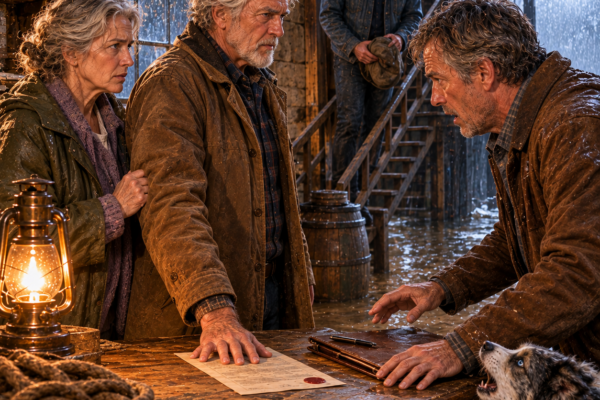
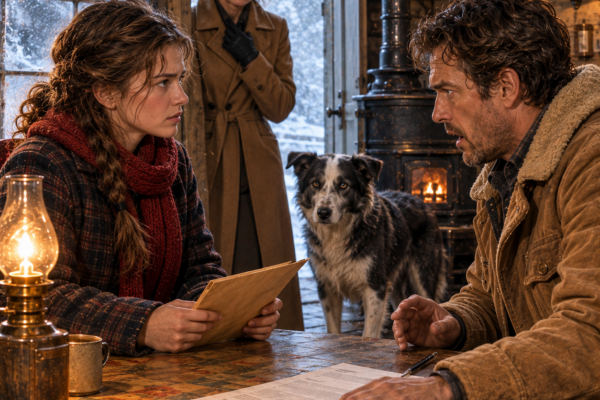
He had made it through the low spots just he pulled into the millard and stopped on the last high gravel and got out in his brown work jacket with a leather folder under his arm and Dwayne got out the other side. They came up the steps and in through the mill door and up the stairs to the second floor where Walter and Ada were waiting at a plank table Walter had set up out of two grain boxes and an old door.
Merl looked around the dim mill floor at the dog, at the lantern, at his brother. Walt, he said warmly.
Ada, thank the Lord youre all right. He set the folder down on the table and opened it and took out a single sheet of paper and a pen.
At the top of the paper in heavy type, it said, Boundary agreement, mill parcel. Im here to help.
Thats all.
You sign this and Ive got the little rental house on Elm Street in town all lined up for you.
First six months paid out of my own pocket.
Youll be warm and dry by tonight.
He laid the pen beside the paper.
Thats all this has ever been about. Looking after you.
Walter looked at the paper.
He did not touch the pen.
Then he reached inside his chore coat, and took out the 1976 deed, crisp and typed, with the clerks stamp in the corner and the recording number written in ink, and laid it on the table beside his brothers paper and turned it around so that Merl could read it.
Read that first, Walter said.
Merl looked down at it. His smile stayed where it was for one line, then two.
Then it slid off his face like wet snow off a tin roof. slowly and then all at once.
At the top of the stairs, Dwayne had stopped with his cap rolled up in his hands, and down below them, on the ground floor of the mill, Post began to bark, sharp and urgent. Walter turned his head.
Under the big front door, across the mudcaked floor where the millstones lay, a thin sheet of brown water was sliding in, silent and shining, a full day early. Merl read it twice.
Then he set it down on the plank table very carefully, as if it might cut him. Thats a copy of something, he said.
Book 41 is ruined, Walt. Everybody knows that.
Nobody can prove what was in it. Thats not a copy.
Thats the deed. Thats the county clerks stamp.
Walter did not raise his voice. Mrs.Maddox matched it to the courthouse index yesterday morning and she has your letter to Hollowell Merl from November.
The one where you told them I was elderly and had no interest in the trees.
Merl did not answer.
Walter reached over and picked up his brothers paper, the one that said boundary agreement at the top, and turned it over and ran his finger down the small print on the back until he found the line. He read it out loud.
together with all timber and timber rights a pertenant there too.
He set it down.
Thats not a boundary line, Merl. Thats Grandpas walnut.
You put us out in the rain with the river coming up so that by Saturday wed sign anything you put in front of us for a roof.
But you cant sell what was never yours. Not the trees and not the mill and not us.
For a long moment, nobody moved.
The river hissed across the floor below them.
Then Merl pulled out the other grain box and sat down on it heavily like a man whose legs had quit and looked at the table.
I was 19, he said.
The spring the bankman came to the kitchen. 1981.
You were already married.
The dad sat at that table with his head in his hands and he looked at me, not at you, at me.
And he said, Youre the one who has to hold this together, Merl. So I held it.
45 years I held it and this winter it came apart. The combine note, the land note, the interest on both.
I found that carbon in dads papers and I read Grandpas name and yours and I thought hell never miss what he never knew he had.
I told myself it was for the farm. He stopped.
It wasnt for the farm. That explains it, Walter said quietly.
It doesnt make it right. No, Merl said, I dont suppose it does.
Merl, Dwaynes voice from the top of the stairs.
It was the first word he had spoken, The truck. Merl went down the stairs fast and pulled the mill door open, and the river came in around his boots.
Walter, at the loading door above, watched his brother weighed out into the yard. The water was at his knees, then his thighs.
The pickup sat on the last gravel with brown water already lapping at its doors.
And Merl wrenched the door open and climbed in, and the engine turned over and caught and coughed and died. He tried it three times.
The third time it did not turn over at all.
He came back through the door soaked to the waist and stood in the water on the ground floor looking up the stairs at his brothers. Roads gone, he said.
Then everybody up, Walter said.
All the way up they went up together.
Ada first with Walters hand under her elbow, then Dwayne, then Merl, dripping on every step, and post bounding ahead of all of them to the gear loft and straight to the far gable wall, where he stood and waited, wagging. Walter slid the plank door open.
He stood aside and let his brothers go through first.
Merl stopped just inside. Dwayne stopped beside him.
They stood under the slope of the roof in the warm amber light from the lantern, looking at the bunks and the shelves and the stove and the rainarrel and the words cut deep in the great tie beam over their heads. Grandpa built this, Dwayne said slowly.
Up here all this time after the flood of 37, Walter said, seven families sat on this roof for 2 days.
He brought them in through the loading door and then he built this so nobody would ever have to sit on the roof again. Ada lit the stove.
The river climbed all afternoon.
By dark it was over the floor of the second story, and the whole mill groaned and shifted with the weight of it, and the rain hammered the tin a few feet above their heads.
They ate beans and bacon from the gray tins, the four of them sitting on the bunks and the floor, and gave post the last of the bacon. Nobody talked much.
It was Merl, a little after 9, who noticed the rafter.
He had been sitting on the floor by the stove with his back to the wall, looking up at the painted names. Briggs, five, Halverson, four, Akerly 6, Lindgrren, three.
He read them out loud slowly, as if they were a prayer he had forgotten.
Then he stopped at the low rafter above the stove, the one that was black with old soot. Whats on that one?
he said.
I couldnt read it, Walter said.
Merl got up. He took the dish towel from Adahs box of kitchen things and wet it in the rainarrel and reached up and began to wipe the rafter slowly, the way you would wash a window.
The soot came away in long black streaks.
White paint came up under it, faded and careful, in the same old-fashioned hand as all the rest.
Astramm three, Gus.
Mary, Helen, age six. Merl stood there with the black towel in his hand.
Austramm Dwayne said behind him. His voice had gone very small.
Thats mother. Helen Austramm.
Thats our mother. Nobody spoke.
The stove ticked.
The river roared through the floor below. She was six, Merl said finally.
She was 6 years old and grandpa carried her up those stairs in the dark. He turned around and looked at his brothers and his face was wet and he did not wipe it.
She never said, not once in her whole life. She married his son and she never said one word.
Nobody ever said anything in this family, Walter said quietly. Thats always been the trouble with us.
Merl sat back down on the floor by the stove and put his face in his hands and stayed that way for a long time.
It was later still, when the lantern was turned low and Ada had lain down on the bottom bunk, that Dwayne got up and crossed the little room and knelt beside her. He had been wearing his denim jacket buttoned to the throat all day, even by the stove.
Now he unbuttoned it. Inside, wrapped in a gray hooded sweatshirt and held against his chest, was something round.
He unwrapped it and held it out to her in both hands.
It was a blue and white porcelain milk pitcher with a chip on the lip. Ada sat up slowly.
She took it from him. She did not say anything.
She held it in her lap and ran her thumb over the chip again and again. Merl told me to put it in the box for the estate sale, Dwayne said.
He did not look at Merl. I put it behind the seat of my truck instead.
Ive been carrying it around all week.
I didnt know how to bring it to you, he swallowed.
And Im the one who called those Hollowell people in March. I couldnt say it to Merls face, so I called them.
I should have said it on your porch on Monday, Walty. I stood there in the rain and I couldnt make my mouth do it.
Im sorry. Im not asking you to forget it.
 [Tap here for the Next Part ]